
Amazon Store Automation Services: How Professional Management Works
Sell on Amazon long enough, and the business outgrows the hours in the day. Repricing, inventory, PPC, and reports all need attention. That is when sellers start comparing Amazon store automation services and asking what they are paying a provider to do.
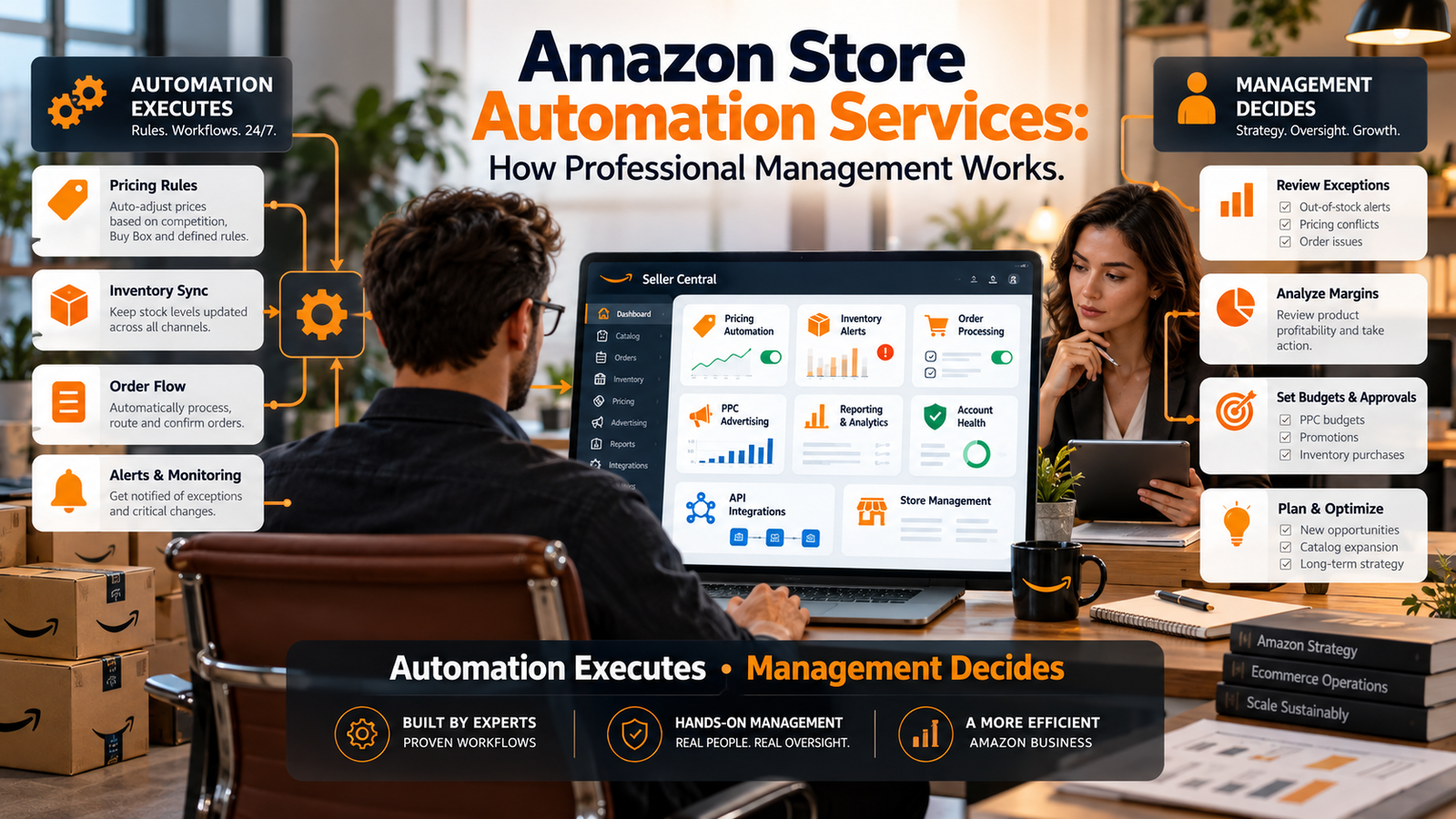
Amazon automation services handle rules, alerts, and data movement. Amazon store automation helps as complexity grows. Professional Amazon management monitors systems, handles exceptions, and changes rules as conditions change.
How Do Amazon Store Automation Services Work?
Professional services combine native Amazon tools, third-party software, APIs, automated workflows, and human oversight. Automation executes repeatable rules and moves data. Management sets guardrails, monitors failures, reviews exceptions, interprets performance, and changes strategy when conditions change. Automation reduces manual work, but it does not eliminate management.
What Are Amazon Store Automation Services?
Amazon store automation services usually combine four layers. Native Amazon automation covers Seller Central tools such as Amazon Automate Pricing, FBA inventory tools, reports, and Account Health alerts. Third-party software adds repricing, forecasting, PPC, analytics, or cross-channel capabilities, a common form of Amazon seller automation and Amazon ecommerce automation.
Custom integrations connect external systems through Amazon API integration. Managed Amazon automation services add people who own monitoring, exceptions, and decisions. That is where Amazon store management services and Amazon account management services differ from software alone. Amazon business automation executes the process; professional Amazon store management owns what happens when it breaks.
How Professional Amazon Store Automation Works
1. The Process Is Mapped First
Identify triggers, approvals, owners, and exceptions. Amazon automation management works best on stable processes.
2. Native Amazon Tools Are Evaluated
Use Seller Central first. Amazon store automation should not start with unnecessary custom code.
3. Software or Integrations Are Added Where Needed
Amazon automation integration services fill data gaps. Amazon ecommerce automation matters when systems must stay synchronized.
4. Rules and Guardrails Are Defined
Price floors, PPC budgets, stock thresholds, and approval limits need owners. Amazon automation management services should document them.
5. Workflows Are Tested
Test missing data, rejected updates, duplicates, and permissions.
6. Automation Goes Live
Use alerts and a named owner.
7. Human Managers Review Exceptions
Professional Amazon management handles suppressed listings, PPC swings, stranded stock, and Seller Central issues.
8. Performance Is Measured and Adjusted
Managed Amazon automation is ongoing. Amazon performance reporting and Amazon performance monitoring should show whether it helps.
Automated Pricing Still Needs Margin Controls
Amazon Automate Pricing is available to Professional sellers. Sellers can set rules, a required minimum price, and optional maximum, then apply them by SKU or in bulk. Existing rules are usually processed in under 15 minutes. Amazon’s Automate Pricing documentation explains the controls.
Amazon pricing automation suits repetitive edits. Amazon automated pricing can react to competitive prices or sales conditions, while Amazon repricing automation saves time.
If a $14.99 minimum stops covering landed cost, the rule can keep selling at a bad margin. Automated Amazon pricing needs review. Amazon repricing executes the rule; it does not judge the economics. A provider handling Amazon pricing automation should monitor outcomes, while the seller keeps margin limits and promotions. A second Amazon automated pricing rule and a second Amazon repricing automation workflow may suit another SKU group. Amazon Automate Pricing still needs guardrails.
Inventory Automation Helps With Monitoring, Not Purchasing Decisions
Amazon inventory automation is strongest at surfacing information. Amazon’s FBA Inventory tool covers sell-through, aged stock, excess inventory, stranded inventory, and replenishment needs. Restock guidance uses sales history, forecasts, seasonality, and seller inputs. Amazon’s FBA Inventory guidance explains the tools.
Amazon inventory management can organize alerts and recommendations. Amazon FBA inventory management can show that a SKU is running low or ageing badly. Amazon automated inventory management may flag the problem early.
It cannot decide whether another $40,000 purchase is smart. Amazon inventory forecasting and Amazon inventory replenishment are inputs, not purchase orders. Amazon inventory monitoring belongs in dashboards. A second Amazon inventory management review and a second Amazon FBA inventory management review matter as exposure grows. Amazon inventory automation surfaces the choice.
Order and Fulfillment Automation
Amazon order automation removes manual work. FBA handles storage, picking, packing, shipping, and customer service, while Seller Central and SP-API support order workflows.
Amazon order processing automation suits predictable transactions. Amazon order management automation moves routine data. Amazon fulfillment automation and Amazon FBA automation reduce daily execution.
Exceptions still need people. Amazon order management covers cancellations, unusual refunds, and mismatches. A second Amazon order management review should focus there. A second Amazon order automation workflow only helps if it solves a real problem. Amazon fulfillment automation reduces repetitive work; Amazon FBA automation does not remove accountability.
Listings Should Not Be Fully Left to Automation
Amazon listing management has automatable pieces. SP-API can create, retrieve, update, and delete listings, while feeds handle bulk changes. Amazon’s SP-API listings guidance documents those capabilities.
Amazon catalog management can streamline recurring changes and issue detection. Amazon product listing services can keep catalogs consistent. A second Amazon listing management workflow may handle approved updates, while a second Amazon catalog management process flags problems.
Amazon listing optimization still needs judgment. Amazon keyword research can surface search behavior, but people decide which terms and claims fit. Amazon listing SEO, copy, images, and positioning need review. Amazon product listing optimization should protect accuracy and brand voice. A second Amazon product listing optimization pass may follow a change. Amazon listing optimization should support judgment. A third Amazon listing optimization review and a second Amazon product listing services workflow support scale.
PPC Automation vs Professional PPC Management
Amazon PPC automation handles routine bid changes, budget rules, reporting, and search-term workflows. Amazon advertising automation can react quickly to predefined conditions.
Professional Amazon PPC management is broader. Amazon Sponsored Products are cost-per-click ads with seller-set bids and budgets, plus fixed and dynamic bidding strategies. Amazon Ads’ Sponsored Products guidance explains the model.
Amazon PPC management decides structure, targeting, budgets, and profitability context. Amazon PPC optimization can use automation without letting one metric run the business. Amazon ACOS optimization may improve while margin worsens; Amazon ROAS optimization may improve while sales fall.
Amazon advertising management needs that context. A second Amazon PPC automation rule may fit another campaign type, but every Amazon Sponsored Products campaign still needs a goal. Another Amazon advertising automation layer should remove manual work. A second Amazon advertising management review and a second Amazon PPC optimization pass connect numbers to action. Professional Amazon PPC management stays strategic.
Native Amazon Tools vs Custom API Automation
Native tools should be the first check. Custom Amazon automation makes sense when systems must exchange data or standard tools fall short.
Amazon’s Selling Partner API supports listings, orders, inventory, reports, notifications, and more, with rate limits and sandboxes. Amazon’s SP-API onboarding guide is the starting point.
Amazon SP-API integration can connect an ERP, warehouse, database, or analytics stack. Amazon API automation can retrieve reports, receive notifications, and move data. Amazon marketplace integration and Amazon ecommerce integration matter as complexity grows.
Custom Amazon automation is not automatically better. A second Amazon API integration adds maintenance as well as capability. A second Amazon API automation workflow should exist only because native tools cannot meet the requirement.
 Reporting Automation Still Needs Interpretation
Amazon reporting automation can gather data, schedule reports, and flag changes. Amazon sales reporting and Amazon business reports reduce spreadsheet work.
Amazon performance reporting may show weaker conversion, higher ad spend, or lower sell-through. Amazon sales analytics organizes data, while Amazon performance monitoring highlights movement. A second Amazon performance reporting review should lead to action. A second Amazon sales analytics view should answer a business question, and a second Amazon performance monitoring process should flag changes.
Account Health and Compliance Need Human Oversight
Seller Central’s Account Health page shows alerts and performance metrics. Amazon describes Account Health Rating as a 0-to-1,000 measure of deactivation risk based on compliance with certain selling policies. Amazon’s Account Health guidance explains the distinction.
Amazon account monitoring surfaces notifications quickly. Amazon account health management organizes issue tracking, while Amazon Seller Central management standardizes reviews. Sensitive appeals and policy decisions need human review. Amazon seller performance and Amazon policy compliance need context. A second Amazon account monitoring process and a second Amazon account health management review still need qualified judgment. This is part of Amazon seller account management and Amazon Seller Central management. Amazon account management services should define the final decision-maker.
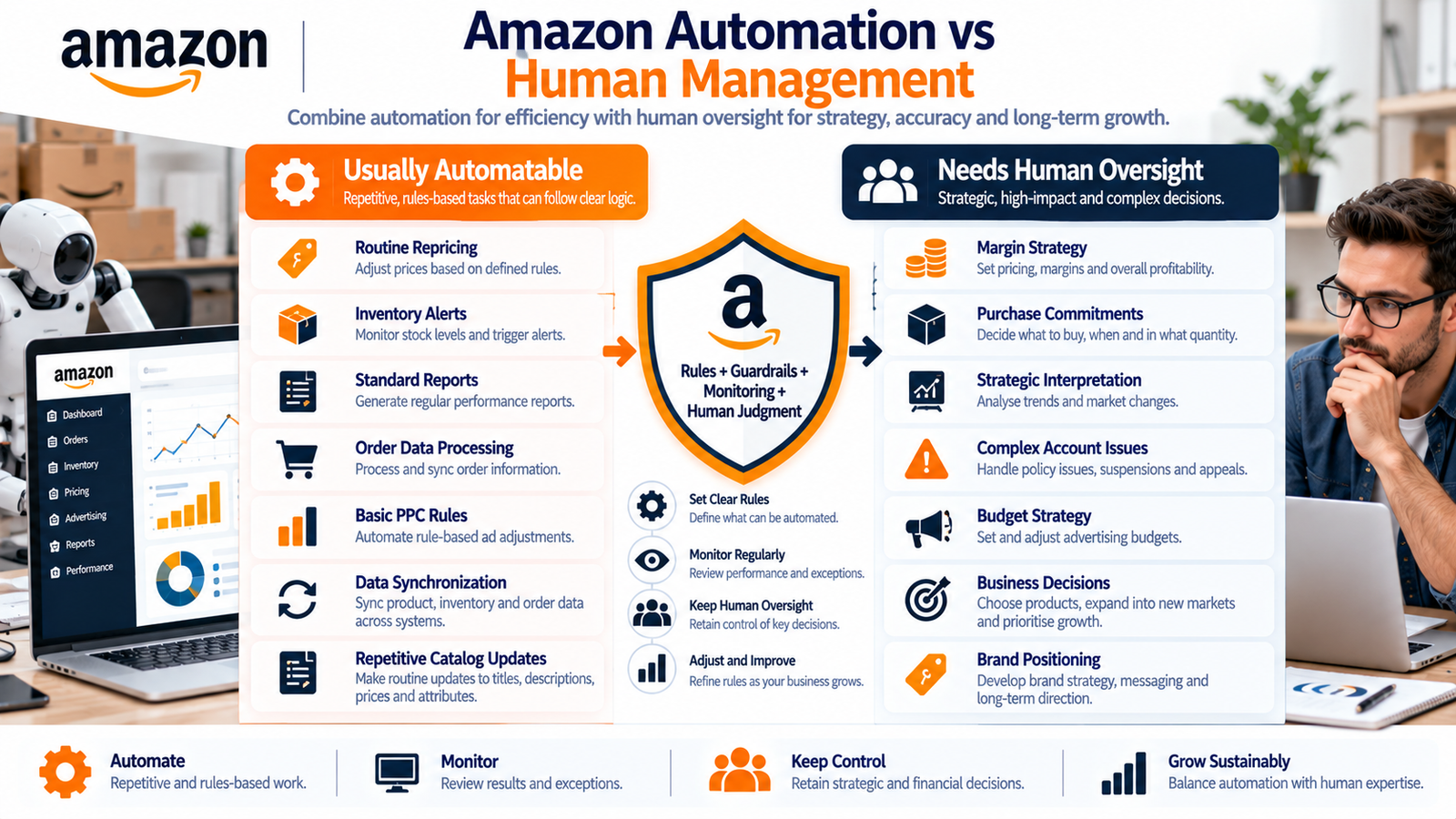
What Should Be Automated and What Still Needs Human Management?
Amazon automation vs manual management is not an either-or decision.
| Usually Automatable | Usually Needs Human Oversight |
| Routine repricing | Margin strategy |
| Inventory alerts | Purchase commitments |
| Standard reports | Strategic interpretation |
| Order-data processing | Complex account/customer issues |
| Basic PPC rules | Budget strategy |
| Data synchronization | Business decisions |
| Repetitive catalog updates | Brand positioning |
Amazon automation vs human management starts where execution meets judgment. Amazon automation with human oversight is more realistic than software-only promises. Amazon store automation vs management is a scope question. A second Amazon automation vs manual management review may favor software for repetition and people for decisions. Managed Amazon automation services sit between them. Amazon store management services, Amazon automation management, and Amazon business automation span both.
 How Much Do Amazon Store Automation Services Cost?
There is no universal Amazon store automation cost. Amazon store automation services vary by catalog, orders, PPC, inventory, integrations, reporting, monitoring, maintenance, and management scope. Amazon automation services cost should be compared at equal scope.
An Amazon automation company may separate setup from management. An Amazon automation agency may use project, retainer, or mixed pricing. Amazon automation pricing only becomes comparable when responsibilities match.
| Cost Driver | Why It Changes Scope |
| Workflows | More rules and monitoring |
| Catalog size | More products and data |
| Order volume | More activity |
| PPC complexity | More campaign management |
| Inventory complexity | More forecasting |
| Integrations/API work | More technical work |
| Reporting | More analysis |
| Account monitoring | More human oversight |
| Maintenance | Ongoing changes |
Keep Amazon selling fees, FBA fees, ad spend, software, implementation, and management separate. Amazon store automation pricing that bundles them is harder to compare. A second Amazon store automation cost quote may exclude more work. Compare Amazon automation agency cost, Amazon automation monthly cost, Amazon management fees, and Amazon automation services cost on equal scope. A second Amazon automation pricing proposal should show what management includes.
Automation vs Software-Only vs Professional Management
| Model | What It Does | Main Limitation |
| Manual management | People perform tasks | Time-intensive |
| Software-only automation | Executes defined rules | Limited judgment |
| Managed automation | Technology plus human oversight | Higher service cost |
| Custom automation | Bespoke workflows | Higher development/maintenance |
Full-service Amazon management may include listings, inventory, PPC, reporting, and Seller Central oversight. Outsourced Amazon management can reduce workload, but done-for-you Amazon management should not mean zero seller involvement.
 When Is Amazon Automation Worth It?
When to automate an Amazon store comes down to workload, stability, and economics. Automation is more compelling when repetitive work consumes real hours, the catalog grows, PPC is harder to review manually, or several systems need the same data.
Amazon automation for scaling can create capacity. The benefits of Amazon automation are speed, consistency, and recovered time. The benefits of Amazon automation are weaker when task volume is tiny or the process changes constantly.
Use a practical model: automation value = time saved + errors reduced + capacity gained − software, implementation, maintenance, and management costs. This is not an official Amazon formula.
Amazon automation ROI depends on work removed and new costs. The decision is worthwhile only when that trade-off is favorable. Is professional Amazon automation worth it? Only when the human layer adds enough value beyond software.
How to Choose an Amazon Automation Provider
Professional Amazon automation services may combine managed Amazon automation, Amazon automation management services, Amazon seller account management, and Amazon automation services.
An Amazon automation company or Amazon automation agency should understand native tools first, then add software or custom work only where needed. Evaluate FBA, PPC, API, testing, monitoring, permissions, pricing, and handover.
An Amazon automation service provider should explain who owns each rule and alert. Another Amazon automation service provider may offer more software but less management. An Amazon management agency should define what it monitors; a second Amazon management agency may bundle differently. An Amazon store management agency should separate management from software.
If you hire an Amazon automation expert, ask for the failure path. An Amazon automation expert should explain when native tools are enough. Avoid passive-income claims, guarantees, zero management, or account-safety promises. Professional Amazon store management should add accountability.
| Management Area | Automation Can Handle | Professional Management Adds |
| Pricing | Rule-based adjustments | Margin strategy |
| Inventory | Alerts/data | Purchasing decisions |
| Orders | Routine processing | Exception handling |
| Listings | Repetitive updates | Positioning and review |
| PPC | Rule-based changes | Strategy and analysis |
| Reporting | Data collection | Interpretation |
| Account health | Alerts | Sensitive decisions |
| Integrations | Data exchange | Architecture and maintenance |
If you’re asking, should I hire an Amazon automation agency, use the table as a quick test. If the automated column works but the management column keeps falling through, the problem is not a lack of software.
Conclusion
Amazon store automation services work best on predictable execution: pricing rules, inventory alerts, order-data movement, reporting, and routine PPC. Amazon store automation stops being enough when the business needs judgment about margins, inventory commitments, budgets, listings, exceptions, or account health.
Amazon automation services add more value with professional Amazon management. Amazon store management services remain important because software cannot interpret every decision. Amazon store automation cost should be judged against hours and risk removed.
If you are comparing Amazon store automation services for sellers, audit the manual workflow first, then compare provider scope and Amazon store automation and management services line by line. Review HiSellit’s Amazon automation vs traditional FBA selling, Amazon FBA store management pricing, and Amazon wholesale FBA services, then request customized automation pricing.
Frequently Asked Questions
Q. What do Amazon store automation services include?
They may combine native tools, software, APIs, pricing, inventory, orders, PPC, reporting, account monitoring, and human oversight. Managed Amazon store automation services should define automation and seller-controlled decisions.
Q. How do Amazon store automation services work?
A provider maps repeatable tasks, evaluates native tools, adds integrations, sets guardrails, tests workflows, and escalates exceptions.
Q. What can be automated in an Amazon store?
Routine pricing, inventory alerts, order data, catalog updates, reports, and some PPC actions can be automated. Amazon seller automation works best with clear limits.
Q. Does Amazon store automation require human management?
Yes. Amazon FBA automation reduces execution, but people still make margin, inventory, PPC, policy, listing, and exception decisions.
Q. What does an Amazon automation agency do?
It builds and monitors workflows across pricing, inventory, orders, listings, PPC, reporting, and integrations, then handles exceptions where software cannot safely decide.
Q. Are Amazon automation services for FBA sellers useful?
They can reduce repetitive work around pricing, inventory, reports, PPC routines, and integrations when those tasks are genuine bottlenecks.