
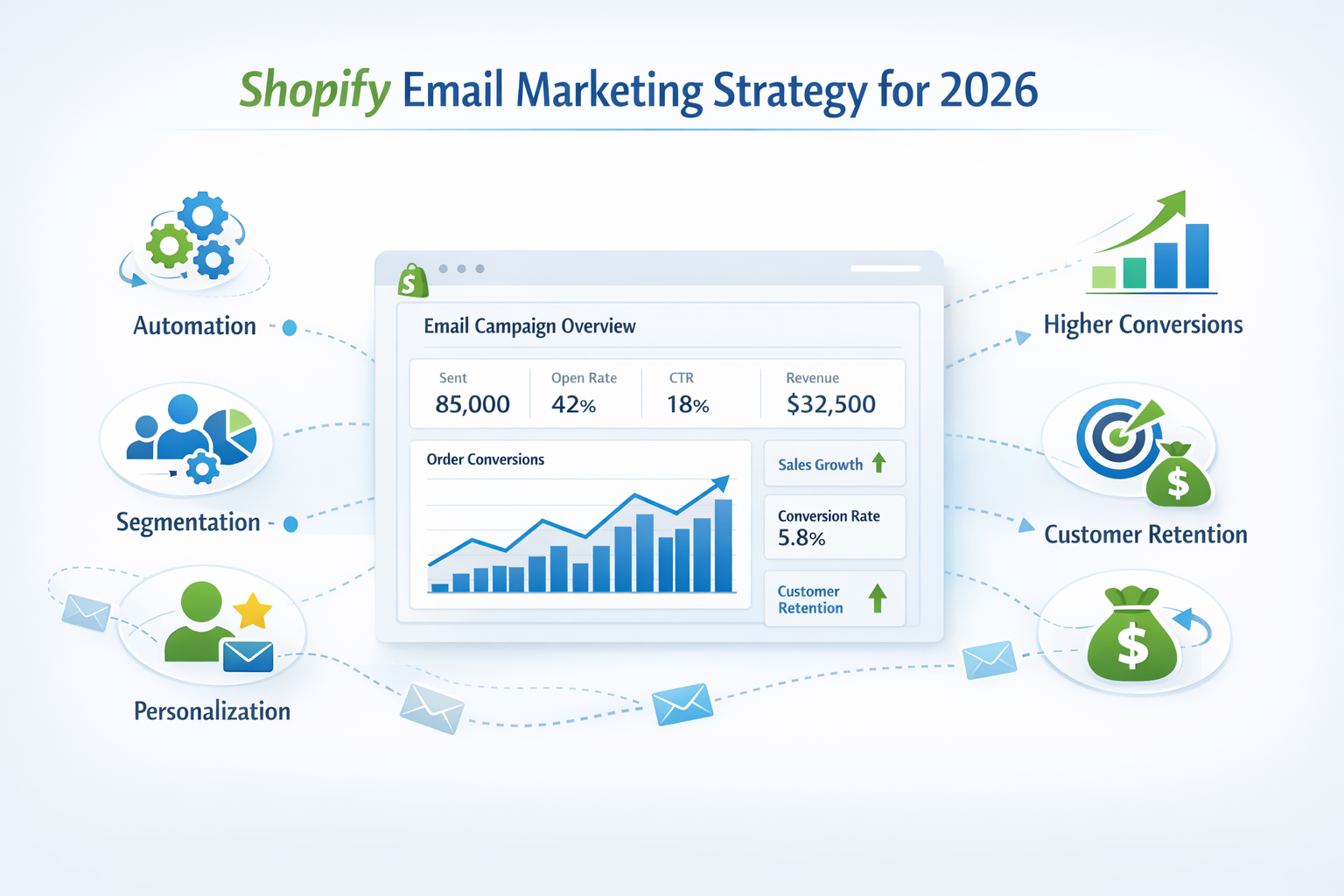
Shopify Email Marketing Strategy for 2026: 5 Proven Tactics That Actually Convert
A solid Shopify email marketing strategy is one of the most reliable ways to drive consistent sales in 2026. According to Statista, email marketing delivers an impressive return of $42 for every dollar spent. This makes it one of the highest ROI channels in e-commerce. However, many Shopify store owners leave significant revenue on the table. They use a generic approach that fails to connect with their audience or encourage repeat purchases.
The real difference lies in strategic planning.
In 2026, thriving e-commerce businesses on Shopify are doing far more than sending weekly newsletters. For instance, they are building automated Shopify email campaigns that guide prospects through the customer journey. These campaigns build loyalty and convert one-time buyers into consistent brand advocates. In addition, stores that adopt a data-driven email marketing strategy for Shopify are seeing conversion rates that are 2 to 3 times higher. This happens when they move beyond basic email broadcasts.
If you are managing a Shopify store and have not yet optimized your Shopify email marketing plan, you are at a disadvantage. This guide will help you change that. We will walk you through practical, proven tactics to transform your email marketing system. You can shift it from a secondary effort into one of your strongest revenue generators.
For store owners who want to expand beyond email and strengthen their overall digital performance, explore HiSellit’s growth resources. Discover how data-backed strategies can help your business reach its full potential.
What Makes an Effective Shopify Email Marketing Strategy?
A strong Shopify email marketing strategy is not about how many emails you send. It is about how relevant, well-timed, and valuable each one feels to your audience. Every Shopify store already gathers valuable customer data. This includes checkout activity, browsing behavior, and abandoned cart recovery emails. However, the real question is whether that data is being used strategically. Are you creating meaningful customer experiences that lead to conversions?
An effective email marketing for Shopify stores brings together three essential components. First, it uses email list segmentation. This ensures each subscriber receives messages tailored to their behavior and interests. Second, it automates key campaigns through lifecycle email marketing. You do not have to send every message manually. Third, it constantly measures and improves results. Important metrics include email open rate optimization, click-through rate improvement, and revenue per email sent. Resources like Campaign Monitor’s email segmentation guide provide excellent insight. They show how segmentation drives higher engagement and conversion rates.
When you combine these three elements, your Shopify email marketing evolves from guesswork into a precise system. As a result, you move beyond hope-based marketing. You start making decisions grounded in actual performance data. Over time, your email list becomes a reliable, revenue-generating asset for your e-commerce business.
1. Build a Shopify Email Segmentation Strategy for Better Open Rates and Conversions
Here’s the hard truth. Sending the same email to everyone on your list no longer works in 2026. Shopify stores that implement a Shopify email segmentation strategy consistently see open rates rise. They move from around 15% to nearly 25%. Click rates often double. That small adjustment creates a huge difference in performance. It aligns your message with what each customer actually cares about.
Segmentation is the process of dividing your email list into smaller, targeted groups. These groups are based on shared characteristics or behaviors. The most effective segments usually focus on purchase history, customer lifetime value, engagement level, and browsing activity. Studies from HubSpot confirm that segmented campaigns generate substantially higher engagement. They also drive better conversions compared to one-size-fits-all messages.
For instance, a customer who made a purchase six months ago but has not opened an email since requires a very different approach. Compare that to someone who ordered yesterday. The six-month customer needs a win-back email or exclusive content that re-engages them. The recent buyer deserves a thank-you message. Follow that with tailored product recommendations based on their purchase.
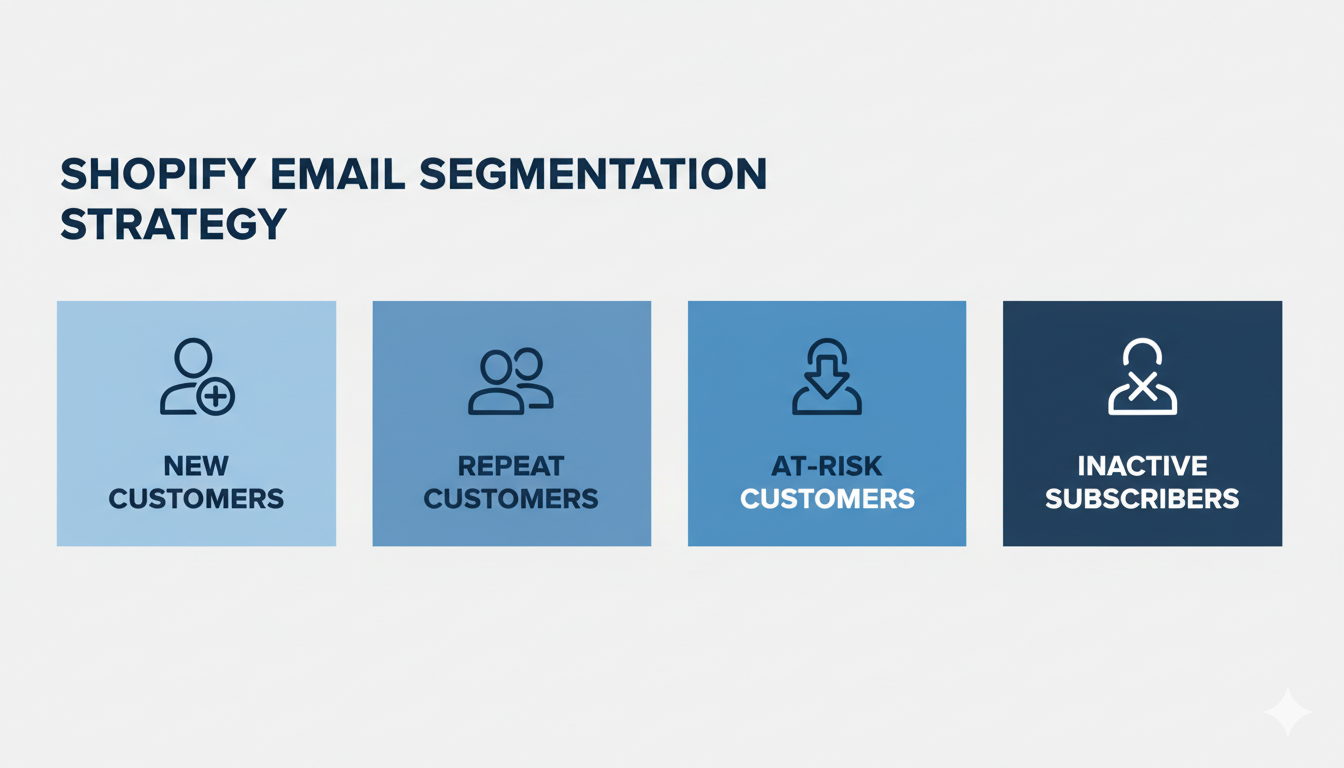
A practical Shopify email segmentation strategy includes four key groups:
- New customers within their first 30 days
- Repeat customers who purchased two or more times
- At-risk customers with no purchases in the last 90 days
- Inactive subscribers with no email opens in the last 60 days
The time you spend on email list segmentation always pays off. You are matching every message to the right audience. This is the foundation of an effective Shopify email marketing strategy. It is one of the clearest paths to stronger engagement, higher conversions, and predictable growth.
2. Implement Shopify Email Automation with Triggered Email Sequences
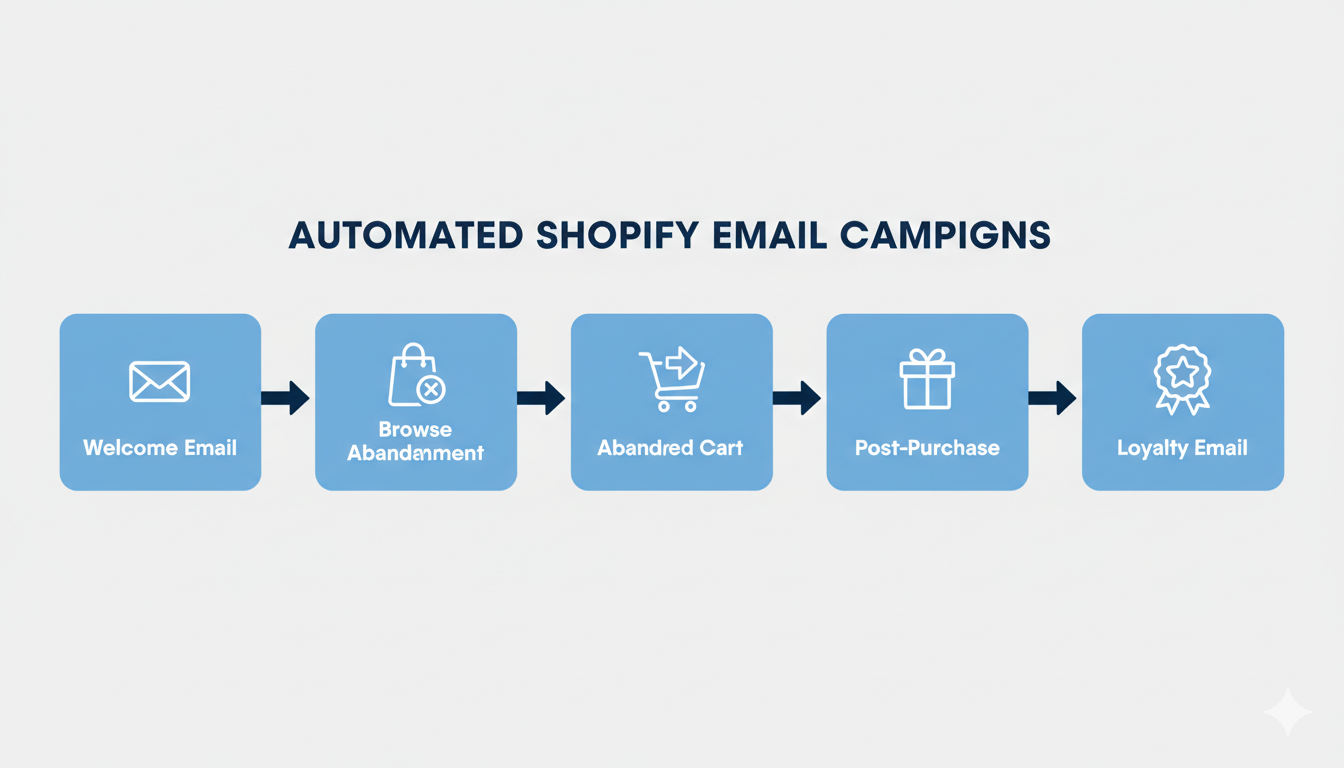
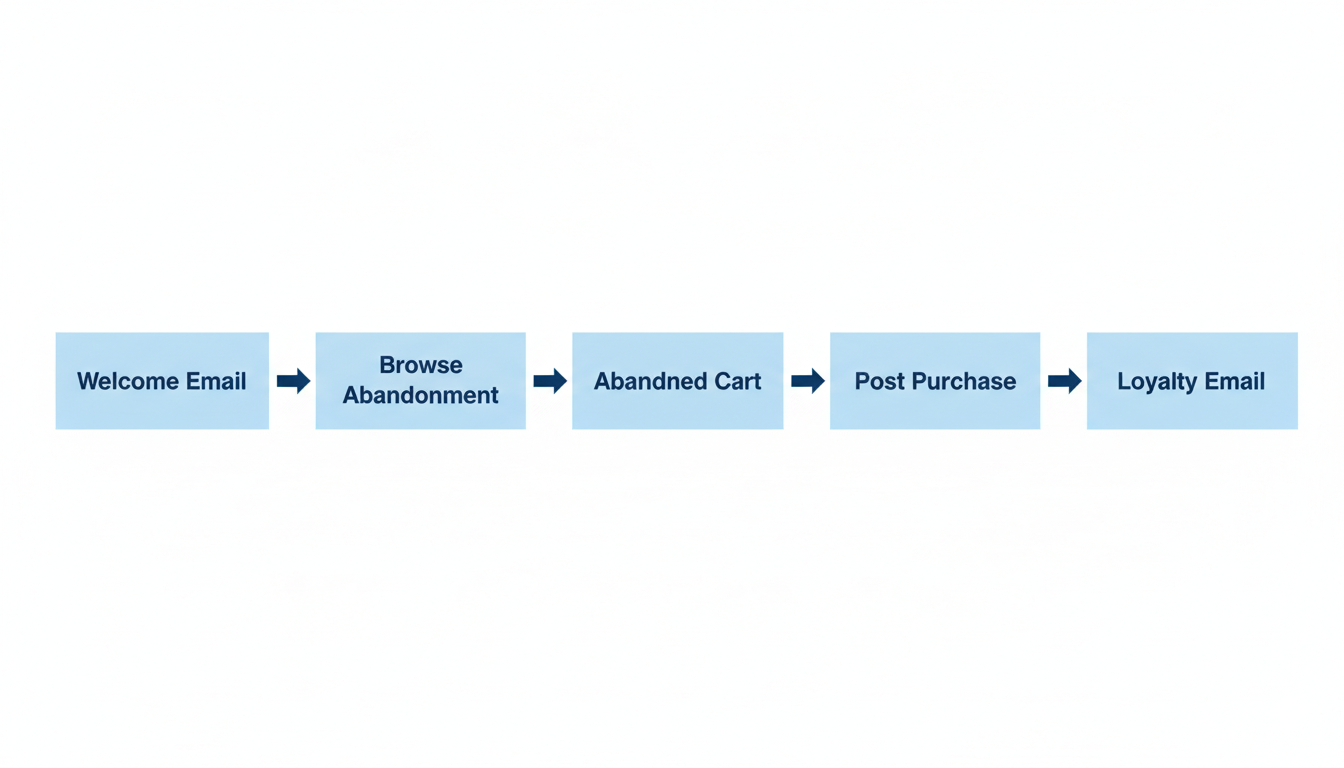
Automation is where most Shopify stores fail to capitalize on the opportunity. Many use basic welcome sequences in their email marketing for Shopify stores. However, they abandon advanced automation right after that. Consider what actually happens in real shopping behavior. A customer lands on your store, views a product, and then leaves without purchasing. That is an abandoned browse. Or they add products to their cart but never finish checking out. That is where your Shopify abandoned cart email strategy comes into play. These are key moments where a well-timed email can recover a sale. But only if you act quickly and with the right message.
According to Klaviyo’s data on automation benchmarks, abandoned cart emails sent within 1 to 3 hours can achieve recovery rates 40 to 50% higher. Compare that to emails sent later. In addition, Shopify email automation ensures that these emails are delivered instantly and consistently. There is no manual intervention required.
Beyond recovery, Shopify post-purchase email automation also drives lasting loyalty. It supports your customer retention strategy. For example, a simple three-email sequence can encourage reviews. It can share product care tips and offer early access to upcoming promotions. Over time, these small actions build stronger customer relationships. They transform how your Shopify email campaigns perform.
The best part about automated Shopify email campaigns is that they work while you sleep. Once you set up your customer journey automation sequences, they run on autopilot. As a result, you can focus on other parts of your business. Your email system continues to recover sales and nurture customer relationships through Shopify email flows that convert.
If you want to scale your automation efforts across multiple channels, consider exploring HiSellit’s Shopify Automation services. See how multi-platform strategies can amplify your results.
3. Use Personalized Email Marketing for Shopify Stores to Drive Revenue
Many Shopify store owners believe email personalization means adding a customer’s first name to an email subject line. That helps, but it barely scratches the surface. However, true personalized email marketing for Shopify stores is about making every message feel relevant to each individual shopper. It means recommending products based on what they actually purchased. It means sending birthday or anniversary rewards. It also means adjusting how often they receive emails based on engagement.
Shopify’s built-in email tools and platforms like Klaviyo and Omnisend make this easier than ever in 2026. These systems allow you to use purchase history, browsing behavior, and customer attributes. You can build dynamic content blocks that adapt automatically for each person. This is done through data-driven email marketing.
For example, a customer who recently bought running shoes might see suggestions for athletic socks or shoe care products. Someone who purchased a winter coat could see matching gloves or scarves. It is the same email template. But each subscriber sees something completely tailored. This level of relevance increases both clicks and conversions in your Shopify email marketing tactics.
Email personalization also applies to timing. According to HubSpot’s email engagement data, sending emails at personalized times can lift open rates by as much as 30%. Some subscribers open weekday mornings. Others engage on weekend evenings. Modern Shopify tools make it possible to send messages exactly when each customer is most likely to engage. This follows e-commerce email marketing best practices.
4. Create a Consistent Shopify Email Marketing Plan with a Sustainable Cadence
Consistency is one of the most overlooked parts of Shopify email marketing. When customers hear from you regularly and predictably, it builds familiarity and trust. However, if weeks or months go by without a single email, that connection fades. Engagement drops.
A balanced email cadence usually includes a weekly promotional or content-based email. Add a monthly educational piece. Include automated sequences like welcome, abandoned cart, and post-purchase messages. This approach keeps communication steady without overwhelming your subscribers. It maintains your Shopify email marketing plan.
According to Campaign Monitor, most audiences stay comfortable with one to three emails per week. Beyond that, unsubscribe rates begin to climb. Go beyond that, and engagement tends to decline. Send less than once per month and you miss out on valuable visibility.
The simplest way to maintain rhythm is by planning ahead. Use proven Shopify email marketing tips for 2026. For instance, create a content calendar each quarter. Schedule seasonal sales, product highlights, and loyalty campaigns in advance. This not only saves time but also ensures every email aligns with your goals. It supports your overall customer retention strategy.
Need help structuring your email calendar? Contact HiSellit’s team to discuss a custom email marketing strategy for Shopify. We tailor it to your store’s unique needs.
5. Test, Measure, and Iterate Your Shopify Email Marketing Strategy Like Your Revenue Depends on It
The Shopify stores succeeding with email marketing for Shopify stores in 2026 rarely get it perfect the first time. They test, track, and adjust continuously. This is where experimentation transforms good campaigns into great ones. It happens through data-driven email marketing.
A/B testing helps uncover what really resonates in your Shopify email campaigns. For example, you can test subject lines to find which earns more opens. Test send times to identify when your audience is most active. Or experiment with CTAs and landing pages to maximize conversions. This improves click-through rate improvement.
Start small with your testing approach. Test one variable per campaign and measure results. If a change performs better, make it your new standard. However, if not, try something else next time. This ongoing cycle of testing and refining leads to measurable gains over time. You will see improvement in revenue per email.
Focus on metrics that actually reflect growth. Email open rate optimization, click-through rate improvement, conversion rate, and revenue per email all matter. Yet the most important signal is sales impact. According to Mailchimp’s 2026 benchmark report, businesses that test consistently improve ROI by up to 37%. Keep refining until you discover the patterns that drive your unique audience. This supports your best Shopify email marketing strategy 2026.
The Bottom Line: Your Shopify Email Marketing Strategy 2026 Is Your Competitive Edge
Your email list is your most valuable owned media channel. Unlike social platforms that can change algorithms overnight, your email subscribers belong entirely to you. That is why a strong Shopify email marketing strategy is not just helpful. It is essential for any e-commerce business aiming for stability and long-term growth in 2026.
The brands that treat email marketing for Shopify stores as a system instead of a one-time campaign see the difference in their numbers. For instance, they build segmented, automated, and data-driven email programs. These programs deliver steady revenue every single month through lifecycle email marketing. These businesses retain customers at a lower cost than paid advertising. They build stronger loyalty with every interaction.
If it has been more than six months since you last reviewed your Shopify email marketing plan, now is the time to act. Start by refining your segmentation. Integrate smart automation. Personalize every message. Commit to testing and improvement. As a result, the impact on your sales will be clear within weeks. You will learn how to build a Shopify email marketing strategy that actually converts.
To explore how structured marketing systems can multiply your store’s performance, visit HiSellit today
FAQ: Shopify Email Marketing Strategy Common Questions
Q. What is a Shopify email marketing strategy in e-commerce?
A Shopify email marketing strategy is a planned approach to sending targeted, personalized emails to customers and prospects. It uses segmentation, automation, and testing to drive sales, build loyalty, and maximize ROI. In 2026, successful strategies focus on behavior-based triggers and data-driven personalization.
Q. How much does it cost to start a Shopify email marketing strategy for 2026?
Shopify’s native email tool is free for up to 10,000 contacts. Premium platforms like Klaviyo or Omnisend range from $20 to $300+ per month. The cost depends on list size and features. Most businesses start with free tools and upgrade as their list grows.
Q. Is Shopify email marketing profitable for beginners?
Yes, email marketing for Shopify stores is one of the most profitable channels for beginners. With an average ROI of $42 for every dollar spent, it offers high returns with relatively low upfront costs. However, success requires consistent segmentation, automation, and testing to maximize conversions.
Q. What tools automate Shopify email marketing?
The best tools for Shopify email automation in 2026 include Klaviyo, Omnisend, and Shopify’s native email app. These platforms offer automated workflows for abandoned carts, welcome sequences, post-purchase follow-ups, and personalized product recommendations. They are all based on customer behavior.
Q. How do you build a Shopify email marketing strategy that converts?
To build a successful Shopify email marketing strategy 2026, start with email list segmentation. Target specific customer groups. Then implement automated email campaigns for abandoned carts and post-purchase sequences. Finally, use personalized content and continuously test your campaigns. This improves click-through rates and revenue per email.