
Etsy Print-on-Demand Automation Setup: Your Complete Guide to Building a Passive Income Stream in 2026
If you’re looking to master your Etsy print-on-demand automation setup, you are stepping into a marketplace that generated over $2.7 billion in revenue during Q3 2024 alone, and print-on-demand sellers are steadily capturing an increasing portion of that growth. Automating your Etsy POD business is not just about earning money while you sleep, though that is certainly appealing. The real advantage lies in creating a scalable system that manages production, order fulfillment, and customer service without consuming your entire day.
The reality for many Etsy sellers is far from this ideal. They spend late nights designing products, wake up early to respond to customer messages, and constantly worry about inventory and shipping logistics. Successful POD sellers understand that automation is no longer optional. It is the defining factor that separates a hobby shop earning sporadic income from a structured Etsy print-on-demand business generating consistent monthly revenue.
Understanding Etsy Print-on-Demand Automation and How It Works
Before diving into the technical setup, it helps to understand what Etsy print-on-demand automation really means in the real world. When we talk about Etsy shop automation, we are referring to systems that handle order processing, production coordination, fulfillment tracking, and even customer communication without requiring constant manual input from the seller.
In a traditional e-commerce model, you would manage inventory, pack boxes, print labels, and visit the post office yourself. Print on demand on Etsy completely reverses that approach. You design products, list them on your Etsy shop, and once a customer places an order, your print-on-demand partner takes over by printing, packing, and shipping directly to the buyer. Automation extends this process even further by removing the need for you to manually confirm or process any step after setup.
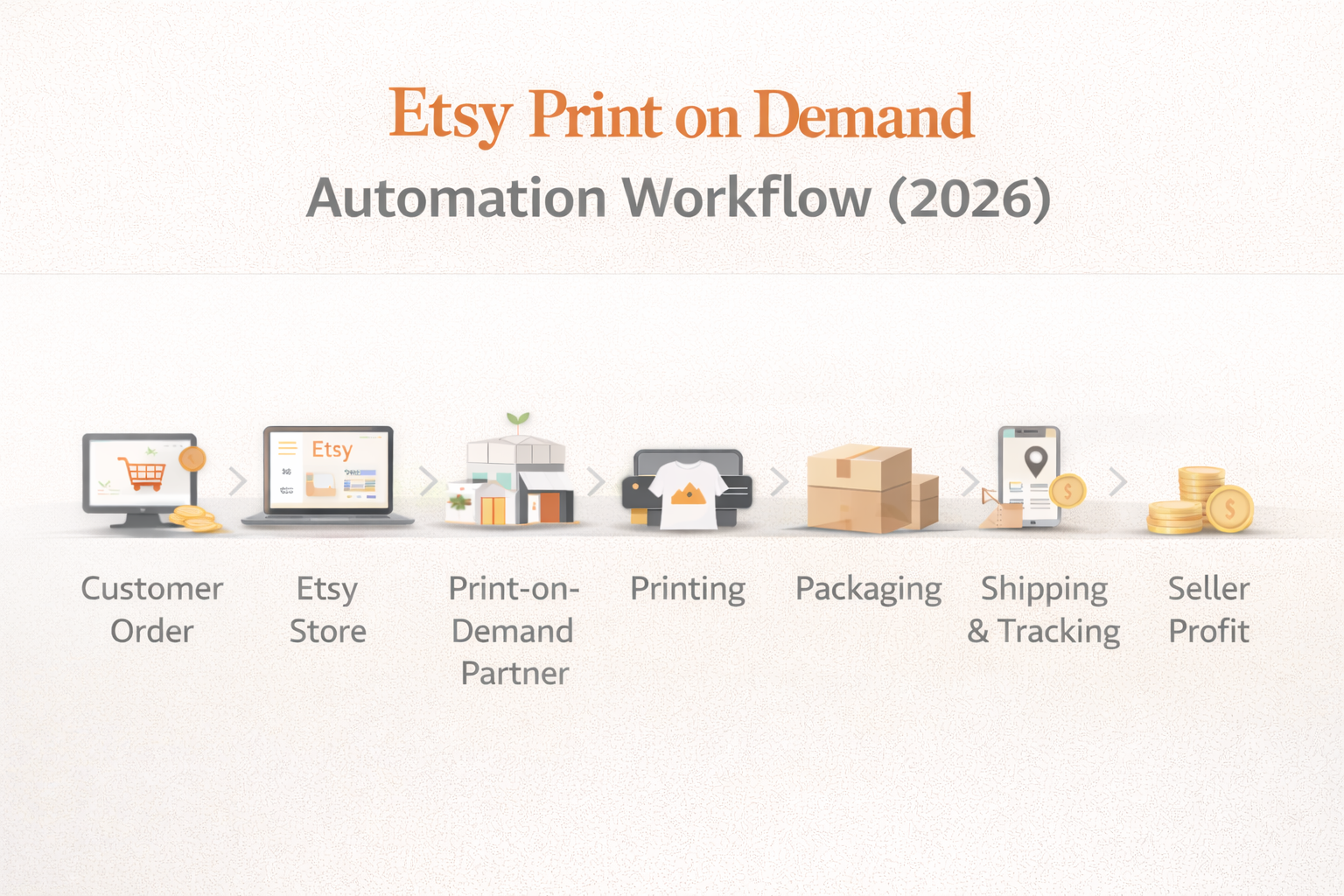
A standard automated Etsy print-on-demand workflow functions like this: a customer places an order, the order automatically syncs with your POD platform, the product is produced and shipped, tracking updates appear in your Etsy dashboard, and you receive your profit margin. Once configured, this system runs continuously in the background.
Choosing the Best Etsy Print-on-Demand Integration Partner for Seamless Automation
Selecting the right print-on-demand partner determines how seamless your automation experience will be. Not every provider integrates efficiently with Etsy’s API, and some require more manual oversight than others.
Printful is widely recognized as the most reliable option for Etsy POD automation. Their platform connects directly with your Etsy shop, automatically syncs product listings, and handles fulfillment without friction. With a catalog of more than 300 customizable items, their mockup generator makes it easy to create professional product visuals instantly. The only limitation is that their per-item cost can be slightly higher, which may affect margins on lower-priced listings.
Printify offers similar Etsy automation for print-on-demand with a marketplace model that lets you choose from several printing partners. This flexibility often leads to more competitive pricing, though the tradeoff can be variation in print quality across different suppliers.
For sellers focused on international growth, Gelato stands out with fulfillment centers in over 30 countries. Their localized production helps reduce both delivery times and shipping expenses for global customers.
If you want expert guidance to implement your print-on-demand systems smoothly and scale without constant manual work, explore our Etsy automation services. This detailed service breakdown shows how HisellIt helps Etsy sellers create structured automation that drives consistent sales growth.
Step-by-Step: Setting Up Your Automated Etsy Print-on-Demand (POD) Workflow
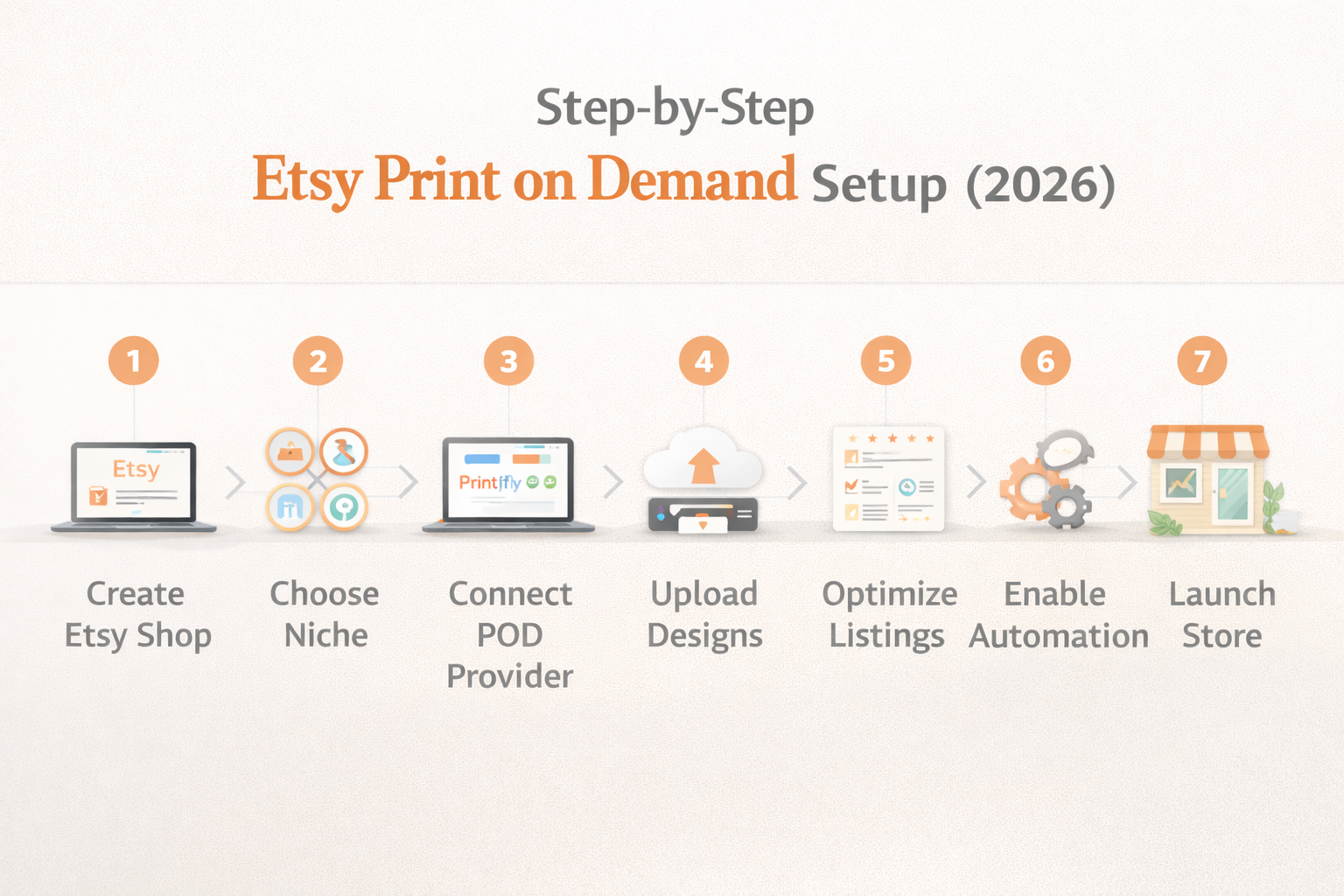
Now, for the practical side of things. Setting up your Etsy print-on-demand automation correctly from the start saves you from countless frustrations later. A clear and well-structured setup ensures every part of your business runs smoothly, from the moment a customer places an order to the second it arrives at their doorstep.
Connect Your Etsy Shop to Your POD Platform
Begin by logging in to your selected POD provider and navigating to their integrations section. You will need to authorize the connection between your Etsy shop and their system. This usually involves granting API permissions, which may sound complex but, in most cases, is just a simple process of clicking through a few confirmation prompts.
Configure Your Product Sync Settings
Next, set up your product sync preferences. This is where your Etsy POD automation setup either flows seamlessly or becomes complicated. Configure your settings so that newly created products in your POD dashboard automatically push to Etsy. Most print-on-demand platforms like Printful and Printify allow you to choose whether items are published instantly or remain as drafts until you manually approve them. Many experienced sellers prefer reviewing new listings before going live to ensure image quality and pricing accuracy.
Enable Automatic Order Routing
Enable automatic order fulfillment to make sure every order from your Etsy shop immediately routes to your print-on-demand provider for production. This removes the need for manual confirmation and ensures that each step of fulfillment happens efficiently. Take a moment to verify your profit margins before activating automation. Many sellers overlook markup settings during setup, which can lead to unexpected losses on early orders. A quick review of your pricing structure can prevent that entirely.
When your Etsy automation starts working properly, you will notice how much time it frees up for design and marketing instead of repetitive management tasks. If you want professional support setting everything up or need help optimizing your automated systems, explore our automation services for Etsy sellers. The HisellIt team specializes in helping Etsy sellers streamline every aspect of their business so they can scale faster and focus on growth.
Optimizing Etsy Product Listings for SEO and Higher Conversions
Automation handles the backend, but your listings still need optimization to actually drive sales. This is where many sellers stumble because they focus so much on automation that they forget about the marketing side.
Your product titles should follow this formula: Primary Keyword + Descriptive Details + Relevant Tags. For example, “Funny Cat Mug, Coffee Lover Gift, Ceramic 11oz Cup, Dishwasher Safe” works better than “Cute Mug.” Front-load your most important keywords since Etsy’s search algorithm weighs the title more heavily.
Product descriptions need to balance SEO with genuine helpfulness. Include your target keywords naturally, but write for humans first. Describe materials, dimensions, care instructions, and ideal use cases.
Photography makes or breaks POD products since customers can’t physically examine items. Your mockup images should show products in realistic settings, not just floating on white backgrounds. Most POD platforms provide mockup generators, but investing time in creating varied, high-quality images pays off in conversion rates. For additional tools and resources, check out our guide on best mockup tools for Etsy sellers.
Automating Etsy Customer Service and Daily Shop Management Tasks
True Etsy shop automation goes beyond order fulfillment. Smart sellers know that automation should also handle communication and daily management tasks that take up unnecessary time. These systems help your shop stay active, responsive, and professional without constant hands-on attention.
Etsy already provides several underused automation tools. You can set up automatic messages that thank customers right after their purchase, share care instructions, and politely request reviews once delivery is confirmed. These messages go out automatically and help create a better customer experience while also building credibility for your shop.
For ongoing optimization, consider third-party tools like eRank and Marmalead. These platforms simplify your Etsy SEO research by tracking keywords, analyzing competitors, and finding trending search terms based on real-time data. Instead of manually checking what is popular every week, they notify you of shifts in search demand so you can adjust listings faster and more accurately.
Even with automation in place, smart sellers still review their shop regularly. Order samples from your own store every month to confirm print quality, check packaging, and ensure shipping times meet expectations. This habit helps identify potential problems early and keeps your Etsy print-on-demand automation running smoothly.
If you are ready to take your automation further, explore our Etsy automation services. The HisellIt team helps sellers create streamlined systems that maintain quality while scaling efficiently.
Scaling Your Etsy Print-on-Demand Business with Automation
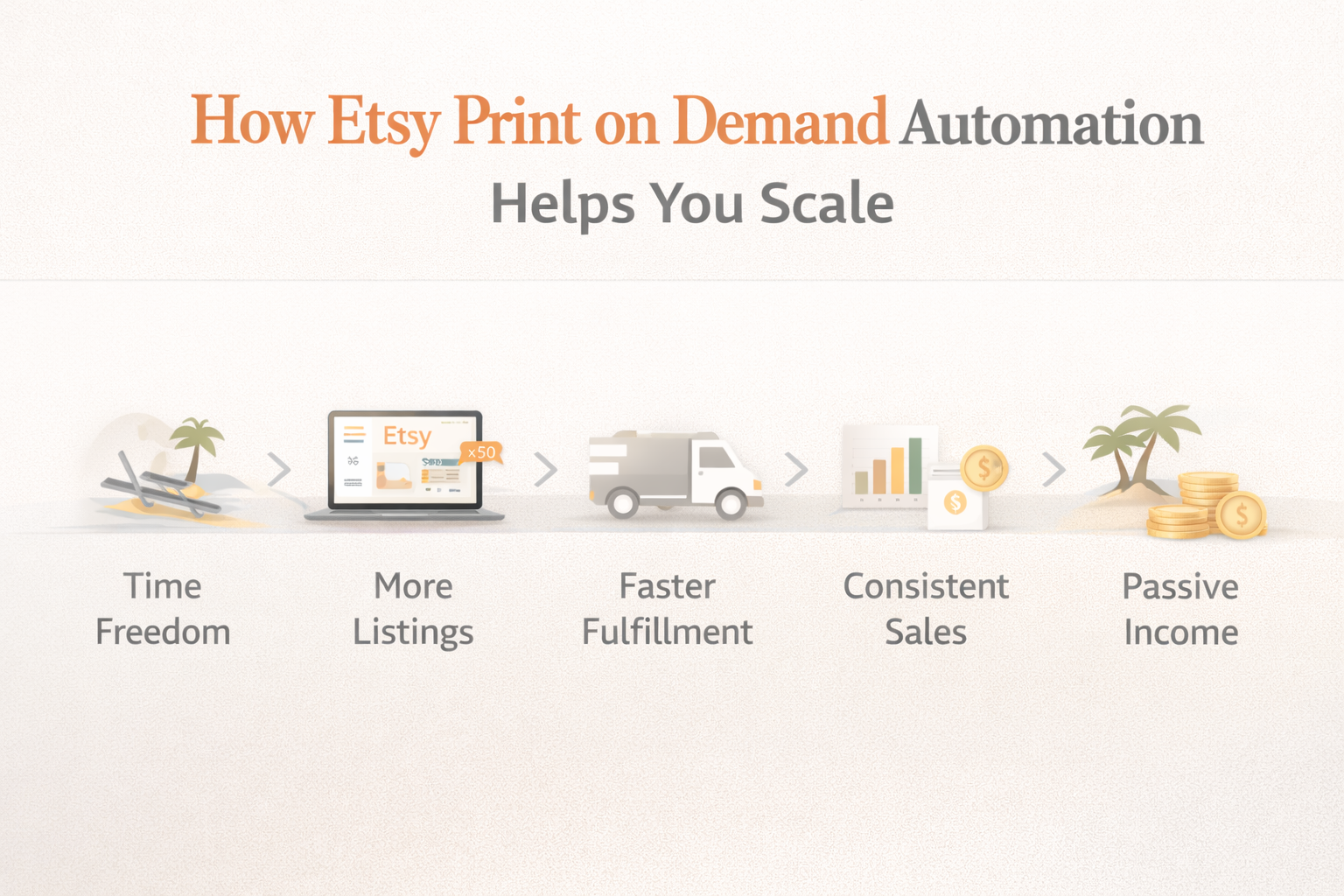
Once your automation runs smoothly, scaling becomes significantly easier than with traditional e-commerce models. With automated fulfillment in place, you can test new products rapidly without unnecessary risk or time loss. Create small themed collections targeting different niches, monitor which designs start gaining traction, and then double down on the top performers while quietly retiring the underperforming ones. The most successful Etsy print-on-demand sellers often manage anywhere between 200 and 500 active listings at a time, allowing them to maintain variety while still focusing on proven winners.
Scaling also means looking beyond Etsy alone. Your Etsy POD business automation setup can easily extend to multiple marketplaces simultaneously. Many sellers run identical catalogs on Etsy, Shopify, and even Amazon Handmade for broader exposure. If you want to explore this strategy further, check out our guide on best automation tools to scale your Etsy shop for practical insights into managing multi-channel partnerships effectively.
It’s also smart to diversify your revenue streams by complementing physical POD products with digital downloads. The profit margins are often 90% or more, there’s zero fulfillment cost involved, and delivery happens automatically after purchase. This combination of print-on-demand on Etsy and digital goods allows your business to scale faster without added overhead.
To stay ahead of the competition and learn more about expanding through automation, you can also explore Etsy automation services at HisellIt. It’s the next logical step if you want to scale your shop efficiently without sacrificing quality or customer experience.
How Much Does It Cost to Start an Automated Etsy Print-on-Demand Business?
Starting an automated Etsy print-on-demand business requires very little upfront investment. Etsy charges a $0.20 listing fee per product, renewed every four months, plus a 6.5% transaction fee and about 3% plus $0.25 in payment processing per order. You can view full details on Etsy’s Fees and Payments Policy.
Most print-on-demand platforms are free to join and only charge when customers order, removing inventory risk entirely. A reasonable startup budget usually falls between $100 and $500, covering listings, optional design tools, and sample products.
Recent data from Statista projects the print-on-demand market to continue strong growth through 2030, with sustained annual expansion.
Conclusion
Etsy print-on-demand automation is one of the easiest and most effective ways to build a passive income business online. The sellers who succeed with it understand that automation is not just about saving time but about creating a system that works for them even when they are not logged in. It gives you the freedom to focus on creativity, product research, and long-term brand growth while your automated tools handle the rest.
If you want to take your e-commerce setup even further, consider exploring our Etsy automation services to help you scale without manual work.
Your Etsy print-on-demand automation setup is the first real step toward financial independence. Focus on building solid systems, test your strategies regularly, and keep refining what performs best. Once your workflow runs seamlessly, your Etsy POD business can grow consistently and earn around the clock.
Frequently Asked Questions
Q. What is the best print-on-demand company for Etsy automation?
Printful offers the most seamless Etsy print-on-demand integration with the most reliable automation features. Their direct API connection handles everything from product sync to order fulfillment to tracking updates without manual intervention.
Q. How long does it take to set up Etsy POD automation?
A complete automated Etsy print-on-demand setup typically takes 3 to 5 hours for your first shop, including account creation, integration configuration, product uploads, and testing. Most of that time goes into creating your initial product listings rather than the technical connection, which usually takes under 30 minutes.
Q. Can I automate my existing Etsy shop, or do I need to start fresh?
You can absolutely automate an existing Etsy shop. Connect your POD provider to your current shop, then either replace existing products with automated POD versions or add POD items alongside your current offerings.
Q. Do I need design skills to run an automated POD business?
Basic design skills help, but aren’t strictly required. Platforms like Canva offer templates specifically for POD products. That said, unique, high-quality designs do convert better, so investing time in learning design fundamentals can significantly improve profitability.
Q. How much can I realistically earn with an automated Etsy POD shop?
For most people starting out, earnings are modest at first. In the first 1–3 months, it’s common to make around $50 to $300 per month while you’re testing designs, learning how Etsy search works, and getting your first reviews.
Once your listings improve and you add more products, many sellers gradually reach $500 to $1,500 per month within 6–9 months. Shops that find a strong niche and build a large, well-optimized catalog can grow to $2,000 to $4,000 per month over time. Making more than $5,000 a month does happen, but it usually takes consistent work, strong branding, and ongoing optimization.
Ready to let your Etsy shop run smoothly on its own? Explore our Etsy automation services or reach out through our contact page to start building your automated workflow today.