

Shopify Branding: Why It Matters More Than Product Quality
Most Shopify store owners think that having the best product is enough to win.
They pour resources into finding quality suppliers, perfecting product features, and beating competitors on price. Then they wonder why customers still choose other stores selling the exact same items.
The truth? Shopify branding determines success more than product quality ever will. Strong branding changes what customers are willing to pay, who they trust, and whether they come back. Without it, even great products become forgettable commodities in a race to the bottom on price.
This guide breaks down why Shopify branding drives real business results, how it affects customer decisions, and what actually works when building a brand from scratch.
What Is Shopify Branding?
Shopify branding is the process of creating a consistent identity, emotional connection, and perceived value that helps a Shopify store stand out beyond product quality and price.
It’s everything customers think and feel about a store, not just the logo or color scheme.
Think about coffee shops. Two places sell identical beans at the same price. One has lines out the door. The other is empty. The coffee didn’t change. How people feel about each place did.
Same thing happens with Shopify stores. Shopify brand identity includes:
- How the store looks (logo, colors, fonts, photos, layout)
- How it talks to customers (friendly, professional, edgy, casual)
- What it stands for (quality, sustainability, affordability, exclusivity)
- The whole shopping experience (emails, packaging, customer service, returns)
- How customers feel when they think about the brand
Products are what stores sell. Branding is why people actually care.
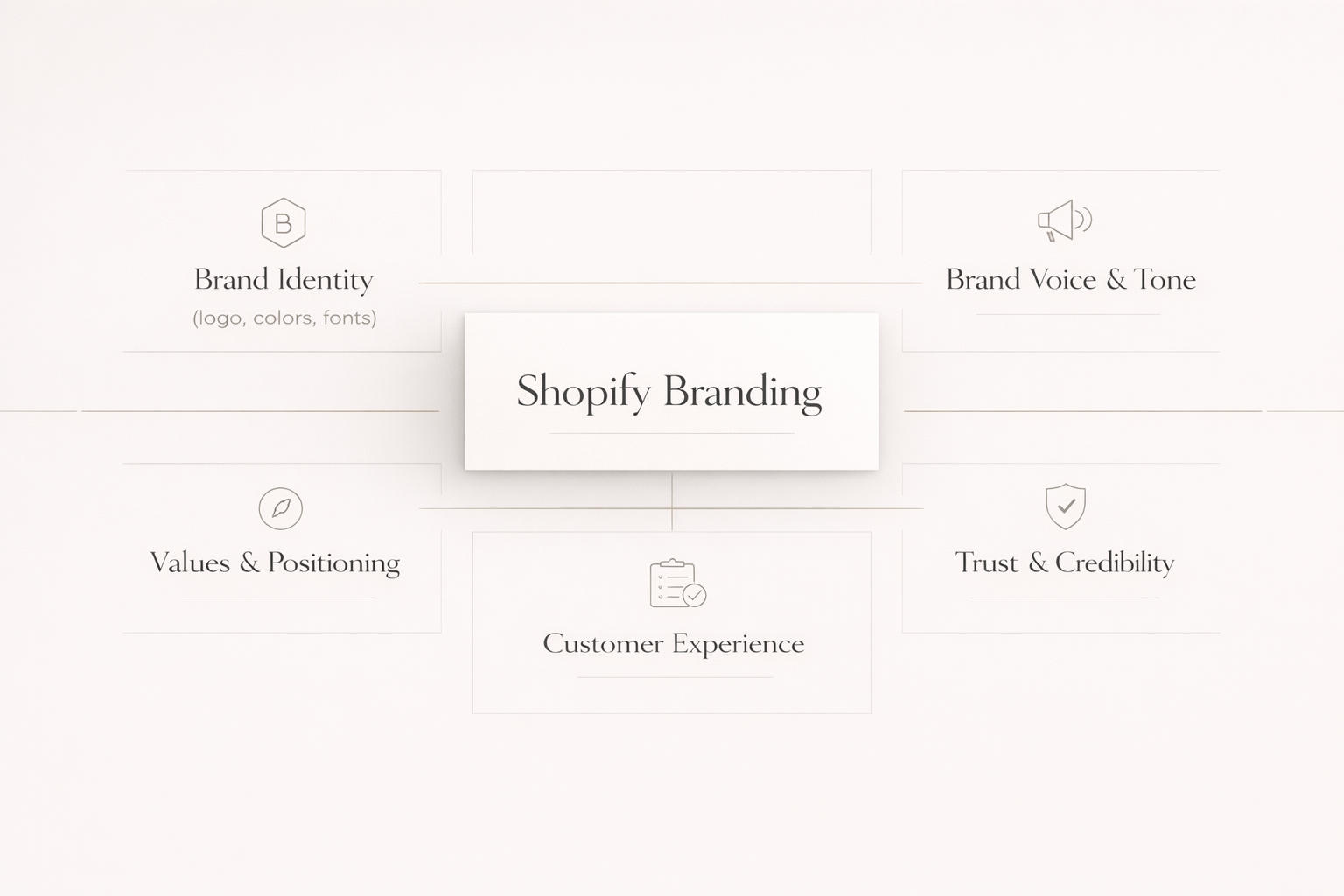
Shopify Branding Framework (Quick Reference)
Here’s a practical framework for building Shopify branding that works:
| Element | What to Define |
| Positioning | Target audience + unique promise + clear differentiation |
| Visual Identity | Logo + color palette (2-4 colors) + typography + photography style |
| Brand Voice | Tone guidelines + word choices + messaging rules |
| Trust Signals | Customer reviews + clear policies + responsive support + guarantees |
| Consistency | Website + email + ads + social media + packaging + post-purchase experience |
This framework covers the five essential areas every Shopify brand strategy needs. Missing even one element weakens the overall brand impact.
Who Shopify Branding Matters Most For
Strong branding for Shopify stores benefits everyone, but certain store types see the biggest impact:
New Shopify store owners who need to establish trust and differentiate from day one. Without an existing reputation or customer base, branding becomes the primary tool for building credibility.
Dropshipping brands that sell products available from multiple suppliers. When dozens of stores offer identical items, branding is often the only differentiator. Understanding dropshipping opportunities combined with strong branding creates sustainable advantages.
Direct-to-consumer (DTC) brands are competing against established retailers. Strong branding helps newer brands compete on emotional connection and values rather than price or selection.
Stores selling commoditized products where functional differences are minimal. Whether it’s water bottles, phone cases, or apparel, branding transforms generic products into meaningful purchases.
If your products can be found elsewhere, which applies to most Shopify stores, then developing a comprehensive Shopify brand strategy isn’t optional. It’s essential for survival.
Why Products Alone Don’t Cut It Anymore
Everyone Sells the Same Stuff
Here’s what most store owners don’t want to admit: product uniqueness is basically dead.
Thousands of Shopify stores source from Alibaba, use the same print-on-demand companies, or dropship identical items. Someone can find your “unique” product, trace it back to the supplier, and sell it themselves within a week. Choosing the right Shopify dropshipping products matters, but it’s not enough anymore.
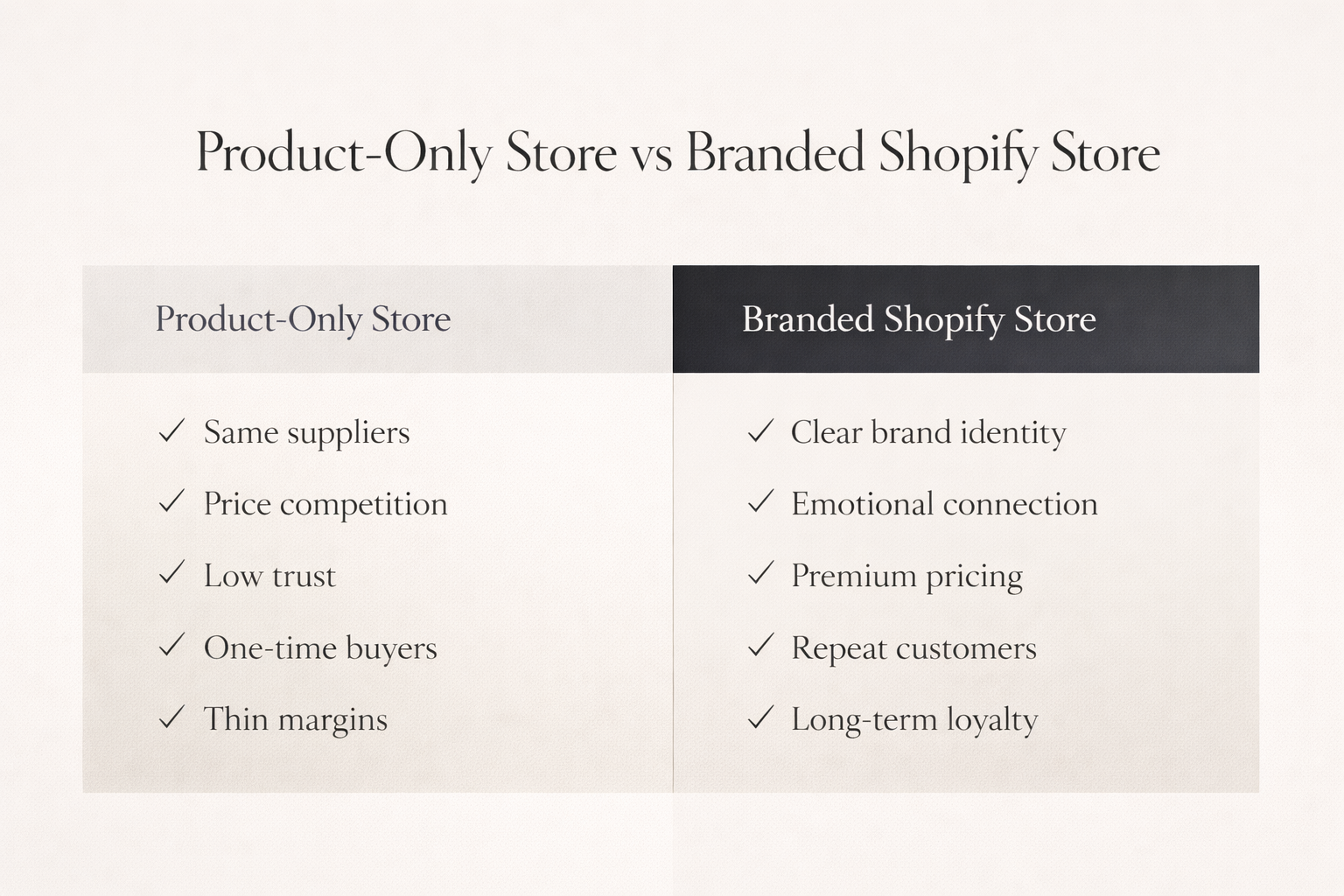
Product commoditization in e-commerce has killed the idea that better products automatically win. When ten stores sell the exact same water bottle, the one that wins isn’t the one with the best bottle. It’s the one with the best brand.
The water bottle becomes about adventure. Or sustainability. Or minimalist design philosophy. The physical product stayed the same. The story changed everything.
Branding Controls What People Pay
Two candles. Identical wax, identical scent, identical burn time. One costs $12. The other costs $45.
The expensive one doesn’t burn better. It has nicer packaging, tells a story about artisan craftsmanship, and makes buyers feel sophisticated. That’s premium pricing through branding.
Customers don’t just calculate value based on features. They calculate based on how products make them feel. A strong brand makes products feel more valuable even when they’re objectively identical.
This isn’t trickery. People genuinely value feeling smart, successful, or environmentally conscious. Brands deliver those feelings. Products deliver functions.
Research from Shopify’s Commerce Trends report shows brand perception influences purchase decisions more than actual product differences in most categories. Customers prioritize brand experience over product specs more than ever before.
Competitors Can Copy Products But Not Brands
Launch a winning product today. Competitors will copy it by next month.
But building authentic brand trust in e-commerce? That takes years and can’t be knocked off. A brand includes relationships, reputation, stories, and community. These things don’t happen overnight.
Someone can manufacture your exact product. They can’t manufacture years of customer trust, emotional connection, and brand loyalty. This makes branding for Shopify stores the only real competitive advantage left.
How Emotions Actually Drive Sales
People Buy Feelings First, Products Second
Most Shopify stores list features and expect customers to get excited.
“This backpack has 6 pockets and water-resistant fabric!”
Great. So do 500 others.
Emotional branding ine-commercee works differently. It connects products to who customers want to be. The backpack becomes: “Built for people who refuse to choose between style and adventure.”
Now it’s not about pockets. It’s about identity.
Purchasing decisions happen emotionally, then get justified rationally afterward. Customers decide they want something based on feeling, then find logical reasons why it makes sense. Yet most stores only give them the logical reasons.
Brand storytelling in e-commerce taps into this. It gives customers the emotional reasons they’re actually looking for. They’re not buying a product. They’re buying into an idea, supporting values they believe in, or expressing who they are.
Lifestyle Brands Create Real Loyalty
Look at successful outdoor brands. They don’t sell jackets. They sell the idea of adventure, freedom, and nature. Customers buy because they want that lifestyle.
This is lifestyle branding for Shopify stores. It creates communities, not just customer lists. People who buy into a lifestyle stick around, spend more, and tell friends.
The psychology is simple: humans want to belong and express identity. Brands that tap into this don’t compete on price. They compete on meaning.
When someone buys from a lifestyle brand, they’re joining something bigger than a transaction. That’s why these customers defend brands online, wear branded gear, and keep coming back even when cheaper options exist.
Building a Shopify Brand Strategy That Works
Start With Clear Positioning
Before worrying about logos or Instagram, figure out what the brand actually stands for.
Answer these honestly:
- Who is this for? (Be specific. “Everyone” means nobody.)
- What problem does it solve beyond the obvious?
- What makes it different from competitors?
- How should customers feel about the brand?
- What does the brand believe in?
This determines everything else. Without clear positioning, branding for Shopify stores becomes random tactics that don’t add up.
A good Shopify brand strategy picks a lane and owns it. Trying to be everything to everyone dilutes the message until it means nothing.
Build a Visual Identity That Actually Matches
Customers judge stores in seconds. Visual branding creates that first impression.
A solid Shopify brand identity needs:
Logo: Simple, memorable, works at any size. Complicated logos get forgotten.
Colors: Pick 2-4 colors and stick with them. Different colors trigger different feelings—blue for trust, green for health, black for luxury. Choose colors that match the brand positioning.
Fonts: Typography says a lot before customers read words. Modern fonts feel current. Classic fonts feel established. Playful fonts feel approachable. Match fonts to brand personality.
Photos: Keep the photography style consistent. Bright and airy versus dark and moody creates completely different impressions. Pick one approach.
Design elements: Patterns, icons, or graphic styles that show up repeatedly become recognizable.
The goal isn’t looking pretty. It’s looking consistent and professional across everything. When customers see the same visual language everywhere, the brand feels established and trustworthy.
Inconsistent visuals scream amateur. Strong visuals make customers confident about buying.
Develop a Consistent Voice
How a brand talks matters as much as how it looks.
Brand voice is the personality in every message—product descriptions, emails, social posts, customer service, even error messages.
Most Shopify stores sound corporate on the website, casual on Instagram, and robotic in emails. This confuses customers. It feels like dealing with three different companies.
A strong Shopify brand strategy defines voice clearly:
- Tone (friendly versus formal, playful versus serious)
- Word choices (technical jargon versus plain English)
- Sentence style (short and punchy versus flowing and descriptive)
- How the brand talks about customers and products
Then apply that voice everywhere. When customers get an email that sounds exactly like the website they just read, it builds trust. Consistency reinforces the brand.
Keep Everything Consistent Everywhere
Customers don’t follow straight paths anymore. They see Instagram posts, Google ads, visit websites, get emails, and unbox packages, often across weeks before buying.
Shopify store branding needs to look and feel the same across all these touchpoints. Inconsistent branding confuses people and kills trust.
Make sure branding stays consistent on:
The website: Design, copy, photos, and layout should all reflect brand identity.
Emails: Welcome emails, abandoned cart messages, shipping confirmations—all should sound like the brand.
Social media: Each platform has its own vibe, but the core brand identity should still be recognizable.
Ads: Paid ads should match the landing page. When they don’t, people bounce.
Packaging: The unboxing experience is a branding moment. Packaging should reflect brand values.
Customer service: Support emails should use the same voice. How brands handle problems reveals identity more than how they handle easy stuff.
Seamless experiences build trust. Disjointed experiences raise red flags.
How Branding Actually Increases Revenue
Better Conversion Rates
Brand trust in e-commerce directly affects whether people buy. Customers hesitate less when they trust a brand.
Strong branding reduces perceived risk. Professional, consistent branding signals that the business is reliable and won’t disappear after taking someone’s money. This matters especially for first purchases.
Clear positioning also speeds up decisions. When branding clearly communicates what the store offers and who it’s for, customers know faster whether it’s right for them. Less comparison shopping means less cart abandonment.
According to research from Baymard Institute, trust-related concerns account for about 18% of cart abandonment. Strong branding directly fixes this problem.
Emotional branding in e-commerce also motivates customers beyond rational comparisons. When customers feel connected to a brand, they are more likely to buy. They’re not just comparing features and prices anymore.
Understanding how to increase Shopify conversion rates through both branding and technical optimization has a compounding effect on revenue.
Higher Prices
The biggest financial impact of good Shopify branding is pricing power. Strong brands charge more because they’ve shifted focus from product features to brand value.
Premium pricing in Shopify stores happens when:
Quality perception changes: Customers assume strong brands mean higher quality, even when products are identical.
Value extends beyond products: Premium brands sell experiences, status, and self-expression alongside products.
Price sensitivity drops: When customers connect emotionally with brands, price matters less. They’d rather pay more than switch to cheaper alternatives.
This isn’t about randomly raising prices. It’s about delivering real value through product quality, customer experience, and authentic brand values. But when done right, it creates profit margins that product-focused competitors can’t match.
More Repeat Customers
Getting new customers costs way more than keeping existing ones. Research from Harvard Business Review shows that acquiring new customers costs 5-25 times more than retaining existing customers.
Brand loyalty in ecommerce creates repeat customers who spend significantly more over time. Strong brands don’t just convert once. They build relationships.
Customer retention in Shopify stores improves when:
Emotional connections form: Customers who identify with brand values don’t switch based on price alone.
Communities develop: Community building in ecommerce creates social bonds. Customers become part of something bigger than purchases.
Experiences stay consistent: When brands consistently deliver on promises, customers trust them and keep coming back.
Customers become advocates: Loyal customers recommend brands to friends and defend them online. This cuts future customer acquisition costs.
Focusing on customer lifetime value in ecommerce instead of single transactions changes everything about how brands approach marketing and experience.
How Branding and SEO Work Together
Strong Shopify branding doesn’t just affect direct sales. It also affects how stores perform in search results.
Brand authority in SEO matters more than ever. Google increasingly prioritizes established brands in search results because branded searches signal trust and relevance. When people specifically search for a brand name, it tells Google that brand provides value.
Building branded search volume through consistent branding efforts improves overall SEO performance. Customers who remember brand names search for them directly, which signals quality to search engines.
Staying current with Shopify SEO trends helps ensure branding efforts reach the right audiences through organic search. Technical SEO and branding work together—neither is sufficient alone.
According to Google Search Central, helpful content created for people (not just search engines) performs better over the long term. This aligns perfectly with authentic branding approaches.
Common Branding Mistakes
Being Inconsistent
The biggest mistake is inconsistency. Many stores create brand guidelines, then ignore them.
Inconsistency shows up as:
- Different visual styles on website versus social media
- Brand voice that shifts between casual and formal randomly
- Messages that emphasize different values across channels
- Customer experiences that contradict stated brand values
This confuses customers and weakens everything. Each inconsistent touchpoint makes customers relearn what the brand means.
Fix this by clearly documenting the brand guidelines. Then make sure everyone creating content, from product descriptions to customer emails, follows them.
Copying Competitors
When stores see successful competitors, copying their branding feels tempting. This misses how branding actually works.
Successful brands win because they’re different and authentic, not because they follow templates. Copying creates problems:
- Customers see the brand as a knockoff
- The brand never occupies unique mental space
- Legal issues can emerge
- Authenticity never develops
Research competitors to understand the market. But find authentic differentiation, not copy what exists. Effective branding for Shopify stores requires being genuinely different.
Skipping Strategy for Design
Many merchants jump straight to tactics, designing logos, picking colors, launching Instagram—without strategic foundation.
This produces pretty branding that doesn’t drive results. Beautiful design without strategic positioning rarely converts because it lacks a coherent identity.
Start with strategy, then move to tactics:
- Define positioning (audience, differentiation, values, benefits)
- Create an identity that expresses that positioning
- Execute consistently across touchpoints
Starting with tactics produces pretty branding. Starting with strategy produces branding that actually works.
Measuring What Matters
Track Brand Awareness
Monitor whether branding efforts are expanding reach:
Branded searches: Check Google Analytics for how many people search the brand name specifically. Growing branded searches mean growing awareness.
Social growth: Track follower growth and engagement rates. Increasing organic social presence suggests brand awareness is building.
Referral traffic: Monitor how often other sites mention and link to the store. Google Search Console shows this.
These metrics show whether branding is expanding the pool of potential customers.
Monitor Brand Perception
Beyond awareness, track how customers actually perceive the brand:
Reviews: Read what customers say beyond ratings. Do they mention brand values or just product features?
Net Promoter Score: Survey customers on likelihood to recommend. Track this over time.
Social listening: Monitor social mentions. Are conversations positive? Do people describe the brand the way positioning is intended?
Repeat purchase rate: Calculate what percentage of customers buy again. Strong brands convert more one-time buyers into repeat customers.
These reveal whether branding creates the intended perceptions and connections.
Measure Revenue Impact
Branding should drive business results:
Average order value: Strong brands typically see higher order values.
Customer acquisition cost: As brand awareness grows, acquisition costs often drop.
Customer lifetime value: Track total revenue per customer over time. Strong branding increases this through repeat purchases.
Conversion rate trends: Monitor conversion rates as branding develops. Improving conversions without product changes suggests branding is working.
Track these metrics over months to see whether branding investments pay off.
Final Thoughts
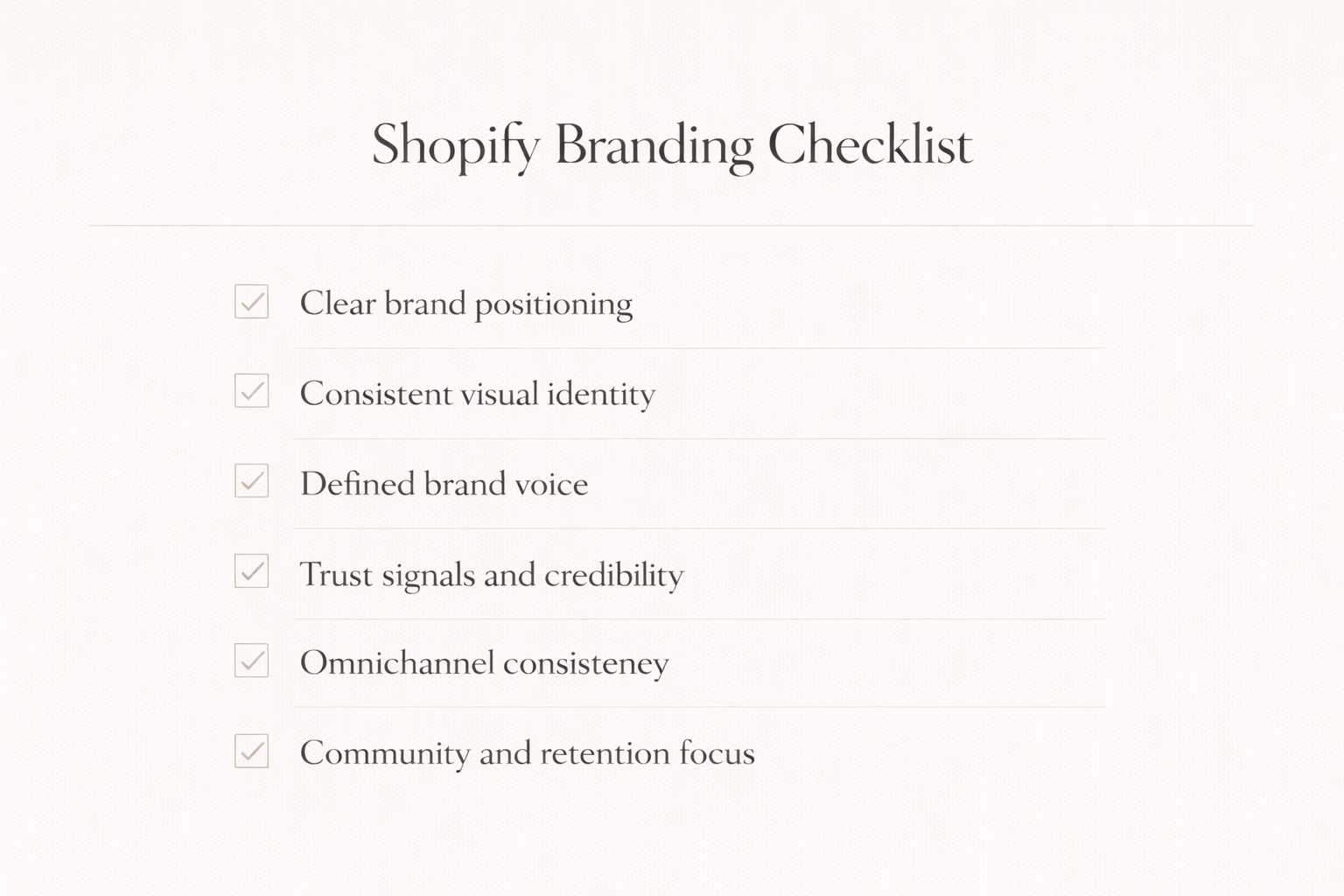
Shopify branding is more than aesthetics or marketing tactics. It’s the strategic foundation that determines how customers perceive value, make decisions, and develop loyalty.
The stores that thrive aren’t necessarily those with the best products. They’re the ones that build authentic brands with clear positioning, consistent identity, and emotional resonance.
Building effective branding for Shopify stores takes time and consistent execution. But the returns, in acquisition efficiency, conversion rates, pricing power, and lifetime value, make it one of the highest-leverage investments.
For merchants ready to move beyond commodity competition, developing a comprehensive Shopify brand strategy isn’t optional. It’s the foundation for long-term success.
For personalized guidance on building comprehensive brand strategy for your Shopify store, contact our team or visit our homepage to learn more about our services.
Frequently Asked Questions
Q. Why does Shopify branding matter more than products?
Shopify branding matters more than products because most ecommerce stores sell similar or identical items. When customers can find the same product in multiple places, branding becomes the deciding factor. Strong branding builds trust, creates emotional connection, and increases perceived value beyond features or price. Products can be copied quickly, but brand reputation, loyalty, and emotional attachment take time to build. In competitive Shopify markets, branding is what makes a store memorable and worth choosing over cheaper alternatives.
Q. How can branding for Shopify stores increase customer retention?
Branding for Shopify stores increases retention by building relationships rather than relying on one-time transactions. When customers connect with a brand’s values, tone, and experience, they are less likely to switch to competitors based on price alone. Consistent branding across the website, emails, and customer support builds trust over time. This trust makes repeat purchases feel safe and familiar, which increases customer lifetime value and long-term loyalty.
Q. What’s the difference between Shopify brand identity and branding?
Shopify brand identity refers to the visible elements of a brand, such as the logo, colors, fonts, and visual style. Shopify branding is broader and includes brand identity plus messaging, positioning, values, customer experience, and emotional perception. Brand identity is what customers see, while branding is how customers feel and what they associate with the store. Successful Shopify stores focus on creating consistent, meaningful experiences.
Q. How does Shopify branding improve conversion rates?
Shopify branding improves conversion rates by reducing hesitation and building trust. When a store looks professional, consistent, and clear about what it stands for, customers feel more confident completing a purchase. Strong branding also simplifies decision-making by clearly communicating who the product is for and why it matters. Emotional branding further motivates buyers by connecting products to identity and values, not just features or price.
Q. Can small Shopify stores compete on branding against larger competitors?
Small Shopify stores can compete with larger brands through focused and authentic branding. While big brands have larger budgets, smaller stores can target specific audiences, build genuine connections, and develop strong brand personalities. Clear positioning and consistent messaging help small brands stand out without competing on price. Customers often prefer brands that feel personal, relatable, and value-driven, which gives smaller Shopify stores a real advantage.
Q. How long does it take to build strong Shopify branding?
Building strong Shopify branding takes time and consistent effort. Initial setup, including positioning and visual identity, usually takes a few months. Meaningful brand awareness and trust typically develop over 6 to 18 months, depending on the level of competition and consistency. Branding grows through repeated positive experiences, not one-time campaigns. Each interaction strengthens brand recognition and loyalty, making branding a long-term investment rather than a quick fix.