
Walmart Automation vs Amazon FBA: Which Is Better in 2026?
The Walmart automation vs Amazon FBA decision comes down to one fundamental question: do you want to operate an ecommerce business yourself, or invest in one that professionals manage for you?
Most comparisons treat these as interchangeable options. They are not. Amazon FBA means you source products, manage inventory, run advertising, and handle compliance daily. Walmart automation means you partner with experienced operators who build and manage a store while you provide capital and receive monthly performance reports and distributions.
With Walmart’s ecommerce revenue growing 23% year-over-year in Q3 2024 and Amazon FBA fees increasing 5.2% in January 2025, understanding which model aligns with your capital, time availability, and business goals matters more than ever.
This guide examines both models with verified data, realistic profit expectations, and the operational differences that determine success or failure in each approach.
Quick Comparison: Walmart Automation vs Amazon FBA
| Factor | Walmart Automation | Amazon FBA |
| Initial Investment | $30,000–$150,000+ | $10,000–$50,000 |
| Monthly Fees | $500–$2,500 + 10–30% revenue share | $40 + storage & fulfillment fees |
| Control Level | Strategic oversight via the provider | Full operational control |
| Time Commitment | Low (2–5 hours weekly) | Medium to High (20–40 hours) |
| Sales Velocity | Growing (WFS expanding) | Faster (Prime shipping) |
| Profit Margins | 15–30% (after management fees) | 20–40% (if optimized) |
| Account Risk | Lower (professional compliance) | Higher (seller’s responsibility) |
| Transparency | Dashboard + monthly reports | Full Seller Central access |
| Scalability | Capital-based (portfolio model) | Time + capital investment |
| Platform Growth | +23% YoY (Walmart Q3 2024) | Mature, saturated categories |
| Best For | Investors, busy professionals | Active operators, brand builders |
What Is Walmart Automation?
Walmart automation is a professionally managed ecommerce model where you fund a Walmart Marketplace store and an experienced team handles all operations. You provide capital. They provide expertise, infrastructure, and daily management.
Here’s how the Walmart automation business model works:
- Professional teams conduct product research using market analysis and data tools
- Products are sourced through verified wholesale channels or established supplier networks
- Items are listed on Walmart Marketplace under your seller account with compliance monitoring
- Orders are fulfilled using Walmart Fulfillment Services (WFS) or approved fulfillment methods
- You receive monthly reports showing revenue, expenses, profit distributions, and account health metrics
What legitimate Walmart automation services include:
- Product research and profitability analysis across categories
- Listing creation and optimization for Walmart’s search algorithm
- Supplier relationship management and inventory coordination
- Order processing and customer service, maintaining performance standards
- Compliance monitoring, ensuring adherence to the Walmart Marketplace Seller Agreement
- Account health tracking, maintaining Order Defect Rate (ODR) below platform thresholds
Most Walmart dropshipping automation operations that rely solely on unauthorized retail arbitrage violate Walmart policies. Professional providers use wholesale sourcing or WFS to maintain compliance. Professional providers use wholesale sourcing or WFS to maintain compliance. Walmart’s seller requirements say that keeping up with the right performance metrics and approved sourcing methods is necessary for an account to stay active.
Walmart automation cost breakdown:
- Setup and infrastructure fees: $15,000–$50,000
- Working capital for inventory: $20,000–$100,000
- Monthly management: $500–$2,500 or 10–30% revenue share
- Total first-year investment: $30,000–$150,000+
The value proposition centers on time leverage for investors who prefer capital deployment over operational involvement. The challenge is identifying providers with genuine operational systems, transparent reporting, and proven compliance infrastructure.
Understanding what separates legitimate automation from non-compliant operations becomes essential due diligence before committing capital.
What Is Amazon FBA?
Amazon FBA (Fulfillment by Amazon) means you run the business, sourcing products, purchasing inventory, managing strategy, while Amazon handles warehousing, order fulfillment, shipping, and customer service.
How the Amazon FBA business model works:
- You identify products through research tools like Jungle Scout or Helium 10
- Inventory is sourced from manufacturers, wholesalers, or private label arrangements
- Products ship to Amazon fulfillment centers for storage
- When customers order, Amazon picks, packs, and ships with Prime or standard delivery
- You manage all operations through Amazon Seller Central
What you’re responsible for:
- Product research and profitability analysis before purchasing inventory
- Supplier negotiation, quality control, and order placement
- Inventory forecasting to prevent stockouts or excess storage fees
- Listing optimization and Amazon PPC (pay-per-click) advertising campaigns
- Account health monitoring, including ODR, late shipment rate, and policy compliance
- Customer communication and review management
Amazon FBA automation services exist where third parties claim to manage operations, but account ownership and ultimate liability remain with the registered seller, regardless of who handles tasks.
Unlike managed Walmart automation, where providers build institutional compliance systems, Amazon FBA requires you to develop that operational expertise directly. The advantage is complete control and full margin retention. The challenge is the time investment and learning curve.
Sellers pursuing the Amazon wholesale FBA model typically aim to build transferable business assets with clear exit valuations.
Walmart Automation vs Amazon FBA Selling: The Real Differences
The comparison between Walmart automation vs Amazon FBA selling fundamentally asks whether you want to operate a business or invest in one that professionals operate.
Who’s Really in Control?
Walmart automation:
- A professional management team makes daily operational decisions
- You maintain strategic oversight through performance dashboards and monthly reporting
- Provider handles supplier relationships, pricing optimization, and inventory management
- You focus on capital allocation and growth strategy rather than day-to-day operations
Amazon FBA:
- You make every decision about product selection, supplier choice, and pricing strategy
- Full visibility into every sale, fee, metric, and performance indicator in real-time
- Direct problem-solving capability when issues arise
- Complete business ownership with all strategic and operational control
How Fulfillment Actually Works
Walmart automation:
- Professional providers use Walmart Fulfillment Services (WFS) when applicable for faster delivery
- Wholesale inventory sourcing through established supplier networks
- Quality control processes managed by the operations team
- WFS provides 2-day shipping on eligible items, competing with Prime delivery standards
Amazon FBA:
- All inventory is stored in Amazon’s extensive fulfillment center network
- Prime shipping eligibility drives faster sales velocity and higher conversion rates
- Consistent delivery standards with Amazon’s logistics infrastructure
- Returns and refunds are processed automatically through Amazon’s systems
Platform Rules and Account Standards
Walmart Marketplace:
- Seller application requires business verification and performance history
- Walmart Marketplace Seller Agreement enforces strict compliance standards
- Lower seller count (approximately 150,000 active sellers vs Amazon’s 2+ million)
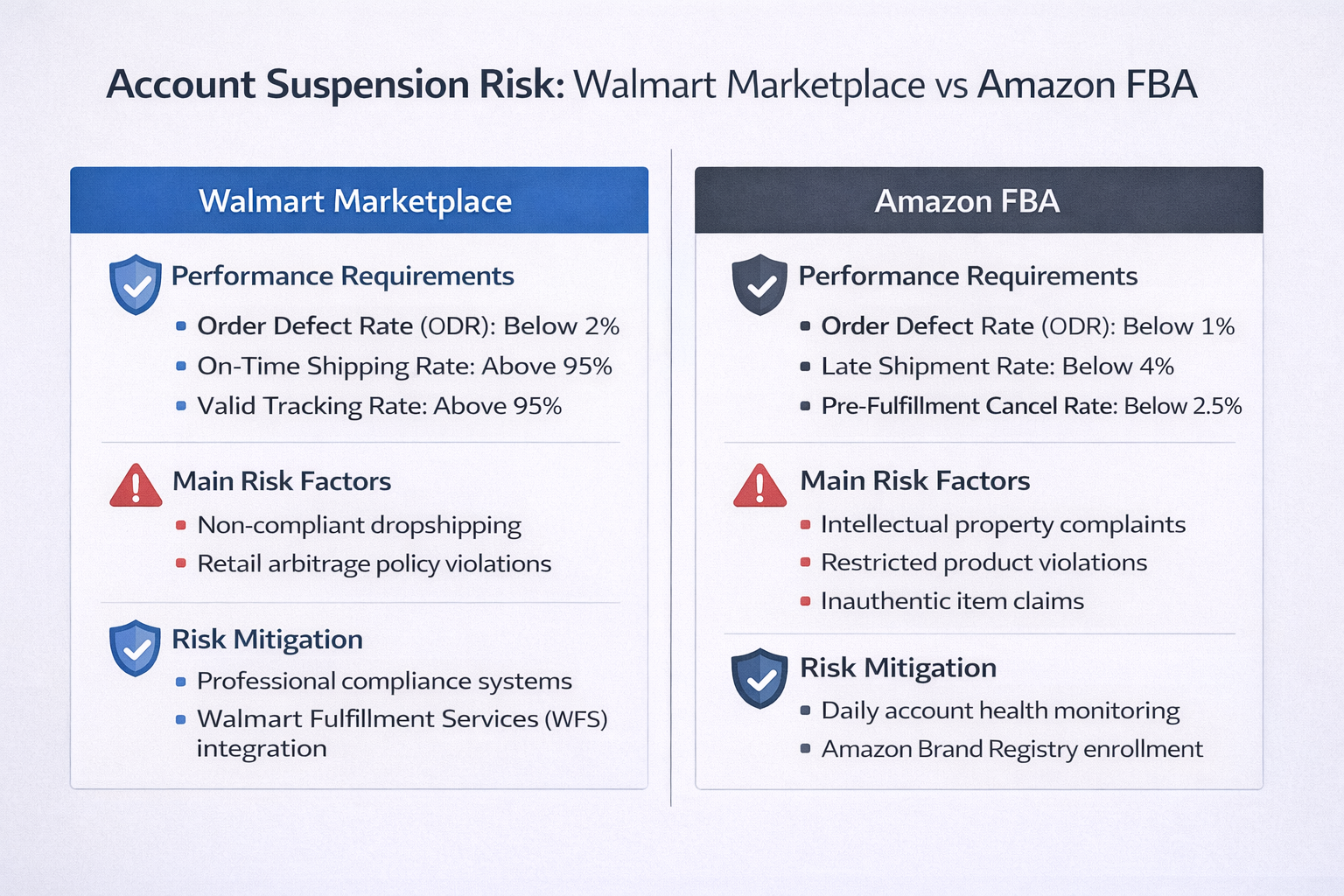
- Platform monitors account health metrics, including ODR, on-time shipping, and valid tracking rate
Amazon Seller Central:
- Open application process with basic business registration requirements
- High competition, but broader product category acceptance
- Strict performance thresholds: ODR below 1%, late shipment rate below 4%, pre-fulfillment cancel rate below 2.5%
- Automated enforcement systems monitor millions of transactions daily
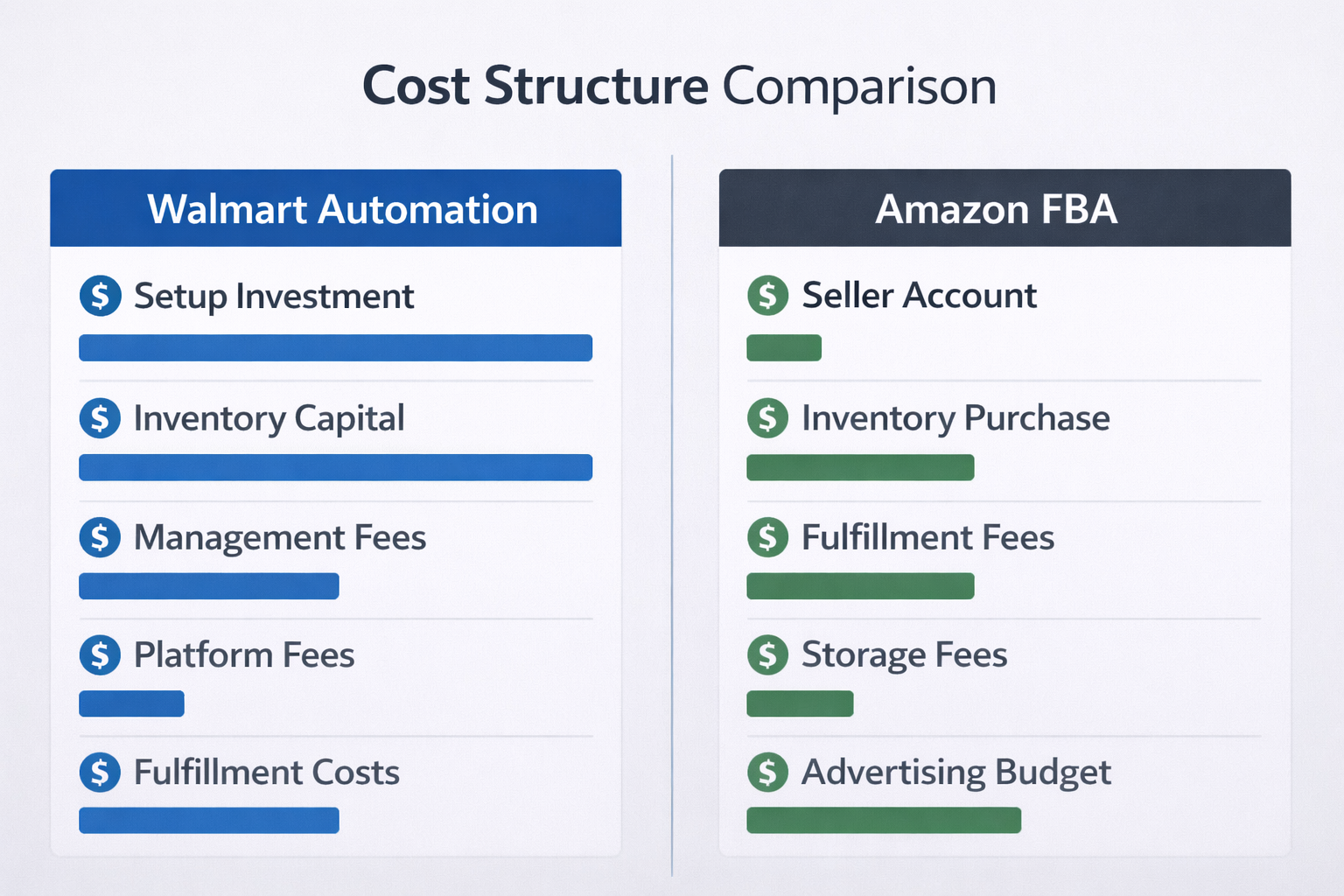
Cost Comparison: Walmart Automation Cost vs Amazon FBA
When you compare Walmart’s automation cost vs Amazon’s FBA, the numbers reflect fundamentally different business models and value propositions.
What Walmart Automation Actually Costs
Initial investment breakdown:
- Setup and infrastructure: $15,000–$50,000 (store build, compliance systems, research)
- Inventory working capital: $20,000–$100,000 (product category dependent)
- Monthly management fees: $500–$2,500 fixed OR 10–30% revenue share
Ongoing operational costs:
- Product sourcing through wholesale supplier networks
- Walmart referral fees: 8–15% per transaction (category dependent)
- Walmart Fulfillment Services fees when applicable: approximately $3.50–$7.50 per standard item
- Advertising spend for competitive visibility: typically 5–15% of revenue
- Management fees covering compliance monitoring, customer service, and optimization
Real first-year investment: $30,000 to $150,000+
That Walmart automation cost includes professional management infrastructure, established supplier relationships, compliance systems, maintaining account health metrics, and time saved from operational involvement. According to Shopify’s ecommerce research, successful sellers typically achieve 20–40% net margins after all costs, but this requires active learning and optimization.
What quality providers include: daily account health monitoring, maintaining ODR below 0.5% (Walmart’s threshold is 2%), supplier vetting, ensuring policy compliance, listing optimization, customer service protocols designed to prevent defects, and proactive policy monitoring for Walmart Marketplace updates.
What Amazon FBA Actually Costs
Starting investment:
- Amazon Professional Seller account: $39.99 monthly
- First inventory order: $2,000–$10,000 (product and quantity dependent)
- Shipping to Amazon fulfillment centers: $200–$1,000
- Product research and analytics tools: $50–$200 monthly (Jungle Scout, Helium 10)
Ongoing operational expenses:
- Amazon FBA fees (effective January 2025, after 5.2% increase):
- FBA fulfillment fees: $3.22–$8.61 per unit for standard-size items
- Monthly storage: $0.87–$2.40 per cubic foot (seasonal variations apply)
- Long-term storage surcharge: $6.90 per cubic foot for inventory stored 271+ days
- Amazon referral fees: 8–15% per sale (most categories 15%)
- Amazon PPC advertising: $500–$5,000+ monthly scaling with revenue and competition
- Inventory replenishment represents ongoing capital requirements
Real first-year investment: $10,000 to $50,000
The Amazon FBA profit margins depend entirely on product selection, supplier negotiation, advertising efficiency, and operational management. Successful sellers typically achieve 20–40% net margins after all costs, but this requires active learning and optimization.
Profitability: Walmart Automation vs Amazon FBA Profitability
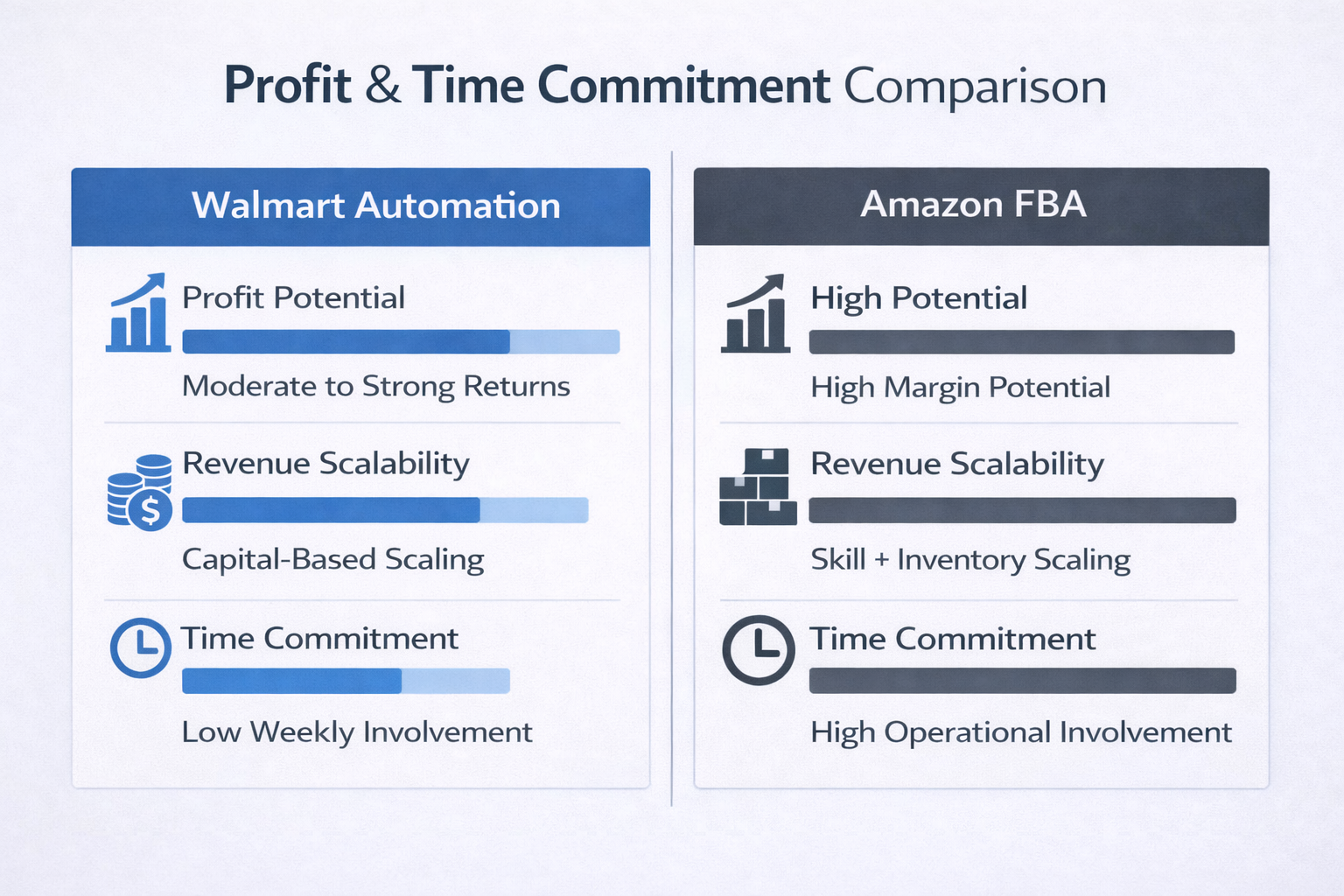
The Walmart automation vs Amazon FBA profitability comparison must account for both financial returns and time value to present an accurate investment analysis.
Walmart Automation Profit Reality
What drives profitability in professional operations:
- No learning curve inefficiencies, experienced teams deploy proven methodologies
- Established supplier networks provide competitive pricing through volume relationships
- Compliance systems reduce the risk of account suspension, which destroys invested capital
- Lower competition on the Walmart platform in many product categories compared to Amazon
Realistic profit expectations:
- Monthly revenue at maturity: $15,000–$40,000 (months 6–12)
- Management fees and costs: 40–60% of revenue (includes all operational expenses)
- Net monthly distribution to investor: $3,000–$10,000 (representing 15–30% annual ROI)
What affects net profitability:
- Management fees (10–30% of revenue) covering professional operations
- Platform referral fees (8–15%) and fulfillment costs
- Advertising expenses in competitive product categories
- Conservative growth strategies prioritizing account health over aggressive scaling
According to industry benchmarks from ecommerce automation providers, successful Walmart stores typically reach $180,000–$480,000 in annual revenue by year two, generating $27,000–$120,000 in net annual distributions after all fees.
The trends for Walmart automation vs Amazon FBA 2026 indicate Walmart’s growing infrastructure and professional provider maturation create viable opportunities for investors seeking passive ecommerce income.
Amazon FBA Profit Reality
What drives profitability for active sellers:
- Prime shipping infrastructure drives faster sales velocity and higher conversion
- Full margin retention without management fees reduces profits
- Direct supplier relationships enable aggressive price negotiation
- Complete control allows rapid testing and strategic pivoting based on real-time data
Realistic profit expectations:
- Monthly revenue: $20,000–$100,000 (highly variable by niche and execution quality)
- Amazon fees and costs: 50–70% of revenue (platform fees, advertising, product costs)
- Net monthly profit: $6,000–$30,000 (operator skill dependent)
What affects profitability:
- Learning curve costs, including failed product tests and inventory mistakes
- Amazon PPC costs ranging 15–40% of revenue in highly competitive categories
- Amazon FBA profit margins compressed by fee increases (5.2% increase in 2025)
- Time investment representing 800–1,600 hours annually in operational management
According to Jungle Scout’s 2024 Amazon Seller Survey, profitable FBA sellers average 20–35% net margins after all costs. Top performers (14% of sellers) exceed $250,000 annually, while 63% report revenues between $10,000–$100,000.
Risk Analysis: What Actually Gets Accounts Suspended
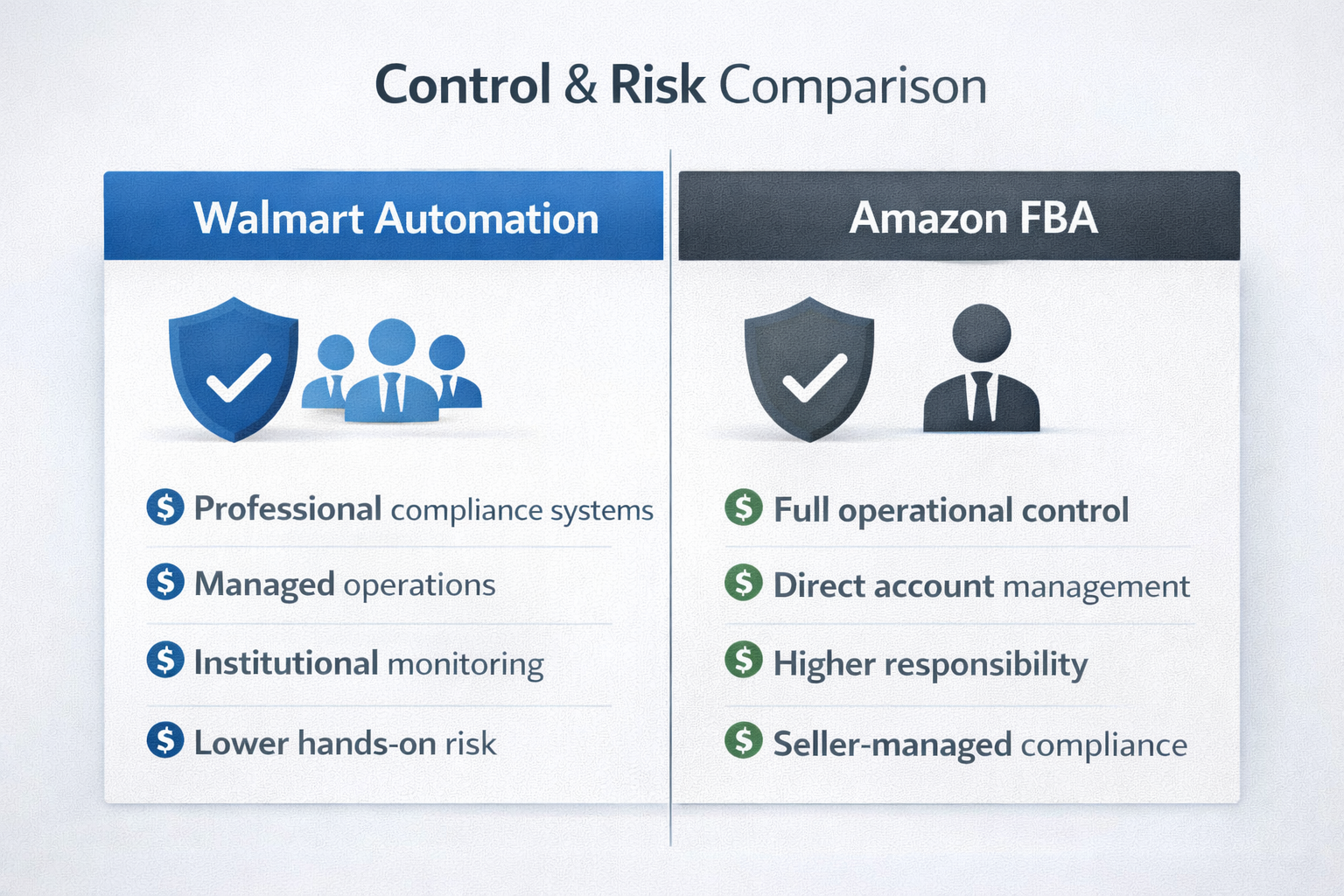
Account suspension eliminates invested capital in both models, but how compliance and how risk are mitigated differ fundamentally.
Walmart Automation Risk Management
How professional operations reduce Walmart automation risks:
- Daily automated account health monitoring through proprietary dashboards
- Multi-layer listing review processes before publication, ensuring policy compliance
- Established customer service protocols, ensuring response within 24 hours
- Proactive monitoring of Walmart Marketplace policy updates with immediate operational adjustments
Why institutional compliance systems work:
- Professional teams maintain current knowledge of Walmart Marketplace Seller Agreement requirements
- Supplier vetting processes ensure compliance with Walmart Prohibited Products Policy
- WFS integration eliminates unauthorized dropshipping violations that trigger immediate suspension
- Account health metrics maintained well below warning thresholds (ODR <0.5% vs Walmart’s 2% limit, on-time shipping >98% vs 95% requirement)
Walmart Marketplace performance standards:
- Order Defect Rate: below 2%
- On-time shipping rate: above 95%
- Valid tracking rate: above 95%
- Cancellation rate: below 2.5%
Quality automation providers typically maintain metrics significantly better than minimum requirements to prevent any risk of account review or suspension.
Warning signs of high-risk providers:
- Reliance on retail arbitrage sourcing from unauthorized retailers (violates Walmart terms)
- Lack of transparency into supplier sources or product acquisition methods
- Unrealistic income guarantees regardless of market conditions
- No documented compliance monitoring systems or account health tracking protocols
The real issue with automation store failure risks is provider quality. Professional operations with institutional compliance systems significantly reduce suspension risk compared to non-compliant dropshipping operations.
Amazon FBA Account Suspension Risks
Common suspension triggers based on Seller Central data:
- Policy violations, including restricted products sold without approval or inauthentic item claims
- Performance metrics falling below thresholds (ODR >1%, late shipment rate >4%, pre-fulfillment cancel rate >2.5%)
- Intellectual property complaints from rights holders
- Amazon FBA account suspension from automated enforcement systems with limited appeal windows
Why is the suspension frequency higher for individual sellers?
- High transaction volume increases the statistical probability of defects reaching threshold percentages.
- Competitor tactics, including false intellectual property claims or review manipulation
- Amazon’s automated enforcement suspends accounts immediately, requiring proof of corrective action for reinstatement.
- Policy changes occur frequently, and sellers bear responsibility for maintaining compliance even when notifications are missed.
Suspension frequency data:
According to ecommerce consulting firms specializing in Amazon reinstatement, approximately 12–18% of FBA sellers experience at least one account suspension during their first three years. Of those, roughly 60% achieve reinstatement, while 40% result in permanent account termination.
Most common suspension causes:
- Inauthentic item claims: 34%
- Order Defect Rate violations: 28%
- Restricted product violations: 18%
- Intellectual property complaints: 12%
- Other policy violations: 8%
Effective risk mitigation for DIY sellers:
- Daily account health dashboard monitoring in Seller Central
- Immediate response to customer complaints and A-to-Z Guarantee claims
- Brand Registry enrollment for intellectual property protection
- Conservative product selection, avoiding restricted categories
- Compliance calendar tracking policy updates and required certifications
The fundamental difference: professional Walmart automation distributes institutional knowledge across client operations through established systems. Amazon FBA sellers must develop that expertise individually through education, experience, and often expensive mistakes.
Which Model Actually Fits You?
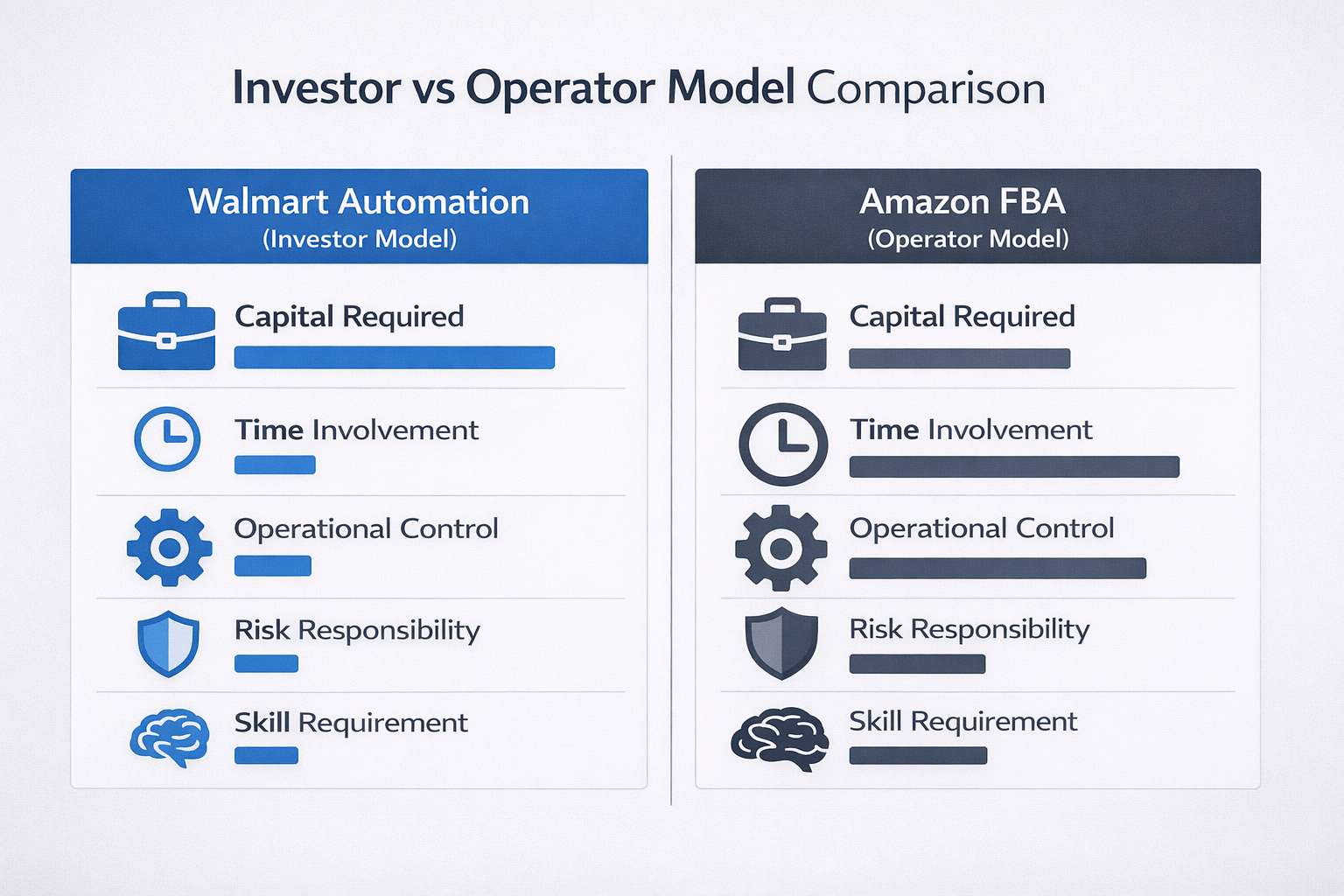
Choosing between Walmart automation and Amazon FBA requires an honest assessment of capital availability, time capacity, operational interest, and risk tolerance.
When Walmart Automation Makes Sense
Your profile matches investor characteristics:
- Capital available: $50,000+ for ecommerce investment
- Time availability: Limited (under 10 hours weekly) or better deployed in other high-value activities
- Operational interest: Prefer strategic oversight over daily management
- Primary goal: Portfolio-style passive income from ecommerce without operational burden
You can properly vet providers:
- Ability to thoroughly evaluate automation companies, including reference checks with current clients
- Understanding of how to assess operational systems and compliance infrastructure
- Willingness to demand transparency, including dashboard access and regular performance reporting
- Legal and financial resources to review service agreements and protect interests
You value institutional risk management:
- Professional compliance systems maintain account health well below platform thresholds
- Established supplier relationships providing competitive pricing and product quality
- Experienced teams navigating platform policy changes and operational challenges
- Time leverage allows focus on other business or professional activities
You can identify legitimate providers:
- Track record with verifiable client references and documented store performance
- Transparent operations, including supplier sources and fulfillment methods
- Clear communication protocols and responsive support systems
- Partnership with established Walmart automation providers demonstrating operational maturity
When Amazon FBA Makes Sense
Your profile matches operator characteristics:
- Capital available: $10,000–$30,000 for initial inventory and tools
- Time availability: 20–40 hours weekly for business operations
- Operational interest: Willing to learn product research, supplier negotiation, and advertising optimization
- Primary goal: Build a transferable business asset with growth potential and an exit opportunity
You commit to skills development:
- Investment in education through courses, mentorship, or systematic self-study
- Willingness to test products and accept early failures as learning opportunities
- Interest in developing expertise in ecommerce operations and platform optimization
- Long-term perspective, accepting a 6–18 month learning curve before consistent profitability
You want maximum control and margin retention:
- Direct relationships with suppliers enable better pricing and product customization
- Full authority over product selection, pricing strategy, and inventory decisions
- Ability to rapidly pivot based on market feedback and performance data
- 100% margin retention without management fees, reducing net profit
You are building toward eventual exit:
- FBA businesses have established valuation multiples (typically 2.5–4x annual net profit)
- Clean financial records and systematized operations increase transferability
- Potential to scale the operation into a seven-figure revenue with a corresponding enterprise value
- Asset ownership provides options for future sale or passive holding
The decision framework centers on time value relative to capital availability. If your time generates more than the management fees you would pay (typically 10–30% of revenue), operating yourself makes financial sense. If your time is better deployed elsewhere and you have sufficient capital ($50,000+), professional management provides better total returns.
Common Mistakes That Destroy Capital
Understanding failure patterns prevents expensive lessons in both models.
Walmart Automation Mistakes
Selecting providers based on marketing rather than verified systems:
- Believing income projections without verifying methodology or track record
- Signing contracts without thoroughly reviewing terms, fees, and exit provisions
- Skipping reference checks with current clients experiencing actual results
- Not understanding what compliance systems actually exist versus what gets claimed in sales materials
Insufficient capital reserves:
- Funding only setup costs without adequate working capital for inventory and operations
- Expecting immediate profitability when a realistic timeline is 6–12 months to maturity
- No reserve capital for market fluctuations, slow periods, or unexpected expenses
- Undercapitalization is forcing premature liquidation before the store reaches profitability
Inadequate oversight despite a passive model:
- Assuming passive income means zero involvement or monitoring
- Not reviewing monthly performance reports critically for operational red flags
- Failing to maintain independent communication with Walmart Marketplace support
- Not verifying supplier compliance and account health independently
Contractual issues and misaligned incentives:
- Management fees tied to revenue rather than profit (incentivizing sales volume over profitability)
- No clear exit strategy or transition terms if the relationship ends
- Restrictions preventing eventual transition to self-management
- No performance guarantees or accountability provisions for provider-caused suspensions
Amazon FBA Mistakes
Product selection without proper research:
- Entering oversaturated categories (supplements, phone accessories, generic electronics) without differentiation
- Failing to calculate all Amazon fees accurately before purchasing inventory
- Choosing products with high return rates, fragility issues, or regulatory restrictions
- Ignoring seasonality results in dead inventory carrying long-term storage fees
Inventory management failures:
- Stockouts during peak demand periods are losing Buy Box eligibility and sales velocity
- Over-ordering based on optimistic projections, leading to excess storage fees ($6.90 per cubic foot after 271 days)
- Poor forecasting creates cash flow problems from capital tied up in slow-moving inventory
- Not accounting for Amazon’s storage fee increases and inventory performance index (IPI) requirements
Advertising and optimization neglect:
- Expecting organic sales without investment in Amazon PPC campaigns
- Poor listing quality, including weak titles, bullet points, and product descriptions lacking relevant keywords
- Not testing price points or running promotions to improve conversion rates
- Ignoring backend search terms and A+ Content optimization opportunities
Compliance and account health ignorance:
- Not reading Amazon policy update emails leads to unintentional violations
- Ignoring performance notifications until metrics cross suspension thresholds
- Slow response to customer complaints, allowing them to escalate into A-to-Z claims
- Selling restricted products without obtaining required approvals or certifications
Both models punish mistakes severely, but the nature of accountability differs. With DIY FBA, you see problems developing through metrics and can course-correct. With automation, you depend on provider systems to prevent issues, making provider quality the critical variable.
Long-Term Scalability: Walmart vs Amazon for Long-Term Business
Building sustainable ecommerce income requires understanding how each model scales beyond initial success.
Walmart Automation Scaling Reality
How professional automation scales:
- Adding additional stores across different product categories to diversify revenue streams
- Geographic expansion as Walmart Marketplace continues international development
- Platform diversification (managed Walmart + managed Amazon operations), spreading platform risk
- Capital deployment across multiple providers, reducing single-provider dependency
What enables portfolio growth:
- Provider infrastructure handles operational complexity without requiring an increase in investor time increase
- Capital-based scaling model (returns compound through reinvestment in additional stores)
- Risk distribution across multiple revenue streams reduces the impact of a single store underperformance
- A passive structure allows parallel business activities or professional career continuation
Realistic scaling trajectory:
- Year 1: Single store establishment ($50,000–$150,000 invested, $2,500–$10,000 monthly distributions)
- Year 2: Add second store or product category ($100,000–$300,000 total invested, $5,000–$25,000 monthly)
- Year 3+: Portfolio of 2–4 stores across categories/providers ($200,000–$600,000 invested, $10,000–$50,000 monthly)
Scaling limitations:
- Dependent on the provider’s operational capacity and willingness to accept new stores
- Platform growth rate limits opportunity (Walmart’s e-commerce is growing 23% annually, but it is still smaller than Amazon’s)
- Returns influenced by management fee structure (10–30% perpetual reduction in gross margins)
- Finding multiple quality operators with proven track records requires thorough vetting
Amazon FBA Scaling Reality
How DIY operations scale:
- Expanding product catalog within successful categories (1–2 SKUs to 10–20 SKUs)
- Private label brand development, creating margin improvement, and customer loyalty
- International expansion through Pan-European FBA or North America Unified Account programs
- Building an operational team (virtual assistants, prep centers, advertising specialists) to remove time constraints
What enables operational growth:
- Complete control allows rapid testing and strategic pivots based on real-time data
- Direct supplier relationships improve with volume, enhancing margins at scale
- Brand building creates defensible competitive advantages and a repeat customer base
- Skills transferable to additional ecommerce channels (Shopify, owned websites, other marketplaces)
Realistic scaling trajectory:
- Year 1: 1–3 products tested, 1 achieving consistent sales ($15,000–$50,000 invested, $3,000–$8,000 monthly profit)
- Year 2: Expand to 5–10 products, optimize advertising ($30,000–$100,000 invested, $8,000–$25,000 monthly profit)
- Year 3+: 15–30 SKU catalogue, private label brand, potential team ($75,000–$250,000 invested, $20,000–$60,000+ monthly profit)
Scale indicators (Jungle Scout seller survey):
- FBA businesses beyond year three: typically $500,000–$2,000,000 annual revenue
- Net profit margins: 22–28% for successful operators
- Enterprise value at exit: 2.5–4.0x annual net profit
Scaling limitations:
- Time-intensive, even with hired support (still requires strategic oversight and decision-making)
- Competition intensifies in proven successful categories
- Amazon fee increases and advertising cost inflation reduce margins over time (5.2% fee increase in 2025)
- Account suspension risk increases with transaction volume and SKU count
The scaling models reflect different constraints. Walmart automation scales through capital deployment across multiple passive income streams. Amazon FBA scales through operational expertise, brand development, and eventually team building to remove time constraints.
What’s Changing in 2026?
Both platforms continue evolving, and these changes directly impact which model offers better long-term viability.
Walmart Marketplace Changes
Platform development indicators:
- Walmart ecommerce revenue grew 23% year-over-year in Q3 2024 (source: Walmart earnings report)
- Walmart Fulfillment Services (WFS) is expanding to 42 fulfillment centers nationwide as of late 2024
- Marketplace seller count growing, but still significantly smaller than Amazon (estimated 150,000 active Walmart sellers vs 2+ million Amazon sellers)
- Walmart+ membership program reaching 32 million subscribers (source: Consumer Intelligence Research Partners, 2024)
Regulatory and policy changes:
- Enhanced verification requirements for new sellers (business documentation, tax verification)
- Stricter enforcement of the Prohibited Products Policy, separating compliant operations from dropshipping violations
- Increased performance standards favoring established operators with proven compliance systems
What Walmart automation vs Amazon FBA 2026 trends indicate:
- Professional automation becomes more viable as platform infrastructure matures
- Compliance requirements increase, benefiting providers with institutional systems over non-compliant operations
- Competition remains lower than Amazon, but is growing steadily with platform investment
- Quality providers differentiate through transparency, proven results, and established compliance track records
Amazon FBA Changes
Platform changes affecting sellers:
- FBA fee increase of 5.2% effective January 2025 (source: Amazon Seller Central announcements)
- Storage fees are rising annually, particularly for slow-moving inventory
- Enhanced brand protection tools, but stricter enforcement of intellectual property policies
- Increased emphasis on seller performance metrics and customer experience standards
Market saturation indicators:
- Over 60% of Amazon sales now from third-party sellers (source: Marketplace Pulse, 2024)
- Top 1% of sellers capture approximately 40% of total seller revenue
- Amazon PPC costs are increasing 12–18% year-over-year in competitive categories
- Private label differentiation is becoming essential for sustainable margins
2026 outlook:
- FBA remains dominant but rewards sophisticated sellers with strong operational fundamentals
- Competition continues to intensify in profitable categories
- Professional management and automation services are emerging for scaling operators
- Success is increasingly tied to brand building rather than simple product arbitrage
Both models require adaptation to evolving platforms. Walmart automation benefits from platform growth and professional provider maturation. Amazon FBA demands higher operational sophistication to maintain profitability in competitive markets.
Final Verdict: Operator or Investor?
The Walmart automation vs Amazon FBA decision ultimately depends on how you define success and what resources you bring to the opportunity.
Choose professional Walmart automation when:
- You have $50,000+ capital available for ecommerce investment
- Your time is limited (under 10 hours weekly) or generates higher value in other activities
- You prefer strategic oversight over daily operations
- You can conduct thorough provider due diligence and verify operational systems
- Your goal is to build a passive income portfolio through capital deployment
Choose DIY Amazon FBA when:
- You have $10,000–$30,000 starting capital and can reinvest profits
- You have 20–40 hours weekly available for business operations
- You want to develop ecommerce expertise and maintain full operational control
- You are building a transferable asset with an exit strategy in mind
- Your goal is to maximize profit margins through direct business management
The honest assessment both models require:
Professional Walmart automation works when structured correctly with legitimate providers who maintain transparent operations, established compliance systems, and verifiable track records. It fails when investors skip due diligence, choose providers based on marketing claims rather than verified systems, or expect guaranteed returns without strategic oversight.
DIY Amazon FBA works when operators commit to learning product research, supplier management, and platform optimization over 12–24 months. It fails when sellers expect immediate profits, undercapitalize inventory needs, or neglect account health management.
Success in either model demands:
- Realistic expectations about timelines and returns
- Proper capitalization, including reserve funds for challenges
- Continuous education about platform changes and market evolution
- Strategic thinking about risk management and scalability
Whether you are exploring professional Walmart automation services or building your own FBA operation, start with education, demand transparency from all service providers, and structure your approach to match your actual capital, time availability, and business goals.
The platform matters less than the alignment between your resources and the model’s requirements. Choose based on an honest self-assessment of whether you want to operate or invest, not which model sounds more appealing in marketing materials.
For additional guidance on provider evaluation and ecommerce automation legitimacy, explore our complete guide on what makes automation services legitimate, or contact our team for consultation on which model fits your situation.
FAQ: Walmart Automation vs Amazon FBA
Q. Which is better, Walmart automation or Amazon FBA?
Neither model is universally superior; the right choice depends on your capital, time availability, and business goals. Amazon FBA is better for individuals who want to operate a business directly, develop ecommerce skills, and maximize profit margins (20–40%). Professional Walmart automation is better for investors with $50,000+ capital seeking managed ecommerce income (15–30% returns) without daily operations. FBA offers higher control and profit potential but requires 20–40 hours weekly. Quality automation provides time leverage through professional management but demands thorough provider vetting and higher upfront capital.
Q. Is Walmart automation better than Amazon FBA for beginners?
It depends on the beginner’s capital position and time availability. If you have limited capital ($10,000–$25,000) and want to learn ecommerce operations, Amazon FBA provides extensive educational resources and lower barriers to entry. If you have significant capital ($50,000+) but limited time (under 10 hours weekly), professional Walmart automation makes sense after conducting thorough provider due diligence. Neither model guarantees easy money; automation still requires provider evaluation and oversight, while FBA demands operational learning. Understanding ecommerce fundamentals helps in both paths, either for managing your own business or evaluating automation providers effectively.
Q. What are the main Walmart automation risks?
The primary risk is partnering with providers who use non-compliant fulfillment methods (unauthorized dropshipping, retail arbitrage violations). Account suspension from provider errors represents the worst-case scenario, where you lose invested capital. Mitigation requires demanding transparency about supplier sources, verifying WFS integration when appropriate, maintaining independent account health oversight, and ensuring contracts include clear accountability provisions. Quality providers distinguish themselves through documented compliance systems, transparent reporting, established supplier networks, and track records with verifiable client references. The risk level depends entirely on provider quality; professional operations with institutional compliance significantly reduce suspension probability compared to non-compliant operations.
Q. How do Amazon FBA profit margins compare to Walmart automation?
Amazon FBA profit margins for competent operators typically range 20–40% of revenue after all fees, advertising, and product costs. Professional Walmart automation delivers 15–30% net returns to investors after management fees. However, direct comparison is misleading because time investment differs drastically. FBA margins are higher but require 20–40 hours weekly operational time. Automation margins are lower but need only 2–5 hours of monthly oversight. The relevant question is total return on invested capital plus time value, which depends on what your time is worth in alternative uses. For busy professionals earning $100+ per hour, automation’s lower margins may produce better total economic returns when time value is factored.
Q. What is the Walmart automation cost compared to Amazon FBA startup costs?
Professional Walmart automation requires $30,000–$150,000 total first-year investment (setup fees $15,000–$50,000 plus working capital $20,000–$100,000). Amazon FBA requires $10,000–$50,000 to start (seller account, inventory, tools, shipping). The cost differential reflects different value propositions: automation includes professional management infrastructure, compliance systems, established supplier networks, and eliminates operational time requirements. FBA requires lower capital but demands substantial time investment to build operational expertise. For capital-constrained individuals, FBA enables earlier market entry. For time-constrained investors, automation’s higher cost is offset by preserved time value and professional risk management.
Q. Can sellers transition from Walmart automation to self-managed stores?
Transitioning from automated to self-managed operations is possible but depends on contractual terms and provider cooperation. Many automation contracts restrict access to supplier relationships, product data, or operational systems. Some providers offer transition programs or buyout options, while others maintain complete control over infrastructure. Best practice: negotiate transition rights before signing initial agreements, maintain enough operational involvement to understand business fundamentals, request regular supplier and process documentation, and ensure contracts allow for eventual independence. Investors considering eventual self-management should select providers that transparently support that pathway and provide operational education, rather than those that require perpetual dependence on their systems.


One Comment