
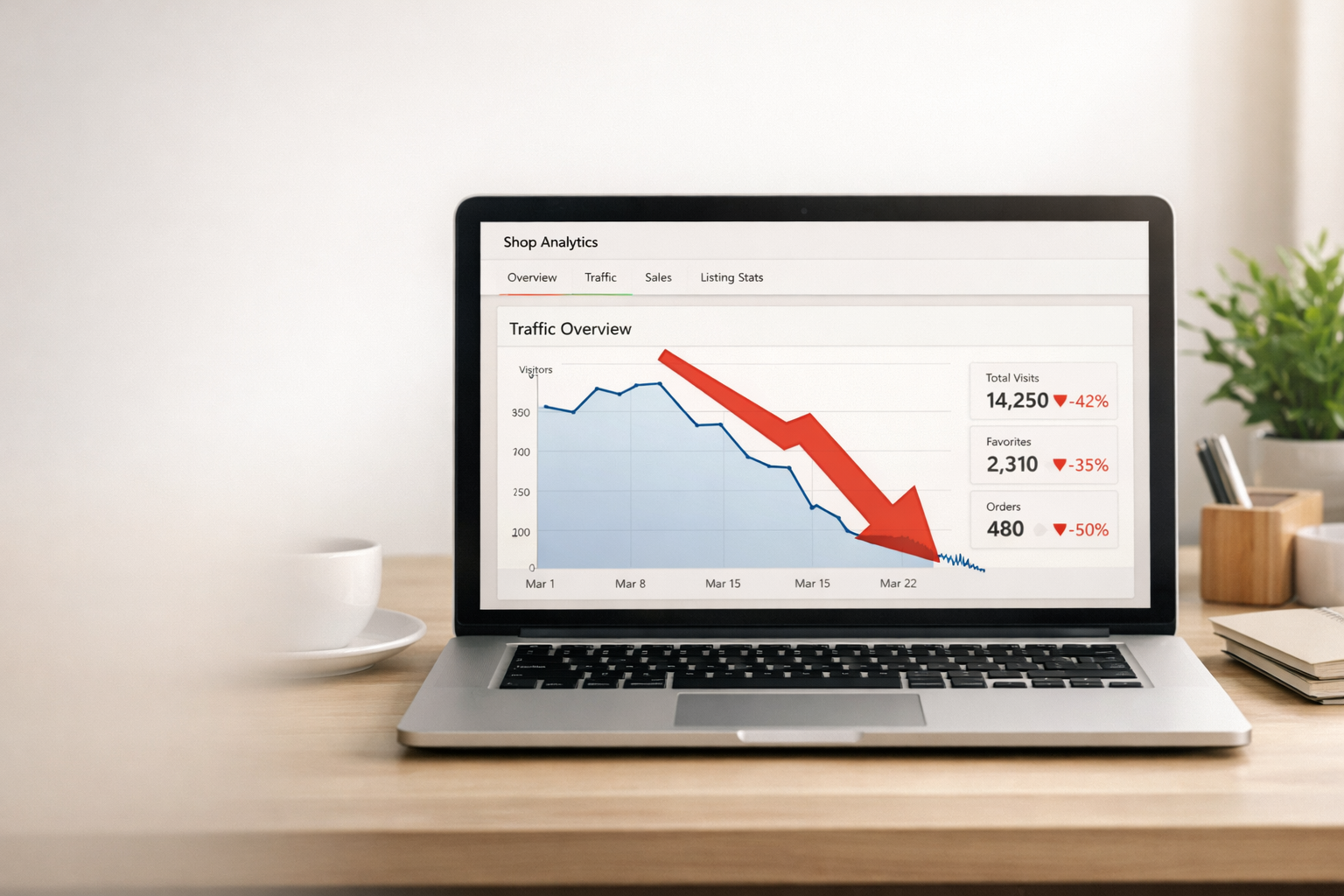
Why Etsy Traffic Drops Suddenly: 2026 Recovery Guide for Sellers
There’s a moment every Etsy seller knows. You open your dashboard expecting a normal morning, and the numbers are just… wrong. Traffic down 60%. Sales flatlined. Listings that were pulling in dozens of visits a day are now sitting completely dead.
The first thought is usually a penalty. The second is panic. The real question, though, the one that actually matters, is why Etsy traffic drops suddenly, and what can actually be done about it.
Here’s what most sellers get wrong: Etsy isn’t punishing you. The platform runs on performance signals, not grudges. When traffic falls, it almost always traces back to something measurable: a click-through rate that slipped, a conversion rate that tanked, or competitors who quietly got stronger while your listings stayed the same. Understanding that difference changes everything about how you respond. Start with the right framework, and recovery becomes systematic rather than stressful.
Why Does Etsy Traffic Drops Suddenly?
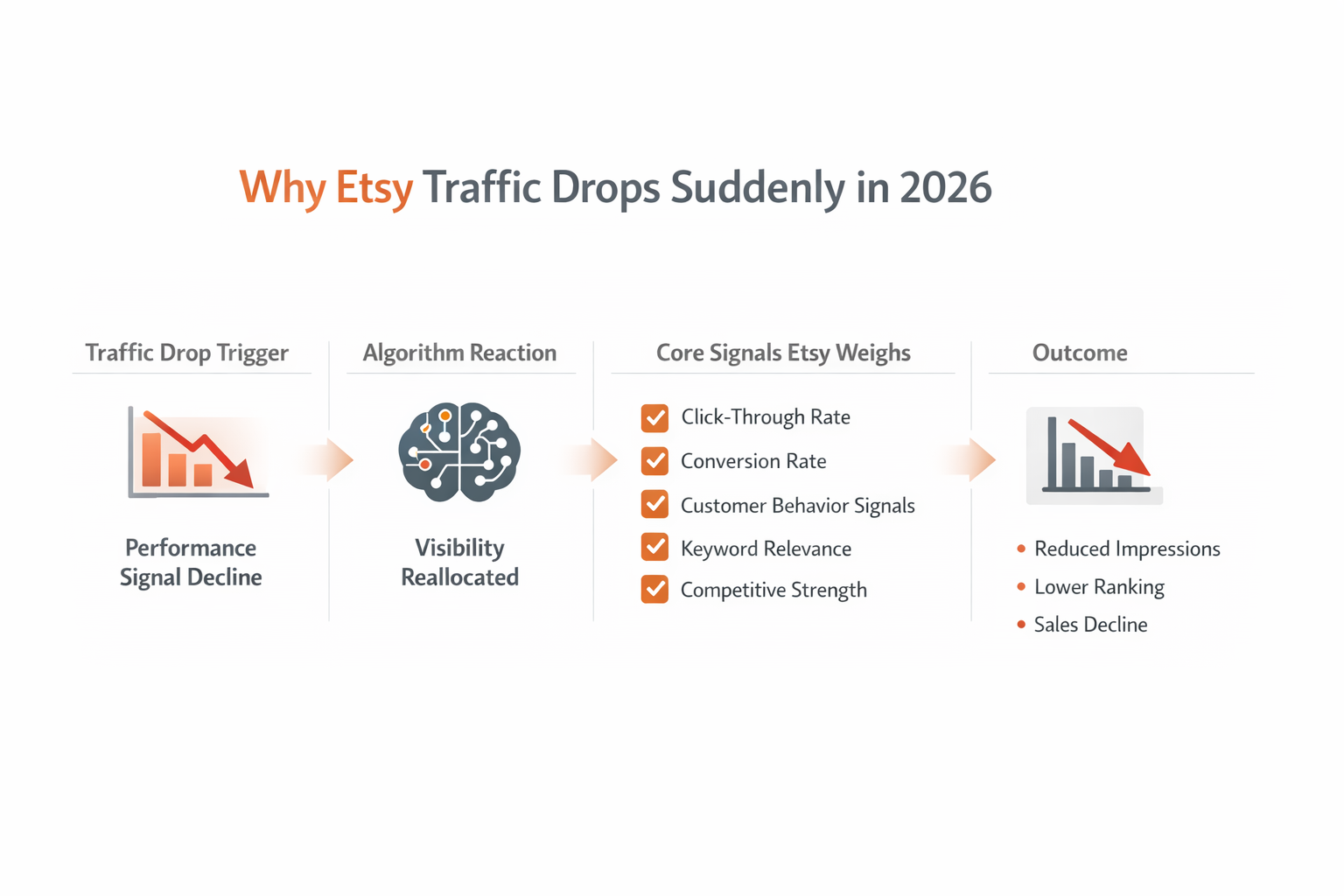
Etsy traffic drops suddenly when performance signals weaken relative to competitors. The most common triggers are a
falling click-through rate, declining conversion rate, weaker keyword relevance, negative review or fulfillment
signals, or stronger competitors. Most visibility changes are performance-based, not penalties.
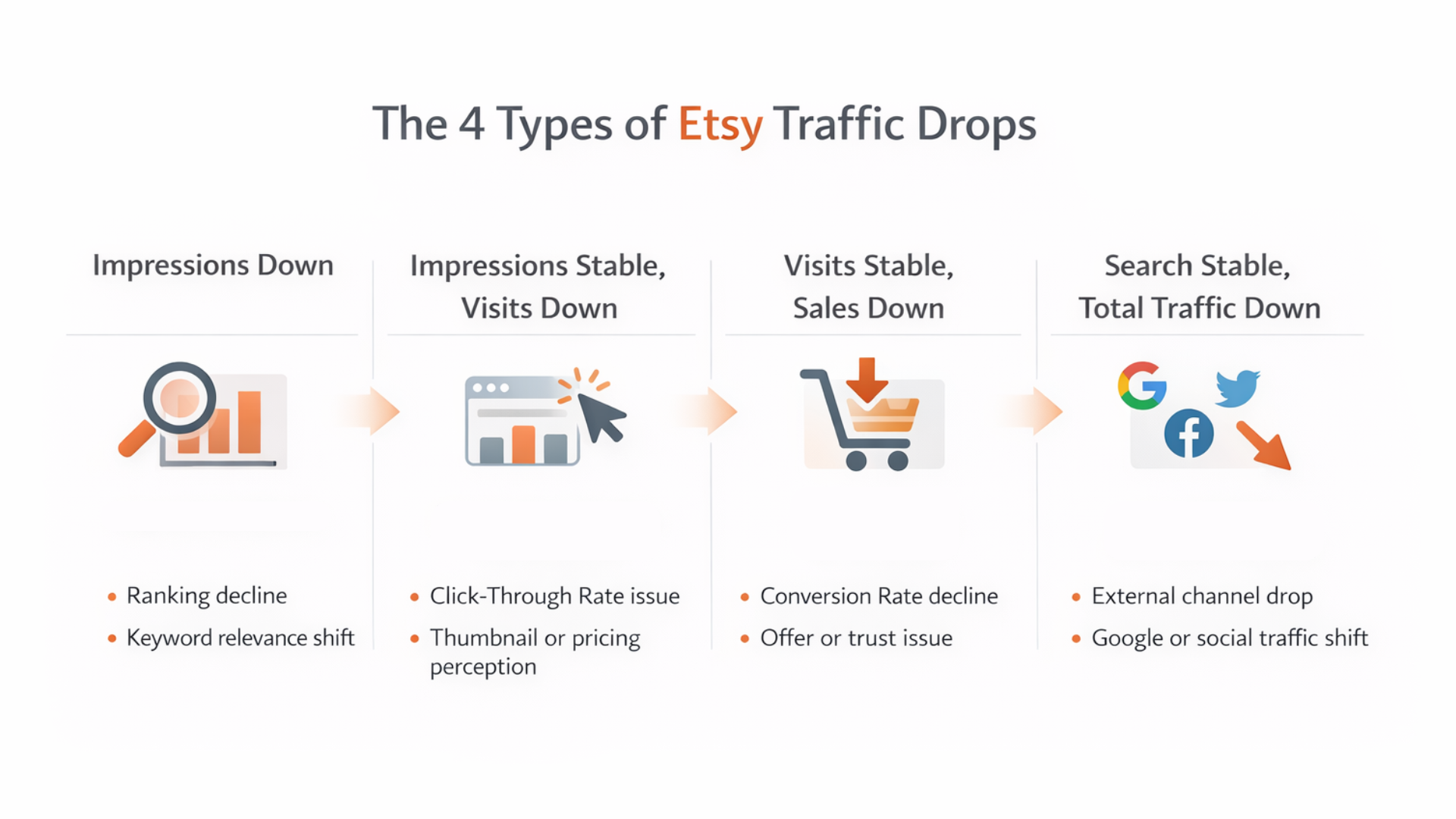
Quick Diagnosis: Find Your Drop Pattern in 60 Seconds
Impressions dropped? → Rankings fell, or visibility was pulled
Impressions stable, but visits dropped? → Click-through rate problem
Visits are stable, but sales dropped? → Conversion barrier somewhere
Etsy search looks fine, but total traffic dropped? → External channel collapsed
Etsy Search Landscape in 2026
Etsy’s search stopped being a simple keyword match a long time ago. The Etsy Search Algorithm now personalizes results based on individual shopper behavior, browsing history, past purchases, and time spent looking at certain styles. Two people searching for the exact same phrase will see different results because of it.
The Etsy algorithm update 2026 pushed even harder toward conversion-weighted ranking. Raw impressions don’t mean much anymore. What matters is whether people actually buy. Etsy increasingly prioritizes listings aligned with active buyer intent rather than just broad keyword presence, so a listing with 100 views and 8 sales consistently outranks one pulling 800 views but converting only 3.
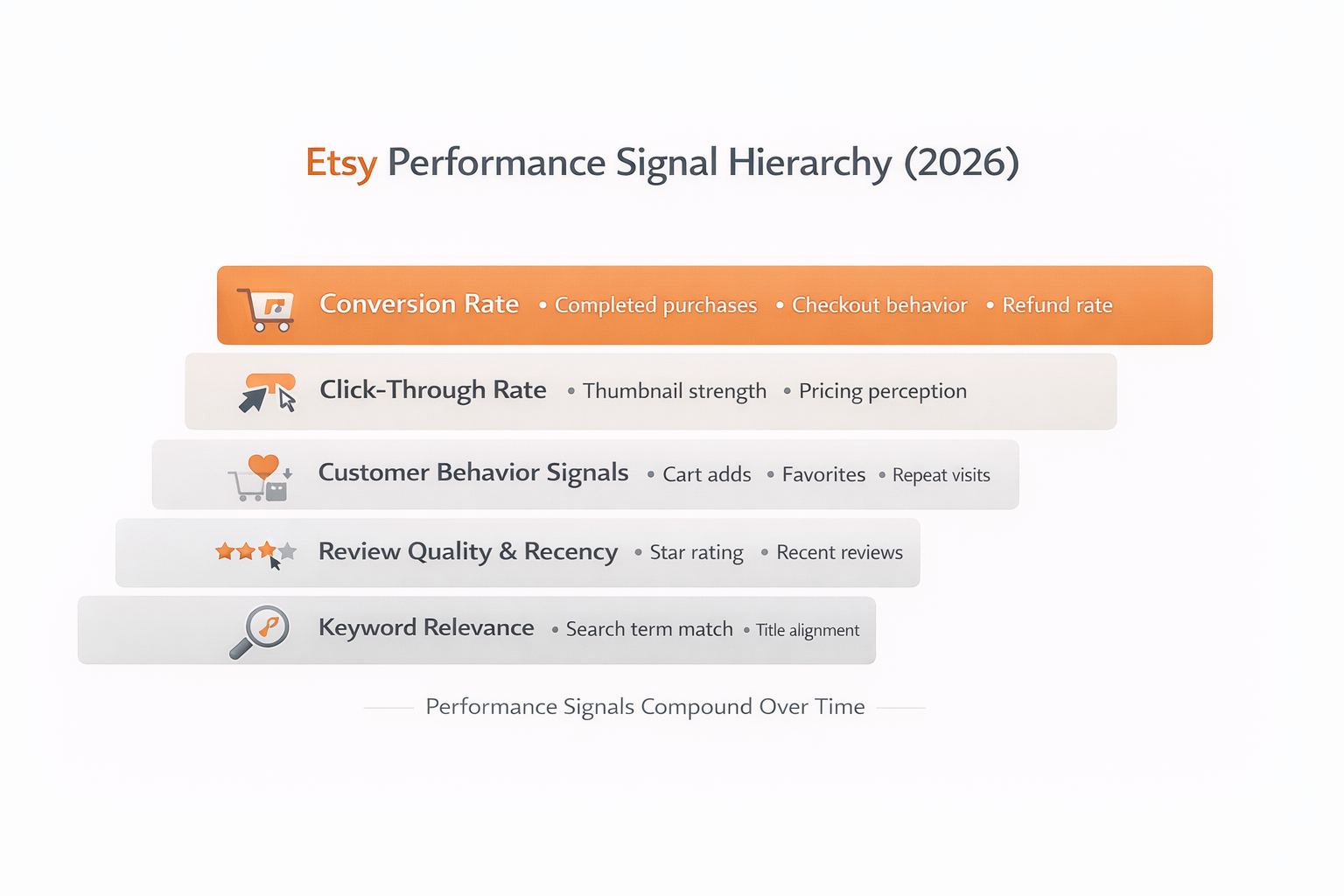
The Listing Quality Score reflects this shift directly. Customer Behaviour Signals, clicks, cart adds, completed purchases, and recent reviews carry far more weight than keyword density alone. According to Etsy’s official guide on how search works, shops that consistently meet customer service standards, strong review ratings, fast message response rates, and low case rates are prioritized in search results. Meanwhile, Marketplace Competition has gotten noticeably tighter. Categories that had breathing room in 2023 are now packed with sellers fighting for the same spots.
Google Core Updates added another layer of complexity, particularly for shops that relied on Offsite Ads. Some external traffic sources dropped significantly when Google shifted how it handles commercial content. The core principle, though, hasn’t changed: Etsy rewards listings that actually convert browsers into buyers.
The Performance Signals Etsy Actually Weighs
Before diagnosing a drop, it helps to know exactly what Etsy is measuring:
- Click-Through Rate (CTR) – Are shoppers clicking your listing when they see it?
- Conversion Rate – Are visitors actually buying?
- Review Quality + Recency – How recent and positive are your reviews?
- Shipping Speed – How fast do you fulfill?
- Keyword Relevance – Do your titles match what buyers are actually typing?
- Customer Behavior Signals – Saves, cart adds, repeat visits, purchases
- Competitive Category Strength – How strong are the listings ranking above you?
These signals compound. One weak area can drag down visibility even when everything else looks healthy.
What a Traffic Drop Actually Means
Not every traffic drop means the same thing, and treating them all the same is how sellers waste weeks optimizing the wrong thing. The Seller Dashboard Analytics will tell you a lot if you know how to read it.
The Four Drop Patterns
Pattern 1: Impressions Dropped
Etsy impressions represent how often your listings show up in results before anyone even clicks. When impressions fall across multiple listings at once, it usually means a ranking drop, either from competitive displacement or declining Keyword Relevance. A drop in Etsy search ranking like this typically follows a period of lower CTR or conversion performance relative to competitors. The algorithm quietly shifted that visibility somewhere else.
Pattern 2: Impressions Stable, Visits Down
When Etsy views suddenly go down, even though your rankings haven’t moved, the problem is the Click-Through Rate. Your listing is showing up in search, but shoppers just aren’t clicking. Usually, it’s because thumbnails look dated compared to new competition, pricing signals look off, or someone nearby just got stronger visuals. The Etsy views suddenly down pattern, like this, is one of the trickier ones because everything looks fine on the surface.
Pro Insight:
If impressions are stable but visits drop, the issue is almost always Click-Through Rate, not keywords. Fix your primary image and pricing perception before rewriting titles.
Pattern 3: Visits Stable, Sales Down
Traffic is holding, but conversions disappeared. Etsy notices when the conversion rate falls and automatically pulls back future visibility; the platform doesn’t want to keep sending shoppers to listings that won’t convert. Many sellers caught in Etsy sales dropped in 2026. This one finds this most frustrating because the traffic data looks completely normal while revenue quietly disappears.
Pattern 4: Etsy Search Stable, Total Traffic Down
Your Etsy search traffic looks fine, but overall numbers collapsed. This almost always means an external source failed, an Instagram algorithm change, a Pinterest reach drop, or Google organic traffic hit by a Core Update. Nothing broke inside your Etsy shop.
Demand drops sit outside all four of these. When the market simply stops searching for what you sell, trends die, seasons end, viral products fade, traffic falls, and no amount of optimization fixes it. In contrast to the performance patterns above, that’s a market reality rather than a shop problem.
Sellers wondering “why is my Etsy shop not getting views” often find out that external traffic collapsed while their Etsy metrics stayed completely stable. That’s exactly why Etsy search visibility issues need a proper source-level diagnosis before making any changes.
The 5 Most Common Reasons Etsy Traffic Drops
Click-Through Rate falls below category average
Conversion Rate declines after pricing or review changes
Keywords no longer match current buyer search behavior
Negative reviews or fulfillment issues reduce trust signals
Stronger competitors outperform on photos, pricing, or shipping
Why Etsy Traffic Drops Suddenly in 2026: The Real Causes
Click-Through Rate Tanks
When Click-Through Rate slips below what Etsy expects in your category, impression allocation drops fast. Your thumbnail got stale, competitors upgraded their photography, or pricing perception shifted against you. As a result, the algorithm starts redirecting that impression budget to listings that are actually earning clicks, and your traffic quietly disappears even though your rankings didn’t officially change.
Keywords Stopped Matching What Shoppers Type
Search behavior shifts more than most sellers realize. Phrases that drove solid traffic six months ago may now be mostly inactive. Shoppers change how they describe what they want, new terminology emerges, and titles that used to match buyer intent start falling short. As a result, Keyword Relevance scores quietly decline and rankings slide, without the seller changing a single thing.
Conversion Rate Crashed
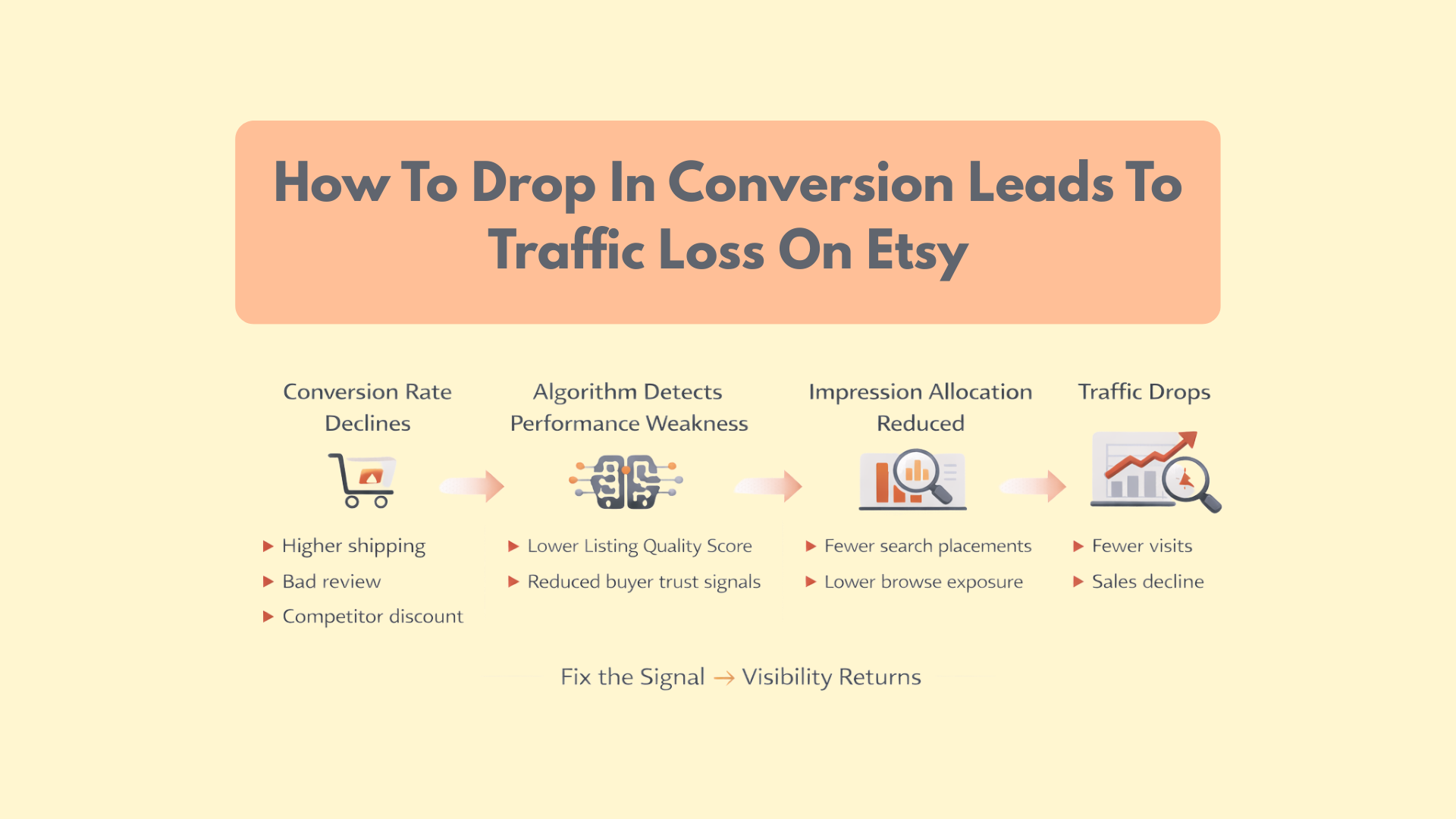
This causes most Etsy traffic dropped overnight situations. Shipping costs went up, a competitor ran a promotion, a bad review showed up, and processing time extended; any of these can flip the signal Etsy reads. When your conversion percentage falls, the platform reads it as “shoppers aren’t interested in this anymore” and cuts visibility to avoid wasting buyer attention on your listing.
Conversion drops are the most common reason for Etsy traffic dropped overnight experiences across the board, and the algorithm responds within days once it detects the shift in buyer behavior.
A Bad Review or Fulfillment Issue Hit
One negative review mentioning a late shipment can crater listing visibility within 48 hours. Etsy’s algorithm treats Customer Behavior Signals as an early warning system; low star ratings, shipping complaints, and item-not-as-described issues quickly trigger ranking reductions because the platform prioritizes sellers who deliver reliable experiences.
Shipping Settings Are Wrong
Accidentally set the processing time to three weeks? Shipping profile broke after a platform update? Delivery estimate mismatches like these kill conversion rates because shoppers see the timeline and immediately leave. Meanwhile, the algorithm registers the resulting conversion drop and reduces your impression allocation accordingly.
Stronger Competitors Moved In
Sometimes Etsy ranking dropped has nothing to do with anything you did wrong. New sellers entered your category with sharper photos, tighter pricing, and faster shipping, and your listings, which hadn’t changed, got pushed from page one to page three. When Etsy ranking dropped purely from competitive pressure like this, the fix isn’t finding what’s “broken.” It’s raising your standards to match or beat the new competition.
Google Changed Its Algorithm
Shops that relied on Google organic traffic took a hit from Core Updates in late 2025 and early 2026. As Google Search Central explains, core updates are broad changes that can cause significant traffic shifts for pages that previously ranked well, and they hit Etsy-dependent shops hard. External traffic dropped sharply for many sellers, creating the impression that Etsy had penalized the shop, when in reality, Google just stopped routing visitors to those listings.
Paid Ads Stopped Converting
For shops that leaned on Etsy Ads or Offsite Ads, a drop in ad Click-Through Rate or conversion metrics means fewer total visitors across the board. When ads underperform, organic traffic alone often can’t make up the difference, especially if shop growth was built assuming both channels are running together.
Traffic Drop Causes at a Glance
Dropped more than 50%? Skip ahead to the recovery timeline below before making major changes.
| Cause | What You’ll See | Where to Check | First Fix |
| CTR Decline | Impressions stable, visits falling | Compare thumbnail to top competitors | Use a stronger lifestyle image as the primary photo |
| Keyword Mismatch | Impressions falling across listings | Etsy Stats search term report | Rewrite titles using current buyer language |
| Conversion Drop | Views holding, sales down | Conversion rate vs 30-day average | Audit pricing, shipping, and offer structure |
| Negative Reviews | Sudden ranking drop after review | Recent reviews + star rating | Address the issue and rebuild review velocity |
| Shipping Problems | Gradual conversion decline | Processing time + delivery estimates | Shorten processing time or add a faster option |
| New Competition | Rankings fell, listing unchanged | Top 3 competitors in the category | Upgrade photos, pricing, or fulfillment speed |
| Google Update | Only external traffic collapsed | Google Analytics breakdown | Diversify to Pinterest, email, and Instagram |
| Ad Performance Drop | Paid traffic fell sharply | Etsy Ads / Offsite Ads dashboard | Adjust targeting or pause underperforming ads |
How to Diagnose the Exact Cause (Audit Framework)
Good Etsy traffic recovery starts with actually knowing what broke, not guessing, not batch-editing everything at once, but pulling real data and reading it correctly.
Start With Traffic Source Breakdown
Open the Seller Dashboard Analytics and filter by traffic source. You’re looking for which specific source fell. Etsy search shows whether your internal rankings moved. Direct pages show browse visibility. Social media reveals campaign health. Google organic tracks search engine traffic. Etsy Ads shows paid performance separately.
Compare now versus 30 days ago. If Etsy search dropped 70% but social and Google traffic stayed flat, the problem is your rankings, not your overall shop health. If every source dropped together, something shop-wide is happening.
Worth noting: If impressions are stable but visits dropped, the issue is almost certainly CTR, not keywords. Focus on your thumbnail and pricing perception before touching titles.
Look at Which Listings Got Hit
Did every listing drop equally? That points to a shop-level issue, reviews dragging down your score, or a policy flag. Did one or two listings tank while others held? That’s listing-specific, keyword mismatch, stale photos, or a pricing problem.
Pull your top competitors and look at what they’re doing. Titles, photos, pricing, fulfillment speed. Something probably changed in your category. Check your Conversion Rate against your 30-day baseline. Below 1-2% typically triggered the algorithmic pull-back.
Check Seasonality Before Changing Anything
Layer your current traffic against last year’s data for the same period. Many perceived drops are part of normal seasonal patterns. Recognizing these before making changes prevents a lot of unnecessary edits. Also, check whether paid and organic traffic dropped together or separately, if only paid fell, the fix is in your ads, not your listings.
Etsy Traffic Recovery Framework (2026)
The difference between shops that recover fast and those that spin their wheels is usually simple: one group starts with the right priority, and the other changes everything at once with no way to know what worked.
Recovery Action Checklist
Week 1: Refresh thumbnails on underperforming listings. Fix shipping configuration errors. Audit your pricing against your top 3 direct competitors.
Week 2-3: Rewrite titles and tags using the current search language. Add lifestyle photography. Set up a free shipping threshold if you don’t have one.
Week 4+: Follow up with recent buyers for reviews. Start building external traffic. Track the conversion rate weekly.
Start With the Thumbnail
Your primary image drives Click-Through Rate more than any other variable, and a CTR improvement of even 15-20% can restore lost impressions within a few weeks. Test lifestyle shots over plain white backgrounds. Show scale. Put the product in context. Give shoppers a reason to click before they even read your title.
Rewrite Titles and Tags Based on Current Search Language
Search language moves. What buyers typed six months ago isn’t necessarily what they type today. Use Etsy’s autocomplete as your research tool, type your main product term and see what surfaces. Build titles around how buyers actually talk right now, not how you’ve always described it. Remove generic or duplicated tags and replace them with specific variations matching real search behavior.
Look Hard at Your Offer
Compare your pricing and full offer against your top 5 competitors. Are they bundling? Offering free shipping, you’re not? A 5-10% pricing adjustment or a value bundle can resurrect a dead Conversion Rate without wrecking margins. Free shipping thresholds and limited promotions both move the needle and are worth testing before assuming something is fundamentally broken.
Remove Every Friction Point
Go through your listings with fresh eyes. Surprise shipping costs at checkout. Processing times longer than competitors. Missing size charts or material specs. Confusing customization options. Each friction point removed directly improves Conversion Rate, which is exactly what the algorithm watches.
Rebuild Review Velocity
Fresh reviews signal that your shop is active and delivering well. Reach out to recent buyers and make it easy to leave feedback. However, never offer discounts or gifts in exchange; Etsy flags it fast, and the consequences are worse than having fewer reviews.
Strengthen Customer Experience Signals
Response time: Answering messages within 24 hours signals reliability and feeds directly into your Listing Quality Score.
Cases and disputes: A single opened case can trigger ranking reductions before it’s resolved. Address issues fast.
Consistency: Late fulfillment, shipping errors, and quality complaints create behavioral patterns that Etsy uses to predict future buyer experience. Maintaining your standards is what builds Etsy shop authority over time, the kind of authority that smooths out ranking volatility across algorithm cycles.
Sellers who build structured systems for managing shop operations see much more stable rankings because their performance metrics stay consistently healthy.
Build Traffic Beyond Etsy
Pinterest, email lists, and Instagram, these protect against exactly the kind of volatility that sends sellers into panic mode. External traffic also signals confidence to Etsy’s algorithm. If you’re ready to think more systematically about this, print-on-demand automation strategies offer a scalable framework.
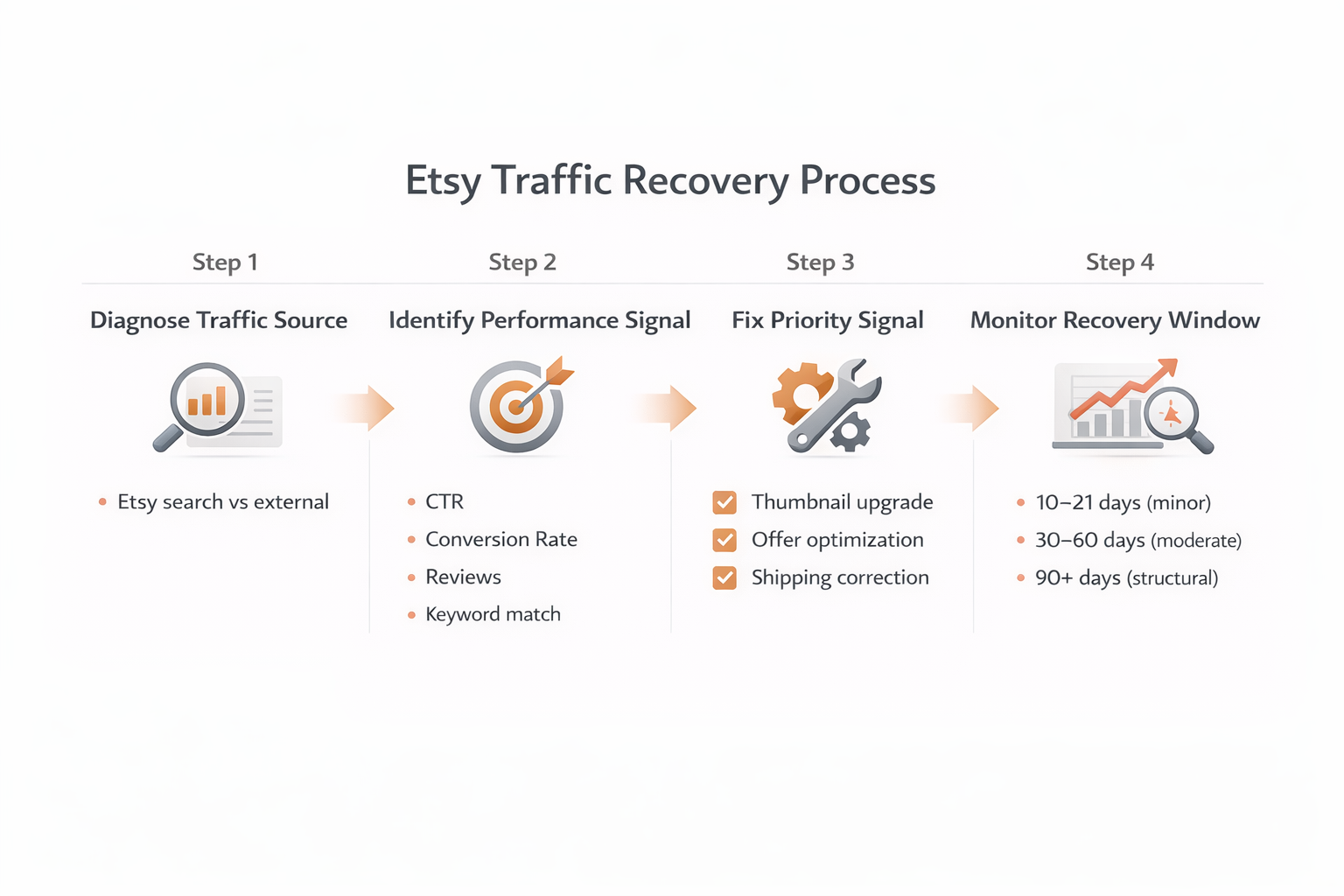
Realistic recovery timelines:
- Minor ranking shift: 10-21 days
- Conversion rate rebuild: 30-60 days
- Structural repositioning: 90+ days
What NOT to Do After an Etsy Traffic Drop
Don’t edit every listing at once. You lose the ability to understand what helped. Make changes to 3-5 listings, give it a week, then scale what worked.
Don’t wipe all your tags. Tags you think are underperforming might still be driving some traffic. Audit first, then replace specific underperformers.
Don’t slash prices aggressively. A 40-50% drop might produce a short-term sales bump, but trains buyers to wait for discounts and destroys the margins that make your shop viable.
Don’t pivot niches without diagnosing first. Moving to a new category without understanding the original problem means facing the same issues with even less data.
The Biggest Misconception About Traffic Drops
The “Etsy shadowbanned me” narrative gets repeated constantly in seller forums. Understandably, when traffic falls without warning, it feels personal. But Etsy doesn’t publicly confirm manual shop suppression exists as a practice, and the platform has no financial incentive to suppress shops that sell well.
What actually happens is simpler. When your Conversion Rate drops, the algorithm shifts visibility toward listings that convert better. That’s not punishment, it’s the marketplace optimizing for buyer experience. The platform would rather show shoppers a listing they’ll buy from than one with a weak conversion signal.
Sellers who convince themselves they’ve been banned tend to miss the actual signals: CTR dropped relative to competitors, reviews fell, demand shifted, or new competition took over. This pattern shows up consistently across high-volume shops analyzed over multiple algorithm cycles; most drops map directly to specific, addressable performance signals. Etsy’s Ultimate Guide to Etsy Search confirms this directly, outlining the exact factors that drive ranking changes.
Recovery means fixing those signals, not submitting support tickets about imaginary penalties.
Structural vs. Temporary Declines
Knowing which type of decline you’re dealing with changes everything about how you respond. A temporary drop calls for patience and targeted optimization. A structural decline calls for rethinking what you’re selling.
Temporary Declines
Seasonal patterns: Holiday products slow down in January, graduation items dip in late summer, and outdoor products fall in winter. These cycles repeat predictably every year, and recognizing them before making changes prevents a lot of unnecessary optimization that disrupts what’s already working.
Ranking fluctuations: Etsy constantly tests algorithm variations, and rankings can shift 20-30% week-to-week before settling back. Meanwhile, sellers who panic-edit during these windows often do more damage than if they’d waited. Stability is usually restored without any intervention.
External channel disruption: When Instagram, Pinterest, or Google shifts its algorithm, referral traffic dips for a few weeks before platforms normalize. As a result, shops that hold steady through these periods often recover on their own.
Structural Declines
Category saturation: When a category goes from 500 sellers to 5,000, the competitive dynamics fundamentally change. In contrast to a temporary dip, this level of saturation doesn’t reverse; it requires real differentiation or a pivot to a less crowded space.
Trend decay: When the underlying demand for a product type genuinely fades, not seasonally, but permanently, optimization can’t bring it back. Product evolution is the only real answer.
Offer fatigue: The same listings, unchanged, for months on end lose their pull. Therefore, sustained visibility requires ongoing product development, not just maintaining what already exists.
Temporary drops respond to targeted fixes and patience. Structural declines require rethinking what you’re selling.
When Etsy Instability Becomes a Business Risk
Single-platform dependency is one of the most underappreciated risks in e-commerce. Algorithm updates, policy changes, sudden competitive surges these happen without warning, and when your entire revenue stream runs through one channel, any of them can hurt badly.
Shops that depend entirely on Etsy face a real ceiling. Marketplace Competition tightens every year. Seasonal Demand swings create income volatility. And when an algorithm shift hits a category hard, shops with no diversified traffic have no cushion.
Building channels you own, email lists, an independent store, and wholesale relationships changes the risk profile significantly. These take time, but they’re assets no algorithm can take from you. Etsy can still be a strong part of the business. It just works better as one channel among several.
Recovery Time Expectations
How long recovery takes depends almost entirely on what caused the drop and how quickly the right fixes get implemented.
Recovery Timeline by Severity
| Severity | Typical Drop | Main Focus | Expected Timeline |
| Minor | 15-30% decline | CTR and thumbnail optimization | 10-21 days |
| Moderate | 50-70% decline | Conversion barrier removal | 30-60 days |
| Severe | 80%+ decline | Full listing and offer repositioning | 90+ days |
Minor ranking slides, dropping a few positions in search, tend to recover within 2-3 weeks after CTR or conversion improvements take hold. These respond to small, targeted changes.
Moderate drops in the 50-70% range need sustained work over 30-60 days. Conversion barrier audits, offer optimization, and rebuilding review velocity all take time to compound into meaningful improvement.
Severe drops of 80% or more usually signal something structural and take 90+ days minimum. Sometimes that means a full product line refresh, new photography across the board, or entering a different category with better competitive dynamics.
Some declines don’t fully recover because the market moved on. Trend decay, category saturation, and evaporating demand sometimes mean the right move is adapting the business model rather than optimizing the existing one.
Strategic Verdict
Here’s the honest version of understanding why Etsy traffic drops suddenly in 2026: the marketplace is a performance system, not a loyalty program. It rewards listings that earn clicks and convert shoppers, and it quietly pulls visibility from listings where those signals weaken, regardless of how long you’ve been selling.
Most traffic drops trace back to something measurable. CTR slipped. Conversions fell. Competition improved. An external channel dried up. Finding the specific cause through Seller Dashboard Analytics is what makes recovery systematic rather than a guessing game. Fix the right thing, and results follow. Fix the wrong thing, and nothing moves.
For sellers who want a more structured approach to Etsy traffic recovery, one that reduces dependence on any single traffic source, the sales funnel automation guide covers exactly that. And for sellers experiencing persistent volatility or ready to scale more sustainably, reach out directly here to explore what a structured recovery approach looks like for your specific shop.
Traffic drops feel personal. They aren’t. They’re data, and data can be worked with.
Frequently Asked Questions
Q. Why did my Etsy traffic drops overnight?
Overnight drops are almost always tied to a Click-Through Rate or Conversion Rate shift that crossed a threshold that Etsy’s algorithm was watching. A new negative review, an unexpected shipping delay, a competitor running a sale, or a pricing change on your end, any of these can trigger it fast. Check your Seller Dashboard Analytics for recent conversion changes and compare your listing against the top 3 competitors in your category.
Q. Did Etsy change its algorithm in 2026?
Yes. The Etsy algorithm update 2026 deepened AI-driven personalization and weighted conversion performance even more heavily in ranking decisions. Search results now adapt to individual shopper behavior rather than returning the same results for everyone. The Listing Quality Score increasingly rewards listings that earn sales, not just impressions. Shops with strong conversion metrics continued to perform well through the update.
Q. How long does traffic recovery take?
It depends on what caused the drop and how targeted the fixes are. Minor ranking slides typically recover within 10-21 days after CTR or conversion improvements. Moderate drops need 30-60 days of consistent work. Severe structural declines take 90+ days and sometimes require repositioning the product line entirely. Market conditions and competitive intensity also play a significant role in actual recovery speed.
Q. Can bad reviews lower Etsy’s ranking?
Yes, and quickly. Negative reviews that mention shipping, product quality, or communication problems can reduce your Etsy search ranking within days. Etsy treats these as signals about buyer experience reliability, and consistent low ratings trigger automated visibility reductions. One bad review won’t ruin a shop with a strong track record, but a pattern of them creates compounding damage that takes months of positive reviews to offset.
Q. Does Etsy penalize inactive shops?
Not explicitly, but inactivity shows up in performance data. Listings without recent sales, engagement, or reviews generate weak Customer Behavior Signals, and the algorithm treats this as a sign of reduced relevance, shifting impressions toward active listings that show current demand. Reactivating requires rebuilding performance momentum, not just relisting items.
Q. Why are views down but favorites increasing?
This is a classic CTR-without-conversion pattern. Shoppers find the listing appealing enough to save but aren’t ready to buy, usually because the price feels too high, shipping costs are unexpected, or they’re comparison shopping. Favorites without purchases signal interest but not urgency. The algorithm registers the conversion gap and starts reducing visibility. Fixing the conversion barrier is what turns those saves into actual sales.