
Why Amazon Listings Lose Rankings in 2026 — A Diagnostic Guide for Serious Sellers
Sales are down 40% overnight. BSR jumped three thousand spots. Organic traffic is gone. Nothing on the listing changed.
That’s when panic sets in. Sellers refresh the page. They check competitor listings. They wonder if Amazon buried them on purpose.
Here’s the truth: Amazon listings lose rankings for clear, trackable reasons, every single time. There’s no hidden blacklist. There’s no random penalty for doing well. The algorithm tracks performance. When performance dips, rank follows.
Across competitive categories, even a 2–3% sustained conversion gap between two listings can separate page-one placement from mid-page visibility.
This guide breaks down every root cause. It shows where to look, what each signal means, and how to build a real recovery plan that actually holds.
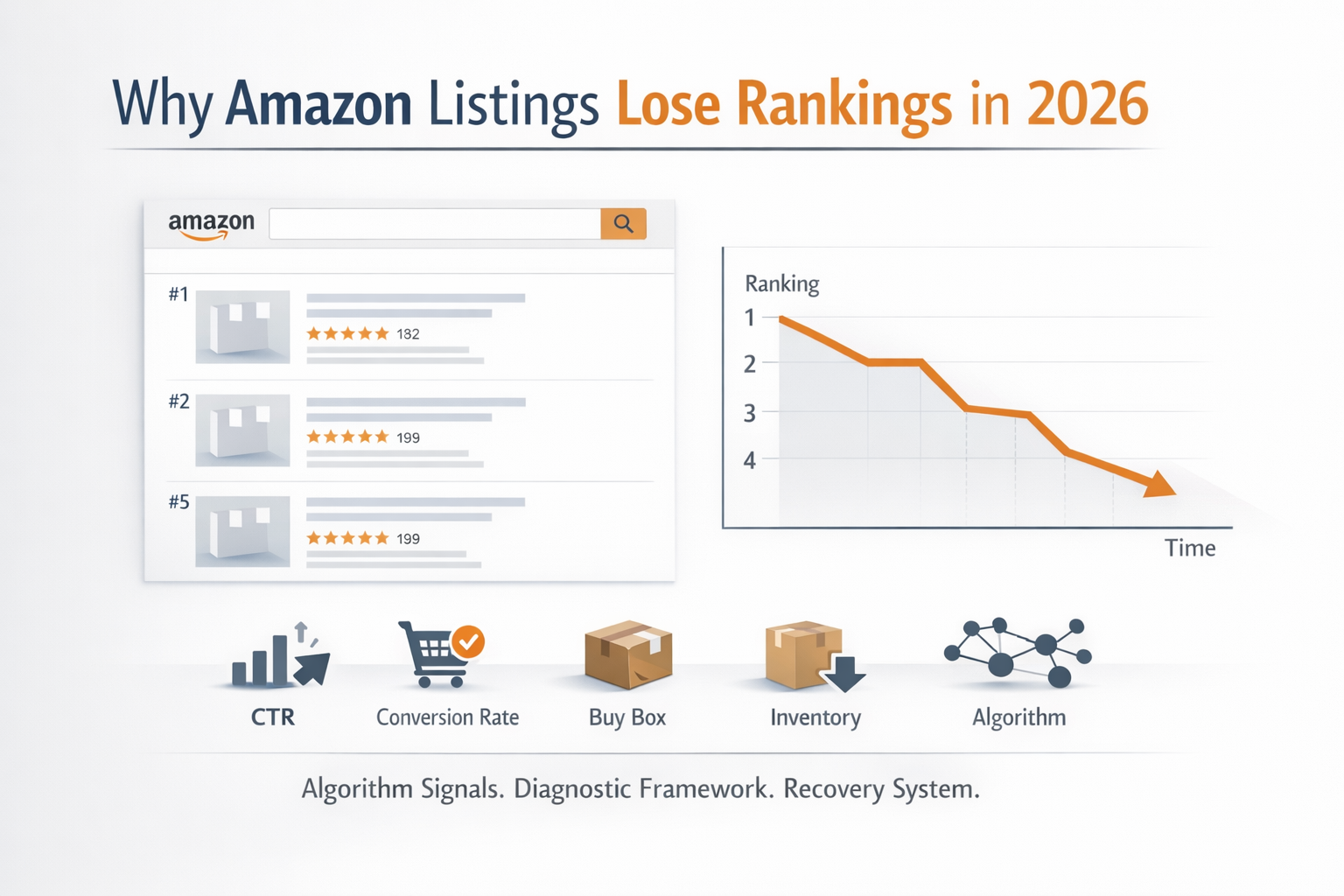
How Amazon Search Works in 2026
The Algorithm Tracks Behavior — Not Just Keywords
Amazon’s A10 algorithm has one main goal. It wants to show shoppers the products they are most likely to buy.
It doesn’t care how well a title is written. It cares whether buyers click, purchase, and come back.
That’s why Amazon SEO ranking factors in 2026 are built around buyer actions, not just keyword placement. Conversion rate, click rate, and sales speed all carry more weight than static optimization.
The Amazon algorithm update 2026 made this even tighter. It now uses AI to personalize results for individual shoppers. Two people searching for the same keyword may see different listings. That’s why monitoring rank at the account level matters more than ever.
Competition has also intensified across most categories. A product that held a top-three rank in 2022 at a 12% conversion rate may now need 16% to stay there. The standard moved up. Many sellers didn’t notice, and that’s why their Amazon listings lose rankings without an obvious trigger.
Understanding Amazon SEO ranking factors as a system, not a checklist, is what separates sellers who recover fast from those who keep guessing. The Amazon algorithm update 2026 rewards this systems-level thinking across every category.
For a detailed breakdown of how behavioral signals and AI-driven scoring now affect search placement, Canopy Management offers a thorough Amazon algorithm ranking factors guide grounded in current marketplace data.
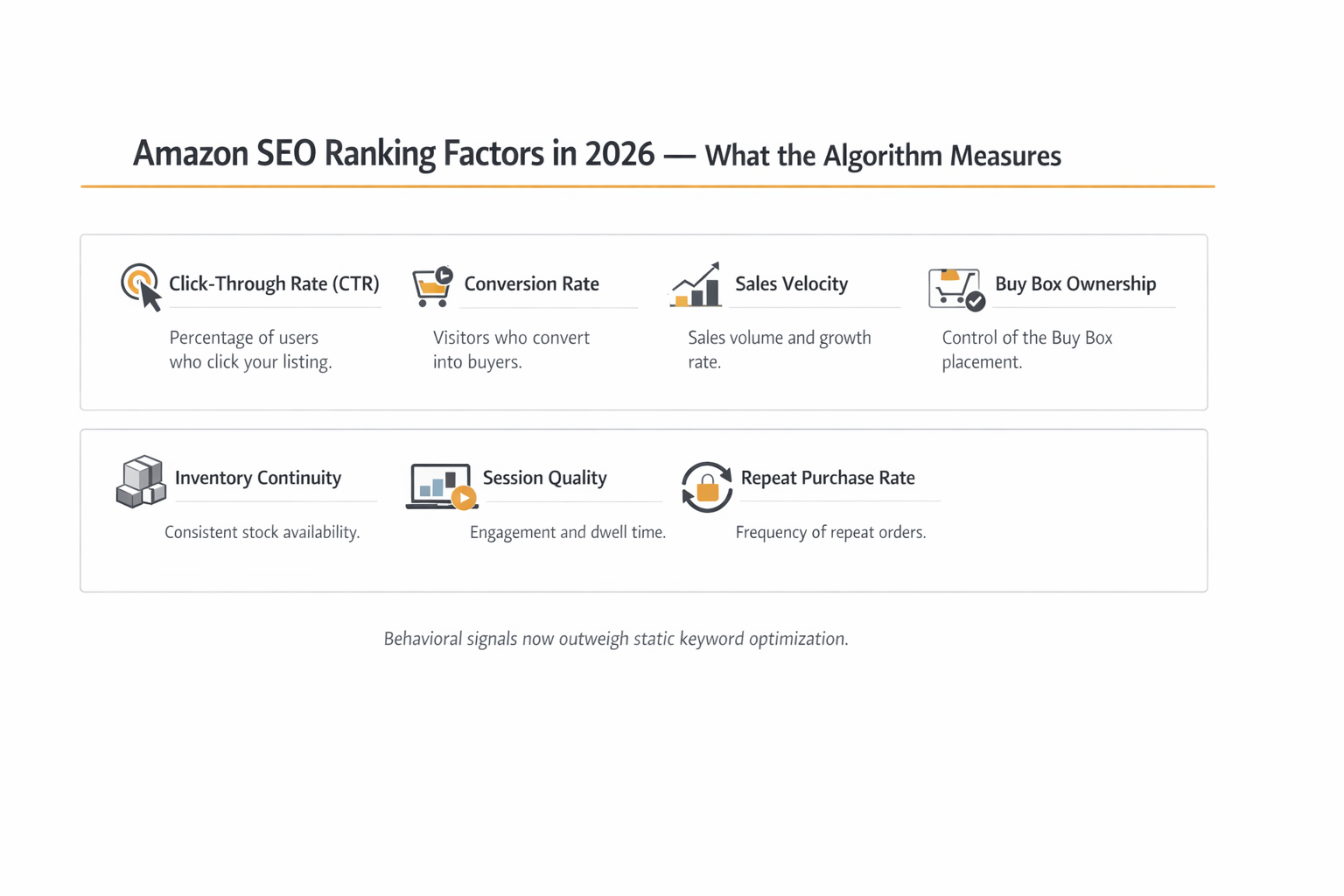
Amazon SEO Ranking Factors in 2026 — What the Algorithm Measures
- Click-through rate (CTR): How often shoppers choose the listing from search results.
- Conversion rate: The percentage of visitors who complete a purchase.
- Daily sales velocity: Steady, consistent sales rather than spike-and-crash patterns.
- Buy Box ownership percentage: Who captures the default purchase action.
- Inventory consistency: No stockouts or availability gaps.
- Session quality: Time on page, scroll depth, and purchase intent behavior.
- Repeat purchase rate: Especially important for consumables and replenishable products.
For sellers in wholesale or private-label, understanding how rank relates to account structure is essential. The Amazon Wholesale FBA service framework covers this in detail, review it before building any recovery strategy.
What a Ranking Drop Actually Means — and What It Does Not
Quick Definition: What a Ranking Drop Actually Means
A ranking drop occurs when a listing moves lower in keyword search results.
It does not always mean sales dropped, BSR changed, or ads failed.
These are related, but separate events, and each requires a different fix.
Getting this wrong wastes weeks of effort and budget. Here’s how each signal type breaks down.
Amazon BSR Drop vs Keyword Ranking Drop
An Amazon BSR drop means a listing is selling more slowly than its competitors in the same category. BSR is a lagging signal; it shifts after sales have already changed.
A higher BSR number means other products outsold this one. It doesn’t confirm that the keyword rank fell.
A keyword ranking drop is different. It means the listing moved lower in search for a specific term. A listing can maintain a stable BSR while losing rank on key terms if it’s still generating sales from other sources.
Treating an Amazon BSR drop like a keyword penalty leads to the wrong fix every time.
Amazon Conversion Rate Drop vs Demand Drop
An Amazon conversion rate drop occurs when traffic remains the same, but fewer people buy. That’s a listing-level problem, price, images, reviews, or copy.
A demand drop is a market-level problem. Fewer people are searching for the product at all. That needs a completely different response, repositioning, not listing tweaks.
Sellers who confuse these two events spend money optimizing a listing that has a market problem. The result is more cost and no recovery.
Attribution Shift
Sometimes rank numbers drop while total sales stay flat. This happens when buyers find the product through ads, brand stores, or external traffic rather than through organic search.
Sellers asking why did my Amazon sales drop need to isolate which event actually occurred. Was it ranking? Conversion? Demand? Attribution? The answer determines every next step.
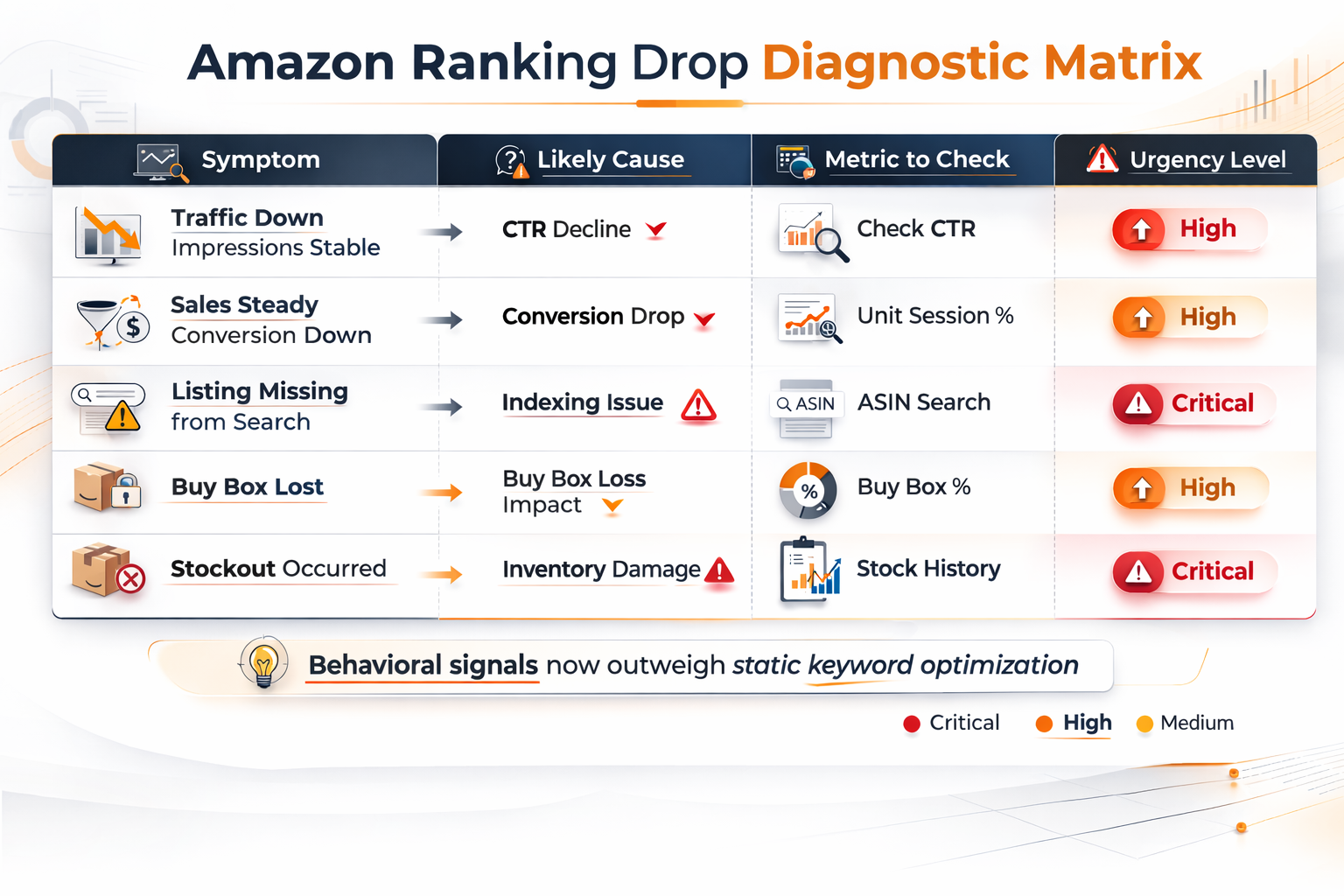
RANKING DROP DIAGNOSTIC MATRIX — MATCH YOUR SYMPTOM TO THE ROOT CAUSE
Find what you’re seeing in Seller Central in the left column. Follow the row across to confirm the likely cause, where to check it, and how urgently to act.
| What You See | Likely Cause | Metric to Check | Where to Look | Priority |
| Traffic down, impressions stable | CTR decline | Click-through rate | Brand Analytics > Search Terms | High |
| Traffic steady, sales dropped | Conversion drop | Unit session % | Business Reports > Detail Page | High |
| BSR climbing, sales slowing | Velocity loss | 7-day sales units | Inventory > Sales Velocity | Medium |
| Listing has gone from the search | Amazon indexing issues | Keyword index status | Search ASIN + keyword on Amazon | Critical |
| Sudden drop after stockout | Inventory out of stock ranking damage | Stock history log | Inventory > Manage > History | Critical |
| Buy Box % fell sharply | Buy Box loss impact | Buy Box ownership % | Seller Central > Buy Box Reports | High |
| Ads running, listing invisible | Amazon listing suppression | Suppression status | Inventory > Fix Your Products | Critical |
| Rank stable, organic sales fell | Attribution shift | Organic vs ad sales split | Advertising > Search Term Report | Medium |
Priority guide: Critical = resolve within 24 hours | High = resolve within 1 week | Medium = schedule within 2 weeks
The Real Reasons Amazon Listings Lose Rankings — Cause by Cause
Amazon listings lose rankings when their signals weaken relative to competing products. The algorithm isn’t making arbitrary choices. Every cause below maps to a specific signal that dropped.
1. CTR Decline — The First Signal to Break
When impressions remain high, but clicks decline, the algorithm interprets this as a relevance problem.
A stale thumbnail sinks CTR. A weak title does too. A stronger competitor sitting above the listing pulls clicks away.
This is one of the most common ways Amazon listings lose rankings, even when nothing on the listing itself changed. A low CTR signals to the algorithm that the listing is no longer relevant, and the ranking adjusts accordingly.
2. Amazon Conversion Rate Drop — The Heaviest Signal
Conversion is the most important ranking signal Amazon tracks. An Amazon conversion rate drop of even 3 to 5 points is enough to trigger a ranking slide. It can begin within two to three weeks.
Common causes include price increases, falling review ratings, outdated images, or listing copy that no longer matches buyer preferences.
Each of these hurts conversion directly. When the Amazon conversion rate drop is sustained, rank slides with it, and keeps sliding until the cause is fixed.
SellerMetrics publishes detailed category-level data on what a healthy unit session percentage looks like across product types. Their Amazon conversion rate benchmark guide is a practical reference for identifying exactly where a listing stands relative to its category average.
3. Buy Box Loss — Fast-Acting and Underestimated
Buy Box loss impact on ranking is one of the most overlooked triggers in this entire conversation.
When the Buy Box shifts to a competing seller, conversion rates drop sharply. Buyers land on the page, but the default purchase path routes elsewhere.
The algorithm sees that as a sign of declining demand and adjusts the rank downward. Buy Box loss impact can show up in ranking data within days of consistent loss. Sellers with ownership below 80% should treat this as the first thing to investigate.
4. Inventory Out of Stock — Documented and Damaging
Inventory out-of-stock ranking damage is one of the most well-documented causes of sudden rank collapse.
When a listing goes out of stock, it exits keyword competition entirely. It stops building velocity signals. The algorithm removes it from the active ranking.
Returning to the previous rank position after inventory-out-of-stock ranking damage typically takes four to eight weeks of strong, consistent performance. And the listing often returns at a lower starting position than before the gap.
Search Engine Journal confirms this directly: stockouts not only lose incremental sales but also damage organic rankings and diminish advertising efforts simultaneously. Their Amazon inventory management guide breaks down IPI scoring and its direct impact on ranking health.
Stockouts also affect Inventory Performance Index (IPI) scores, which influence restock limits and long-term account health. A declining IPI compounds ranking instability by restricting inventory flow during recovery.
5. Negative Review Velocity — The Conversion Domino
Amazon doesn’t penalize listings directly for bad reviews. But bad reviews kill conversions, and lower conversion rates kill rank.
A rating drop from 4.5 to under 4.0 changes how buyers behave on the page. They hesitate. They leave. They buy from the competitor instead.
That behavioral shift drives the ranking movement, not the reviews themselves in isolation.
6. Ad Performance Shift — The Organic Halo Effect
Consistent PPC campaigns create a halo effect on organic rank. Ad-driven daily sales contribute to the velocity signals the algorithm uses to track demand.
When ad spend drops suddenly, that velocity disappears. The algorithm sees the drop and adjusts the rank accordingly.
This is why Amazon listings lose rankings quickly after an abrupt budget cut, even when the listing itself hasn’t changed.
Monitor TACoS (Total Advertising Cost of Sales) alongside organic share. If TACoS rises while organic revenue falls, it often signals that Amazon listings lose rankings due to weakening organic authority rather than demand decline.
7. Amazon Indexing Issues — When the Listing Disappears
Amazon indexing issues happen when a listing is no longer tied to a specific keyword in Amazon’s search index.
Title changes, backend keyword removal, or a content compliance flag can all cause Amazon indexing issues. When a listing isn’t indexed for a keyword, it can’t rank for it, period. No optimization helps until indexing is restored.
This is fully diagnosable. Search the primary keyword on Amazon and check whether the ASIN appears. If it doesn’t show up, Amazon indexing issues are the confirmed root cause.
8. Amazon Listing Suppression — Full Removal from Search
Amazon listing suppression means the listing disappears from search results entirely, not just drops in position.
Amazon listing suppression is triggered by missing product attributes, image compliance violations, pricing anomalies, or category requirements that haven’t been met.
A suppressed listing earns zero ranking signals. Every day of Amazon listing suppression deepens the recovery timeline. Check Fix Your Products in Seller Central immediately if the listing is completely invisible.
9. Competitive Price Pressure — Market Response, Not a Penalty
When competitors drop prices, a listing’s value looks weaker to buyers. Conversion falls. Rank follows.
This is not the algorithm penalizing anyone. It’s the market shifting, and the algorithm accurately reflects that shift.
Sellers who haven’t adjusted their pricing in months, while competitors have dropped theirs, often see what appears to be a mystery drop. The answer is competitive displacement, nothing more.
10. Keyword Targeting Drift — Self-Inflicted Authority Loss
Changing a title or backend keywords without tracking the impact is a reliable way for Amazon listings lose rankings with no external trigger.
Amazon rankings are keyword-specific. Shifting content toward new terms loses authority on the established ones. Without a transition plan and rank tracking in place, this creates a gap that looks identical to an algorithm change.
For a broader view on sudden sales drops and how to correctly interpret each signal, the why Amazon sales dropped suddenly resource is worth reading alongside this section before taking any corrective action.
How to Diagnose Why Amazon Listings Lose Rankings — Step-by-Step Audit
Quick Diagnosis — 5 Checks to Run Before Anything Else
- Is the listing indexed for the primary keyword? — Search ASIN + keyword on Amazon.
- Is Buy Box ownership above 80%? — Check Seller Central Buy Box %.
- Did a stockout happen in the last 60 days? — Review inventory history.
- Has the conversion rate dropped more than 3 points? — Pull the Traffic Report.
- Is the listing suppressed? — Check “Fix Your Products” in Seller Central.
If any of these five checks return a yes, that’s the starting point. Don’t rewrite copy or run keyword research until these are cleared.
Step 1 — Traffic Source Analysis
Pull the Traffic Report in Seller Central. Compare organic sessions to PPC sessions week over week.
If organic dropped while ads held steady, the issue is keyword ranking, not listing conversion. If both are dropped, look at the demand level or account health instead.
Step 2 — Keyword Index Check
Search Amazon for the primary keywords. Confirm the ASIN appears in the results.
If it doesn’t show up at all, Amazon indexing issues are confirmed as the root cause. No other optimization step matters until indexing is fixed first.
Step 3 — Conversion Rate Audit
Review the unit session percentage for the last 30 days versus the prior period. A drop of more than three percentage points means the listing itself needs attention.
Compare the listing head-to-head against the top three competitors ranking for the primary keyword. That gap is the optimization target.
Step 4 — Buy Box Status
Confirm Buy Box ownership percentage in Seller Central. If it’s below 80%, the buy box loss impact is likely driving the conversion drop.
Investigate pricing, shipping speed, seller account metrics, and competing offers on the same ASIN.
Step 5 — Inventory History
Check whether any stockout occurred in the last 60 days. Even a 48-hour gap causes real ranking damage.
Inventory out-of-stock ranking recovery takes weeks of consistent performance, not days. The listing has to earn its way back.
Step 6 — Ad vs Organic Split
Calculate what percentage of sales came from ads versus organic before and after the drop.
If ad sales stayed stable but organic search collapsed, the Amazon ranking dropped suddenly, even if it was algorithm-driven. If both fell, look at demand or account health.
Step 7 — Competitor Comparison
Find the top three listings now ranking above the affected ASIN. Compare review count, rating, price, images, and estimated velocity.
This tells whether a competitive shift caused the drop, or whether internal performance decline is the real issue. Both need different recovery paths.
This seven-step audit works for any seller dealing with what looks like an Amazon ranking dropped suddenly event with no obvious internal trigger.
When Amazon listings lose rankings, the mistake is changing everything at once instead of isolating the signal that weakened.
Recovery Strategy for When Amazon Listings Lose Rankings — 2026 Framework
Fast Recovery — 7-Day Priority Action Plan
Day 1: Resolve any listing suppression. This is always first.
Day 1–2: Confirm keyword indexing for all primary terms.
Day 2–3: Fix Buy Box ownership. Resolve pricing or seller metric gaps.
Day 3–4: Run a conversion rate audit against category benchmarks.
Day 4–5: Refresh the main image if CTR data shows a decline.
Day 5–6: Realign PPC campaigns to primary keyword targets.
Day 6–7: Check inventory buffer and set reorder triggers.
Recovery is a sequence, not a one-time fix. The right path depends entirely on which diagnostic step identifies the root cause.
Thumbnail and Image Optimization
When the CTR decline is confirmed, the main image is the first lever.
Test updated images using Manage Your Experiments, where brand registry allows. Focus on contrast, product scale, and visual clarity. Compare directly against the top competitors ranking for the primary keyword.
Title and Backend Keyword Refresh
After confirming Amazon indexing issues, run a full keyword audit. Use Seller Central search term reports alongside third-party rank tracking tools.
Update backend keywords with high-relevance current terms. Make sure the title leads with conversion-focused phrases. This also addresses cases where Amazon listings lose rankings due to keyword drift, map keyword authority before and after any title change.
Conversion Improvement
Address image stack, A+ content, bullet-point specificity, and pricing in a single coordinated effort. Don’t do them one at a time across months.
Review negative feedback for recurring objections. Address those objections inside the listing content, not just in seller responses.
Even a 1-point improvement in conversion rate FR accelerates ranking recovery. The algorithm responds to sustained improvement within two to three weeks of consistent positive signals.
Offer Repositioning for Buy Box Recovery
When buy box loss impact is confirmed, pricing is usually the fastest fix available.
Review FBA fee structures before cutting margin. Small pricing adjustments often have an outsized effect on Buy Box ownership in competitive listings.
Review Velocity Improvement
Use Amazon’s Request a Review tool for all fulfilled orders without exception.
Enroll in Vine for new or recently updated products where applicable. Better review recency improves buyer trust, which improves conversion rate, which improves rank. The chain runs in one direction.
Inventory Stabilization — Prevent the Next Stockout
Set a 45- to 60-day inventory buffer as the baseline. For products with long lead times or variable demand, push to 90 days during peak periods.
Inventory out-of-stock ranking events are preventable. One stockout can erase months of ranking progress. Set automated reorder triggers and review velocity projections monthly.
PPC Realignment During Organic Recovery
Rebuild campaigns around current high-converting search terms. Use Sponsored Products exact match on primary keywords to maintain consistent daily velocity.
Avoid broad match campaigns during recovery. They dilute the budget across low-relevance terms and generate sales noise that doesn’t rebuild keyword authority. Amazon ranking dropped suddenly; recoveries need signal quality, not volume scatter.
Sellers rebuilding or restructuring their Amazon catalog should read the Amazon automation product selection strategies guide to understand how product positioning decisions affect long-term ranking health from day one.
The Biggest Myth About Why Amazon Listings Lose Rankings
Amazon does not randomly punish successful listings.
This one belief causes more wasted recovery spend than anything else. Sellers see a sudden drop and assume Amazon made an arbitrary call. In nearly every case, a measurable performance signal changed first, and rank followed that signal.
What Actually Happens in an ‘Unexplained’ Drop
The Amazon algorithm update 2026 did not add punitive tools for well-performing sellers. What it did was tighten the competitive window.
Behavioral signals are now more granular. Small performance gaps produce bigger ranking separations than they did in 2022 or 2023.
A listing that comfortably outperformed its category in 2023 may now sit at the category average, because the whole category got better. That’s not a penalty. That’s market movement.
Amazon SEO ranking factors reward consistent performance. When performance dips relative to competitors, the rank accurately reflects that. Understanding this framing is the foundation for any real recovery.
The Right Way to Frame a Drop
Amazon listings lose rankings when signals weaken relative to competitors. The question is never why did Amazon do this. It’s always which signal dropped, when, and why.
Sellers who think this way recover faster and with more durable results than sellers who spend weeks looking for a penalty to reverse.
When Amazon Listings Lose Rankings: Structural vs Temporary Declines
Definition — Temporary vs Structural Ranking Decline
Temporary decline: A short dip that corrects once the trigger is fixed.
Structural decline: A sustained downward trend driven by market shift, product lifecycle, or persistent conversion misalignment, one that does not self-correct.
Use the comparison below to identify which type the listing is actually experiencing before committing any recovery budget.
| Temporary Decline | Structural Decline |
| Short-term conversion dip | Market saturation in the category |
| Minor PPC pause or budget cut | Offer fatigue — buyers moved on |
| Seasonal demand shift | Product lifecycle decay |
| Brief stockout under 72 hours | Low conversion — not improving with fixes |
| Minor algorithm recalibration | Strong new competitor in the category |
| Recovers in 2 to 4 weeks | Needs repositioning or product exit |
If the listing shows 3 or more structural indicators, repositioning is likely the correct answer — not more optimization.
Temporary Ranking Declines
These come from short-term conversion dips, brief inventory gaps, minor algorithm recalibrations, or seasonal demand shifts.
They typically recover in 2 to 4 weeks if the cause is quickly resolved and the underlying listing quality is solid.
An Amazon ranking dropped suddenly event that stabilizes within a few days without listing changes is almost always temporary. Overreacting with major listing changes can actually extend the recovery period.
Structural Ranking Declines
These come from market saturation, product lifecycle decay, offer fatigue, or an Amazon conversion rate drop that doesn’t respond to listing optimization.
These do not self-correct. A listing holding a six-month declining trend despite consistent optimization is in structural decline.
Recovery here means repositioning the product, pivoting the category angle, or exiting. More keyword tweaks won’t fix a structural problem.
The Simplest Way to Tell the Difference
If the drop stabilized within two to three weeks without major changes, it was likely temporary.
If it continues to fall for 60 or more days despite real corrective efforts, it is structural.
Treating structural decline as temporary is one of the most expensive mistakes a seller can make. Amazon listings lose rankings permanently when sellers keep patching symptoms rather than fixing the root cause.
When Ranking Instability Becomes a Business Risk
Amazon listings lose rankings periodically. That’s built into how a performance-ranked marketplace operates; it’s not an anomaly.
However, when a single listing or channel drives most of the revenue, a ranking drop becomes a cash flow crisis fast.
The Over-Reliance Problem
A two-month recovery that cuts revenue by 50% can simultaneously break supplier relationships, cash cycles, and team operations.
Sellers are managing recovery manually, checking dashboards daily, adjusting bids by hand, tracking pricing themselves, burn capacity that should be going toward growth.
Sustainable ecommerce in 2026 requires multi-channel presence, automation systems, and inventory infrastructure. These reduce the exposure created by depending on Amazon organic rank as the only revenue driver.
Why did my Amazon sales drop is a question that becomes a recurring crisis when there’s no system to catch early signals or cushion the impact.
Businesses evaluating their full marketplace strategy can explore a structured approach at HiSellIt or reach out directly through the contact page to discuss operational positioning.
Recovery Time Expectations — What’s Actually Realistic
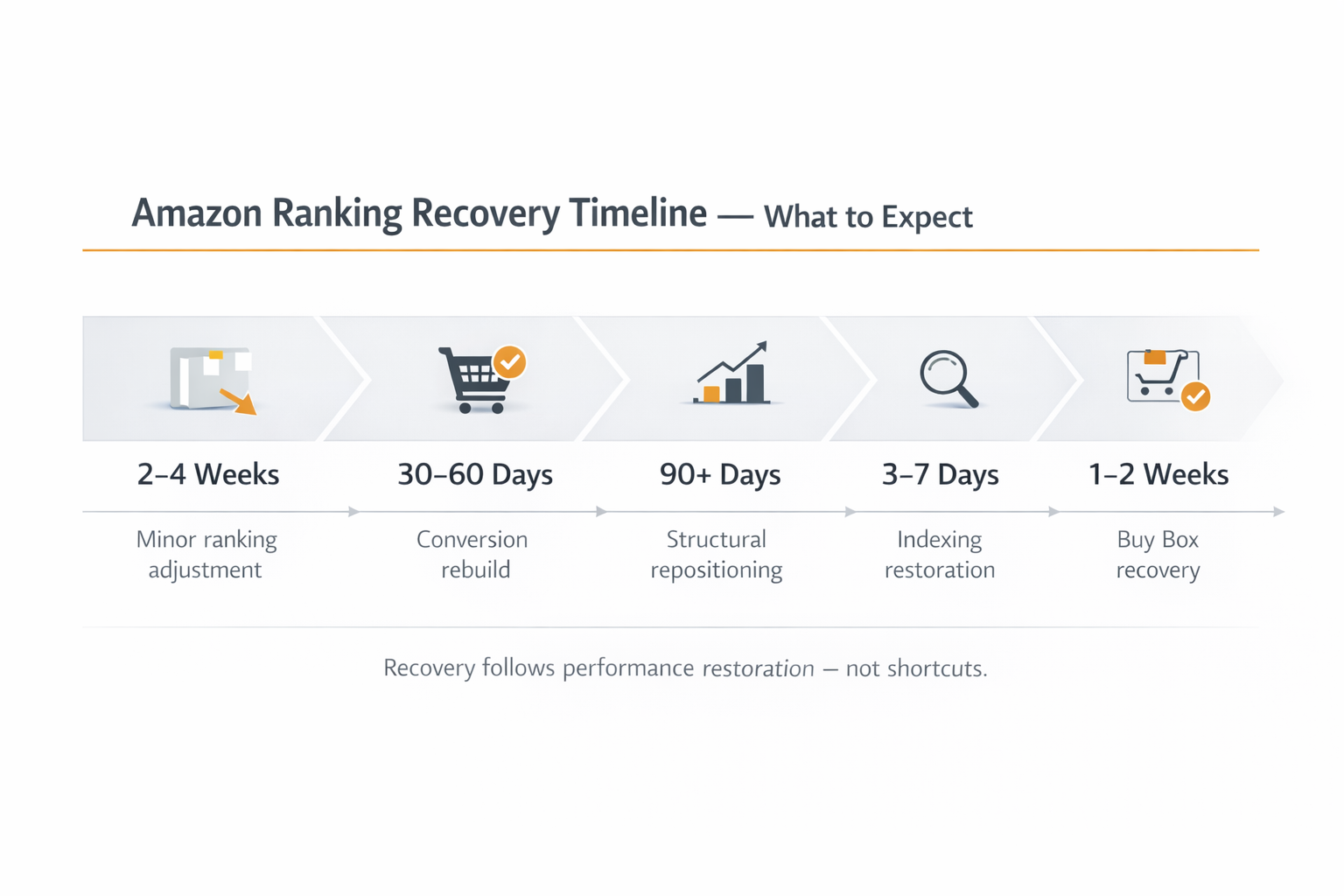
There are no shortcuts here. The algorithm responds to sustained performance, not one-time fixes. Plan around these ranges:
Recovery Timeline — Realistic Expectations by Cause Type
- Minor ranking adjustment: Short conversion dip or brief ad pause — typically 2 to 4 weeks.
- Conversion rebuild: Image refresh, pricing fix, review recovery — 30 to 60 days.
- Structural repositioning: Extended suppression or market saturation — 90+ days.
- Indexing restoration: After Amazon indexing issues — 3 to 7 days once content is corrected.
- Buy Box recovery: After pricing realignment — 1 to 2 weeks of consistent wins.
Meanwhile, avoid changing title, images, price, and backend keywords all at once during recovery. Doing too much at the same time makes it impossible to know what is working.
Make one change. Give it two weeks. Measure. Then move to the next. This applies to every scenario where Amazon listings lose rankings and a seller is trying to identify which fix drove the improvement.
Strategic Verdict — What Serious Sellers Do Differently
Amazon listings lose rankings when performance signals weaken, not randomly, not arbitrarily, not because of hidden penalties.
The algorithm reflects real seller performance. Every drop maps to an identifiable shift in CTR, conversion, inventory continuity, Buy Box ownership, Amazon indexing issues, or competitive position.
The sellers who recover fastest treat ranking drops as diagnostic problems, not platform failures. They audit before acting. They find which signal dropped before deciding which lever to pull. They set realistic timelines and build systems to reduce future exposure.
Amazon SEO ranking factors in 2026 reward sustained, consistent relevance. That relevance is earned through listing quality, conversion performance, inventory discipline, and competitive positioning, not shortcuts or reactive sprinting.
When Amazon listings lose rankings, recovery follows the same pattern every time: diagnose the signal, restore performance, protect inventory, and outpace competitors.
The algorithm is mechanical. The recovery must be too.
FAQ — Frequently Asked Questions
Q. Why do Amazon listings lose rankings suddenly?
Amazon listings lose rankings suddenly when a key performance signal shifts fast. Usually, it’s conversion rate, CTR, Buy Box ownership, or stock availability. The algorithm responds in near real-time. A sudden change in any of these produces a quick ranking drop. It always traces back to a measurable shift, never a random algorithm decision.
Q. Did Amazon change its algorithm in 2026?
Yes. The Amazon algorithm update 2026 continued the A10 model’s shift toward behavioral signals, especially conversion rate, session quality, and personalized result ordering. No update introduced random penalties. However, the competition gap between average and strong listings is now wider than in prior years. Amazon SEO ranking factors are being evaluated on a tighter benchmark. The bar got higher, not more arbitrary.
Q. How long does it take to recover ranking after Amazon listings lose rankings?
Recovery timelines depend on the root cause. Minor drops from short-term conversion dips recover in 2 to 4 weeks with corrective action. Conversion rebuilds take 30 to 60 days. Structural issues like extended Amazon listing suppression or market saturation take 90 or more days. There are no guarantees; recovery requires sustained signals, not one-time fixes.
Q. Can bad reviews lower Amazon ranking?
Not directly. However, bad reviews reduce conversion rate, which is a core Amazon SEO ranking factor. When the rating drops and buyers hesitate to purchase, the Amazon conversion rate drop that follows triggers a ranking decline. The reviews themselves are not penalized. The resulting buyer behavior is what moves the rank downward.
Q. Does being out of stock hurt ranking?
Yes, significantly. Inventory out-of-stock ranking damage is well-documented and fast. When a listing goes out of stock, it exits keyword competition and stops building velocity signals. Returning to the prior rank takes four to eight weeks of consistent performance. Amazon listings lose rankings faster from inventory gaps than from almost any other single trigger. Preventing stockouts is far cheaper than recovering from them.
Q. What is the difference between an Amazon BSR drop and a keyword ranking drop?
An Amazon BSR drop means the relative sales velocity fell compared to competitors in the category. It’s a lagging indicator; it moves after sales patterns have already shifted. A keyword ranking drop means the listing moved lower in search results for a specific keyword. They often occur together. However, an Amazon BSR drop can occur during a category-wide slowdown without a change in keyword rank. And keyword rank can fall due to a drop in CTR or Amazon conversion rate, without immediate BSR movement. Treating them as identical leads to the wrong diagnosis every time.