

Walmart Marketplace Approval Process (2026 Requirements, Timeline & Rejection Reasons)
If you have ever tried to figure out the Walmart Marketplace approval process on your own, you already know how confusing it gets. There is no public checklist Walmart hands out. The timeline is vague. And plenty of sellers get rejected without really understanding why.
That is what this guide is here to fix.
Every part of the Walmart Marketplace approval process is broken down here. From how to get approved on Walmart Marketplace the right way, to the real requirements. The actual timeline, why applications get rejected, and what to do if yours does. Whether this is the first application or a second attempt after a rejection, these are the answers sellers actually need before they start.
What is the Walmart Marketplace Approval Process?
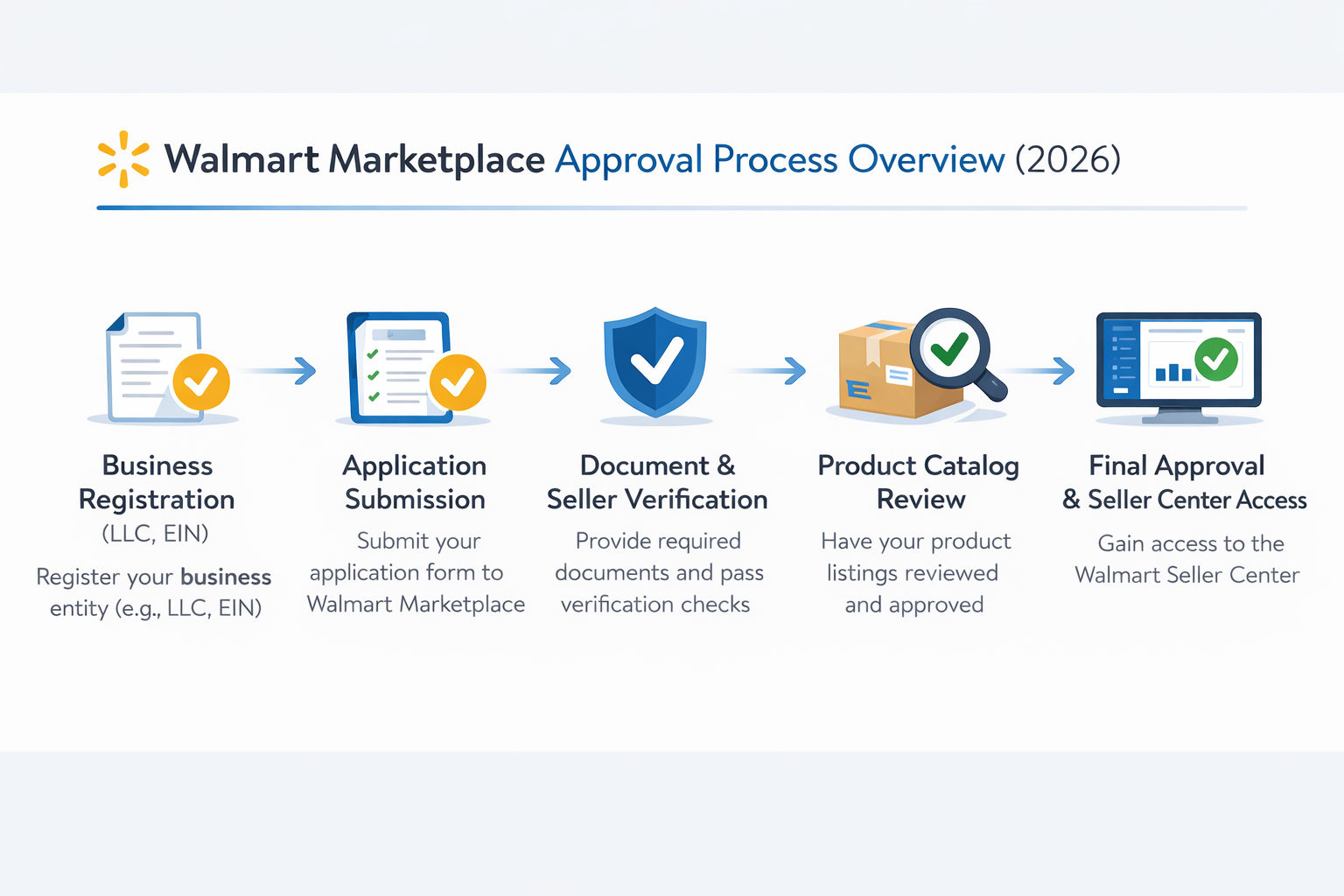
The Walmart Marketplace approval process is the multi-step review Walmart Inc. uses to evaluate and verify third-party sellers before they can list products on Walmart.com.
It covers business verification, EIN validation, ecommerce history, product catalog review, and a Trust & Safety compliance check.
Most sellers who meet the requirements receive a decision within 2 to 4 weeks.
Worth Knowing: Walmart.com Traffic
Walmart.com attracts hundreds of millions of monthly visits, which is a major reason Marketplace approval is valuable for serious sellers.
Source: Statista
That level of built-in traffic gives approved sellers access to one of the largest ecommerce audiences in the United States.
Why Walmart Is Selective About the Walmart Marketplace Approval Process
Walmart is not running an open marketplace. Every seller goes through the Walmart Marketplace approval process before getting access, and that is completely intentional.
Think about it from Walmart’s perspective. Millions of shoppers buy on Walmart.com every month trusting that what they find there is legitimate, accurately described, and actually going to show up. One wave of low-quality sellers can damage that trust fast. So Walmart built a strict vetting process to make sure only businesses that can actually perform get through.
That process includes checking seller performance standards, evaluating fulfillment metrics, and running every application through a Trust & Safety review. Walmart also runs Walmart Fulfillment Services (WFS), its own logistics network. Sellers who drop the ball on orders create real problems for that infrastructure.
So yes, is Walmart Marketplace hard to get into? Harder than Amazon. But that difficulty is also what makes it worth pursuing. Less competition, more room to grow, and a platform that still has plenty of white space for sellers who qualify.
Walmart Seller Approval Requirements for 2026: What Walmart Actually Looks For
Before anything else, make sure the basics are covered. These are the non-negotiable Walmart seller approval requirements that every application needs to clear. Without each one, the Walmart Marketplace approval process does not move forward.
A Registered U.S. Business Entity
Walmart only works with properly registered U.S. businesses, LLC, corporation, or similar legal structure. Sole proprietors operating informally and unregistered individuals do not make the cut. The business needs to be verifiable, which means it has to actually exist on paper in the eyes of state and federal authorities.
A Valid EIN / Tax ID
An Employer Identification Number from the IRS is a hard requirement. This is how Walmart confirms who it is actually dealing with during the seller verification process. No EIN means no application. Sellers who do not have one yet can apply directly through the IRS EIN portal, it is free and usually processed the same day.
A Real Track Record in Ecommerce
Walmart is not looking for beginners. A proven history of selling online, on Amazon, through a Shopify store, on eBay, anywhere tells Walmart that the business can actually handle orders at scale. Zero selling history is a red flag, not a clean slate.
A Clean, Compliant Product Catalog
The products being sold have to hold up under scrutiny. Prohibited items, restricted categories, counterfeit goods, or anything with a murky sourcing story will get flagged immediately during the product catalog review. Walmart Marketplace approval requirements 2026 still put catalog quality near the top of the list, the Walmart Marketplace approval process flags weak catalogs early.
The Ability to Actually Fulfill Orders
Walmart cares a lot about what happens after a sale. Fulfillment metrics like on-time delivery rate and order defect rate (ODR) are part of the evaluation. If the business cannot reliably ship orders and handle returns without drama, it is not going to pass.
Pricing That Holds Up on a Competitive Platform
Walmart shoppers are price-conscious. Coming in with prices significantly higher than what buyers can find anywhere else is a problem both at the approval stage and after it. Competitive pricing is part of what Walmart is looking for.
For some broader context on where Walmart.com sits in the U.S. ecommerce picture, Shopify’s ecommerce industry stats give a useful sense of the overall landscape sellers are operating in.
The Walmart Marketplace Application Process, Step by Step
Here is what the Walmart Marketplace application process actually looks like in practice — every step in the Walmart Marketplace approval process matters. Each stage matters, so do not rush through any of it.
- Head to marketplace.walmart.com and hit the Request to Sell button. That is the official start of the Walmart Marketplace application process.
- Fill out the application form completely, legal business name, EIN, business address, store or website URL, the product categories being sold, and estimated annual revenue. Take the time to do this right. Sloppy entries create problems later.
- Show the e-commerce history. Walmart will ask about selling experience. Link to existing storefronts, include sales figures, share any performance data that proves the business can handle volume. This part of the application carries real weight.
- Upload the supporting documents. Business registration proof, tax ID, and sometimes a W-9. Make sure everything matches exactly. A mismatch between the business name on the EIN and the state registration is one of the most common reasons the Walmart seller verification process stalls.
- Wait for the review. Walmart’s team goes through the application — partly automated, partly manual. This is where business verification, catalog review, and compliance screening all happen.
- Answer any follow-up requests fast. If Walmart comes back asking for more documents or clarification, get back to them within a day or two. The clock on Walmart approval time does not stop ticking just because the ball is in Walmart’s court.
- Get the decision. Approved applications come with instructions to finish setting up in Walmart Seller Center and start listing products. Rejections come with a reason, read it carefully.
Walmart Approval Time: How Long Does the Review Actually Take
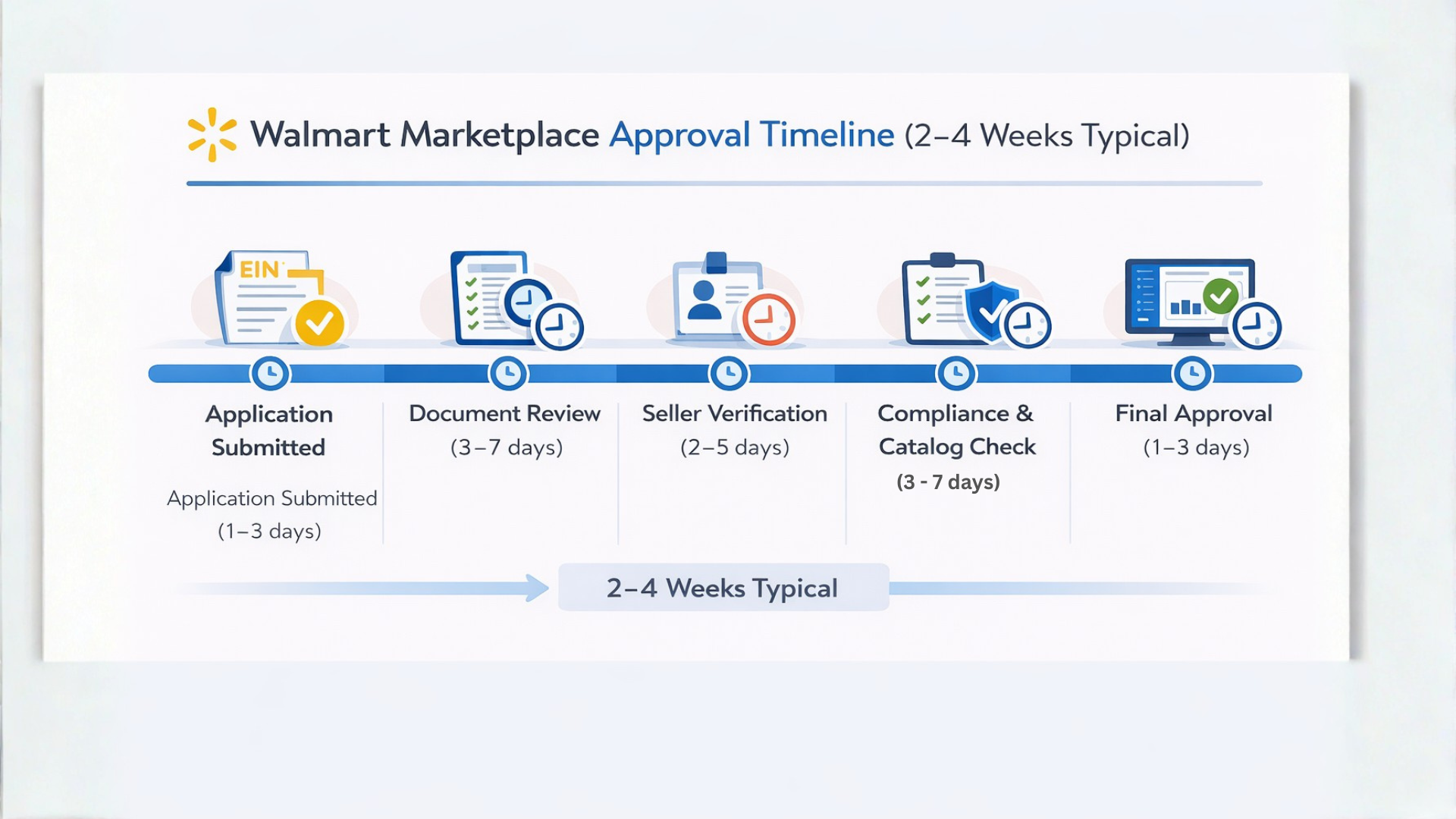
How long does Walmart Marketplace approval take? The short answer is two to four weeks for a clean, complete application. That number stretches when documents are missing or the business history raises questions during the Walmart Marketplace approval process.
| Stage | What Happens | Duration | Notes |
| Application Submitted | Walmart checks initial eligibility | 1-3 days | Business info validated |
| Document Review | EIN, business registration, sales data verified | 3-7 days | Most delays happen here |
| Seller Verification | Identity and compliance screening | 2-5 days | Trust & Safety review |
| Catalog & Compliance | Product listings checked against policy | 3-7 days | Listings must meet standards |
| Final Approval | Account activated, onboarding begins | 1-3 days | Access to Seller Center granted |
| Total (Typical) | 2-4 weeks | Faster with complete docs |
How Long Does Walmart Marketplace Approval Take?
Walmart Marketplace approval usually takes 2 to 4 weeks.
The timeline depends on document accuracy, ecommerce history strength, and whether the product catalog passes review.
Slow responses and incomplete paperwork are the two biggest causes of delays in the Walmart Marketplace approval process.
Walmart does not commit to a fixed Walmart approval time for the Walmart Marketplace approval process. If four weeks pass without a response, a polite follow-up through Walmart Seller Center is completely reasonable.
Can Individuals Sell on Walmart Marketplace?
Short answer: generally, no, not without a registered business entity behind them.
Can individuals sell on Walmart Marketplace? The Walmart Marketplace approval process requires a formal U.S. business structure and a valid EIN to even submit an application. Someone selling casually without a registered LLC or corporation does not meet the baseline requirements. This is a meaningful difference from platforms like Amazon Marketplace, which has an Individual plan designed for exactly that kind of seller.
That said, this is not a permanent door closing. Anyone who formalizes their business structure can go through the standard Walmart Marketplace approval process, the path is open once the entity is registered. The path is available, it just requires formalizing the business first.
For anyone planning to sell on Walmart long-term, setting up an LLC before applying is not optional. It is step one.
Walmart Marketplace vs Amazon Marketplace: How the Two Stack Up
A lot of sellers come to Walmart after Amazon, or consider both at the same time. Here is how the Walmart Marketplace application process and approval compare to Amazon, so expectations going in are grounded in reality.
| Factor | Walmart Marketplace | Amazon Marketplace |
| Open to All Sellers? | No — selective approval only | Yes — open registration |
| Application Review | Manual + automated, thorough | Mostly automated, quick |
| Approval Time | 2-4 weeks typically | 24-48 hours typically |
| Individual Sellers | Generally not accepted | Accepted (Individual plan) |
| Monthly Fee | None — category commission only | Monthly fee + per-item fees |
| Seller Competition | Lower — less crowded | Extremely saturated |
| Dropshipping | Allowed with strict compliance rules | Allowed with restrictions |
The headline comparison: the Walmart Marketplace approval process takes more effort upfront than Amazon. But on the other side of that approval is a less crowded platform, no monthly seller fee, and Walmart’s massive customer base working in the seller’s favor.
Why Walmart Seller Applications Get Rejected During the Walmart Marketplace Approval Process
Rejections happen more than most sellers expect. The single most useful thing a seller can do is understand why Walmart seller application gets rejected before ever clicking submit. Every case where a Walmart seller application gets rejected traces back to one of these patterns.
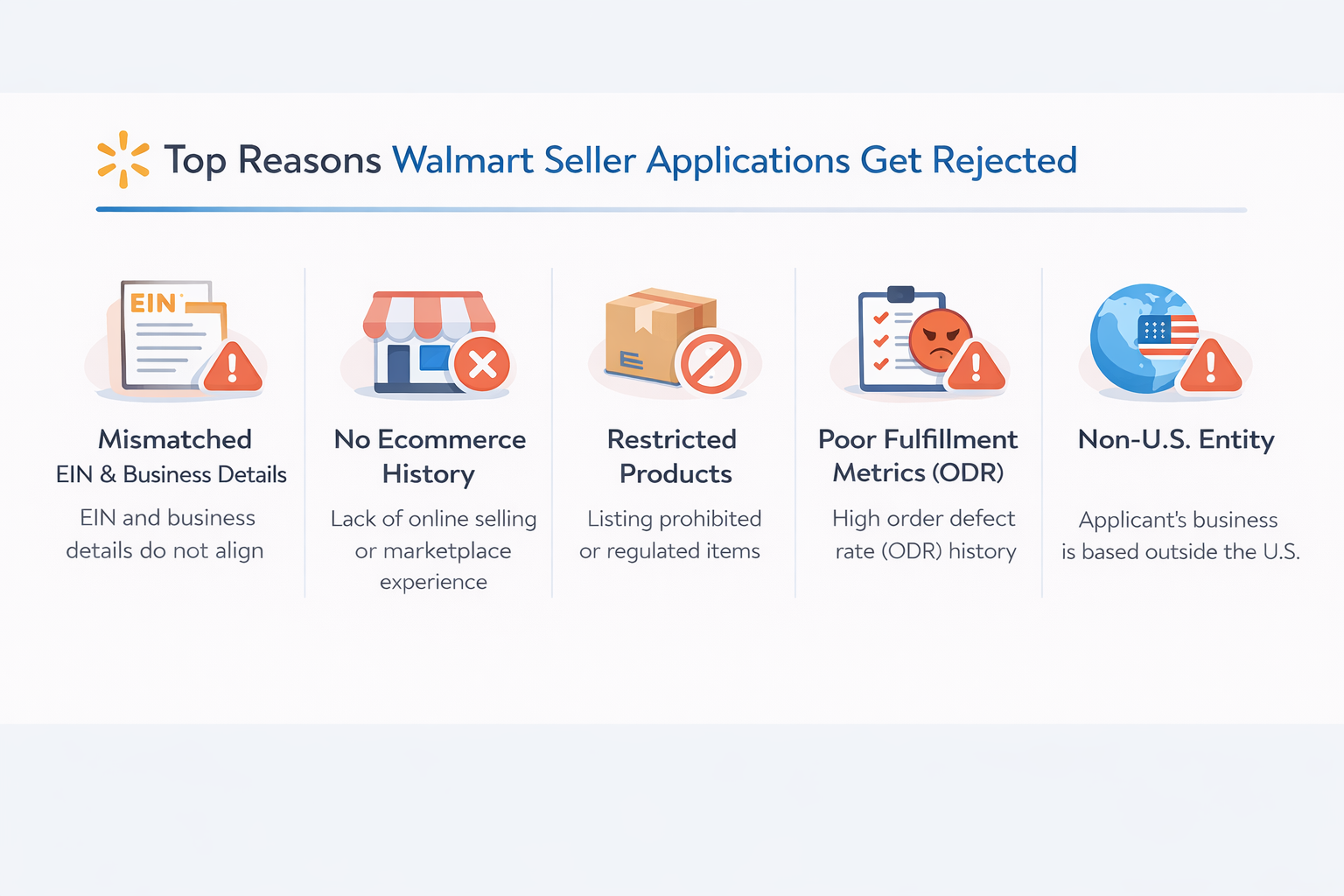
- Business information that does not match up. The legal business name, the EIN, and the state registration all need to line up perfectly. Any discrepancy is a red flag that stalls or kills the application.
- No real ecommerce track record. Sellers without verifiable history on another platform rarely make it through. Walmart is not in the business of onboarding beginners.
- Problem products in the catalog. Restricted categories, prohibited items, or anything with a compliance question will get flagged during the product catalog review stage, often before a human even reads the rest of the application.
- A weak fulfillment history. High order defect rate (ODR) numbers or poor delivery performance on other platforms can follow a business into a Walmart application. Walmart checks.
- No U.S. business registration. International sellers operating without a U.S. entity are typically turned away. There is no workaround here.
- Listings that are not ready. Incomplete product descriptions, low-quality images, or content that does not meet Walmart’s standards are a signal that the seller is not ready.
- Prices that do not compete. Coming in significantly above market rates is a problem both for approval and for actual performance on the platform.
A lot of rejection issues can be caught before the application even goes in. A breakdown of the most common Walmart product research mistakes sellers make covers the catalog and product selection errors that quietly sink applications, worth reading before submitting anything.
Top Reasons Walmart Seller Applications Get Rejected
- Mismatched business name and EIN details
- No proven ecommerce selling history
- Restricted or non-compliant product categories
- Poor fulfillment performance metrics
- Unregistered or non-U.S. business entity
Walmart Dropshipping Approval Rules: Read This Before Applying
Dropshipping is allowed, but Walmart dropshipping approval rules are tighter than most sellers realize, and getting this wrong during the Walmart Marketplace approval process is one of the fastest ways to lose an account.
The core rule is simple: the seller must be the seller of record on every single order. That means full responsibility for the transaction, the delivery, the customer experience, and any returns. Listing a supplier as the actual seller, or having orders arrive in packaging from Amazon, Target, or any other retailer, breaks Walmart’s dropshipping policy outright.
The specific Walmart dropshipping approval rules every seller needs to know:
- The seller controls the customer experience from the moment an order is placed through to delivery.
- No orders can be fulfilled by shipping from a competing retailer’s warehouse or account.
- Packaging cannot include another retailer’s branding, packing slips, receipts, or any reference to the actual supplier.
- Every dropshipped order is held to the same fulfillment metrics as any other order, on-time delivery, order defect rate, the whole thing.
- Walmart audits dropshipping operations and removes sellers who are not operating within the rules.
For sellers building out a compliant dropshipping catalog from the ground up, a guide on using AI tools for Walmart dropshipping product research walks through how smarter sourcing decisions can keep the catalog clean and competitive from day one.
How to Reapply to Walmart Marketplace After a Rejection
Getting rejected from the Walmart Marketplace approval process stings, but it is not final. Plenty of sellers come back and get approved the second time around — because they actually fixed what was wrong and reapproached the Walmart Marketplace approval process with a stronger application.
Here is how to approach a reapplication the right way:
- Read the rejection notice like it matters, because it does. Walmart usually points to the area of concern. Do not skip this and jump straight to reapplying.
- Fix the actual problem before doing anything else. Not a surface-level fix. The root cause. If the EIN did not match, sort out the documentation. If the product catalog had compliance issues, rebuild it properly. A recycled application with the same problems gets the same result.
- Build more selling history if that was the issue. If limited ecommerce experience was flagged, spend a few months putting real numbers on the board through another platform before coming back.
- Respect the reapplication window. Walmart may specify a waiting period before a new application can be submitted. Jumping back in too early often triggers an automatic rejection.
- Come back with a noticeably stronger application. Updated documents, a cleaner catalog, sharper product listings, more ecommerce history, the reapplication needs to look meaningfully different from the first one, not just reworded.
What Happens During the Walmart Seller Verification Process
Once the application is submitted, Walmart runs it through a multi-stage seller verification process. Knowing what happens at each stage of the Walmart Marketplace approval process helps set realistic expectations, and makes it easier to understand where a rejection might have come from.
Stage 1 is an automated eligibility scan. Walmart’s systems check for the basics: valid EIN, confirmed U.S. business registration, and a product catalog free of prohibited items. Applications that fail here get rejected fast, sometimes within 24 to 48 hours.
Stage 2 of the Walmart Marketplace approval process is where a real person gets involved in the Walmart seller verification process. A Walmart reviewer looks at the application in detail, ecommerce history, catalog quality, business documentation. This is also the stage where most of the variation in Walmart approval time comes from. A strong, complete application moves quickly. A thin or inconsistent one gets scrutinized.
Stage 3 is the Trust & Safety review. This is Walmart’s compliance layer, checking that the business is legitimate, that there are no prior violations attached to it, and that nothing about the operation poses a risk to buyers on the platform.
Stage 4 is the final call on the Walmart Marketplace approval process. Clear all three stages and the application is approved, with access to Walmart Seller Center and instructions to complete onboarding. If any stage raises a flag, the application gets held, questioned further, or rejected.
Risk Signals That Quietly Hurt Approval Chances
Beyond the obvious rejection reasons, there are subtler patterns that raise flags and quietly stall the Walmart Marketplace approval process. These are the things that do not necessarily break a rule outright but still make Walmart hesitant.
- A brand new domain with no traffic, no content, and no history attached to it as the primary storefront.
- A business that was just registered weeks before the application, no track record, no activity, nothing to evaluate.
- An application listing 30 different product categories with no clear focus or sensible inventory strategy behind them.
- A customer service description that clearly cannot handle real order volume at any meaningful scale.
- A product catalog full of placeholder images, thin descriptions, or obvious copy-paste listings.
None of these automatically kill the Walmart Marketplace approval process, but together they paint a picture of a seller who is not operationally ready. Walmart Marketplace approval requirements in 2026 have not changed fundamentally, but Walmart’s reviewers have seen enough applications to spot these patterns quickly.
How to Get Approved on Walmart Marketplace: What Actually Works
Here is what actually moves the needle when figuring out how to get approved on Walmart Marketplace in 2026. These are the steps that consistently make the Walmart Marketplace approval process go smoothly for sellers who take them seriously.
- Every document needs to match exactly. The legal business name on the EIN must be identical to what is on the state registration and on the application. Even small discrepancies, a missing comma, a different abbreviation, cause problems in the Walmart seller verification process.
- Lead with the strongest proof of ecommerce experience. An Amazon store with strong reviews, a Shopify site with real traffic, any platform with verifiable sales history, put the best evidence front and center. That is what Walmart wants to see.
- A tight, focused catalog beats a massive, scattered one every time. Ten well-prepared listings in a single category with clean images and accurate descriptions will outperform 200 sloppy listings across 20 categories.
- Having the fulfillment side sorted before applying matters. Sellers planning to use Walmart Fulfillment Services (WFS) tend to move through the process more smoothly because it signals real operational infrastructure.
- When Walmart asks a follow-up question, answer within 24 hours. Every day spent waiting on the seller’s side adds time to the review.
For sellers starting to think about what happens after approval and why managing everything manually quickly becomes a ceiling, a look at why manual selling no longer scales is worth the read, especially for anyone planning to grow on Walmart long-term.
Walmart Marketplace Approval Checklist
- Registered U.S. business entity
- Valid EIN or Tax ID
- Proven ecommerce selling history
- Compliant product catalog
- Reliable fulfillment infrastructure
When Getting Outside Help With Walmart Automation Makes Sense
Not every business owner has the bandwidth to handle the Walmart Marketplace approval process, source a compliant catalog, manage fulfillment logistics, and maintain seller performance standards, all at once.
For founders, investors, and professionals who want a presence on Walmart.com but do not want to build and run every piece of it themselves, understanding how a structured Walmart automation setup works can be genuinely useful. Especially for sellers who have hit a rejection and want to reapproach the process with stronger infrastructure behind them.
A look at how professional Walmart automation services are structured covers what a fully managed Walmart operation actually involves, from application support through ongoing store management.
For anyone who has specific questions about the process and wants to talk through their situation directly, the HiSellIt contact page is the right place to start.
Final Thoughts on the Walmart Marketplace Approval Process
The Walmart Marketplace approval process is not quick, and it is not easy. Walmart designed it that way on purpose, to protect the quality of its marketplace and the trust of its shoppers. Every seller who makes it through the Walmart Marketplace approval process represents a business that can actually perform.
For sellers who prepare properly, that selectivity pays off. Less competition, a more credible selling environment, no monthly platform fee, and one of the most-visited retail sites in the country. The Walmart seller approval requirements are demanding, but they exist for good reason. Meeting every Walmart seller approval requirement separates sellers who last on this platform from those who never get through. Come in prepared, and the Walmart seller approval requirements stop feeling like obstacles.
The sellers who move through the Walmart Marketplace approval process most smoothly are not the ones who got lucky. They came in with clean documentation, real ecommerce history, a compliant catalog, and a fulfillment setup that works. Walmart Marketplace approval requirements 2026 reward exactly that kind of preparation, same foundations, higher expectations.
For anyone exploring what a fully managed, professionally structured approach to Walmart looks like, professional Walmart automation services can make the difference between grinding through the process alone and building something that actually scales.
Frequently Asked Questions
Q. How long does Walmart Marketplace approval take?
For most sellers with clean paperwork and a solid e-commerce history, the Walmart approval time during the Walmart Marketplace approval process runs somewhere between two and four weeks. That said, it is not a hard rule. Applications that are missing documents, have inconsistent business information, or sit in restricted product categories tend to take longer. The single biggest factor in how quickly things move is how responsive the seller is when Walmart comes back with questions.
If four weeks go by with no response, following up through Walmart Seller Center is fair game. There is no magic number Walmart publishes, so staying patient but engaged is the right approach.
Q. Why Does a Walmart Seller Application Get Rejected?
Why Walmart seller application gets rejected usually comes down to one of these: no real ecommerce history, mismatched business documents, problem products in the catalog, a non-U.S. business entity, or listings that are clearly not ready for a professional platform. A poor fulfillment track record on other marketplaces can also carry over.
If a rejection notice arrives, read it before doing anything else. Jumping back in without actually fixing the root cause almost always leads to a second rejection. The reapplication needs to address the real problem, not just update the wording.
Q. Is Walmart Marketplace hard to get into?
Compared to most other selling platforms, yes. The Walmart Marketplace approval process is more selective. Getting approved means showing up with a real business, real sales history, and a catalog that holds up. Knowing how to get approved on Walmart Marketplace starts with accepting that bar is higher than most platforms, and preparing accordingly. That bar is meaningfully higher than Amazon’s open registration or eBay’s individual accounts.
But that higher bar is also the reason why Walmart Marketplace still has room for sellers who qualify. Lower seller density, less price competition on listings, and a massive built-in audience make the harder approval process worth working toward.
Q. Can individuals sell on Walmart Marketplace?
Not directly. Walmart requires a registered U.S. business entity with a valid EIN. An individual without a formal business structure in place does not meet the eligibility requirements, full stop. This is a real difference from platforms that offer casual seller plans.
The path forward for an individual who wants to sell on Walmart.com is to register a proper LLC or corporation first, then apply. Once the business structure is in place, the standard Walmart Marketplace application process is open to them.
Q. What are the Walmart dropshipping approval rules?
Walmart allows dropshipping, but the seller has to be the seller of record on every transaction, fully responsible for the order, the delivery, and the customer experience. Products cannot ship in another retailer’s packaging, and the supplier cannot appear anywhere in the transaction as the actual seller. Walmart watches for violations and removes sellers who are not following the rules.
Fulfillment performance standards apply to every dropshipped order, same as any other. That means on-time delivery rates, order defect rate, and return handling all have to meet Walmart’s baseline. There is no reduced standard for dropshipping.
Q. How to Reapply to Walmart Marketplace After a Rejection
Knowing how to reapply to Walmart Marketplace correctly makes all the difference. Before doing anything else, understand exactly why the Walmart seller application gets rejected in the first place, then start with the rejection notice and identify the specific issue. Then fix it, not the symptom, the actual problem. If e-commerce history was thin, go build some. If the catalog had compliance issues, rebuild it properly. If documentation was mismatched, sort it out completely before touching the application again.
Wait for any reapplication window Walmart specifies. Then come back with an application that is genuinely stronger, different enough that the reviewer can see real improvement, not just a revised submission with the same weak spots dressed up differently.