
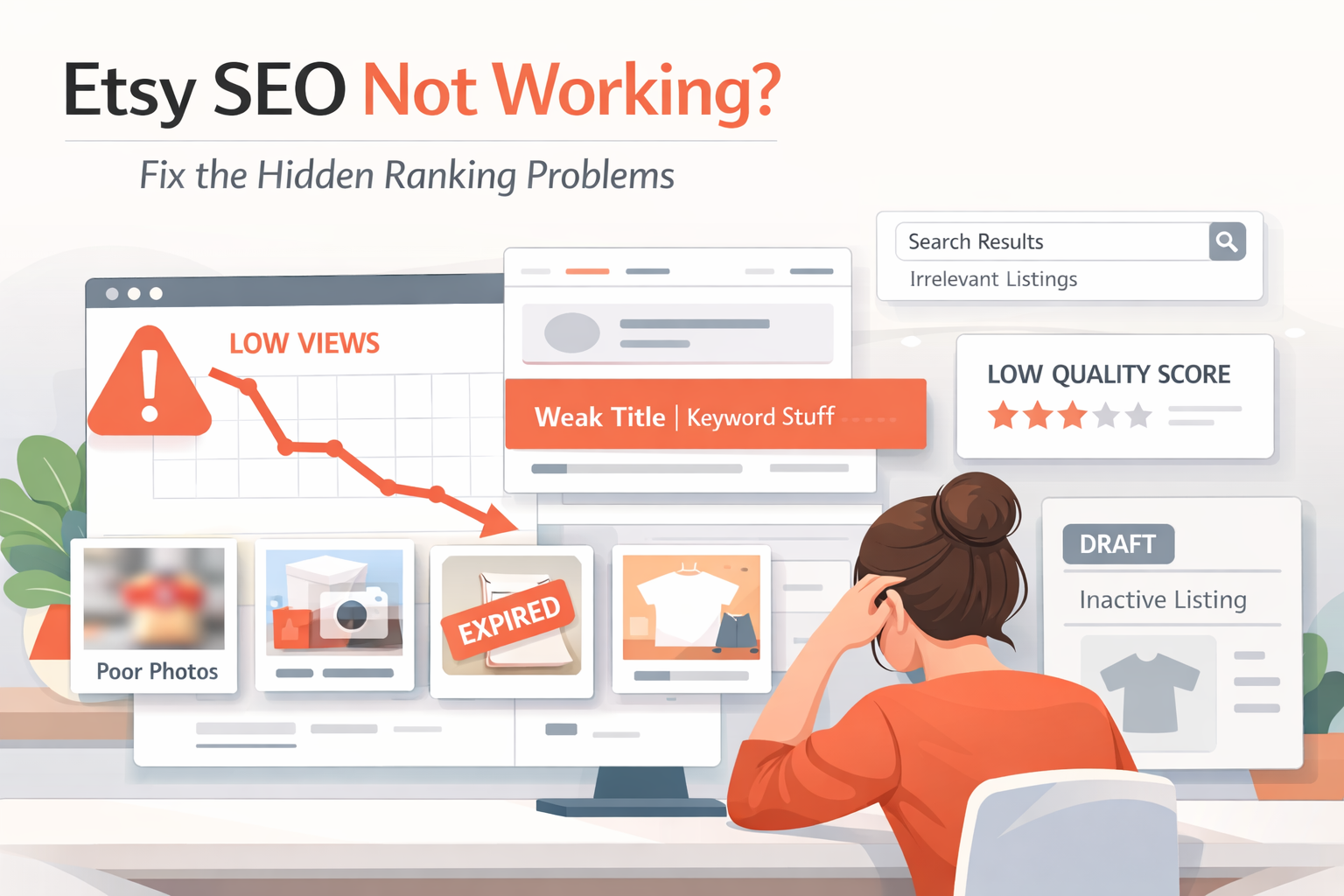
Etsy SEO Not Working? 9 Reasons Your Listings Are Not Ranking
Your Etsy listings are live. Your photos look good. But the views are not coming in.
Sound familiar? You are not alone.
Etsy SEO not working is one of the most searched problems among Etsy sellers in 2025. Many sellers spend hours writing titles and filling tags. They still get zero views. Etsy has more than 90 million active buyers worldwide, according to research from Statista on ecommerce marketplaces.
Etsy listings not getting views is almost always caused by something fixable. The key is knowing where to look.
This guide covers what Etsy SEO is, how the Etsy search algorithm ranks listings, why Etsy SEO stops working, and how to fix every problem step by step.
|
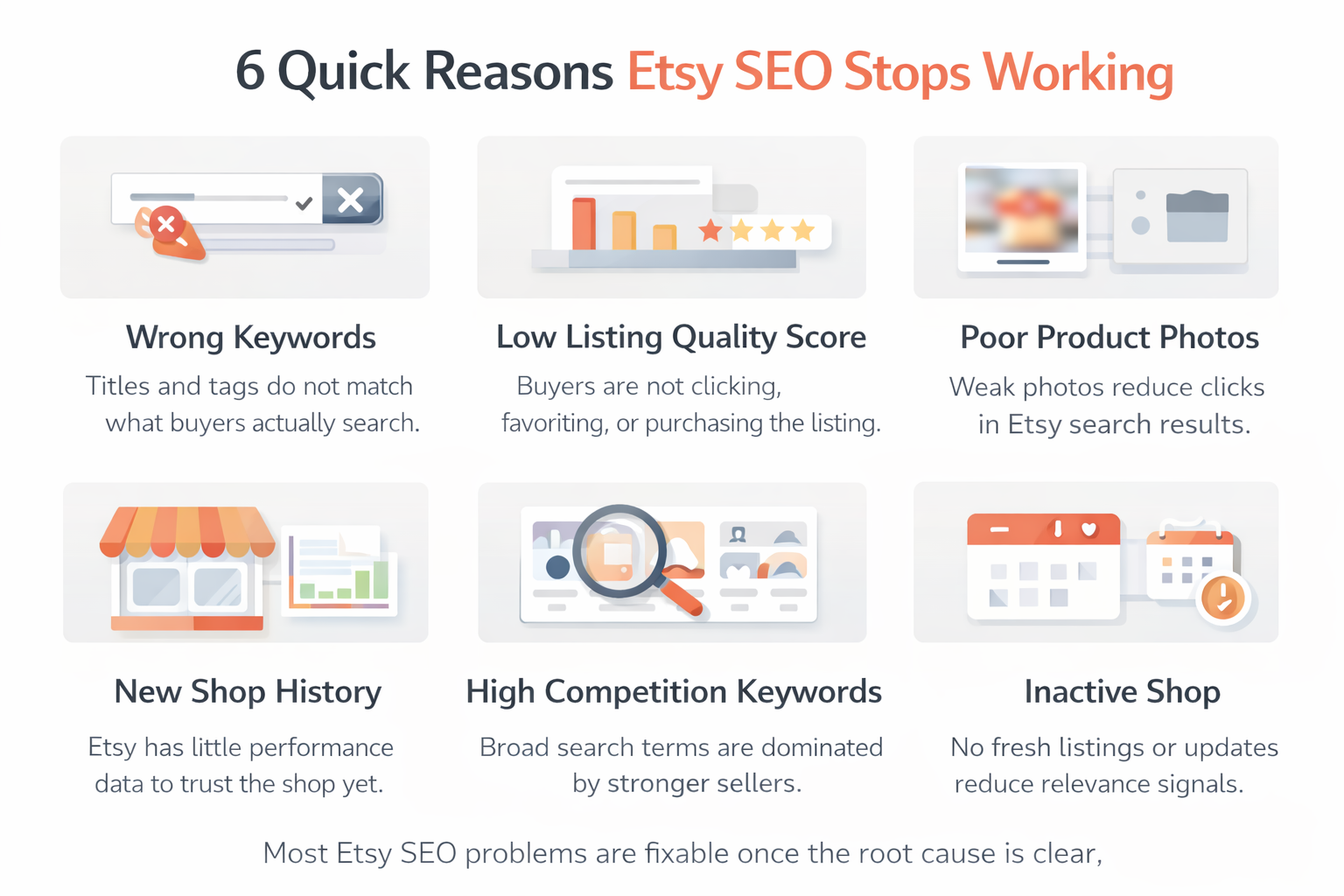
Quick Answer: Why Is Etsy SEO Not Working?
The most common causes of Etsy SEO problems are:
- Wrong keywords: Titles and tags do not match what buyers actually search.
- Low listing quality score: Buyers are not clicking or purchasing the listing.
- Poor product photos: The main image does not attract clicks in search results.
- New shop with no history: Etsy has no data yet to rank the listings.
- High competition keywords: Targeting search terms that large sellers dominate.
- Inactive shop: No new listings or updates signal low relevance to the algorithm.
Each one is fixable. This guide covers all of them.
How Etsy SEO Works in the Etsy Marketplace?
Etsy SEO is how buyers find your products inside the Etsy Marketplace.
Every time a buyer types a phrase into the Etsy search bar, the Etsy Search Algorithm scans every listing on the platform. It finds matches. Then it ranks those listings from most relevant to least.
Your job is to give Etsy enough signals to understand what your listing is and why it should show up at the top of results.
Those signals come from five areas:
- Etsy Titles: The first thing Etsy reads. Must include exact phrases buyers search for.
- Etsy Tags: 13 slots available. Each one is a keyword phrase that helps Etsy categorize the listing.
- Etsy Product Descriptions: Support keyword strategy and answer buyer questions.
- Product Photos: Affect click-through rate, which directly affects ranking.
- Etsy Keyword Research: Finding the right search phrases is the foundation of all other SEO work.
When these signals are strong and aligned, Etsy rewards the listing with better placement. When even one is weak, the listing drops lower in results.
How Etsy Search Ranking Works
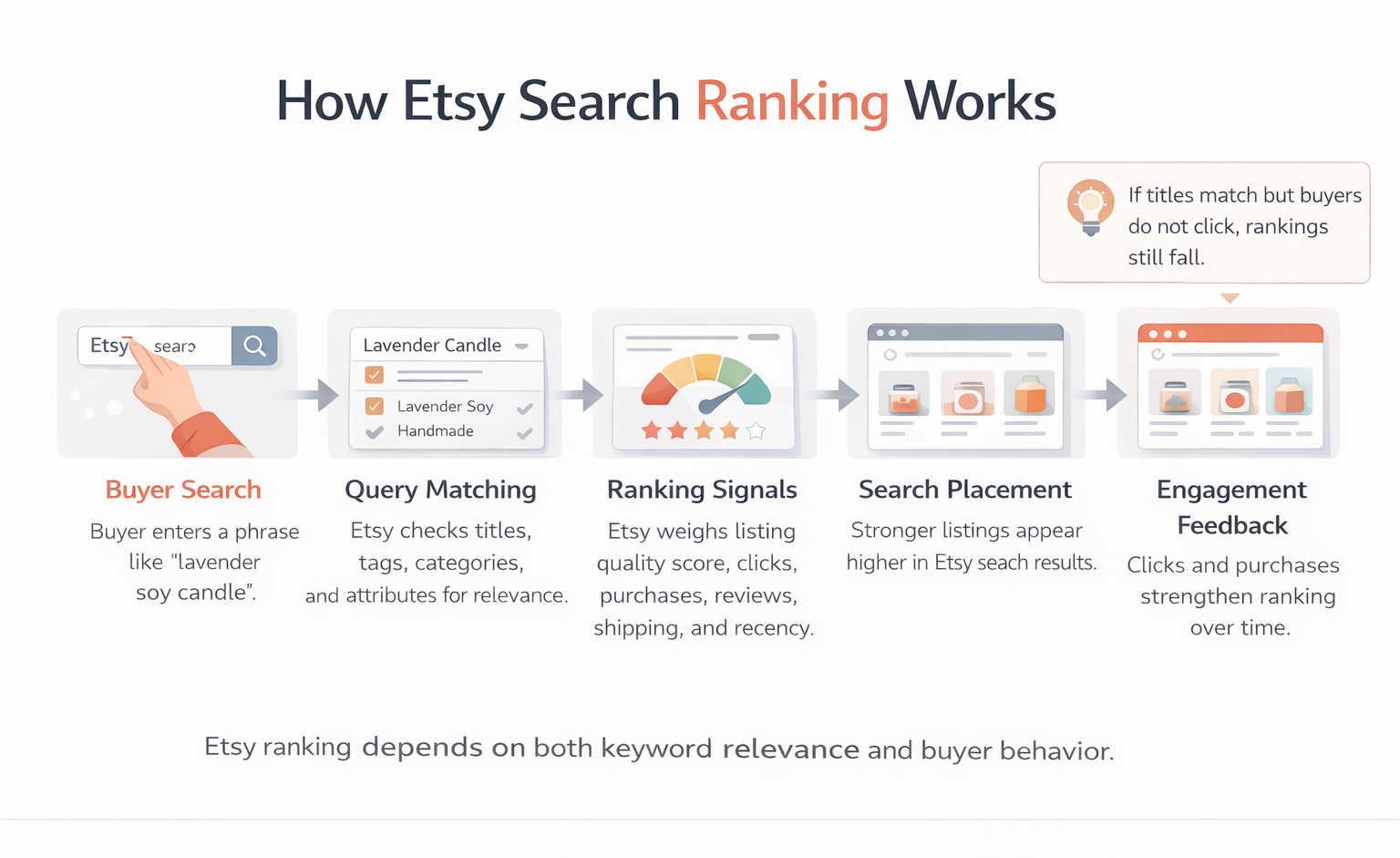
The Etsy search algorithm uses a two-step process to decide where your listing appears. Etsy processes millions of searches every day, which is why strong keyword alignment is critical for visibility.
Step 1: Query Matching
Etsy checks whether your listing is relevant to the buyer’s search. It scans your title, tags, categories, and attributes.
If the listing matches the search phrase, it enters the results pool. If it does not match, it never shows up. A listing with perfect photos and great reviews will still get zero views if the keywords are wrong.
Step 2: Ranking
Once a listing qualifies as a match, Etsy ranks it against all other matches. The Etsy Ranking System uses these signals:
- Listing Quality Score: Clicks, favorites, and purchases on the listing. This is the most important factor.
- Relevance Score: How closely the title and tags match the exact search phrase.
- Recency: Newly created or recently renewed listings get a short visibility boost.
- Customer Experience Score: Based on reviews, response time, and order handling.
- Shipping Price: Listings with free or low-cost shipping rank higher for competitive searches.
- Context-Specific Ranking: Etsy personalizes results based on each buyer’s past behavior.
Track all of this inside the Etsy Seller Dashboard in your Etsy Shop Manager. Check views, visits, and conversion rates at least once a week.
How Etsy Search Ranking Works: A Simple Example
Buyer searches: lavender soy candle
Etsy checks:
- Title match: Yes
- Tag match: Yes
- Listing quality score: Good
- Shop reviews: Positive
Result: Listing ranks higher in Etsy search results and appears in front of more buyers.
Change any one of these signals to No or Poor and the listing drops in Etsy search ranking. Every signal matters.
Every signal influences Etsy search ranking. Even small improvements can move a listing higher in results.
What Affects Etsy Search Ranking?
Etsy search ranking is driven by listing quality score, keyword relevance in titles and tags, recency of listing renewals, customer experience score, shipping price, and personalized buyer behavior signals. The listing quality score carries the most weight. A listing that buyers consistently click and purchase will outrank a perfectly keyworded listing that gets ignored.
How to Find the Best Etsy Keywords
Good Etsy SEO always begins with keyword research.
Buyers search using specific phrases. If your listing does not include those phrases, Etsy cannot show your product to the right buyers.
The easiest place to find keywords is the Etsy search bar itself.
Type your product name and watch the auto-suggest phrases appear. Every suggestion comes directly from real buyer searches. These are phrases buyers type every day.
For example, typing “soy candle” might show suggestions like:
- soy candle gift
- lavender soy candle
- Soy candle for relaxation
- natural soy candle handmade
Each suggestion is a real keyword opportunity. Use these phrases directly inside your titles and tags to improve Etsy search ranking.
Do not rely on what you think buyers search for. Use what Etsy shows you. The search bar is the most accurate keyword research tool available to any Etsy seller.
According to Shopify’s ecommerce research, keyword alignment between buyer search intent and listing content is one of the highest-impact factors for marketplace visibility. This is especially true on category-specific platforms like Etsy.
For Etsy keyword optimization, also pay attention to the number of results each phrase returns. Phrases that return fewer results are easier to rank for as a small or new shop.
Why Your Etsy SEO Is Not Working: 9 Real Reasons
Here are the nine most common Etsy SEO problems. Each one includes a plain explanation and a direct fix.
1. Poor Keyword Research
This is the number one reason Etsy SEO is not working for most sellers.
Many sellers write titles using words they would use to describe their product. But those words are often not what buyers type. Research from Forbes on ecommerce marketplace trends shows that more than 70% of online shoppers begin their product search on marketplaces rather than brand websites.
A seller might title a listing “Handcrafted Ceramic Morning Cup.” But buyers search for “large coffee mug handmade pottery.” If the words do not match, Etsy cannot connect the listing to the right buyers.
Fix it: Use auto-suggest phrases from the Etsy search bar. Target what buyers search for, not what you call the product internally.
2. Weak Etsy Titles
Etsy reads your title from left to right. The first few words carry the most ranking weight.
A strong Etsy title starts with the most specific keyword phrase. Then it adds two or three natural variations of how buyers might search for the same product.
Vague words like “beautiful” and “unique” waste valuable title space. They do not match any real buyer search query.
Fix it: Put the primary keyword phrase at the very start of the title. Add keyword variations after that. Keep the title specific and under 140 characters.
3. Etsy Tags Not Working Correctly
Etsy tags not working is a common complaint. The problem is almost always the tag strategy itself.
Single-word tags like “mug” or “necklace” are too broad. No small shop can rank for them. Copying words from the title into tags is also wasteful because Etsy already uses the title for matching.
Good tags cover different buyer angles: occasion, recipient, material, style, and use case. Each tag should open a new search door.
Fix it: Use all 13 tag slots. Every tag must be a different multi-word phrase. Never leave slots empty.
4. Low Listing Quality Score
The Etsy listing quality score is built from real buyer behavior. Every scroll-past without a click counts against the listing. Low click-through rate and low conversion rate both push the listing down in search results.
A low quality score causes ranking to drop over time, even when keyword targeting is correct.
Fix it: Improve the main photo to boost click-through rate. Rewrite the description to answer buyer questions and increase conversion rate.
5. Low Click-Through Rate
Your listing might appear in Etsy search. But buyers are not clicking on it.
In search results, buyers see many listings at once. The main photo is the only thing that makes them stop scrolling. A dark, blurry, or cluttered image loses clicks every time.
Fewer clicks means a lower listing quality score. Lower quality score means lower ranking. Lower ranking means even fewer views. The cycle compounds quickly.
Fix it: Compare the main photo directly to the top three listings for the target keyword. If it does not stand out, reshoot it before changing anything else.
6. Poor Product Photos
Poor product photos affect both click-through rate and conversion rate.
Buyers on Etsy cannot touch or try the product. Photos are the entire buying experience before checkout. Unprofessional images reduce trust and reduce sales.
Fix it: Use natural light or a simple lightbox. Shoot on a clean, neutral background. Include close-up detail shots, a lifestyle photo, and a size-reference image. Use at least five photos per listing.
7. New Shop Without Sales History
The Etsy algorithm relies on past performance data. Sales history, reviews, and engagement signals all tell Etsy whether a shop can be trusted.
A new shop has none of this. Without that history, Etsy has no reason to rank new listings above shops with hundreds of five-star reviews and thousands of completed sales.
Fix it: Generate the first sales from outside Etsy. Share listings on Pinterest or Instagram. Run a short discount to push the first few purchases. Each sale builds the history Etsy needs to start ranking listings organically.
8. Targeting High Competition Keywords
Searching for “candle” on Etsy returns millions of results. No new or small shop can rank for that term.
The solution is Etsy keyword optimization with long-tail phrases. These are specific, multi-word searches with lower competition but strong buyer intent.
A buyer searching “lavender soy candle in glass jar for bedroom” is far closer to purchasing than a buyer searching “candle.”
Fix it: Use long-tail keyword phrases from the Etsy search bar. Build rankings in lower-competition searches first before targeting broader terms.
9. Inactive or Inconsistent Shop
The Etsy search algorithm gives preference to active sellers. If a shop goes weeks without new listings or updates, Etsy treats it as lower priority.
Etsy product ranking also responds to listing renewal. A listing not updated in several months naturally loses momentum.
Fix it: Add new listings regularly. Renew older listings that are losing views. Respond to messages quickly. These small habits strengthen Etsy shop SEO strategy over time.
Example of Etsy Listing Optimization
Here is a simple example of how Etsy listing optimization works in practice.
Before and After: Etsy Title Optimization
Weak title (before):
Handmade Mug for Coffee Lovers
Optimized title (after):
Large Handmade Coffee Mug, Pottery Mug for Coffee Lovers, Ceramic Coffee Cup Gift
Why the second title works better:
- Includes the primary keyword phrase early in the title
- Uses multiple buyer search phrases that different buyers might type
- Describes the product clearly so buyers know exactly what they are getting
- Better keyword coverage increases the number of searches the listing can appear in
The same principle applies to tags. Replace vague, single-word tags with exact multi-word phrases.
Each keyword phrase creates another entry point into Etsy search ranking.
Common Etsy SEO Mistakes Sellers Make
Many Etsy SEO problems happen because of simple, repeated mistakes. Recognizing them is the fastest way to fix them.
The most common Etsy listing mistakes are:
- Using single-word tags: Tags like “ring” or “print” are too broad to rank for. Always use multi-word phrases.
- Writing decorative titles: Titles filled with adjectives like “beautiful” and “handcrafted luxury” do not match real buyer searches.
- Uploading dark or blurry photos: Low-quality images reduce click-through rate and listing quality score immediately.
- Leaving tag slots empty: Every empty tag slot is a missed ranking opportunity. Fill all 13.
- Changing listings too frequently: Changing a listing before the algorithm has had time to re-index it resets the clock. Wait at least three to four weeks between adjustments.
- Targeting only broad keywords: Small shops cannot compete for high-volume single-word searches. Long-tail phrases win more rankings early on.
These mistakes reduce Etsy search ranking and listing quality score. Fixing them one by one is the fastest way to improve Etsy visibility without needing any paid advertising.
How to Fix Etsy SEO That Is Not Working
How Do I Fix Etsy SEO Problems?
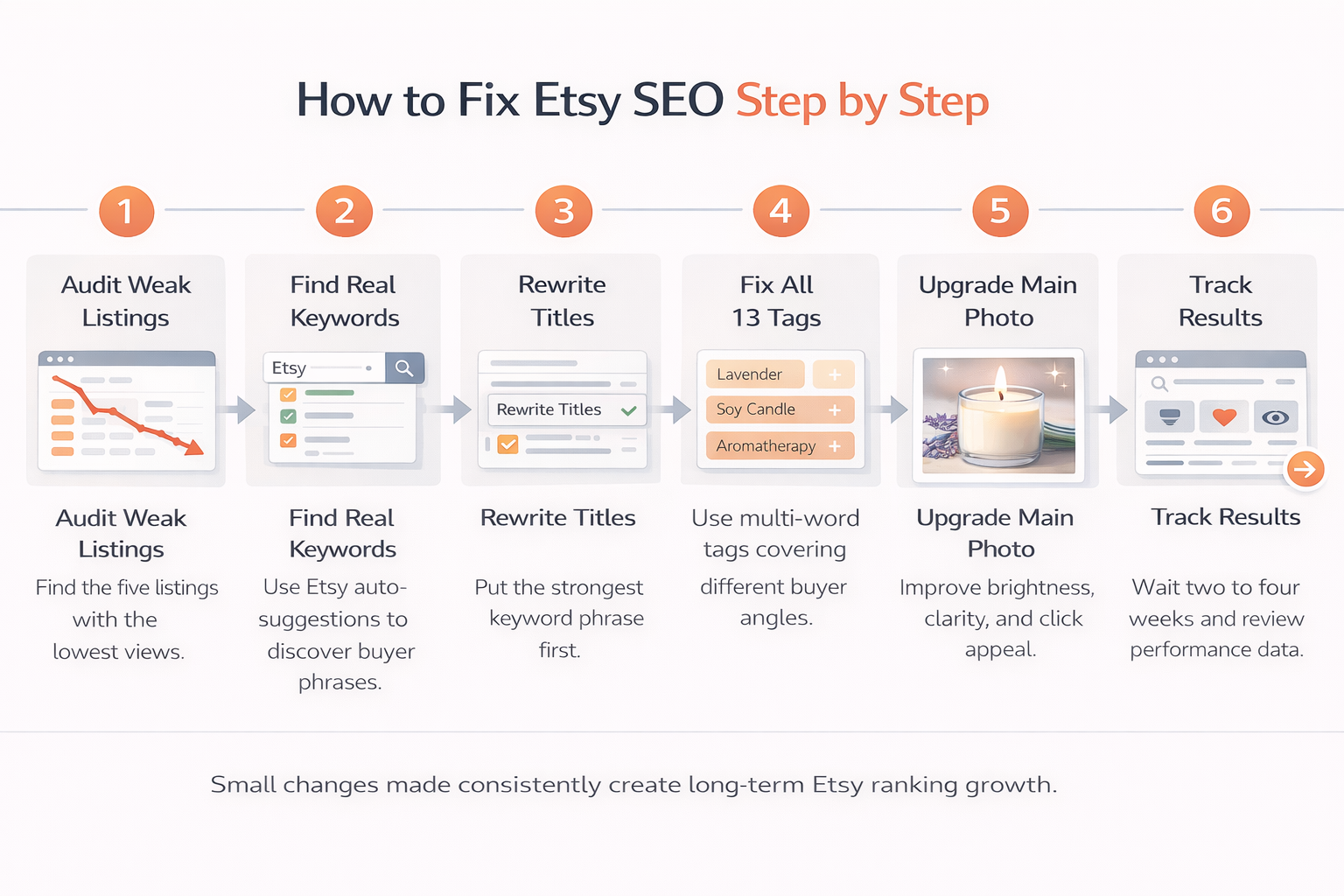
Start by auditing your five lowest-performing listings. Check that titles begin with a strong keyword phrase, all 13 tag slots are filled with multi-word phrases, and the main photos are bright and sharp.
Make one change at a time and track results in the Etsy Seller Dashboard after two to four weeks.
- Find your weakest listings. Open Etsy Shop Manager. Identify the five listings with the lowest views in the last 30 days.
- Research buyer keywords. Use the Etsy search bar auto-suggestions to find real buyer phrases for your product.
- Rewrite the title. Start with the strongest keyword phrase. Add two or three variations after it.
- Replace weak tags. Remove single-word tags. Fill all 13 slots with specific multi-word phrases.
- Upgrade the main photo. Compare it to the top three listings for the target keyword. If it does not stand out, reshoot it first.
- Track changes in the Etsy Seller Dashboard. Wait two to four weeks before judging results. The algorithm needs time to re-index and collect new data.
For sellers managing large catalogs, Etsy automation services can handle listing optimization at scale, keeping SEO quality consistent across every product without spending hours on manual updates.
What Successful Etsy Sellers Do Differently
Successful Etsy sellers do not treat SEO as a one-time setup task. They treat it as an ongoing process.
The sellers who grow consistently are the ones who:
- Test new keyword phrases regularly based on Etsy search bar data
- Improve listing photos whenever the click-through rate drops
- Monitor listing performance in the Etsy Seller Dashboard every week
- Add new listings frequently to signal shop activity to the algorithm
- Renew older listings that are losing views to trigger a recency boost
- Review their tags every quarter to keep up with changing buyer search trends
These small, regular improvements help listings gain stronger engagement signals over time. Better engagement signals lead to higher listing quality scores. Higher quality scores lead to better Etsy search ranking.
The compounding effect of consistent optimization is what separates sellers who grow year over year from sellers who plateau after the first few months.
For a complete walkthrough of turning Etsy search traffic into a repeatable income system, the
Etsy sales funnel automation guide covers how top sellers build sustainable monthly revenue from organic Etsy search traffic.
Etsy SEO Checklist: 12 Points Every Listing Must Pass
Use this Etsy SEO checklist before publishing any new listing and when auditing existing listings that are not getting views.
Etsy SEO Checklist: 12 Must-Pass Points
- ✓ Title starts with the primary keyword phrase buyers search for
- ✓ Title includes 2 to 3 natural keyword variations across the full title
- ✓ All 13 tag slots are filled with no empty slots remaining
- ✓ Every tag is a multi-word phrase, not a single word
- ✓ Tags cover different buyer angles: occasion, recipient, style, material, use
- ✓ First product photo is bright, sharp, and stands out in search results
- ✓ Product description opens with a keyword-rich sentence in the first paragraph
- ✓ Product category and subcategory match the actual product exactly
- ✓ All relevant attributes are fully completed, including color, size, and material
- ✓ Shipping price is competitive, and free shipping is offered where possible
- ✓ Listing has been renewed or updated within the last 90 days
- ✓ Listing performance is reviewed in the Etsy Seller Dashboard at least monthly
Final Thoughts
Etsy SEO not working is almost always a solvable problem.
Start with the weakest listings. Fix titles so they begin with a real buyer search phrase. Fill every tag slot. Upgrade the main photo to earn more clicks. Then be patient.
Most Etsy SEO problems in 2025 are small, fixable gaps in keyword targeting, photo quality, or shop history that compound over time into zero traffic and zero sales.
Sellers who treat Etsy listing optimization as an ongoing practice are the ones who build real, lasting growth. Small improvements made every week add up to major results over months.
For hands-on help and Etsy store growth strategies, visit hisellit to connect with specialists who work exclusively with Etsy sellers.
Frequently Asked Questions
Q. Why is my Etsy SEO not working?
Etsy SEO usually stops working when the listing does not match buyer search intent. The Etsy algorithm checks titles, tags, and categories to decide whether a listing is relevant. If the keywords in the listing do not match what buyers search for, the listing will not appear in results. Other common causes include low listing quality score, weak product photos, and targeting highly competitive keywords.
Q. Why are my Etsy listings not getting views?
Etsy listings that receive no views usually have a keyword mismatch. The titles and tags may not match the phrases buyers actually search for. A new listing can also take 24–72 hours before it appears in Etsy search results. If the listing has been live for longer than that, review the keyword strategy and main photo to improve visibility.
Q. How long does Etsy SEO take to work?
Etsy SEO changes normally take two to four weeks before noticeable results appear. The Etsy search algorithm needs time to re-index updated listings and collect new engagement data, such as clicks and purchases. For brand new shops, it may take three to six months for rankings to stabilize while the algorithm gathers enough performance history.
Q. Why are my Etsy listings not appearing in search?
If Etsy listings are not appearing in search results, the most common reason is incorrect keywords. The title and tags may not match real buyer search phrases. Listings can also disappear from search if they violate Etsy policies or are still being indexed after publishing. Checking tags, titles, and shop status in the Etsy Shop Manager usually reveals the problem.
Q. What are the most important Etsy ranking factors?
The most important Etsy ranking factors are listing quality score, keyword relevance, and customer experience score. Listing quality score is based on click-through rate, purchases, and engagement actions such as favorites. Keyword relevance comes from how closely titles and tags match buyer search queries. Customer experience score reflects shop reviews, response time, and order reliability.
Q. Does renewing an Etsy listing improve SEO?
Renewing an Etsy listing can temporarily improve visibility because Etsy gives recently renewed listings a short recency boost in search results. This boost is usually short-term and works best when the listing already has strong keywords and good engagement. Renewing a listing without improving the title, tags, or photos rarely produces long-term ranking gains.
Q. Do Etsy descriptions affect SEO?
Etsy descriptions play a supporting role in SEO. The Etsy search algorithm primarily evaluates titles, tags, categories, and attributes when matching listings to search queries. However, descriptions help reinforce keywords and improve conversion rates by answering buyer questions. A well-written description can increase purchases, which indirectly improves listing quality score and ranking.


One Comment