
How Much Does YouTube Pay Per View? 2026 Earnings Breakdown
If you are thinking about starting a YouTube channel, this is probably the first question you ask.
How much does YouTube pay per view?
The honest answer is: it is not a flat rate. YouTube pay per view depends on several factors that are different for every channel and every video. But once you understand how the system works, you can make smarter decisions and grow your YouTube income faster.
This guide breaks it all down. Real numbers. Real examples. No fluff.
Quick Answer: How Much Does YouTube Pay Per View?
YouTube typically pays $2 to $12 per 1,000 views. That equals roughly $0.002 to $0.012 per single view. Actual earnings vary depending on niche, audience location, advertiser demand, and how viewers interact with ads.
- Niche: Finance, software, and business channels often earn higher CPM rates.
- Audience location: Views from the United States, United Kingdom, Canada, and Australia usually generate more ad revenue.
- Advertiser demand: Ad spending increases during peak seasons such as Q4.
- Viewer engagement: Longer watch time and higher interaction increase monetized views.
Because of these factors, two channels with the same number of views can earn very different amounts from YouTube advertising revenue.
What Does “YouTube Pay Per View” Actually Mean?
YouTube pay per view does not mean a fixed payment for every video view.
Instead, YouTube earnings come from advertising revenue generated when ads are shown during a video. Creators earn a share of that ad revenue through the YouTube Partner Program. This is why actual YouTube earnings per view vary so widely from channel to channel.
One creator might earn $0.003 per view. Another earns $0.015 per view. Same platform, completely different YouTube revenue per view.
Why are YouTube earnings per view different for every channel
The difference comes down to niche, audience location, and how much advertisers are willing to pay to reach that audience. Understanding this is the foundation of every smart YouTube monetization strategy.
How YouTube Actually Pays Creators
Here is the first thing most beginners get wrong. YouTube does not pay you for every person who watches your video. It pays you based on the ads shown to those viewers.
When a viewer watches your video and an ad plays, that is called a monetized view. YouTube takes ad money from businesses, keeps 45% for itself, and gives you the remaining 55%. That is where your YouTube revenue per view comes from.
To start earning, you need to join the YouTube Partner Program. You can read the full eligibility details directly on the YouTube Partner Program official page.
Once you are in, your channel connects to a Google AdSense account. That is how your earnings get tracked and paid out every month.
Why some YouTube views do not generate revenue
Not every view on your video will show an ad. Some viewers use ad blockers. Some are in countries where advertisers spend very little.
All of that affects your YouTube earnings per view and explains why that number shifts from video to video. This is why two channels with the same total views can have very different YouTube money per view figures.
Content creators who understand this earn more because they focus on audience quality, not just raw view counts.
How Much Does YouTube Pay Per 1000 Views?
This is the number most creators want to know. On average, how much does YouTube pay per 1000 views? The typical range is $2 to $12.
That is a wide window on purpose. YouTube earnings per 1000 views vary a lot depending on your niche and audience.
A personal finance channel with US viewers can easily earn $15 or more per 1,000 views. A gaming channel with a young global audience might earn $2 to $3 for the same YouTube earnings per 1000 views. Same platform, very different YouTube money per view.
So when people ask how much does YouTube pay per 1000 views, the honest answer is: it depends on your niche, your audience location, and how many of those views actually get an ad.
Realistic YouTube Earnings by View Count
| Views | Low Estimate | High Estimate | Typical Channel Type |
| 1,000 views | $2 | $12 | Most niches |
| 10,000 views | $20 | $120 | Most niches |
| 100,000 views | $200 | $1,200 | Mid-tier channel |
| 1,000,000 views | $2,000 | $12,000 | Established channel |
These figures cover YouTube ads revenue only. Sponsorships, affiliate deals, and merchandise sit on top of this. How much does YouTube pay per 1000 views also depends on the time of year.
Advertisers spend peaks in Q4, so how much does YouTube pay per 1000 views in November can be two to three times higher than in January.
The metric that tells you your actual take-home rate is called RPM. More on that next.
YouTube CPM vs RPM Explained
These two terms confuse a lot of creators. Both are important, and they mean very different things.
What Is YouTube CPM?
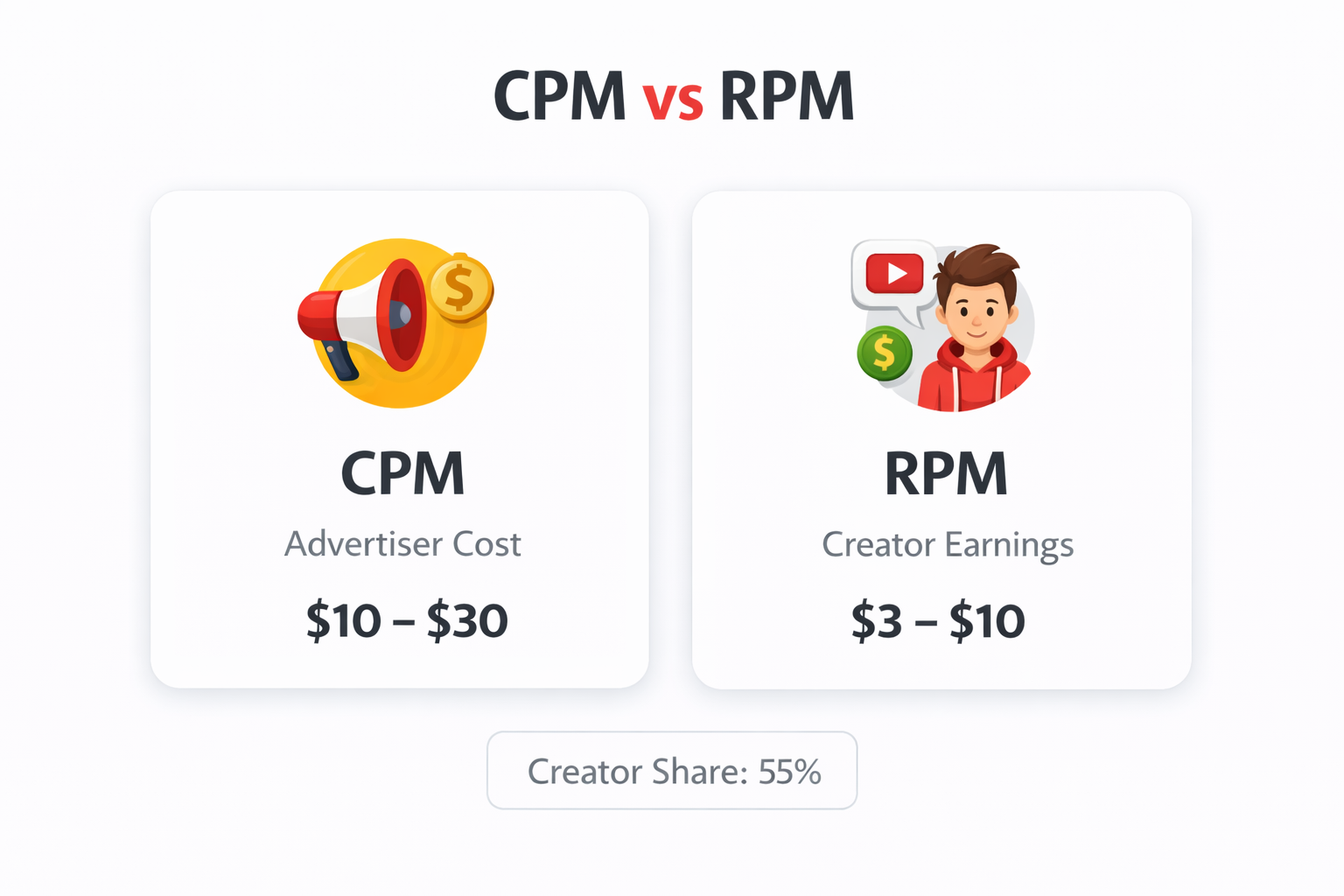
CPM stands for Cost Per Mille. That means cost per 1,000 ad impressions.
This is what advertisers pay YouTube to show their ads. The YouTube cpm rate is set by advertiser bidding.
Businesses compete to show ads to your audience. The more valuable your audience, the higher your YouTube cpm rate goes. A business selling accounting software wants to reach small business owners.
If your channel covers business topics, advertisers will bid more to appear on your videos. That is why niche selection matters so much for YouTube advertising revenue.
The YouTube Creator Academy has detailed guidance on how advertising on YouTube works and how CPM rates are determined.
What Is YouTube RPM?
RPM stands for Revenue Per Mille. This is what you actually earn per 1,000 views. After YouTube takes its 45% cut, you keep 55%.
So, if your YouTube cpm rate is $10, your YouTube RPM rate works out to around $5.50 to $6. That RPM figure is your real answer to how much does YouTube pay per 1000 views in take-home terms.
RPM is always lower than CPM. It is the number that actually lands in your Google AdSense account. Your YouTube RPM rate is visible inside YouTube Studio under the Analytics tab.
Tracking it weekly helps you understand which videos are generating the most YouTube video monetization value.
| Term | Full Name | What It Measures | Who Uses It |
| CPM | Cost Per Mille | What advertisers pay per 1,000 ad views | Advertisers |
| RPM | Revenue Per Mille | What creators earn per 1,000 total views | Creators |
Think of CPM as the price tag on the shelf. RPM is what you actually take home after the store takes its cut.
How Much YouTube Pays For 1 Million Views
This is one of the most searched questions in the YouTube creator economy.
And the answer depends heavily on your niche and audience. For a typical channel, how much YouTube pays for 1 million views lands somewhere between $2,000 and $8,000 from ads alone. But channels in premium niches can go much higher when asking how much YouTube pays for 1 million views.
Example earnings by YouTube niche
Here are realistic examples of how much YouTube pays for 1 million views across different content types:
- Finance or investing channel: $8,000 to $20,000
- Business or technology channel: $6,000 to $15,000
- Health or wellness channel: $4,000 to $10,000
- General entertainment channel: $2,000 to $5,000
- Gaming or reaction content: $1,500 to $4,000
The difference comes down to advertiser bidding.
Premium advertisers pay high CPMs to reach specific audiences.
When your content attracts those audiences, how much YouTube pays for 1 million views goes up significantly.
Real Calculation Example
Here is how YouTube channel earnings from 1 million views break down for a finance channel:
- Total views: 1,000,000
- Monetization rate: 65% (not every view gets an ad)
- Monetized views: 650,000
- YouTube cpm rate: $18
- Gross ad revenue: $11,700
- Creator share at 55%: approximately $6,435
That is a realistic look at YouTube creator earnings from ad revenue on a well-targeted finance video with a US-heavy audience.
Factors That Affect YouTube Earnings
Two channels can have the exact same view count and earn completely different amounts.
Here is why.
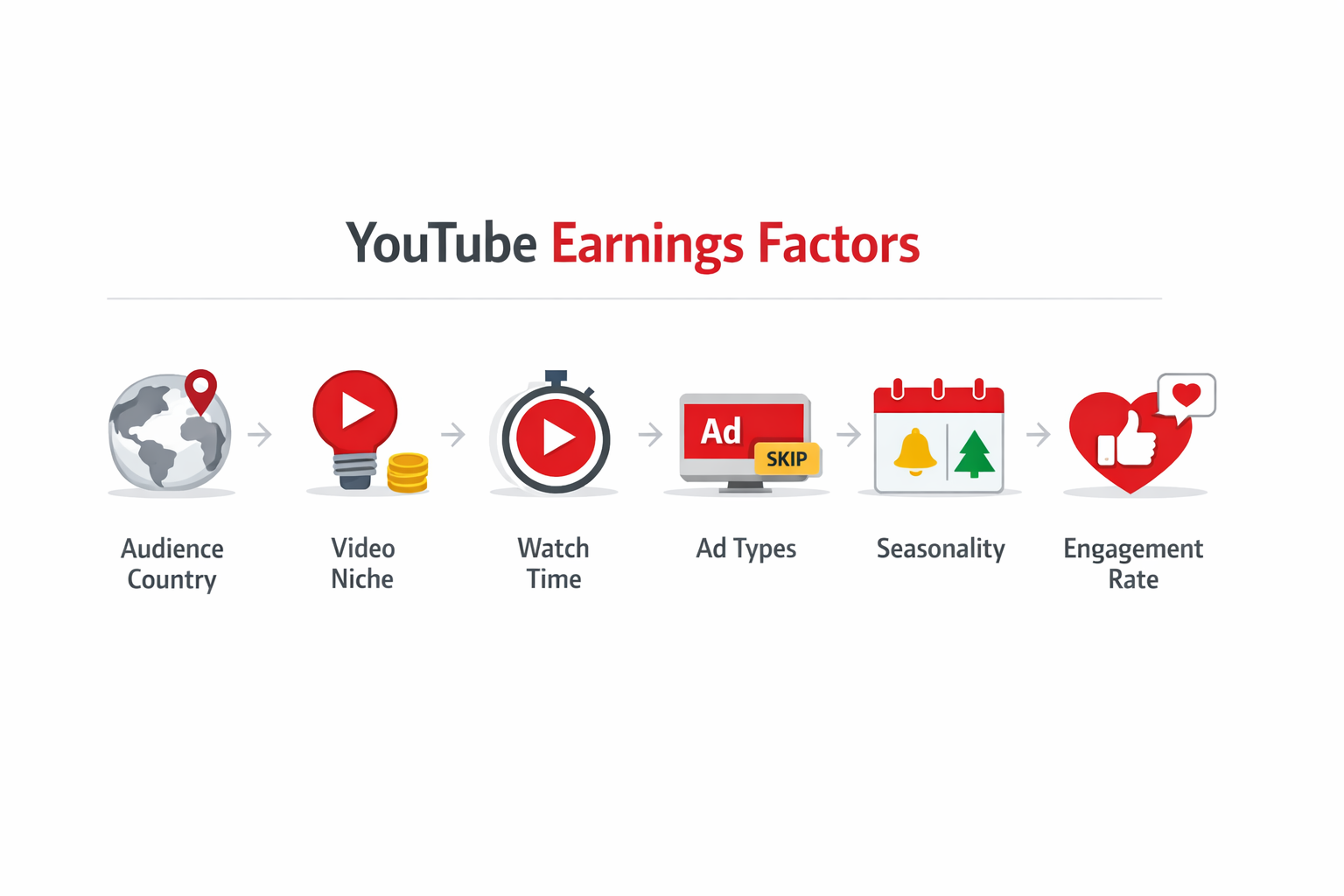
Audience Location
This is one of the biggest factors in YouTube revenue per view. Viewers in the United States, the United Kingdom, Canada, and Australia generate far higher YouTube ads revenue than viewers from other regions.
Advertisers in these countries pay premium CPMs because their products and services cost more. A channel with 90% US traffic will earn much more per view than one with 90% traffic from lower-CPM regions.
Audience location alone can triple or quadruple your YouTube money per view.
Video Niche
Finance, software, real estate, insurance, and business content earn the highest YouTube cpm rates. These audiences have money and are likely to buy expensive products.
Entertainment, comedy, and gaming channels attract younger viewers who are less valuable to most advertisers. Niche selection is the single biggest decision that affects your long-term YouTube income.
Watch Time
Longer videos can include mid-roll ads, which means more ad impressions per view.
A 20-minute finance video can serve three or four ads throughout. A 4-minute video serves one. More ad impressions equal more YouTube money per view.
The YouTube algorithm also rewards longer watch time with better distribution, which compounds earnings over time.
Advertiser Demand and Seasonality
Q4 is the golden quarter for YouTube advertising revenue. October, November, and December bring the highest YouTube cpm rates of the year.
Advertisers are competing hard for holiday shoppers during this period. January usually drops sharply as annual budgets reset. According to Statista’s digital advertising data, global digital ad spend peaks significantly in Q4 every year, directly impacting YouTube cpm rates.
Knowing this helps you plan your publishing schedule around peak advertiser demand periods.
Ad Types: Skippable, Non-Skippable, and Display Ads
Non-skippable ads generate more revenue per impression because advertisers are guaranteed full delivery. Skippable ads only pay in full when the viewer watches 30 seconds or to the end.
Display ads run alongside the video and add to total YouTube monetization earnings with minimal disruption. A video that serves a mix of non-skippable ads and skippable ads will generate more YouTube money per view than one that only runs display ads. A healthy mix of all three ad types adds up meaningfully over time.
Video Engagement
High video engagement signals quality to the YouTube algorithm. When viewers watch longer, like, comment, and share, YouTube pushes the video to more people.
More reach means more monetized views and more YouTube ads revenue. Engagement does not directly change your CPM, but it feeds the distribution that grows your total earnings.
How Much YouTube Pays For 10K Views and YouTube Income Per 100K Views
Early-stage creators often ask how much YouTube pays for 10k views.
At a YouTube RPM rate between $3 and $8, that works out to $30 to $80 in YouTube channel earnings from 10,000 views.
To put that in per-thousand terms, those YouTube earnings per 1000 views from a new channel typically land at the lower end of the $2 to $12 range. That number feels small, but it compounds fast as you publish more consistently.
For YouTube income per 100k views, most channels land between $200 and $1,200. A finance or tech channel with strong US traffic can push past $1,500 per 100,000 views when the YouTube RPM rate is strong.
Again, the YouTube earnings per 1000 views for that niche can be $10 to $15, which explains the jump in total earnings.
Using a YouTube Earnings Calculator
Using a YouTube earnings calculator tool gives you a rough estimate before you even hit monetization. These tools let you plug in your niche, estimated CPM, and view count to see potential YouTube channel earnings.
The key takeaway: YouTube video monetization rewards consistency.
Ten videos at 10,000 views each equals 100,000 total views. At average RPM that is $200 to $1,200 monthly. That is a real business if you treat it like one.
Simple YouTube Earnings Formula
You can estimate YouTube ad revenue using a simple formula based on RPM (Revenue Per Mille).
Estimated Earnings = (Views ÷ 1,000) × RPM
Example:
- Total views: 100,000
- Average RPM: $6
- Calculation: (100,000 ÷ 1,000) × $6
- Estimated earnings: $600
This formula gives a rough estimate of YouTube advertising revenue. Actual earnings may vary depending on niche, audience location, and advertiser demand.
How Much YouTube Shorts Pay
YouTube Shorts monetization works very differently from long-form video.
Instead of direct ad revenue per video, YouTube pools all advertising revenue earned between Shorts into a Creator Pool.
That pool is then split among creators based on their share of total Shorts views.
In practice, most creators report earning between $0.03 and $0.08 per 1,000 Shorts views through YouTube shorts monetization. That is far lower than the $2 to $12 range for long-form content.
This does not mean Shorts are useless for YouTube income. They are one of the best discovery tools on the platform.
A viral Short that brings 50,000 new subscribers can generate significant YouTube advertising revenue indirectly by growing the audience for monetized long-form videos.
Think of YouTube Shorts monetization as a growth engine, not a primary YouTube passive income source.
The real YouTube monetization earnings come from long-form content.
How Much Does YouTube Pay Per Subscriber?
This question comes up a lot, and the answer surprises most creators. YouTube does not pay per subscriber. Subscribers do not directly generate any YouTube advertising revenue on their own.
So why do subscribers matter so much for YouTube channel earnings? Because subscribers are your most loyal viewers.
When you publish a new video, subscribers are the first to watch it. That early engagement boost tells the YouTube algorithm the video is worth distributing.
More distribution means more total views, more monetized views, and more YouTube ads revenue.
Subscribers also tend to have longer watch time per session because they already trust your content. Longer watch time means more ad impressions per viewer. And more ad impressions means a higher YouTube RPM rate for that video.
In short, subscribers do not pay you directly. But they are the engine that multiplies your YouTube money per view across every video you publish.
A channel with 100,000 highly engaged subscribers will consistently out-earn a channel with 500,000 passive ones.
The Forbes Business Council has covered how creator audience engagement drives long-term YouTube creator earnings far more than raw subscriber counts alone.
Subscriber loyalty, not subscriber count, is what drives sustainable YouTube income growth.
Highest Paying YouTube Niches in 2026
Niche selection is everything in the YouTube ad revenue model.
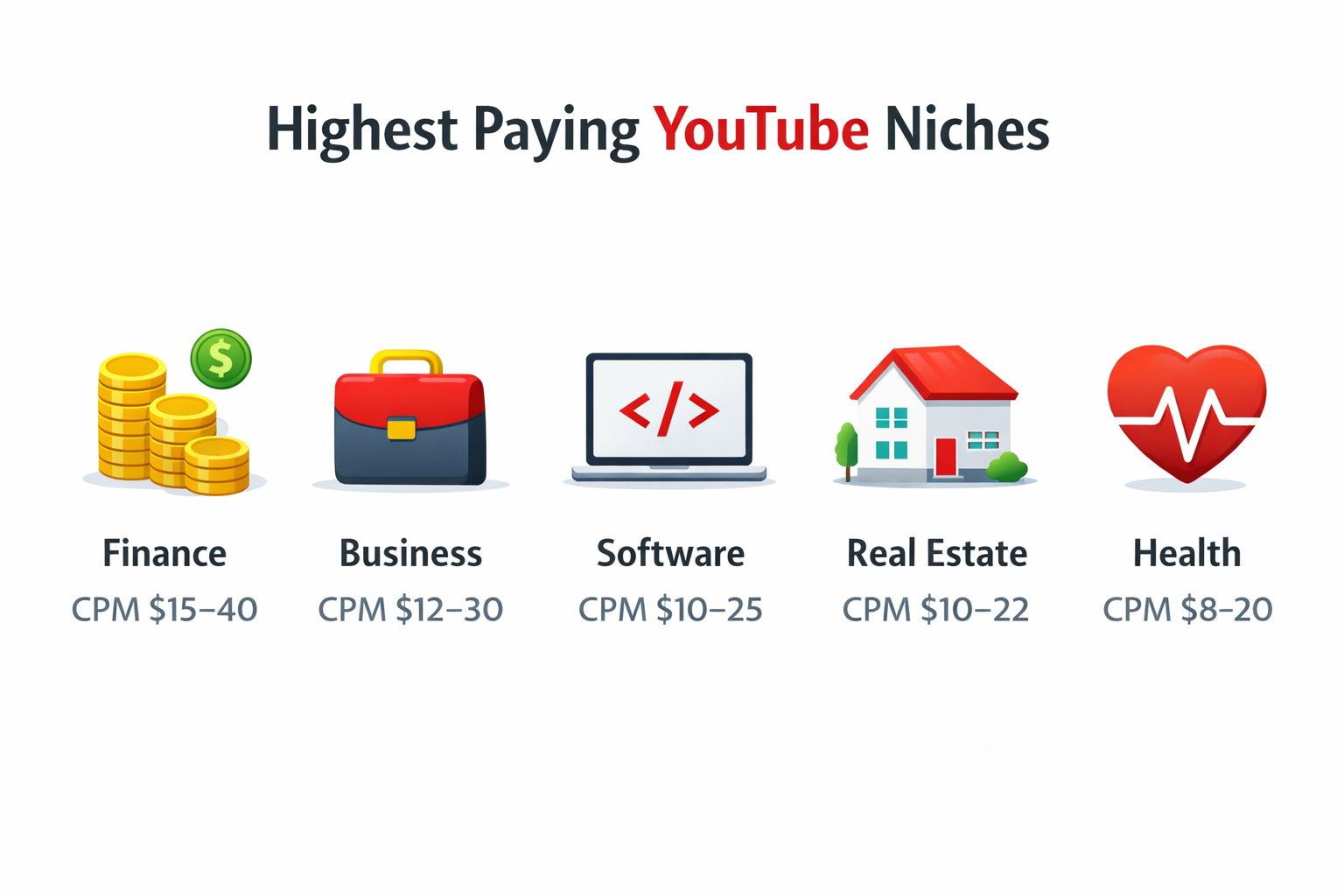
Here are the niches where premium advertisers spend the most, driving up YouTube cpm rates and YouTube channel earnings:
| Niche | Average CPM Range | Why CPM Is High |
| Personal Finance / Investing | $15 – $40 | Banks, brokers, and financial apps target buyers |
| Business / Entrepreneurship | $12 – $30 | B2B software, courses, and tools |
| Technology / Software (SaaS) | $10 – $25 | High-value software subscriptions |
| Real Estate | $10 – $22 | Mortgages, agents, and property platforms |
| Legal / Law | $12 – $28 | Legal services have very high client value |
| Health and Medical | $8 – $20 | Pharma and health brands pay well |
| Gaming | $2 – $6 | Young audience, lower advertiser spend |
| Entertainment / Reaction | $1.50 – $5 | Broad audience, low buyer intent |
Content creators in high-CPM niches earn exponentially more per view than those in broad entertainment.
A finance channel with 50,000 subscribers can out-earn a gaming channel with 500,000 subscribers purely because of advertiser bidding differences.
YouTube Monetization Requirements (2026)
Before any YouTube monetization earnings land in your account, you need to qualify for the YouTube Partner Program.
Here are the current YouTube monetization requirements:
Standard Monetization Tier (Full Ad Revenue)
- 1,000 subscribers
- 4,000 valid public watch hours in the past 12 months, OR 10 million Shorts views in 90 days
- An approved and linked Google AdSense account
- No active Community Guidelines strikes
- Full compliance with YouTube monetization policy
Expanded Access Tier (Fan Funding Features Only)
- 500 subscribers
- 3 public uploads in the past 90 days
- 3,000 watch hours or 3 million Shorts views in 90 days
- Grants access to channel memberships and Super Thanks only, not full ad monetization
Meeting YouTube monetization requirements is the starting line, not the finish line.
Once you are in the YouTube Partner Program, the real work is optimizing your content to maximize YouTube creator earnings from every video.
YouTube reviews all applications manually. Most channels hear back within 30 days.
If rejected, you can reapply after 30 days.
How YouTube Automation Channels Make Money
YouTube automation channels are one of the most discussed models in the YouTube creator economy right now.
The idea is simple. Instead of doing everything yourself, you build a team and a production system. Scriptwriters, voiceover artists, video editors, and thumbnail designers each handle one part of the process. The channel owner focuses on strategy, niche selection, and scaling.
This is what makes YouTube automation channels attractive for entrepreneurs who want YouTube passive income without appearing on camera.
Popular YouTube automation niches include personal finance, true crime, history, AI, and motivational content. These niches also happen to sit in the higher CPM brackets. That means YouTube channel earnings can scale faster than in entertainment niches.
Creators building automated channels often rely on structured production workflows to publish consistently. Businesses offering YouTube automation services handle scripting, editing, and publishing so creators can focus entirely on strategy and growth.
A well-run channel producing two to three videos per week in a $10 to $20 CPM niche can generate $2,000 to $10,000 per month in YouTube advertising revenue once it reaches 100,000 to 500,000 monthly views.
The YouTube video monetization model for automation channels is the same as any other channel. But the key advantage is that automation lets you operate multiple channels in parallel. That multiplies your total YouTube revenue streams significantly.
Before building one of these channels, it helps to understand the risks. Knowing the most common YouTube automation demonetization mistakes can save months of work and protect your YouTube monetization earnings.
For creators wondering if the model is still worth it, this deep dive on whether YouTube automation is saturated gives an honest answer backed by real data.
Other Ways YouTubers Make Money Beyond Ads
Smart content creators never rely on YouTube ads revenue alone. The YouTube creator economy offers multiple ways to earn.
Many creators find that YouTube advertising revenue makes up less than half of their total income once they grow.
Brand Sponsorships
Brand sponsorships are often the biggest income source for mid-to-large channels.
A company pays the creator directly to mention or demonstrate their product in a video.
This is completely separate from YouTube advertising revenue and does not require ad impressions. A finance creator with 100,000 subscribers might charge $2,000 to $8,000 per sponsored segment.
Affiliate Marketing
Affiliate marketing lets content creators earn commissions when viewers buy products through unique links.
This works especially well in niches like tech reviews, software, and finance tools.
It adds to YouTube income without requiring any extra production. One well-placed affiliate link in a high-traffic video can generate recurring commissions for years.
Channel Memberships and Super Thanks
YouTube’s built-in fan funding features let loyal viewers support creators directly.
Channel memberships offer monthly perks like exclusive content or badges. Super Thanks and Super Chats during live streams let viewers tip their favorite creators.
These YouTube passive income features work best for channels with tight-knit communities.
Merchandise and Digital Products
Creators with strong personal brands sell merchandise, online courses, ebooks, and templates.
This YouTube revenue stream is entirely independent of advertiser bidding and algorithm shifts. Digital products have near-zero fulfillment cost, making them one of the most scalable options.
The most successful creators in the YouTube creator economy treat YouTube advertising revenue as one income layer, not the whole picture.
Quick Answer: How Creators Increase YouTube Earnings Per View
Creators increase YouTube earnings per view by improving the quality of their audience, content, and ad opportunities. The most effective ways include:
- Choose high-CPM niches: Topics like finance, software, business, and real estate attract advertisers who pay higher rates.
- Target high-advertiser regions: Views from the United States, United Kingdom, Canada, and Australia usually generate higher ad revenue.
- Publish longer videos: Longer videos allow mid-roll ads, increasing total ad impressions.
- Increase watch time: Videos that hold attention longer are pushed to more viewers by the YouTube algorithm.
- Improve engagement: Likes, comments, and shares help videos reach more viewers and generate more monetized views.
Optimizing these factors can significantly increase your YouTube revenue per view over time.
Final Takeaway: What Should You Focus On?
Understanding how much does YouTube pay per view is just the beginning. The number itself is less important than the factors you can control to push it higher.
Choose a niche with strong advertiser demand. Build an audience in high-CPM countries. Create longer videos that can run mid-roll ads. Publish consistently so the YouTube algorithm keeps distributing your content. And never rely on YouTube ads revenue alone as your only YouTube income source.
The YouTube creator economy rewards creators who think like business owners.
Content is the product. Your audience is the asset. And YouTube channel earnings from ads are just one revenue layer among many.
Creators using YouTube SEO strategies alongside their monetization plan see faster growth because organic discovery compounds over time.
More visibility means more views, more monetized views, and more YouTube advertising revenue month after month.
Whether you are building a personal brand or a YouTube automation business model, the path to meaningful YouTube creator earnings is the same.
Understand the system. Optimize for the right variables. Treat it as a long-term investment.
Frequently Asked Questions
Q. Does YouTube pay per view or per ad?
YouTube pays creators when an ad is shown on a video. It does not pay for every view. A creator earns money when a viewer watches an advertisement during the video.
If no ad appears, that view does not generate income. This can happen when a viewer uses an ad blocker or when advertiser demand is low in that region. Because of this, YouTube pay per view is not a fixed amount.
Q. How much does YouTube pay per 1,000 views?
Most channels earn between $2 and $12 for every 1,000 views. The exact amount depends on the niche, audience location, and advertiser demand.
Channels in finance, software, or business topics often earn more because advertisers pay higher rates. The number creators should watch is RPM, which shows the real earnings per 1,000 views inside YouTube Studio.
Q. How much money is 1 million YouTube views worth?
For many channels, 1 million YouTube views generate about $2,000 to $8,000 from ads. The amount can be higher in premium niches such as finance or technology.
Channels with a large audience in the United States, the United Kingdom, or Canada often earn more because advertisers pay higher CPM rates in those countries.
Q. What is the difference between YouTube CPM and RPM?
CPM shows how much advertisers pay for 1,000 ad impressions. RPM shows how much creators actually earn per 1,000 views after YouTube takes its share.
For example, if the CPM is $12, the RPM may be around $6 to $7. RPM is the most important number because it shows the real money a creator receives.
Q. How much do YouTube Shorts pay per 1,000 views?
YouTube Shorts usually earn about $0.03 to $0.08 per 1,000 views. This is much lower than long videos.
YouTube collects ad revenue from Shorts and places it in a shared pool. That pool is then divided among creators based on their share of total views.
Q. What are the YouTube monetization requirements in 2026?
To earn ad revenue, creators must join the YouTube Partner Program. A channel needs 1,000 subscribers and 4,000 watch hours in the last 12 months.
Another option is 10 million Shorts views within 90 days. The channel must also follow YouTube policies and connect a Google AdSense account before payments can start.


2 Comments