
Why Ecommerce Businesses Fail: Causes and How to Avoid Them
Thousands of new online stores launch every week. Most of them won’t make it to the next year. Not because the market is too hard, not because the products were bad, but because the same handful of mistakes keeps showing up, store after store, niche after niche.
Understanding why ecommerce businesses fail matters more than any launch checklist or ad strategy. Get the foundation right and growth tends to follow. Skip it and more budget just means faster losses. This guide covers what actually goes wrong, which numbers expose the problem early, and what fixing it really looks like in practice.
Quick Answer: Why Ecommerce Businesses Fail
Most ecommerce businesses fail due to poor product research, low conversion rates, and weak marketing systems. Stores rely too heavily on paid ads without optimizing their funnel or tracking key metrics like Customer Acquisition Cost and Return on Ad Spend. The losses build quietly until there is no budget left to recover with.
The Reality: Why Most Ecommerce Stores Fail
Statista projects global ecommerce revenue will exceed $8 trillion by 2027. The opportunity is real and growing. Yet roughly 90% of online stores still close within their first year, which tells you the market size alone does not save a store with weak fundamentals.
Shopify’s own research on ecommerce business failure keeps pointing to the same short list: skipped validation, costs that were underestimated, stores that scaled before they were ready. Forbes notes that poor financial planning sits near the top of why small businesses fail across every industry, and ecommerce is no different.
The thing is, anyone studying why ecommerce businesses fail will spot these patterns fast. They are not obscure. They are just easy to skip when the energy is on launching rather than planning.
What makes it tricky is how slow the damage happens. Ad spend goes out, revenue trickles in, margins quietly shrink. Then, one month, the numbers just stop working, and there is nothing left in the tank to turn it around.
Stores that survive figure this out before it happens. They understand the unit economics before they try to grow, not after the first bad quarter forces the conversation.
Why Ecommerce Businesses Fail (Main Causes Explained)
1. Poor Product Research
Poor product research is behind more ecommerce failures than anything else. Founders fall in love with a product idea, or spot something trending and move fast, without stopping to check whether enough people actually want to buy it at a margin that works.
Product market fit is not a buzzword. A product with genuine demand almost sells itself with half-decent marketing. A product without it will resist every tactic, every ad campaign, every discount strategy thrown at it.
Before committing, validate using Google Trends, Amazon bestseller data, and small paid test campaigns. The money spent testing early is a fraction of what gets lost building out a product that had no real market to begin with.
Key Insight: Validation mistakes are the hardest to recover from. By the time the product market fit problem is obvious, months of ad spend and branding investment are already gone.
2. A Marketing Strategy That Is Really Just Paid Ads
A bad ecommerce marketing strategy does not announce itself. From the outside it looks fine: ads are running, clicks are coming in, some sales are happening. The problem only shows up when the numbers get honest.
Running Meta Ads Manager campaigns without building an email list, without organic traffic developing in the background, and without a clear Customer Acquisition Cost target is not really a strategy. It is renting an audience with nothing to fall back on if the rent goes up.
The stores that hold up long-term layer their channels. Paid traffic through Meta Ads Manager or Google Shopping brings in buyers now. SEO builds traffic that keeps coming regardless of ad costs. Email through Klaviyo brings existing customers back for free. Stores that rely entirely on one paid channel face ecommerce traffic problems the moment that channel hiccups, whether through ad account issues, iOS privacy shifts, or CPMs that suddenly double.
3. A Conversion Rate Nobody Is Watching
Ask most store owners their current conversion rate. A lot of them cannot answer. That is the whole problem.
Low conversion rate ecommerce quietly drains money faster than almost any other issue. The average store converts somewhere between 1% and 4% of visitors. Most new stores run well below 1%. At 0.5%, it takes 200 visitors to get one sale. Running paid traffic into that is like filling a bucket with a hole in the bottom.
The causes are almost always the same: slow page load times, weak product copy, no visible social proof, a checkout that confuses people, or a mobile experience that barely works. Conversion Rate Optimization works through every one of these directly. The right time to do it is before ad spend goes up, not after months of poor Return on Ad Spend, force the issue.
Stores with optimized conversion rates can generate 2 to 3 times more revenue from the same traffic without increasing spend.
Key Insight: Ecommerce conversion optimization is the highest-leverage activity available. More traffic is expensive. Better conversion is mostly free.
4. Margins That Look Fine Until They Are Not
A product at $15 cost selling for $45 looks like a healthy 67% margin. Then the bills start arriving. Shopify subscription. Payment processing. Shipping. Returns. Time spent on customer service. And on top of all that, the ad spend it took to get the customer there in the first place.
Add it all up and that $30 gap can shrink to $2 or less per order. That is why ecommerce stores lose money even when sales feel like they are going well. Ecommerce profit margins and product margins are two different numbers, and a lot of early-stage stores only learn that distinction the hard way.
It hits hardest in dropshipping, where sellers copy competitor prices without running the full cost model. Ecommerce profitability only works when pricing starts from the profit target and works backward, not from the product cost forward.
What Causes Ecommerce Failure?
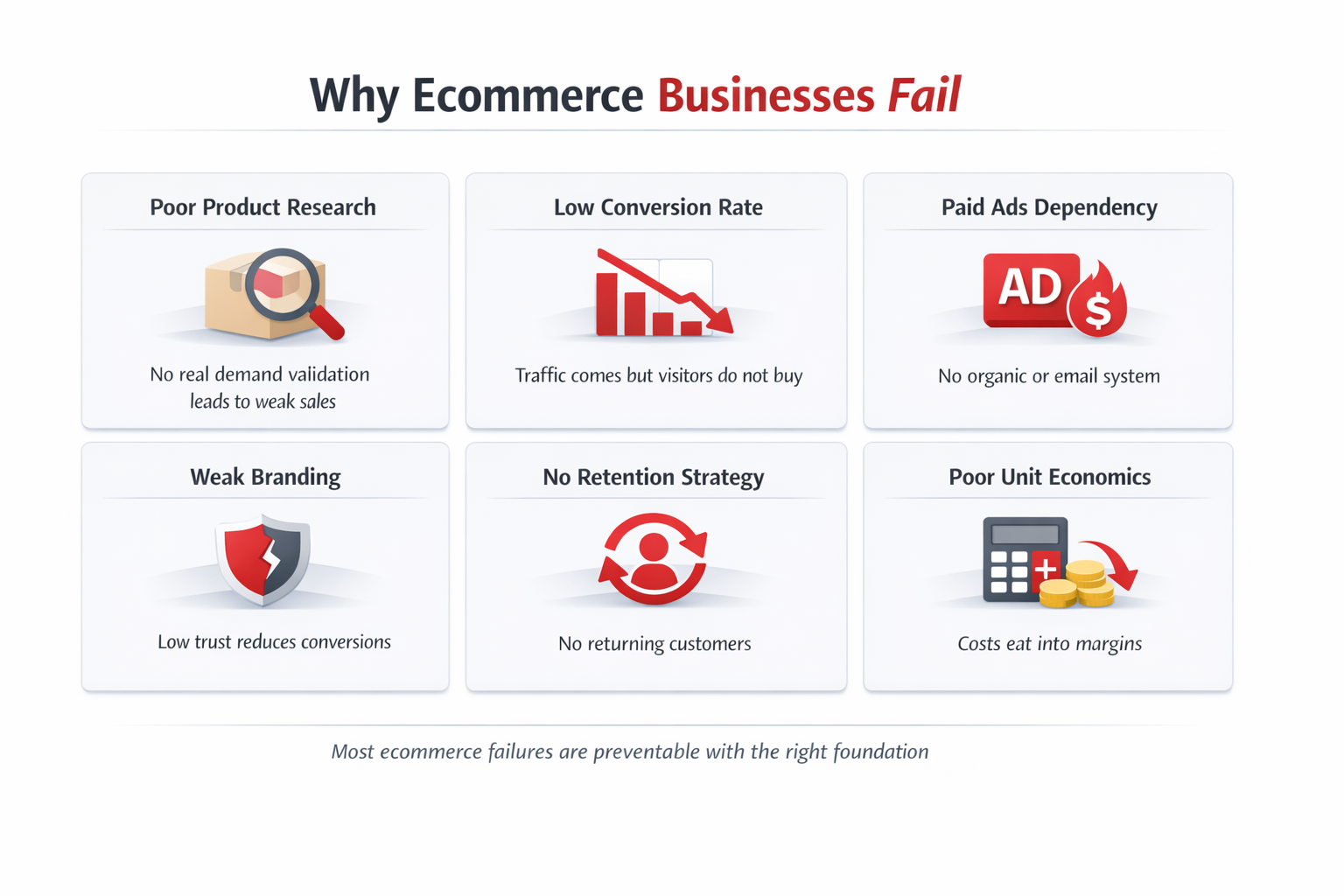
The most common causes of ecommerce failure are poor product research, low conversion rates, weak brand trust, and a marketing strategy that depends only on paid traffic.
- Launching products without validating demand
- Sending traffic to a store that does not convert
- Ignoring CAC, ROAS, and profit margins
- Failing to build retention and repeat purchases
5. Branding That Does Not Build Trust
Shoppers decide whether to trust a store within a few seconds of landing on it. A store with blurry product photos, no reviews, no visible contact information, and a vague return policy loses that decision before the product even gets a look.
That trust decision feeds directly into conversion rate. A credible-looking store converts more visitors, which stretches every ad dollar further, pulls better returns from organic traffic, and brings Customer Acquisition Cost down without touching the campaign itself. Branding is not decoration. It does real financial work.
It is one of the most overlooked ecommerce business challenges because the cost is invisible until it compounds. Weak branding quietly explains why ecommerce businesses fail even when the product is solid and the traffic is real. See exactly how branding decisions affect conversion in this Shopify branding complete guide.
6. No Automation or Inventory Systems
Ecommerce automation tools exist because manual processes at scale create customer experience disasters. Ten orders a day is manageable by hand. A hundred gets messy fast. Five hundred is a full crisis.
Missed shipping notifications, oversold products, delayed follow-up emails, slow refunds. These are not just operations headaches. They show up in reviews, and bad reviews from preventable mistakes are painful to undo.
Shopify handles order workflow cleanly for most direct-to-consumer setups. Fulfillment by Amazon (FBA) removes logistics entirely for the right product types. Klaviyo runs post-purchase flows, abandoned cart recovery, and welcome sequences automatically once they are set up. Inventory management ecommerce systems catch stockout risk before it turns into lost sales. Build all of this before order volume makes it urgent. For a complete breakdown of what tools are worth using, see this Amazon seller tools complete guide.
7. No Plan to Keep Customers Coming Back
Bringing in a new customer costs roughly five times more than keeping an existing one. Most stores still spend almost everything on acquisition and almost nothing on getting buyers to return.
When retention is low, the store is stuck replacing customers every month just to hold revenue flat. Ecommerce revenue growth cannot happen when lifetime value stays the same because the churn never slows down.
Post-purchase email flows through Klaviyo, a simple loyalty setup, clean refund processes, and proactive shipping updates all reduce effective Customer Acquisition Cost over time by turning one-time buyers into repeat customers. Stores that build this kind of retention are far more stable when paid traffic costs spike.
Why Ecommerce Stores Lose Money (Cost Breakdown)
A product may look profitable until all hidden costs are included.
| Cost Type | Example Cost | Impact |
|---|---|---|
| Product Cost | $15 | Base cost of goods |
| Ad Spend | $20–$30 | Customer acquisition |
| Platform Fees | 2%–5% | Payment + platform charges |
| Shipping & Returns | $5–$10 | Logistics and refunds |
| Final Profit | $0–$5 | Actual earnings per order |
5. Branding That Does Not Build Trust
Buyers make trust decisions in seconds. A store with low-quality images, no reviews, missing contact information, and an unclear return policy loses visitors before product quality even enters the picture.
This directly affects conversion rate. A store that looks credible converts more of its traffic, which means paid traffic works harder, organic traffic converts better, and Customer Acquisition Cost comes down without touching the ad itself. Branding is not aesthetic. It is structural.
Weak branding is one of the most overlooked ecommerce business challenges because the damage is not always immediately visible. But it is a consistent reason why ecommerce businesses fail, even with strong products and real traffic. See exactly how branding decisions affect conversion in this Shopify branding complete guide.
6. No Automation or Inventory Systems
Ecommerce automation tools exist specifically because manual operations break at scale. At ten orders a day, manual management works. At a hundred, it becomes chaotic. At five hundred, it is a customer experience disaster.
Missed shipping updates, oversold products, delayed follow-up emails, and slow refunds are retention problems, not just operational ones. Bad reviews from preventable errors are very hard to reverse.
Shopify handles order workflow efficiently for most direct-to-consumer setups. Fulfillment by Amazon (FBA) removes logistics entirely for the right product types. Klaviyo runs automated post-purchase flows, abandoned cart recovery, and welcome sequences without ongoing manual effort. Inventory management ecommerce systems prevent stockout errors before they happen. Build these systems before volume demands them. For a complete breakdown of what tools are worth using, see this Amazon seller tools complete guide.
7. No Plan to Keep Customers Coming Back
Acquiring a new customer costs five times more than retaining an existing one. Despite that, most stores put nearly all energy into acquisition and almost nothing into keeping buyers coming back.
A low retention rate forces the store into a permanent acquisition loop. Every month requires new customers just to stay flat. Ecommerce revenue growth stalls completely when lifetime value never improves.
Post-purchase email flows through Klaviyo, a straightforward loyalty structure, fast refunds, and proactive shipping updates build the kind of experience that generates repeat purchases and referrals. Both reduce effective Customer Acquisition Cost over time. Stores with strong retention survive paid traffic volatility far better than stores without it.
The Hidden Metrics Killing Your Store
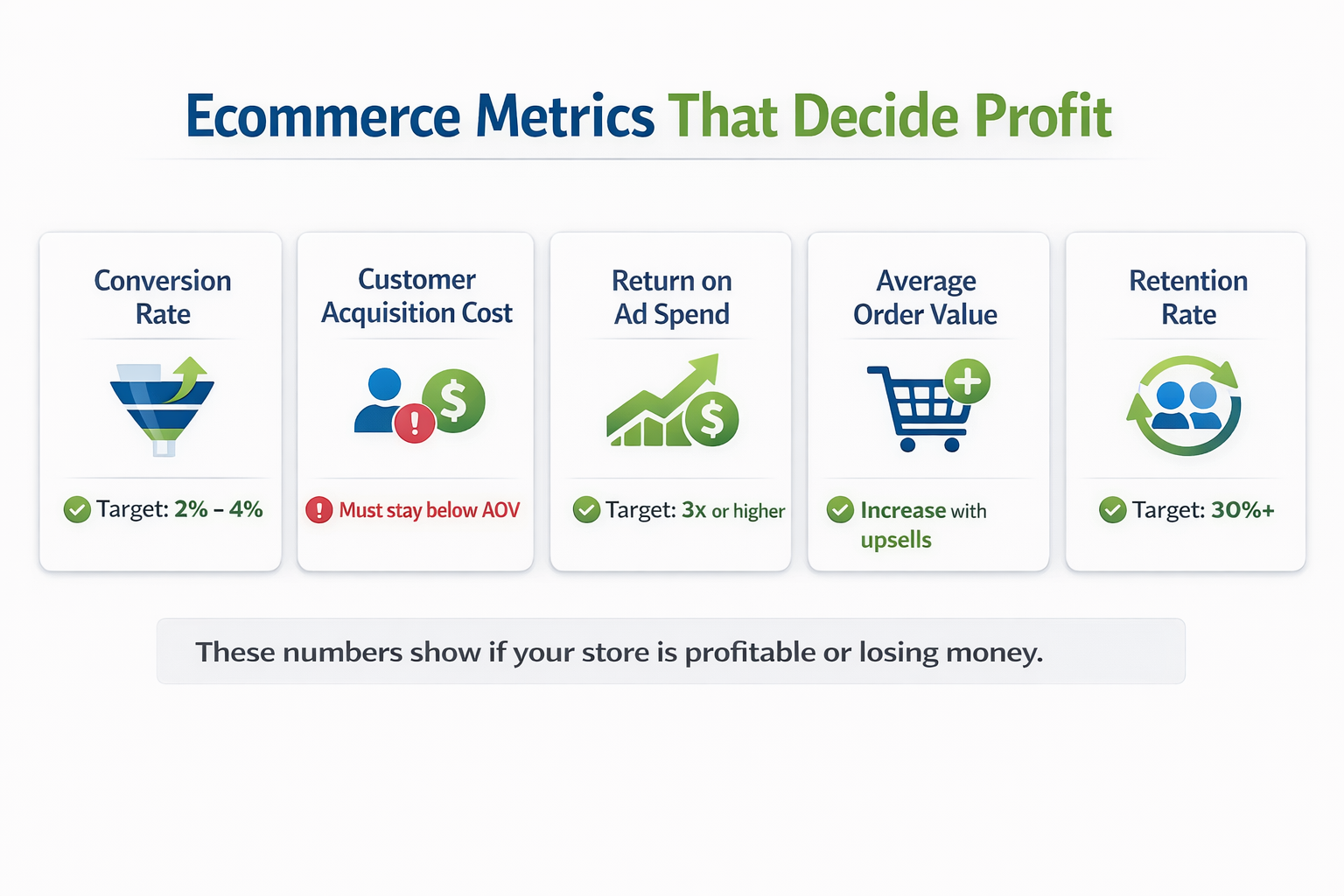
Understanding why ecommerce businesses fail often comes down to numbers that nobody is watching. These are the ecommerce failure reasons that do not show up until the damage is already done. Revenue can look healthy on the surface while the store bleeds out underneath. These three metrics tell the real story.
| Metric | Healthy Range | What It Measures |
| Conversion Rate | 2% – 4% | Visitors who become buyers |
| Customer Acquisition Cost | Lower than AOV | Total spend to win one customer |
| Return on Ad Spend | 3x or higher | Revenue per dollar of ad spend |
| Average Order Value | Rising over time | Revenue per transaction |
| Retention Rate | 30%+ (repeat buyers) | Customers who come back |
Conversion Rate Optimization
Conversion rate is the percentage of visitors who actually buy. The gap between 0.8% and 2.5% on the same traffic is roughly three times more revenue without spending another dollar on ads. Conversion Rate Optimization (CRO) is the activity that closes that gap, and most stores treat it as optional when it should be the first thing on the list.
Google Analytics breaks down conversion rate by traffic source, device type, and landing page. A weekly review shows exactly where the ecommerce funnel is leaking and which fixes will move the needle most.
Customer Acquisition Cost
Customer Acquisition Cost (CAC) is the total marketing spend divided by the number of customers brought in during the same period. When that number climbs without average order value or lifetime value climbing with it, profit margins compress fast, and the business starts losing money on growth.
Stores that fail almost never set a CAC target from the start. Without a target, every budget decision is a guess. With one, every campaign has a clear profitability floor to measure against.
Return on Ad Spend
Return on Ad Spend (ROAS) measures revenue earned per dollar of ad spend. A 2x ROAS means $2 back per $1 spent. After product cost and fees, most stores need 3x or above to actually profit. Anything below that is losing money at the campaign level, regardless of how the top-line revenue looks.
Meta Ads Manager and Google Analytics both show ROAS by campaign, product, and audience segment. Checking these numbers weekly stops bad campaigns from running for months longer than they should.
Key Insight: Stores that track Customer Acquisition Cost and Return on Ad Spend weekly are significantly more likely to reach profitability than those that review performance monthly.
How to Avoid Ecommerce Failure (Action Plan)
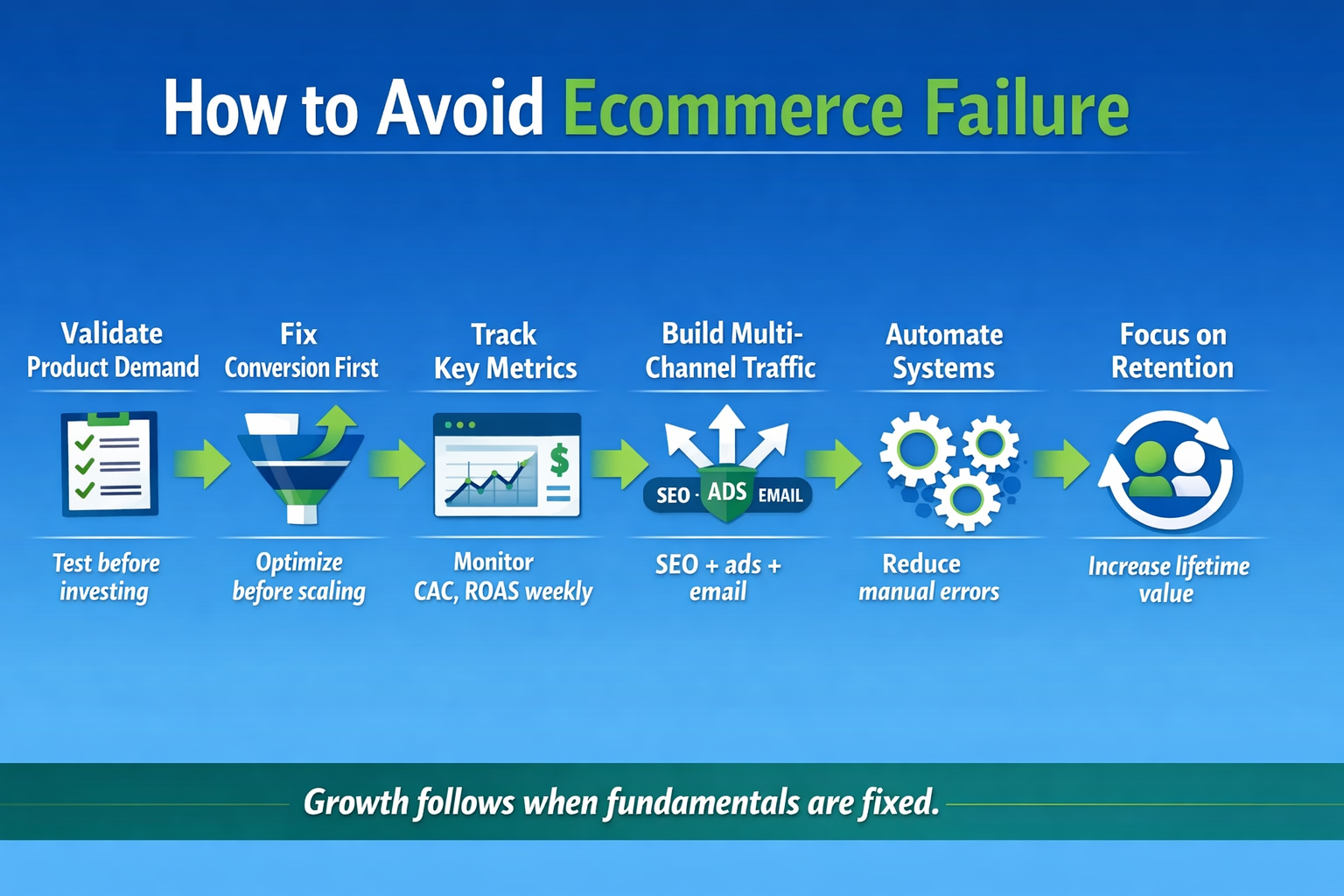
How to avoid ecommerce failure comes down to sequencing. The steps are not complicated. What separates stores that get through the first two years from those that do not is doing them in the right order. Timing is exactly why ecommerce businesses fail at stages where they appeared to be working.
Validate demand with real data before investing. Poor product research ecommerce mistakes happen before the store even opens. A small paid test costs far less than a bad inventory bet. Real purchase data confirms demand. Gut feel does not.
Fix low conversion rate ecommerce problems before scaling traffic. Get above 2% first. Every ad dollar goes further on a store that converts well. This is not slowing down. It is the fastest path to profitable growth.
Build multiple traffic sources from the start. A bad ecommerce marketing strategy depends entirely on one paid channel with no backup. Paid ads start the engine. SEO and email keep it running when paid costs spike or accounts get disrupted. These are the foundational ecommerce success strategies that most stores put off until something goes wrong.
Track CAC, ROAS, and retention rate every week. Monthly reviews catch problems after they are already expensive. Weekly tracking catches them while they are still cheap to fix.
Automate before volume demands it. Klaviyo email flows, abandoned cart recovery, inventory alerts, and post-purchase sequences should all be running before they are needed. Retrofitting them into a busy store is always harder than building them in early.
Raise average order value to increase ecommerce sales without raising ad spend. Bundles, upsells, and free shipping thresholds lift revenue per transaction without touching the ad budget. A 20% improvement in average order value can flip a marginal store into clear profitability. It is also one of the most overlooked ways to fix common ecommerce mistakes around margin pressure.
Think long-term about how to grow ecommerce business. Ecommerce revenue growth compounds when lifetime value improves. Stores that invest in retention, email, and brand trust scale more efficiently than stores chasing nothing but new buyers.
Get expert help fixing the exact problems causing ecommerce failure through professional ecommerce services.
How to Avoid Ecommerce Failure
To avoid ecommerce failure, validate demand before investing, improve conversion rate before scaling traffic, and track profitability metrics every week.
- Test demand with real data
- Fix low-converting pages early
- Build email, SEO, and retention systems
- Scale only after the numbers work
Tools and Systems That Actually Work
None of these are optional for a store that wants to grow past the early stage. They are the operational foundation.
Shopify is the most dependable platform for direct-to-consumer ecommerce. It handles scale well, the app ecosystem covers most operational gaps, and it keeps infrastructure complexity low enough that focus stays on product and marketing rather than technical maintenance.
WooCommerce works well for stores already running on WordPress that need more customization control. Lower platform cost, but it takes more technical upkeep. Better suited for stores with developer access than founders who need to move fast.
Fulfillment by Amazon (FBA) is worth considering when volume matters more than brand control. Amazon handles warehousing, shipping, and returns entirely. The tradeoff is thinner margins and limited ability to build direct customer relationships.
Meta Ads Manager is where most consumer ecommerce paid acquisition happens. Understanding Return on Ad Spend at the product and audience level is what separates stores that scale paid traffic profitably from ones that burn through budgets and blame the algorithm.
Klaviyo is the go-to for ecommerce email and SMS automation. A well-built Klaviyo setup typically drives 20 to 30% of total revenue at a fraction of what paid acquisition costs. It is also the core tool for the retention work most stores ignore until losing money makes it impossible to avoid.
Google Analytics connects traffic sources to real conversion behavior across the full ecommerce funnel. Free, powerful, and consistently underused by the stores that need it most. Google Analytics remains one of the most useful ecommerce analytics tools for understanding funnel performance and catching conversion problems before they become expensive. Setting up proper ecommerce tracking inside Google Analytics takes a few hours and saves months of guesswork.
How to Build a Profitable Ecommerce Business
Scaling ecommerce business sustainably has nothing to do with finding the right growth hack. It comes from getting the basics right before trying to grow, not after hitting a wall.
The stores that build lasting revenue know their unit economics from month one. Customer Acquisition Cost, Return on Ad Spend, margin per product, and lifetime value are tracked consistently, not pulled up for the first time when something goes wrong in month twelve.
They treat Conversion Rate Optimization as ongoing work rather than a one-time project. The gains stack. A 1% improvement this quarter makes every future campaign more efficient at no extra cost.
They build brand trust early. Strong Shopify branding, genuine customer reviews, clear policies, and reliable support reduce friction across the whole funnel. That lowers Customer Acquisition Cost, strengthens retention, and creates the kind of word-of-mouth that paid ads cannot buy.
They focus on how to grow ecommerce business through lifetime value, not just bringing in new customers. Stores built purely on acquisition always hit a ceiling. Stores with strong retention grow past it.
Ecommerce profitability is achievable. It comes from building systematically, tracking honestly, and fixing the right things in the right order. The core ecommerce failure reasons are well-documented and largely preventable. Looking closely at why online stores fail usually reveals the same avoidable patterns. Every store owner who studies why ecommerce businesses fail closely enough walks away with a clear picture of what to do differently. The stores that avoid these patterns are not lucky. They are disciplined.
Visit HiSellIt for ecommerce growth tools and full solutions, or contact the team directly for personalized support on building a store that actually profits.
Frequently Asked Questions
Q. Why do most ecommerce businesses fail in the first year?
Most fail because of poor unit economics that go untracked until the damage is done. Customer Acquisition Cost outpaces average order value, the conversion rate never gets fixed, and there is no email list or organic traffic to fall back on when paid ads stop covering costs. Ecommerce failure reasons at this stage are predictable but rarely caught early enough. The stores that survive year one almost always started tracking CAC and conversion rate within the first month of running paid traffic.
Q. Is ecommerce still profitable in 2026 and beyond?
Yes, but the margins are tighter than they were five years ago. Ad costs have gone up across every major platform. Competition has sharpened in most product categories. Profitable stores still exist, but they are the ones building genuine brand trust, fixing conversion, and investing in retention rather than just spending more on acquisition. Stores that depend entirely on paid traffic with no email list or returning customer base are running on a margin that keeps shrinking.
Q. What are the most common beginner ecommerce mistakes?
Common ecommerce mistakes among new store owners include picking products based on personal interest rather than demand data, running paid ads before the store actually converts, ignoring email marketing entirely, and never once looking at Return on Ad Spend or Customer Acquisition Cost. Underestimating fulfillment complexity is also very common, especially in dropshipping, where a supplier delay becomes the store’s reputation problem overnight. These mistakes are cheap to fix early and very expensive to fix late.
Q. How long does it take for an ecommerce business to become profitable?
Most stores take six to eighteen months to reach consistent profit. Stores using Fulfillment by Amazon or dropshipping might see revenue faster, but sustainable margins still require a stable conversion rate and a base of customers who come back. The ecommerce business challenges in the early stage almost always come back to finding the right Customer Acquisition Cost to lifetime value balance, which takes real data and time to figure out.
Q. What is the biggest risk in ecommerce?
Scaling ad spend before the business model is actually working. Revenue goes up, which feels like progress, but when conversion rate is low and margins are thin, more traffic just loses money faster. The biggest ecommerce business mistakes almost always follow this pattern. The budget grows, the revenue follows, but profit never appears because the unit economics were broken from the start.
Q. How does poor branding cause ecommerce failure?
Poor branding cuts conversion rate across every traffic source at once. A store that looks untrustworthy loses buyers before the product ever gets a fair shot. Weak visuals, no social proof, and unclear messaging send visitors straight to a competitor. Paid ads underperform, organic traffic converts poorly, and Customer Acquisition Cost stays stubbornly high. Strong branding is one of the most reliable ecommerce success strategies available because it quietly improves the performance of everything else in the funnel simultaneously.