
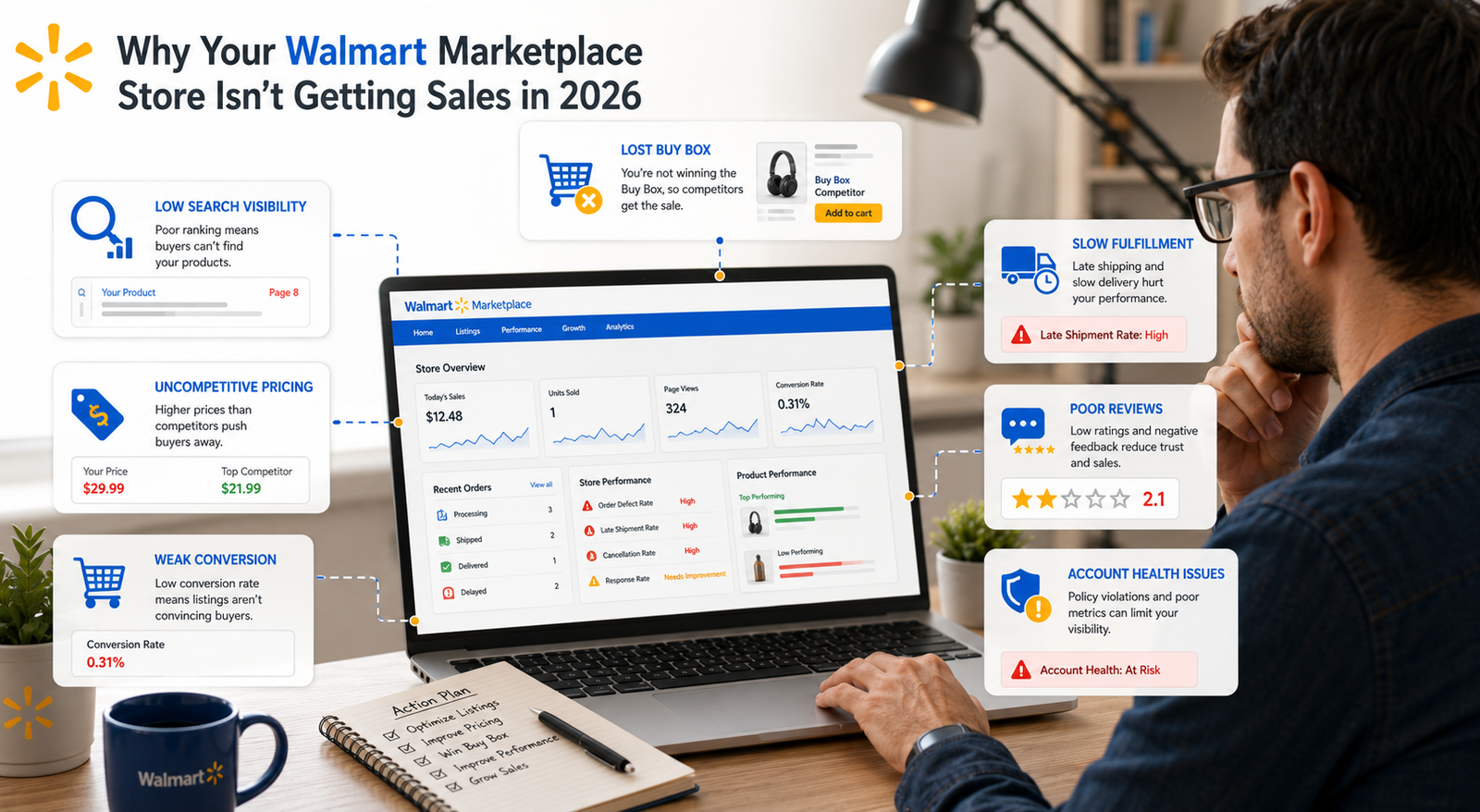
Why Your Walmart Store Is Not Getting Sales in 2026 and How to Fix It
Selling on Walmart Marketplace looked simple at first. You listed your products. You waited. And then nothing happened. No orders. No real traffic. Maybe a few page views, but zero conversions.
This is more common than most sellers think. And the frustrating part? The fix is not always obvious. Your listings might look fine on the surface. But under the hood, there are real reasons why your Walmart store is not getting sales.
This guide breaks down every major reason. It also gives you a clear, practical fix for each one. No theory. Just what actually works in 2026.
Quick Answer: Why Is Your Walmart Store Not Getting Sales?
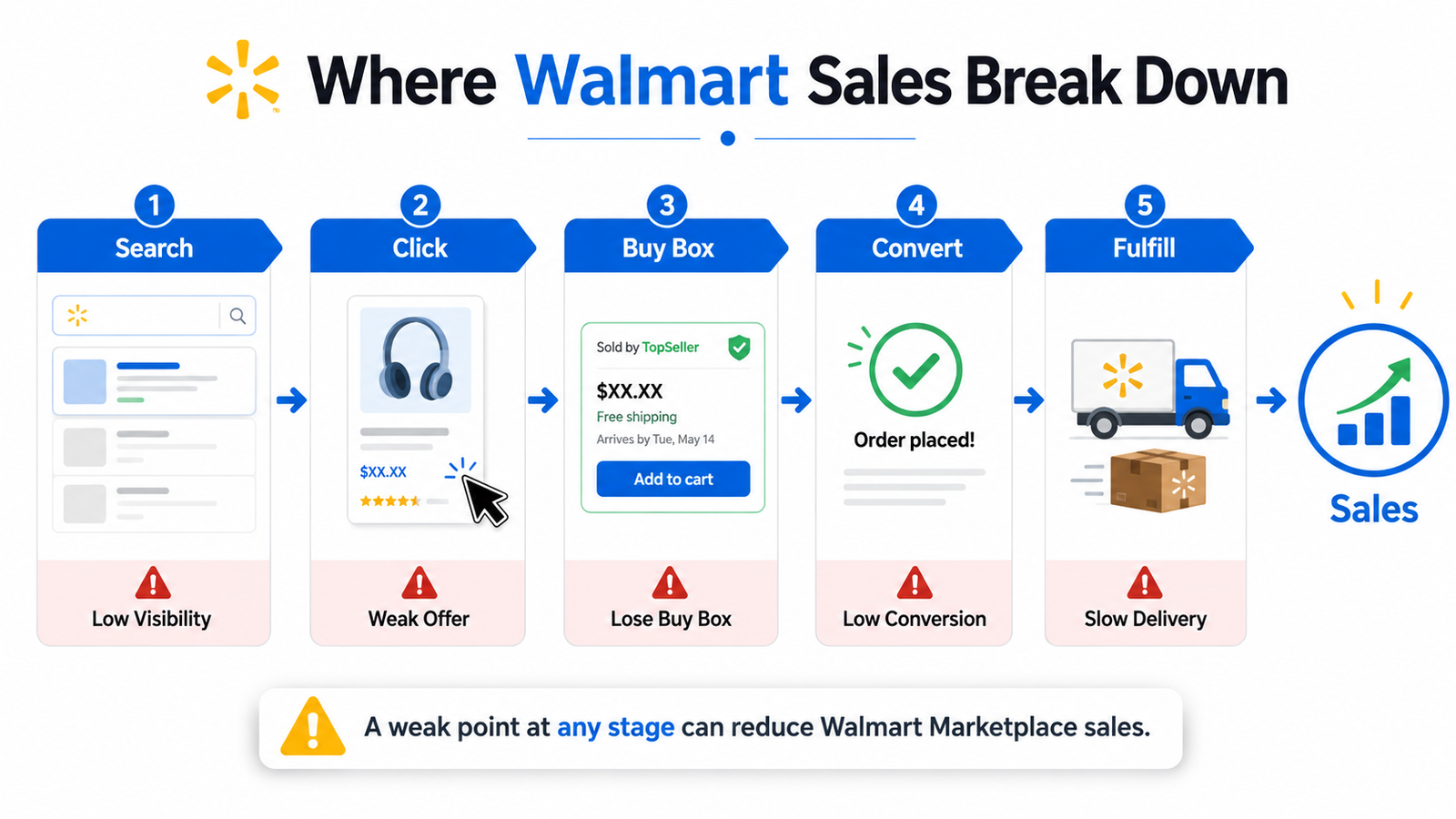
Your Walmart store may not be getting sales because your listings have low search visibility, you are losing the Buy Box, your pricing is not competitive, your product pages are not converting, your fulfillment is too slow, or your seller performance needs improvement. Start by checking Listing Quality, Search Insights, pricing, Buy Box performance, and Seller Performance data inside Seller Center.
How Sales Actually Work on Walmart Marketplace
Before diagnosing any problem, it helps to understand what drives sales on Walmart Marketplace in the first place.
Walmart Marketplace is a search-driven platform. Shoppers search for a product, and Walmart determines which items and offers appear based on relevance, listing quality, offer competitiveness, availability, fulfillment, seller performance, and other signals.
Unlike Amazon, Walmart has a smaller seller pool. That can create opportunities, but sellers still have to meet Walmart’s marketplace and performance standards consistently.
Walmart does not publish a simple three-factor search algorithm. However, its seller tools consistently emphasize areas such as:
- Content and discoverability: Does your listing accurately match what the buyer is searching for?
- Offer quality: Is the price competitive, and is the product available?
- Fulfillment: Can the order reach the customer quickly and reliably?
- Ratings and reviews: Does the product give shoppers enough confidence to buy?
- Seller performance: Is the account meeting Walmart’s marketplace standards?
Walmart’s Listing Quality guidance gives sellers a useful view of how content, discoverability, offer quality, ratings, and reviews can affect listing performance.
One important thing to note: Walmart Seller Center gives sellers access to tools such as Listing Quality, Search Insights, Pricing Insights, and performance reporting. If you are not reviewing that data regularly, you are making decisions without knowing where the problem actually starts.
 Your Listings Are Not Ranking in Walmart Search
This is one of the most common problems. And many sellers do not even know it is happening because they never check their impressions.
Low Walmart impressions mean your products are not being shown often enough to shoppers. If buyers never see you, they cannot buy from you. It is that simple.
Why It Happens
- Your title does not match the words buyers actually search for
- Your listing content is thin, incomplete, or copied from another source
- Your product category, product type, or attributes are wrong
- Your listing has missing required information
- Your item has setup errors, product-ID problems, or an unpublished status
- Your content has poor search relevance
How to Fix It
Start with Walmart listing optimization basics. Go into each listing and do this:
- Write a clean, specific title using the attributes and keyword structure appropriate for your product type. Put the most important product information first and avoid keyword stuffing.
- Complete the relevant attribute fields Walmart provides for your product.
- Write a product description that uses natural language and clearly explains what the product is and who it is for.
- Complete the relevant Key Features fields with specific and useful product information rather than forcing a fixed number of bullets.
- Make sure the product is assigned to the correct category, product type, and related attributes.
Incorrect categorization and missing attributes can hurt discoverability because Walmart uses product and attribute data to determine how products appear in search and browse results.
A Walmart listing not showing in search may also have an unpublished status or a setup problem rather than simply a keyword issue. Check Seller Center for item-level errors and unpublished reasons before rewriting the entire listing.
If you want a deeper look at choosing products and researching demand before listing them, the guide on Walmart dropshipping product research with AI is a useful starting point.
You Are Losing the Buy Box
Walmart Marketplace no sales often come down to one thing: another seller is winning the Buy Box on your products.
The Buy Box is the main purchase option on a Walmart product page. If several sellers offer the same product, the seller controlling that offer has a major advantage when the customer clicks to buy.
Why It Happens
- Your price is less competitive than other offers
- Your seller performance is weaker
- Your shipping promise is slower
- Your item availability is inconsistent
- Your overall offer is less competitive
WFS can help sellers offer faster and more reliable fulfillment, but it does not automatically guarantee the Buy Box.
How to Fix It
Losing the Walmart Buy Box is often a combination of pricing, fulfillment, availability, and seller performance.
Here is how to approach it:
- Consider Walmart Marketplace’s free Repricer or another compliant repricing tool. Automated pricing can respond to competitive offers while still letting you define minimum and maximum prices.
- Set a floor price that protects your minimum acceptable margin. Know your costs before competing on price.
- If fulfillment speed is a recurring problem, compare your current setup with Walmart Fulfillment Services.
- Focus your catalog on products where the competitive landscape still leaves room for sustainable margins.
A smart Walmart pricing strategy is not just about going low. It is about staying competitive without destroying the economics of the product.
Your Pricing Strategy Is Blocking Conversions
Sometimes sellers win the Buy Box but still get no sales. That can mean the total offer is not competitive enough for what buyers expect.
Walmart shoppers compare price, value, delivery speed, reviews, and competing products before buying. If your offer looks weak beside similar alternatives, the customer may simply leave.
Why It Happens
- You chose a product with heavy price competition
- Your cost of goods is too high to price competitively
- You are pricing based only on your desired profit instead of current market conditions
- Shipping or fulfillment costs make the total economics difficult
- Another comparable offer provides stronger value
How to Fix It
Your Walmart pricing strategy needs to start with both the market and your actual costs.
Use this process:
- Check the current Walmart Buy Box and other relevant offers for the item.
- Calculate your full landed cost, including product cost, referral fees, fulfillment or shipping, returns, advertising, and other operating expenses.
- Decide the minimum price at which the product still makes financial sense.
- Use Walmart’s pricing tools or a compliant repricer to stay competitive within those limits.
Competitive pricing on Walmart is not a race to the bottom. If your economics do not allow you to compete sustainably, better sourcing or a different product may be a stronger solution than repeated price cuts.
Account Health Is Quietly Hurting Your Store
This one catches a lot of sellers off guard. Your listings look fine. Your prices look good. But sales are still dropping, or never really started. Seller performance may be part of the problem.
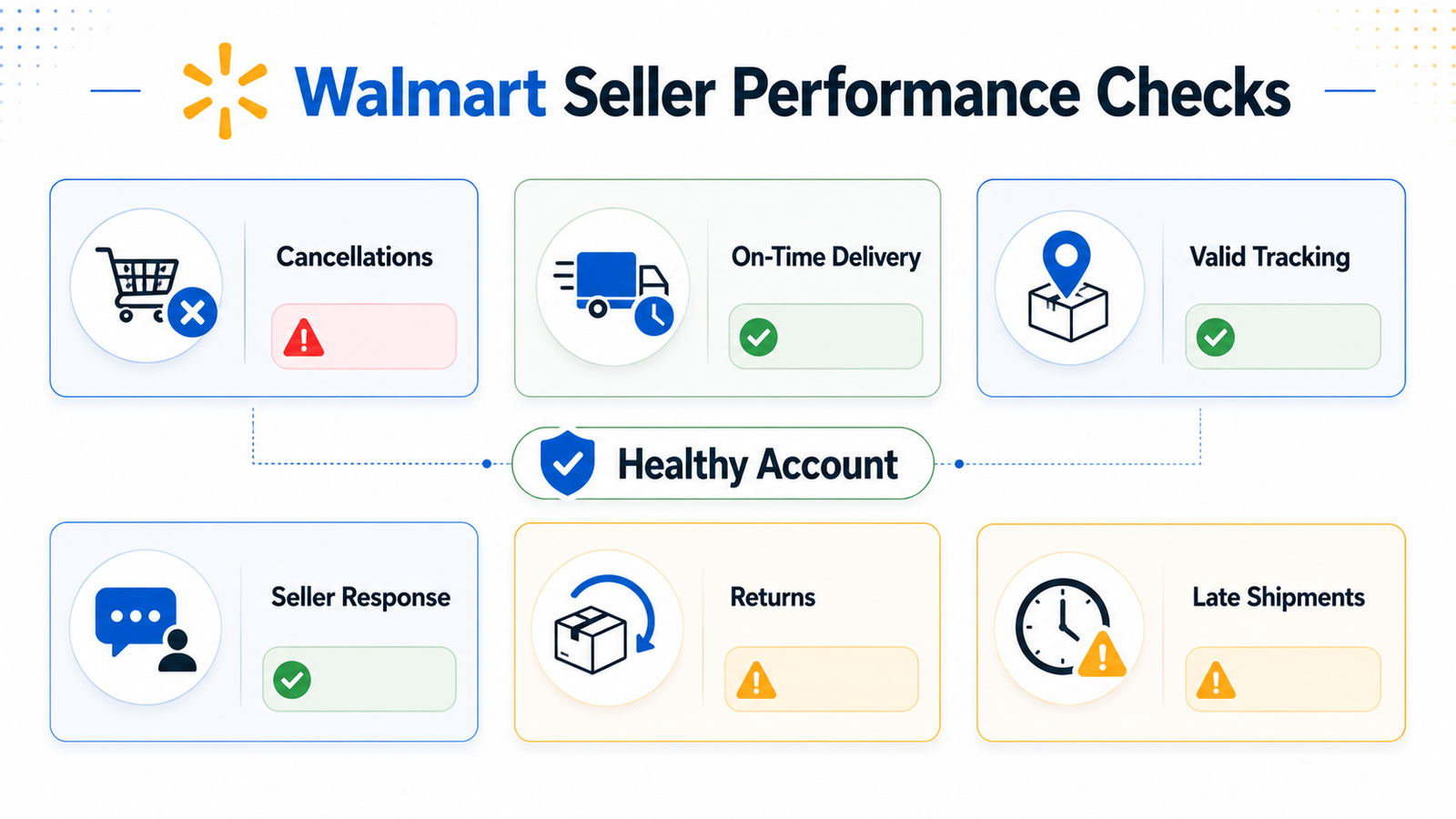
Walmart Seller Center tracks seller performance continuously. Falling below Walmart’s current Seller Performance Standards can result in performance warnings and, if problems continue, may lead to item suppression, account suspension, or other enforcement.
Current Walmart Seller Performance Standards
Walmart’s current standards track several metrics individually rather than relying on one general Order Defect Rate.
| Performance Metric | Current Walmart Standard |
|---|---|
| Cancellation Rate | 2% or below |
| On-Time Delivery Rate | 90% or above |
| Valid Tracking Rate | 99% or above |
| Seller Response Rate | 95% or above |
| Negative Feedback Rate | 2% or below |
| Return Rate | 6% or below |
| Item Not Received Rate | 2% or below |
| Late Shipment Rate | 5% or below |
Review Walmart’s current Seller Performance Standards because these metrics are important to maintaining a healthy Marketplace account.
One important distinction is that Walmart’s 90% or above standard applies to On-Time Delivery Rate, while the 99% or above standard applies to Valid Tracking Rate.
 How to Fix It
Log in to Walmart Seller Center and review the Performance section. If a metric is moving in the wrong direction, identify the operational issue behind it instead of waiting for account enforcement.
- Use valid tracking information and reliable shipping methods.
- Do not list products you cannot fulfill consistently. Stock-out cancellations directly affect your Cancellation Rate.
- Review listings for Walmart policy violations, inaccurate product information, or prohibited content.
- Check customer-service response times.
- If a listing has been suppressed or unpublished, review the reason shown inside Seller Center and complete the required correction.
If you need a refresher on account setup and Marketplace compliance, review this guide to the Walmart Marketplace approval process.
Your Product Listings Are Not Converting
Getting impressions and clicks is only half the battle. If buyers reach your listing and then leave without purchasing, the problem may be conversion rather than visibility.
There is no single healthy Walmart conversion rate for every product category. Conversion can vary depending on product type, price, traffic quality, competition, delivery promise, reviews, and customer intent.
Instead of chasing one universal benchmark, compare your own conversion trends over time and investigate what changed.
Common Conversion Killers
- Bad or low-resolution product images
- Weak or confusing product descriptions
- Few ratings or reviews compared with competing products
- Missing size charts, compatibility details, or important specifications
- Uncompetitive pricing
- Slow delivery
- Traffic coming from searches that are not highly relevant to the product
Walmart’s current U.S. image guidance recommends square product images at 2200 × 2200 pixels, with at least 1500 × 1500 pixels needed for zoom functionality. Main images should generally have a seamless white background, and Walmart recommends using multiple high-quality images to show the product clearly.
How to Fix It
Walmart product description optimization and stronger visual presentation are two important conversion levers.
Here is what to prioritize:
- Replace low-quality images with clear, professional product images that meet Walmart’s current standards. Add useful secondary or lifestyle images where appropriate.
- Rewrite confusing descriptions in simple, clear language. Answer the questions a buyer is most likely to have before purchasing.
- Build your Walmart reviews strategy through approved methods. Genuine ratings and reviews can strengthen shopper confidence, but there is no fixed number of reviews that guarantees higher conversion.
- Add missing product attributes and specifications.
- Review your price and shipping promise against competing offers.
- Improve fulfillment speed where operationally possible.
The Walmart conversion rate is directly influenced by more than listing copy alone. Price, delivery speed, reviews, product demand, traffic quality, and listing content all work together.
You Are Not Using Walmart Fulfillment Services Correctly
Fulfillment can influence both shopper behavior and Marketplace performance. If your products take too long to reach customers, buyers may choose another offer.
Walmart Fulfillment Services, or WFS, works similarly to a third-party fulfillment network. You send eligible inventory to Walmart fulfillment centers, and Walmart stores, picks, packs, and ships orders for you.
Why It Matters
Walmart says eligible WFS products can receive Fulfilled by Walmart and fast-delivery benefits that can help improve visibility, conversion, and Buy Box performance.
That does not mean every WFS item automatically ranks higher or wins the Buy Box.
Pricing, availability, listing quality, product demand, reviews, and other seller signals still matter.
WFS can also reduce the operational burden associated with fulfillment because Walmart handles many fulfillment-related processes for enrolled orders.
You can review Walmart’s own explanation of the benefits of Walmart Fulfillment Services before deciding whether it fits your catalog.
When WFS Makes Sense
- Your products meet current WFS eligibility, size, weight, and prohibited-product requirements
- You have enough demand to justify storing inventory in Walmart’s network
- You sell products that move consistently rather than highly uncertain inventory
- You want to reduce day-to-day fulfillment work
- Faster delivery could strengthen your customer offer
Walmart WFS is not a magic fix. Storing slow-moving inventory can create additional costs. The key is to evaluate WFS using actual sales velocity and product economics rather than assuming every SKU belongs in Walmart fulfillment.
You Picked the Wrong Products
Sometimes the issue is not your listing, your pricing, or your fulfillment. Sometimes the issue is the product itself.
A Walmart Marketplace store with no sales can simply have weak product-market fit.
Not every product that performs well on Amazon will perform the same way on Walmart. And not every trending product is a good fit for Walmart Marketplace.
Signs You Picked the Wrong Product
- Low search demand for the product on Walmart
- Heavy seller competition and weak margins
- The product requires a brand or category approval you do not have
- Returns make the economics difficult
- The product has strongly seasonal demand and was listed at the wrong time
- You cannot compete on price or delivery
How to Fix It
Better product research is the answer.
Here is how to think about it:
- Look for products with consistent demand rather than relying entirely on short-lived trends.
- Review how many competing offers exist, but do not rely on an arbitrary seller-count threshold.
- Compare Buy Box pricing with your real landed costs.
- Look at seasonality and demand trends.
- Consider expected return risk.
- Check category and product restrictions before sourcing inventory.
- Avoid products where the economics only work under unrealistic pricing assumptions.
For a structured research process, the Walmart dropshipping product research with AI guide explains how sellers can use data more effectively before adding products.
For sellers who want professional help building and managing a Walmart catalog, explore HiSellIt’s Walmart services.
Your Automation Setup Is Misaligned
Many sellers today use Walmart automation stores or Walmart dropshipping automation services to manage their operations. These services can improve efficiency and make larger catalogs easier to manage. But they can also create problems when the setup is wrong.
A poorly configured Walmart automation store can lead to listing errors, inconsistent pricing, inaccurate inventory, and fulfillment failures. These problems can compound quickly and damage seller performance before the owner notices.
Common Automation Problems
- Repricing rules are too aggressive and create pricing problems
- Inventory sync fails, and customers order out-of-stock items
- Supplier fulfillment delays hurt delivery metrics
- Listing content is auto-generated with thin or duplicate information
- Products are assigned to incorrect categories through bulk imports
How to Fix It
Walmart dropshipping automation works best when it is carefully set up and regularly monitored.
Automation is not a set-and-forget solution. It is a tool that still requires oversight.
- Review your repricing rules regularly and confirm that minimum and maximum prices still protect the economics of the product.
- Audit inventory synchronization based on how quickly your catalog and order volume change.
- Watch your Cancellation Rate closely. Stock-out cancellations directly hurt a metric Walmart currently requires sellers to keep at 2% or below.
- Review listing quality and missing attributes inside Seller Center.
- Make sure automation tools are not creating inaccurate product data or policy violations.
- Work with experienced support if your catalog is large enough that manual monitoring becomes difficult.
If you are evaluating whether automation is worth using at scale, read why Walmart automation attracts serious sellers for a broader look at the model.
If you prefer a managed approach, HiSellIt’s Walmart services focus on ongoing store operations rather than simply launching a catalog and leaving it unattended.
What to Do Next
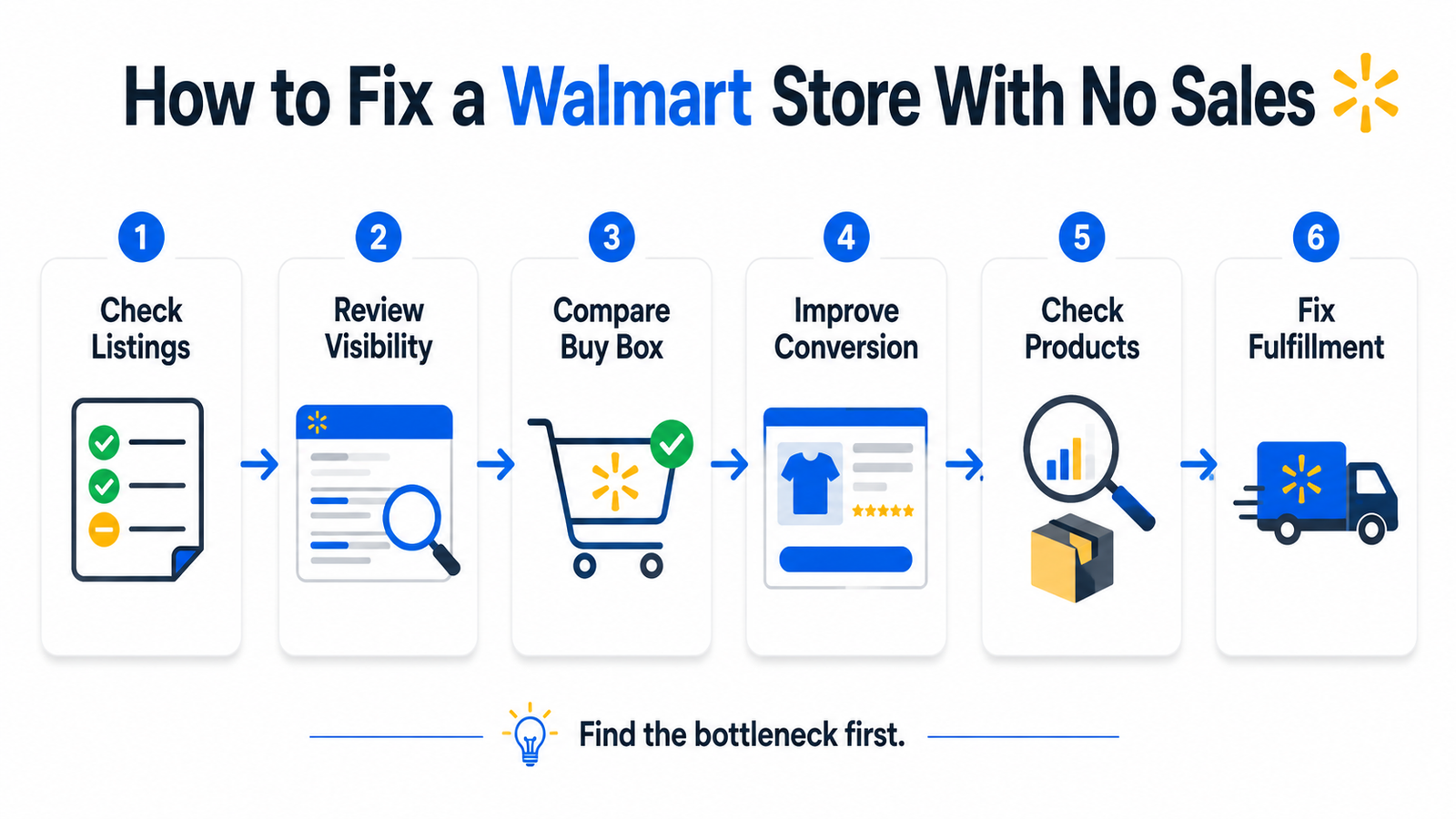
If your Walmart store is not getting sales, the first step is to find out where the breakdown is happening.
Use this checklist:
- Check Seller Center for suppressed or unpublished listings and performance warnings.
- Review your Walmart search visibility. If impressions are low, focus on discoverability, listing content, categories, and attributes.
- Check who is winning the Buy Box. If it is not you, compare pricing, fulfillment speed, availability, and seller performance.
- Review conversion performance. If visibility and clicks are healthy but orders are weak, inspect the offer, images, reviews, delivery promise, and product-page content.
- Evaluate product selection. Make sure the product has real demand and sustainable economics on Walmart specifically.
- Assess your fulfillment setup. Compare self-fulfillment with WFS where faster delivery could improve the offer.
How quickly results improve depends on the actual problem.
A listing correction may affect discoverability differently from a product-selection problem, while reviews, account performance, pricing changes, and fulfillment improvements may take longer to influence results.
The important part is diagnosing the problem before changing everything at once.
 Final Thoughts
If your Walmart store is not getting sales, do not assume the entire business model is failing.
The problem usually exists somewhere in the path between visibility, offer competitiveness, conversion, fulfillment, product selection, and seller performance.
Start with the data inside Seller Center.
If impressions are low, investigate discoverability and listing quality. If shoppers are clicking but not buying, examine your price, product page, reviews, and delivery promise. If you keep losing the Buy Box, compare the strength of your offer. And if performance warnings are appearing, fix the operational problem before trying to scale.
The goal is not to change everything at once. It is to identify the weakest part of the store and fix that first.
If you want help diagnosing listing, pricing, fulfillment, automation, or catalog issues, explore HiSellIt’s Walmart services or contact the HiSellIt team to discuss your current store.
Frequently Asked Questions
Q. Why is my Walmart store getting traffic but no sales?
Traffic without sales often points to a conversion or offer problem.
Your listing is getting seen, but something may be preventing the customer from completing the purchase. Common causes include weak product images, unclear descriptions, uncompetitive pricing, slow delivery, limited reviews, poor product-market fit, or traffic coming from searches that do not closely match the product.
Start by comparing your price, delivery promise, images, listing content, reviews, and competing offers.
A low Walmart conversion rate is not automatically a visibility problem because the shoppers are already reaching the product page.
Q. How long does it take to get sales on Walmart Marketplace?
There is no fixed timeframe for getting sales on Walmart Marketplace.
A competitive product can generate orders quickly, while another may struggle even after being live for much longer.
Timing depends on factors such as product demand, pricing, Buy Box performance, search visibility, delivery speed, reviews, advertising, competition, and listing quality.
Instead of waiting for a specific number of days, track impressions, clicks, Buy Box performance, conversion, and seller metrics to see where progress is actually happening.
Q. Does Walmart favor WFS sellers?
WFS can provide a meaningful fulfillment advantage, but it does not guarantee higher rankings or the Buy Box.
Walmart says eligible WFS items receive Fulfilled by Walmart and fast-delivery benefits that can help improve visibility, conversion, and Buy Box performance.
Seller-fulfilled listings can still compete when they offer competitive pricing, strong availability, and fast, reliable delivery.
The important factor is the overall strength of the offer, not simply whether the item uses WFS.
Q. Can Walmart automation increase sales?
Automation can improve operational efficiency, but it does not guarantee more sales.
A well-managed Walmart automation setup can help maintain pricing, inventory synchronization, listing updates, and other repetitive operations more efficiently.
The risk is that poor automation can cause more problems than it solves. Incorrect repricing, inventory-sync failures, weak bulk-generated listing content, and fulfillment errors can quickly hurt seller performance.
Sellers remain responsible for their account’s pricing, inventory accuracy, fulfillment, listing content, and compliance even when third-party automation tools or service providers are involved.
Q. Why is my Walmart listing not showing?
A Walmart listing not showing in search can have several causes.
The item may be unpublished or suppressed, required attributes may be missing, there may be a product-ID or setup error, the item could be incorrectly categorized, the product may be out of stock, or the listing content may have poor relevance to active searches.
Log in to Walmart Seller Center and check the item’s status first.
Look for unpublished reasons, setup errors, missing information, or policy flags before assuming that the problem is purely keyword-related.
Q. Is Walmart dropshipping still profitable in 2026?
Walmart dropshipping can be profitable in 2026, but profitability is not guaranteed.
Results depend on product economics, referral fees, supplier pricing, shipping performance, returns, competition, advertising costs, product demand, and compliance with Walmart Marketplace policies.
Automation can help make some operational tasks easier, but it cannot turn an uncompetitive product or unreliable supplier into a profitable business.
The strongest approach is to focus on good product research, accurate inventory, reliable fulfillment, competitive pricing, and consistent account health.


One Comment