
How Amazon Automation Stores Choose Products: A 2026 Guide to Smart Selection
How Amazon automation stores choose products has become the make-or-break factor for online sellers in 2026. According to recent Shopify data, automated Amazon stores now generate over $4.8 billion in combined revenue, with Amazon automation product selection accounting for nearly 70% of their success rate. Most sellers are doing it completely wrong.
Countless automation stores crash and burn because they pick products based on gut feelings or YouTube hype. Someone sees a guru promoting the latest trend and thinks they’ve found gold. Three months later, $10,000 worth of inventory sits in an Amazon warehouse, collecting dust.
Successful automation stores in 2026 use data science, street smarts, and amazon automation product research to find products that actually sell. They’re not chasing trends. They’re hunting for market gaps nobody else has noticed yet.
Understanding Amazon Automation Product Selection in Automated Stores
Amazon automation product selection is the entire future of any store wrapped up in one decision. Mess this up, and everything else falls apart. Fancy amazon automation tools won’t save the business. Killer marketing won’t matter. The result is just automating failure faster.
The Three Pillars That Actually Matter
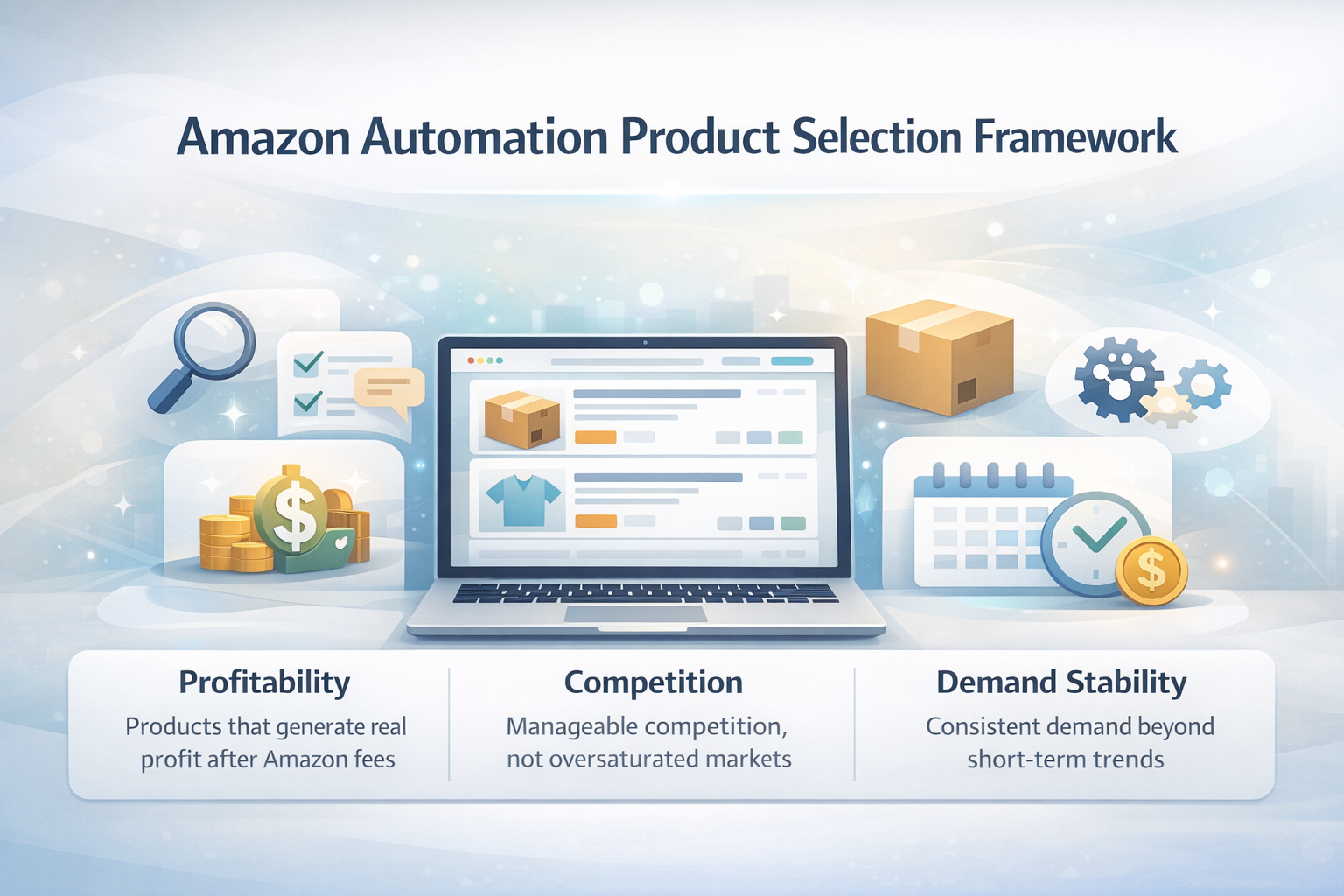
Successful automation stores evaluate every product through three lenses: profitability, competition, and demand stability. Profitability means making real money after Amazon takes its cut (and they take a lot). Competition analysis reveals whether the battle involves fighting established sellers with massive advantages. Demand stability shows if people will still want this product in six months or if it’s just this week’s fad.
However, these three factors constantly shift. A product that looked amazing in January might be a disaster by March. That’s why top automated Amazon stores treat Amazon automation product selection as an ongoing process, not a one-time decision.
Why Most Sellers Fail
Most beginners pick products backward. They find something personally appealing or something a friend said was “hot right now.” That’s not data. That’s gambling. For example, one seller loved coffee and stocked 47 different coffee-related products. The problem? Nobody actually searched for “artisanal coffee spoon holders” on Amazon.
The winners flip this script entirely. The numbers tell them what to sell, then ways get found to make those products better than what’s already out there.
How Amazon Automation Stores Choose Products Using Data Analytics
Data analytics is the secret weapon. In 2026, the automated Amazon stores are crushing it. Use software that analyzes millions of data points in seconds. Sales trends, customer complaints, seasonal patterns, pricing wars, everything gets tracked.
The Tools That Changed Everything
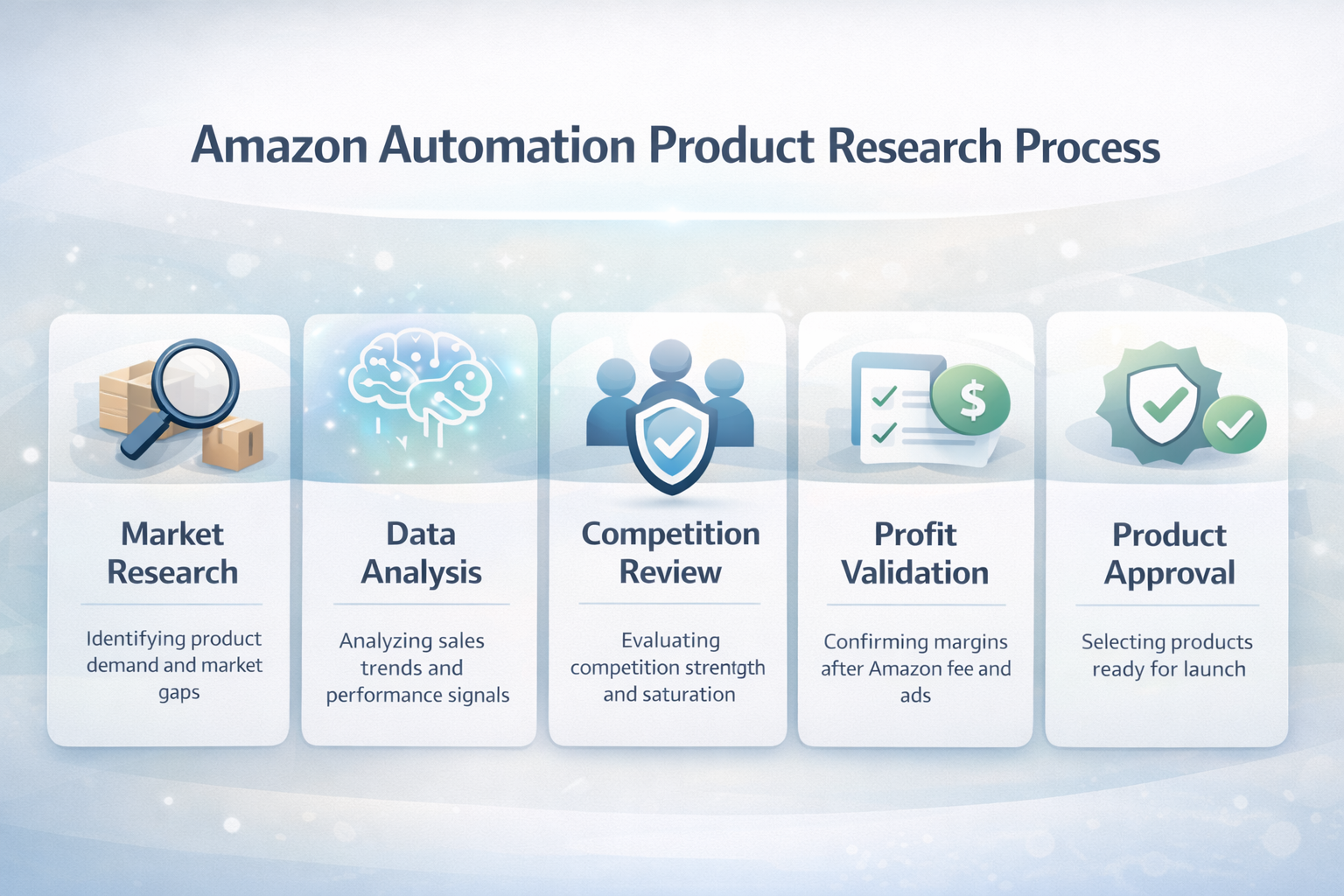
The process usually starts with platforms like Helium 10, Jungle Scout, or newer AI-powered Amazon automation tools that emerged in late 2025. These aren’t just fancy calculators. They work like having a team of researchers operating 24/7, scanning Amazon for opportunities that would never get spotted manually.
Here’s how it works in practice. Specific criteria are plugged in, such as products that sell at least 300 units per month with fewer than 50 reviews. The software generates a list of possibilities in minutes. Without these tools, weeks would be spent manually checking products one by one.
Reading the Numbers Like a Pro
Top automation stores track specific metrics religiously. Best Seller Rank is the big one; if a product consistently ranks in the top 20,000 across all Amazon categories, it indicates steady demand. In addition, revenue estimates are monitored to gauge market size and to review ratings to spot quality issues.
But here’s the trick nobody mentions. Just one data source can’t be trusted. Smart sellers cross-reference everything. Keepa is used to check price history, demand is verified through Google Trends, and then the numbers are run through FBA calculators. This multi-layered approach catches red flags that single Amazon automation tools miss.
For example, a product might show great sales volume, but if the price has dropped 40% in three months, that’s a race to the bottom nobody wants to join. As a result, experienced sellers walk away from “opportunities” that newbies jump into headfirst.
Key Criteria for Amazon Automation Product Selection in 2026
Let’s get into the specific criteria that define how do amazon automation stores pick products that actually work in 2026. These aren’t theoretical guidelines. These are battle-tested standards from sellers making real money.
Profit Margins: The Only Number That Actually Matters
Most experts recommend targeting a $5 to $10 profit per unit after all Amazon fees. That’s the minimum. However, successful automation sellers aim for $10 to $15 when possible. Why? Because advertising costs keep climbing, a cushion is needed for when Amazon randomly decides to increase fees (which happens regularly).
Lower margins turn sellers into volume hamsters. Running faster and faster just to stay in place. Higher margins give breathing room to grow. Understanding the cost structure of Amazon FBA automation helps sellers set realistic profit expectations from the start.
Size and Weight: The Unsexy Factor That Kills Profits
Amazon’s FBA fees for oversized items jumped again in 2026. That decorative floor lamp might seem profitable until you realize Amazon charges $8 just to store and ship it.
Smart automation stores hunt for products under three pounds that fit in standard-size tiers. This keeps fulfillment costs low and profit per sale high. For instance, phone accessories consistently outperform furniture for this exact reason.
The Competition Sweet Spot
Competition is wanted, just not too much. Zero competition usually means zero demand. Monster competition means fighting Amazon’s Choice products with 5,000 reviews. Neither scenario works.
The sweet spot? Categories where the top ten listings have fewer than 500 reviews each. This signals healthy demand without impossible barriers. Ranking becomes possible. Competition becomes manageable. Winning becomes achievable.
Seasonality: Double-Edged Sword
Year-round products provide consistent cash flow. Seasonal items can generate insane profits during peak periods. Many automation stores run a hybrid approach, 70% evergreen products for stability, 30% seasonal opportunities for home runs.
However, seasonal products demand serious planning. Launches need to happen three to four months before peak season to build rankings and reviews. One seller nailed Halloween products by launching in June. By October, page one rankings were achieved, and products sold out in two weeks. The competition that launched in September couldn’t get traction.
Review Quality Over Quantity
Sometimes, products with mediocre reviews present the best opportunities for Amazon automation product selection. If customers consistently complain about specific issues, cheap materials, confusing instructions, or missing pieces, a roadmap to success has been found.
A better version gets sourced. Those exact problems get fixed. The improvements are communicated clearly in listings. For example, upgrading packaging or adding missing accessories often justifies premium pricing and generates better reviews from day one.
Leveraging Amazon Automation Tools for Product Research
The tool game changed massively in 2026. Basic keyword scrapers are history. These platforms use artificial intelligence to predict trends before they fully emerge.
The New Generation of Research Tools
Modern Amazon automation tools offer opportunity scoring. Desired profit margin, competition level, and investment budget get inputted. The software ranks potential products based on specific criteria. This streamlines decision-making from days to hours.
What’s really powerful is how these tools now monitor competitor inventory levels in real time. If a competitor runs out of stock, instant alerts arrive. That gap can be exploited immediately by increasing advertising spend.
Chrome Extensions: Secret Shopping Weapon
Chrome extensions have become extremely powerful for quick validation. While browsing Amazon normally, these tools display instant overlays showing estimated monthly revenue, profit margins, and competition metrics. Hundreds of products can be evaluated during a single research session.
However, findings always need verification with comprehensive Amazon automation tools before pulling the trigger. Extensions provide great initial filtering, but they’re not perfect.
AI-Powered Prediction Tools
The newest tools in 2026 use machine learning to spot emerging trends. Search volume changes, social media mentions, Google trends, and competitor behavior all get analyzed simultaneously.
One automation store owner reported their AI tool flagged portable air purifiers three months before wildfire season. Stock got purchased early, listings got optimized, and sales exploded when demand hit. Competitors scrambled to catch up but couldn’t source inventory fast enough.
If expert guidance on Amazon automation product selection and Amazon automation store strategy is needed, Hisellit’s Amazon wholesale FBA services provide comprehensive support for sellers at every level.
The Role of Supplier Relationships in Amazon Automation Product Selection
How Amazon automation stores choose products depends heavily on supplier relationships. The best product opportunity in the world means nothing if it can’t be sourced reliably at competitive prices.
Building a Supplier Network
Experienced automation stores develop relationships with multiple suppliers for each product category. This isn’t paranoia. It’s smart business. Suppliers raise prices, run out of stock, or just disappear sometimes.
For example, if a primary supplier suddenly increases prices by 30%, having alternatives prevents margin erosion. Suppliers can be switched without missing sales or disappointing customers.
Minimum Order Quantities: The Capital Trap
Minimum order quantities ruin more automation dreams than anything else. An excellent product gets discovered, then the discovery reveals that the supplier requires a $15,000 minimum order.
Smart automation stores start with suppliers offering lower minimums, even if per-unit costs are slightly higher. This approach allows testing Amazon automation profitable products before committing huge capital. Once demand gets validated, better terms can be negotiated or switches made to cheaper suppliers.
Quality Control: Non-Negotiable in 2026
Customer expectations have skyrocketed. Products that arrive damaged or underperform create review disasters that haunt stores for months.
Before adding any product to an automation store, samples are requested from every potential supplier. Testing happens thoroughly. Assessment gets done brutally. One bad batch can destroy months of ranking work.
Avoiding Common Amazon Automation Product Selection Mistakes
Some painful lessons get learned the hard way by sellers. These mistakes seem obvious in hindsight, but they’re incredibly common.
The Social Media Trend Trap
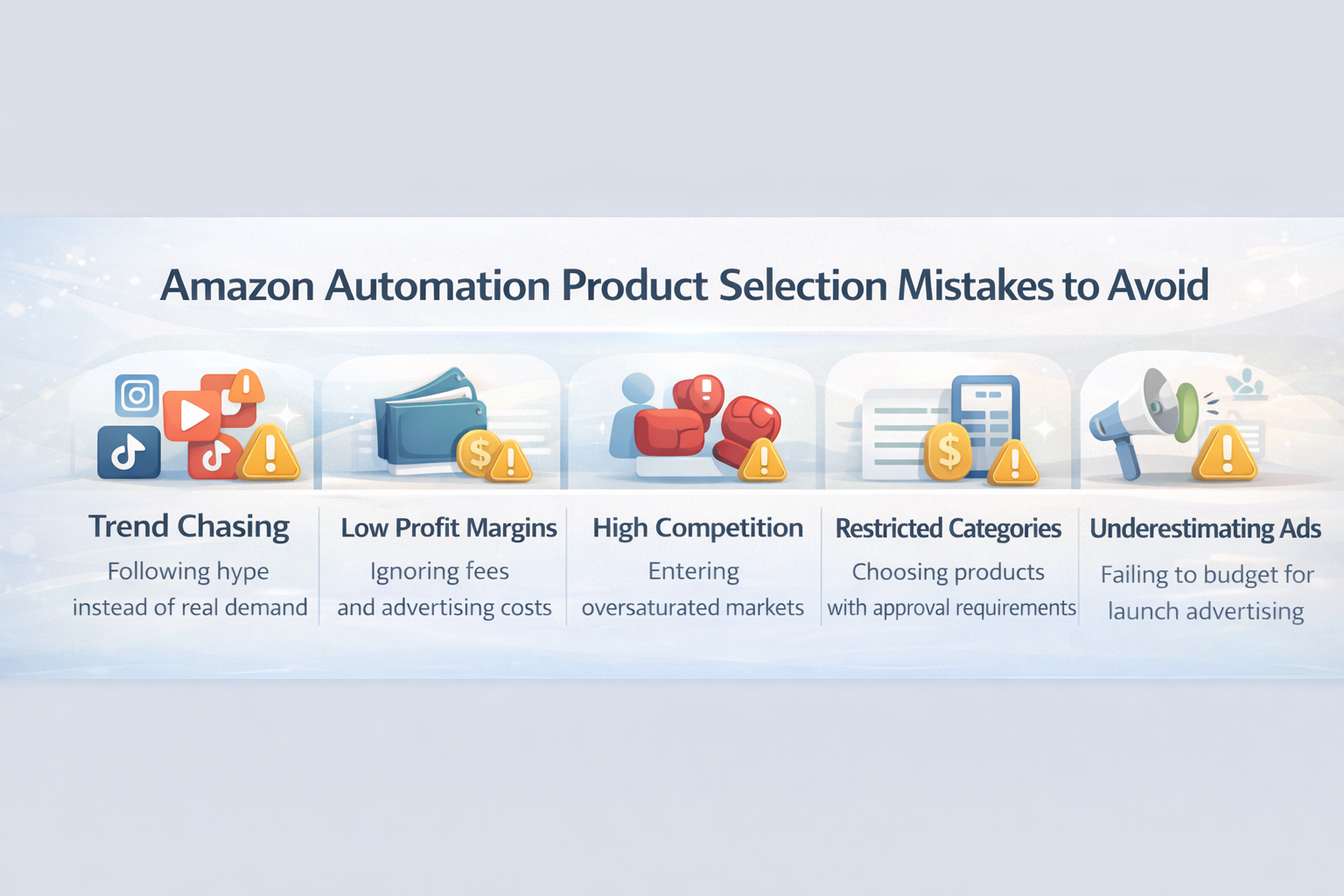
Choosing products because they’re trending on TikTok or Instagram is a recipe for disaster. By the time inventory gets sourced, listings get built, and ranking starts, the trend has moved on. Inventory that nobody wants gets left behind.
The Restricted Category Nightmare
Amazon requires approval, certifications, or testing documentation for certain categories. Choosing restricted products without understanding requirements leads to listing suspensions and wasted inventory.
For instance, selling anything in the topical category requires FDA registration and specific testing. Electronics need FCC compliance. Children’s toys require CPSIA certification. These factors are taken into timelines and budgets, or unrestricted categories get picked instead.
The Too Many Products Problem
New automation stores often launch with 50 different products, thinking that more options equal more sales. Wrong. Capital and attention just got spread so thin that nothing succeeds.
Winners start with the five to ten best products for Amazon automation stores, at maximum. Those products get mastered, cash flow builds, and then gradual expansion happens. In addition, advertising can actually be afforded properly when budgets aren’t getting split 50 ways.
Underestimating Advertising Costs
Organic rankings take months to build in 2026. Amazon’s algorithm favors products with sales velocity, which means advertising is needed to jumpstart momentum.
Advertising expenses get calculated into profitability analysis from day one. Assumption should be made that $500 to $2,000 per product will be spent on ads before organic rankings kick in. If that kills margins, different Amazon automation profitable products get chosen.
How Market Trends Shape Amazon Automation Product Research in 2026
Understanding current market trends helps automation stores choose products with staying power. The landscape shifted dramatically over the past year, creating new opportunities for sellers paying attention.
Sustainability: From Buzzword to Requirement
Sustainability moved from niche preference to mainstream expectation in 2026. Products made from recycled materials, offering plastic-free packaging, or supporting environmental causes see measurably higher conversion rates.
However, “eco-friendly” can’t just be slapped on garbage with sales expected. Customers research claims now. Products need legitimate environmental benefits backed by certifications or transparent sourcing.
The Health and Wellness Evolution
Health and wellness products continue dominating Amazon sales, but the category has evolved significantly. Generic supplements face brutal competition. Specialized wellness products addressing specific concerns show much stronger growth.
For example, sleep optimization products and stress management tools consistently outperform broad vitamin categories. According to Statista, personalized wellness products grew 34% in 2025 and continue trending upward.
Technology Integration Everywhere
Smart home compatibility and app connectivity add value across categories. A standard pet feeder becomes premium with smartphone controls. Regular locks become luxury items with remote access.
Traditional products that could benefit from tech integration are identified, and improved versions are sourced. The margin potential on tech-enhanced products usually exceeds basic alternatives significantly.
Seasonal vs. Evergreen Amazon Automation Store Strategy
The seasonal versus evergreen debate significantly impacts how Amazon automation stores choose products. Both approaches work, but they require completely different mindsets and strategies.
Evergreen: The Steady Income Foundation
Evergreen products generate consistent sales year-round. Kitchen tools, phone accessories, pet supplies, and fitness gear; these categories don’t experience wild fluctuations. The beauty of evergreen products is cash flow stability.
However, evergreen categories often have more competition since everyone wants that stable income. Stronger differentiation is needed to stand out.
Seasonal: The Profit Explosion Strategy
Seasonal products offer concentrated profit potential during specific periods. One automation seller makes 60% of its annual profit during the December holiday season. Those December profits fund lifestyle and business growth for the entire year.
The Hybrid Approach That Works Best
Most successful automation stores run hybrid strategies. Core evergreen products that generate baseline revenue are maintained, and supplementation occurs with seasonal items during peak periods.
For instance, yoga mats might sell year-round, then beach accessories get added each summer, and gift sets during holidays. This maximizes annual revenue while minimizing risk.
For sellers wanting comprehensive support in implementing these strategies, Hisellit offers end-to-end automation services that handle everything from Amazon automation product research to inventory management.
Real-World Examples of Successful Amazon Automation Product Selection
Real stories illustrate how Amazon FBA automation products actually work in practice.
The Home Organization Win
One automation store observed that drawer dividers received poor reviews. Customers criticized their flimsy materials and lack of customization. They sourced bamboo dividers with adjustable sizes and launched them at competitive prices. Within six months, they captured a significant market share.
The Pet Product Upgrade
Another store focused on dog waste bag holders. Existing products broke constantly. Reinforced versions with double capacity and weatherproof materials got sourced. Listings highlighted these specific improvements. Result? Profitability within the first quarter.
The Bundle Approach
One seller discovered an opportunity in bundling the best products for Amazon automation stores. Instead of selling measuring cups separately, they offered beginner, intermediate, and advanced baker sets with different combinations of cups. This bundling approach increased the average order value and made product selection easier for customers.
Notice the pattern? Revolutionary products aren’t just invented. Instead, existing problems are identified, better solutions are offered, and improvements are communicated clearly.
Building a Sustainable Amazon Automation Product Selection Portfolio
Long-term success requires thinking beyond individual product wins. How do Amazon automation stores pick products that align with broader business goals and brand identity?
The Customer Persona Approach
Many successful automation stores build portfolios around specific customer types rather than random opportunities. A store targeting new parents might offer baby monitors, diaper organizers, nursery lighting, and feeding accessories. This approach encourages repeat purchases and builds genuine customer loyalty.
Maintaining strong customer service in an automated Amazon store becomes easier when your product portfolio serves a specific audience with related needs.
Diversity Protects Business
Portfolio diversity protects against category-specific disasters. The goal should be that no single product represents more than 20% of total revenue. This ensures one product failure doesn’t sink the entire business.
Product Lifecycle Management
Every product eventually declines as markets saturate or preferences shift. Successful automation stores continuously test new Amazon automation profitable products while optimizing existing ones. Underperformers get retired before they become cash drains.
Compliance and Quality Considerations in Amazon Automation Product Research
Amazon automation product selection must account for regulatory compliance and quality standards. Amazon increasingly enforces strict requirements, and violations lead to listing removals or account suspensions.
Know the Rules Before Playing
Certain categories require specific documentation before listing. All applicable regulations are researched before finalizing product decisions. These certifications add time and cost to launches.
Quality Control Starts Before Amazon
Shipments from suppliers get inspected before being sent to Amazon warehouses. Product functionality gets tested. Packaging gets verified to meet requirements. Many automation stores use third-party inspection services in supplier countries.
This upfront investment prevents costly returns and review disasters. One bad batch can destroy months of ranking work.
Safety Isn’t Optional
Beyond legal requirements, liability issues are considered. Products with injury risk create costly legal problems even if technically compliant. Many automation stores specifically avoid supplements, electrical items, or children’s products due to liability concerns.
Authenticity Documentation Matters
Amazon cracks down hard on counterfeit items. Only authorized distributors or manufacturers who provide authenticity documentation get worked with. Invoices and supplier communications stay organized. Counterfeit allegations can destroy automation stores overnight.
Future-Proofing Your Amazon Automation Product Selection Strategy 2026
Successful automation stores adapt selection strategies to anticipated changes. The e-commerce landscape evolves rapidly. Strategies working today might fail tomorrow.
AI Integration Is Accelerating
Artificial intelligence will play expanding roles in both Amazon automation product research and customer shopping behaviors. Stores integrating Amazon automation tools now position themselves advantageously for future developments.
The automation stores winning in 2026 use AI for trend prediction, pricing optimization, and inventory forecasting. These capabilities compound over time as algorithms learn from specific business patterns.
Voice Commerce Changes Discovery
Voice commerce continues growing, influencing how customers discover and purchase products. Products optimized for voice search queries may gain algorithmic advantages.
Consideration should be given to how customers might verbally describe products being evaluated. “Alexa, order dog waste bags” works differently from typed searches. Optimization strategies need to account for this shift.
Sustainability Requirements Will Increase
Both Amazon and consumers demand greater environmental responsibility. Products with minimal packaging, recyclable materials, or carbon-neutral shipping may receive preferential treatment.
Evaluating environmental impact now prepares stores for inevitable policy changes. Waiting until requirements become mandatory puts sellers behind competitors who adapted early.
If professional Amazon automation product selection strategy 2026 guidance with expert support is needed, contact Hisellit’s team to discuss how automation services can accelerate Amazon business growth.
Advanced Strategies: How Amazon Automation Stores Choose Products for Hidden Opportunities
Once you’ve mastered the basics, these advanced approaches separate good Amazon automation product selection from great results.
Reverse ASIN Lookups for Competitor Analysis
Take a successful competitor’s ASIN and run it through Cerebro or Jungle Scout’s keyword tool. You’ll see every keyword they rank for, their estimated traffic, and which terms drive the most sales.
This reveals opportunities in competitive spaces. Instead of competing head-to-head, find the long-tail keywords competitors rank for accidentally. Target those specifically with optimized listings.
For example, a competitor selling yoga mats might rank for “extra thick yoga mat for bad knees” without targeting that phrase intentionally. If you optimize specifically for that search, you can capture that traffic with less competition and lower advertising costs.
Private Label Differentiation in Commodity Categories
Commodity products—phone cases, water bottles, resistance bands—seem like terrible choices because of competition. But that’s where private labeling creates opportunity.
The Amazon FBA product research process for private label focuses on improvement, not invention. Take an existing product, make it 10% better, and market that improvement clearly. Better materials, smarter design, or solving a specific customer complaint can carve out market share.
Bundling Strategies That Create New Markets
Instead of selling individual products that face massive competition, create bundles that don’t exist yet. Combine complementary items into packages that solve specific problems.
Bundling involves understanding customer purchase patterns. What do people buy together? Amazon’s “frequently bought together” section reveals these patterns, giving you bundle ideas validated by actual customer behavior.
A single resistance band might compete with 500 other sellers. But a resistance band bundle with a door anchor, carrying bag, and exercise guide? That’s a unique product with fewer direct competitors.
Geographic and Demographic Targeting
Most sellers think nationally. But, amazon automation profitable products can emerge from targeting specific customer segments that others ignore.
Products for seniors, left-handed users, or people with specific medical conditions often have less competition because sellers overlook these niches. The demand might be smaller, but so is the competition, and customers in underserved segments often pay premium prices.
Use Amazon automation tools to identify keywords with decent search volume but surprisingly few optimized listings. These gaps represent opportunities where targeted products can dominate small but profitable niches.
The Role of Data in Scaling Amazon Automation Product Selection
You can’t scale on instinct. As your automation store grows, data becomes even more critical for maintaining profitability across multiple products.
Building a Product Performance Dashboard
Track every product’s metrics weekly: sales volume, advertising cost of sales (ACoS), profit margin, inventory turnover, and return rate. This dashboard shows you which Amazon automation profitable products are actually profitable versus which ones just generate revenue.
Expansion decisions are based on what’s already working. If one product category consistently delivers 35% margins with low returns, that’s your signal to expand within that category.
The dashboard also reveals when to kill products. If a SKU hasn’t been profitable for three months despite optimization efforts, cutting it frees up capital and attention for better opportunities.
Seasonal Trend Analysis and Inventory Planning
Historical data prevents the feast-or-famine cycle that kills many automation stores. Analyze your sales by month for each product over at least one full year.
This reveals subtle seasonality you might not notice otherwise. Sports equipment might peak in January (New Year’s resolutions) and September (back to school), not summer when you’d intuitively expect it. Amazon automation product research using historical trends lets you build inventory before demand spikes, not after.
Competitive Monitoring and Market Shifts
Markets change. A product with great fundamentals six months ago might be oversaturated now. Automated monitoring through Amazon automation tools tracks when new competitors enter your markets, when pricing shifts, or when review velocity changes.
Set up alerts for:
- New sellers entering your top product markets
- Price changes by competitors (especially race-to-bottom patterns)
- Review velocity increases (signals growing demand or new competitor success)
- Keyword ranking changes
This intelligence informs ongoing optimization versus when to pivot to new opportunities.
Conclusion: Mastering How Amazon Automation Stores Choose Products
Success in Amazon automation comes down to disciplined Amazon automation product selection. How Amazon automation stores choose products affects everything from profit margins and scalability to long-term sustainability in a competitive Amazon FBA environment.
The sellers winning in 2026 are not relying on luck or trends. They use Amazon automation tools, follow structured Amazon automation product research, and focus on identifying profitable Amazon automation profitable products with proven demand and manageable competition. They understand that finding the best products for Amazon automation stores is an ongoing process that requires continuous testing and market validation.
Whether you are starting or scaling, the fundamentals remain the same. Prioritize strong margins over volume, apply clear Amazon FBA automation product selection criteria, and build supplier relationships that support quality and consistency. These principles protect cash flow and allow steady growth over time.
The landscape will continue to evolve. AI will further improve Amazon automation product research, and consumer behavior will shift. However, data-driven decisions, disciplined testing, and ongoing optimization will always define a successful Amazon automation product selection strategy 2026.
Start with the best opportunities you can validate today. Test carefully using modern Amazon automation tools, scale what works, and remove what doesn’t. When you master how to find profitable products for Amazon automation, you build a business designed to adapt and grow regardless of market changes.
Frequently Asked Questions
Q. What is Amazon automation product selection in e-commerce?
Amazon automation product selection is the data-driven process of choosing profitable products for automated Amazon stores using analytics, research tools, and proven criteria instead of guesswork. It focuses on evaluating sales velocity, competition levels, profit margins, and demand stability before any inventory is purchased. In practice, sellers use Amazon automation tools to screen hundreds of products quickly, then manually verify the best opportunities. This combination of automation and human judgment helps identify products that align with long-term business goals rather than short-lived trends.
Q. How much does it cost to start an Amazon automation business in 2026?
Starting an Amazon automation business in 2026 typically costs between $5,000 and $15,000, depending on product selection, inventory size, and tool usage. Most budgets are split across inventory purchases, Amazon seller fees, automation software subscriptions, and advertising. Experienced sellers usually allocate the largest portion to inventory, followed by ads and then tools. Understanding how to find profitable products for Amazon automation early helps reduce wasted spend and makes scaling more predictable once consistent demand is proven.
Q. Is Amazon automation profitable for beginners?
Amazon automation can be profitable for beginners who follow a structured product selection process and avoid chasing trends without data. New sellers who focus on proven-demand products with manageable competition often see results within six to twelve months. The biggest advantage for beginners is Amazon’s built-in traffic and fulfillment infrastructure, which reduces operational complexity. Starting with a small number of well-researched products allows beginners to learn faster and protect capital while refining their automation strategy.
Q. What tools automate Amazon product selection?
Amazon product selection is commonly automated using tools like Helium 10, Jungle Scout, Keepa, AMZScout, and Viral Launch. These platforms analyze millions of listings to estimate sales volume, track pricing history, evaluate competition, and flag profitable opportunities. In 2026, many of these tools. Also, use AI to predict demand shifts before they peak. Chrome extensions help with quick validation, while full platforms provide deeper insights needed for confident product selection decisions.
Q. How does Amazon automation help small business owners?
Amazon automation helps small business owners scale by reducing the time spent on product research, inventory management, and daily operations. Automation tools handle repetitive tasks such as price tracking, stock monitoring, and basic customer service. This allows owners to focus on strategy rather than execution. By using the same data and tools as large brands, small businesses can compete effectively, identify overlooked opportunities, and grow without needing large teams or complex logistics.