
Amazon FBA Automation Cost in 2026: Fees, Risks & ROI
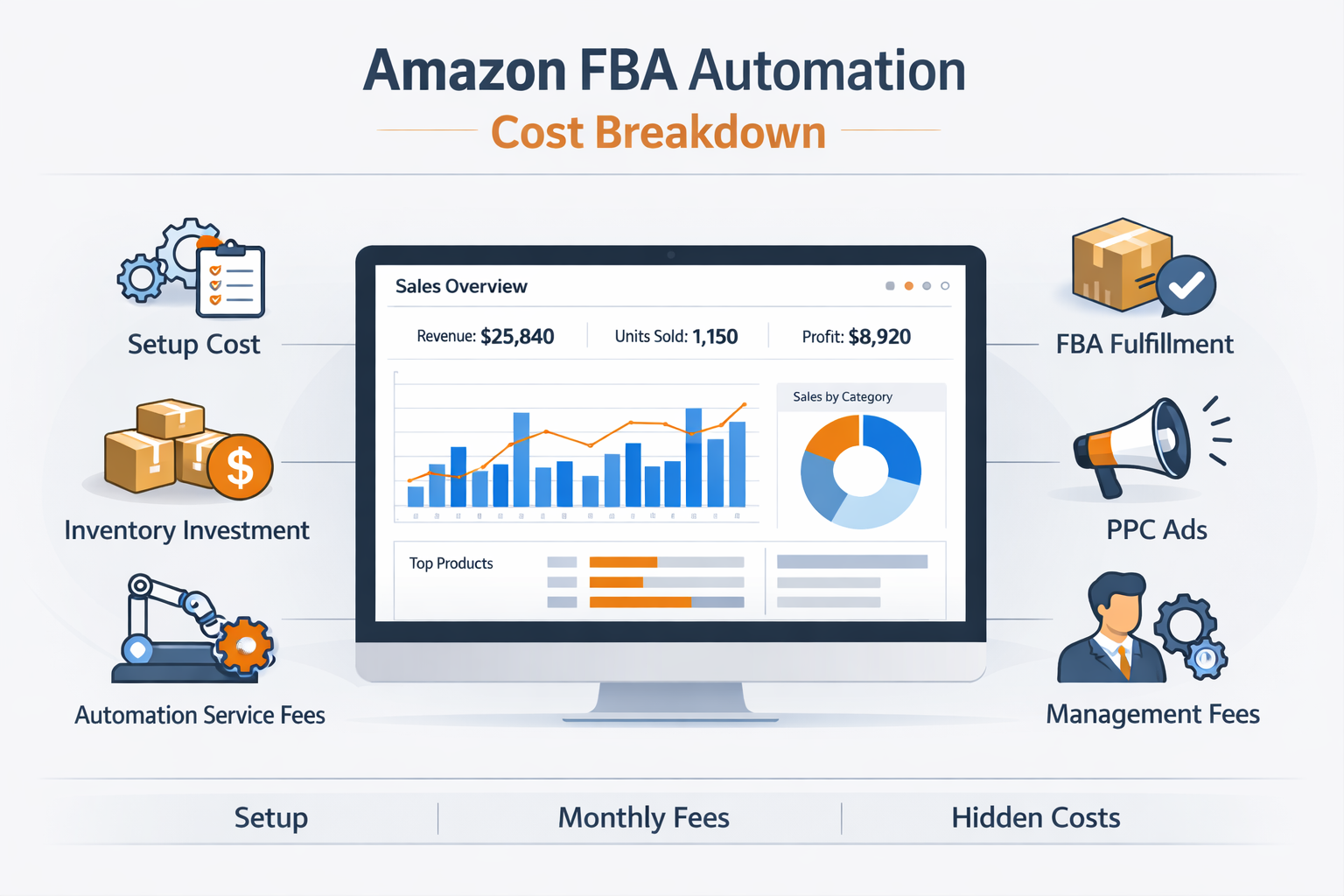
Understanding the Amazon FBA automation cost breakdown is the first step toward building a sustainable e-commerce business. A lot of sellers are drawn to this model because it lets them grow on Amazon without managing daily operations themselves. And the investment has grown alongside the opportunity. According to the latest available Jungle Scout State of the Amazon Seller report, many sellers invest between $4,000 and $8,500 in their first three months on Amazon before factoring in automation service fees. When automation is added, total capital requirements increase significantly due to setup costs and professional management fees.
When you bring in an Amazon FBA automation service, the pricing structure changes quite a bit. A dedicated team takes over the heavy lifting and applies its own fee structure on top of Amazon’s. For busy professionals looking for reliable income streams or entrepreneurs juggling multiple ventures, knowing exactly how much Amazon FBA automation costs is what lets you set realistic budgets and avoid nasty surprises. HiSellIt’s e-commerce solutions are a good starting point if you want to see what a transparent, full-service provider looks like before diving deeper.
How much does Amazon FBA automation cost in 2026?
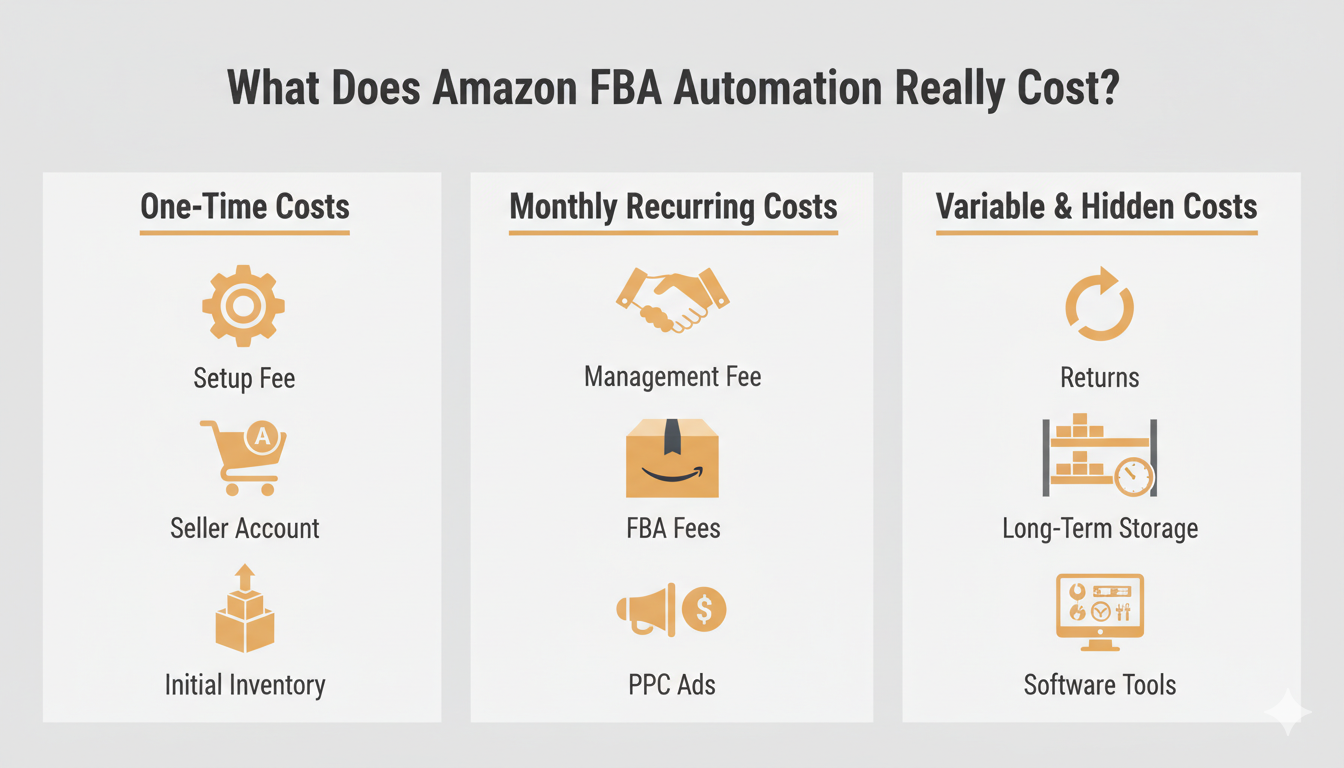
Most sellers need between $12,000 and $47,000 to get started. Monthly costs usually range from $6,000 to $25,000 depending on scale. This includes setup fees, inventory, Amazon fulfillment charges, advertising, and automation management fees.
This guide breaks down every single cost tied to Amazon FBA automation. Setup fees, monthly management fees, Amazon’s own fulfillment charges, advertising spend, and the hidden costs most people don’t plan for. By the end, you’ll know whether this model fits your financial goals and how much risk you’re comfortable taking on.
What Changed in Amazon FBA Automation Costs in 2026?
If you’ve been evaluating this model for a while, here are the notable shifts reflected in Amazon’s most recent fee structure and marketplace trends:
-
Ad costs increased.
Amazon ads are more competitive than ever. More sellers are bidding for the same keywords. That means higher cost-per-click in most categories. You need a bigger ad budget just to stay visible.
-
Niche saturation intensified.
Easy wins are rare. Strong product research takes more time and better data. Because of that, serious agencies charge more for sourcing and validation work.
-
AI listing optimization became standard.
Most solid agencies use AI tools to help write, test, and improve listings. It’s not optional anymore. It’s part of the service, and it’s built into the pricing.
-
FBA fees were adjusted.
Fulfillment and storage rates change from time to time. Some size tiers went up. Before you run numbers, always double-check the latest fee schedule inside Seller Central.
-
Inventory management penalties carry more weight.
If you run out of stock too often, Amazon may charge extra fees. Your IPI score also affects how much inventory you’re allowed to send in.
-
More automation agencies entered the market
There are more agencies than ever. Some are experienced. Some are not. This means you have options, but it also means you need to vet carefully.
What Is Amazon FBA Automation and Why Does It Matter?
Amazon FBA automation means working with a specialized agency that runs your entire Amazon business on your behalf. You provide the capital. They supply the operational expertise. These companies handle product research, supplier negotiations, listing optimization, inventory management, and customer support.
The appeal is simple. You can own an Amazon business without spending 40 hours a week managing it. For people with full-time jobs, limited e-commerce experience, or multiple ventures running at once, Amazon FBA automation creates a structured path to building income on Amazon without constant involvement.
Before looking at pricing, understand what you’re paying for. A full-service package typically covers product research, supplier outreach, listing creation, inventory planning, PPC advertising management, customer service, and monthly performance reporting. You’re essentially hiring an entire e-commerce team through one provider.
According to Forbes’ analysis of e-commerce automation trends, More busy professionals are choosing automation because they simply don’t have 30–40 hours a week to learn Amazon from scratch.
Initial Setup Costs for Amazon FBA Automation
Automation Service Setup Fee
The setup fee is your first major expense. It’s a one-time charge that covers the groundwork: market research, product selection, supplier vetting, account setup (if you need one), your first inventory order, listing creation with professional photography and copywriting, and the foundation for your PPC campaigns.
In 2026, setup fees typically fall between $2,500 and $12,000 depending on the agency’s reputation, how deep their onboarding process goes, and whether performance guarantees are included.
Premium agencies at the higher end often launch multiple products at once or give you access to proprietary research software. Lower-cost options cut upfront expenses but tend to offer less personalized support during those critical early stages. When evaluating setup fees, look at what’s actually included rather than just comparing the numbers.
To explore transparent pricing structures with clear deliverables, check out HiSellIt’s Amazon wholesale FBA services.
Amazon Seller Account Fee
If you’re starting from scratch, you’ll need a Professional Seller account. That costs $39.99 per month in 2026. It unlocks the tools and features you need to run a real Amazon business. You can review all available account options on Amazon’s official Seller Central pricing page.
Initial Inventory Investment
Your inventory investment is almost always the biggest upfront cost. It depends heavily on what product you’re launching. Most automation companies recommend allocating between $6,000 and $30,000 for your first inventory order.
The range is wide because product types vary so much. A lightweight kitchen gadget might only need around $6,000 to stock 500 units. Electronics or premium home goods can easily exceed $25,000 for a similar quantity. A good automation partner will give you detailed forecasts on expected product costs, sales velocity, and profit margins before you commit to anything.
If you want to go deeper on how profitable product selection works, this guide to Amazon FBA best products and profitable categories is worth a read.
Monthly Recurring Costs in Amazon FBA Automation
What are the monthly costs of Amazon FBA automation?
- Automation management fee (10%–25% of revenue or flat fee)
- Amazon seller account ($39.99/month)
- FBA fulfillment and storage fees
- Inventory replenishment (30%–50% of revenue)
- PPC advertising spend (10%–30% of revenue)
Service Management Fees
After setup, you’ll pay your automation partner every month. There are three common pricing models, and each has real trade-offs:
Flat Monthly Fee: Some agencies charge a fixed amount, usually $600 to $2,500 per month regardless of how your store performs. Predictable for budgeting, but you pay the same whether your store generates $3,000 or $30,000 in a month.
Percentage of Revenue: The most common structure. Agencies take 10% to 25% of your gross monthly sales. On $10,000 in revenue, that’s $1,000 to $2,500. This ties the agency’s earnings to your performance, which generally creates better incentives.
Hybrid Model: A lower flat fee ($400 to $600/month) combined with a smaller revenue percentage (5% to 15%). Balances cost predictability with performance-based motivation.
| Model | Typical Range (2026) | Best For |
| Flat Monthly Fee | $600 to $2,500 | Predictable budgeting |
| Percentage of Revenue | 10% to 25% of sales | Performance-based growth |
| Hybrid | $400-$600 flat + 5%-15% revenue | Balanced approach |
Understanding which model fits your cash flow is important before you calculate real profit margins. Statista’s e-commerce fulfillment cost analysis confirms these pricing models are now standard across the industry.
Amazon FBA Fulfillment Fees
Amazon charges storage and fulfillment fees for every unit sold. These rates vary by product size, weight, and season, and are updated periodically. As of Amazon’s most recent published fee schedule:
- Standard-size fulfillment typically falls in the $3 to $5 range per unit.
- Oversized items vary significantly depending on dimensions and weight.
- Storage fees increase during peak Q4 months.
- Long-term storage fees apply to inventory stored for more than 365 days.
Because Amazon adjusts these fees regularly, sellers should confirm current rates directly through the official FBA fee calculator or Seller Central fee schedule before making financial projections.
You can check Amazon’s official FBA fee schedule for detailed, up-to-date pricing. These costs are separate from what you pay your automation provider.
Monthly Inventory Replenishment
To keep your listings ranking well, you need consistent stock. Running out of inventory kills your organic ranking fast. Most successful sellers reinvest 30% to 50% of monthly revenue into replenishing stock. A solid replenishment plan is also how you protect your IPI score and avoid the Low Inventory Level Fee that Amazon now charges when your stock drops below healthy thresholds.
Amazon PPC Advertising Costs
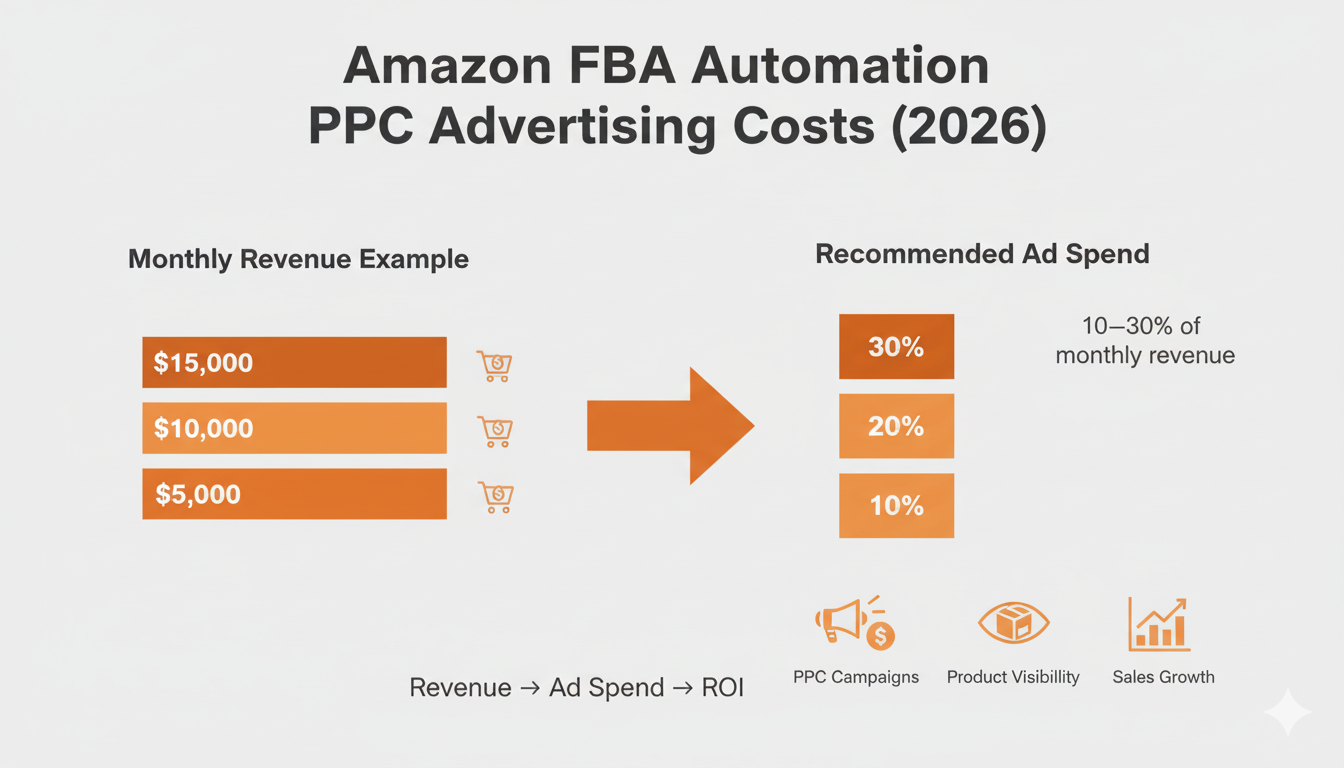
Amazon PPC is a key driver of visibility, especially for new products. Most sellers put 10% to 30% of monthly revenue toward ads. On a $10,000 revenue month, that’s $1,000 to $3,000 in ad spend.
Your automation partner manages the campaigns, but the ad budget comes from you. Two metrics matter most here: ACoS (Advertising Cost of Sale), which measures your ad spend as a percentage of ad-attributed revenue, and TACoS (Total Advertising Cost of Sale), which measures ad spend against your total revenue including organic sales. TACoS is the better overall health indicator because it shows how dependent your business is on paid traffic. According to WordStream’s Amazon advertising benchmarks, effective PPC management can improve ROAS by 40% to 60% compared to unoptimized campaigns.
Hidden and Variable Costs to Plan For
Long-Term Storage Fees
If inventory sits in Amazon’s warehouses for more than 365 days, you’ll be charged long-term storage fees: $7.20 per cubic foot or $0.15 per unit in 2026, whichever is higher. These fees hit twice a year. They can quietly eat into your margins if you overstock slow-moving items. Good automation teams watch inventory age closely and suggest promotions or liquidation before these fees kick in.
Referral Fees, Return Processing Fees, and Removal Fees
Amazon charges a referral fee on every sale, typically 8% to 15% depending on category. Beyond that, three other variable fees matter:
- Return Processing Fees: Charged in certain categories when customers return items.
- Removal Fees: If you need to pull inventory out of a warehouse, Amazon charges for it.
- Return rates: Average 5% to 15% depending on the category. Electronics and apparel run higher. Consumables and pet products tend to be lower.
According to the National Retail Federation’s return rate data, understanding category-specific return patterns helps you account for this in your profit calculations before it surprises you.
Low Inventory Level Fee (New in 2026)
Amazon may apply a Low Inventory Level Fee when a seller’s historical stock levels are consistently too low relative to sales velocity. This fee is designed to encourage healthier replenishment cycles and reduce fulfillment disruptions.
Your automation partner should be actively monitoring inventory turnover, replenishment timing, and IPI score thresholds to avoid triggering this fee unnecessarily. If they are not tracking these metrics, it’s worth raising the question directly.
Product Photography and Listing Optimization
Initial photography is usually included in your setup fee. But as your catalog expands, you’ll need updated visuals and enhanced content. Professional Amazon product photography typically costs $125 to $600 per product in 2026. A+ content design runs $250 to $900 per listing. These improve click-through and conversion rates and are worth the investment once your margins support it.
Software and Tools
Some agencies include software access in their management fee. Others don’t. Tools for inventory tracking, profit analysis, keyword research, and review monitoring typically add $60 to $350 per month. For Amazon’s own tools, you can check Amazon Seller Central for the latest options and pricing.
Real-World Amazon FBA Automation Pricing Scenarios (2026)
Here are three realistic scenarios based on different investment levels. These are honest projections based on current market data, not guarantees.
Budget-Conscious Starter ($12,000 to $18,000 Initial Investment)
| Initial Cost Item | Amount |
| Automation service setup fee | $3,000 |
| Initial inventory investment | $9,000 |
| Amazon Professional account (first month) | $40 |
| Initial product photography and listing assets | $1,200 |
| Total initial investment | $13,240 |
| Monthly Cost Item | Amount |
| Automation fee (15% of $9,000 in sales) | $1,350 |
| Amazon seller account fee | $40 |
| Amazon FBA fulfillment fees (approx.) | $1,800 |
| Inventory replenishment (40% of revenue) | $3,600 |
| Amazon PPC advertising (20% of revenue) | $1,800 |
| Total monthly operational cost | $8,590 |
| Expected monthly profit | $400 to $900 |
This is a good entry point for testing the model with limited capital. Growth is slower, but the risk is manageable, and you learn how the operational dynamics work without overcommitting.
Mid-Range Investment ($25,000 to $35,000 Initial Investment)
| Initial Cost Item | Amount |
| Automation service setup fee | $5,500 |
| Initial inventory | $13,000 |
| Professional photography | $1,000 |
| Amazon Professional account (first month) | $40 |
| Total initial investment | $19,540 |
| Monthly Cost Item | Amount |
| Automation fee (12% of $22,000 in sales) | $2,640 |
| Amazon seller account fee | $40 |
| Amazon FBA fulfillment fees | $4,400 |
| Inventory replenishment | $8,800 |
| Amazon PPC advertising | $4,400 |
| Software tools | $180 |
| Total monthly operational cost | $20,460 |
| Expected monthly profit | $1,500 to $2,800 |
This balanced approach gives you enough capital to launch multiple products and handle early-stage adjustments without stalling your growth. It’s similar to the investment structure that mid-tier investors use within professional automation programs.
Premium Investment ($45,000+ Initial Investment)
| Initial Cost Item | Amount |
| Premium automation setup fee | $9,500 |
| Initial inventory (multiple products) | $35,000 |
| Professional photography and A+ content | $2,500 |
| Amazon Professional account (first month) | $40 |
| Total initial investment | $47,040 |
| Monthly Cost Item | Amount |
| Automation fee (10% of $45,000 in sales) | $4,500 |
| Amazon seller account fee | $40 |
| Amazon FBA fulfillment fees | $9,000 |
| Inventory replenishment | $18,000 |
| Amazon PPC advertising | $9,000 |
| Advanced software tools | $350 |
| Total monthly operational cost | $40,890 |
| Expected monthly profit | $4,000 to $7,000 |
At this level, you’re launching a full product portfolio with serious marketing support. The ROI potential is real, but so is the risk if you’re working with the wrong agency. Vetting matters even more at this investment level.
Is Amazon FBA Automation Legit, or Is It a Scam?
Amazon FBA automation as a business model is legal. Amazon does not prohibit sellers from working with third-party agencies. However, sellers remain fully responsible for complying with Amazon’s policies, account health requirements, and performance standards.
There are legitimate, professional automation providers operating successful stores. There are also inexperienced or unethical operators who overpromise and underdeliver.
The scam version typically looks like this: a large upfront setup fee, minimal operational transparency, restricted access to your own Seller Central account, and vague explanations when performance falls short.
A legitimate provider will:
- Keep you as the primary owner of your Seller Central account
- Provide transparent fee breakdowns
- Share regular performance reporting
- Offer verifiable client references
- Avoid guaranteeing specific income results
The Federal Trade Commission advises consumers to be cautious with business opportunity ventures that lack fee transparency or make unrealistic income claims. The difference comes down to who you choose. Pick the wrong agency, and it gets expensive fast.
Is Amazon FBA Automation Worth the Cost?
Is Amazon FBA automation profitable?
It can be profitable if your margins stay healthy after fees. Most Amazon FBA businesses operate at 12%–32% margins, depending on the category. Profit depends on product selection, ad efficiency (ACoS and TACoS), and how well inventory is managed.
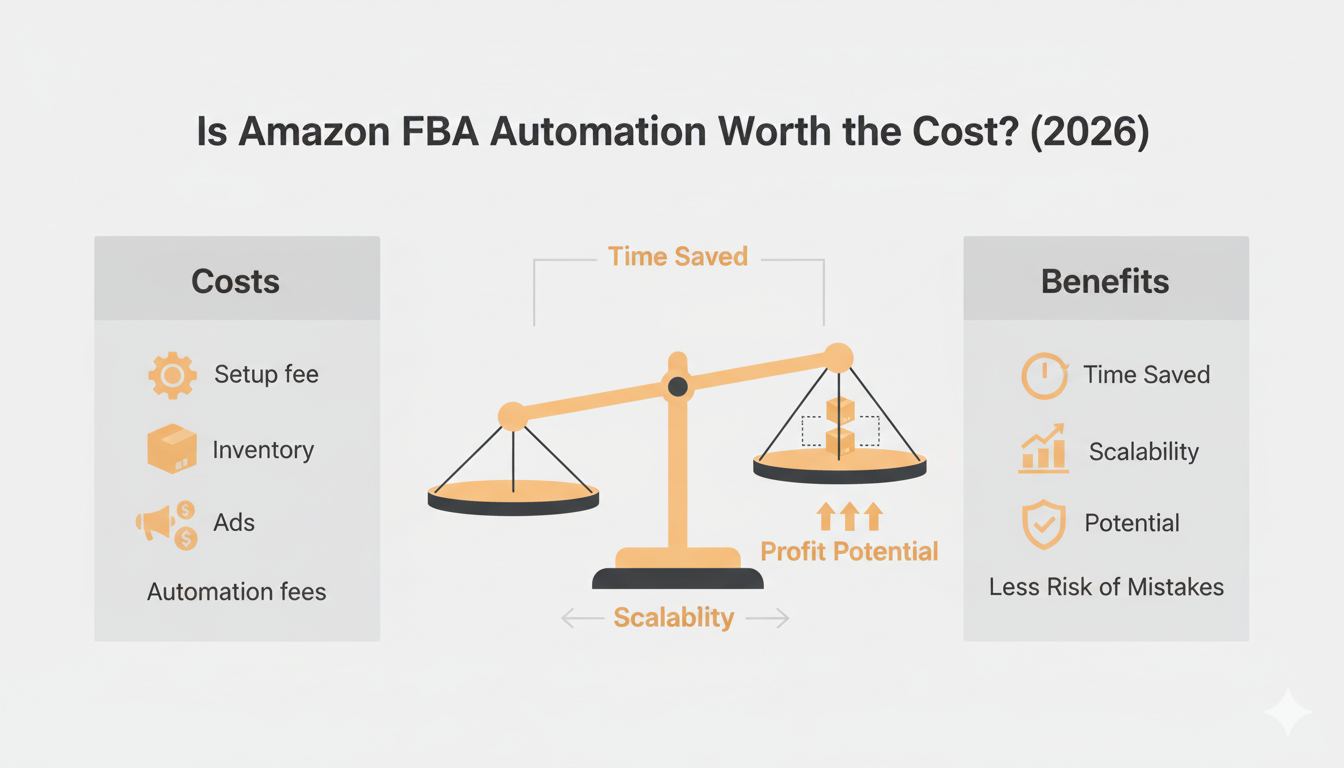
The real question isn’t whether automation costs money. It’s whether the return justifies the investment for your specific situation.
Time Savings
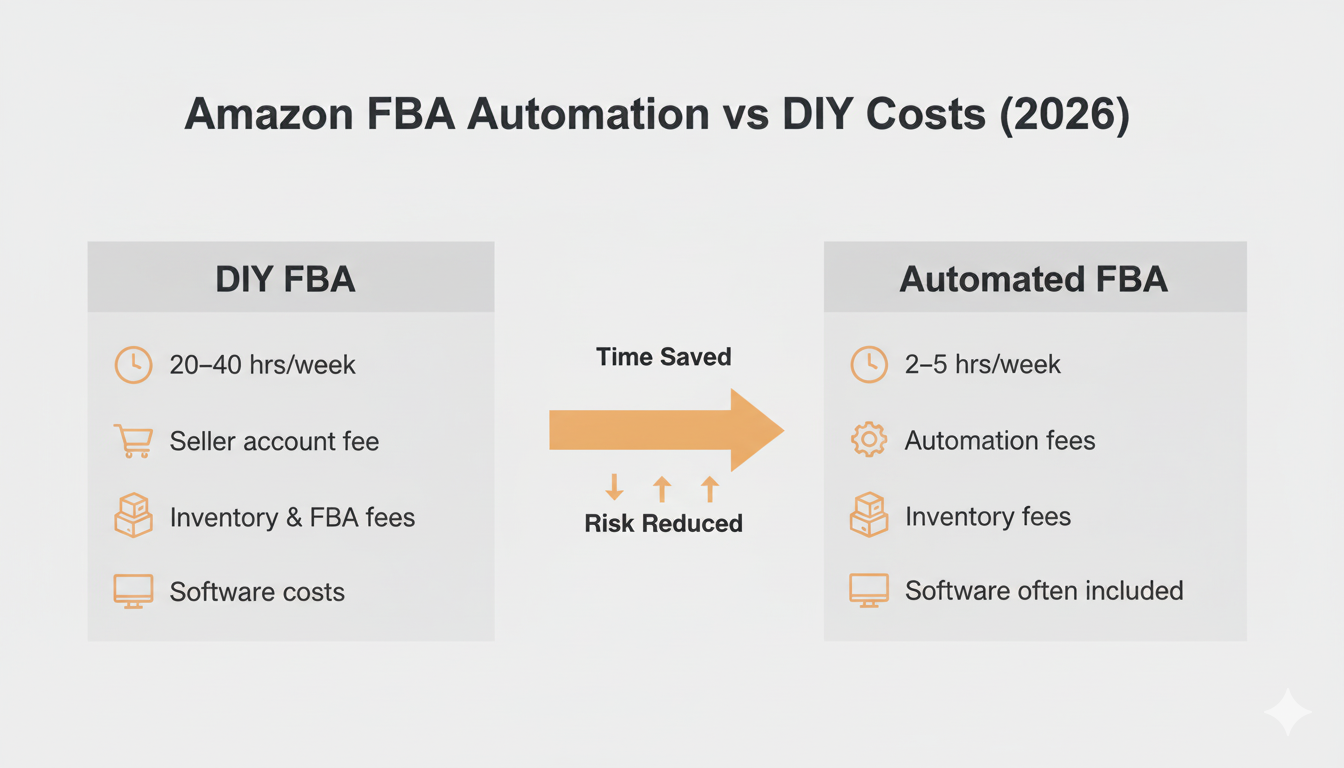
Managing an Amazon store yourself takes 20 to 40 hours a week, especially early on. If your time is worth $50 to $100 an hour, that’s $4,000 to $16,000 a month in opportunity cost. Quality automation brings your involvement down to 2 to 5 hours a week for oversight, freeing you up for higher-value work.
Expertise Access
Top automation companies bring years of Amazon experience to your store. They already know how to structure listings, manage PPC, negotiate with suppliers, and keep metrics like ACoS, TACoS, and your IPI score in a healthy range. For most beginners, developing that knowledge through trial and error takes one to two years and costs more in mistakes than the agency fee. Harvard Business Review’s research on e-commerce expertise backs this up: partnering with specialists shortens your path to profitability significantly.
Profit Margins
According to eMarketer’s e-commerce profitability report, average Amazon FBA profit margins in 2026 range from 12% to 32% depending on category and competition. The key metrics to track are ACoS, TACoS, contribution margin (revenue minus all variable costs), and net margin after automation fees. These numbers tell you whether the model is actually working for you.
Scalability
Amazon FBA automation lets you build an Amazon business while keeping your primary income source. A full-time professional earning $100,000 a year can potentially add $28,000 to $55,000 in additional net profit through automation without sacrificing their main career.
Cost Comparison: DIY Amazon FBA vs. Full Automation
Choosing between managing your store yourself and working with an automation service comes down to time, cost, and risk tolerance.
| Category | DIY FBA | Automated FBA |
| Time Commitment | 20 to 40 hrs/week | 2 to 5 hrs/week |
| Setup Fee | $0 | $2,500 to $12,000 |
| Learning Curve | High | Minimal |
| Risk of Errors | High | Low |
| Monthly Costs | $2,500 to $5,000 | $6,000 to $12,000 |
| Growth Speed | Moderate | Faster |
DIY looks cheaper at first glance. But the real cost of going it alone is the time you put in, the expensive mistakes you make while learning, and the slower growth that comes from building expertise from scratch. Full automation carries higher direct fees but puts experienced people in charge and gives you your time back.
You can review Amazon’s official seller fee breakdown to understand base costs for either approach.
Red Flags: Avoid These Cost Traps
Unrealistic Income Promises
If an agency guarantees specific revenue numbers or promotes 100% passive income with zero risk, walk away. Amazon involves real market risk. Any ethical automation service acknowledges that upfront.
Opaque Fee Structures
A trustworthy agency explains every charge clearly. Vague ‘processing’ or ‘administrative’ fees outside their stated percentage are a red flag. The Federal Trade Commission specifically warns about unclear fee structures in business opportunity ventures.
High Setup Fees with Thin Deliverables
Paying $10,000+ in setup fees should come with comprehensive services: thorough product research, professional listing creation, supplier vetting, inventory coordination, and a solid PPC foundation. If the service description is vague, that price isn’t justified.
Hidden Inventory Markups
Some agencies buy inventory at wholesale and bill clients at a higher rate, pocketing the markup on top of their percentage fee. Reputable partners provide supplier invoices and charge their fee completely separately.
Long-Term Contracts with No Performance Clauses
Quality automation services include clear benchmarks and defined exit terms. Multi-year contracts with no escape clause trap you even when performance falls short. Don’t sign one.
Maximizing ROI on Your Amazon FBA Automation Investment
Simple Profit Formula
Net Profit = Revenue – (Product Cost + FBA Fees + PPC + Returns + Automation Fees)
If the remaining number meets your income goal, automation may make sense for you.
Start with Clear Financial Goals
Before partnering with any agency, define what success looks like for you. Is it $2,500 in monthly profit within 12 months? A $120,000 annual revenue business in 18 months? Your targets determine how much to invest and give you a benchmark to hold your agency accountable to.
Monitor Key Performance Indicators Every Month
Even with a fully managed store, staying on top of your numbers is essential. Track:
- Monthly revenue and growth rate
- Net profit after all fees and costs (this is your real number)
- ACoS and TACoS on your PPC campaigns
- IPI score in Seller Central
- Inventory turnover rate
- Return on ad spend (ROAS)
- Customer review ratings and seller feedback scores
Request detailed monthly reports from your agency. If numbers consistently miss projections without clear explanations or a fix plan, that’s a problem worth addressing directly.
Reinvest Profits in the First 6 to 12 Months
Resist the urge to pull profits early. Reinvesting back into inventory and expanding your product portfolio compounds growth faster. Automation fees become a smaller slice of revenue as the business scales. Once you hit your target margins, you can start taking regular distributions without slowing things down.
Diversify Beyond Amazon When the Time Is Right
After achieving stable performance on Amazon, consider expanding to other platforms. Many successful sellers look at Walmart automation vs Amazon FBA to reduce platform dependency and tap into a different customer base. Diversification strengthens overall profitability and limits the risk that comes from relying on a single marketplace. According to Entrepreneur magazine’s multi-channel strategy guide, diversification is one of the most consistent drivers of long-term e-commerce success.
Conclusion: Making an Informed Decision About Amazon FBA Automation Costs
The full Amazon FBA automation cost picture is clear now. Getting started requires $12,000 to $47,000 or more. Monthly running costs range from $6,000 to $25,000, depending on scale. Between setup fees, inventory, fulfillment charges, ad spend, and your automation service fee, the numbers add up fast.
But those numbers aren’t meant to scare you. They’re meant to set honest expectations. Real Amazon businesses need proper funding. Unlike passive income myths that promise returns with minimal investment, this model works when it’s properly capitalized and professionally managed.
The key question is whether the return justifies the investment. For people with capital but limited time, or for entrepreneurs who want expert guidance without years of trial and error, Amazon FBA automation can be a smart way to build sustainable e-commerce income.
Before signing with any agency: ask for client references you can actually contact, understand every line item in the fee structure, make sure you retain access to your own Seller Central account, and compare what’s included, not just the price.
With the right partner, transparent pricing, and a long-term mindset, Amazon FBA automation can deliver meaningful returns while preserving your time for other priorities. If you’re ready to talk through whether this model fits your situation, get in touch with HiSellIt’s team for an honest conversation about your options.
Frequently Asked Questions About Amazon FBA Automation Costs
Q. How much does it cost to start Amazon FBA with automation?
Starting Amazon FBA with automation typically requires $12,000 to $47,000 in initial capital for 2026. That breaks down into a setup fee ($2,500 to $12,000), initial inventory ($6,000 to $35,000), and first-month operational expenses including your Amazon seller account, automation management fee, and initial ad budget. The exact number depends on your product selection, how many SKUs you launch, and which agency you go with.
Q. What percentage do Amazon FBA automation companies typically charge?
Most charge between 10% and 25% of gross monthly revenue. Some use flat monthly fees ranging from $600 to $2,500. Others use hybrid models combining a smaller flat fee with a reduced revenue percentage. The 12% to 15% range is most common among reputable full-service providers.
Q. Are Amazon FBA automation services worth the cost?
They can be, depending on your situation. If you value your time, lack Amazon-specific expertise, or want to build an e-commerce business alongside other commitments, automation often proves worthwhile despite the fees. The determining factor is whether the net profit you receive exceeds what you could achieve independently after accounting for your own time investment. Most sellers have a clear answer within 6 to 12 months.
Q. What are the ongoing monthly costs for automated Amazon FBA?
A fully automated store generating $17,000 a month will typically carry $12,500 to $15,000 in monthly costs. That includes the management fee (10% to 25% of sales or $600 to $2,500 flat), the $40 Amazon seller account fee, FBA fulfillment fees, inventory replenishment (30% to 50% of revenue), and PPC advertising spend (10% to 30% of revenue). Net profit at that scale is roughly $2,000 to $4,500.
Q. How long until Amazon FBA automation becomes profitable?
Most automated Amazon businesses reach initial profitability within 3 to 6 months. Building to meaningful profit levels typically takes 6 to 12 months. The timeline depends on product selection, initial capital, how aggressively you reinvest early revenue, and how effectively your automation partner manages PPC and listing optimization during the launch phase.
Q. What are ACoS and TACoS, and why do they matter?
ACoS (Advertising Cost of Sale) is your ad spend divided by ad-attributed revenue. If you spend $100 and generate $400 in ad-attributed sales, your ACoS is 25%. TACoS (Total Advertising Cost of Sale) divides your total ad spend by your total revenue, including organic sales. TACoS is the better long-term health indicator because it shows how dependent your business is on paid traffic. A declining TACoS over time means your organic rankings are growing, which is exactly what you want.
Q. What is the IPI score, and how does it affect my business?
The Inventory Performance Index (IPI) is Amazon’s score for how well you manage your inventory. A low score can limit your warehouse storage capacity, which directly caps your ability to scale. Your automation partner should actively manage your sell-through rate, replenishment timing, and overall inventory health to keep this score above Amazon’s minimum threshold.