
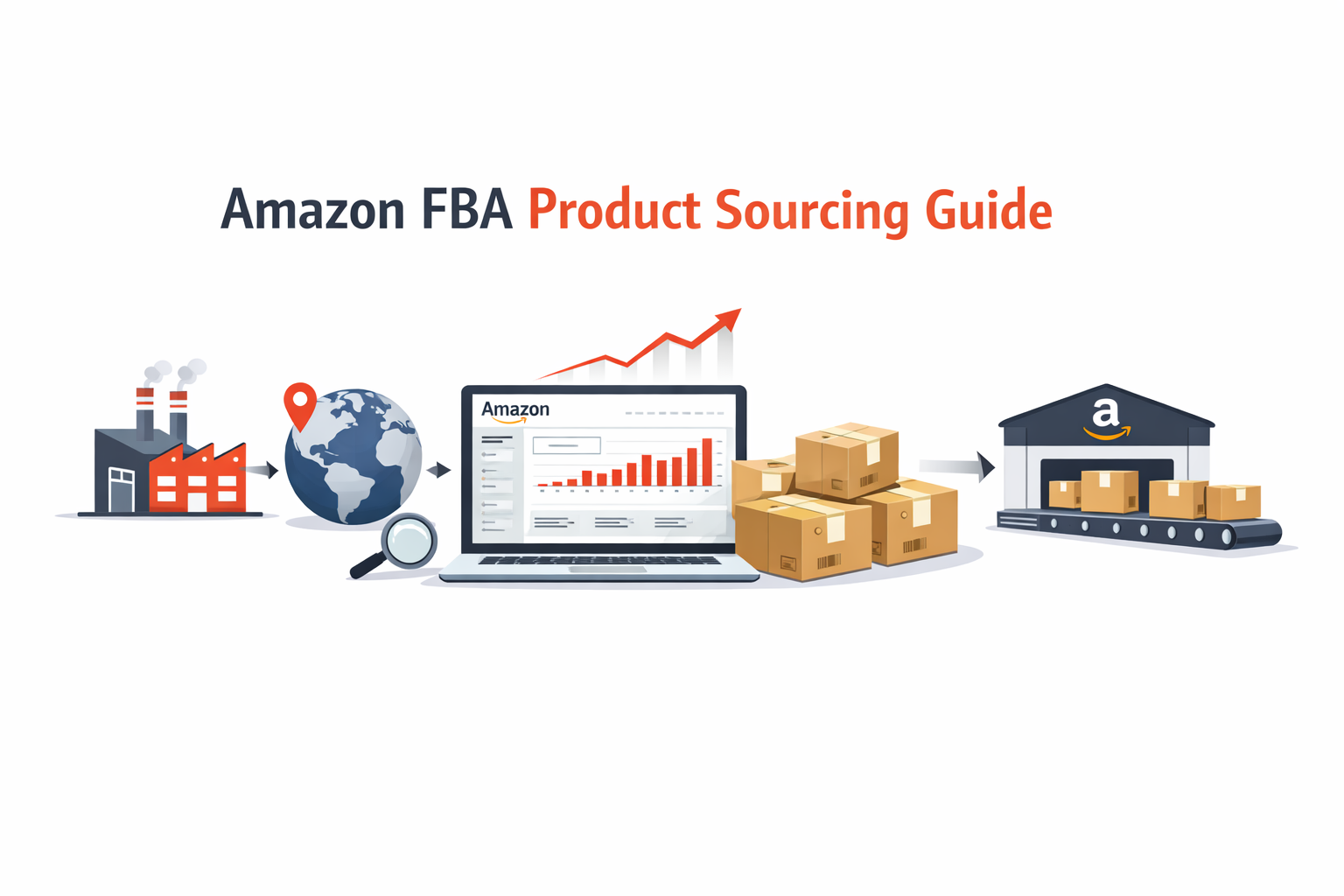
Complete Amazon FBA Product Sourcing Guide (2026): How to Find Profitable Products & Reliable Suppliers
Amazon FBA product sourcing is one of the most important steps in building a successful Amazon business. It means finding products from manufacturers or suppliers and selling them through Amazon’s Fulfillment by Amazon (FBA) program.
Amazon now has over 9.7 million sellers worldwide, with roughly 2 million active sellers, which makes competition stronger than ever. Because of this, choosing the right products and suppliers is critical.
Sellers who succeed on Amazon usually focus on:
-
strong profit margins
-
reliable suppliers
-
products with steady demand
Many sellers also scale their business using Amazon wholesale strategies, where they source products directly from authorized distributors and sell them on Amazon. If you want to understand how this model works, explore our Amazon wholesale FBA services.
In this guide, you will learn how Amazon FBA product sourcing works in 2026.
You will also discover:
-
How to find profitable products
-
where to find reliable suppliers
-
The difference between wholesale and private label
-
Tools used by successful Amazon sellers
By the end of this guide, you will understand how to build a smart sourcing strategy for Amazon FBA.
Quick Answer: What Is Amazon FBA Product Sourcing?
Amazon FBA product sourcing means finding products from manufacturers or suppliers and selling them on Amazon using Fulfillment by Amazon.
- Research profitable products
- Find reliable suppliers
- Order inventory in bulk
- Send products to Amazon warehouses
- Amazon stores, packs, and ships orders
Most successful Amazon sellers target profit margins between 30% and 50%.
What is Amazon FBA Product Sourcing for Sellers?
Amazon FBA product sourcing means finding products from manufacturers or suppliers and selling them on Amazon.
Instead of shipping products yourself, you send your inventory to Amazon fulfillment centers. Amazon then stores, packs, and ships the orders to customers.
This system allows sellers to focus on product research, marketing, and growing their business.
There are several ways to source products for Amazon FBA, including:
-
private label
-
wholesale sourcing
-
retail arbitrage
-
online arbitrage
Each method has different risks, costs, and profit potential.
Many successful Amazon sellers focus on strategic product sourcing instead of simple arbitrage.
This means building strong relationships with suppliers and choosing products with healthy profit margins.
Sellers who use structured sourcing methods often earn higher profits and maintain better inventory control than those who rely only on retail or online arbitrage.
When you control your supply chain, you can:
-
improve product quality
-
avoid stock shortages
-
maintain better profit margins
Because of this, successful Amazon sellers treat product sourcing as a long-term strategy, not just a quick way to find cheap products.
The Complete Amazon FBA Sourcing Process
Extensive product research for Amazon FBA starts the Amazon FBA product sourcing process. At this stage, sellers assess market demand, competitiveness, and profit potential. Finding products fit for your business’s goals and market potential depends on this research phase.
Finding suppliers for an Amazon business is significant. This means investigating several paths. Options include direct manufacturer contact, trade show attendance, and internet markets like Alibaba. You can also work with local wholesalers. Depending on your budget, schedule, and company plan, every Amazon FBA product sourcing method has unique benefits.
Amazon FBA supplier research follows. Here, you vet potential partners through background checks, sample requests, and communication assessments. This phase determines the reliability and quality standards of your future business relationships.
During supplier negotiations, sellers discuss several key factors. These include pricing, minimum order quantities (MOQs), payment terms, and delivery schedules. Effective negotiations usually define the profitability and capacity for competition of what you sell in the market.
Product samples and inspections help to assure quality. Your inventory must meet Amazon’s requirements and consumer expectations. At last, items reach Amazon fulfillment facilities. They then become available for Prime delivery to consumers.
Why Amazon FBA Product Sourcing is Essential for Sellers
One of the most profitable prospects in e-commerce, private label Amazon FBA product sourcing encourages sellers to develop their own brand identity. At the same time, it allows them to keep reasonable profit margins. Purchasing directly from the manufacturer allows you to personalize several elements. These include the packaging, appearance, and even product characteristics. This sets you apart from competing companies.
For new vendors, Amazon wholesale sourcing offers a lower-risk entrance point. It uses established product lines with proven market demand. Usually requiring less initial marketing and branding investment, this strategy provides strong profit potential.
Good Amazon FBA product sourcing strategies provide clear cost advantages. These advantages apply when compared to retail arbitrage or dropshipping. Purchasing straight from manufacturers or approved distributors helps sellers obtain better wholesale pricing. Enhanced profit margins and more flexible pricing ranges are the result.
Control of the sourcing process helps one to handle quality control. Quality standards, inspections, and supplier relationships built upon your needs offer several benefits. Eventually, these improve customer satisfaction and reduce returns.
Strategic sourcing also helps to build sustainable brands. Sellers can create long-term commercial assets instead of merely transacting goods. Brand recognition, repeat business, and finally, business scalability outside of Amazon’s platform become possible.
Ready to apply these sourcing strategies with expert guidance? Schedule a free consultation with our Amazon FBA specialists.
Top Amazon FBA Product Sourcing Strategies for New Sellers
Your sourcing approach will determine whether or not your Amazon FBA product sourcing business meets expectations. Knowing several ways to discover products helps expand more rapidly. It also helps you reduce risk and preserve profitability in a market that is increasingly more competitive. This section will go over the most popular and successful Amazon FBA product sourcing strategies. We’ll cover their advantages, disadvantages, and pragmatic applications.
Popular Amazon FBA Product Sourcing Methods
Retail Arbitrage
Retail arbitrage refers to buying discounted goods from physical retail stores. You then resell them on Amazon for profit. Due to its low entry requirements, low startup costs, and lack of significant inventory investments, this strategy is well-liked by beginners. To start scanning products and comparing prices on Amazon, you can use a basic smartphone app. Popular options include Scoutify, SellerAmp, or the Amazon Seller App.
Fast cash flow, flexible scheduling, and practical experience with the FBA system are all made possible by retail arbitrage. Successful sellers often focus on particular categories like toys, electronics, or groceries. In addition, they learn store clearance cycles and create solid connections with local managers.
However, challenges exist. It can be time-consuming and difficult to scale. Stock availability and brand limitations can impact results. There is fierce competition. Additionally, it takes constant attention to small details to stay on top of price changes.
Online Arbitrage
Although it emphasizes sourcing products from e-commerce websites rather than physical stores, online arbitrage is comparable to retail arbitrage. On internet marketplaces, sellers hunt for sales. They search for products that are on sale or reduced by coupons and cashback rewards. The process has been simplified significantly. Product profitability across multiple sites is analyzed with the support of tools. These include OAXray, SourceMogul, and Tactical Arbitrage.
This model has the same low-risk entry point as retail arbitrage. It’s convenient to use from any location. The approach is perfect for learning about Amazon’s fees and pricing. It’s also ideal for testing out various niches.
However, since many sellers use similar tools, the competition is tough. Retail websites may have varying inventory levels. Some platforms do not permit large purchases. Monitoring price fluctuations and stock availability is another aspect of online arbitrage that calls for caution.
Amazon FBA Sourcing from Local Wholesalers
Wholesale Sourcing
Purchasing goods in large quantities straight from producers or approved distributors is known as wholesale sourcing. By providing continuous inventory and more profitable margins than arbitrage models, this approach promotes scalability. It also supports long-term company growth. Despite the moderate upfront investment required, it offers the opportunity to build professional relationships. You can also become an authorized seller of well-known products.
Starting wholesale sourcing will call for specific documentation. You’ll need a business license and a tax identification number. Sometimes a reseller’s certificate is also required. Trade events can help you find wholesale suppliers. Examples include the National Hardware Show or ASD Market Week. Websites like Faire and TopTenWholesale are also useful.
Building confidence with vendors is crucial. Show that you can sell and market successfully. Start with smaller orders and offer business documentation.
Research shows that sellers using wholesale sourcing methods achieve 2.3x higher annual revenue. This compares to those relying solely on arbitrage strategies.
Predictable inventory, scalability, and access to reliable products with established demand are some benefits of wholesale sourcing. The primary obstacles include high minimum order quantities and upfront capital requirements. Competition from other sellers who might have dealt with better terms is also a challenge.
Explore our Amazon wholesale FBA solutions to learn how we help sellers scale profitably.
Private Label vs Wholesale: Choosing Your Amazon Sourcing Method
Private Label Product Sourcing
A more effective approach is private label product sourcing. In this model, you collaborate with a manufacturer to produce a specific branded good. Complete control over product design, branding, packaging, and marketing is possible. Additionally, this model has the highest profit potential. Finding gaps or opportunities in the market is the first step. This is followed by supplier vetting, sample testing, bulk production, and listing optimization.
Private label vendors concentrate on creating a distinctive, long-lasting brand. Investments are made in product development, customer interaction, and expert packaging. With this model, you can scale effectively while defending your listings. Protection against price competition and hijackings is a major advantage.
Despite its advantages, private labeling has several challenges. There’s a higher risk of product failure and longer lead times. Significant upfront investment is required. Additionally, you have to oversee supplier dependability, shipping logistics, and quality control. Nonetheless, when done correctly, private label selling provides the best flexibility and branding potential on Amazon.
Amazon Wholesale Sourcing
Amazon wholesale sourcing offers a middle-ground approach. It sits between retail arbitrage and private labeling. In this strategy, you purchase established products from authorized distributors or manufacturers at wholesale prices. You then resell them on Amazon under their existing brand names.

Dropshipping for Amazon
Dropshipping is a sourcing strategy with a unique approach. The seller passes orders to a third party who ships the product to the customer. Inventory is not kept by the seller. While this seems simple, Amazon’s strict policies make traditional dropshipping dangerous. The seller bears the obligation of ensuring that the invoice and packing receipt show their name alone. The supplier’s name cannot appear. This requirement makes the alignment of dropshipping with Amazon FBA more difficult.
Certain suppliers use hybrid models. They reserve FBA for fast-moving goods and dropship slow or seasonal products. Market expansion is another area where dropshipping can help. This is especially true where inventory storage is not practical. New product testing is another valid use case.
Among the risks connected with dropshipping are policy violations and delayed delivery. Bad customer service and account suspensions are also concerns. Though it can be used in some cases, dropshipping is not a long-term approach. It’s not advised for major Amazon FBA suppliers.
Print-on-Demand (POD)
Print-on-demand is a sourcing model that combines customization capability with the ease of dropshipping. After merchants create the graphics, the POD service takes over. Goods are printed and distributed on demand. This includes notebooks, mugs, and t-shirts. Tools help to manage fulfillment and enable flawless Amazon integration automatically. Examples include Printful, Printify, and Gooten.
For designers, artists, or business owners looking at niche markets, POD is a great option. It allows the offering of hundreds of product variants with low investment. Testing of new designs is possible without the need to maintain inventory.
Still, reliance on outside suppliers exists. Thus, there are limitations to consider. These include higher production costs, longer delivery times, and quality control issues.
POD’s low startup risk and creative freedom are helping it gain popularity. This is despite these limitations. For suppliers hoping to build a brand centered on customized or themed products, it is beneficial.
How to Find Reliable Suppliers for Your Amazon FBA Business
Finding reliable suppliers is a critical step in successful Amazon FBA product sourcing. This section covers the best platforms, strategies, and verification methods to ensure you partner with trustworthy manufacturers and distributors.
Using Alibaba for Amazon FBA Product Sourcing
Alibaba is still the most significant B2B market worldwide. It’s the primary source of suppliers for Amazon’s business. On Alibaba, success calls for an organized approach. Mindful supplier evaluation is essential. Strategic negotiating ability is also crucial.
Step-by-Step Alibaba Sourcing Guide:
- Search and Filter Effectively: Include minimum order quantities in your filters. Trade assurance participation should be considered. Supplier location and certification status are also important factors. Use particular product keyword filters. Pay extra attention to vendors with solid records and good reviews.
- Request for Quotations (RFQ): Get in touch with 8 to 12 vendors with thorough product details. Include quantity needs and quality standards. Usually, professional RFQ applications get more competitive pricing. Favorable responses are also more common.
- Negotiation Strategy: Negotiate delivery schedules and standards of quality. Packaging needs should be discussed, along with payment terms, not only price. At times, creating connections results in improved long-term pricing. Better services are another benefit.
- Sample Ordering Process: Always ask for samples before ordering in bulk. Review several supplier samples carefully. Check quality, materials, and construction. Assess general fit for your market.
- Supplier Verification: Request business licenses and use Alibaba’s verification tools. Schedule video conferences when possible. For significant orders, think about third-party audits.
For businesses looking for expert guidance in navigating international suppliers and quality control, our Amazon FBA consulting team can help streamline your sourcing process.
Building Relationships with Amazon FBA Suppliers
Working with U.S.-Based and Local Suppliers for Amazon FBA Product Sourcing
For Amazon FBA product sourcing, domestic sourcing offers special benefits. These include improved quality control and more rapid communication. Much quicker shipping is another advantage. Supporting local economies is also a consideration. American producers and marketers are connected by platforms. Examples include Makers Row, ThomasNet, and industry-specific directories.
Benefits of Domestic Sourcing:
- Quick delivery and shorter lead times
- Better communication and time zone alignment
- Easier quality control and facility visits
- Reduced import duties and customs complications
- Supporting the local economy and “Made in USA” branding
- Better intellectual property protection
Recommended Platforms:
- ThomasNet: Comprehensive directory of North American manufacturers
- Makers Row: Platform connecting brands with American manufacturers
- Alibaba USA: Domestic supplier directory
- Global Sources: Focus on verified suppliers and trade shows
- Industry-specific associations: Direct manufacturer relationships
Considerations:
- Higher manufacturing costs compared to international suppliers
- Limited product variety in specific categories
- MOQ requirements may be higher
- Fewer suppliers for specialized products
Quality Control in Amazon FBA Product Sourcing
Vetting and Verifying Product Manufacturers
Complete inquiry is necessary for effective Amazon FBA supplier research. This ensures the supplier’s reliability and quality of skills. Business credibility must also be confirmed. This procedure protects your investment. Consistent product quality is ensured through this process.
Supplier Verification Checklist:
- Business license and registration verification
- Industry certifications and quality standards compliance
- Financial stability and credit references
- Production capacity and quality control processes
- Previous client references and testimonials
- Facility photos and virtual tours
- Communication, responsiveness, and professionalism
Factory Audits and Inspections: If you have essential suppliers or big orders, consider using third-party inspection services. Factory audits and pre-shipment inspections are valuable. Quality control services are offered by organizations. Examples include SGS, Bureau Veritas, and QIMA.
Verification Tools:
- Alibaba’s supplier verification services
- Third-party background check companies
- Government business registry searches
- Industry association membership verification
- Credit reporting and financial stability checks
Essential Tools for Amazon FBA Product Research and Sourcing
A successful Amazon FBA product sourcing business is built based on efficient product research. Going through millions of listings on the platform can be challenging. Finding the correct item to source requires the right tools and strategies. By using innovative tools like Helium 10 and Jungle Scout, sellers can avoid congested markets. Discovering profitable opportunities becomes easier with proper Amazon FBA product sourcing techniques. This section covers proven research techniques. Essential metrics and trend analysis strategies help you make informed sourcing decisions.
Best Amazon FBA Product Research Tools
Using Jungle Scout, Helium 10, and Other Tools
Product research for Amazon FBA today is driven by data. Top Amazon FBA sellers rely on specialized tools. These uncover untapped product opportunities. Market competition is analyzed effectively. Long-term viability is also checked. These tools save time significantly. Accuracy when projecting profitability is improved as well. Many sellers use tools like Helium 10 and Jungle Scout for product research. You can also explore our complete guide to Amazon seller tools to find the best tools for product research and optimization.
Jungle Scout Product Research
Jungle Scout remains one of the most trusted tools in the Amazon FBA community. It offers a Chrome extension and a comprehensive web app. Real-time data is delivered to check products effectively. Its key features include:
- Sales estimates to gauge product performance
- Competition analysis to assess market entry difficulty
- Profitability calculators that account for FBA fees and shipping
- Product tracking to monitor sales trends over time
- Keyword tools to uncover search volume and buyer intent
- A supplier database to find and connect with manufacturers
Recommended Research Process with Jungle Scout:
- Install the Jungle Scout Chrome extension
- Browse Amazon categories or use the web app for product discovery
- Analyze product listings for monthly sales, reviews, and seller presence
- Calculate profit potential using estimated costs and Amazon fees
- Track shortlisted products to identify stable or growing demand
Helium 10’s Comprehensive Suite
Offering an extensive collection of tools, Helium 10 facilitates everything from product discovery to keyword research. Listing optimization is also included. It’s a one-stop shop for Amazon sellers. Necessary research equipment consists of:
- Black Box for filtering product ideas based on specific metrics
- X-ray, integrated with the Chrome extension, for analyzing product demand and revenue
- Trends for identifying upward trends and seasonal demand patterns
Key Metrics to Check with Helium 10:
- Monthly sales volume and total revenue estimates
- Number of sellers in the niche and overall market saturation
- Average selling price and estimated profit margins
- Total number of reviews and average rating
- Seasonality of the product over time
- Keyword volume and search competition
Helium 10 allows more profound insights into keyword trends. It even helps with competitor monitoring. Reverse ASIN lookups are another useful feature. This makes it a must-have for sellers planning to scale with precision.

Other Valuable Tools to Consider
While Jungle Scout and Helium 10 dominate the market, other tools offer specific strengths. Consider these alternatives:
- AMZScout: Known for accurate sales data. Product tracking and detailed FBA fee calculations are included.
- Viral Launch: Provides competitive analysis. Keyword research and advanced trend forecasting are offered.
- SellerApp: Combines product and keyword research. PPC campaign support is also available.
- MerchantWords: Specializes in keyword search volume. Helps target buyer language more effectively.
To reduce sourcing risk and cross-validate results, use each tool separately or in combination.
Need help choosing the right tools for your business? Contact HiSellIt for personalized recommendations.
Spotting Trends and High-Demand Products
Sourcing profitable products goes beyond static research. Emerging niches are frequently dominated by sellers who spot trends early. Getting in front of the competition is the goal. You can identify future bestsellers before they become oversaturated. This is done by incorporating trend analysis into your Amazon FBA product sourcing strategy.
Amazon Trend Analysis
Start your research within Amazon itself. Focus on the following sections for real-time product insights:
- Best Sellers Lists: Identify consistent top performers in each category
- New Releases: Spot new products that are gaining traction quickly
- Movers and Shakers: Analyze products with recent surges in sales rank
By monitoring these sections daily or weekly, you can discover products with upward momentum. These represent untapped opportunities worth exploring.
External Trend Sources
Go beyond Amazon to find trend indicators. Some may not have reached the platform yet. Here are some of the best sources:
- Google Trends: Examine search volume for keywords related to your product. Track seasonal variations over time.
- Social Media: Keep an eye out for popular product ideas. Follow viral content on Pinterest, Instagram Reels, and TikTok.
- Kickstarter and Indiegogo: Look for crowdfunding projects with strong investor support. This indicates potential demand.
- Retail Websites: Find out what new products are available. Monitor well-known stores like Costco, Target, and Walmart.
- Industry Publications: Read trade journals and niche magazines. Gain professional insights and market developments.
These outside resources assist in verifying your findings. Make sure you’re not depending exclusively on Amazon data.
Trend Evaluation Criteria
Not all trends are worth pursuing. Use the following criteria to check product trends effectively:
- Look for sustained growth over at least three to six months. Avoid short-term viral spikes.
- Ensure the niche contains multiple complementary products. This supports upselling or bundling.
- Validate the trend across various platforms. Include Google, Amazon, and social media.
- Avoid entering markets already saturated with heavy competition.
- Confirm that profit margins allow for long-term advertising and fulfillment costs.
By following these guidelines, you can focus on trends. Choose those offering both strong demand and manageable competition.
Amazon FBA Product Sourcing Trends in 2026
Amazon selling is more competitive today than it was a few years ago. Sellers now use smarter sourcing strategies to stay profitable.
Here are the biggest Amazon FBA sourcing trends in 2026.
AI Product Research
Many sellers now use AI-powered tools like Helium 10, Jungle Scout, and SmartScout to find profitable products faster.
These tools help sellers analyze:
-
search demand
-
competition
-
profit margins
-
keyword trends
Smaller First Orders
New sellers often start with smaller test orders instead of large inventory purchases.
Testing a product before scaling helps reduce financial risk.
Brand-Focused Private Label
Private label products remain the most profitable Amazon model.
Sellers create their own brand, improve product design, and control the entire listing.
Multi-Supplier Strategy
Many experienced sellers work with multiple suppliers instead of relying on only one.
This prevents stockouts and supply chain issues.
Evaluating Product Profitability in Amazon FBA Product Sourcing
Calculating Amazon FBA Product Sourcing Costs and Margins
Amazon FBA Profit Margin Benchmarks
Most successful sellers target strong profit margins to cover Amazon fees and advertising.
| Product Price | Ideal Profit Margin | Profit Potential |
|---|---|---|
| $10 – $15 | 20–30% | Low |
| $15 – $30 | 30–40% | Good |
| $30 – $70 | 35–50% | Excellent |
| $70+ | 40–60% | High |
Products priced between $20 and $50 usually perform best for new Amazon sellers.
Important Insight
Most successful Amazon FBA sellers aim for profit margins between 30% and 40% after all expenses. This allows room to cover Amazon fees, advertising costs, returns, and price competition while still maintaining consistent profit.
Impact on Profit Margins
Effective Amazon FBA product sourcing directly correlates with improved profit margins. Multiple mechanisms drive this improvement. Cost reduction benefits emerge from eliminating intermediaries. Negotiating better wholesale pricing directly with manufacturers is key. Rather than paying retail or distributor markups, sellers can often achieve 40-60% cost savings. This is possible through strategic sourcing.
Controlling supply chain expenses helps you to become price-competitive. Lower product costs allow for competitive pricing. Keeping good margins is still possible. The capacity to spend more on marketing and advertising while remaining profitable is another advantage.
Successful Amazon FBA sellers typically aim for gross margins of 35-50%. This accounts for advertising costs, returns, and market fluctuations.

Best Product Criteria for Amazon FBA Beginners
Choosing the right product is one of the most important steps in Amazon FBA. If you want to explore profitable niches, check our guide on Amazon FBA best products and profitable categories.
Many new sellers fail because they pick products with too much competition or very low profit margins.
Successful sellers usually look for products that meet a few simple criteria.
Here are the most common product features beginners should look for:
-
Small and lightweight products to reduce shipping and storage costs
-
Selling price between $20 and $50
-
Products with fewer than 300 reviews on top listings
-
At least 300 monthly sales in the niche
-
Profit margin of 30% or higher after all costs
These criteria help beginners reduce risk and improve their chances of success.
Before choosing a product, always check:
-
product demand
-
competition level
-
profit margins
-
supplier availability
Taking time to research these factors can help you find products that sell consistently and generate long-term profit.
Building Your Amazon FBA Sourcing Budget
Quality Control Benefits
Brand reputation protection represents a critical benefit of controlled sourcing relationships. You can establish quality standards when you choose and oversee your suppliers directly. Carrying out inspections becomes easier. Guaranteeing consistent product quality that enhances your brand is the result.
When product quality meets or surpasses expectations, customer satisfaction increases significantly. Amazon’s algorithm gives a lot of weight to customer reviews and return rates. Because of this, quality control is essential. Long-term success on the platform depends on it.
Reduced returns and complaints result from better quality control. Several benefits follow from improved quality standards. Improved seller metrics are one outcome. Lower return processing costs are another. Enhanced customer lifetime value is also achieved. Amazon sellers with consistently high-quality products enjoy better search visibility. Buy Box placement improves as well.
Scalability Advantages
Volume discounts become accessible as your sourcing relationships mature. Order quantities increase over time. For larger, regular orders, suppliers usually provide better pricing. This increases your margins as you grow.
Better forecasting accuracy is made possible by consistent supply chain relationships. Lower stockout risks are another benefit. Predictable inventory replenishment is also achieved. Reputable vendors who understand your delivery needs make excellent business partners. Awareness of quality principles makes them even more valuable.
Establishing sourcing relationships accelerates the potential for business growth. Look for suppliers able to handle growing order volumes. New product variations should be manageable. Expanding market opportunities must be accommodated. Rapid scaling without sacrificing quality or delivery performance becomes possible. Strong supplier relationships are the key.
Managing Amazon FBA Product Sourcing Timelines and Logistics
Legal Considerations in Amazon Product Sourcing
Understanding Customs and Import Duties
International Amazon FBA product sourcing requires understanding customs procedures, import duties, and documentation requirements. Delays and unforeseen expenses that could affect profitability are avoided with careful planning.
How Customs Works for China Imports: The majority of Amazon FBA products are imported from China and must be cleared by U.S. Customs and Border Protection (CBP). Physical inspection procedures, duty assessments, and documentation reviews are all part of the process.
Required Documentation:
- Commercial invoice with detailed product descriptions
- Packing list with quantities and weights
- Bill of lading or airway bill
- Import licenses (if required for specific products)
- FDA, FCC, or other regulatory permits (if any)
Calculating Import Duties
Harmonized Tariff Schedule (HTS) codes are used to classify products and determine import duties. Duty rates differ depending on the nation of origin and product category.
Formula for Calculating Duty: (Product Value + Shipping + Insurance) × Duty Rate = Total Duty Owed
Common Duty Rates:
- Electronics: 0-25% depending on specific product
- Textiles: 5-32% based on material and construction
- Household goods: 0-15% for most categories
- Toys: 0-12% depending on materials and features
Duty Optimization Strategies:
- Accurate HTS code classification
- Utilizing free trade agreements when applicable
- Considering country of origin alternatives
- Working with experienced customs brokers
Labelling and Packaging Requirements
To prevent rejection, delays, or additional costs, Amazon FBA has strict packaging and labeling guidelines that must be followed. Understanding these requirements is essential for successful product fulfillment and purchase.
Amazon FBA Packaging Rules:
- Products must be appropriately protected for shipment and storage
- Individual units require Amazon FNSKU labels or manufacturer barcodes
- Case packs must include Amazon shipping labels
- Fragile items require appropriate protective packaging
- Liquids, powders, and hazardous materials have special requirements
Labelling Requirements:
- FNSKU Labels: Required for inventory tracking and identification
- Expiration Date Labels: Required for products with a shelf life
- “Fragile” Stickers: Required for breakable items
- Poly Bag Requirements: Bags over 5 inches require suffocation warnings
- Made in [Country] Labels: Required for imported products
Prep Center Services: Many sellers use prep centers to handle FBA preparation requirements, especially for international shipments. Prep centres provide:
- Product inspection and quality control
- FBA-compliant packaging and labelling
- Inventory storage and shipment coordination
- Returns processing and refurbishment
- Cost-effective alternative to self-preparation
Packaging Best Practices:
- Use Amazon-approved packaging materials
- Ensure products are secure and protected during transport
- Include all required labels and warnings
- Consider the customer unboxing experience for branded products
- Plan packaging costs into product pricing calculations
Common Amazon Product Sourcing Mistakes to Avoid
Understanding common pitfalls in Amazon FBA product sourcing helps you avoid costly errors and build a more profitable business from the start.
Negotiating MOQs with Amazon FBA Suppliers
When sourcing products for Amazon FBA, many suppliers require a Minimum Order Quantity (MOQ). This means the smallest number of units you must buy in one order.
New sellers often choose suppliers with very low MOQs. While this seems safer, it can lead to higher unit costs and lower profit margins.
Instead of focusing only on MOQ, you should calculate the total landed cost of the product.
Landed Cost Formula
To understand your real profit, calculate the total landed cost:
Landed Cost = Product Cost + Shipping + Import Duties + Packaging + Amazon Fees
This gives you the true cost of each product before selling it on Amazon.
Profit Margin Target
Most successful Amazon sellers aim for at least a 30–40% profit margin after all costs.
This margin helps cover:
-
Amazon referral fees
-
FBA fulfillment fees
-
advertising costs
-
product returns
-
price competition
If your margin is below 30%, the product may be risky to sell.
When negotiating with suppliers, try to:
-
Ask for better pricing at higher quantities
-
Request sample orders first
-
Compare multiple suppliers before ordering
A strong supplier relationship often leads to better pricing and lower MOQs over time.
Choosing Trendy Instead of Evergreen Products
The allure of trending products can lead sellers to ignore fundamental business principles about sustainable demand and long-term profitability. The fidget spinner phenomenon of 2017 provides a cautionary tale about trend-based sourcing decisions.
The Fidget Spinner Case Study: Fidget spinners became quite trendy at the beginning of 2017. Thousands of Amazon vendors started sourcing them. While initial sellers made significant profits, the market soon grew crowded. Prices dropped dramatically. Most sellers were left with useless inventory.
Critical Warning: Over 80% of sellers who focused exclusively on trending products during the 2017-2018 period experienced significant inventory losses when trends shifted rapidly.
Problems with Trend-Based Sourcing:
- Rapid market saturation and price erosion
- Short product lifecycle and inventory obsolescence
- High competition from established brands
- Seasonal or fad-based demand patterns
- Limited repeat purchase opportunities
Evergreen Product Advantages:
- Consistent year-round demand
- Established market size and growth patterns
- Opportunities for product improvement and differentiation
- Building long-term brand recognition
- Predictable inventory management
Balanced Product Portfolio
Successful Amazon FBA product sourcing businesses often combine:
- 70-80% evergreen products for stable revenue
- 10-20% seasonal products for profit spikes
- 5-10% trending products for growth opportunities
Trend Evaluation Framework
Before sourcing trending products, check:
- Market size and growth sustainability
- Competition levels and barriers to entry
- Product differentiation opportunities
- Brand building potential
- Long-term demand indicators

Why Most Amazon Sellers Fail at Product Sourcing
Many Amazon sellers fail because they rush the product sourcing process.
Instead of researching the market carefully, they choose products based only on low prices or short-term trends. This often leads to poor sales and unsold inventory.
Some sellers also work with unreliable suppliers, which can cause quality problems and negative reviews.
Here are some common mistakes new Amazon sellers make:
-
Choosing products with too much competition
-
Copying trending products too late
-
Ignoring product quality
-
Focusing only on cheap suppliers
-
Not calculating profit margins properly
Successful sellers take time to research both products and suppliers before placing their first order.
They focus on steady demand, reliable suppliers, and healthy profit margins. This approach reduces risk and helps build a long-term Amazon business.
Conclusion: Mastering Amazon FBA Product Sourcing for Long-Term Success
Amazon FBA product sourcing is the most important step in building a profitable Amazon business.
When you choose the right product and work with reliable suppliers, your chances of success increase.
Focus on:
-
strong profit margins
-
evergreen products
-
reliable manufacturers
With the right sourcing strategy, you can build a long-term Amazon business.
Ready to transform your Amazon FBA business? Contact our team at HiSellIt to discuss your sourcing needs and growth goals today.
Amazon FBA Product Sourcing Guide: FAQs
1. How do I find profitable products to sell on Amazon FBA?
Find items with steady sales volume and low competition (fewer than 300 reviews on the top listings). Look for high-profit margins (at least 30–40% after all costs). Price points between $15 and $50 work best. Utilize tools for evaluating products that consistently demonstrate consumer interest. Sales volume and favorable reviews prove demand. By looking at review counts, you can identify products in greater demand facing less competition.
2. What profit margin should I target for Amazon FBA products?
After deducting all costs, aim for a minimum profit margin of 30–40%. These costs include product costs, Amazon FBA fees, shipping to warehouses, and advertising expenditures. Verify that a product will generate a healthy profit margin. You can use this to fund your company or generate revenue for yourself.
3. Where should I source products besides Alibaba?
Despite Alibaba’s popularity, consider other B2B platforms. Local providers, trade events, and wholesale directories are good options. Local manufacturers offer alternatives, too. Alibaba suppliers work with many sellers. But there are other options for Amazon FBA product sourcing beyond Alibaba. You can find better deals and unique products by expanding your sourcing options.
4. How do I check supplier reliability and quality?
Before placing bulk orders, start with small orders to test quality and interaction, ask for samples from several suppliers, confirm company licenses and certifications, check references from previous customers, and perform factory audits (in person or virtually).
5. What are the key criteria for selecting Amazon FBA products?
Prioritize products that are small and light to reduce storage costs. They should have a consistent demand all year long. Avoid trendy or seasonal items. Look for space for development or uniqueness. Products shouldn’t be controlled by big brands or have apparent challenges.
6. How much initial investment do I need for Amazon FBA product sourcing?
Set aside money for several key expenses. These include shipping, FBA fees, and product photography. Budget for samples ($50-200) and minimum order quantities (usually $1,000-$3,000 for first orders). Don’t forget initial advertising costs. To properly launch their first product with sufficient inventory and marketing budget, most successful sellers begin with $5,000 to $10,000.