
Etsy Sales Funnel Automation for 2026: Complete Guide to Scaling Without Burnout
An Etsy sales funnel that runs on automation has become essential for sellers who want sustainable growth in 2026. According to recent Shopify e-commerce data, sellers using structured automation workflows see roughly 35% better operational efficiency and 28% higher customer lifetime value compared to manual management. If you’re juggling inventory updates, customer messages, order processing, and listing optimization all by yourself, you’re working harder than necessary.
This guide shows you how to build an automated Etsy sales funnel that operates smoothly while you focus on what truly grows your business. Whether you’re just starting out or managing multiple product lines, you’ll find practical strategies and reliable tools for every stage. For a deeper look at scaling your shop efficiently, explore our guide on Etsy automation services.
What Is an Etsy Sales Funnel and Why Automate It?
Before jumping into strategies, let’s clarify what we’re building. Your Etsy sales funnel is the path customers follow from discovering your shop to making a purchase and returning for more. Automation means using smart workflows to handle repetitive tasks so you can invest time in strategy instead of busywork.
For example, instead of manually sending welcome messages to new customers, automation handles it instantly. Instead of spending hours syncing inventory across platforms, a tool keeps everything aligned in real time. Automation doesn’t replace your personal touch. However, it removes the grunt work so your effort goes where it matters most.
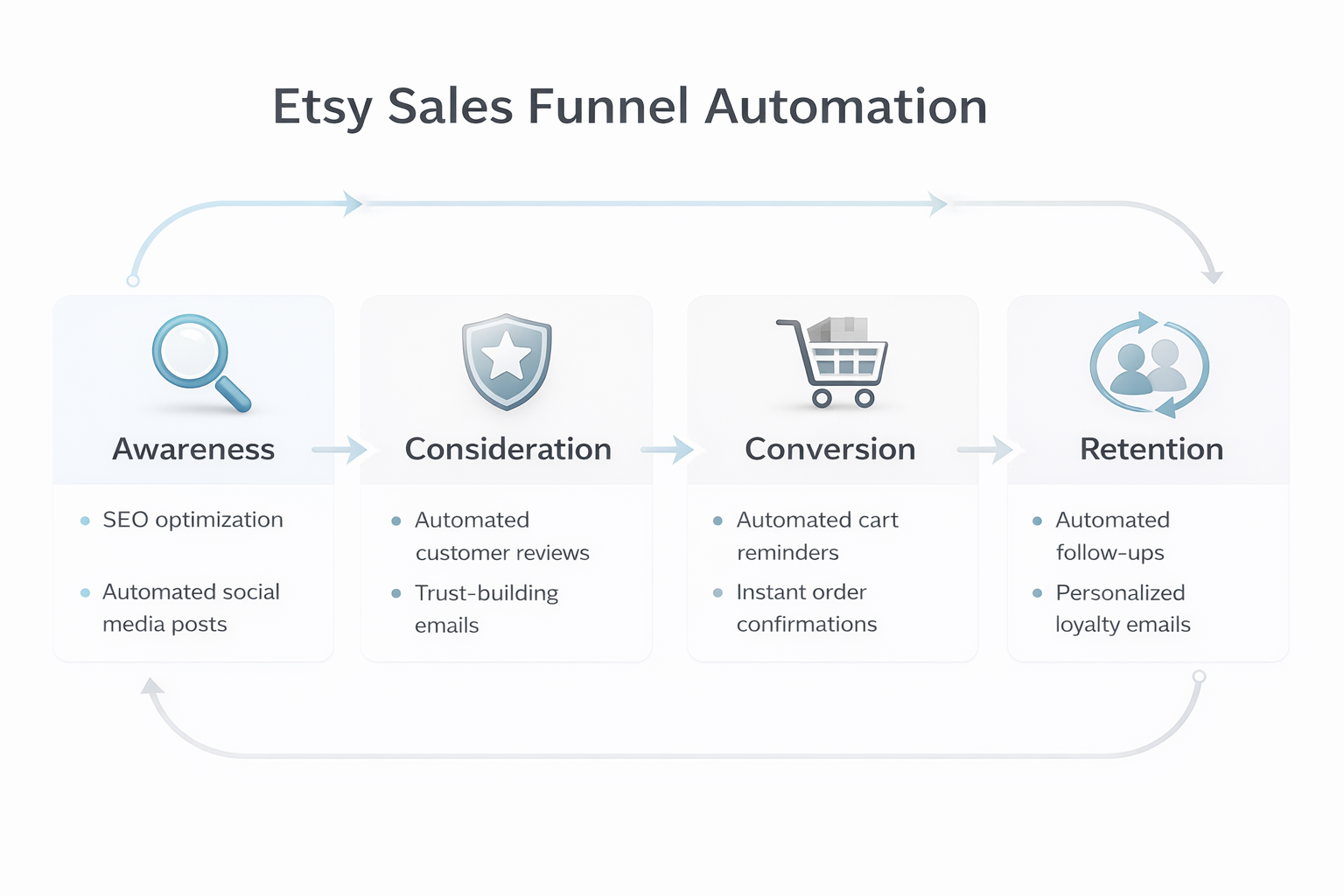
A complete setup for your Etsy sales funnel typically covers four core areas: customer acquisition, product discoverability, conversion optimization, and customer retention. Each stage plays a vital role in sustainable growth. You can learn more about optimizing each stage in Etsy’s Seller Handbook, or check our breakdown on Etsy automation.
Understanding the Stages of Your Etsy Sales Funnel
Awareness: Getting Discovered
Your Etsy sales funnel starts the moment someone searches for products like yours on Google, Etsy, or social media. This awareness stage is where potential buyers first encounter your brand. Automation helps here by optimizing your SEO, scheduling social posts, and managing ad campaigns without constant manual input.
Consideration: Building Trust
Once visitors land on your listings, they compare prices, read reviews, and evaluate your shop’s credibility. During this consideration stage, automation can trigger personalized product recommendations, send timely follow-ups, and display dynamic inventory updates. These touchpoints keep shoppers engaged without requiring you to monitor every interaction.
Conversion: Closing the Sale
The decision stage happens at checkout. Automation smooths friction points by sending cart reminders, offering time-sensitive discounts, and streamlining the payment process. When these systems work together, conversion rates naturally improve.
Retention: Building Loyalty
After the purchase, retention becomes critical. Automated thank-you emails, review requests, and loyalty campaigns turn one-time buyers into repeat customers. This stage drives long-term profitability and boosts your shop’s visibility through positive reviews.
How Etsy’s Built-In Features Support Your Sales Funnel
Etsy provides several automation tools within the platform itself. Shop sections, tags, and product attributes help buyers find what they need faster. Etsy Ads adjust bids automatically based on performance. The shop announcement feature lets you communicate updates to visitors.
Still, these built-in tools only scratch the surface. Most successful sellers quickly realize they need third-party solutions for true workflow efficiency. For instance, inventory syncing across multiple sales channels requires tools like ShipStation. Automated email follow-ups for abandoned carts work best with platforms like Klaviyo or Mailchimp. If you want a comprehensive look at these integrations, visit our Etsy automation services page.
Core Automation Strategies That Transform Your Etsy Sales Funnel
Inventory Management Automation
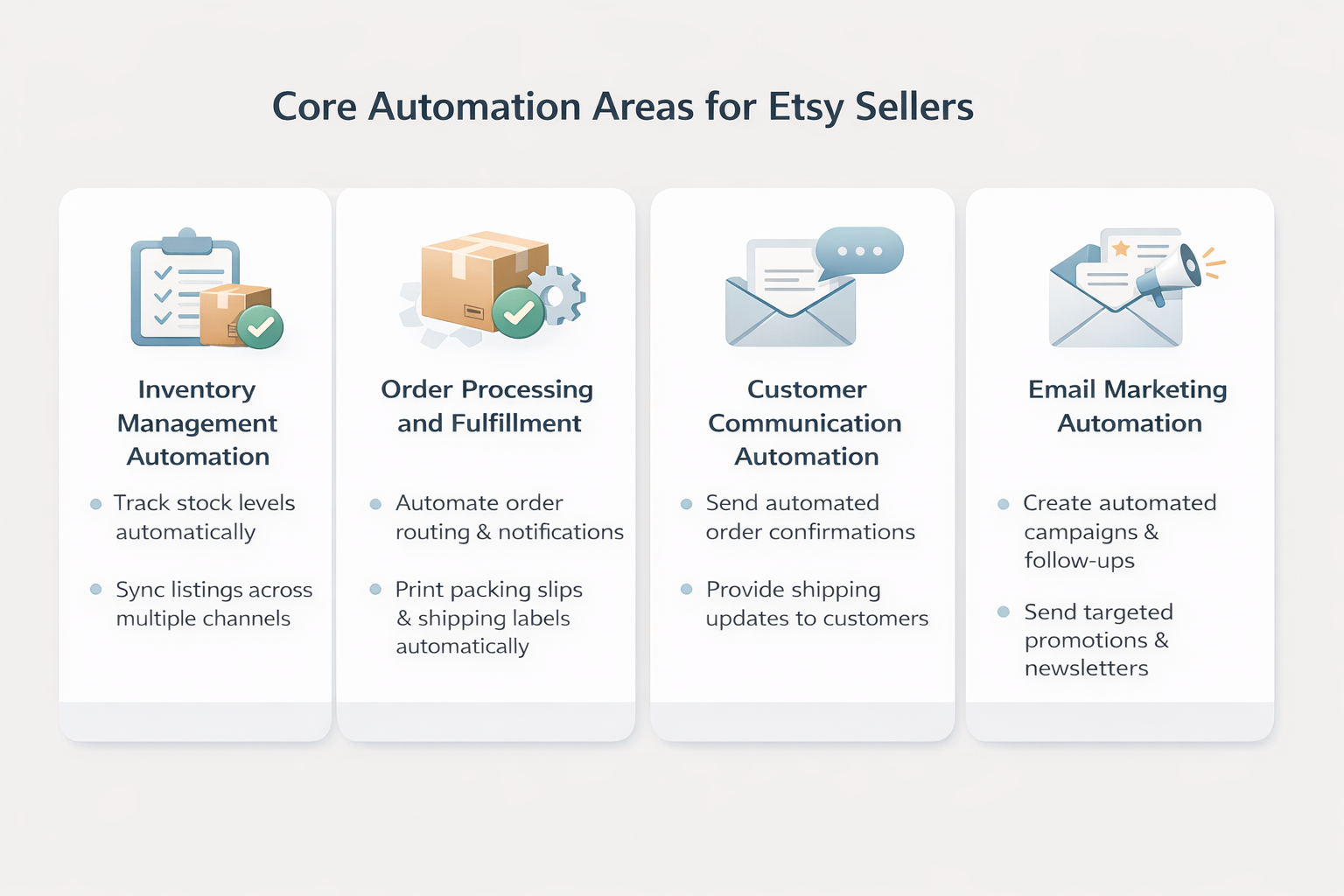
Inventory chaos is one of the biggest headaches for multi-channel sellers. If you’re selling on Etsy, Amazon, your website, and eBay, manually updating stock levels invites costly errors. Just one overselling incident can damage your reputation fast.
Inventory automation solves this by syncing stock counts across every platform in real time. When a product sells on Etsy, your inventory updates everywhere else instantly. This prevents double-selling and keeps operations running smoothly.
Beyond syncing, advanced tools send low-stock alerts, reorder products automatically, and adjust pricing based on market demand. Many sellers now connect directly to supplier databases, which lets them offer thousands of products without holding physical inventory. Platforms like Sellbrite and Cin7 make this scalable and straightforward.
Order Processing and Fulfillment Automation
Once an order comes in, automation takes over again. Your order data flows directly from Etsy to your fulfillment system or accounting software without manual steps. When you work with a logistics partner, information transfers instantly, so items get packed and shipped right away.
This setup works especially well for print-on-demand businesses. When someone orders a custom mug or t-shirt, the design and order details go straight to your printing partner, who handles everything from production to shipping. Some sellers run six-figure Etsy shops while spending just a few hours weekly on operations.
Even if you fulfill orders yourself, automation can print packing slips, generate tracking numbers, and notify buyers once packages ship. As a result, you save hours every week while improving customer satisfaction.
Customer Communication Automation for Your Etsy Sales Funnel
Customer communication is one of the highest-return areas for automation. Buyers appreciate quick thank-you messages and clear tracking details after purchase. Automated confirmation emails that include tracking info build trust and reduce post-purchase inquiries.
Abandoned cart automation delivers proven results as well. If someone adds an item but doesn’t check out, a reminder email sent within 24 hours can recover lost sales. Adding a small discount or incentive often increases conversions by 10% to 30%.
Automation also simplifies review requests. When sellers earn consistent positive reviews, Etsy’s algorithm rewards them with higher search rankings. Setting up an automated review request system can double or triple your review rate over time. For more on optimizing customer interactions, check out our guide on best-selling Etsy categories.
Best Tools for Automating Your Etsy Sales Funnel in 2026
All-in-One Etsy Shop Automation Platforms
Using a dedicated automation service is the most efficient way to keep everything running smoothly. These platforms connect directly to your shop and handle inventory updates, order processing, and customer communication automatically. Most services cost between $50 and $200 monthly, depending on features and order volume.
When choosing a platform, look for multi-channel inventory syncing, built-in customer message templates, automatic order routing to fulfillment partners, and analytics that highlight top-performing products. Tools like CraftKit and Shopify Flow provide excellent examples of effective automation.
Here’s a quick comparison of popular tools for your Etsy sales funnel:
|
Tool |
Monthly Cost | Inventory Sync | Order Automation | Email Campaigns |
Best For |
| Zapier | $0–$99 | Yes (with setup) | Yes (custom) | With integration | Custom workflows |
| Make | $0–$99 | Yes (with setup) | Yes (custom) | With integration | Advanced users |
| Etsy Automation Service | $50–$200 | Yes | Yes | Yes | All-in-one solution |
| Klaviyo | $20–$300 | Limited | Limited | Excellent | Email marketing focus |
| Mailchimp | $0–$350 | Limited | Limited | Excellent | Budget email marketing |
The right tool depends on your specific needs, technical skill level, and budget. Most growing sellers start with an all-in-one platform, then add specialized tools like Klaviyo for advanced email marketing.
Zapier and Make for Custom Etsy Workflows
If you want more flexibility, workflow automation platforms like Zapier or Make allow you to connect Etsy with hundreds of other tools. You can create workflows that automatically generate tasks in your project management software, send notifications to your team in Slack, or update financial tracking sheets every time a new order comes in.
While these platforms take some time to learn, the customization level makes the effort worthwhile. Many sellers build complex workflows that would otherwise cost thousands to develop from scratch. For a detailed look at combining tools with your Etsy setup, explore our guide on print-on-demand automation.
Email Marketing Automation
Email continues to deliver the highest return on investment for sellers, and automation makes it effortless to manage. Tools like Klaviyo and Mailchimp connect directly with Etsy to automatically segment customers based on purchase behavior. Someone who bought art prints receives completely different emails than a shopper who ordered handmade jewelry.
You can create automated email sequences triggered by specific customer actions. When a shopper makes their first purchase, send a short sequence designed to build loyalty. If someone hasn’t bought anything for six months, a win-back campaign with a gentle discount can bring them back. For repeat buyers, VIP emails offering early access or special deals work perfectly.
Step-by-Step: Building Your Automated Etsy Sales Funnel
Step 1: Audit Your Current Process
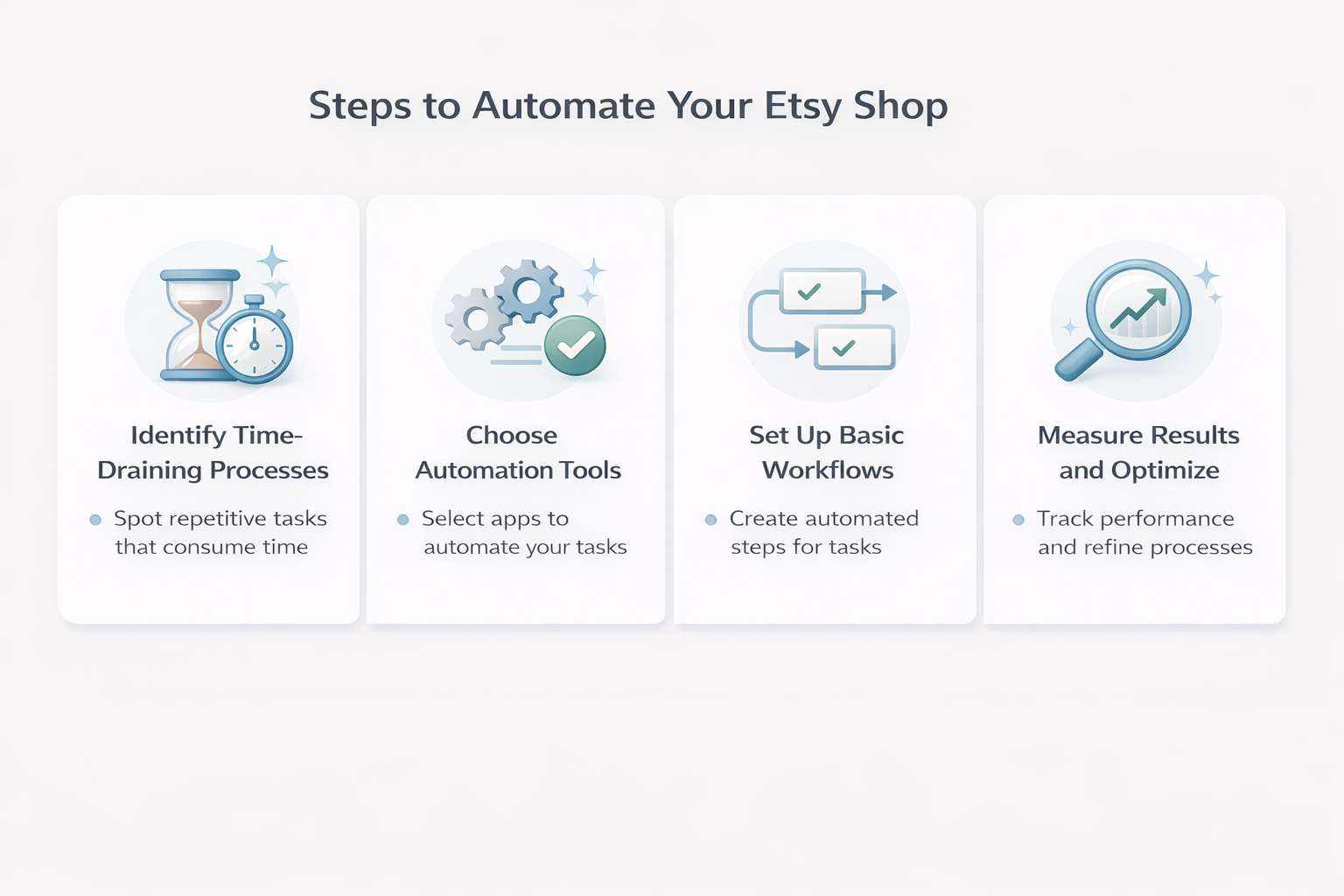
Start by mapping out everything you currently handle manually. Write down each task, how much time it takes, and how often you repeat it. This simple audit helps you see where your time goes and highlights areas where automation can save the most effort.
For most Etsy sellers, the biggest time drains are inventory management, customer follow-ups, repetitive inquiries, and order processing. These same areas also give the fastest return once automated.
Here’s a breakdown of typical time spent on manual tasks for a mid-level Etsy seller:
| Task | Time Per Week (Manual) | Time Per Week (Automated) | Time Saved | ROI Priority |
| Inventory Management | 8 hours | 0.5 hours | 7.5 hours | Very High |
| Order Processing | 6 hours | 0.25 hours | 5.75 hours | Very High |
| Customer Follow-ups | 5 hours | 0.5 hours | 4.5 hours | High |
| Email Marketing | 4 hours | 1 hour | 3 hours | High |
| Review Requests | 3 hours | 0.25 hours | 2.75 hours | Medium |
| Abandoned Cart Recovery | 2 hours | 0 hours | 2 hours | Medium |
| Total Weekly Time | 28 hours | 2.5 hours | 25.5 hours |
— |
As you can see, the gap between manual work and automated operations is substantial. That’s roughly 25.5 extra hours every week you can redirect toward creating new products, improving marketing, or enjoying personal time. If you want clear insights on how automation impacts productivity, check out Zapier’s automation report.
Step 2: Prioritize Quick Wins First
Don’t try to automate everything at once. Start with one or two simple but high-impact automations and make sure they run perfectly before moving forward. Many sellers begin with automated order confirmations and follow-up messages. These are easy to set up, save hours every week, and instantly improve customer experience.
Once those are running smoothly, move on to inventory syncing. After that, focus on customer segmentation and personalized email campaigns. The key is building steady progress without getting overwhelmed. For inspiration, explore Mailchimp’s automation guide and see how successful sellers scale efficiently at HiSellIt.
Step 3: Choose Your Automation Tools
Select tools based on what your shop actually needs and what fits your budget and comfort level. Begin with essentials like inventory and order management, then gradually add customer communication automation once the basics are stable.
When reviewing different options, pay attention to how easily they integrate with Etsy, how responsive their customer support is, and how their pricing works. Some charge per order, while others use flat monthly rates. Take a moment to calculate which structure fits your current volume and long-term growth plan.
How Automating Your Etsy Sales Funnel Boosts Rankings and Conversions
Here’s something many sellers overlook: automating your Etsy sales funnel doesn’t just save time; it can also boost your SEO and conversion rates significantly.
When orders are processed quickly, and customers receive tracking details without delay, they’re far more likely to leave positive reviews. Etsy’s algorithm favors shops with consistent, high-quality feedback by placing them higher in search results. That visibility brings more visitors, which leads to more sales. It creates a self-sustaining growth cycle.
Automation also improves your responsiveness. When someone sends a question to your shop, an instant automated reply or an alert for quick follow-up makes a strong impression. Buyers see that as professionalism and reliability, which naturally raises conversion rates.
Perhaps most importantly, once you free yourself from manual tasks, you finally have time for real strategy. You can refine product descriptions, update listings for SEO, or plan new launches that attract long-term customers. These are the actions that truly drive ranking and revenue. For a deeper look into Etsy SEO optimization, explore Etsy’s Seller Handbook on SEO or learn more at our contact page.
Measuring the Impact of Your Etsy Sales Funnel Automation
Implementing automation without tracking results is like running a business blindfolded. You need clear data to know what’s really improving. Start by measuring essential metrics before and after each automation you add.
Look at how long it takes to process an order, how quickly customer emails are answered, and how often reviews come in after purchases. Most importantly, track your revenue per hour of work. For example, if you once spent 20 hours weekly on manual work and earned $2,000, that’s $100 per hour. If automation cuts that down to just 5 hours while keeping or increasing revenue, you’ve not only saved 15 hours weekly but also made your time more profitable.
Here’s what typical metrics look like before and after implementing your Etsy sales funnel automation:
| Metric | Before Automation | After Automation | Improvement |
| Avg. Order Processing Time | 4 hours | 15 minutes | 94% faster |
| Email Response Time | 24 hours | 30 minutes | 96% faster |
| Customer Review Rate | 8% | 22% | 175% increase |
| Abandoned Cart Recovery | 0% | 18% | $2,000–$5,000/month |
| Time Per Customer Inquiry | 10 minutes | 3 minutes | 70% faster |
| Monthly Revenue Per Hour Worked | $42 | $168 | 300% increase |
| Inventory Sync Errors | 3–5 per month | 0 | 100% elimination |
These numbers reflect what mid-level Etsy sellers usually see once they’ve set up essential automation. Your own results will depend on factors like shop size, product range, and which processes you automate first. Still, even a careful rollout often leads to a 200% to 300% jump in efficiency within just 90 days.
Alongside performance metrics, make sure to track customer satisfaction. Notice how automation impacts their experience. Are messages starting to feel cold or robotic? Review sentiment, service inquiries, and repeat purchase rates will reveal the truth. Great automation should feel natural, not mechanical. If feedback starts pointing to generic replies or slow follow-ups, it’s a sign your workflows need fine-tuning. For guidance, check Etsy’s seller service quality tips.
Common Automation Mistakes to Avoid in Your Etsy Sales Funnel
Over-Automating Customer Communication
It can be tempting to automate every customer exchange, but some interactions simply need a human voice. When someone reaches out about a damaged item or incorrect order, that’s not the time for a canned message. Automation should handle repetitive or time-consuming tasks so you can personally manage moments that actually build trust and loyalty.
Ignoring Quality Control
Automation is powerful, but it isn’t flawless. Systems can misfire, inventory syncs can glitch, and scheduled messages can reach the wrong people. Create safety nets by reviewing automation logs and setting alerts for unusual behavior. Think of automation as an assistant that needs oversight, not something you set and forget.
Choosing Tools Without Considering Scalability
When selecting automation tools, look at the long-term picture. A platform that fits your shop perfectly today might become expensive or inefficient once your sales scale. Choose solutions that grow with your business and adapt easily to higher order volumes.
Your Action Plan: Getting Started with Etsy Sales Funnel Automation
Ready to automate your Etsy shop? Here’s where to start.
First, explore our comprehensive Etsy automation services to see how professional automation can transform your operation. Then work through these steps:
- Complete your process audit this week
- Identify your top three time drains
- Research tools that address those specific pain points
- Set up your first automation (start with something simple)
- Measure the impact after 30 days
- Build from there
The sellers who dominate Etsy in 2026 won’t be the ones working 60-hour weeks. They’ll be the ones who’ve automated wisely and used their extra time to grow their brand and products.
If you’re not sure where to begin, we’re here to help. Our team can design automation that fits your exact workflow and business goals.
Conclusion: Build an Etsy Sales Funnel That Works for You
An automated Etsy sales funnel is no longer a luxury. It’s the foundation for how successful sellers grow their businesses without burning out. By automating critical tasks like inventory management, order fulfillment, and customer communication, you can reclaim hours of time to invest in innovation, marketing, and strategic growth.
The best part about automation is that it doesn’t eliminate your personal touch. Instead, it amplifies it. While backend systems handle the repetitive work, you can focus on creating better products and building deeper relationships with your customers.
If you’re ready to take your Etsy shop from busy to efficient, visit HiSellIt to explore how custom workflows can streamline your business. You can also check Etsy’s official Seller Handbook for deeper insights on optimizing your shop performance with automation.
Frequently Asked Questions About Etsy Sales Funnel Automation
Q. What is an Etsy sales funnel in e-commerce?
An Etsy sales funnel is the customer journey from discovering your shop to making a purchase and returning for repeat orders. It includes awareness, consideration, conversion, and retention stages. Automation streamlines each stage by handling repetitive tasks like follow-ups, inventory updates, and email campaigns without manual effort.
Q. How much does it cost to automate an Etsy sales funnel in 2026?
Entry-level automation costs between $0 and $50 monthly using free Etsy features or basic Zapier workflows. Mid-tier solutions handling inventory, orders, and email typically range from $50 to $150 monthly. Enterprise-level platforms with custom integrations and dedicated support can cost $200 to $500 monthly or more, depending on your shop’s complexity and order volume.
Q. Is Etsy sales funnel automation profitable for beginners?
Yes, even new sellers benefit from automation. Starting with automated order confirmations, review requests, and abandoned cart recovery can boost conversions by 10% to 30% without requiring technical expertise. As your shop grows, automation scales with you, saving time and reducing costly errors like overselling or delayed customer responses.
Q. What tools automate an Etsy sales funnel?
Popular tools include Zapier and Make for custom workflows, Klaviyo and Mailchimp for email marketing automation, ShipStation for order fulfillment, and all-in-one platforms like CraftKit. These tools integrate with Etsy to automate inventory syncing, customer communication, abandoned cart recovery, and analytics tracking, allowing you to focus on growth instead of manual tasks.
Q. How does Etsy sales funnel automation help small business owners?
Automation helps small business owners reclaim 20 to 30 hours weekly by eliminating repetitive tasks like inventory updates, order processing, and email follow-ups. This time can be reinvested into product development, marketing strategy, and customer relationship building. Additionally, automation improves customer satisfaction through faster response times and consistent communication, leading to higher review rates and better Etsy search rankings.