
Etsy vs Shopify 2026: Which Platform Is Better for Online Sellers?
Choosing between Etsy vs Shopify 2026 ranks among the most crucial decisions facing online sellers today. Recent data shows Shopify powers over 2 million active businesses worldwide, while Etsy supports more than 5.6 million sellers globally. This platform decision directly shapes your profit margins, brand independence, and customer reach strategy.
This comprehensive guide covers everything you need to know about Etsy vs. Shopify in 2026. We’ll examine startup investments, recurring fees, traffic generation methods, and scaling capabilities. You’ll discover which platform aligns with your business goals and understand why this decision matters for long-term success.
Your platform choice influences more than product listings. It determines customer discovery patterns, fee structures, and whether you can transition from hobby income to sustainable revenue. Let’s explore what sets these platforms apart so you can decide with confidence.
Ready to build your online presence? Discover comprehensive e-commerce solutions that integrate seamlessly with both platforms and support your growth journey.
Etsy vs Shopify 2026: Understanding the Core Differences
What Is Etsy?
Etsy operates as a global marketplace centered on handmade items, vintage products, and craft supplies. Picture it as a digital craft fair where millions of shoppers search for unique goods unavailable elsewhere. For sellers, Etsy manages the technical infrastructure, from website hosting to payment processing, allowing you to concentrate on creating and listing products.
The marketplace model means renting space within Etsy’s ecosystem. You operate within their guidelines, fee structure, and design parameters. This setup provides instant access to millions of active buyers who already trust the platform. Etsy also offers a Seller Handbook with guidance on photography, marketing, and shop optimization, creating a beginner-friendly environment for the Etsy vs Shopify 2026 decision.
What Is Shopify?
Shopify is an e-commerce website builder that lets you launch and manage your independent online store. Unlike Etsy, you control your domain name, customize your design completely, and sell virtually any legal product. The platform offers complete flexibility to build a store that reflects your brand, without category limitations.
The fundamental difference in the Shopify vs. Etsy debate for sellers centers on ownership and control. Shopify isn’t a shared marketplace where you compete alongside millions of sellers. Instead, you construct your own storefront where customers engage directly with your brand. This independence proves valuable for sellers pursuing long-term brand recognition and a customer base they completely own when evaluating Etsy vs Shopify 2026.
Cost Comparison: Etsy vs Shopify in 2026
Etsy Fees 2026
Etsy’s fee structure appeals to beginners because the upfront investment remains minimal. You can test products and assess demand without substantial financial risk. Here’s how Etsy costs typically break down in the Etsy vs Shopify 2026 comparison:
- Listing fees: $0.20 per product, valid for four months or until sold
- Transaction fees: 6.5% of the item price, including shipping
- Payment processing: 3% + $0.25 per transaction
- Advertising costs: Optional, typically 2% to 4% if using Etsy Ads
These expenses accumulate rapidly as sales increase. For example, selling a $50 product generates approximately $6.50 in transaction fees, $1.75 in payment processing, plus the listing cost. That totals nearly 16.5% of your sale going to Etsy before considering packaging or shipping. This explains why many expanding sellers evaluate the Etsy vs. Shopify cost comparison 2026 to improve long-term cost efficiency.
Shopify Pricing 2026
Shopify employs a subscription model with fixed monthly costs and transaction fees varying by plan. Here’s the current Shopify pricing 2026 structure that factors into the Etsy vs Shopify 2026 analysis:
- Basic Shopify: $39 per month with 2.9% + 30¢ per transaction
- Shopify: $105 per month with 2.6% + 30¢ per transaction
- Advanced Shopify: $399 per month with 2.4% + 30¢ per transaction
Beyond subscriptions, most Shopify sellers budget for:
- Premium themes, usually $100 to $300 one-time
- Apps and plugins, often $10 to $100+ monthly
- Custom development if required
- Marketing and advertising aligned with growth strategy
For instance, selling a $50 product on Basic Shopify costs approximately $1.75 in transaction fees. While you maintain the monthly subscription, this structure becomes more cost-effective as sales volume expands. High-volume sellers often find Shopify’s flat fee more manageable than Etsy’s percentage-based model. Current details appear on the Shopify pricing page.
Traffic & Customer Acquisition: Etsy Marketplace vs Shopify Store
Etsy Marketplace Advantages
Etsy’s primary strength lies in its established audience. The platform attracted over 95 million active buyers in 2026, and these shoppers arrived with clear intent. They’re specifically seeking handmade goods, vintage items, and unique products. For new sellers considering Etsy vs Shopify 2026, this built-in marketplace traffic creates an immediate opportunity because you access motivated buyers before mastering marketing.
Etsy SEO optimization in 2026 plays a vital role in visibility. The platform uses its proprietary search algorithm, distinct from Google’s ranking system. On Etsy, visibility depends on keyword relevance, listing quality, customer reviews, and shop performance. Understanding Etsy’s algorithm often matters more than traditional search engine optimization when weighing Etsy vs Shopify 2026.
However, popularity generates competition. The same search function helping buyers locate you also displays millions of competing listings. Targeting popular keywords can make your products easily vanish from search results. Standing out demands unique items, strong branding, or additional marketing beyond Etsy itself.
Building Independent Store Traffic with Shopify
Shopify takes a contrasting approach in the Etsy vs Shopify 2026 debate. It doesn’t supply built-in traffic, meaning you’re responsible for attracting visitors through organic or paid methods. While this might feel daunting initially, the long-term advantages prove substantial.
Most Shopify sellers generate traffic through:
- Search engine optimization (SEO)
- Social media marketing
- Email campaigns
- Paid advertising (Google Ads, Facebook)
- Content marketing and blogging
- Influencer partnerships
The advantage is ownership. Every customer visiting your site, every email subscriber, and every repeat buyer belongs to your brand, not a shared marketplace. This independence allows you to build a business ecosystem you completely control.
Shopify also excels at niche-market focus. By targeting specific product types or customer segments, you sharpen messaging and attract highly relevant audiences. Instead of competing with millions of sellers on one platform, you establish your own online space. Over time, this strategy builds loyalty and makes scaling into a sustainable business considerably easier, especially when comparing Etsy vs Shopify 2026.
Need support with traffic generation? Contact our team for personalized guidance on driving qualified visitors to your online store and optimizing conversion rates.
Design and Customization Options
Etsy Shop Customization
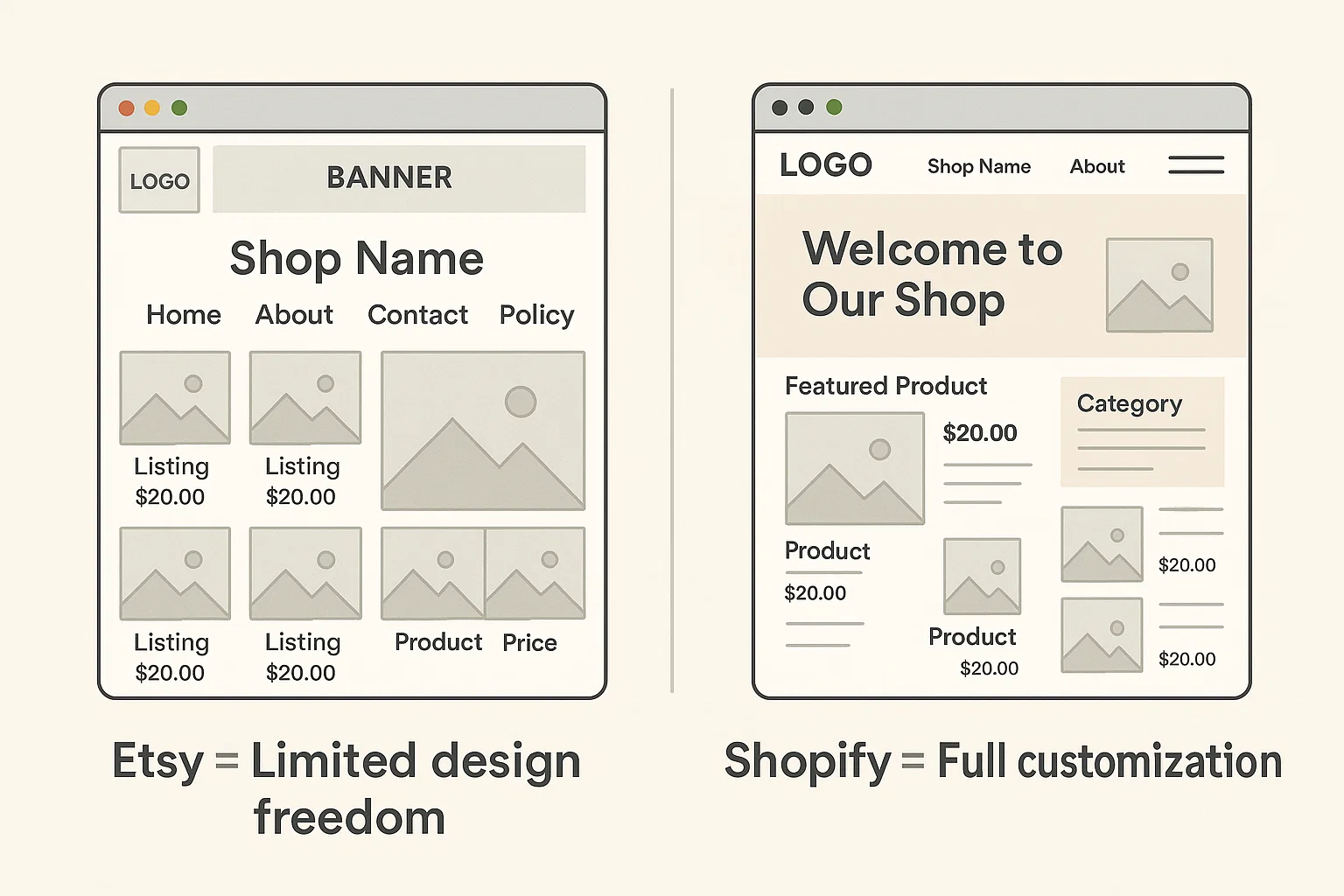
Etsy provides basic customization tools, helping maintain some brand consistency within their framework. You can upload shop banners, add logos, write detailed product descriptions, and organize listings into categories. While Etsy has recently expanded customization options, you’re still operating within its design structure for the Etsy vs Shopify 2026 comparison.
This means your shop will always carry the recognizable Etsy appearance. On the one hand, buyers instantly understand the browsing and purchasing processes, which builds trust. On the other hand, you have restricted freedom to create unique brand experiences. Because of this constraint, product photography becomes your most powerful differentiation tool. High-quality images often determine whether shoppers click your listing or scroll past.
Shopify Store Features
Shopify themes range from free options to premium designs costing several hundred dollars. More significantly, these themes can be extensively customized or completely rebuilt to align with your brand vision. You control every aspect of the customer experience, from homepage layout to checkout flow, in the Etsy vs Shopify 2026 decision.
This flexibility extends to functionality. Shopify offers thousands of apps that add features such as product reviews, advanced analytics, subscription services, and complex product configurations. In most cases, an app exists for your needs, and if not, you can work with developers to create custom solutions.
The learning curve can be steep, particularly without technical experience. However, Shopify’s interface becomes easier with practice, and many successful store owners start with simple adjustments before advancing to complex customizations as businesses grow.
Product Categories and Restrictions
What Sells Best on Etsy?
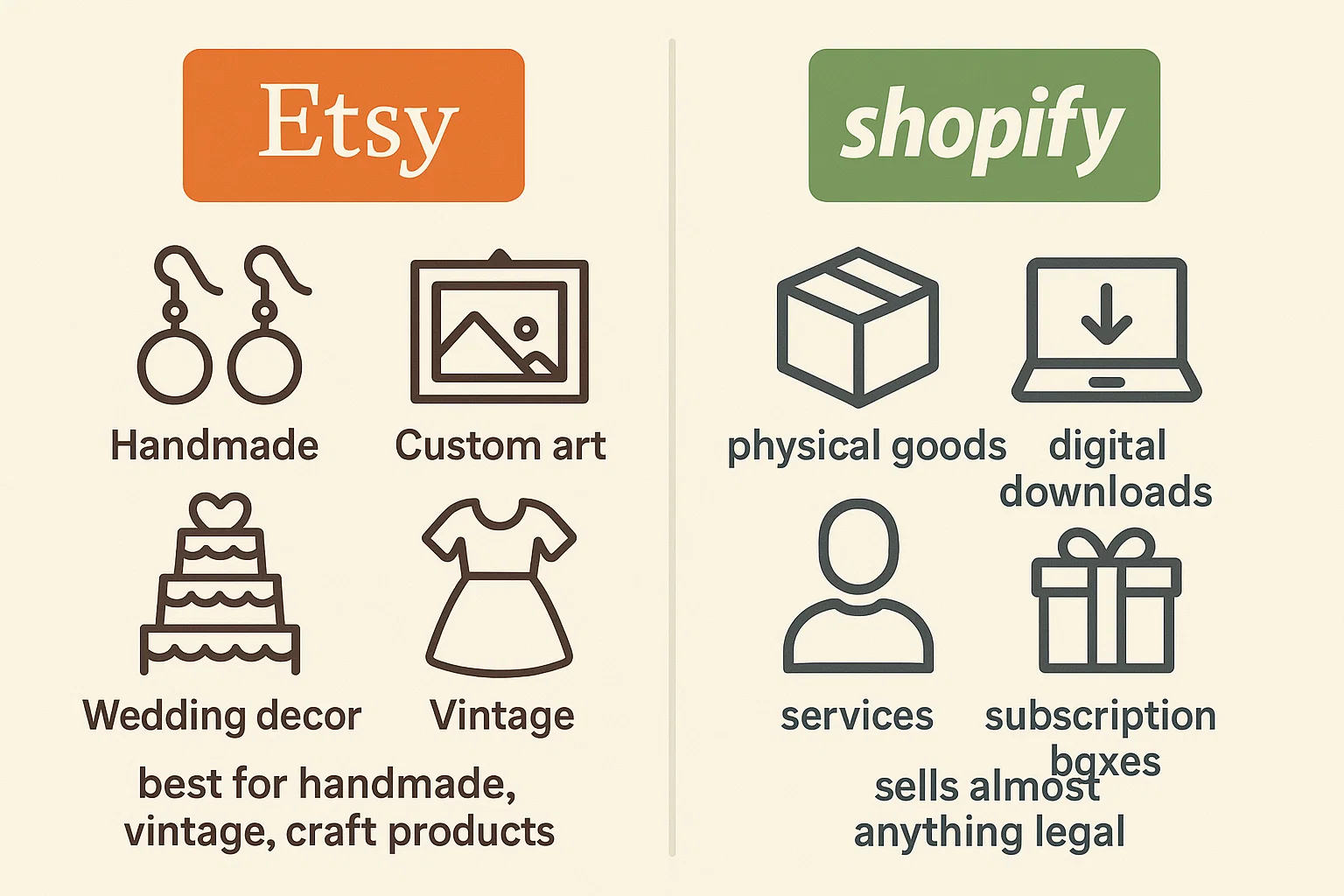
Etsy’s market revolves around creativity and uniqueness, explaining why specific categories consistently perform well in the Etsy vs Shopify 2026 landscape. Top-selling categories include:
- Handmade jewelry and accessories
- Custom artwork and prints
- Wedding and party supplies
- Home decor and furniture
- Vintage clothing and collectibles
- Digital downloads and templates
- Craft supplies and materials
The platform prohibits mass-manufactured products, though enforcement varies. For most sellers evaluating Etsy vs Shopify 2026, success stems from offering personalization, custom work, or designs that genuinely stand out and can’t be easily replicated elsewhere.
Etsy works especially well for artists, makers, and crafters wanting to monetize creative skills without managing complicated business infrastructure. Understanding what thrives within Etsy handmade and vintage product categories helps sellers position their offerings effectively.
Shopify’s Product Flexibility
Shopify places virtually no restrictions on legal products or services. You can sell:
- Physical products of any type
- Digital downloads and courses
- Services and consultations
- Subscription boxes
- Print-on-demand items
- Wholesale to other businesses
This flexibility allows business model experimentation and expansion into new product categories without platform constraints. Many entrepreneurs start with one product type and expand into complementary areas as they understand their market better. For sellers ready to scale in the Etsy vs Shopify 2026 comparison, explore our Shopify dropshipping services designed specifically for growth-focused businesses.
Marketing and SEO Capabilities
Etsy SEO Tips and Marketing Tools
Etsy provides several built-in marketing features designed specifically for its marketplace in the Etsy vs Shopify 2026 evaluation:
- Etsy Ads: Pay-per-click advertising within search results and category pages
- Offsite Ads: Etsy promotes your products on Google and Facebook (with a 15% fee on resulting sales)
- Sales and coupon tools: Create discounts to attract buyers
- Social media integration: Share listings directly to Instagram and Facebook
The platform’s marketing tools work best when combined with a strong Etsy marketplace SEO strategy 2026 practices. Understanding how Etsy’s search algorithm functions becomes essential for organic visibility.
External marketing remains possible but challenging since you’re directing traffic to Etsy’s domain rather than building your own brand recognition in the Etsy vs Shopify 2026 context.
Shopify SEO Tools and Marketing Advantages
Shopify marketing encompasses the full spectrum of digital strategies for the Etsy vs Shopify 2026 decision:
- Built-in SEO tools: Customize meta titles, descriptions, and URLs for better Google rankings
- Email marketing integration: Connect with services like Klaviyo or Mailchimp
- Social commerce: Sell directly through Instagram, Facebook, and TikTok
- Content marketing: Add blogs and landing pages to your site
- Abandoned cart recovery: Automatically email customers who leave without purchasing
- Advanced analytics: Track customer behavior and marketing performance
The key advantage lies in building your own brand recognition and customer relationships. Every marketing effort strengthens your independent business rather than primarily benefiting a third-party platform. According to Statista’s 2026 e-commerce report, brands with owned customer data see 40% higher retention rates compared to marketplace-dependent sellers.
Shopify’s mobile commerce optimization also stands out in 2026. The Shopify mobile app and push notifications enable direct customer engagement, while mobile-optimized checkout processes reduce cart abandonment significantly in the best e-commerce platform 2026 discussion.
E-Commerce Trends Impacting Etsy and Shopify in 2026
AI Commerce Integration
Both platforms are adapting to e-commerce trends 2026, AI shopping experiences that influence the Etsy vs Shopify 2026 comparison. Shopify has integrated AI-powered product recommendations, automated inventory forecasting, and intelligent customer service chatbots. These tools help sellers personalize shopping experiences and operate more efficiently.
Etsy leverages AI differently, focusing on search personalization and matching buyers with relevant handmade products based on browsing history and preferences. The platform’s algorithm continuously learns from user behavior to surface products with higher conversion potential. According to eMarketer’s AI commerce research, AI-driven personalization increased conversion rates by 25% across e-commerce platforms in 2025.
Multi-Channel Selling Strategy
The best e-commerce platform 2026 discussion increasingly emphasizes multi-channel capabilities within the Etsy vs Shopify 2026 framework. Shopify excels here, offering seamless integration with social media platforms, Amazon, eBay, and physical retail through POS systems. This allows sellers to manage inventory across channels from one dashboard.
Etsy sellers can also expand beyond the marketplace, though options remain more limited. Many successful sellers implement a multi-channel selling strategy, using Etsy for marketplace visibility while building independent stores on Shopify for brand control and better margins.
Long-term Business Growth Potential
Scaling on Etsy
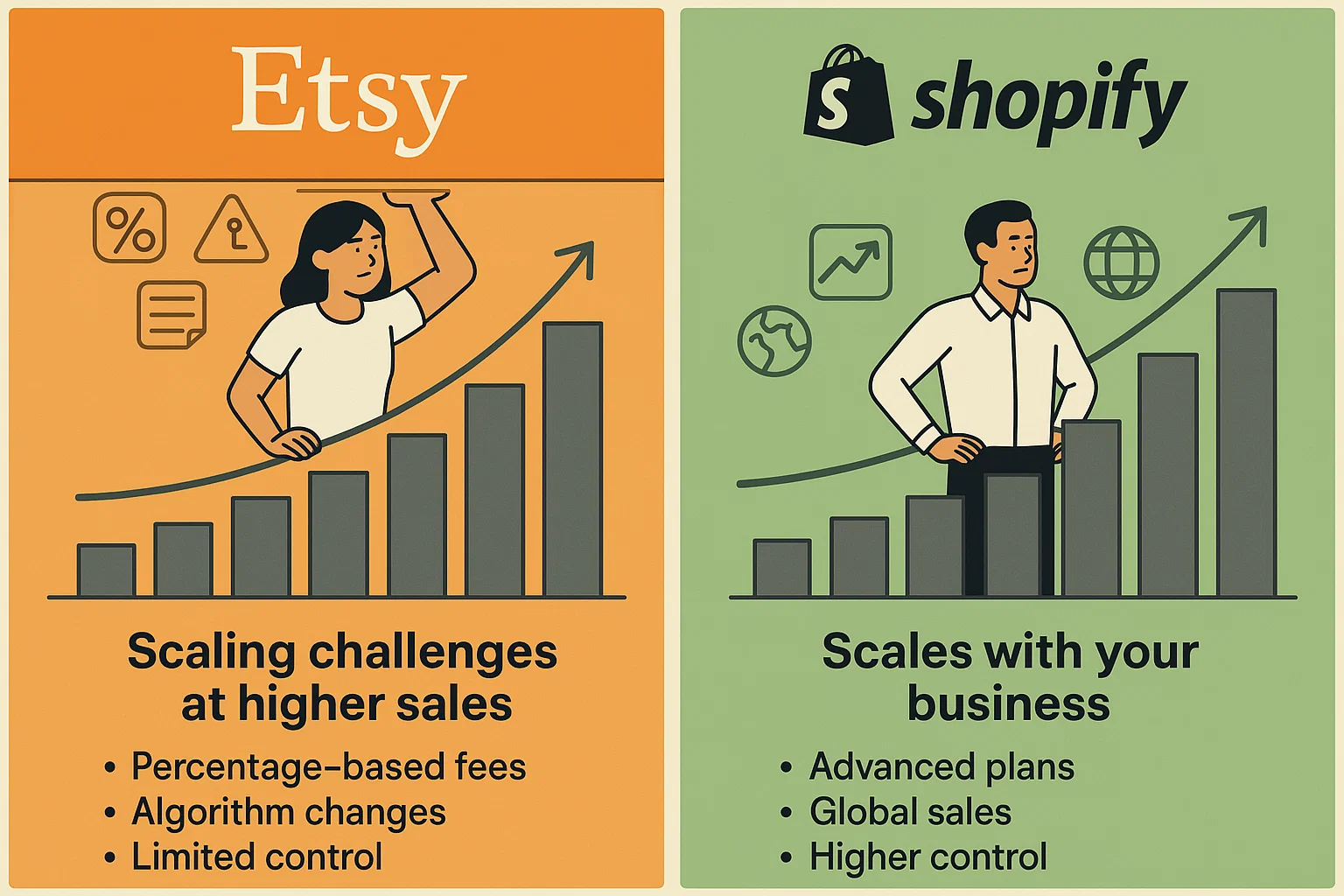
Etsy’s marketplace model creates natural growth limitations in the Etsy vs Shopify 2026 evaluation. As your business expands, percentage-based marketplace fees vs subscription pricing become increasingly expensive. A seller generating $100,000 annually might pay $16,000 to $20,000 in various Etsy fees.
The Etsy vs Shopify cost comparison 2026 becomes particularly relevant as businesses mature. Etsy’s algorithm changes, policy updates, and fee increases directly impact your business without your input or control.
However, some sellers successfully scale by:
- Expanding into wholesale through Etsy’s wholesale portal
- Using Etsy as one channel among several
- Building email lists to maintain customer relationships
- Creating systems for efficient production and fulfillment
Shopify’s Scalability
Shopify grows with your business through increasingly sophisticated features and integrations for the Etsy vs Shopify 2026 decision. Advanced plans include:
- Multi-location inventory management
- Advanced report building
- Third-party calculated shipping rates
- Enhanced security features
- Priority customer support
The platform supports businesses at all levels, from startups to enterprises. Many successful brands process millions in annual revenue through Shopify, with the platform handling technical demands of high-volume sales. In fact, Shopify’s 2026 merchant data shows that stores properly optimized for SEO and customer retention grow 3x faster than those relying solely on marketplace traffic.
Shopify customization and headless commerce capabilities also enable advanced sellers to create unique shopping experiences that differentiate them from competitors. This technical flexibility supports Shopify or Etsy for small business growth decisions favoring long-term scalability in the Etsy vs Shopify 2026 landscape.
Customer Support and Resources
Etsy Seller Support
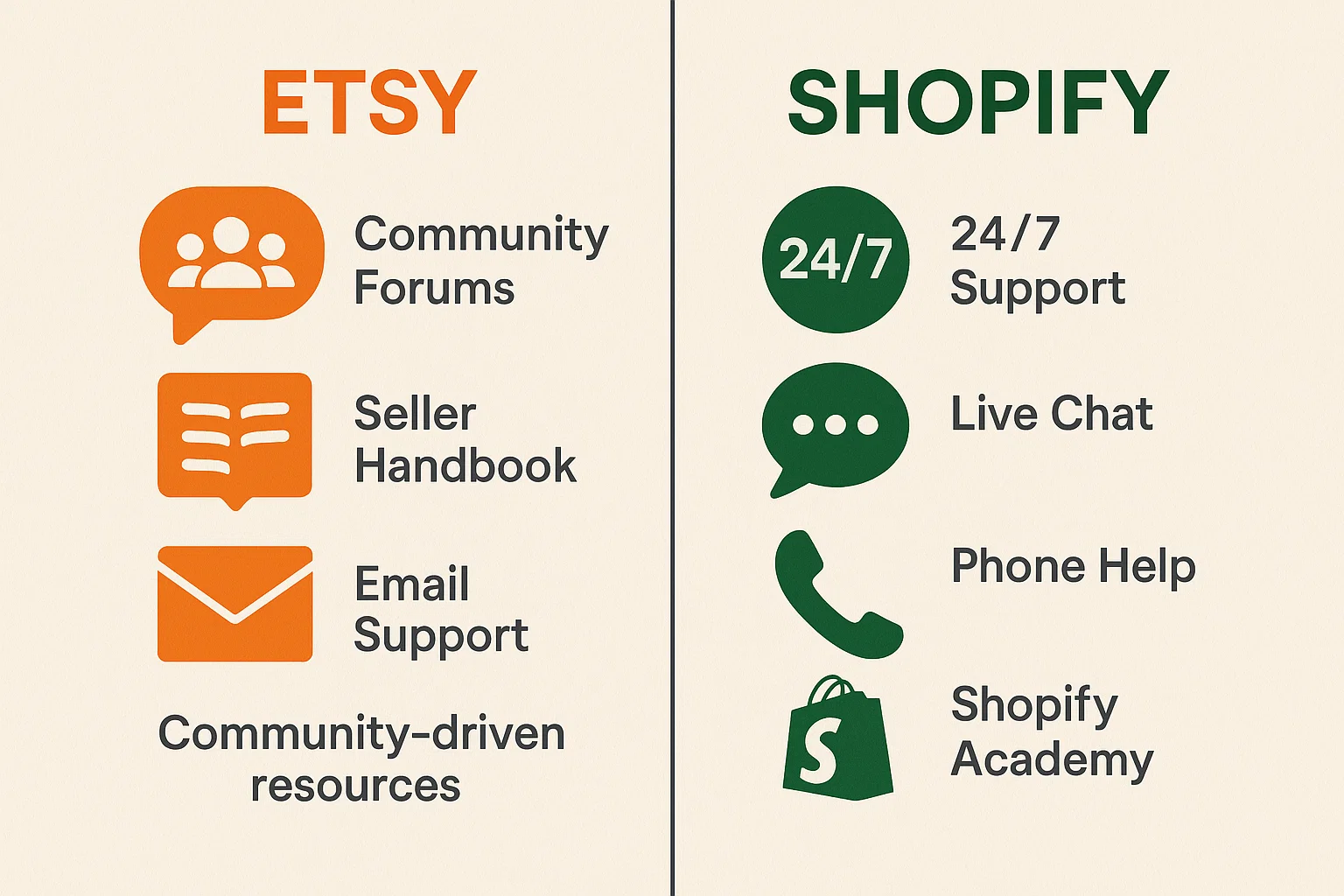
Etsy provides sellers with community forums, educational articles, and email support for those navigating the Etsy vs Shopify 2026 choice. The Seller Handbook represents one of the most valuable resources, covering topics like product photography, Etsy SEO tips, customer service, and business management. These tools help new sellers get started, though direct support can sometimes feel slow when addressing individual issues.
The community aspect adds value. Many sellers share experiences, tips, and advice, creating peer-to-peer support. However, you’re ultimately reliant on Etsy’s priorities for platform updates and improvements, meaning less control compared to running your own independent store in the Etsy vs Shopify 2026 comparison.
Shopify Support Infrastructure
Shopify provides 24/7 customer support through phone, email, and live chat. For sellers wanting to learn more about running online businesses within the Etsy vs Shopify 2026 framework, Shopify Academy offers extensive educational resources. Additionally, the platform connects you with certified experts who provide specialized assistance when needed.
Another strength is Shopify’s vast app ecosystem. Solutions exist for almost every business challenge, from marketing automation to inventory management. The only drawback is that the sheer number of choices can feel overwhelming for beginners, especially when determining which tools are truly essential.
Looking for expert guidance on the Etsy vs Shopify 2026 decision? Our team specializes in Etsy automation services and can help you maximize success on either platform through proven strategies and automation tools.
Making Your Decision: Key Factors to Consider
Choose Etsy If You:
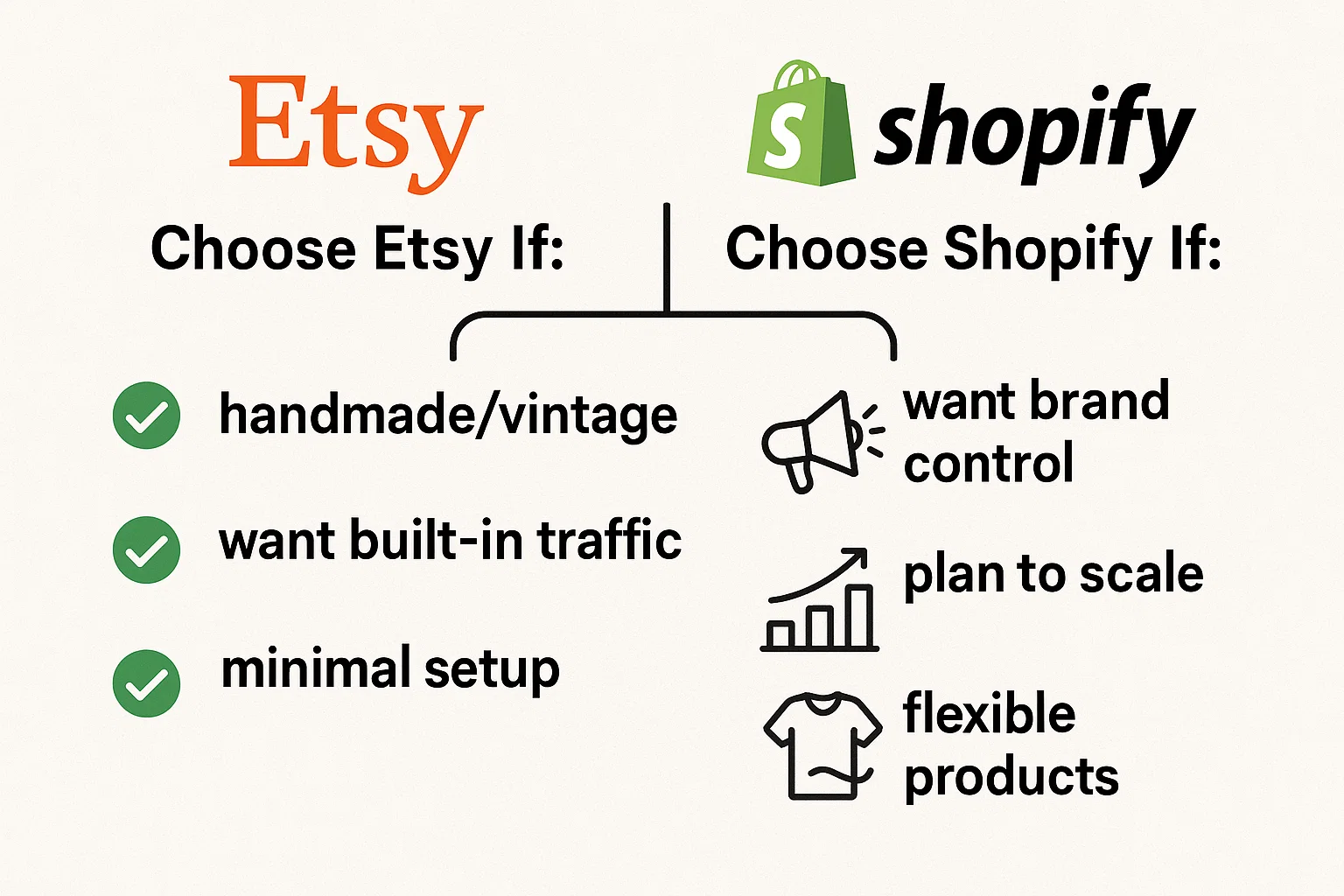
When evaluating Etsy vs Shopify 2026, choose Etsy if you:
- Create handmade, vintage, or craft items aligning with Etsy’s marketplace focus
- Want immediate access to motivated buyers without building traffic from scratch
- Prefer minimal technical complexity and are comfortable with platform limitations
- Have limited startup capital and want to test market demand
- Enjoy the community aspect of being part of a creative marketplace
- Don’t mind paying higher fees in exchange for built-in traffic and infrastructure
Choose Shopify If You:
When considering Etsy vs Shopify 2026, choose Shopify if you:
- Want complete control over your brand and customer experience
- Plan to scale beyond hobby-level sales into substantial business
- Can invest time in learning marketing and basic website management
- Prefer paying fixed monthly costs rather than percentage-based fees
- Want to sell any legal product or service without category restrictions
- Value building your own customer base, independent of third-party platforms
The Hybrid Approach
Many successful sellers don’t limit themselves to one platform in the Etsy vs Shopify 2026 landscape. A common path involves starting on Etsy to validate products and build initial sales, then expanding to Shopify for greater control and lower fees. This approach lets you leverage Etsy’s built-in audience early while using Shopify’s flexibility to scale your brand independently.
This strategy allows you to:
- Test products with minimal investment
- Learn e-commerce fundamentals in a supportive environment
- Build capital for a more substantial Shopify investment
- Diversify sales channels for reduced risk
- Gradually transition customers to your independent store
Should I Sell on Etsy or Shopify in 2026?
Starting an Etsy shop can cost as little as $20 for initial listings, making it accessible to almost anyone wanting to test products in an online marketplace. The main expenses are listing fees and transaction costs, which increase as sales rise.
Shopify startup costs typically range from $200 to $1,000 in the first month. This usually includes the subscription fee, a basic theme, and essential apps. While the upfront investment is larger, it provides the structure and flexibility to run a scalable, fully independent business.
When comparing Etsy vs Shopify 2026, consider your available capital, risk tolerance, and long-term goals. Neither platform is automatically better. The Etsy vs Shopify 2026 decision comes down to what aligns most closely with your entrepreneurial vision and business model. According to BigCommerce’s platform comparison study, 68% of successful online sellers use multiple sales channels, suggesting that the Etsy vs Shopify 2026 choice doesn’t have to be exclusive.
Conclusion
Deciding between the best e-commerce platform 2026 options ultimately depends on the type of business you want to build and your comfort level with technology. The Etsy vs Shopify 2026 debate has no universal winner. Etsy works better for creative entrepreneurs who want fast access to a built-in marketplace and prefer minimal technical complexity. In contrast, Shopify proves stronger for business owners ready to invest in long-term brand building, who want more control and flexibility that scales with growth.
What many sellers eventually realize is that they don’t have to choose just one platform permanently in the Etsy vs Shopify 2026 decision. Some of the most successful e-commerce businesses utilize both platforms. Etsy helps them tap into a ready-made audience, while Shopify provides independence and complete brand control. This combination often leads to greater exposure and broader revenue streams.
Remember that your Etsy vs Shopify 2026 decision isn’t permanent. Many businesses start with Etsy to test demand, then transition to Shopify once they’re confident about scaling. The important thing is to start where you’re comfortable, gain experience, and remain flexible as you grow.
Success in online selling depends less on which platform gets more traffic Etsy or Shopify and more on how well you serve your customers. Strong products, reliable service, and consistent effort will always matter more than the platform itself. Select the option that fits your current stage while keeping long-term goals in mind so your business has room to grow and evolve.
Frequently Asked Questions
Q. What is the Etsy vs Shopify 2026 comparison?
The Etsy vs Shopify 2026 comparison examines two leading selling platforms. Etsy is a marketplace for handmade and vintage items with built-in traffic, while Shopify is a website builder providing complete control over your independent online store. The Etsy vs Shopify 2026 choice depends on whether you prioritize immediate marketplace access or long-term brand ownership.
Q. Is Shopify cheaper than Etsy in 2026?
Starting on Etsy costs as little as $20 for initial listings, plus transaction fees of 6.5% and payment processing of 3% + $0.25 per sale. Shopify requires $39 monthly for the basic plan, plus transaction fees of 2.9% + 30¢ per sale. Shopify also involves additional costs for themes and apps, typically $200 to $1,000 to start. However, Shopify becomes more cost-effective as sales volume increases in the Etsy vs Shopify 2026 comparison.
Q. Which platform has better SEO for organic traffic in 2026?
Both platforms offer SEO advantages, but in different ways, for the Etsy vs Shopify 2026 evaluation. Etsy provides immediate marketplace visibility through its internal search algorithm, giving new sellers faster initial exposure. Shopify offers superior long-term SEO potential through customizable meta tags, blogging capabilities, and full Google indexing control. Shopify SEO tools allow you to build organic traffic that you own, while Etsy SEO focuses on marketplace-specific optimization.
Q. What tools automate operations on these platforms?
For Etsy in the Etsy vs Shopify 2026 context, automation tools include Etsy Ads for marketing, listing management apps, and inventory sync software. Shopify offers thousands of apps for automation, including email marketing platforms like Klaviyo, inventory management tools, abandoned cart recovery, and social media integration. Many third-party services also help manage both platforms simultaneously for sellers using a multi-channel approach.
Q. Should new sellers start on Etsy or Shopify this year?
New sellers evaluating Etsy vs Shopify 2026 should consider their product type, budget, and technical skills. Etsy suits creators of handmade or vintage items who want immediate marketplace access with minimal setup and technical requirements. Shopify better serves sellers planning to build a scalable brand with complete control, who can invest time learning marketing and website management. Many successful sellers start on Etsy to validate products, then expand to Shopify for growth in the Etsy vs Shopify 2026 journey.