
How to Write Product Descriptions That Sell: The Complete Guide to Converting Browsers Into Buyers
Turning casual visitors into loyal customers requires product descriptions that sell. Strategic e-commerce product copywriting and compelling sales copy make this transformation possible. Recent research from the Baymard Institute shows that 87% of online shoppers consider product content highly significant in purchasing decisions. Many retailers struggle with crafting high-converting product descriptions that truly convert.
Simply listing features won’t elevate your copy beyond mediocre standards. Understanding customer psychology, addressing pain points, and crafting narratives that align with audience desires are essential for writing product descriptions that boost sales. Effective e-commerce product copywriting integrates conversion optimization techniques with consumer behavior insights to create product listings that drive sales autonomously.
Compelling product descriptions that sell require persuasive writing skills and proven sales copywriting techniques. These guide customers from interest to purchase through benefit-driven product descriptions.
Understanding Product Descriptions That Sell
Before diving into how to write product descriptions for online stores, understanding online purchasing behavior and e-commerce conversion rates is crucial. Online shopping differs from in-person experiences because consumers cannot physically touch or examine items. They must depend on persuasive product copy and sales messaging to transition from curiosity to purchase.
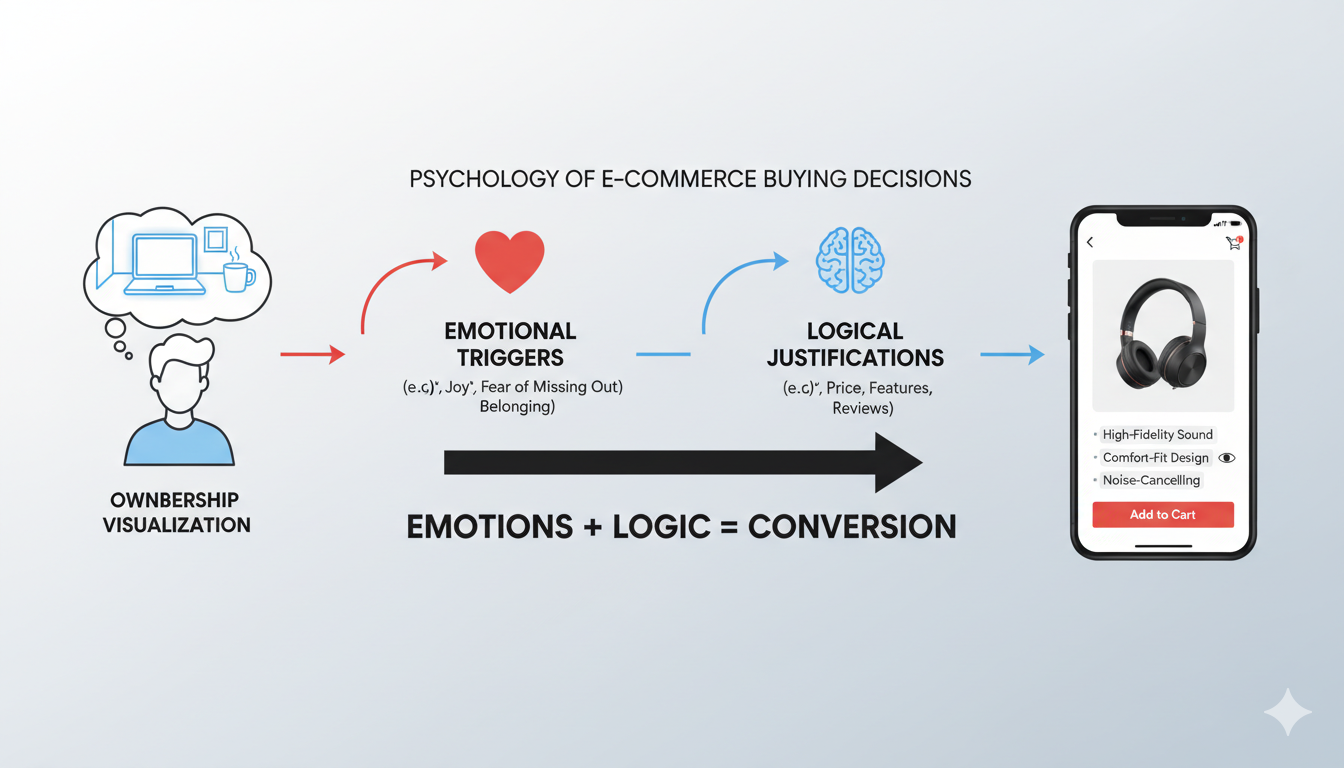
A Nielsen Norman Group study indicates that high-converting product descriptions engage emotional triggers while providing logical purchase justification. Customers must visualize product use and comprehend functionality. They need to understand how products enhance their lives or address pain points through conversion-focused product descriptions.
Compelling, benefit-driven product descriptions help shoppers envision themselves owning and using the products. Psychologists call this ownership visualization. This psychological concept explains why benefit-focused product descriptions consistently outperform feature-heavy alternatives in conversion rate optimization studies.
Statista reports that over 54% of website traffic originates from mobile devices. Contemporary e-commerce product copywriting must prioritize mobile optimization and user experience. Product descriptions that sell need to be scannable and engaging across all screen sizes.
Psychology Behind Product Descriptions That Convert
Customer purchase behavior drives successful product descriptions that sell. Understanding emotional product copy and persuasive writing techniques creates connections between products and buyers. The AIDA framework for product copy (Attention, Interest, Desire, Action) provides structure for conversion-focused product descriptions.
Emotional buying triggers influence decisions more than rational considerations. Harvard Business School research indicates that 95% of purchasing decisions occur subconsciously. A vacuum cleaner’s value extends beyond suction power to encompass the psychological benefits of maintaining clean homes and achieving peace of mind.
Sales-driven product copy addresses both emotional and logical needs. Product descriptions that sell incorporate storytelling to create memorable experiences. This dual approach ensures high-converting product descriptions resonate with diverse customer segments.
Essential Elements of High-Converting Product Descriptions
Know Your Target Customer for Product Descriptions That Sell
Targeted messaging ensures every word communicates effectively with your ideal customer. This requires comprehensive market research and customer analysis to understand demographics, pain points, purchasing behaviors, and the terminology customers use to describe challenges.
Creating detailed buyer personas enables the formulation of product descriptions that sell. These descriptions appear personalized and relevant to target markets. Consider age, income, lifestyle, and specific problems your solution resolves. A skincare product targeting busy working mothers requires distinct messaging versus one aimed at teenagers experiencing acne.
Examine customer reviews, social media comments, and support inquiries. Identify terminology and expressions your audience uses. Imitating their speaking manner enhances authenticity in e-commerce product copywriting. Think with Google research indicates that brands employing customer language experience a 47% increase in engagement rates.
Understanding how to write product descriptions for online stores starts with knowing your audience. Benefit-focused product descriptions that convert speak directly to customer needs using their vocabulary.
Focus on Benefits Over Features in Product Descriptions That Sell
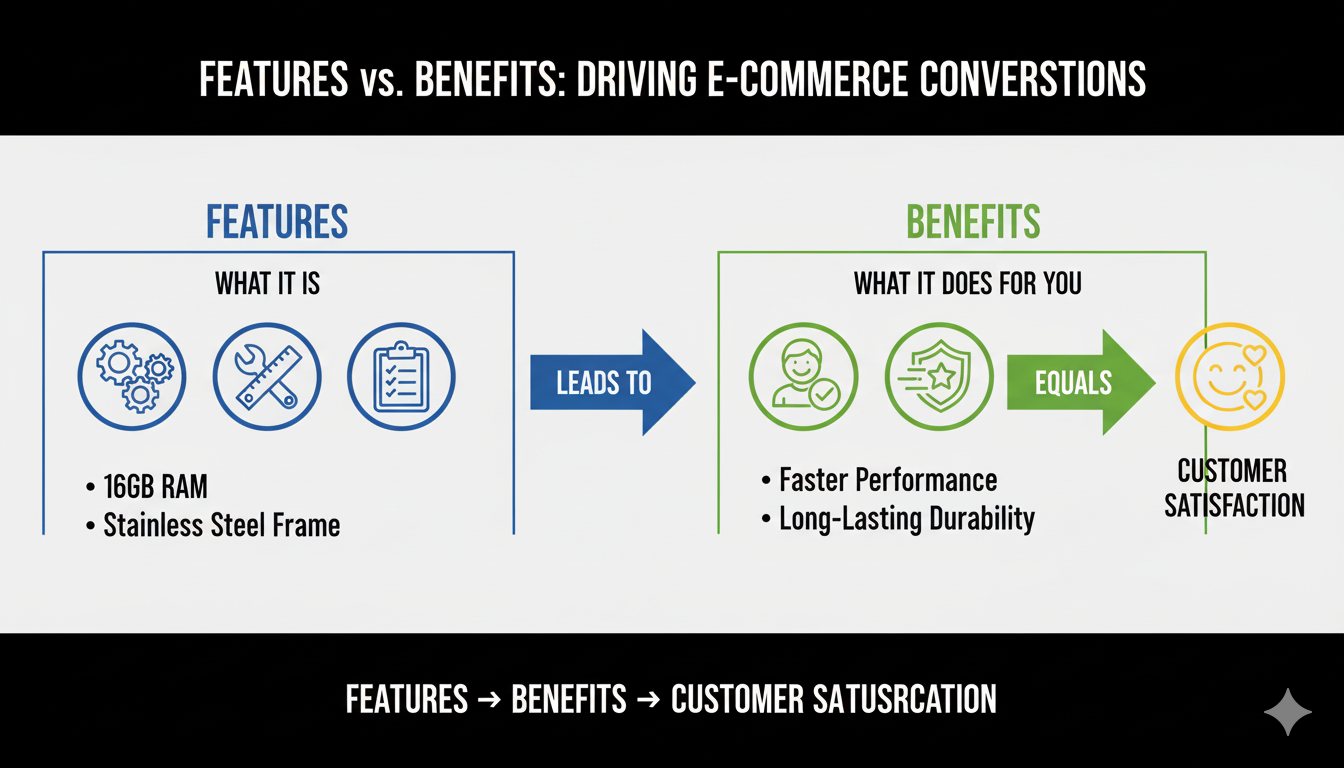
Product features vs benefits represents a crucial distinction in persuasive product copy. Features describe what products have or do. Benefits explain how products impact customer lives and how customers feel about purchases. Features represent objective details while benefits reflect emotional outcomes.
Rather than stating a laptop features “16GB RAM and quad-core processor,” articulate that this configuration enables “seamless multitasking for video editing, simultaneous applications, and video conferencing without lag or crashes.” This approach defines high-converting product descriptions prioritizing benefit-driven copywriting over technical jargon.
Effective e-commerce product copywriting addresses “So what?” for each feature. Consider implications for customers’ daily life. Focus on discussing significant effects rather than technical details. Conversion Rate Experts’ findings indicate that benefit-focused descriptions enhance conversion rates by up to 40%.
Writing product descriptions that boost sales requires emphasizing tangible outcomes. Product descriptions that sell transform specifications into lifestyle improvements through conversion-focused product descriptions.
 Ready to transform your approach? Explore our comprehensive Etsy automation services to streamline your entire online selling process with product descriptions that sell.
Using Sensory Language and Emotional Appeals in Product Descriptions
You cannot physically touch products when shopping online. Your product descriptions that sell need rich sensory language and emotional storytelling resonating with consumers. Rather than describing a sweater as “soft,” use phrases like “luxuriously smooth cashmere providing gentle embrace against skin” to create vivid ownership images and encourage emotional buying triggers.
Color descriptions facilitate interpersonal connections and enhance brand storytelling. Instead of “blue,” employ phrases like “calming ocean blue” or “confident navy capturing attention in professional settings.” These approaches allow consumers to visualize not just products but ownership experiences and lifestyle representations.
Emotional appeals remain highly effective in persuasive product copy. Emotions drive most purchasing decisions despite rational considerations. For example, a vacuum cleaner’s value extends beyond suction power. It encompasses the psychological benefits of maintaining clean homes and peace of mind associated with healthy living environments through emotional product copy.
Using sensory language in e-commerce creates immersive experiences. High-converting product descriptions examples demonstrate how vivid imagery transforms bland specifications into compelling narratives. This technique is essential for writing product descriptions that boost sales.
Structuring Product Descriptions That Sell for Maximum Impact
AIDA Framework for Product Descriptions That Convert
The AIDA model (Attention, Interest, Desire, Action) is proven for writing high-converting product descriptions. This framework guides shoppers through buyer journeys and improves e-commerce sales funnel effectiveness through conversion-focused product descriptions.
Attention should immediately showcase the most compelling feature or unique selling proposition. Start highlighting the transformative impact of the product rather than generic introductions, which risk losing reader interest. Product descriptions that sell capture attention within the first seconds.
Interest building provides information directly relevant to audiences. This description section outlines the primary product benefits and integrates key features to reinforce the claims. Give customers reasons to continue reading through persuasive product copy.
Desire creation involves helping customers visualize ownership and the positive changes products bring. Use storytelling elements, lifestyle imagery, and social proof like customer reviews or testimonials. These elements make benefits feel real and attainable in benefit-driven product descriptions.
Action prompts should be natural and non-intrusive. Guide readers to the next steps while addressing lingering doubts. Strong yet friendly calls to action, such as “Order today for free shipping” or “Secure yours now,” improve conversions without sounding pushy in sales-driven product copy.
Optimizing Product Descriptions for Mobile and UX
Most online shoppers scan rather than read every word. Apply UX writing principles to improve readability and flow in mobile-friendly product copy. Use formatting strategies like bullet points, short paragraphs, and strategic bolding to highlight essential points for time-pressed consumers.
Bullet points quickly communicate practical benefits and address common customer objections. They’re perfect for converting skimmers into buyers through scannable e-commerce copy. Breaking content into smaller chunks helps hurried shoppers find the exact information needed without sifting through dense paragraphs.
Organizing content with SEO-friendly subheadings helps search visibility and makes descriptions more approachable. Nielsen Norman Group research shows users read in “F-shape” patterns. Strategically placed headings and highlighted keywords prove crucial for maintaining attention and boosting engagement in product descriptions that sell.
Tips for effective e-commerce product copy include prioritizing mobile experience. Scannable product descriptions reduce cart abandonment and improve overall engagement through conversion optimization strategies.
Need help optimizing your approach? Contact our experts for personalized guidance on improving your e-commerce product copywriting strategy with product descriptions that sell.
Advanced Techniques for Product Descriptions That Sell
Storytelling and Social Proof in Product Descriptions
Stories create emotional connections that product specs cannot match. Rather than listing skincare ingredients, narrate how inventors developed perfect formulas after years of experiencing sensitive skin. This brand storytelling method fosters trust and distinguishes brands from competitors through persuasive product copy.
Incorporating customer tales and testimonials offers social proof in product listings. Phrases like “customers consistently report” or “our community appreciates this product” enhance authenticity without appearing contrived in high-converting product descriptions.
User-generated content like customer images and reviews can be integrated into descriptions. This enhances trust and provides authentic insights regarding product advantages. BrightLocal studies indicate 91% of individuals regard internet reviews with same trust level as personal recommendations. User-generated content for product pages proves key for improving product descriptions that sell.
Storytelling in product descriptions transforms ordinary copy into memorable narratives. Social proof in product listings validates claims through real customer experiences, creating conversion-focused product descriptions that resonate.
SEO Optimization Without Keyword Stuffing
Optimizing product descriptions for SEO and conversions requires balancing keyword research with accessible content creation. Utilize long-tail keywords and semantic search terms reflecting how consumers search for products in benefit-driven product descriptions.
Use alternative terminology conveying the same meanings. Instead of repeatedly using “wireless Bluetooth headphones,” vary with “cord-free listening experience,” “wireless audio solution,” and “Bluetooth connectivity.” This method appears more organic, increases search query coverage, and enhances search engine rankings for product descriptions that sell.
Product titles and meta descriptions must incorporate significant keywords while engaging audiences. Search engines increasingly prioritize user experience signals and site engagement metrics. Descriptions engaging readers achieve higher rankings compared to keyword-saturated alternatives. Google’s John Mueller consistently states that beneficial user-centered information performs optimally in search results.
High-converting product descriptions examples demonstrate natural keyword integration. Writing product descriptions that boost sales involves strategic SEO without compromising readability or persuasive product copy quality.
Addressing Common Objections and Concerns
Consider and promptly resolve customer uncertainties about product descriptions that sell. Individuals frequently express concerns regarding durability, dimensions, compatibility, and value for cost. Proactively addressing these issues reduces friction and fosters trust in conversion-focused product descriptions.
Size recommendations, care instructions, and compatibility information should integrate into descriptions rather than appearing on separate pages. This comprehensive approach enables informed decisions without requiring customers to exit product sites for additional research.
Present money-back guarantees, warranty details, and return policies promptly to alleviate purchase concerns. Comprehensive information should remain in separate sections, avoiding obstruction of primary descriptions in persuasive product copy.
Testing and Optimizing Product Descriptions That Sell
A/B Testing for Product Description Performance
Systematic testing reveals the most effective components for target audiences. Experiment with various benefit-driven product descriptions, emotional appeals, and structural techniques, determining which methods produce the highest conversion optimization for product pages.
Commence with significant modifications rather than minor terminology adjustments. Examine descriptions highlighting benefits versus those concentrating on features. Experiment with different emotional tones, seeing which resonates most with customers through high-converting product descriptions.
Monitor metrics beyond conversion rates. Track time spent on product pages, scroll depth, and items added to shopping carts. This evaluates the impact of varied descriptions on consumer engagement throughout purchase processes, improving add-to-cart rates for product descriptions that sell.
A/B testing provides data-driven insights for writing product descriptions that boost sales. Tips for effective e-commerce product copy include continuous testing and refinement based on actual performance metrics.
Analyzing Customer Feedback for High-Converting Copy
Customer reviews often reveal aspects most significantly influencing purchasing decisions. Analyze testimonials regarding advantages and impacts on customer lives to enhance social proof in product listings through persuasive product copy.
Customer inquiries and support tickets highlight gaps in high-converting product descriptions. When customers frequently ask about the same aspects, clarification or expansion of those copied parts becomes necessary for product descriptions that sell.
Continuous improvement comes from analyzing sales data combined with customer feedback. This identifies products succeeding despite weak descriptions and those underperforming even with effective e-commerce product copywriting strategies. Refine your approach over time for benefit-focused product descriptions that convert.
For businesses looking to scale efficiently, explore professional automation services at HiSellIt.com that optimize entire product catalogs. Focus on strategic growth while we handle conversion-focused product descriptions.
Industry-Specific Product Description Strategies
Fashion and Apparel Product Descriptions That Sell
Clothing descriptions should provide stylistic insights and practical information. Customers require details regarding appearance, fit, visual quality, and mobility with their bodies for high-converting product descriptions.
Employ sensory language for fabric descriptions, enabling customers to visualize tactile wearing experiences. Descriptions must emphasize comfort, durability, and maintenance requirements, supporting product descriptions that sell. Size information should be comprehensive yet succinct for primary descriptions.
Styling tips and diverse references enable clients to envision multiple product applications. This enhances perceived value and supports elevated pricing through persuasive product copy. Incorporating storytelling makes fashion descriptions more engaging and creates benefit-driven product descriptions.
Electronics Product Descriptions
Technology products require balancing technical specifications with consumer advantages. Some clients seek comprehensive details, while most are primarily interested in technology’s potential benefits, highlighting the importance of features vs benefits in product descriptions.
Compatibility information must be explicit and comprehensive. Address both software and hardware requirements. Many electronics purchases fail due to compatibility issues mitigated through thorough product descriptions for e-commerce and conversion-focused product descriptions.
Evaluating performance against previous models or competitors proves beneficial. Emphasis should remain on tangible, real-world improvements rather than technical metrics that are potentially irrelevant to average consumers. This aligns with e-commerce product copywriting strategies focusing on benefit-driven approaches in product descriptions that sell.
Home and Lifestyle Product Descriptions That Sell
Home goods descriptions should enable clients to visualize item appearances within residences. Comparing dimensions to standard room or furniture sizes enhances comprehension beyond numerical representations for high-converting product descriptions.
Lifestyle benefits generally outweigh utilitarian qualities for home goods. A decorative bowl serves not only as an item receptacle but also creates spaces conducive to dining and conversation. Incorporating social proof or user-generated content enhances credibility and engagement in persuasive product copy.
Descriptions must include maintenance and care details. Enable customers to understand long-term ownership experiences and associated effort requirements. This supports writing product descriptions that boost sales and reduce post-purchase concerns through conversion optimization.
Common Mistakes to Avoid in Product Descriptions That Sell
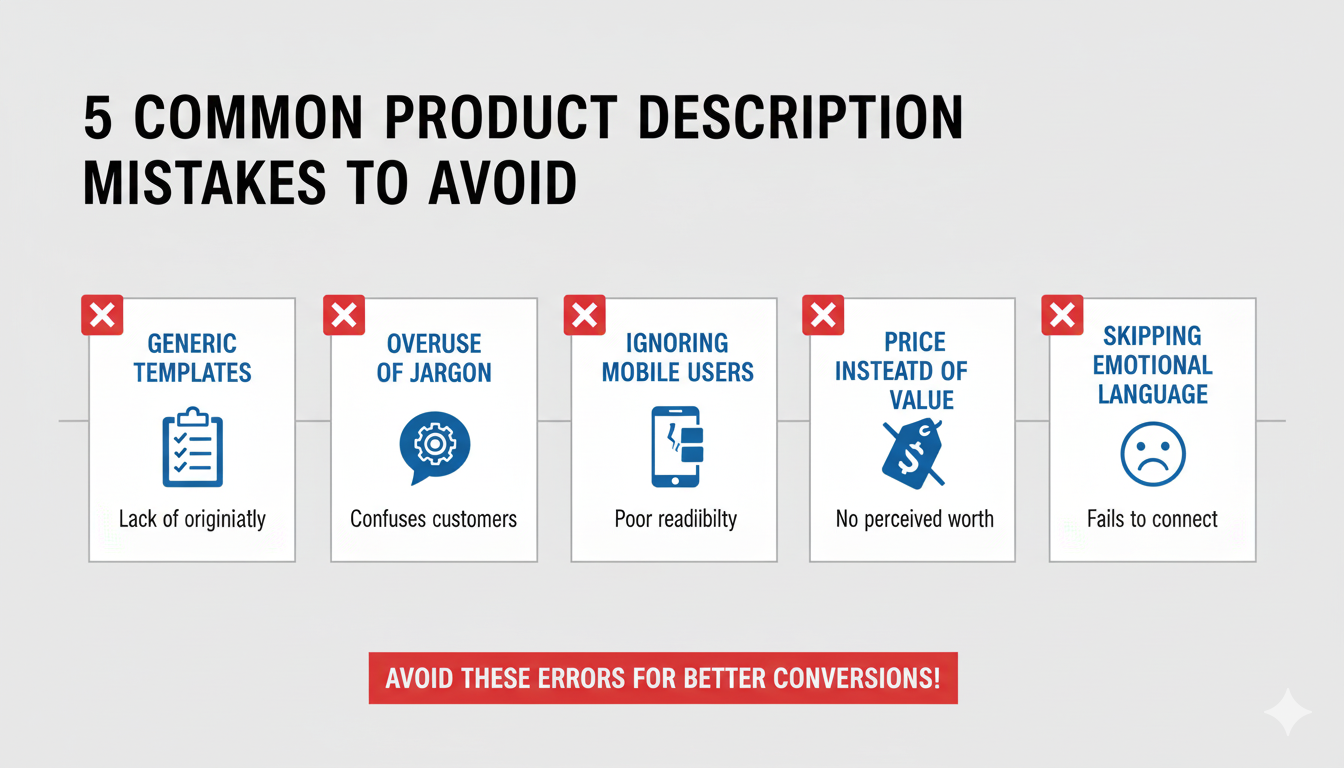
Generic Template Descriptions
Copying descriptions applicable to any similar product doesn’t make offerings stand out. Every product description should feel specifically written for that item and the purchasing audience, following product description best practices for online stores.
Without specific context, words like “high-quality” or “premium materials” don’t convey real value. Provide detailed information about construction, materials, and manufacturing processes demonstrating quality. This supports writing product descriptions that boost sales and creating high-converting product descriptions.
Overwhelming Technical Jargon
Technical accuracy matters, but excessive jargon alienates non-expert buyers. Translate technical benefits into everyday language, highlighting practical advantages. This represents a key persuasive product description aspect.
Give context for technical specifications when necessary. Instead of stating “500-thread count cotton,” explain that “500-thread count cotton provides perfect balance of breathability and luxurious softness improving with every wash.” This aligns with benefit-driven copywriting in product descriptions that sell.
Ignoring Mobile Experience
Many descriptions appearing effective on desktops become challenging to read on mobile devices. Test descriptions across various screen sizes, ensuring they remain mobile-friendly and easy to scan with engaging formats.
Mobile users often have limited attention spans. Front-load the most important benefits and use formatting techniques like bullet points, concise paragraphs, and clear headings. Create scannable product descriptions, reducing cart abandonment and improving overall engagement through conversion-focused product descriptions.
 Conclusion
Successful product descriptions that sell require a deep understanding of target audiences. Emphasis on meaningful benefits and content resonating with rational and emotional appeals creates high-converting product descriptions. Compelling descriptions enable consumers to visualize ownership and foster positive emotions regarding purchasing decisions—core principles of ownership visualization in e-commerce product copywriting.
Success demands continuous testing, refinement, and attentiveness to customer feedback. As e-commerce evolves, descriptions prioritizing user experience alongside optimizing product descriptions for SEO and conversions will consistently outperform generic template-driven alternatives. Writing product descriptions for online stores requires dedication to improvement and adaptation.
Recognize that compelling product descriptions serve not only to drive immediate sales but also to nurture lasting customer relationships. Consumers feeling informed and confident about purchases become repeat buyers and brand advocates, ensuring long-term e-commerce business success through benefit-focused product descriptions that convert.
This guide provides principles for enhancing the effectiveness and engagement of high-converting product descriptions. True success emerges when strategies are tailored to specific products, target audiences, and brand voices. Implement these persuasive product copy strategies systematically, evaluate impact for audiences, and refine approaches based on actual performance data supporting conversion optimization.
Ready to transform your product listings into product descriptions that sell and drive sales? At HiSellIt.com, we provide expert guidance and tools for writing product descriptions for online stores. We help create persuasive product descriptions that engage customers, reduce cart abandonment, and boost conversions through proven e-commerce product copywriting techniques. Start optimizing your benefit-driven product descriptions today and turn casual visitors into loyal buyers. Get started now at HiSellIt.com.
Frequently Asked Questions
Q. How long should product descriptions be for optimal conversions?
Product description length should match customer research needs rather than following arbitrary word counts. Complex or expensive products typically require longer descriptions (150-300 words) to address customer concerns and build confidence through high-converting product descriptions. Impulse-purchase or straightforward items often perform better with concise descriptions (50-100 words), quickly communicating key benefits. The key is providing enough information to overcome purchase hesitations without overwhelming customers with unnecessary details in product descriptions that sell.
Q. What’s the difference between features and benefits in product descriptions?
Features describe what products have or do (technical specifications, materials, dimensions) while benefits explain what those features mean for customer experiences (convenience, satisfaction, problem-solving). For example, “waterproof construction” is a feature, but “keeps belongings dry during unexpected rain showers” is the benefit. Compelling product descriptions that sell lead with benefits customers care about, then support those benefits with relevant features as proof points in persuasive product copy.
Q. Should I include pricing information in product descriptions?
Product descriptions that sell should focus on value demonstration rather than price justification, as pricing typically displays separately on e-commerce sites. Instead of focusing on cost, highlight the value customers derive from quality, durability, versatility, or unique benefits, justifying pricing. If addressing price-conscious customers, concentrate on cost-per-use calculations or long-term savings rather than defending upfront investments in high-converting product descriptions.
Q. How do I write descriptions for products with multiple variations?
Multi-variation products require descriptions highlighting common benefits while allowing specific differences between options. Focus main descriptions on shared features and benefits, then use variation-specific details (size, color, capacity), addressing discrepancies. Consider creating master description templates customizable for each variation while maintaining consistent messaging about core value propositions in conversion-focused product descriptions and e-commerce product copywriting.
Q. What role do customer reviews play in product description strategy?
Customer reviews provide valuable insights for improving product descriptions that sell by revealing which benefits resonate most strongly and which concerns need addressing. Monitor reviews identifying frequently mentioned benefits that should be emphasized in descriptions. Address common complaints or questions that descriptions should proactively handle. Reviews also provide authentic language customers use to describe products, which can be incorporated into descriptions for better relatability and SEO performance in high-converting product descriptions and persuasive product copy.