
Is Ecommerce Automation Legit or a Scam? A 2026 Buyer’s Guide
You’ve seen the ads. Some guy standing in front of a rented Lamborghini, telling you he made $50,000 last month while sipping drinks on a beach. “Fully automated ecommerce store. Zero work required.’ That’s usually the moment people pause. Because if it really worked like that, everyone would be doing it.
So naturally, you’re wondering: is ecommerce automation legit, or is this whole thing just another scam designed to take your money?
Here’s the reality. Ecommerce automation is real. Real businesses use it. Real money is made with it. But there are also plenty of scammers out there making promises they have no intention of keeping.
The problem is not the business model.
The problem is how it is sold.
This guide cuts through the marketing. It explains what ecommerce automation is, why it gets a bad name, where it works and where it fails, and how to spot red flags before making a costly decision.
Quick Answer:
Ecommerce automation is when a company handles the daily tasks of running an online store for you. They find products, process orders, manage inventory, and handle basic customer service. You own the store and fund it, but they do most of the work. When done right with realistic expectations, it can work. When sold as “passive income” with guaranteed returns, it’s usually a scam.
What Is Ecommerce Automation?
Think about running an online store. There’s a lot to do.
You need to find products that people actually want to buy. You need to list them with good descriptions and photos. When orders come in, you process them. You track inventory. You answer customer questions. You handle refunds when someone’s not happy.
None of this is complicated. But it takes time. Real-time.
Ecommerce automation means paying a company to do most of that work for you. They set up your store on platforms like Amazon, Shopify, or Etsy. They research products. They manage the day-to-day operations. They send you reports.
You still own the store. You still fund it. You still make the final calls on big decisions. But you’re not spending hours every day clicking buttons and answering emails.
Think of it like hiring a property manager for a rental house. The house is yours. The profit is yours. The risk is yours. But someone else collects the rent and fixes the toilet when it breaks.
That’s the basic idea.
So when people ask “is ecommerce automation legit?” – they’re really asking if this business model actually works or if it’s just marketing hype. The answer depends on understanding what automation can and can’t do.
What Parts of Ecommerce Can Be Automated?
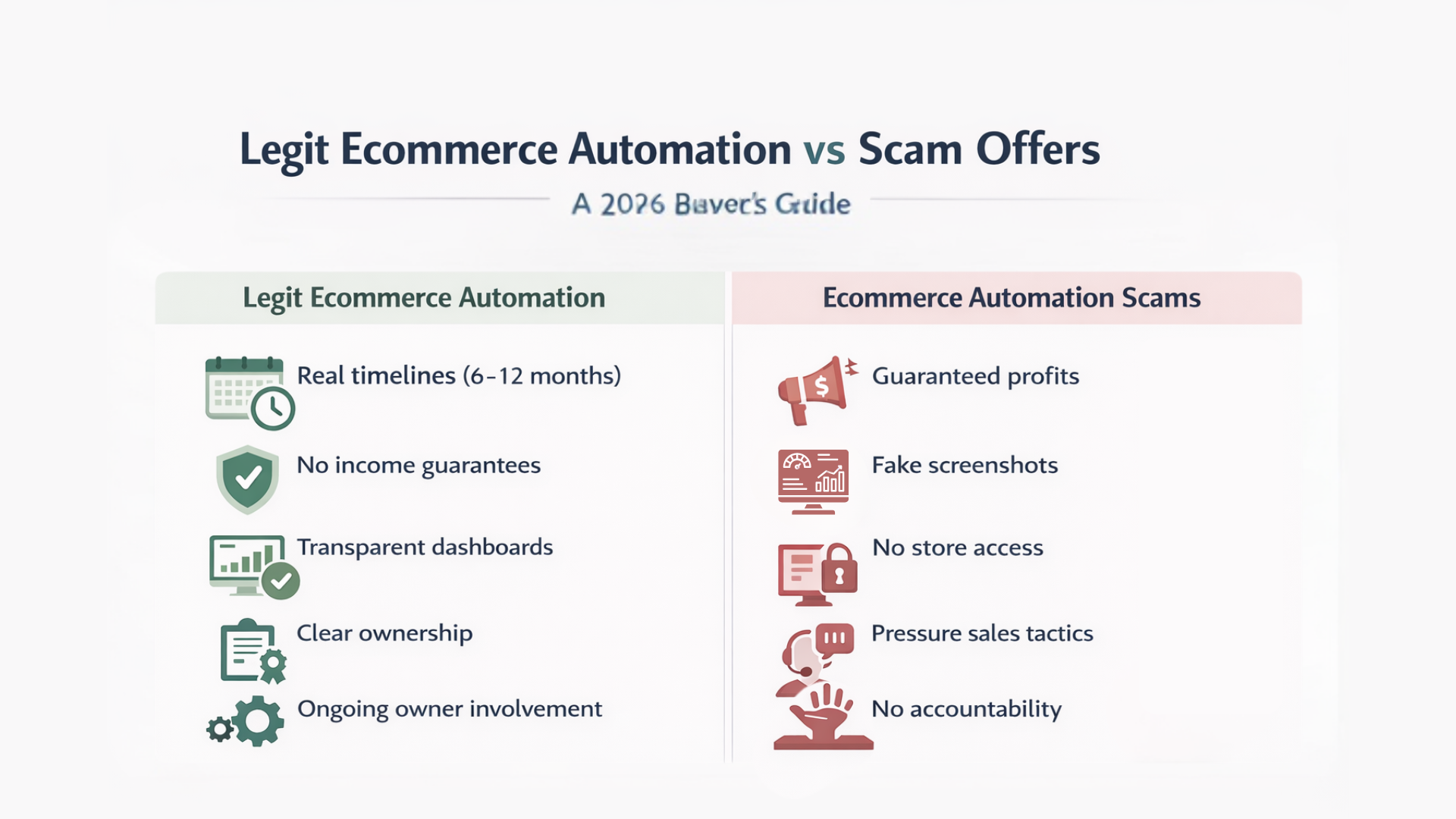
Here’s what most automation companies handle:
Product research – They look for items that are selling well and have decent profit margins. They check trends, competition, and pricing data to find opportunities.
Order fulfilment – When someone buys from your store, the automation company processes it. They coordinate with suppliers, track shipments, and update customers.
Inventory management – They keep track of what’s in stock and what’s running low. They update listings so you don’t accidentally sell something that’s out of stock.
Customer support – They answer basic questions, handle simple returns, and deal with routine issues. The complicated stuff usually still needs a human touch.
Listing optimization – They write product descriptions, upload photos, adjust prices, and try to get your products noticed by more buyers.
Performance tracking – They monitor sales, profit margins, and other numbers. Then they send you reports so you know how the store is doing.
Now here’s what usually doesn’t get automated, no matter what the sales pitch says:
Strategic decisions still need you. Compliance with platform rules needs oversight. Major customer complaints often need personal attention. And someone needs to watch the money to make sure things actually make sense.
According to Shopify’s ecommerce automation research, ecommerce automation reduces repetitive manual tasks and errors, helping businesses save time and cut operational burdens while focusing more on growth.
Is Ecommerce Automation Legit or a Scam?
Short answer: The model is legit. Some ecommerce automation companies offering it are legit. But plenty of scammers have figured out how to dress up garbage and sell it to hopeful people.
Here’s how to think about it.
Ecommerce automation, as a concept, works the same way as hiring an accountant. Accountants are real. Good ones exist. They save you time and help you make more money. But there are also terrible accountants who mess up your books and disappear when tax season hits.
The service is real. The results can be real. But the company you choose matters more than anything else.
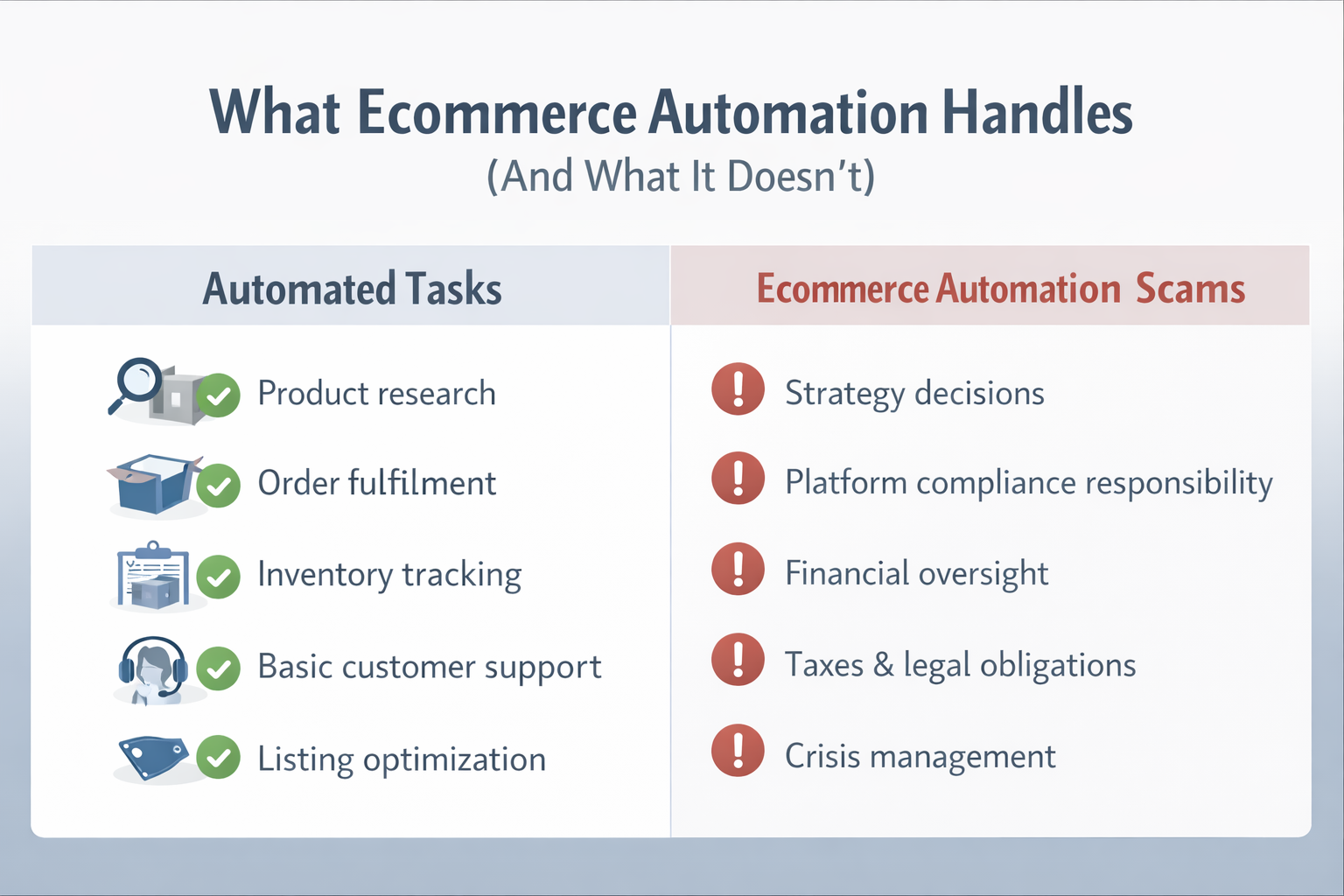
Legitimate ecommerce automation companies exist. They build real stores, find real products, make real sales, and send real profit to their clients. These companies are transparent about timelines, costs, and realistic expectations.
But scam companies also exist. They promise guaranteed income, show fake screenshots of earnings, rush you into contracts, and deliver nothing close to what they promised. Some take your setup fee and ghost you. Others build a store so poorly that it gets banned within weeks.
So when someone asks “is ecommerce automation legit?” – the answer is: it depends entirely on who you’re dealing with.
Why Ecommerce Automation Gets a Bad Reputation
The scammers ruined it for everyone else. Here’s how.
Misleading marketing – Videos showing luxury cars and beach houses. Claims of “an estimated $10K per month guaranteed.” Screenshots of sales that are either fake or belong to someone else’s store. This stuff preys on people who want quick money.
Unrealistic income promises – Nobody can guarantee you’ll make an estimated $5,000 next month from a brand new store. That’s not how ecommerce works. Sales depend on products, competition, timing, and variables nobody can control. Real companies know this. Scammers pretend they don’t.
Lack of transparency – Some companies won’t show you the actual store they’re building. They won’t give you access to the dashboard. They won’t explain their product selection process. That’s a huge red flag.
Hidden costs – The setup fee might be advertised at an estimated $5,000. But then there’s a monthly management fee. Plus ad spend. Plus inventory costs. Plus platform fees. Suddenly, you’re an estimated $15,000 deep and haven’t made a dollar yet.
No real support – They built your store and collected your money. Now, when you have questions or problems, they take three weeks to respond with a copy-paste answer that doesn’t help.
This is why people search for “is ecommerce automation legit” and “ecommerce automation scam” before signing up. The question isn’t new – it’s been asked thousands of times because the bad actors created that reputation.
But here’s the thing – plenty of industries have scammers. Real estate investing has scammers. Stock trading education has scammers. Franchise opportunities have scammers. That doesn’t make the underlying business model fake.
You just need to know what you’re looking at.
The Real Risks of Ecommerce Automation
Even with a legitimate company, ecommerce automation comes with risks. Real ones.
Understanding these ecommerce automation risks matters whether you’re working with a top-tier company or considering a budget option.
Here’s what can actually go wrong.
Common Reasons Ecommerce Automation Fails
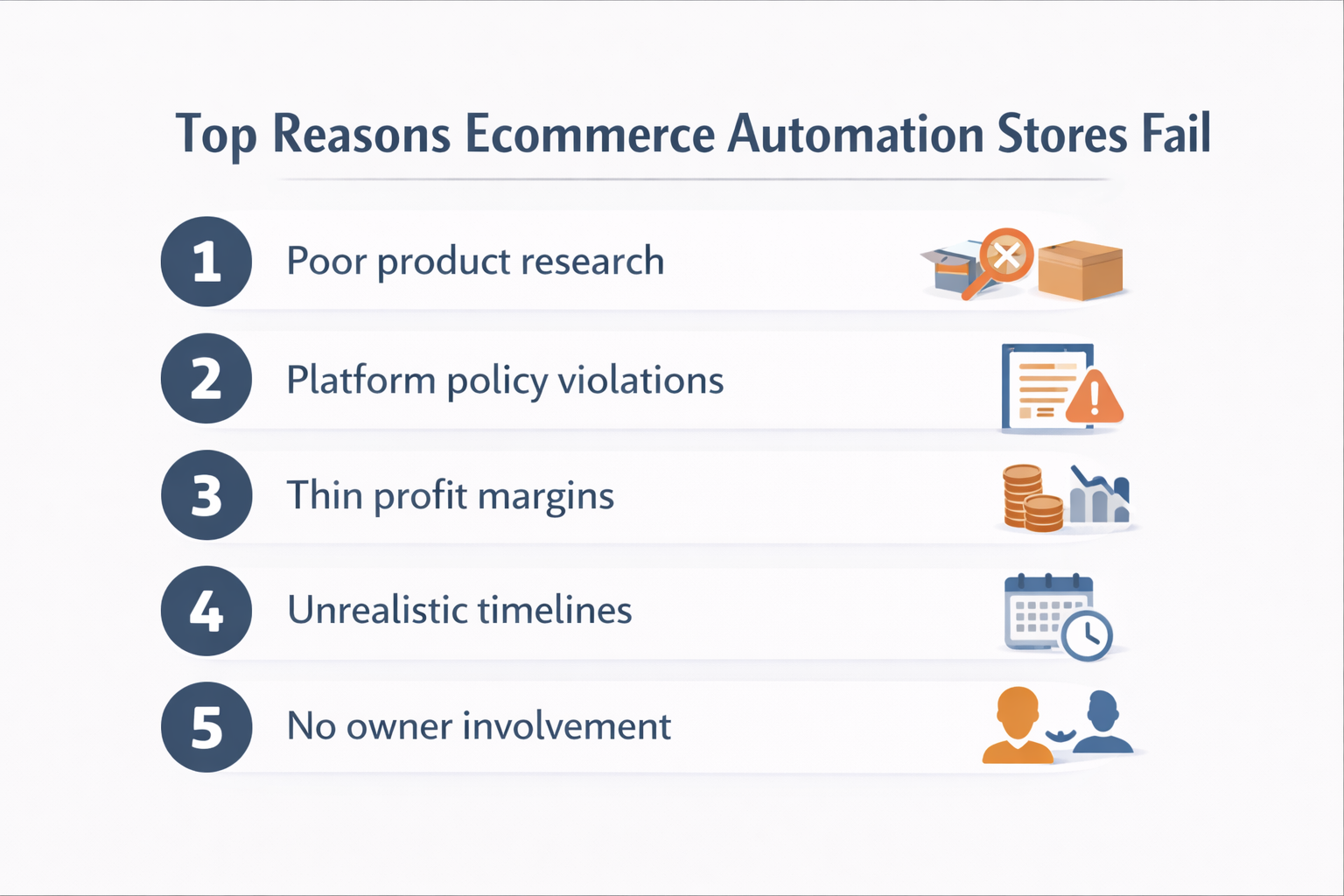
Poor product research – This is the biggest killer. The company picks products that look good on paper but don’t actually sell. Maybe the competition is too fierce. Maybe the margins are too thin. Maybe the trend already passed. Bad product choices sink stores fast.
Platform policy violations – Amazon has rules. Etsy has rules. Shopify, connected to certain sales channels, has rules. If your automation company doesn’t know these rules or doesn’t follow them, your account gets suspended. Sometimes permanently.
Razor-thin profit margins – A product sells for an estimated $30. It costs an estimated $18 to buy and ship. Amazon takes an estimated $6 fee. Advertising costs an estimated $4 per sale. You’re left with an estimated $2 profit. Then you pay your automation company. Suddenly, you’re losing money on every sale.
Zero owner involvement – Some people think “automated” means they never have to look at the store. Wrong. Even with a management company, you need to check in, review numbers, and make decisions. Stores that get completely ignored tend to drift into problems.
Unrealistic timeline expectations – People expect profit in month one. That’s almost never how it works. Most stores take an estimated 3-6 months to start seeing consistent sales. Many people give up before that happens.
Cash flow problems – You need money for inventory, ads, fees, and management costs before you see sales. If you run out of cash in month three, the store dies even if it was starting to work.
This is part of why manual selling no longer scales for most busy professionals – automation helps, but only if it’s done right with realistic expectations and proper capital.
Platform Rules That Can Shut Stores Down
The platforms where automated stores operate have strict rules. Break them, and you’re done.
Account health scores – Amazon tracks how well you handle orders. Late shipments hurt you. Order defects hurt you. Too many customer complaints, and they suspend your account. Your automation company needs to stay on top of this constantly.
Refund and chargeback rates – If too many customers ask for refunds or dispute charges, platforms assume something’s wrong with your store. High rates trigger investigations and possible bans.
Intellectual property violations – Selling products that use trademarked names or copyrighted images without permission gets you banned fast. Some automation companies cut corners here, and their clients pay the price.
Restricted product categories – Certain items require approval to sell. Some automation companies list restricted products anyway, hoping to slip through. When the platform catches it, your store goes down.
Fake reviews or manipulation – Trying to game the system with fake positive reviews or attacking competitors violates every platform’s terms. Automation companies that do this eventually get caught.
Multiple account violations – Running more than one store on the same platform usually violates the rules unless you have explicit approval. Some shady companies try it anyway.
Platform policy violations are a common reason automated stores fail. According to Forbes’ analysis of ecommerce business failures, compliance issues and poor operational oversight account for a significant portion of shutdowns in the first year.
The bottom line: your automation company needs to know platform rules inside and out. If they don’t, you’re the one who loses the account.
These ecommerce automation risks are exactly why the question “is ecommerce automation legit?” gets asked so often. The model itself works, but the risks are real, and the company you choose makes all the difference.
 How Ecommerce Automation Services Actually Work
Getting into the nuts and bolts now. What do these ecommerce automation services actually do?
Most legitimate companies follow a similar process. The details vary, but the basic structure looks like this:
Initial consultation – They talk to you about goals, budget, and timeline. They explain their process. Good companies ask questions about your risk tolerance and involvement level. Bad companies just push you to sign a contract.
Store setup – They create accounts on the platforms you’re targeting (Amazon, Shopify, Etsy, etc.). They handle the technical setup, payment processing connections, and basic branding.
Product research and selection – This is where the real work starts. They analyze market data to find products with decent demand and reasonable competition. They calculate potential profit margins, including all fees and costs.
Listing creation – They create product listings with descriptions, photos, pricing, and keywords designed to get found by buyers.
Inventory and fulfillment setup – They connect to suppliers or set up FBA (Fulfillment by Amazon) so orders get processed without you physically handling products.
Ongoing management – They monitor sales, adjust prices, update inventory, handle customer questions, and try to optimize performance.
Reporting – They send regular reports showing sales, expenses, profit, and other key numbers.
For a detailed breakdown of what this actually costs, check out this Amazon FBA automation cost breakdown.
What Is Usually Included in Automation Services
Here’s what you can typically expect from a real automation company:
- Store setup and configuration on your chosen platform
- Product research and selection based on data analysis
- Professional product listings with optimized descriptions
- Supplier sourcing and relationship management
- Order processing and fulfillment coordination
- Inventory tracking and restocking
- Basic customer service for routine questions
- Performance monitoring and adjustments
- Monthly or weekly reporting on sales and profitability
- Platform compliance monitoring
- Pricing adjustments based on competition
Different companies include different services. Some charge extra for advertising management. Some include it. Some handle returns in-house. Others train you to handle them. Make sure you know exactly what you’re getting before you sign anything.
What Is NOT Fully Automated
Here’s the part the sales pitches conveniently skip.
Strategic decisions – Choosing which products to add or remove from your catalog. Deciding whether to expand to new platforms. Figuring out if you should invest more money or pull back. These calls usually need your input.
Platform policy compliance – While good companies monitor this, you’re ultimately responsible for your account. You need to understand the rules and make sure your team follows them.
Complicated customer issues – When a customer files a serious complaint or threatens legal action or wants something unusual, that usually needs personal attention. Most automation companies handle routine stuff but escalate the messy situations.
Financial oversight – You need to watch the money. Check that expenses match what you agreed to. Verify that profit numbers make sense. Make sure you’re not slowly bleeding cash.
Tax and legal obligations – Your automation company isn’t your accountant or lawyer. You’re responsible for taxes, business licenses, and legal compliance in your area.
Crisis management – If your store gets suspended, or a supplier vanishes, or a product gets recalled, you need to be involved in solving it. The automation company helps, but you own the problem.
This is where a lot of people get disappointed. They thought “automation” meant they’d never think about the business. That’s not realistic.
Think of it more like having a general manager for a small business. They run day-to-day operations, but you’re still the owner. You still need to know what’s happening.
How Much Does Ecommerce Automation Cost in 2026?
Talk money now. Real numbers.
Ecommerce automation isn’t cheap. If someone’s offering to build and run your store for an estimated $500, run away.
Typical Cost Ranges (Setup + Ongoing)
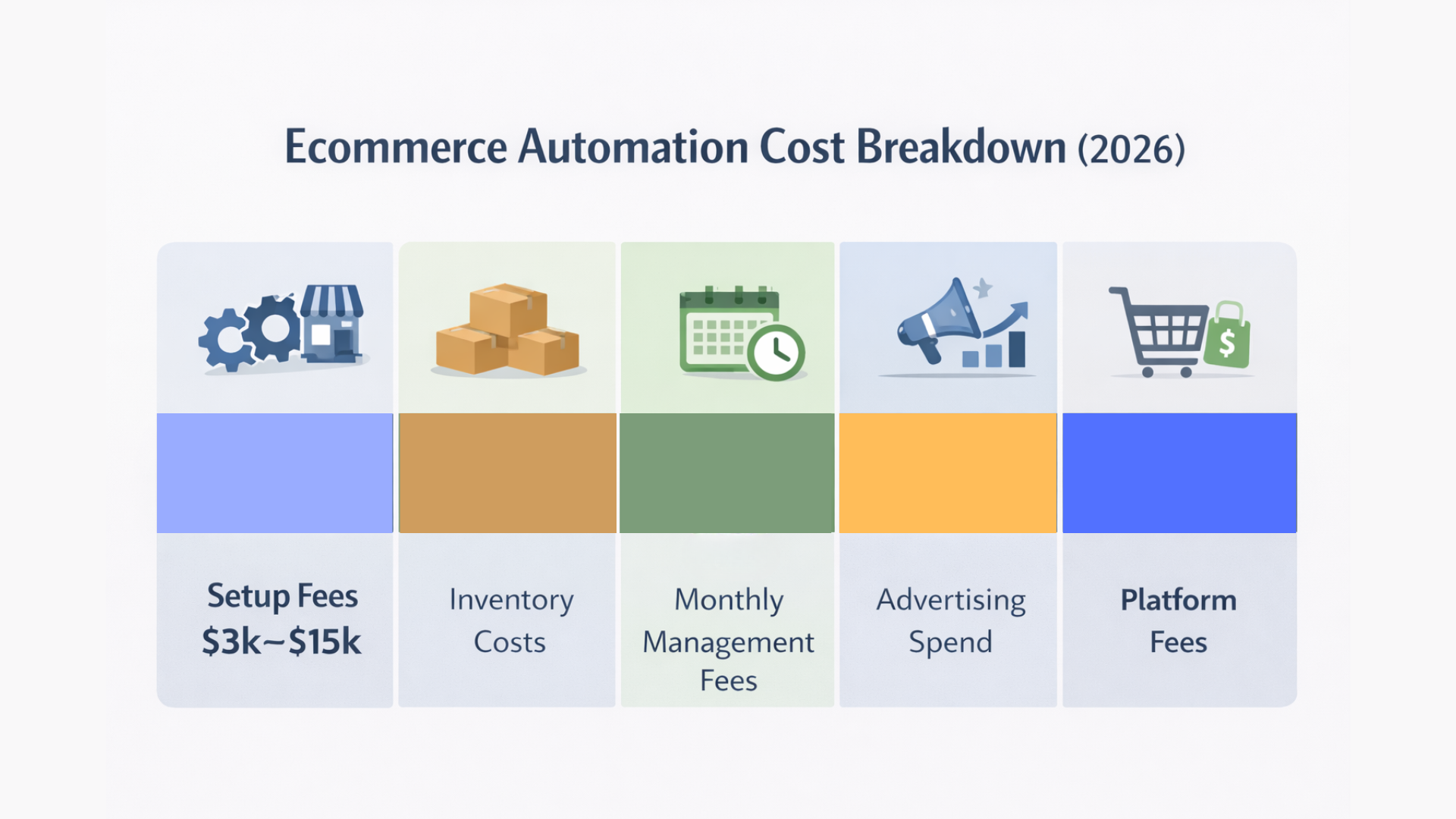
Setup fees – Most legitimate companies charge an estimated $3,000 to $15,000 to build your store. This covers account setup, initial product research, listing creation, and getting everything live.
The wide range depends on the platform, number of products, and level of customization. Amazon FBA automation tends to be on the higher end. Shopify dropshipping is usually cheaper to start.
Monthly management fees – Expect an estimated $300 to $2,000 per month for ongoing management. This covers product research, listing optimization, inventory management, customer service, and reporting.
Some companies charge flat monthly fees. Others charge a percentage of sales (usually an estimated 10-20%). Some use a hybrid model.
Performance-based fees – Some companies take a cut of profit instead of charging monthly fees. This sounds great but read the fine print. Make sure they’re taking a percentage of profit, not revenue. Big difference.
Inventory and product costs – This isn’t paid to the automation company, but you need capital to buy inventory. Depending on the model, you might need an estimated $2,000 to $20,000+ just to stock products.
Advertising spend – Most stores need advertising to get initial traction. Budget at least an estimated $500-$1,500 per month for ads, especially in the first few months.
Platform fees – Amazon charges referral fees (an estimated 8-15% of each sale) plus FBA fees if you use their fulfillment. Shopify charges monthly subscription fees. Etsy takes transaction fees. Factor these in.
Total startup cost – Realistically, you need an estimated $10,000 to $30,000 to properly launch an automated ecommerce store with a decent chance of success.
Some companies advertise lower numbers, but when you add inventory, ads, and unexpected costs, you’ll hit this range.
When Ecommerce Automation Can Be Worth It
So when does spending this money actually make sense?
You have the capital to sustain losses for an estimated 6-12 months – Most stores don’t profit immediately. If you need your money back in 90 days, this isn’t for you.
You value time over money – If you make an estimated $150/hour at your day job and ecommerce tasks would take an estimated 20 hours per week, paying someone an estimated $800/month to handle it might make financial sense.
You’re building for 2-5 year returns – This is more like real estate investing than day trading. People who think long-term tend to do better.
You have realistic profit expectations – If you’re happy with an estimated 15-25% annual return on your investment, automation can work. If you need to double your money in six months, you’ll be disappointed.
You stay involved enough to catch problems – Checking in weekly, reviewing numbers, and making strategic decisions when needed. Not obsessing daily, but not completely absent either.
You pick a company with proven systems – Working with established automation services that have actual client results and transparent processes dramatically improves your odds.
Most automated stores see break-even between an estimated 8-14 months, with profitability ramping up after that point. According to Harvard Business Review’s research on ecommerce profitability, sustainable profit margins typically develop after the initial setup and testing phase.
For people wondering “is ecommerce automation legit?” – the answer becomes yes when these conditions are met and you’re working with a transparent company.
The math needs to work. If you invest an estimated $20,000 total and expect an estimated $500/month profit after year one, you’re looking at an estimated 30% annual return once you’re profitable. That’s solid. But it’s not “quit your job” money.
Who Ecommerce Automation Is (and Isn’t) For
Not everyone should do this. Seriously.
Here’s who this works for and who should look elsewhere.
Good Fit Profiles
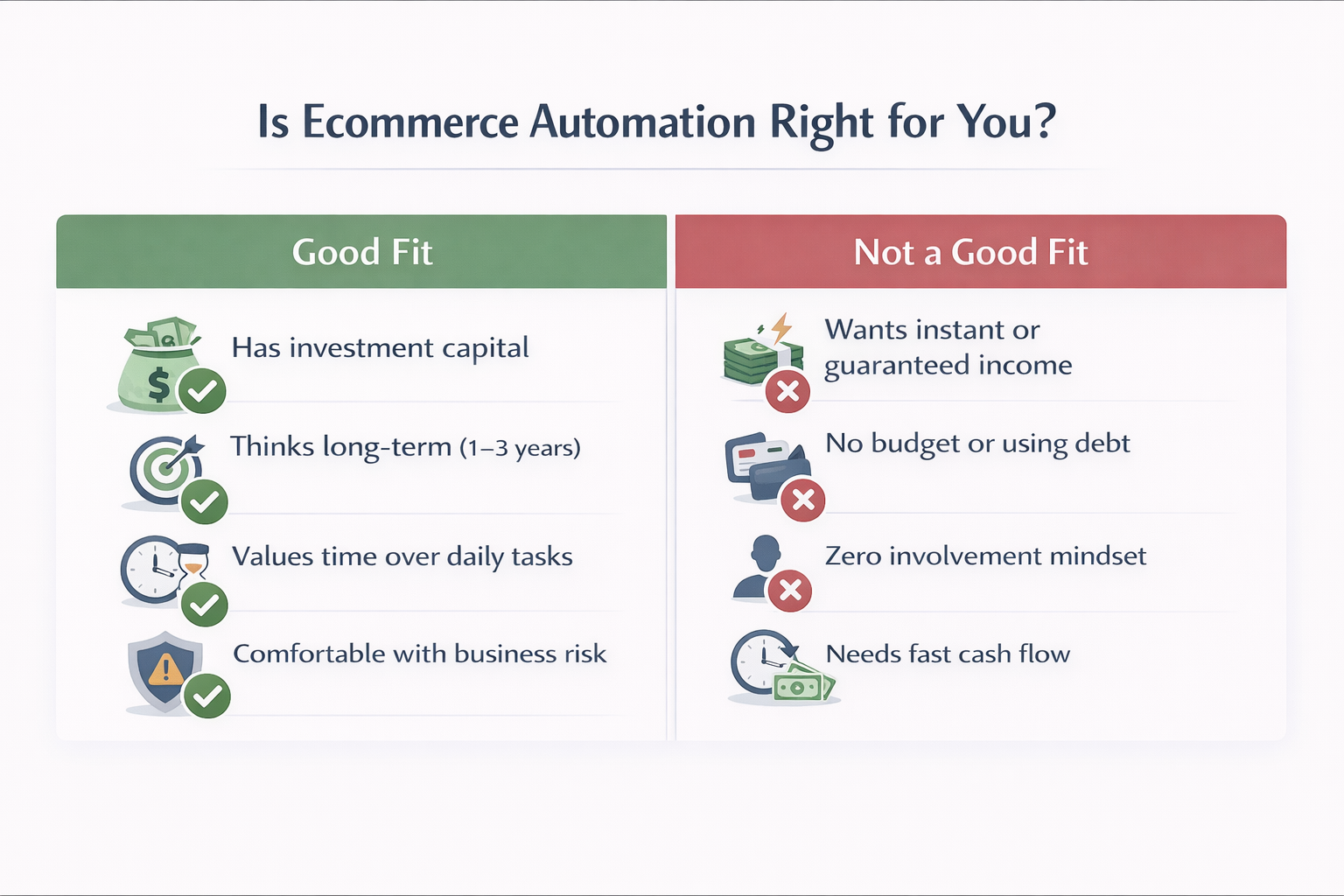
Busy professionals with capital – Doctors, lawyers, tech workers, executives who make good money but have zero time. They can fund a store and want someone else to handle operations. This is probably the best fit.
Long-term investors – People who think about ecommerce like buying rental property. They’re okay waiting a year for ROI. They want diversification. They’re not looking for quick cash.
Process-driven people – Folks who understand systems, trust data, and can evaluate performance objectively. They review reports, ask good questions, and make informed decisions.
People with realistic expectations – They know this isn’t passive income. They understand risk. They’ve done research. They’re prepared for the actual reality, not the fantasy version.
Entrepreneurs scaling existing businesses – Business owners who want to add an ecommerce channel but don’t have bandwidth to learn it themselves. They already understand business fundamentals.
People who can handle losses – If losing an estimated $15,000 would devastate you financially, don’t do this. Period. Only invest money you can genuinely afford to lose.
For more on how automation fits into broader ecommerce strategies, this Etsy sales funnel automation guide shows how different platforms work.
Bad Fit Profiles
Passive income seekers – If you want money with zero work, this isn’t it. The marketing might say “passive,” but successful automated stores require attention.
Zero-budget starters – Don’t put this on credit cards. Don’t use your emergency fund. Don’t borrow money to start an automated ecommerce store. The risk is too high.
Get-rich-quick mentality – If you need money next month for bills, this is the wrong move. It takes time to build and scale.
People who can’t handle uncertainty – Ecommerce has ups and downs. Sales fluctuate. Platforms change rules. Suppliers have issues. If uncertainty stresses you out, this will make you miserable.
Those who want complete control – If you need to approve every product, review every customer message, and second-guess every decision your team makes, automation will frustrate you. You’re better off doing it yourself.
Anyone who can’t verify the company – If you can’t find real reviews, real client testimonials, or real evidence the company is legitimate, don’t sign up. Period.
Be honest with yourself. There’s no shame in realizing this isn’t a good fit. Better to know now than an estimated $20,000 later.
How to Spot Ecommerce Automation Scams
Red flags time. Here’s how to tell if a company is legit or trying to take your money.
Avoiding an ecommerce automation scam starts with knowing what to look for before you sign anything.
Red Flags Before Hiring a Company
Guaranteed profit promises – “We guarantee an estimated $5,000 profit per month.” Nobody can guarantee this. Sales depend on products, market conditions, competition, and timing. Companies that promise specific income are lying.
Pressure tactics – “This deal expires tonight.” “Only 3 spots left this month.” “Sign now or miss out.” Legitimate companies don’t need to pressure you. Scammers do.
No access to your own store – They won’t give you admin access to the account. They won’t show you the dashboard. They want complete control with zero transparency. Massive red flag.
Vague about what they actually do – Ask specific questions about product research methods, supplier relationships, and management processes. If they give fuzzy non-answers, they probably don’t know what they’re doing.
No clear ownership terms – Who owns the store? Who owns the products? What happens if you want to stop working with them? If this isn’t crystal clear in writing, walk away.
Upfront payment with nothing to show – They want an estimated $10,000 before building anything. They won’t show you examples. They won’t explain the timeline. They just want money first. Classic scam move.
No verifiable reviews or testimonials – You can’t find real people who used their service. The testimonials are stock photos or obviously fake. No legitimate online presence exists.
No customer support – Try contacting them with questions before signing up. If they take days to respond or dodge your questions, imagine how bad it’ll be after you pay them.
Unrealistic timelines – “You’ll be profitable in 30 days.” Unless you’re selling a product that already has huge demand and zero competition (spoiler: you’re not), this timeline is garbage.
Before signing anything, check reviews independently. Search “[company name] + scam” and “[company name] + reviews” on Google. Look for patterns in complaints. The difference between a legitimate service and an ecommerce automation scam often shows up in third-party reviews.
What Legit Companies Do Differently
Real, professional ecommerce automation companies operate differently. Here’s what to look for:
Clear, realistic projections – They’ll say something like “Most stores break even between an estimated 8-12 months, with profitability growing after that.” They talk about ranges and variables, not guarantees.
Full transparency – You get complete access to your store dashboard, sales data, and financial reports. They walk you through how to check everything yourself.
Detailed service agreements – Everything is in writing. Services included, costs, timelines, ownership terms, exit clauses. No verbal promises that aren’t documented.
Proven track record – They can show real client results (with permission). They’ve been in business for years, not months. They have verifiable history.
Education and communication – They explain what they’re doing and why. They answer questions patiently. They want you to understand the business, not stay confused.
Reasonable contract terms – You can exit the relationship if things aren’t working. There’s a clear process. You’re not locked in forever with no recourse.
Third-party verified reviews – Real reviews on Google, Trustpilot, Better Business Bureau, or industry forums. Not just testimonials on their own website.
Specific expertise – They specialize in certain platforms or product types. They know the rules, the processes, and the pitfalls. Generalists who claim to do everything are usually good at nothing.
Ongoing support – Regular check-ins, performance reviews, and strategy discussions. They act like partners, not vendors who disappear after setup.
If you’re serious about this, talk to at least 3-5 companies. Compare their approaches. Ask hard questions. See who gives straight answers.
And if something feels off, trust that feeling. There are enough legitimate ecommerce automation services like HiSellIt out there that you don’t need to settle for a sketchy one. Companies that provide transparent automation services focus on realistic timelines, clear ownership, and ongoing support.
Final Thoughts
So is ecommerce automation legit? That’s the question this entire guide has been answering.
Yes – when done with the right company, realistic expectations, adequate capital, and ongoing involvement. It’s a real business model that can generate real returns for the right people.
But it’s also an industry full of scammers who’ve ruined the reputation with fake promises and terrible service.
The model works. The question is whether you’re working with someone legitimate, whether you have the capital to do it right, and whether you’re prepared for the reality instead of the fantasy.
Do your homework. Ask hard questions. Verify everything. And if someone promises you a guaranteed income with zero work, laugh and walk away.
If you want to discuss your specific situation before making any commitments, reach out with questions to get clarity on whether this model fits your goals.
Frequently Asked Questions
Q. Is ecommerce automation a scam?
No, ecommerce automation itself is not a scam. It’s a legitimate business model where companies manage online stores on behalf of owners. However, many scam companies use misleading marketing and false promises to take advantage of people.
The confusion comes from how aggressively scammers market in this space. They promise guaranteed income, show fake results, and deliver nothing valuable. But legitimate ecommerce automation services exist and do provide real value for the right clients.
Q. Can ecommerce automation really make money?
Yes, but with realistic expectations. Properly managed automated stores can generate profit, typically showing returns after an estimated 8-14 months of operation. Most successful stores earn an estimated 15-30% annual returns on investment once established.
The money comes from consistent sales of products with decent margins, managed efficiently over time. It’s more similar to investing in a small business than any “passive income” scheme.
Q. How long does it take to see ROI from ecommerce automation?
Most stores break even between an estimated 8-14 months, with profitability increasing after that point. The first estimated 3-6 months usually involve setup, testing, and optimization with minimal or negative returns.
This timeline assumes adequate capital for inventory, advertising, and management fees during the setup phase. Stores that run out of cash before month 6 rarely make it to profitability.
Can automated ecommerce stores fail?
Absolutely. Common failure points include poor product selection, platform policy violations, inadequate capital, razor-thin margins, and unrealistic owner expectations.
Success requires the right products, proper management, sufficient funding, platform compliance, and owner involvement in key decisions. Stores that fail usually have problems in one or more of these areas.
Q. Is ecommerce automation good for beginners?
Generally, no, unless the beginner has significant capital and can afford to lose their investment while learning. Ecommerce automation works better for people who understand basic business concepts and can evaluate performance data.
Complete beginners often have unrealistic expectations about timelines and effort required. They’re also more vulnerable to scam companies because they don’t know what questions to ask.
Q. What’s the minimum budget needed for ecommerce automation?
Realistically, an estimated $10,000- $30,000 to get started properly. This covers setup fees (an estimated $3,000-$15,000), initial inventory (an estimated $2,000-$10,000), advertising budget (an estimated $1,500-$5,000 for the first few months), and a cash reserve for unexpected costs.
Some companies advertise lower entry points, but when you factor in all real costs, you’ll hit this range. Trying to do it cheaper usually means cutting corners that hurt success chances.