
Is YouTube Automation Saturated in 2026? Honest, Data-Backed Answer
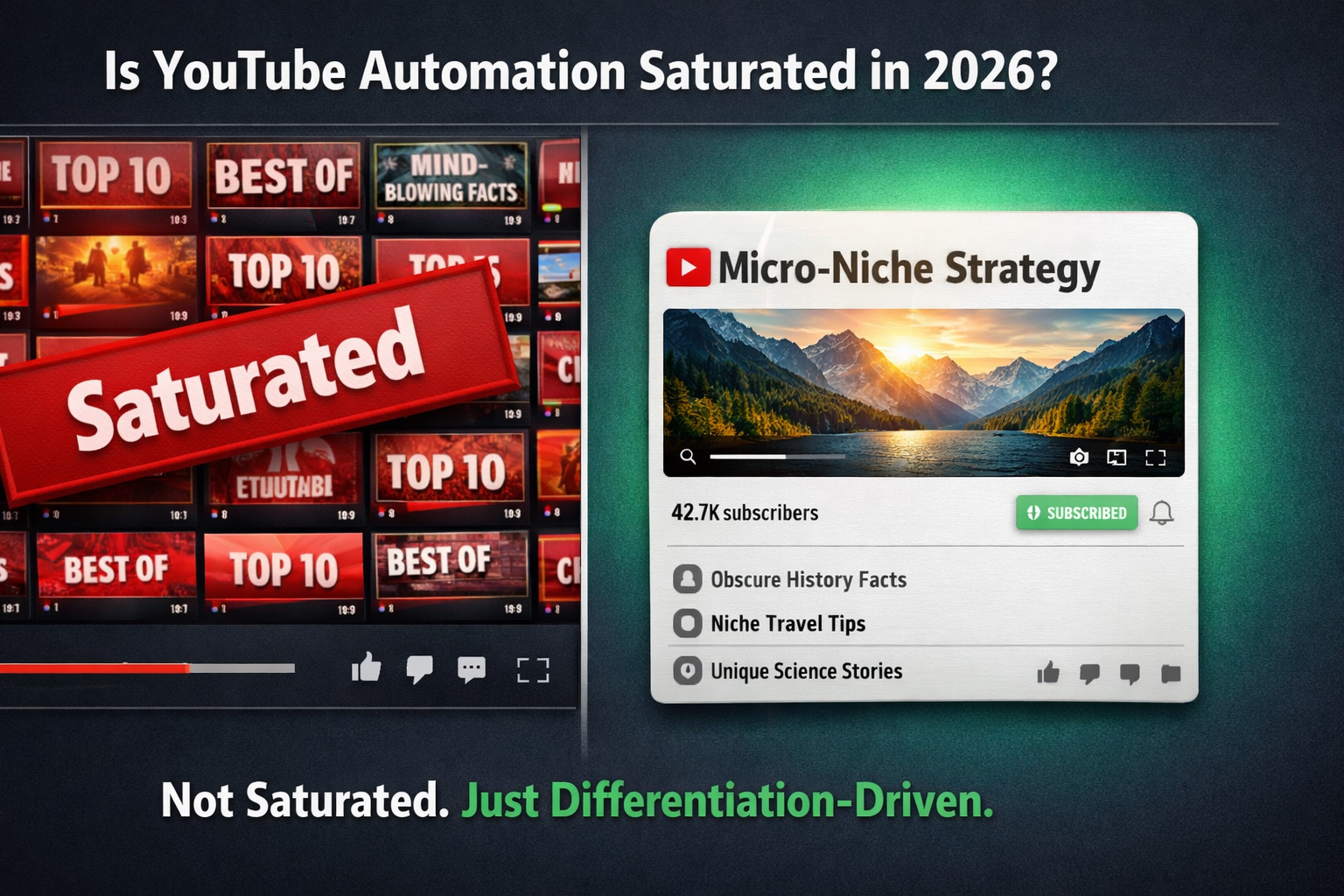
Is YouTube automation saturated in 2026? No, not as a business model. What’s saturated are the copy-paste niches everyone piled into after seeing someone else’s income screenshot. Generic crypto news, motivational quote pages, mass-market finance content, those lanes are genuinely overcrowded. But channels built around a specific micro-niche, real research, and strong content differentiation are still growing and still hitting the monetization threshold. The model works. The lazy version of it doesn’t.
This question comes up constantly, and it’s easy to understand why.
Start researching YouTube automation, and within five minutes, there are faceless channels everywhere. Same thumbnails. Same AI voice. Same “five tips to build wealth” script with stock footage of piggy banks and rising graphs. It looks saturated. It feels like everything’s already been done.
But here’s what becomes clear after spending real time in this space: asking whether YouTube automation is saturated is the wrong question entirely. The real question is whether a specific YouTube automation niche or execution model is saturated.
According to Statista, there are over 100 million active channels on YouTube. That number sounds terrifying until you realize the vast majority are inactive, abandoned, or producing content that’s completely interchangeable with everything else. Is YouTube automation still profitable for people doing it strategically? Yes. The channels growing in 2026 prove it.
What changed is that “doing it strategically” now actually means something. Real thought, real research, real positioning, not just a freelancer, a script template, and a hope.
What “Saturated” Actually Means on YouTube
People throw around “saturated” like it just means “competitive.” Those aren’t the same thing.
Think about it this way. Five burger places open on the same street. They all do fine; there are enough hungry people to go around. Then thirty more open, same menu, same price, same vibe. Nobody makes money anymore. Customers get spread so thin that even the best locations struggle.
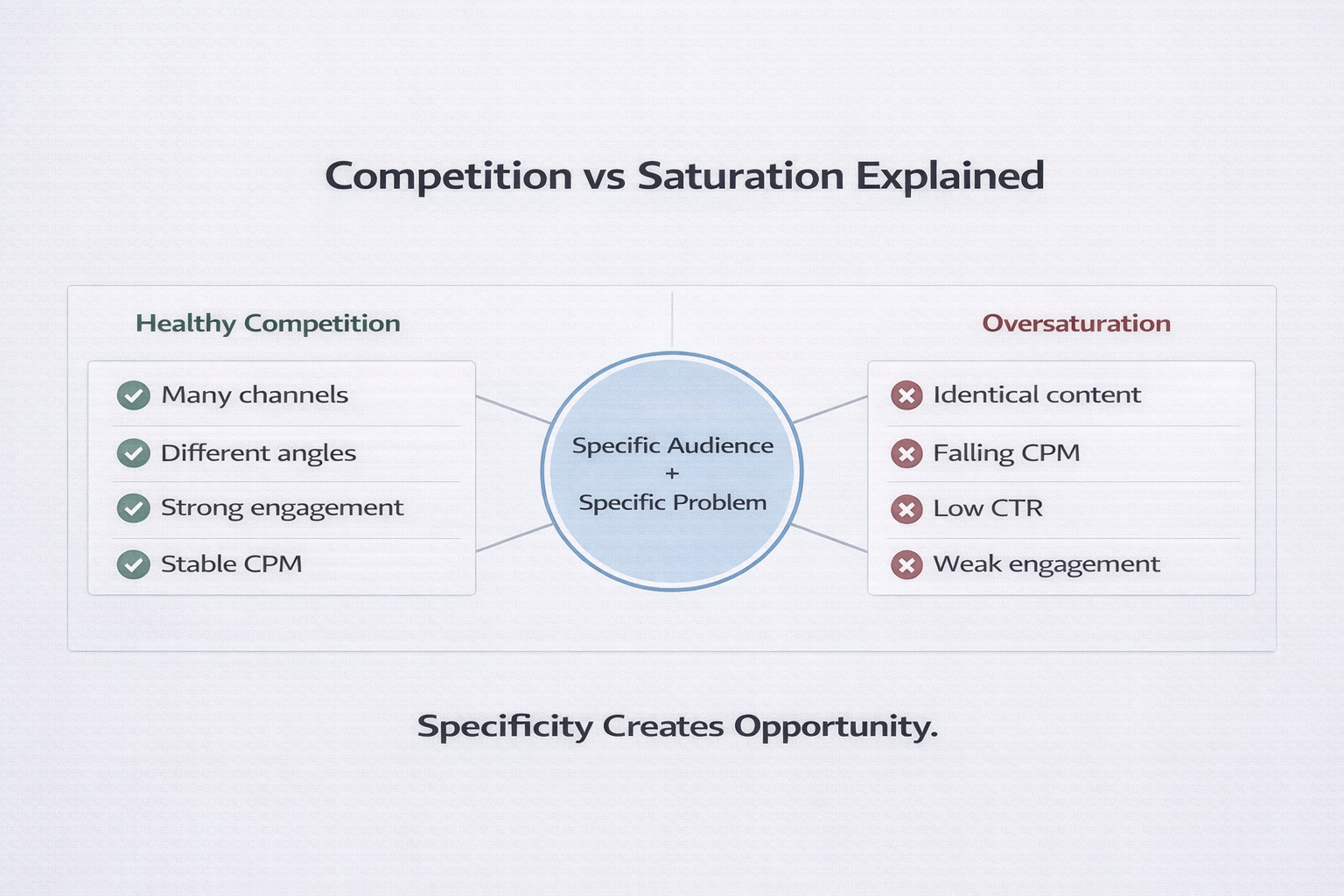
That’s saturation. Not competition. Not a lot of channels. It’s specifically when supply crushes demand and nobody is offering anything meaningfully different.
| Scenario | What It Actually Means |
| Many channels, different angles | Healthy competition — real room to win |
| Many channels, identical content | Oversaturation — very hard to survive |
| High search demand, few quality videos | Genuine opportunity — move on it |
| Low demand, hundreds of recent uploads | Dead niche — skip it completely |
The YouTube algorithm doesn’t punish channels for being in a competitive space. It punishes channels for being replaceable. Huge difference.
Google’s helpful content guidelines spell this out directly: content that doesn’t add new value struggles to surface. That applies to YouTube just as much as Search. The recommendation system is built to push what’s distinct, not just what’s optimized.
So when people say “all YouTube automation niches 2026 are dead”, what they really mean is the lazy, templated version of those niches is dead. And that was always bad content anyway.
Understanding how the YouTube algorithm evaluates retention, click-through rate, and watch time makes a significant difference before launching anything. This breakdown of how the YouTube SEO ranking guide explains what actually moves distribution beyond just uploading more often.
Why 2026 Feels Different From Before
Something genuinely shifted, and not enough people are being honest about what it actually is.
It’s not just “more competition.” A few specific things changed the environment in ways that matter when deciding whether to start or scale a channel right now.
The YouTube algorithm got much better at spotting copycats
The recommendation system processes millions of uploads every single day. It’s gotten very good at recognizing when a video is essentially a remix of something that already performs well. If a video is the fifteenth version of “5 Ways to Make Passive Income”, same structure, same talking points, same stock footage, the system effectively asks: does this add anything new? If the answer is no, it doesn’t get pushed. High production quality alone won’t save it. Perfect keyword optimization won’t save it. The content itself needs to be distinct.
Viewer fatigue is real and measurable
People have watched two or three versions of the same video enough times that they’ve developed instant pattern recognition. They know within the first ten seconds if they’re about to watch something they’ve basically already seen. When that happens, they leave. Watch time drops, audience retention tanks, YouTube pulls back distribution, and it becomes a cycle that’s very hard to recover from.
What used to take a year to saturate now takes about three months.
This is the part that catches people completely off guard. Barriers to entry keep dropping, AI tools are cheaper, outsourcing is more accessible, and the standard automation playbook has been taught to hundreds of thousands of people. When a niche becomes visibly profitable, it floods faster than it ever did before.
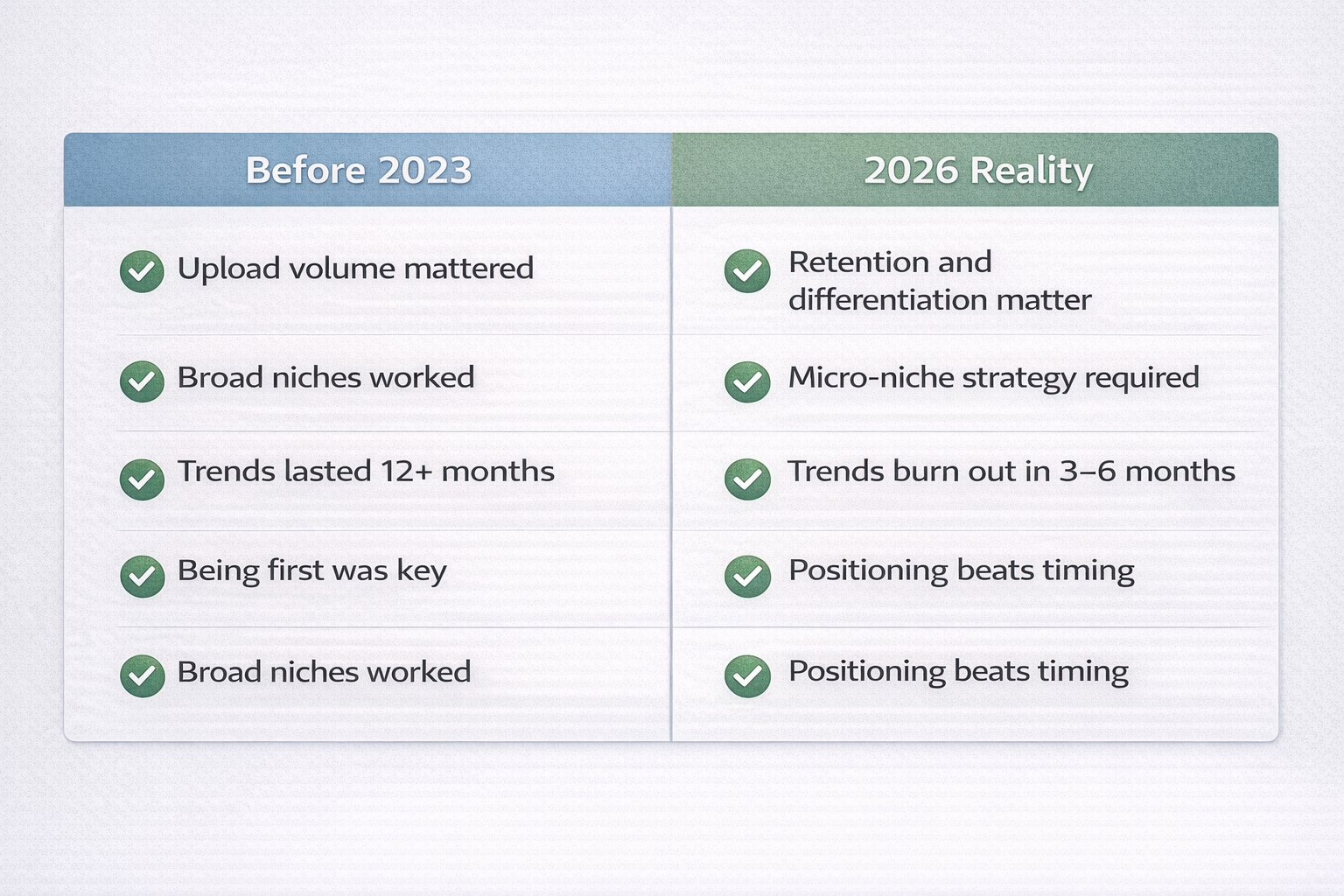
| Before 2023 | Reality in 2026 |
| Upload volume was the main lever | Retention and differentiation move the needle |
| Broad niches had room for everyone | Micro-niche strategy is no longer optional |
| Trends held for 12+ months | Most trend-based niches burn out in 3–6 months |
| Being first was the biggest advantage | Positioning matters more than timing |
This is why so many people feel like the YouTube automation competition has become impossible. The model isn’t broken. The pace around it just accelerated dramatically.
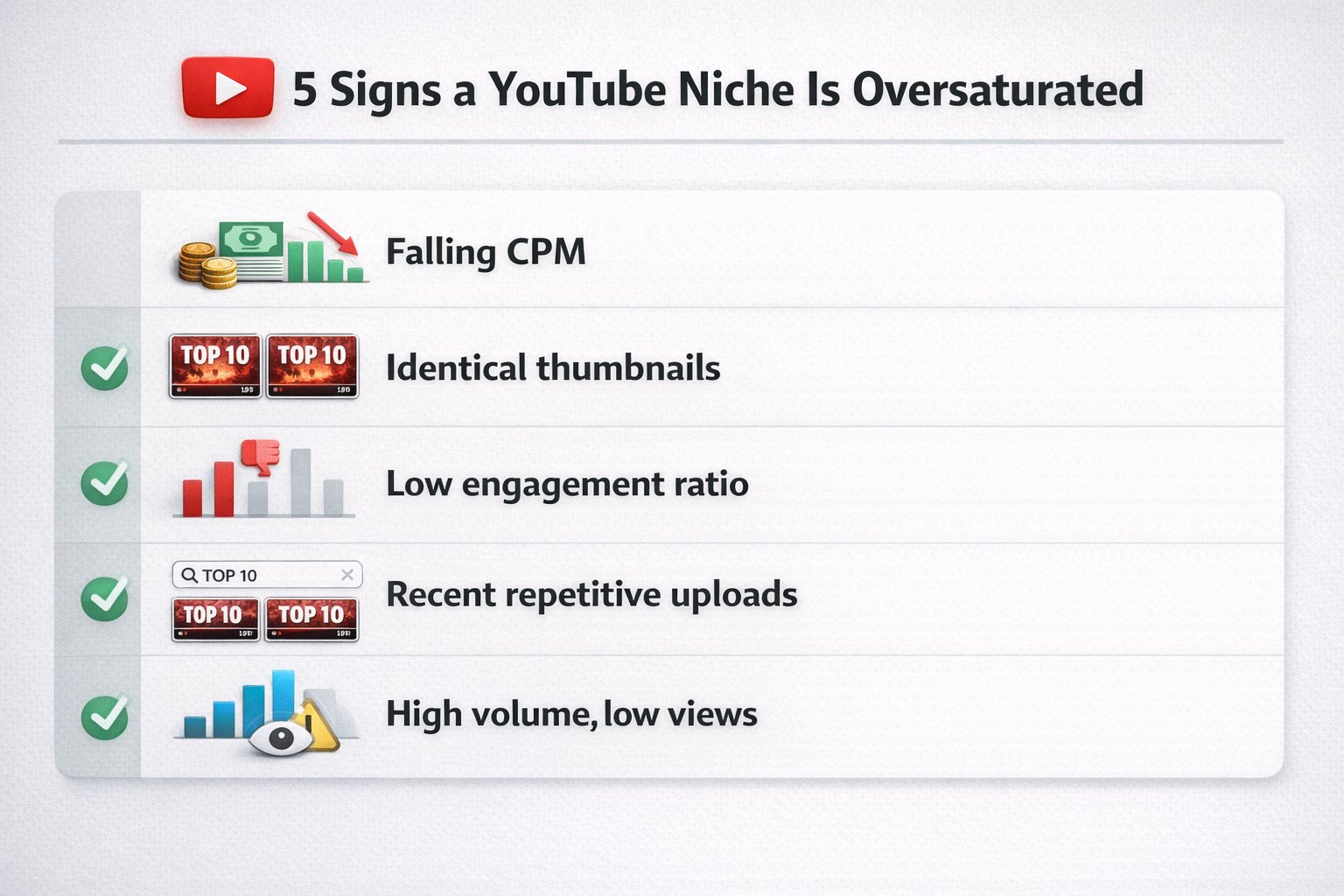
5 Clear Signs a YouTube Niche Is Already Dead
Before spending months building a channel, knowing how to spot a niche that’s already gone is essential. These are the YouTube niche saturation signs that actually matter — not opinions, just observable patterns anyone can check.
1. CPM is already low or dropping fast.
Revenue pressure is usually the first real signal. When too many channels pile into the same audience, advertisers gain leverage, supply goes up, rates compress, CPM (cost per mille) starts shrinking. In genuinely oversaturated YouTube niches, CPM rates barely justify production costs, even with decent view counts. If established channels are quietly increasing upload frequency just to maintain previous earnings, that’s not growth, that’s survival mode.
2. Identical content, weak view counts.
Search the target keyword. If there are dozens of recent uploads covering the exact same angle with near-identical thumbnails and titles, pay close attention to the numbers. When established channels upload frequently but can’t hold consistent views, the audience isn’t growing anymore; it’s just getting redistributed thinner and thinner across more channels.
3. Thumbnails all look the same.
Scroll through search results. If every thumbnail follows the same color scheme, text placement, and emotional cue, the battle is already lost before it starts. When nothing stands out visually, click-through rate (CTR) collapses. And when CTR collapses, the algorithm stops distributing the content. That’s how channels quietly stagnate without ever really knowing why.
4. Engagement ratios are consistently low.
Check the relationship between subscriber count and actual views. A channel with 100,000 subscribers pulling 2,000–3,000 views per video is a red flag. Healthy engagement typically runs in the 10–20% range for an active audience. If most channels in a niche sit below 5%, viewers have stopped caring, and that directly kills recommendation system visibility.
5. Search results are recent and repetitive.
Type the topic into the YouTube search. If the top results were all published in the last month and cover nearly identical perspectives, there’s a short-term flood happening in real time. Rapid content spikes almost always precede rapid burnout. Entering at that moment means entering at exactly the wrong time.
Myths That Kill Channels Before They Even Start
Bad information about saturation is everywhere. It makes people quit too early, or worse, jump into terrible niches, thinking they’ve found hidden gold. Here are the ones doing the most damage.
Myth 1: Everything’s already been done.
This belief kills more channels than actual overcrowding. Yes, broad categories like fitness and personal finance are competitive. But when drilling down, the landscape changes completely. “Fitness” is saturated. “Mobility exercises for remote workers with lower back pain” is not. “Personal finance” is crowded. “Tax strategies for freelance designers” is not. The difference is specificity, not originality. As Forbes has noted, growth in the creator economy increasingly comes from niche, highly focused audiences rather than mass-market generalization. Opportunity didn’t disappear; it shifted somewhere most people aren’t looking.
Myth 2: Competition means there’s no room left.
Competition doesn’t equal saturation. Saturation happens when everyone looks and sounds the same. Plenty of competitive niches still produce breakout channels, not because those channels were first, but because they were different. They targeted a demographic others ignored. They combined two topics nobody had paired before. They presented information more practically than anything else in that space. A productivity channel built specifically for neurodivergent professionals isn’t competing with general productivity content. It’s serving a distinct audience, a completely different game.
Myth 3: Being first is everything.
Being early helps. But it isn’t everything. YouTube’s algorithm rewards watch time, CTR, and viewer satisfaction, not upload dates. A channel that launches later but delivers better research and stronger positioning can absolutely outperform early movers producing average content. Quality and differentiation beat timing, especially in spaces where replication happens fast.
Is YouTube Automation Saturated or Just Poorly Positioned?
This isn’t about finding some secret niche nobody knows about. Those basically don’t exist anymore. It’s about finding specific problems that existing content doesn’t fully solve, and then solving them better.
Start with what people are genuinely trying to accomplish.
Stop picking topics based on what’s trending or what some course called profitable two years ago. Start with understanding the real search intent behind what people type into YouTube. Someone searching “budget meal prep” might really be trying to save money for a specific goal, eat healthier while working long hours, or stop wasting food every week. Each of those is a different intent, potentially a different micro-niche to own entirely.
Tools like Google Trends, AnswerThePublic, and YouTube’s own autocomplete reveal exactly what questions people are asking that aren’t being answered well. The opportunity lies in the gap between what people actually want and what existing content actually delivers. A channel answering “budget meal prep for night shift nurses” isn’t competing with every generic meal prep channel out there; it’s solving a problem those channels don’t even address.
Validate demand before spending a single dollar.
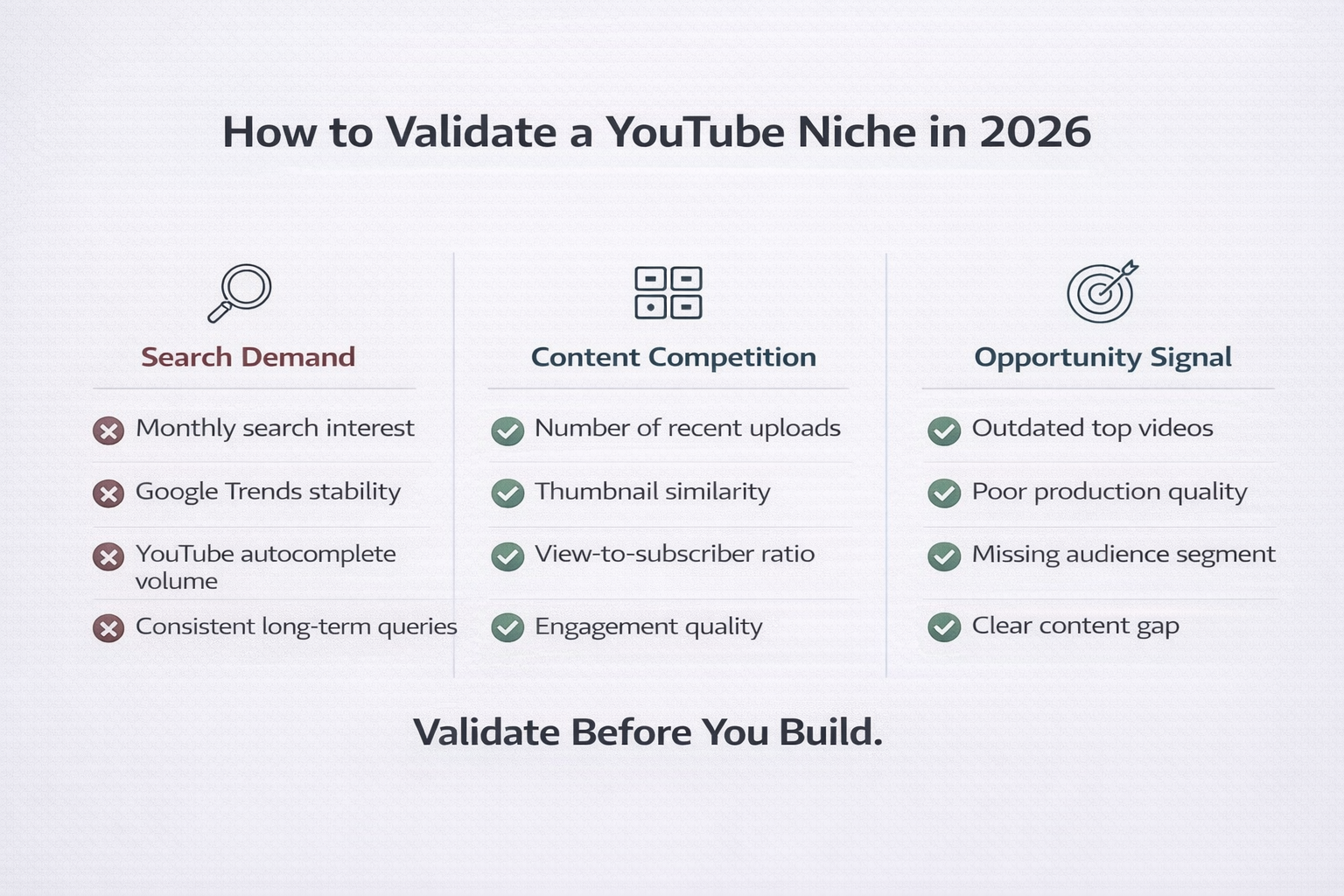
This is the core of proper YouTube automation niche research, and most people skip it entirely. Before committing any time or money, two things need confirmation: people are actively searching for the content, and it’s not already being served well.
Check search volumes for target keywords. Look at how many quality videos already rank for those terms. Check engagement on existing content. Are people actually watching and commenting, or just scrolling past? The sweet spot is decent monthly searches with very few comprehensive, high-quality videos answering them. If the top-ranking videos are three years old and poorly produced, that’s an opening. If there are twenty well-made videos from the past month, all covering it well, move on.
For a realistic picture of what investment looks like before starting, the YouTube automation cost and ROI breakdown covers what different approaches actually require at each stage.
Make the content angle genuinely different.
Even competitive spaces have room for channels that approach topics from a truly unique angle, not a gimmick, but actual strategic positioning that makes a channel fundamentally different from everything else out there.
Mix two topics that aren’t usually combined. Target a specific demographic that bigger channels ignore because it seems “too small.” Present information through a format nobody else in that space uses. Add original research that competitors can’t just copy.
Instead of another “passive income ideas” video, done to death, what about “passive income strategies for teachers during summer break”? That immediately narrows the competition and makes the content dramatically more relevant to a specific audience. That’s micro-niche strategy in practice. Not finding a secret, just being more specific than others are willing to be.
Finding low competition YouTube niches also means thinking about who is being served, not just what is being covered. Underserved demographics are often more valuable than underserved topics.
Best Low-Competition Niches Still Worth Entering
Some categories still have real room to grow without fighting established channels for every view. These have consistent demand without the crushing competition that kills most new channels before they get traction.
Evergreen educational content (specific skills).
Topics that maintain steady interest year-round without depending on trends. Deep dives into historical events, explaining how specific systems work, teaching repair skills for particular products, and breaking down complex subjects for regular people. A channel explaining legal concepts for small business owners, or translating dense scientific research into plain English? These serve real, ongoing needs. Views accumulate over months and years instead of spiking and crashing with a trend that burned out last quarter.
Niches that require real expertise
Markets that genuinely require knowledge naturally limit competition. Production can still be automated, but incorporating real expertise creates a barrier to entry that filters out most people who’d otherwise flood in. Industry analysis for contractors, medical research explained for patients, financial regulations broken down for small business owners, both viewers and the algorithm reward actual authority in these spaces in ways that generic content simply can’t match.
Underserved demographics.
Bigger channels often ignore specific audience segments because they seem “too small.” That’s exactly where opportunity lives. Content built for Gen X professionals (constantly overlooked), people in specific life situations like digital nomads or single parents, or communities that mainstream channels don’t serve, these audiences are actively searching for content made for them and finding very little. That gap is an invitation.
Still weighing whether automation is the right path or whether building a personal brand makes more sense for a specific situation? This honest comparison of YouTube automation vs. personal brand channels lays out the real trade-offs of each approach.
Who Honestly Shouldn’t Try YouTube Automation Right Now
Not everyone should jump into this; being upfront about that saves a lot of wasted time and money.
Trend chasers.
If the whole plan is “make videos about whatever’s trending right now,” the race is already lost before it starts. By the time a trend gets spotted, researched, produced, and published, the market is flooded. What worked in 2020 is a fast track to failure in 2026.
People who just want to copy.
Planning to replicate someone else’s successful channel frame for frame? The algorithm actively penalizes derivative content, and viewers can smell it instantly. Copying isn’t a strategy; it’s a way to spend money and get nothing back.
Low-budget with no real plan.
Succeeding at automation requires either money to invest in quality or time to build strategic positioning from scratch. Starting with $500 and “figuring it out along the way” rarely works anymore. The barrier to entry is genuinely higher than it used to be, and pretending otherwise doesn’t help anyone.
“Set it and forget it” thinkers.
Building a channel, fully automating it, and never thinking about it again, that expectation leads to disappointment every single time. Even well-automated channels need ongoing management, optimization, and strategy adjustments. The truly passive version of this is mostly a myth.
Anyone unwilling to do real research
Skipping actual market research, competitive analysis, and strategic planning before starting means competing blindfolded. The channels winning right now are research-driven, data-informed operations. Guesswork stopped cutting it a long time ago.
How to Scale Without Fighting Oversaturated Markets
Growing an automation business doesn’t mean going head-to-head with massive established channels in packed niches. Smarter paths exist, ways to sidestep direct YouTube automation competition and build something with actual staying power.Build an ecosystem, not just one channel
Instead of putting everything into one basket, building complementary content across related topics creates what’s called a content ecosystem. Different channels serve different angles of the same broader interest area. Someone interested in sustainable living might run into a brand covering eco-friendly home improvements, sustainable fashion, zero-waste cooking, and green investing, all separate channels, all part of the same family. Each one faces manageable competition on its own. Together, they create something much harder for competitors to replicate. This approach also spreads risk; if algorithm changes or overcrowding affect one niche, revenue doesn’t disappear entirely.
Run multiple channels like an investment portfolio
Scaling through multiple channels instead of trying to dominate one saturated market spreads risk and multiplies opportunities. Not randomly starting channels in unrelated topics, building a strategic portfolio where each channel targets a validated micro-niche with clear demand and manageable competition. This creates real data about what works across different spaces and makes future decisions much smarter. It’s a diversified, data-driven approach built for the long term instead of betting everything on one channel.
Make channels hard to copy
The best defense against overcrowding is building something competitors can’t easily replicate. This means developing original research methods, getting access to unique data sources, and creating presentation styles that actually require skill to duplicate. Channels relying solely on publicly available information and standard production techniques will always face content-differentiation challenges, because anyone can replicate their approach. Channels that bring something to the table requiring real investment, expertise, or creativity to copy? Those transform from just another voice in a crowded space into a unique resource people actively seek out and keep coming back to.
The Bottom Line
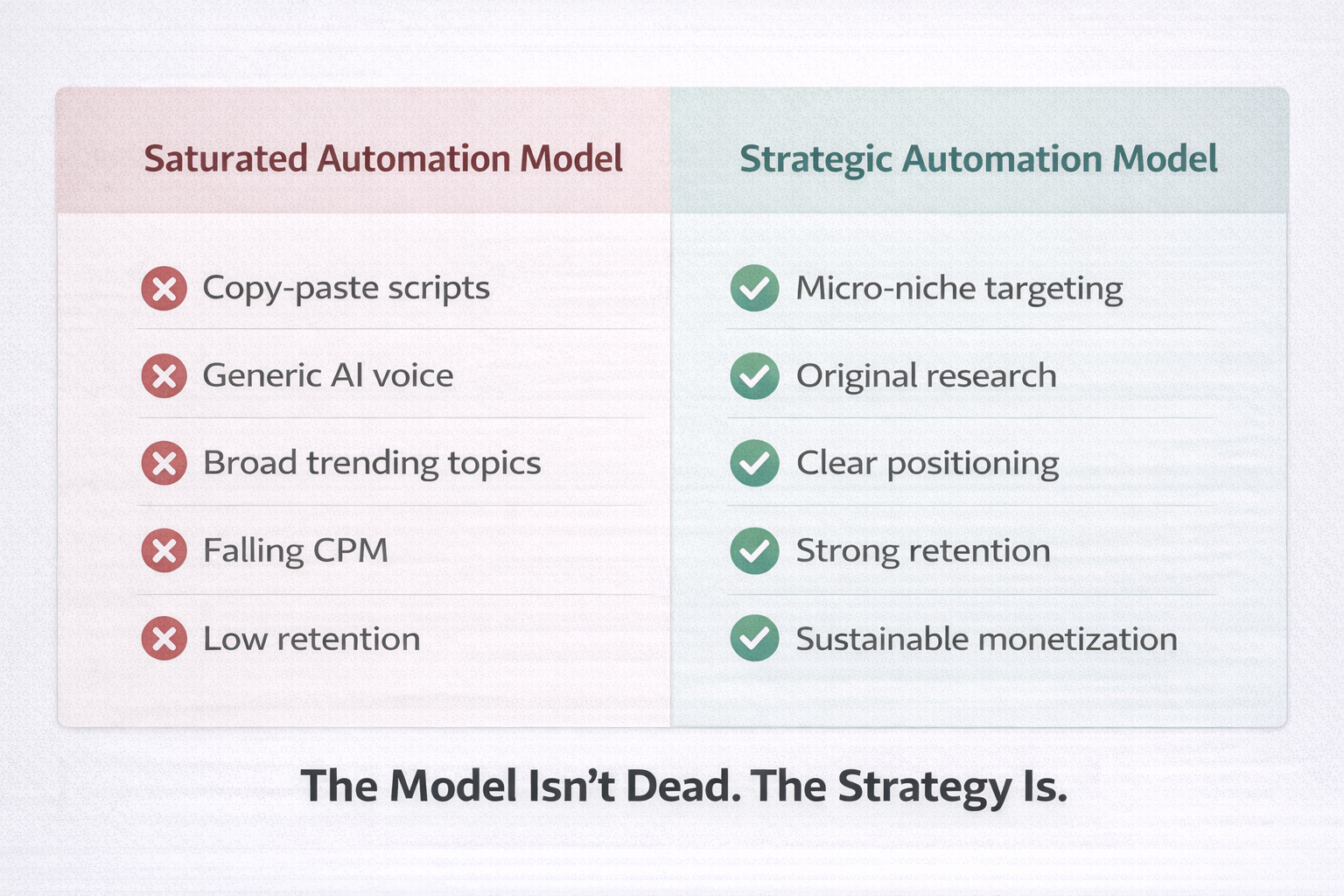
YouTube automation isn’t dead. But the version of it that required zero strategic thinking? That’s gone, and it’s not coming back.
The channels struggling right now all share something in common. They picked a niche because someone else made money there. They followed the same playbook that everyone downloaded from the same course. They produced content that looked exactly like the fifty channels that launched the month before them. The YouTube algorithm noticed. Viewers noticed. Nobody clicked. Nobody stayed.
The channels actually growing in 2026 did something different. They got specific about who they were serving. They did real YouTube automation niche research before spending a dollar. They built content that the recommendation system had a reason to push because viewers had a reason to stay.
That’s the whole game now. Not working harder at what everyone else is already doing, working smarter about where to compete and how to stand out once there.
Saturation isn’t the enemy. Blending in is.
The opportunity in YouTube automation is still very real. It just belongs to the people willing to think before they build, not the ones who copy and hope for the best.
If building a channel with actual strategic foundations sounds like the right move, Hisellit’s YouTube automation services are worth exploring. The difference between a channel that grows and one that quietly dies usually comes down to the decisions made before a single video gets produced.
Frequently Asked Questions
Q. Is YouTube automation too saturated in 2026?
YouTube automation as a business model isn’t saturated. Specific broad niches definitely are. Success depends on choosing underserved YouTube automation niches 2026, delivering genuine value, and using strategic positioning instead of copying what popular channels are already doing. Generic approaches fail fast. Targeted strategies still work.
Q. How do you find low competition YouTube niches in 2026?
Start by researching specific questions people have or problems they face that current content isn’t fully answering. Use Google Trends and YouTube’s autocomplete to find searches with decent volume but few high-quality videos addressing them. Validate actual demand before committing resources. Focus on what people are genuinely trying to accomplish, not just what happens to be trending right now. That’s how to find unsaturated YouTube niches that can actually sustain a channel long-term.
Q. What are the clearest YouTube niche saturation signs to watch for?
Watch for CPM rates dropping, slow subscriber growth despite consistent uploads, and lots of recent videos all taking the exact same approach. Difficulty ranking, even with proper optimization and engagement rates sitting below 5% across the niche are also a strong signal. Pay attention to how quickly niches are getting crowded; what used to take a year now happens in a few months.
Q. Can faceless YouTube channels 2026 still succeed?
Yes, but only with strong differentiation. Faceless channels without a unique angle, real expertise, or distinctive presentation style get buried quickly now. Success requires either specialized knowledge, access to unique data, genuinely strong research quality, or serving a highly specific audience segment that personality-driven channels are ignoring.
Q. What’s the biggest mistake people make when starting YouTube automation?
Choosing niches based on what’s popular right now instead of researching what audiences actually need and where the competitive gaps are. Most failures happen because channels copy successful formats without understanding why those formats worked, then attempt to compete in oversaturated YouTube niches with zero strategic differentiation. The result is spending real money on something that was never going to work from day one.
Ready to build a channel that’s actually positioned to grow? Reach out here to talk through what a data-driven strategy looks like for a specific niche and goal, no generic playbooks, just real positioning work.
For a full picture of what YouTube automation actually costs at different levels, the complete budget and ROI breakdown is a good next read. And if the question is still whether automation or a personal brand is the smarter path, this comparison covers both sides in full.