
Is TikTok Shop Automation Worth It in 2026? Profit Potential & Risks
Executive Overview
Is TikTok Shop automation worth it in 2026 — the full financial breakdown • Real profit margins, fee structure, and ROI expectations • Capital requirements by phase and honest risk assessment • TikTok Shop vs Amazon automation — side-by-side comparison • Who should invest and who should wait
The Real Question Behind All the Hype
TikTok Shop crossed $20 billion in Gross Merchandise Value (GMV) in 2023, and growth has continued since. Sellers rushed in. Brands expanded into creator-led commerce. The platform’s algorithm-driven discovery model made it look almost effortless from the outside.
Then came the automation pitch. Outreach systems, creator dashboards, inventory sync, fulfillment coordination, all running on autopilot. For anyone managing a serious ecommerce operation, appeal is obvious.
The real question in 2026 is whether TikTok Shop automation worth it for serious ecommerce operators, or whether it simply adds operational complexity without improving net profit.
But here’s what’s actually being debated in serious ecommerce circles in 2026: Is TikTok Shop automation worth it, or is it a well-packaged operational layer being sold to people who haven’t done the margin math?
This article breaks down the real cost structure, realistic TikTok Shop automation ROI windows, the risks that don’t make it into pitch decks, and the specific operator profile for whom automation actually makes strategic sense.
That is the central question behind the surge in searches for whether TikTok Shop automation worth it is a legitimate strategic move or simply hype.
The TikTok Shop Landscape in 2026
TikTok Shop has grown up fast. What started as an experimental feature on a short-video app is now a full-blown social commerce infrastructure, affiliate marketplaces, in-app checkout, live shopping streams, and creator storefronts. According to eMarketer’s social commerce forecasts, social commerce in the US is projected to surpass $100 billion by 2026, and TikTok Shop is positioned as a primary driver of that shift. TikTok Shop GMV growth has been one of the defining ecommerce stories of the past three years.
Evaluating whether TikTok Shop automation worth it 2026 depends entirely on understanding how this evolved social commerce infrastructure now operates.
What makes TikTok structurally different from Amazon or Google Shopping is the discovery model. Products go viral here, not because of PPC bids, but because a creator made a 45-second video that resonated. The TikTok for Business research team has consistently shown that in-feed product content drives purchasing behavior at rates traditional display advertising can’t match. That’s the engine this whole ecosystem runs on.
The creator affiliate side has scaled dramatically too. TikTok’s affiliate marketplace now connects brands with tens of thousands of creators who earn TikTok Shop creator commissions on every sale. Managing that volume, outreach, samples, performance tracking, and content approvals is where automation stops being a luxury and starts being a necessity.
Platform maturity has also brought harder edges. Compliance requirements have tightened. Return fraud has become a documented operational cost. Sellers who don’t understand this landscape going in tend to find out the hard way.
What TikTok Shop Automation Actually Means
‘Automation’ gets used loosely here, so it’s worth being precise. Nobody is building a shop that runs itself. What automation actually does is remove the operational bottlenecks that make scaling a TikTok Shop unsustainable at volume.
Here’s what a properly structured TikTok affiliate marketing automation system actually handles:
- Affiliate outreach — bulk-messaging and onboarding creators through TikTok’s affiliate marketplace, with follow-up sequences and vetting workflows
- TikTok Shop creator management — tracking which affiliates are active, what commission tiers they’re on, how their content is converting, and when samples are shipped
- Comment moderation — responding to product questions in real time, which has a measurable impact on conversion rate
- Performance analytics — consolidating data across creators, SKUs, and time periods so decisions are based on numbers, not instinct
- TikTok Shop inventory syncing — keeping stock levels accurate across platforms so overselling doesn’t become a fulfillment disaster
- TikTok Shop 3PL fulfillment coordination — routing orders, managing returns, and keeping SLA compliance in check at volume
Operators exploring what a full-service management relationship looks like can review how TikTok Shop automation services are typically structured before making a commitment.
What automation doesn’t touch: creative strategy, product selection, offer construction, or audience insight. These stay human. The most expensive mistake in TikTok automation is assuming that building operational systems removes the need to think about content. It doesn’t, and that assumption is where a lot of money gets lost.
Misunderstanding this distinction is where many operators miscalculate whether TikTok Shop automation worth it, actually applies to their situation.
How Profitability Is Measured
Any serious discussion around TikTok Shop automation worth it in 2026 begins with margin structure, not revenue screenshots.
TikTok Shop profit margins are thinner than they appear on the surface. TikTok Shop profit margins are thinner than they appear on the surface, especially once creator commissions and platform fees compound across higher revenue volume. The platform takes its cut. Creators take their cut. 3PLs take their cut. And that’s before factoring in returns, software costs, or the ads that fill gaps in organic content performance. A useful reference point: Jungle Scout’s ecommerce margin benchmarks show that consumer goods sold through social channels typically carry 15–35% net margins, and that’s before platform-specific fee stacks are applied.
Full Cost Breakdown
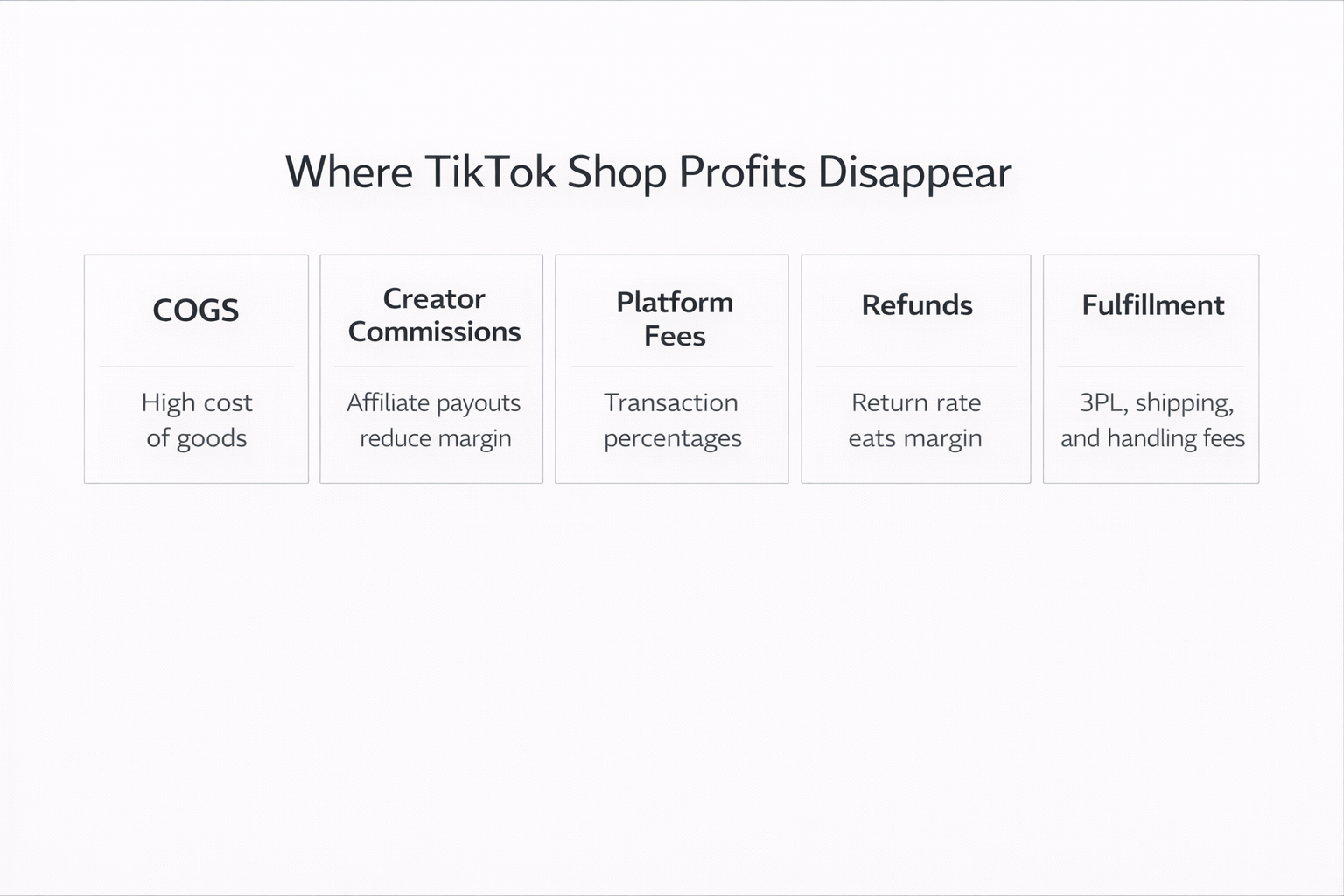
| Cost Component | Typical Range |
| COGS (product cost) | 25–45% of revenue |
| TikTok Shop fees 2026 (platform fee) | 2–8% of GMV |
| TikTok Shop creator commissions | 10–25% of sale price |
| TikTok Shop 3PL fulfillment | 5–12% depending on volume |
| Refund losses | 2–8% depending on category |
| Automation software / management | Fixed or % of revenue |
| Customer acquisition cost (net) | Variable by content performance |
The Net Profit Formula
Net Profit = Revenue – (COGS + Creator Commission + Platform Fees + Ads + Fulfillment + Refund Losses + Tool Costs)
This formula is the foundation for determining whether TikTok Shop automation worth it is financially viable for a specific product category.
For a broader context on ecommerce automation economics and how profit drivers differ across channels, see our comprehensive guide to ecommerce automation legitimacy and value.
Run this formula backward on any product before committing to automation infrastructure. A product with 35% gross margin sounds fine until creator commissions (15%), platform fees (5%), and fulfillment (8%) are applied. That leaves 7%, before software costs or any paid amplification. Products with a gross margin below 40% require serious scrutiny before being taken to TikTok Shop at scale.
TikTok Shop conversion rate is the variable that can flip the equation. Organic content-driven traffic converts at 3–8% when product-content fit is strong, far above what search-intent channels typically deliver. But that rate isn’t a guarantee. It’s the reward for getting the creative strategy right.
Profit Potential Analysis
Where the Real Upside Lives
The genuine opportunity here is algorithmic amplification, the kind that doesn’t exist anywhere else in ecommerce at this cost structure. One creator video with legitimate reach can drive the revenue equivalent of a mid-size paid campaign, without the ad spend. When that happens with a high-margin product and a tight fulfillment stack, the TikTok Shop automation ROI is genuinely compelling. The key is whether TikTok Shop automation ROI remains consistent across multiple creators and content cycles, not just during isolated viral moments.
The affiliate scalability model is the second lever. Operators running 50–200 active affiliates spread their customer acquisition cost across a portfolio of content; no single piece of content carries the whole load. According to Influencer Marketing Hub’s 2024 TikTok Commerce Report, brands running structured affiliate programs on TikTok Shop saw 3–4x higher content output than those managing creator relationships manually. That difference is where automation pays for itself.
However, high upside alone does not answer whether TikTok Shop automation worth it and remains sustainable across volatile content cycles.
Where Margin Compression Happens
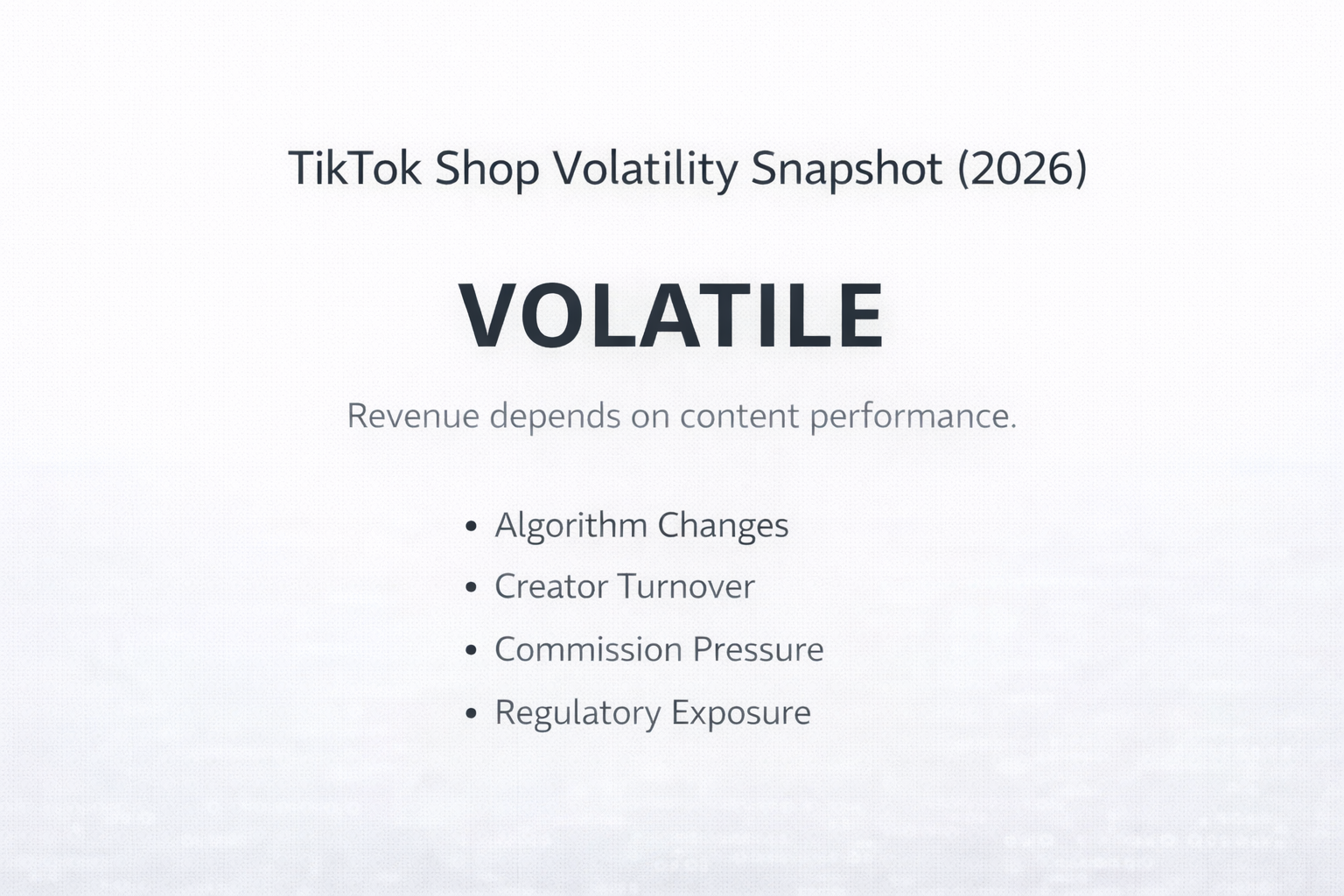
Here’s the uncomfortable truth about TikTok Shop profit margins: they depend entirely on content performance, which is inherently unpredictable. A product that’s converting at 6% this month might be at 2% next month because the creator ecosystem moved on to something else. That’s not a platform failure, that’s just how algorithm-driven discovery works. Operators who don’t model this volatility into their planning tend to be the ones who declare the platform ‘doesn’t work’ six months in.
Seasonal swings make this worse. Q4 on TikTok Shop typically runs 2–3x Q2 revenue. Brands that don’t plan inventory and working capital around that curve end up in trouble on both ends.
Realistic Time-to-Profit
With a validated product and real capital behind it, the path to consistent monthly profitability is 90–180 days. The first 60 days are almost always dominated by creator recruitment, content testing, and fulfillment calibration. Automation shortens the operational overhead during that period, but it does not shortcut the market validation process. Anyone expecting meaningful returns inside 30 days without an existing content strategy is working from an unrealistic model.
The Biggest Misconception About TikTok Shop Automation
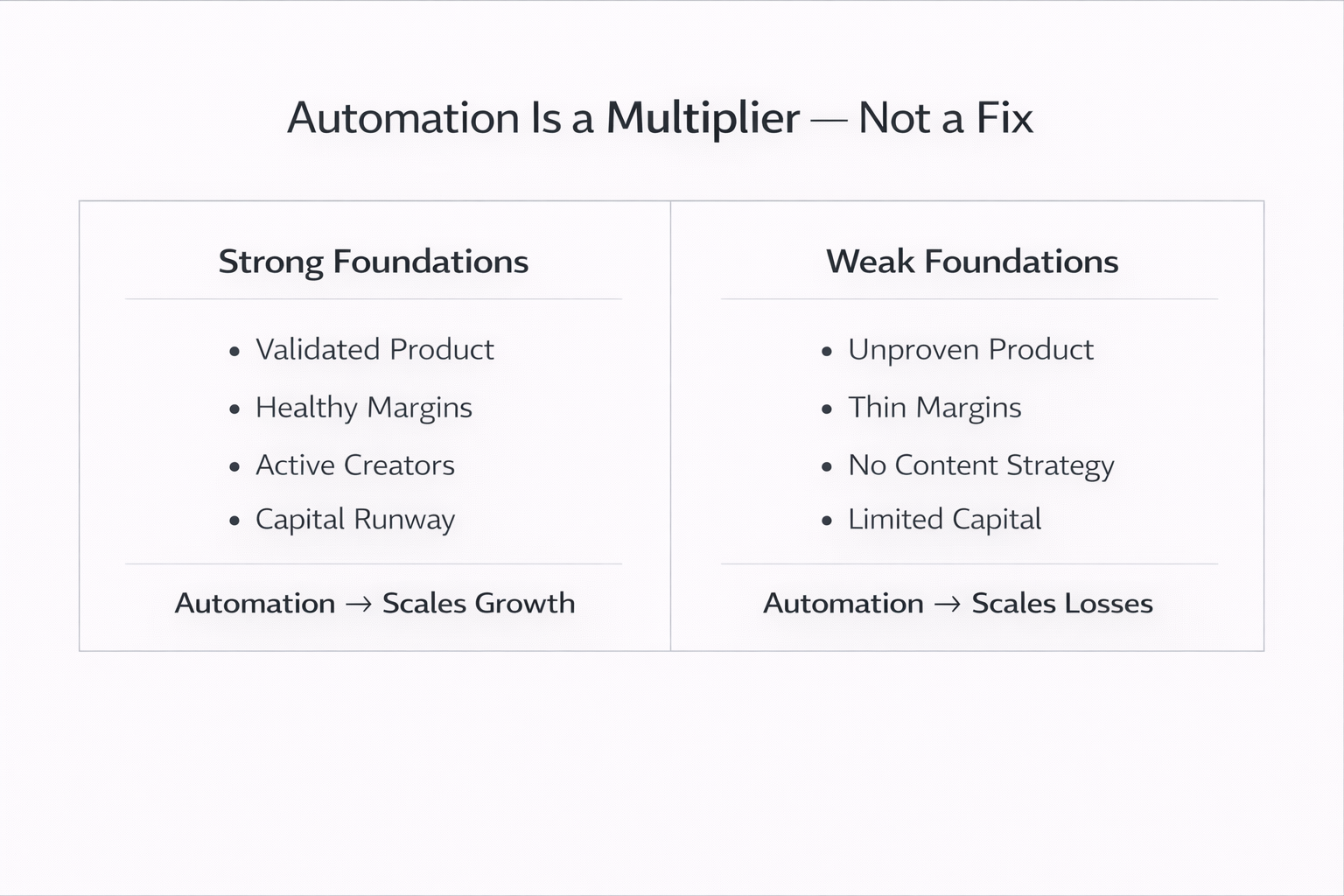
Automation replaces operational work. It does not replace thinking.
That sounds obvious, but the automation pitch often blurs this line, and sellers who buy into the idea that a systematized shop removes the need for creative strategy tend to discover that reality quickly and expensively. Operational efficiency is a multiplier. It multiplies what’s already working. If creative direction is weak, automation just scales that weakness faster.
The operators who genuinely benefit from a fully systematized TikTok Shop have already done the hard part: they know which product angles convert, they understand what kind of creator drives their customer, and they have a clear brief. Automation then takes that proven playbook and runs it at a scale no human team could sustain manually.
This is a well-documented pattern in scaling ecommerce operations. Shopify’s Commerce Trends report consistently notes that brands hitting growth ceilings are almost always constrained by operational bandwidth, not market demand. Automation solves bandwidth. It doesn’t solve demand problems or weak product-market fit. Sustainable TikTok Shop automation ROI depends less on early spikes and more on whether content output and margin discipline hold steady beyond the first 90 days.
Volatility in content performance directly affects TikTok Shop profit margins, because even small shifts in conversion rate can erase net margin entirely.
Major TikTok Shop Risks in 2026
The primary TikTok Shop risks 2026 extend beyond algorithm shifts and into regulatory exposure, refund abuse, and commission inflation.
Algorithm Shifts
TikTok’s algorithm has changed significantly in the past 24 months. Distribution logic that worked reliably in 2023 has been re-weighted toward watch time, saves, and shares. Operators who built their whole playbook around the old signal patterns have felt it. This isn’t speculation; SocialInsider’s TikTok Benchmark Report documented a meaningful drop in average organic reach per post across 2024 as the algorithm recalibrated. The platform will keep evolving. Strategies need to evolve with it.
Algorithm volatility alone forces operators to re-evaluate whether TikTok Shop automation worth it and fits within a diversified platform strategy.
Regulatory Uncertainty
The regulatory situation around TikTok in the United States is not resolved. Legislative pressure on ByteDance has created genuine uncertainty about long-term market access. Reuters has covered this extensively. Treating TikTok as the sole revenue channel for a brand isn’t a strategy; it’s a single point of failure. Serious operators run TikTok alongside Amazon, Shopify, and increasingly Walmart Marketplace, not instead of them.
Policy Volatility
TikTok Shop policy changes have accelerated with platform maturity. Listing requirements, shipping SLAs, and customer service standards have all tightened. Sellers who were operating in a more permissive early environment have had to restructure. The platforms that grow fastest tend to enforce standards hardest once scale is achieved; TikTok Shop is no exception.
Fraud and Creator Scams
Affiliate fraud is a real operational cost on TikTok Shop at scale. The patterns are familiar: creators who accept samples and produce nothing, inflated performance numbers, click fraud on affiliate links. None of this is unique to TikTok; it’s a documented challenge in any large affiliate ecosystem. The mitigation is robust vetting processes and performance-gated commission structures. Neither of those happens without systems.
Refund Abuse and Commission Inflation
Return rates in certain categories, particularly apparel, beauty tools, and electronics accessories, regularly exceed 15% on TikTok Shop. That’s a direct hit to net margin that compounds fast at scale. Combined with rising TikTok Shop creator commissions as high-performing niches get competitive, TikTok Shop risks 2026 around margin erosion deserve a dedicated line item in every financial model. This regulatory backdrop remains one of the most significant TikTok Shop risks 2026 for brands overly dependent on a single platform.
Capital Requirements & Time-to-Profit
Capital isn’t just about inventory. It’s about runway, the ability to absorb volatility in content performance, early refund volume, and the inevitable fulfillment learning curve before the operation hits its stride. Why manual selling no longer scales explains exactly where the operational ceiling shows up for brands that haven’t systematized their stack.
Capital Phase Overview
| Phase | Capital Range | What It Covers |
| Testing Phase | $5,000–$15,000 | Initial inventory, creator sampling, content testing, basic tooling |
| Scaling Phase | $15,000–$50,000 | Affiliate expansion, inventory depth, fulfillment integration |
| Multi-Creator Scale | $50,000+ | 100+ creators, multi-SKU management, full automation stack |
Undercapitalized entries often conclude prematurely that TikTok Shop automation worth it is flawed, when the real issue is insufficient runway.
The operators who enter with less than $5,000 aren’t testing TikTok Shop, they’re testing their own risk tolerance. Content performance variance, inventory mismatches, and early returns will absorb that capital before meaningful data exists. That’s not a platform problem. It’s a planning problem.
TikTok Shop Automation vs Amazon Automation
TikTok Shop vs Amazon FBA is not a debate with a clear winner; they’re different tools for different jobs. Both have automation pathways. Both carry real risks. The question is which model fits the product, the brand stage, and the operator’s capability set. For context on how the Amazon automation model operates at the infrastructure level, the comparison below frames where they diverge.
| Factor | 🛍 TikTok Shop | 📦 Amazon FBA |
| Traffic | Algorithm + creator-driven | Search + PPC spend |
| Stability | High growth, high volatility | Predictable, competitive |
| Margins | Squeezed by creator commissions | Squeezed by ads & FBA fees |
| Content | Critical — content is the ad | Secondary to keyword ranking |
| Entry Cost | Moderate | High — expensive to compete |
| Policy Risk | Elevated (regulatory exposure) | Moderate — well-documented |
| Ceiling | Very high if content hits | Scalable but expensive to hold |
This structural difference is central to deciding whether TikTok Shop automation worth it, aligning with an operator’s risk tolerance and content capabilities.
TikTok vs Amazon automation isn’t either/or for most serious multi-platform ecommerce operators; it’s sequencing. TikTok as demand creation. Amazon is a demand capture. The brands running both together and using data from TikTok to inform Amazon keyword strategy are playing the long game correctly.
Beyond these two, operators building out systemized ecommerce infrastructure should be tracking Shopify automation capabilities and Walmart Marketplace automation as complementary channels. Walmart in particular offers lower content dependency and an established customer base that’s increasingly being activated for ecommerce, a useful counterbalance to TikTok’s volatility.
ROI Qualification Checklist
Before evaluating infrastructure, operators should ask whether the projected TikTok Shop automation ROI justifies the operational complexity being introduced.
This likely makes sense if:
✔ There’s a validated product with sales data behind it — not a hunch about what might work
✔ Creator-led marketing is already understood, at least at a conceptual level
✔ Multiple SKUs need to be managed systematically — one product doesn’t justify full automation infrastructure
✔ TikTok Shop capital requirements are met: at a minimum of $5,000–$15,000 available for the testing phase
✔ There’s bandwidth to oversee operations — automation reduces manual work, it doesn’t eliminate oversight
✔ TikTok is being added to an existing channel mix, not built as the sole revenue foundation
This probably isn’t the right move if:
✘ The first ecommerce product is still being tested — build the fundamentals before automating them
✘ Capital is below the minimum viable threshold — underfunded starts don’t produce useful data
✘ There’s no content strategy or understanding of what makes a product perform on TikTok
✘ The expectation is passive income inside 60 days — that’s not what this is
Strategic Verdict: Is TikTok Shop Automation Worth It in 2026?
For the right operator profile, genuinely yes. The platform’s organic distribution model is still one of the most powerful demand-creation engines in ecommerce, and automation is what makes that engine manageable at scale.
But the honest answer is that automation is leverage, and leverage doesn’t care which direction it’s pointing. Operators with validated products, real capital, and a functioning content strategy will find that it compounds their advantages. Operators without those foundations will find it compounds their problems instead.
Before committing to an automation infrastructure decision, it’s worth understanding exactly how fulfillment, creator management, and analytics reporting fit together operationally. The TikTok Shop fulfillment and operations guide covers the logistics layer in detail.
The channel is real. The opportunity is real. The math is also real, and it only works when the product margin, creator strategy, and capital base are all in place simultaneously. Ignoring TikTok Shop risks 2026 while focusing only on upside is how otherwise profitable operations become fragile.
Operators ready to evaluate whether their specific situation qualifies can start that conversation here.
Bottom Line
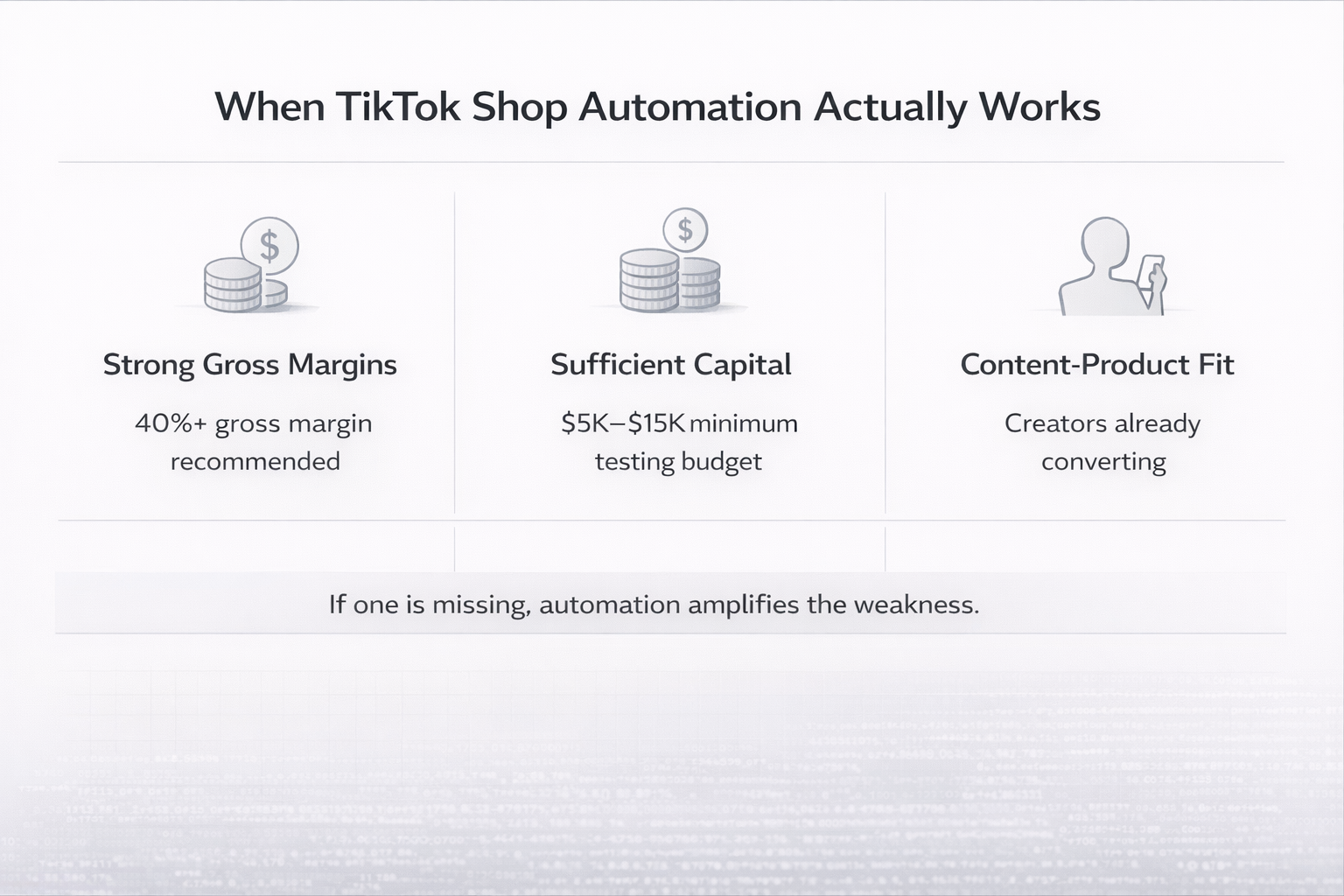
TikTok Shop automation worth it for operators who understand how to protect TikTok Shop profit margins through disciplined commission control and capital management. Without all three, automation amplifies weaknesses rather than strengths. The platform offers genuine upside, but only to businesses already built to handle it. Treat automation as leverage, not as a shortcut.
FAQ: TikTok Shop Automation in 2026
Q. Is TikTok Shop automation profitable in 2026?
Whether TikTok Shop automation worth it depends on gross margin, TikTok Shop creator commissions, platform fees, and fulfillment costs working together. Products with sub-40% gross margins face real viability challenges once the full fee stack is applied. Operators with strong product-market fit, active creator relationships, and adequate capital can achieve sustainable TikTok Shop profit margins, but there are no guarantees, and performance is directly tied to content strategy, not automation alone.
Q. How much capital is required to start?
TikTok Shop capital requirements start at $5,000–$15,000 for a legitimate testing phase, enough to cover initial inventory, creator sampling, content testing, and basic tooling. Scaling to 50+ active affiliates requires $15,000–$50,000. Multi-creator programs operating at real revenue volume need $50,000 or more in working capital. Operators entering below these thresholds rarely generate actionable data before running out of runway.
Q. What are TikTok Shop’s platform fees?
TikTok Shop fees 2026 include a referral/commission fee of 2–8% of GMV, depending on product category. These figures have shifted over recent platform cycles and should be verified against current published rate cards before building any financial model. Payment processing and promotional program participation carry additional costs that need to be factored in separately.
Q. What are the biggest risks for sellers in 2026?
The primary TikTok Shop risks 2026 are algorithm volatility affecting organic reach, ongoing regulatory uncertainty around TikTok’s US market status, rising creator commission expectations in competitive niches, refund fraud in high-return product categories, and affiliate scams within the creator marketplace. Sellers running TikTok as a single-channel business carry disproportionate exposure to any of these disruptions.
Q. Can beginners succeed with TikTok Shop automation?
Not in most cases, at least not immediately. A meaningful TikTok Shop operation requires product validation, understanding of creator-led marketing, and enough capital to sustain 90–180 days of build-out before consistent returns appear. Beginners without those foundations aren’t positioned to use automation productively; the infrastructure will amplify whatever gaps exist rather than paper over them.
Q. How does TikTok Shop automation compare to Amazon automation?
TikTok vs Amazon automation is a comparison of fundamentally different traffic models. TikTok delivers higher upside through organic, algorithm-driven discovery but carries significant content dependency and platform volatility. Amazon delivers more predictable demand through search intent but requires heavier ad investment and faces more entrenched competition. Neither is universally better; the right answer depends on product type, margin structure, and how much creative infrastructure the operator already has in place.