TikTok Shop Commission & Fee Changes in 2026: The Complete Seller Guide
TikTok Shop commission in 2026 starts at 6% of the product sale price, but most sellers pay significantly more once affiliate commissions, payment processing fees, and refund costs are included.
Most sellers think TikTok Shop takes 6%. The real number is often closer to 33%.
That gap is why so many sellers are confused right now. Sales are strong. Payouts are not what they expected. And no one told them about the fees stacking underneath that 6% headline.
This guide fixes that. It covers every detail of the TikTok Shop Commission & Fee Changes in 2026. You will see the real math behind each cost, a step-by-step pricing model, and the strategies that protect your margins as the platform matures.
Whether you are a new seller deciding if TikTok Shop is worth it in 2026, or an existing seller trying to stop margin bleed, this is the most complete breakdown of the TikTok Shop Commission & Fee Changes in 2026 available. Start here.
TikTok Shop Fees in 2026 (Quick Summary)
- Referral fee: 6% of the product sale price
- New seller promo rate: 2%–3% for the first 90 days
- Affiliate commissions: usually 10%–30% of the sale
- Payment processing: roughly ~2% per transaction
- Typical total take-rate: 18%–33%, depending on affiliates and returns
Most sellers only account for the 6% referral fee, but once affiliate commissions,
processing fees, and refunds are included, the real marketplace cost is often significantly higher.
Why TikTok Shop Fees Matter More for Sellers in 2026
From 2021 to 2024, TikTok Shop was in growth mode. Sellers got subsidized shipping. Commission rates were reduced. The algorithm favored new listings heavily. It was a great time to launch.
That era is over.
The platform needs real revenue now. The subsidies are gone, and the full fee structure is in effect. According to Statista’s TikTok commerce data, global TikTok Shop GMV is projected to grow significantly in 2026, which is why the platform is now enforcing its full monetisation structure.
The sellers who are getting hurt are not losing because the platform stopped working. They are losing because their pricing was built for 2023 rates, not 2026 TikTok Shop fees.
The sellers who are winning planned for the full TikTok Shop Commission & Fee Changes in 2026 from day one. They know how the referral fee, payment processing fee, affiliate creator commissions, and refund costs all compound together. That is the foundation of a smart TikTok Shop pricing strategy.
Key Takeaway
TikTok Shop’s subsidized era is over. Price for the full 2026 fee structure from day one.
Sellers still using 2023 assumptions are losing the margin they do not realize they are losing.
What Is the TikTok Shop Commission Rate in 2026?
Here is a complete breakdown of every TikTok Shop seller fee you need to account for. The TikTok Shop referral fee is the first layer. Others are the quiet margin killers that catch new sellers off guard.
Standard Referral Fee (6%)
The referral fee is the core TikTok Shop commission rate 2026 charges on every sale. It is 6% of the item price, not including shipping.
On a $45 product, that is $2.70. Easy to underestimate. But it is just the starting point.
This fee is deducted automatically before your payout hits. It is the number TikTok advertises. It is accurate. It is also incomplete.
Do not build your margin model around this number alone. Every other fee in this list stacks on top of it.
New Seller Promotional Rate (2% to 3%)
New sellers get a reduced commission window for their first 90 days. The rate drops to 2% to 3% to help new shops get started without heavy fee pressure.
It ends. When it does, the full 6% kicks in overnight.
A lot of sellers build their entire pricing model around the promo rate. That is a mistake. Price for 6% from day one. Treat the lower rate as a bonus margin to reinvest, not your baseline.
Use the 90-day window to test products and build reviews. Then re-price for the full TikTok Shop commission rate 2026 before you scale.
Category-Based Fee Variations
Not every category pays the same TikTok Shop referral fee. TikTok adjusts rates by product type. Here is how common categories typically break down:
- Beauty and personal care: around 6%
- Fashion and apparel: 5% to 7%, depending on sub-category
- Electronics and gadgets: often 5% or lower
- Health and wellness: around 6%
- Home goods and kitchen: around 6%
- Food and consumables: variable, sometimes lower
Always check your category’s current TikTok Shop commission rate 2026 in the TikTok Seller Center before listing. Rates do shift. Old information is one of the most common sources of surprise in TikTok Shop seller fees.
TikTok Shop Affiliate Commission (10% to 30%+)
This is the fee that catches most sellers completely off guard.
When you open your products to the TikTok affiliate marketplace, you pay creators a commission on every sale they generate. You set this rate yourself.
But here is the reality: creators will not promote products offering less than 10% to 15%. In competitive categories like beauty, fitness, and home goods, creators regularly ask for 20% to 30% or more.
The TikTok Shop affiliate commission stacks directly on top of the referral fee and payment processing fee. On a $50 product with a 20% affiliate rate, you are already giving up 28% of the sale price before your cost of goods is even counted.
High affiliate volume looks great on a dashboard. But if you have not priced for the commission, high volume just means faster losses.
This is the most important TikTok Shop hidden fee new sellers need to understand before they touch the affiliate marketplace.
Need help managing your affiliate program at scale? The TikTok Shop automation services at HiSellIt handle creator relationships, rate setting, and performance tracking end-to-end.
Payment Processing Fee (~2%)
Every sale on TikTok Shop comes with a payment processing fee of roughly 2%. It covers the transaction cost through TikTok’s payment infrastructure.
On a $50 sale, that is $1.00. Across 1,000 monthly sales, that is $1,000 that never reaches your account.
At volume, the TikTok Shop payment processing fee is a real cost line that belongs in every pricing model. It is fully disclosed in the TikTok Business Help Center, but it gets left out of quick calculations constantly.
Refund Admin and Chargeback Fees
When a buyer returns a product, you do not automatically get the TikTok Shop referral fee back. TikTok may retain part or all of it as a refund administration fee, depending on the reason.
For fashion sellers with 15% return rates, this adds up fast.
Chargebacks are handled through TikTok’s resolution process. If a dispute goes against you, the transaction amount is deducted along with any dispute handling fees.
These TikTok Shop fees 2026 apply even when buyers are at fault. Model a 5% return rate buffer into your per-unit cost before listing. Fashion and electronics sellers should go higher.
Fulfilled by TikTok (FBT) Costs
Fulfilled by TikTok is the platform’s own fulfillment program. You send inventory to TikTok’s warehouses. They handle storage, packing, and shipping.
The benefit is real: faster delivery and better algorithm placement. The TikTok Shop FBT fees depend on product size and weight. Light, compact items are usually economical. Heavy or bulky products can get expensive fast.
Storage fees also apply when inventory sits too long, similar to Amazon FBA’s long-term storage penalties.
FBT works best for your top-selling, fast-moving SKUs. Slower products are better handled through your own 3PL or self-fulfillment.
For a full breakdown of FBT versus third-party logistics, read the TikTok Shop fulfillment guide for sellers in 2026 on HiSellIt.
How TikTok Shop Fees Stack on a Sale
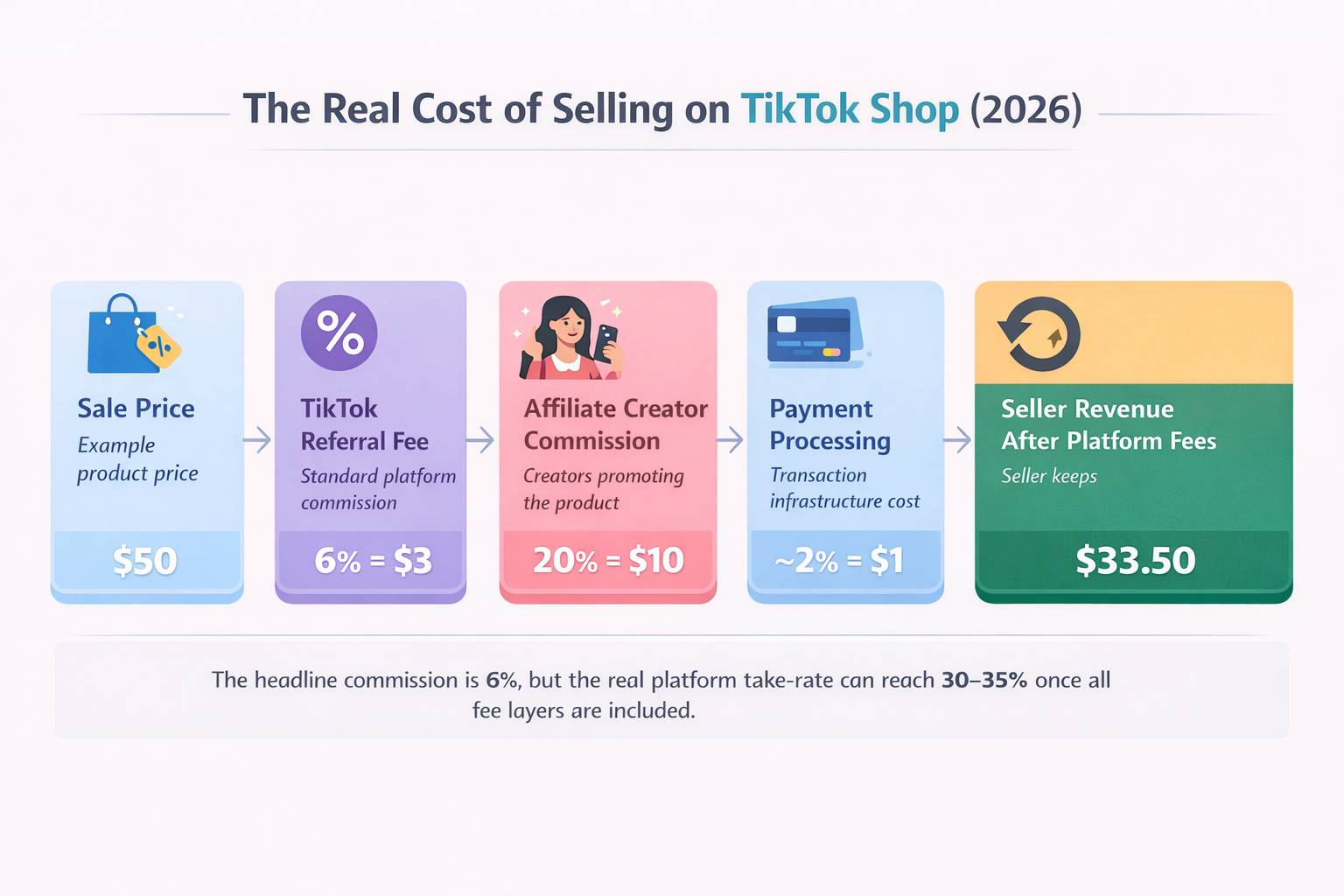
This visual shows how TikTok Shop seller fees stack on a single order and why margin planning
matters before scaling.
Complete TikTok Shop Fee Table 2026
Here is every TikTok Shop seller fee in one place. Bookmark this before you price a single product:
| Fee Type | Rate | When It Applies |
| Standard Referral Fee | 6% of the sale price | Every sale after the promo period |
| New Seller Promo Rate | 2%–3% (first 90 days) | Your first 90 days only |
| Payment Processing Fee | ~2% per transaction | Every single transaction |
| Affiliate Creator Commission | 10%–30%+ of sale | When a creator drives the sale |
| Fulfilled by TikTok (FBT) | Varies by size and weight | When using the FBT warehouse |
| Refund Admin Fee | Up to full referral fee | When a buyer returns an item |
| Chargeback / Dispute Fee | Per case — platform rate | When a dispute is filed |
| FBT Long-Term Storage Fee | Per cubic foot per month | Slow-moving inventory |
Note: The TikTok Shop referral fee is deducted first, before any other cost. Affiliate commissions are set by you, but must stay competitive to attract quality creators. Most categories need at least 10% to get consistent creator interest.
How Much Does TikTok Shop Take Per Sale?
This is one of the most searched questions from sellers evaluating this platform. Here is the exact math on a $50 product sale.
| Cost Line | Amount | % of Sale |
| 💰 Sale Price | $50.00 | 100% |
| Referral Fee (6%) | –$3.00 | 6% |
| Payment Processing (~2%) | –$1.00 | 2% |
| Affiliate Commission (20%) | –$10.00 | 20% |
| Return Buffer (5%) | –$2.50 | 5% |
| Cost of Goods + Shipping | –$18.00 | 36% |
| Seller Net Profit | $15.50 | 31% |
| Total Platform Take | ~$16.50 | ~33% |
That single sale costs $14 in platform-related fees alone before counting your cost of goods. Here is that same breakdown in a clean calculation:
| Fee Type | Rate | On a $50 Sale |
| Referral Fee | 6% | $3.00 |
| Payment Processing Fee | ~2% | $1.00 |
| Affiliate Commission | 20% | $10.00 |
| Total Platform Fees | 28% | $14.00 |
| Remaining for COGS + Profit | 72% | $36.00 |
TikTok Shop cost to sell: On a $50 sale with a 20% affiliate rate, the TikTok Shop take rate is roughly 28% in direct platform fees. Add a 5% return buffer, and the total TikTok Shop marketplace fee impact reaches 33%.
Now change one number. If the product costs $28 to source instead of $18, net profit drops to $5.50. That is just 11%. One bad return wipes out the profit on four or five good sales.
This is how sellers end up with strong volume and weak payouts. The TikTok Shop profit margin calculation was never done correctly before pricing.
Not sure if TikTok Shop automation is worth it for your operation? Read the honest breakdown at HiSellIt: Is TikTok Shop Automation Worth It?
Key Takeaway
The advertised fee is 6%. The real TikTok Shop take rate on affiliate-driven sales is often 30% to 35%.
Model every fee layer before you set your price. Never just subtract 6%.
What Is the Real Effective Take-Rate on TikTok Shop?
How much does TikTok Shop take from each sale depends on your full cost stack. Here is what a real $50 sale looks like when all fees are applied through an affiliate creator at 20% commission:
| Cost Line | Amount | % of $50 Sale |
| Sale Price | $50.00 | 100% |
| Minus: Referral Fee (6%) | –$3.00 | 6% |
| Minus: Payment Processing (~2%) | –$1.00 | 2% |
| Minus: Affiliate Commission (20%) | –$10.00 | 20% |
| Minus: Return Buffer (5%) | –$2.50 | 5% |
| = Net Revenue After Platform Costs | $33.50 | 67% |
| Minus: Cost of Goods + Shipping | –$18.00 | 36% |
| = Actual Net Profit | $15.50 | 31% |
| Total Platform Ecosystem Take | ~$16.50 | ~33% |
The seller nets $15.50 in actual profit on a $50 sale. That is 31%. Not bad.
But the platform ecosystem took $16.50. That is 33% of the sale price. That is the real TikTok Shop seller commission picture once all fee types are stacked.
Key Takeaway
Advertised TikTok Shop commission: 6%.
Real marketplace take rate including affiliate and processing: 30% to 35%.
Always calculate the full TikTok Shop cost to sell before finalizing your price.
TikTok Shop Profit Calculator: Step-by-Step Pricing Model
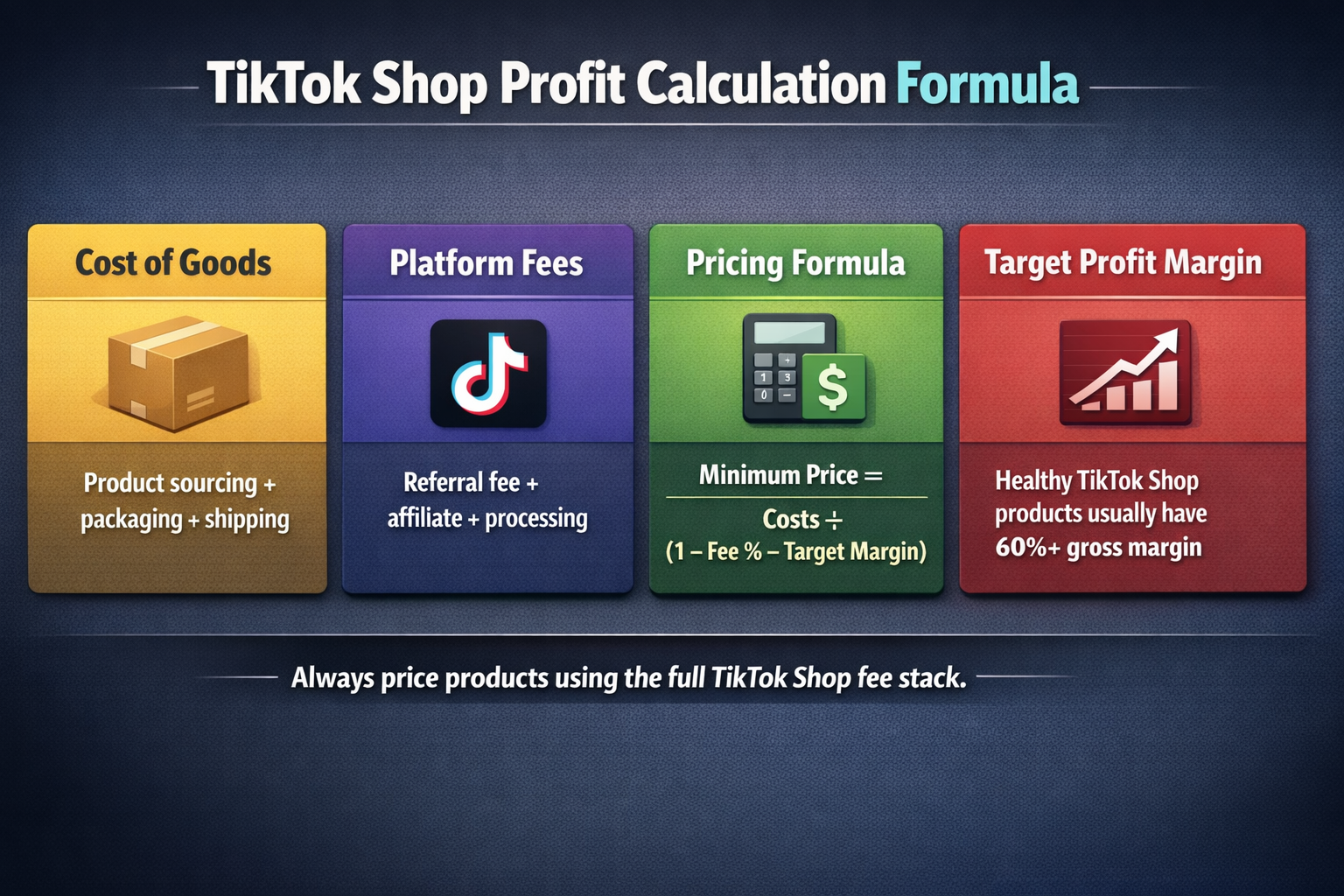
The TikTok Shop profit calculator logic is straightforward. Work backwards from your target margin to find the minimum price your product needs to sell for.
Formula: Minimum Sale Price = Total Variable Costs / (1 – Total Fee % – Target Net Margin %)
Total variable costs = cost of goods + packaging + shipping to buyer.
Total fee percentage = referral fee + processing fee + affiliate commission if using one.
Target net margin = the minimum profit you need after all deductions.
Here is that TikTok Shop pricing strategy applied across three product scenarios:
| Input / Output | Low Scenario | Mid Scenario | High Scenario |
| Sale Price | $25 | $50 | $85 |
| COGS + Shipping | $8 | $18 | $28 |
| Referral Fee (6%) | $1.50 | $3.00 | $5.10 |
| Processing (~2%) | $0.50 | $1.00 | $1.70 |
| Affiliate (15%) | $3.75 | $7.50 | $12.75 |
| Total Fees Combined | $5.75 (23%) | $11.50 (23%) | $19.55 (23%) |
| Net Revenue After Fees | $19.25 | $38.50 | $65.45 |
| Net Profit After COGS | $11.25 | $20.50 | $37.45 |
| Net Profit Margin | 45% | 41% | 44% |
The margin holds consistently across all price points when the fee ratios stay the same. That is the model working.
Where it breaks: sellers who set a 25% to 30% affiliate rate without running this math first. At 30%, total fees jump to roughly 38%. On a $50 product with $18 COGS, net profit collapses to around $12. One bad week of returns pushes that negative.
Quick TikTok Shop pricing strategy rules to follow:
- Never set affiliate commission higher than your gross margin can absorb after referral and processing fees.
- Aim for at least 60% gross margin on product cost before any platform fees.
- Price for the full 6% referral fee from day one, even during the promo window.
- Add a 5% to 10% buffer to your price for returns and shipping edge cases.
- Test organic content before opening affiliates, so you know your baseline conversion rate.
Key Takeaway
Use the formula: Minimum Price = Variable Costs / (1 – Fee % – Target Margin %).
60% gross margin before fees gives you room to run affiliates and still earn real profit.
Always price for 6%, not the promo rate. The promo rate is a bonus, not your baseline.
TikTok Shop vs Amazon, Shopify, and Etsy: Fee Comparison 2026
Context matters. The TikTok Shop vs Amazon fees debate is one of the most common questions new sellers ask. According to the Shopify Commerce Trends Report, social commerce platform fees are now directly competitive with traditional marketplaces. Here is how the full picture looks across every major platform in 2026:
| Platform | Base Fee | Creator / Affiliate | Processing | Est. Total Take |
| TikTok Shop | 6% | 10%–30%+ | ~2% | 15%–35%+ |
| Amazon FBA | 8%–15% | 0%–4% | Included | 15%–20% |
| Shopify | 0%–2% | N/A | 2.9% + $0.30 | 3%–5% |
| Etsy | 6.5% | N/A | 3% + $0.25 | 10%–12% |
| Walmart Marketplace | 6%–20% | N/A | Included | 10%–20% |
At first glance, TikTok Shop vs Amazon fees looks like a fair fight. TikTok’s 6% base rate is lower than many Amazon categories.
But add affiliate creator commissions, and the picture changes. TikTok Shop’s total take on affiliate-driven sales is among the highest of any platform.
Understanding TikTok Shop fees 2026 in the context of all platforms changes the trade-off calculation. TikTok affiliate traffic is largely organic discovery. On Amazon and Shopify, you pay for that same reach through PPC ads and off-platform marketing. For products that convert well with creator content, TikTok’s total acquisition cost can actually be lower, even with the higher affiliate fees.
Shopify has the lowest platform fees. But there is zero built-in traffic. You are on your own.
Etsy is affordable but limited in audience reach.
Amazon gives scale but charges more across most categories, plus advertising costs to stay competitive.
Running on multiple platforms? HiSellIt’s ecommerce automation services cover TikTok Shop, Amazon, Walmart, and Shopify under one managed program.
Key Takeaway
TikTok Shop’s base fee is competitive. The affiliate layer is what raises the total cost.
TikTok affiliate traffic replaces paid ads. Factor that into your full CAC comparison.
Shopify is the cheapest. Amazon gives scale. TikTok gives organic discovery. Know which you need.
What the 2026 TikTok Shop Fee Changes Mean for New Sellers
Starting on TikTok Shop in 2026 is still a strong move. But the entry strategy has to be tighter than it was two years ago.
Product Selection Is Everything
Low-margin products will not survive the full fee structure. Full stop.
If your product has a 35% gross margin and you want to use affiliates, the math does not work. After the 6% referral fee, 2% processing, and a 15% affiliate rate, you have already spent 23% of the sale price in fees alone. What is left has to cover COGS, shipping, returns, and profit.
The products that work on TikTok Shop in 2026 have high perceived value and high gross margins. Beauty, wellness, kitchen accessories, unique home goods, and consumable personal care items tend to check both boxes.
Generic or commodity products with many price-matching competitors struggle most with TikTok Shop seller fees.
Use the Promo Window as a Testing Lab
The 2% to 3% new seller promotional rate is a real advantage. Use it wisely.
Do not price for the promo rate. Price for 6% from day one. Let the lower rate be extra margin that goes back into testing.
Use the 90 days to find out which products convert, what your return rate looks like, and which price points resonate. Then you are scaling something that already works at full rate.
Do Not Open Affiliates on Day One
Creator content drives TikTok growth. That is true. But launching affiliates before you understand your unit economics is a fast path to losing money at scale.
Run at least 30 days of organic sales first. Get your real conversion rate and return rate data. Then set your affiliate commission based on actual numbers, not guesses.
Key Takeaway
Only list products with 60%+ gross margin before fees.
Price for 6% from day one, even during the promo window.
Wait 30 days before opening affiliates. Know your numbers first.
TikTok Shop Scaling Strategy for Existing Sellers in 2026
For sellers already operating on TikTok Shop, 2026 is about defending margins as TikTok Shop fees 2026 become permanent. Ignoring the current TikTok Shop seller fees while scaling volume just means scaling the problem.
Work With Fewer, Better Affiliates
More affiliates does not mean more profit. It usually means more noise and harder-to-track data.
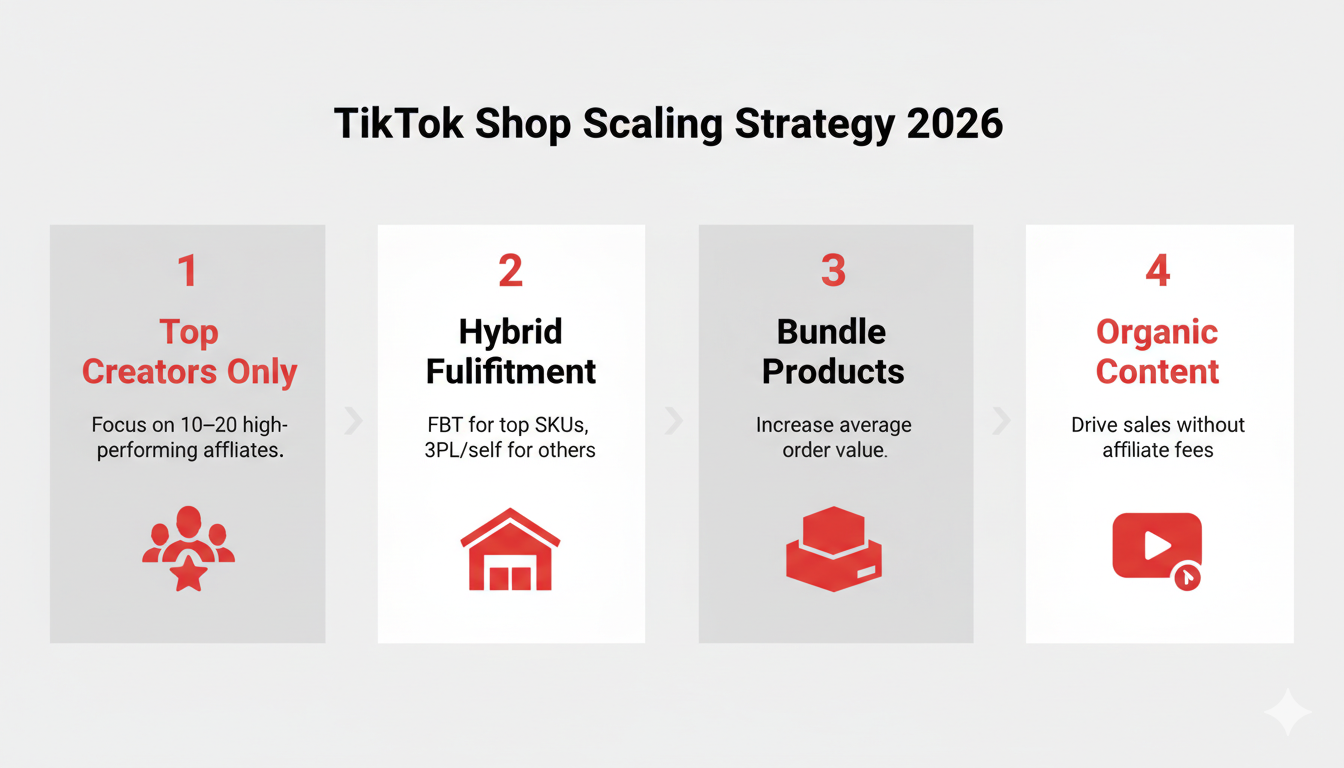
A better TikTok Shop scaling strategy: identify the 10 to 20 creators who consistently drive high-converting, low-return sales. Build tighter relationships with those people. Offer them slightly better rates in exchange for exclusivity or priority.
Track return rate by creator. Some creators drive huge volume but also drive high returns. Those partnerships can cost more than they generate once all TikTok Shop fees are calculated against the actual net.
Use a Hybrid Fulfillment Model
Using Fulfilled by TikTok for every SKU is often not the most efficient choice.
A smarter approach: calculate your TikTok Shop FBT fees per SKU first, then run your top 20% of SKUs by volume through FBT for the algorithm benefit and fast shipping. Handle everything else through your own 3PL or self-fulfillment.
This keeps ecommerce profit margins healthier across the full catalog. You get the FBT algorithm advantage on your best sellers without accumulating storage fees on slower inventory.
Bundle Products to Raise Average Order Value
Bundles are one of the cleanest margin improvements on TikTok Shop. Because fees are percentage-based, a higher average order value means more dollars left after fees.
An $80 bundle with $28 COGS has far better economics than two separate $40 sales with the same total cost. The fee percentage is the same. The TikTok Shop profit margin per dollar spent is much better.
Bundles also tend to reduce return rates. A buyer who spent more on a set is less motivated to return one piece of it.
Build Organic Content Alongside Affiliates
Your own TikTok content is the most underused margin tool on the platform.
Every sale from your own organic video has no affiliate commission attached. The only fees are the TikTok Shop referral fee and the processing fee. That brings the total take from 33% back down to around 8%.
Even shifting 20% of your total sales from affiliate-driven to organic-driven makes a meaningful difference to your blended ecommerce profit margins.
Key Takeaway
Cut affiliate roster to 10-20 high performers. Track by return rate, not just volume.
Use FBT only for the top 20% of SKUs. 3PL for the rest.
Bundles increase AOV and reduce returns simultaneously.
Organic content is fee-efficient. Build it in parallel with your affiliate program.
How to Reduce TikTok Shop Fee Impact: 7 Practical Tips
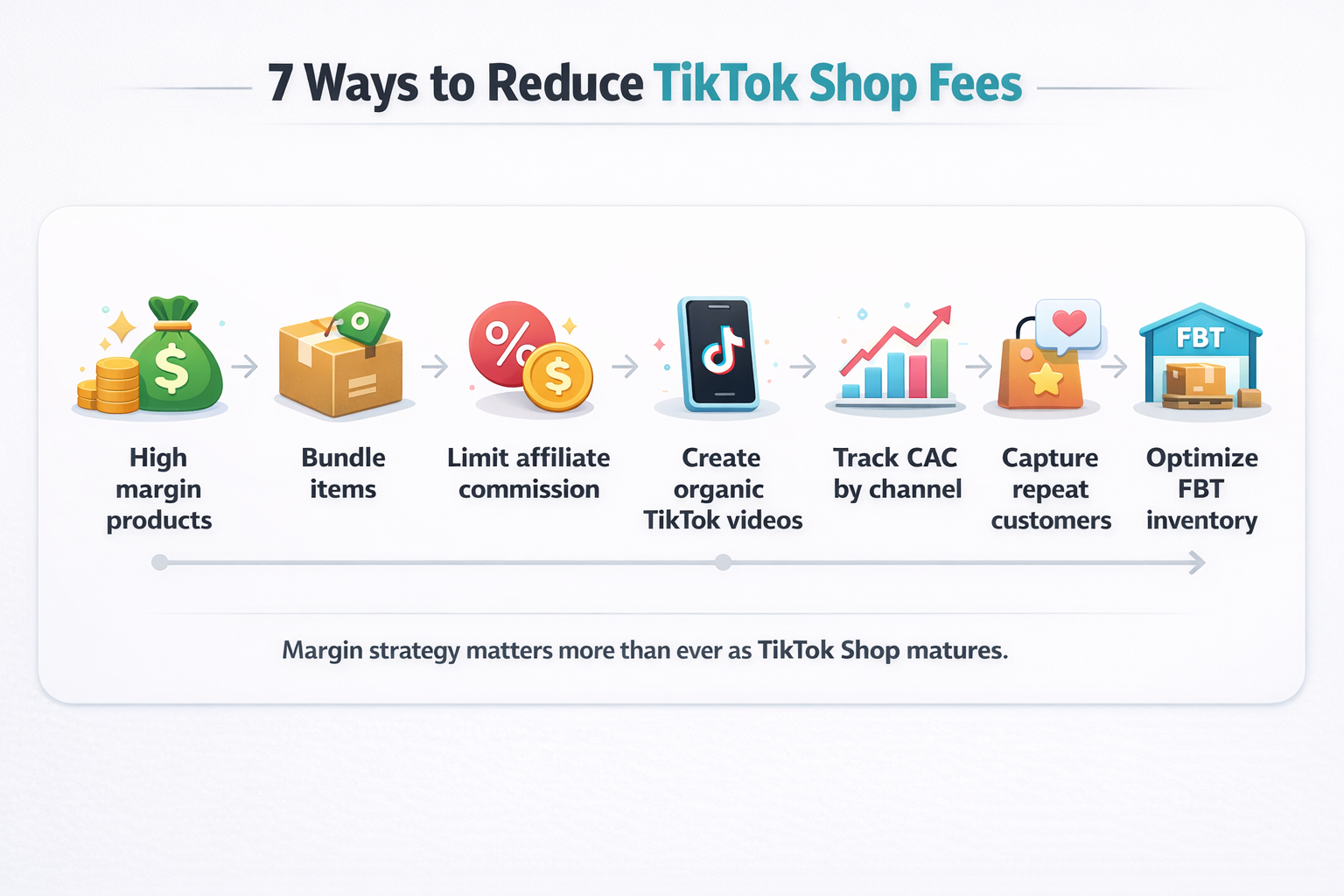
- Margin-first product selection: Only list products that can absorb 25% to 35% in combined TikTok Shop seller fees and still hit your target profit. If the math fails before you list, it will not improve after.
- Bundle to raise average order value: Higher AOV means better TikTok Shop profit margin per transaction with the same fee percentages applied.
- Affiliate rate discipline: Set rates based on your actual margin model. Market average commission rates in your category are not automatically affordable for your product.
- Build organic traffic in parallel: Every sale from your own brand content avoids creator commission entirely. Even a 15% to 20% organic sales share changes your blended cost structure.
- Track customer acquisition cost by channel: Know what each sale actually costs you across organic, affiliates, and paid channels. Allocate budget to what generates the best net profit per sale.
- Capture customers off-platform: Use packaging inserts, email capture, and post-purchase follow-up to build direct relationships. Repeat buyers who come back directly carry no new affiliate commission.
- Manage FBT inventory tightly: Review FBT inventory monthly. Pull slow-moving SKUs before long-term storage fees accumulate. FBT is efficient for fast movers, expensive for anything else.
Is TikTok Shop Worth It in 2026?
Sellers ask how much does TikTok Shop take from each sale, and whether the answer is worth paying.
The platform is still one of the most powerful product discovery engines in ecommerce. According to Forbes ecommerce trends data, social commerce is among the fastest-growing acquisition channels in 2026. Creator content drives organic sales volume that would be expensive to replicate through paid advertising on Google or Meta. For products that work in short-form video, there is no better new customer acquisition channel in 2026.
TikTok Shop hidden fees, like refund admin costs and FBT storage, are not forgiving of thin-margin products either. A 35% gross margin will not survive the full cost stack. A 70% gross margin has room to work.
The sellers who are frustrated right now never modeled the full TikTok Shop fees 2026 structure before pricing. The sellers who are winning built products and prices that work within the full fee structure from the start.
Is TikTok Shop worth it in 2026? Yes, for the right products. No, for low-margin commodity items. Understanding the TikTok Shop Commission & Fee Changes in 2026 is the filter that separates profitable sellers from unprofitable ones.
Ready to build a serious TikTok Shop operation? Contact HiSellIt to talk through whether a managed program makes sense for your product line.
Key Takeaway
TikTok Shop works well for high-margin, video-friendly products.
It does not work well for low-margin, commodity, or heavily price-competitive items.
Model the full fee structure before you decide. Not just the 6%.
Ready to Build a Profitable TikTok Shop Operation?
Understanding the TikTok Shop commission and fee structure is step one. Building a business that prices correctly, uses affiliates strategically, and scales without losing margin is the real work.
For sellers who want expert help running that operation from product setup through creator management, fulfillment, and growth, HiSellIt’s managed ecommerce automation programs are designed for exactly that.
Visit hisellit to learn more, or reach out directly to talk through your product line and what a managed TikTok Shop program would look like.
Frequently Asked Questions
Q. What is the TikTok Shop commission rate in 2026?
The TikTok Shop commission rate in 2026 is 6% of the product sale price, known as the referral fee. New sellers may receive a 2%–3% promotional rate for the first 90 days. After that period, the standard 6% rate applies. Some categories may have slightly different referral fees depending on the product type.
Q. Does TikTok Shop charge payment processing fees?
Yes. TikTok Shop typically charges around 2% per transaction as a payment processing fee in addition to the 6% referral fee. This fee is deducted before payouts are sent to sellers. On a $50 sale, the processing cost is about $1.00.
Q. How much commission do TikTok affiliates take?
TikTok Shop affiliate commissions are set by the seller but usually range from 10% to 30% of the sale price. Many creators expect 15%–25% commissions before promoting a product. This commission is paid only when an affiliate drives the sale and is deducted along with the referral fee.
Q. Are there hidden fees on TikTok Shop?
TikTok Shop does not technically have hidden fees, but multiple costs stack together. In addition to the 6% referral fee, sellers may also pay affiliate commissions, refund administration fees, fulfillment costs, and other deductions. When combined, the total effective take-rate on affiliate-driven sales can reach 30% to 35% of the sale price.
Q. What is the total effective take-rate on TikTok Shop in 2026?
The official TikTok Shop referral fee is 6%, but the total effective take-rate is usually higher. When payment processing, affiliate commissions, and returns are included, sellers often see a blended take-rate between 18% and 33%, depending on their sales mix.
Q. How do you calculate TikTok Shop profit?
TikTok Shop profit is calculated by subtracting platform fees and product costs from the sale price.
Formula:
Net Profit = Sale Price − Referral Fee − Processing Fee − Affiliate Commission − Cost of Goods − Shipping
For example, a $50 sale with $18 COGS and 20% affiliate commission generates about $15.50 profit, or roughly a 31% margin before returns.
Q. How much does TikTok Shop take per sale?
TikTok Shop officially takes a 6% referral fee on most product sales. However, the real cost per sale is often higher. When affiliate commissions, processing fees, fulfillment costs, and returns are included, the total marketplace take-rate can range from 15% to 35% of the sale price.
Q. What fees do TikTok Shop sellers pay?
TikTok Shop sellers may pay several fees depending on how they operate. The main costs include the 6% referral fee, affiliate commissions paid to creators, refund administration fees, fulfillment costs through Fulfilled by TikTok (FBT), and other adjustments that appear in Seller Center settlement reports.