
Walmart Dropshipping Product Research with AI
Walmart dropshipping product research with AI has completely transformed how online sellers discover profitable opportunities in 2026. Recent industry data indicate that sellers using AI-powered product research tools achieve up to a 47% higher success rate in product selection compared to traditional manual methods. Walmart’s marketplace now attracts over 150 million monthly visitors who actively search for competitively priced products, creating massive potential for new dropshippers.
If you are building a Walmart dropshipping business, you likely know that the most challenging part isn’t setting up the store. The challenge lies in identifying products that consistently sell well. Traditional research methods, such as scrolling through endless product pages, guessing what might work, and hoping instincts are correct, often waste time and lead to disappointing results. Artificial intelligence is revolutionizing this process by transforming Walmart dropshipping product research with AI into faster, more accurate work.
This guide explains how to utilize Walmart dropshipping product research with AI, which AI tools deliver real results, and how to transform data into informed decisions that lead to profitable products. Whether you are launching your first store or scaling an existing one, learning to use AI effectively can be the difference between guessing and actually knowing what sells.
Ready to discover how modern sellers are finding winning products faster? Explore our Walmart automation and product research services to see how we help entrepreneurs build profitable online stores with less guesswork.
Why AI Matters for Walmart Dropshipping Product Research
Manual product research was once the only method. You would spend hours reviewing bestseller lists, checking competitor stores, calculating margins, and still end up with products that failed to sell. That process was not only time-consuming but also unreliable. Many sellers discovered too late that the products they had chosen had little to no demand once they were listed.
AI tools for Walmart dropshipping product research with AI do not replace human judgment; instead, they significantly enhance it. These systems can review thousands of products in seconds, identify supply and demand gaps, predict seasonal patterns, and even detect trends before they peak. For Walmart dropshipping, AI tools help you understand which products perform best on the platform and how to position your listings to attract Walmart’s massive audience of value-focused shoppers.
The most significant advantage lies in speed and scale. While manual research may allow you to analyze 10 or 20 products a day, AI-powered Walmart product finder tools can evaluate entire categories, compare supplier pricing, and highlight high-potential items using real data rather than guesswork. This transforms a process that used to take days into one that can be completed in minutes.
What Makes Walmart Different for Dropshippers
Walmart’s marketplace operates differently compared to Amazon or eBay. According to Walmart’s official corporate news, the platform focuses on offering everyday low prices and attracts customers who seek value and reliability. The platform also maintains stricter seller performance standards, which means dropshippers must work within tighter profit margins while maintaining intense customer satisfaction.
As a result, your Walmart dropshipping product research with AI strategy must consider high-volume opportunities, limited pricing flexibility, and expedited delivery expectations. AI research tools designed for Walmart help identify products that fit these conditions. They analyze data such as average order value, seasonal demand patterns, return rates, and competitive density to determine which items are worth pursuing and which ones are not.
How AI-Powered Product Research Actually Works
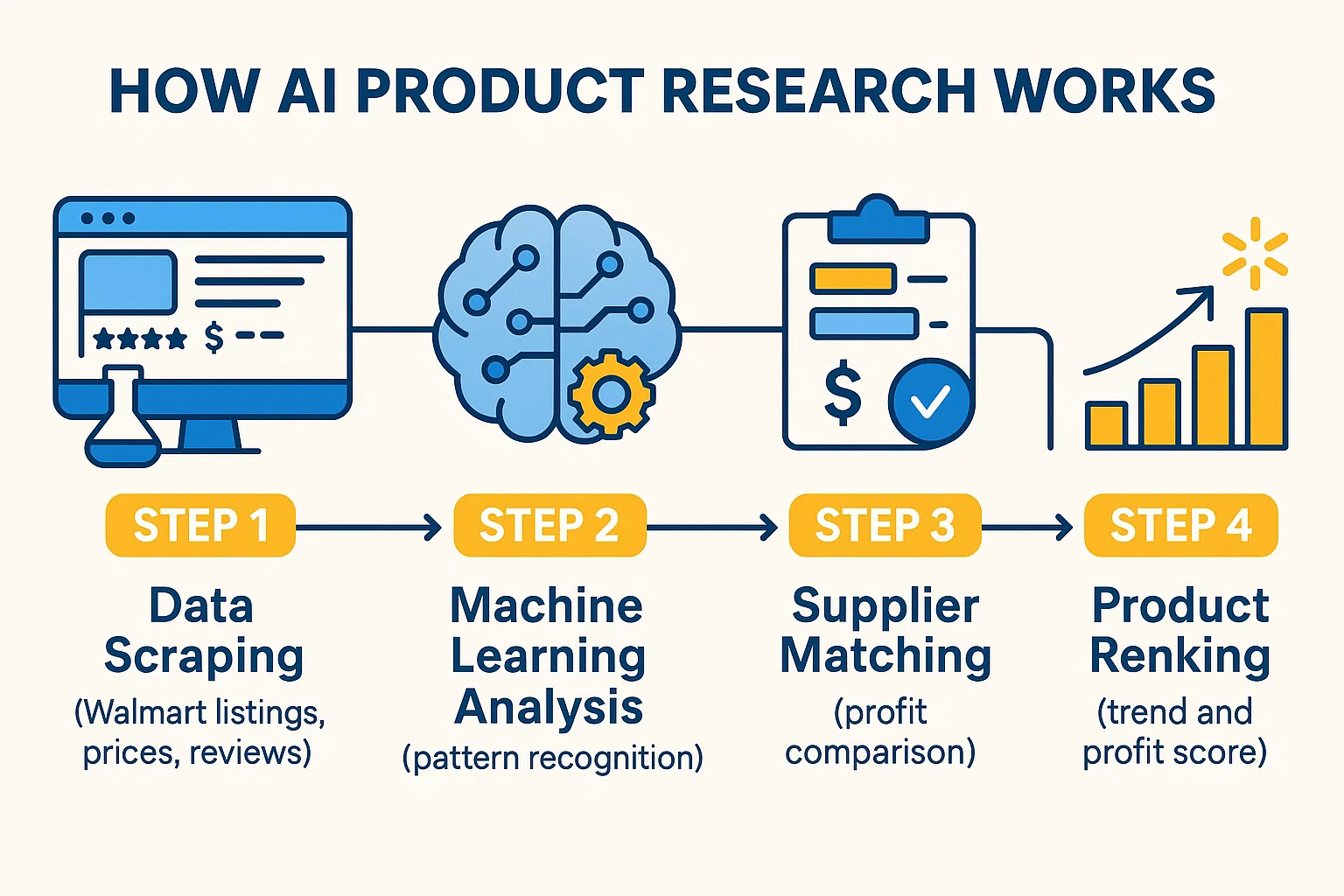
Understanding the mechanics helps you use Walmart dropshipping product research with AI tools more effectively. Most AI product research platforms for dropshipping combine several data sources and analytical methods.
First, they scrape real-time sales data from Walmart’s publicly listed items. This includes current pricing, seller count, review volume, rating trends, and inventory levels. Second, they apply machine learning algorithms to historical performance data, identifying patterns that predict future demand. Third, they cross-reference this information with supplier databases to match profitable products with reliable sourcing options.
The final result is a ranked list of product opportunities, each with specific insights, including estimated monthly sales, average selling price, number of competitors, potential profit margin, and the direction of the trend, whether it is rising, stable, or declining.
Some of the more advanced platforms for Walmart dropshipping product research with AI even use sentiment analysis, reviewing customer feedback to identify what buyers like, dislike, or wish was improved. This helps you position your Walmart listings better by offering minor improvements that current sellers may have overlooked.
For more insights into using automation in your research workflow, explore our guide on free tools that can help beginners get started and determine which tools best align with your Walmart product strategy.
Essential AI Tools for Walmart Dropshipping Product Research
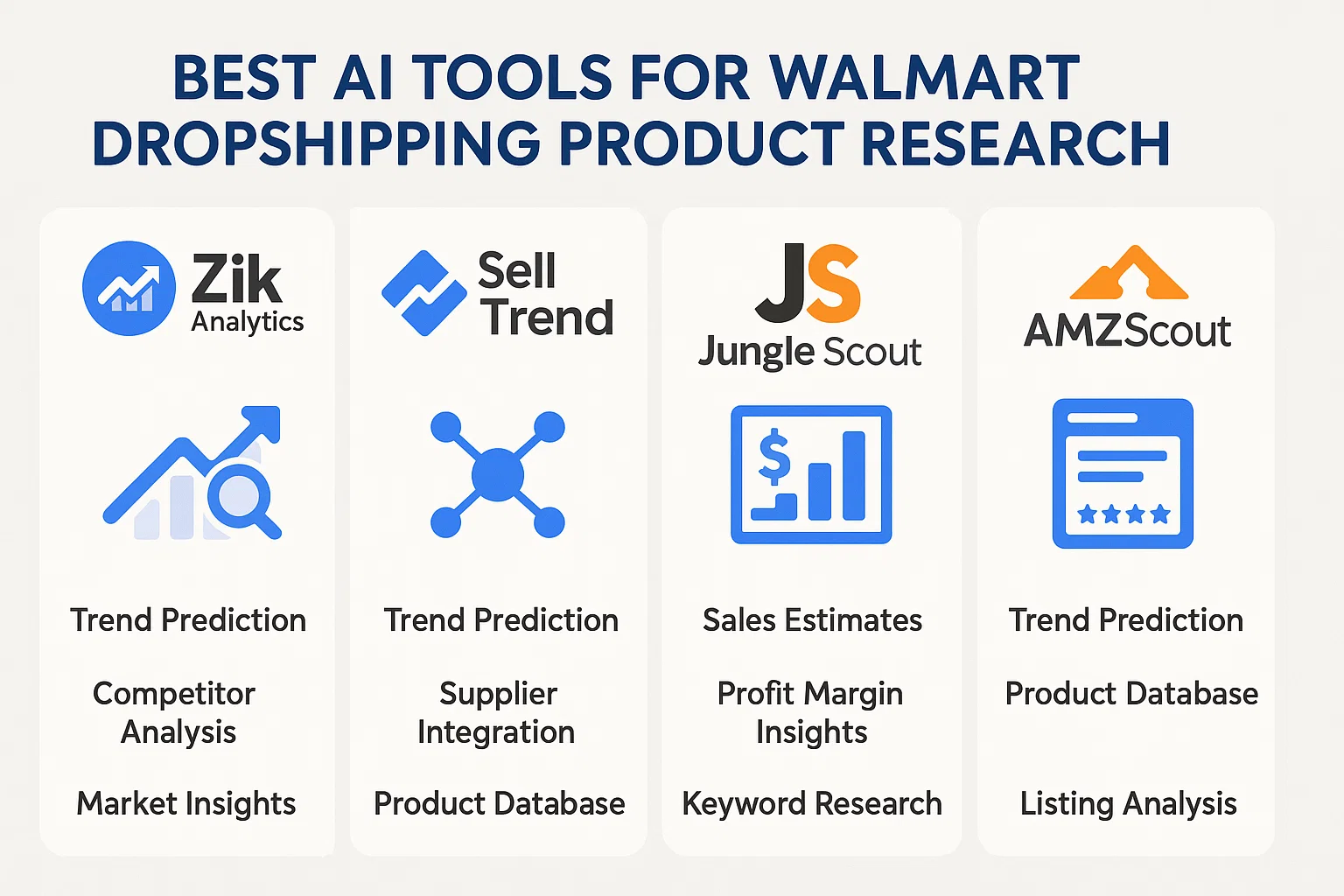
Several AI-powered tools have become reliable options for Walmart dropshipping product research with AI, focusing specifically on Walmart’s marketplace. Each one has its own strengths depending on your specific goals, experience level, and budget.
Zik Analytics began as an eBay research platform but now offers deep support for Walmart dropshipping product research with AI. It provides detailed sales analytics, profitability insights, and competitor tracking tools that make product discovery much easier. The interface is simple enough for beginners who want to understand data without feeling overwhelmed, yet powerful enough for experienced sellers refining their product strategies.
Sell The Trend stands out for its wide coverage across multiple marketplaces, including Walmart. Its AI-driven product research system helps you identify trending products early, often before saturation begins. It also connects directly to trusted supplier networks, creating a smooth path from research to listing without needing multiple tools.
Jungle Scout, initially known for its Amazon research, now also includes comprehensive Walmart analytics features. This is especially useful if you sell on both platforms, since it provides combined insights that help you find profitable products others might overlook.
AMZScout offers similar cross-marketplace functionality with a strong focus on profitability metrics. Its Chrome extension allows you to research products directly while browsing Walmart’s site, saving time and helping you evaluate items in a real context.
For those specifically interested in Walmart automation and research, our comprehensive Walmart store automation solutions integrate product research with store management, allowing you to focus on growth while we handle operations.
Choosing the Right Tool for Your Business Stage
Early-stage sellers often benefit from tools with lower monthly costs and simpler interfaces. As you scale, investing in more sophisticated platforms for Walmart dropshipping product research with AI, with deeper data and automation features, makes sense. Consider your current monthly revenue, the number of products you plan to test simultaneously, and whether you require features such as automated repricing or inventory syncing.
Most platforms offer free trials. Use them to test 3 to 5 products through the entire research process before committing to a subscription.
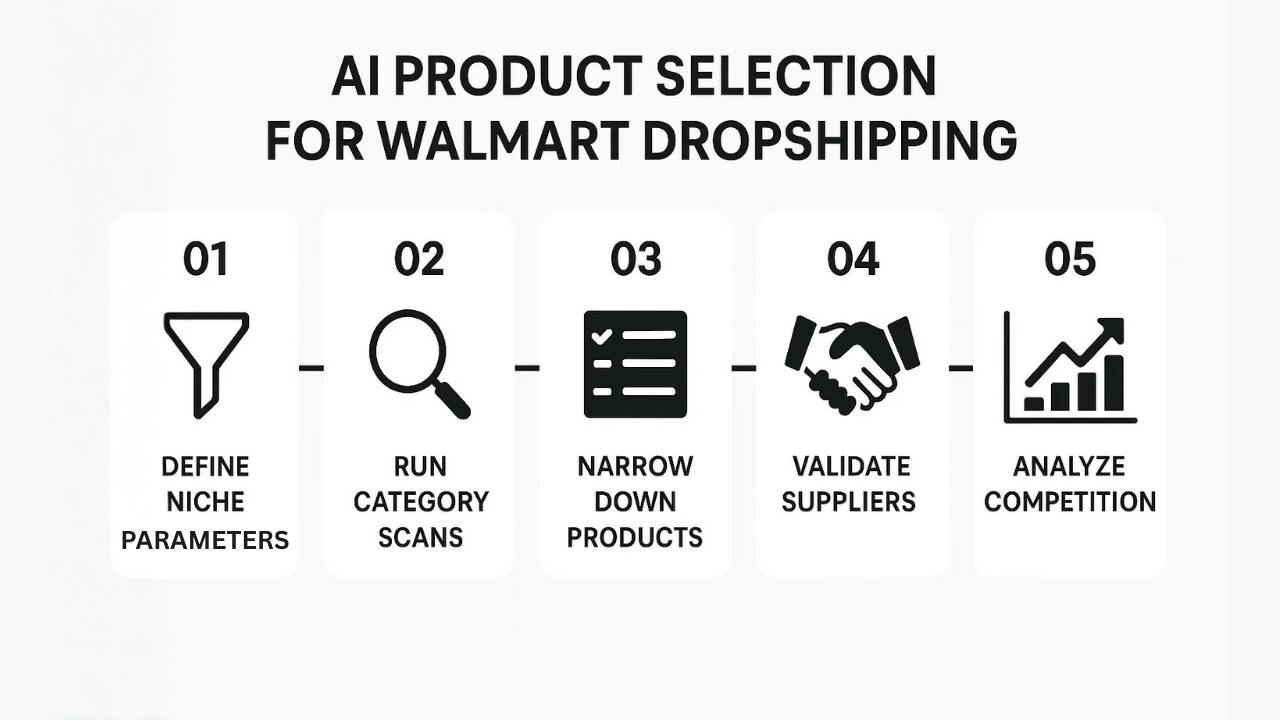
Step-by-Step: Using AI for Profitable Product Selection
Let’s walk through a realistic research workflow that blends Walmart dropshipping product research with AI and strategic thinking. This process works well whether you are launching your first store or adding new profitable products to an existing Walmart dropshipping operation.
Step 1: Define Your Niche Parameters
Before letting AI take over your Walmart dropshipping product research, set your filters. Decide on your preferred price range (products between $15 and $75 tend to strike a balance between margin and sales volume on Walmart), acceptable competition levels (fewer than 15 sellers is a good starting point), and minimum monthly search volume (1,000 or more searches indicate real demand).
These parameters enable AI tools, like Zik Analytics or Sell The Trend, to focus on products that align with your business model. Without them, you’ll waste time on results that look appealing but won’t align with your goals.
Step 2: Run Broad Category Scans
Next, run broad category scans using your chosen tool for Walmart dropshipping product research with AI. Focus on areas such as home and garden, sports and outdoors, pet supplies, or electronics accessories. At this stage, the goal is discovery, not decision-making.
Look for repeating trends. Are certain subcategories showing faster growth? Are specific price points less saturated? Are products with high demand underrepresented in listings? Tools like Jungle Scout can effectively reveal these insights.
Step 3: Narrow to Specific Product Opportunities
Once you find promising subcategories, drill down to specific items. Utilize your Walmart dropshipping product research with AI tools to gather insights, including estimated monthly sales, trend direction over the last 90 days, review volume, and seller count.
Products with consistent or rising sales and fewer than 10 competitors deserve a closer look. Also, pay attention to items with strong demand but frequent complaints in reviews. Those issues could be opportunities to differentiate through improved product descriptions, bundling, or quality assurance.
Step 4: Validate Supplier Availability and Margins
This step filters out unrealistic ideas. Utilize integrated supplier features in tools like Sell The Trend, or conduct manual research through popular supplier platforms like AliExpress, CJ Dropshipping, or Spocket.
Then, calculate your real margins by subtracting product cost, Walmart seller fees (typically between 6% and 15% depending on the category), shipping, and payment fees from your average selling price. A gross margin below 25% to 30% may not be sustainable in the long term.
Need help identifying trustworthy suppliers? Learn more about finding and vetting reliable suppliers through our comprehensive guides that outline vetting processes and partnership strategies that protect your business.
Step 5: Analyze Competition and Differentiation
Finally, use your Walmart dropshipping product research with AI tools to identify competitors selling similar products, and then review their listings manually. Study their titles, photos, and descriptions. Identify what they do well and what’s missing.
Even when products are identical, you can win through clearer photography, stronger benefit statements, or faster response times. Sometimes, minor tweaks like offering unique colors, bundle options, or more detailed listings help you outperform others in Walmart search results.
Ready to connect with our team for personalized guidance on your product research strategy? Get in touch with our experts to discuss how we can help accelerate your Walmart dropshipping success.
Advanced AI Strategies for Competitive Advantage
Basic Walmart dropshipping product research with AI gets you started. These advanced techniques help you build sustainable competitive advantages that compound over time.
Trend Prediction Before Market Saturation
The best tools for Walmart dropshipping product research with AI don’t just report current performance; they also provide insights into future trends. They predict future trends by analyzing changes in search patterns, social media mentions, and historical data from previous seasons. Learning to read these signals lets you stock products before everyone else catches on, giving you a first-mover advantage with better rankings and higher margins.
Watch for gradual increases in search volume paired with low seller counts. That combination often indicates emerging demand that has not yet attracted significant competition. Enter at this stage, and you can establish strong rankings before the market gets crowded.
Seasonal Planning with Machine Learning Models
Some platforms for Walmart dropshipping product research with AI use machine learning to forecast seasonal demand shifts with impressive accuracy. They analyze years of historical data to predict when specific products will peak, how steep the demand curve will be, and when to start reducing inventory before the crash.
This capability is particularly valuable for Walmart dropshipping because the platform’s customer base responds strongly to seasonal opportunities (back-to-school, holidays, summer outdoor products). Getting your timing right can significantly increase your profits, while being late means competing against dozens of other sellers who are racing to the bottom on price.
Review Mining for Product Improvement
AI-powered sentiment analysis tools can scan hundreds of product reviews in seconds, identifying the most common praises and complaints. Use this information to craft listings that highlight customer favorites and proactively address common dislikes.
For example, if reviews consistently mention that a product is smaller than expected, include detailed size comparisons in your listing. If customers praise durability, make that a headline benefit. This approach simultaneously improves your conversion rate and reduces returns.
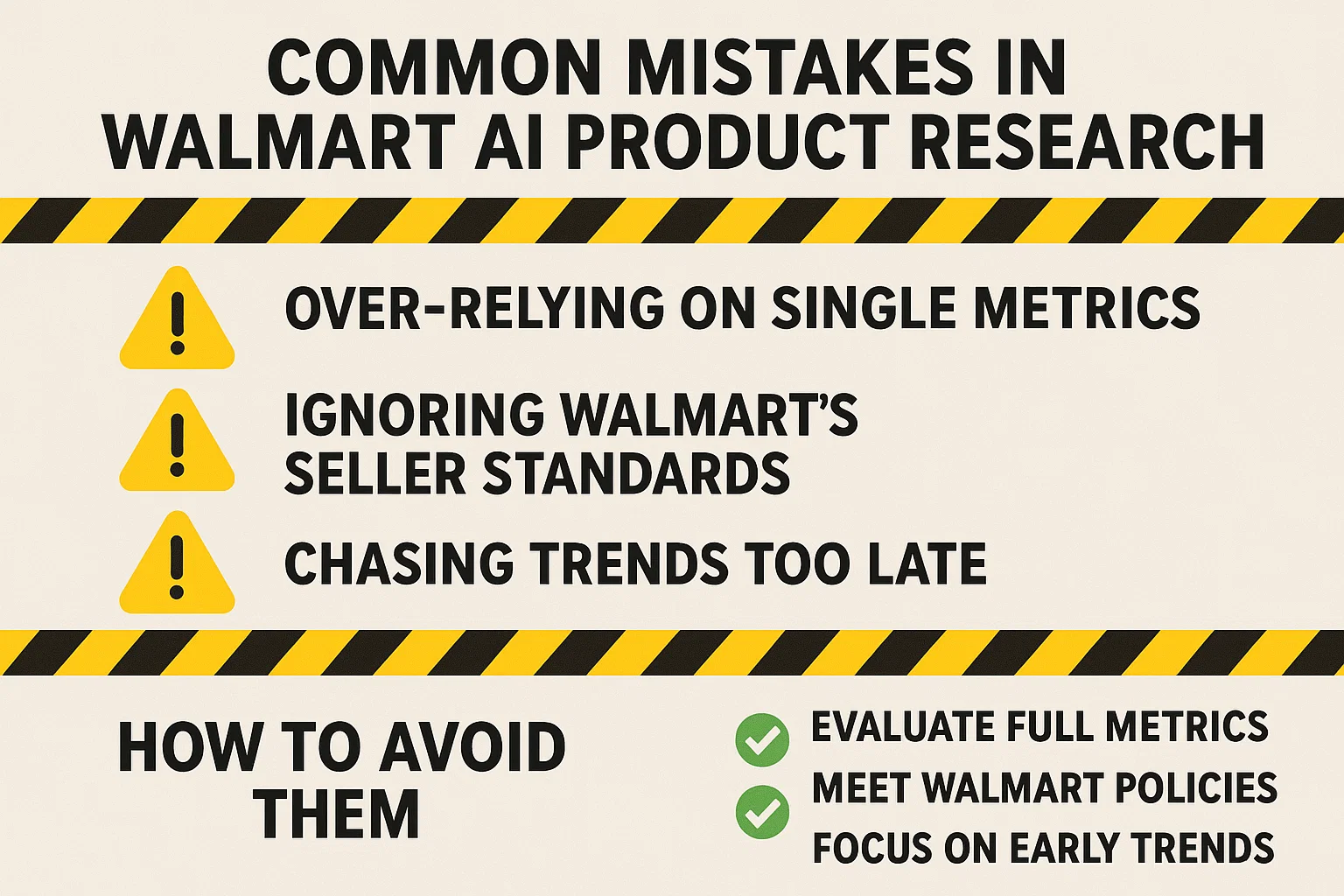
Common Mistakes in AI Product Research (and How to Avoid Them)
Even with powerful tools for Walmart dropshipping product research with AI, sellers make predictable mistakes that limit their results. Recognizing these patterns helps you avoid wasting time and money.
Over-Relying on Single Metrics
Just because a product shows high sales volume doesn’t automatically make it a good opportunity. You need to evaluate multiple factors together. High sales in a highly competitive market with razor-thin margins may generate revenue, but little profit. Moderate sales with few competitors and healthy margins often build better businesses.
Train yourself to consider the entire picture. Sales velocity, competition levels, margin potential, trend direction, and supplier reliability all play a role. Tools for Walmart dropshipping product research with AI provide you with this data, but synthesizing it into informed decisions requires human judgment.
Ignoring Walmart’s Specific Requirements
Walmart maintains stricter performance standards than many other marketplaces. According to Walmart’s official seller documentation, they monitor key metrics, including the on-time shipping rate (which must stay above 99%), the order defect rate (which should be under 2%), and the cancellation rate (which should also be under 2%). Selling products that can’t consistently meet these standards will get your account suspended, regardless of how good your Walmart dropshipping product research with AI was.
When evaluating products, consider the practicality of fulfillment. Can your supplier ship within Walmart’s timeframes? Is the product prone to damage in transit? Does it have high return rates? These operational factors matter as much as demand metrics.
Chasing Trends Too Late
By the time a product trend becomes evident to everyone, it’s usually too late to profit from it. AI tools that show you what’s popular right now are describing yesterday’s opportunity, not tomorrow’s.
Focus on tools and strategies for Walmart dropshipping product research with AI that identify emerging trends early. Look for products with gradually building momentum rather than explosive spikes (which often indicate fads that will crash just as fast). Building a business on sustainable demand is preferable to chasing viral products that burn out.
Creating Listings That Convert After Your Research
Finding a great product through Walmart dropshipping product research with AI is only half the battle. Converting browsers into buyers requires compelling listings, and this is another area where AI can be beneficial.
Modern AI writing tools can assist in drafting product titles and descriptions, but they require human refinement to resonate truly. Use them to generate first drafts based on keyword research and competitor analysis, then edit for authentic voice and specific customer benefits.
Your product title should naturally include your main keyword, specify key differentiating features, and appeal to customer motivations (rather than just describing the item). For example, instead of “Blue Yoga Mat 6mm,” try “Premium Non-Slip Yoga Mat 6mm Thick, Extra Cushion for Joints, Eco-Friendly Material”.
Bullet points should focus on benefits over features. Don’t just list specifications. Explain what those specifications mean in terms of the customer’s life. Instead of “Made from ABS plastic,” write, “Durable ABS construction resists cracking and breaking, lasting years longer than cheaper alternatives.”
Optimizing for Walmart’s Algorithm
Walmart’s search algorithm considers several factors when ranking products. Relevance (how well your title and description match search queries), price competitiveness (products priced within 10% of competitors rank better), conversion rate (a higher conversion rate signals quality to the algorithm), and customer satisfaction metrics all influence visibility.
Use your Walmart dropshipping product research with AI to identify the exact keywords customers search for, then incorporate them naturally throughout your listing. Monitor your conversion rate and adjust your pricing and imagery if it falls below 2-3%. Encourage reviews through excellent service, as products with more positive reviews tend to outperform those without.
Scaling Your Walmart Dropshipping Business with AI
Once you’ve validated several profitable products using Walmart dropshipping product research with AI, scaling becomes the next challenge. The good news is that the same tools that helped you find your first winners can help you systematically expand.
Develop a testing framework that regularly introduces new products based on AI recommendations. Allocate a specific budget (approximately 10% to 20% of your revenue) for testing 3 to 5 new items each month. Track performance closely for the first 30 days, then decide whether to scale successful products or cut underperformers.
AI tools can monitor your existing products and alert you when demand patterns change. If one of your top-selling products starts to decline, you’ll know immediately and can adjust rather than watching profits erode. Similarly, if a moderate performer suddenly experiences a surge in performance, you can increase your marketing investment to capitalize on the opportunity.
Automating Repetitive Tasks
Beyond Walmart dropshipping product research with AI, artificial intelligence can handle numerous routine tasks that drain your time. Automated repricing tools adjust your prices dynamically to maintain competitiveness. Inventory monitoring systems alert you when a supplier’s stock is running low. Customer service chatbots handle common questions, freeing you to focus on strategy.
If you’re interested in building a truly hands-free operation that combines AI research with automated fulfillment and customer service, explore how our automation services help scale online businesses and create sustainable, profitable operations.
Integrating AI Research with Other Revenue Streams
Smart sellers don’t limit themselves to a single income source. The insights you gather from Walmart dropshipping product research with AI can do more than just improve your store; they can also enhance your overall business strategy and guide you toward other profitable strategies that expand your income streams.
For instance, products that excel in your dropshipping store often present strong opportunities for affiliate marketing. The official Walmart Affiliate Program lets you earn commissions by promoting products without handling any inventory. Since your Walmart dropshipping product research with AI already highlights items with proven demand and solid conversion potential, those same products can fuel more targeted and profitable affiliate campaigns.
You may also uncover entire product categories where educational content performs exceptionally well. Writing reviews, comparison posts, or how-to guides around these items can attract steady search traffic. Building a content-based website centered on these topics opens another income channel through display ads and affiliate links while indirectly driving traffic back to your Walmart dropshipping store.
This diversified model helps protect your business against market fluctuations. If one source of income slows down, your other revenue channels can help balance the dip. With AI-powered product research tools handling the heavy data work, diversification becomes a strategic rather than random process, allowing every move to be backed by precise data and predictable patterns.
Conclusion: Your Next Steps in AI-Powered Product Research
Walmart dropshipping product research with AI is not just a trendy shortcut. It is a valuable tool and a fundamental shift in how successful sellers identify profitable products and build sustainable businesses. The data-driven approach replaces guesswork with evidence, accelerates decision-making, and helps you identify winning products before markets become saturated.
Start by choosing a tool for Walmart dropshipping product research with AI that fits your budget and business stage. Spend time learning its features instead of moving between several platforms. Define your niche clearly so the AI can filter results accurately. Then commit to a steady process where you research, launch, and evaluate new products based on the data you collect.
Remember that AI tools enhance your work but never replace strategic thinking. The Walmart dropshipping sellers who succeed in the long term combine AI capabilities with genuine customer understanding, operational discipline, and patience as they navigate the learning curve.
Your competition is already using these tools or will be soon. The advantage belongs to sellers who master Walmart dropshipping product research with AI early and build systems that identify profitable products before others.
FAQs About Walmart Dropshipping Product Research with AI
Q. How much does it cost to start using AI for Walmart product research?
Most AI product research tools for dropshipping range from $29 to $99 per month, depending on the features and data limits. Many offer free trials of 7 to 14 days, letting you test before committing. Some basic research can be conducted using free tools in combination with manual analysis; however, paid platforms can save significant time and provide more accurate data. Overall, you can start Walmart dropshipping product research with AI for under $50 per month, plus the time investment.
Q. Can AI tools guarantee I’ll find profitable products?
No tool can guarantee profits because success depends on multiple factors, including your execution, supplier reliability, customer service quality, and market timing. However, Walmart dropshipping product research with AI dramatically improves your odds by identifying products with proven demand, manageable competition, and healthy margins. Think of them as shifting your approach from guessing to informed decision-making based on real data. Sellers using AI research consistently outperform those relying on intuition alone.
Q. How long does AI product research take compared to manual methods?
AI tools can scan and analyze hundreds of products in the time it would take you to research 5 to 10 items manually. A comprehensive session using Walmart dropshipping product research with AI, which identifies 3 to 5 testable products, typically takes 2 to 3 hours, compared to 15 to 20 hours of manual work for comparable results. The time savings compound as you scale because the tools don’t slow down when analyzing larger product catalogs, while manual research time increases proportionally.
Q. Do I need technical skills to use AI product research tools?
Most modern platforms for Walmart dropshipping product research with AI are designed for non-technical users with intuitive interfaces and clear data presentations. If you’re familiar with basic software like Excel or <a href=”https://www.shopify.com/” target=”_blank” rel=”noopener”>e-commerce platforms like Shopify</a>, you can use these tools. Many provide tutorials, documentation, and customer support to help you learn their features. The learning curve typically takes a few days to a week before you’re comfortable extracting insights efficiently. No coding or data science knowledge is required.
Q. Should I use AI research for every product or just some?
Use Walmart dropshipping product research with AI as your primary research method for all potential products. The data they provide helps you make better decisions across your entire catalog. That said, combine AI insights with your own market knowledge and customer understanding. AI excels at processing large datasets and identifying patterns, but human judgment remains valuable for evaluating brand fit, understanding nuanced customer motivations, and making informed final selection decisions. The best approach integrates both AI efficiency and human intuition.
Ready to transform your Walmart dropshipping business with expert support and proven systems? Explore our complete automation solutions today and discover how we help entrepreneurs build profitable stores faster with less trial and error. Your next winning product is hiding in the data. Let’s find it together.