
Why Amazon Sales Dropped Suddenly (2026 Guide: Causes & Fixes)
Revenue was steady.
Ads were running.
Inventory was in stock.
Then the performance collapsed.
When Amazon sales dropped suddenly and nothing obvious changed on your end, the instinct is to increase ad spend or adjust pricing. Both moves without a proper diagnosis usually make things worse. The root cause matters more than the reaction speed.
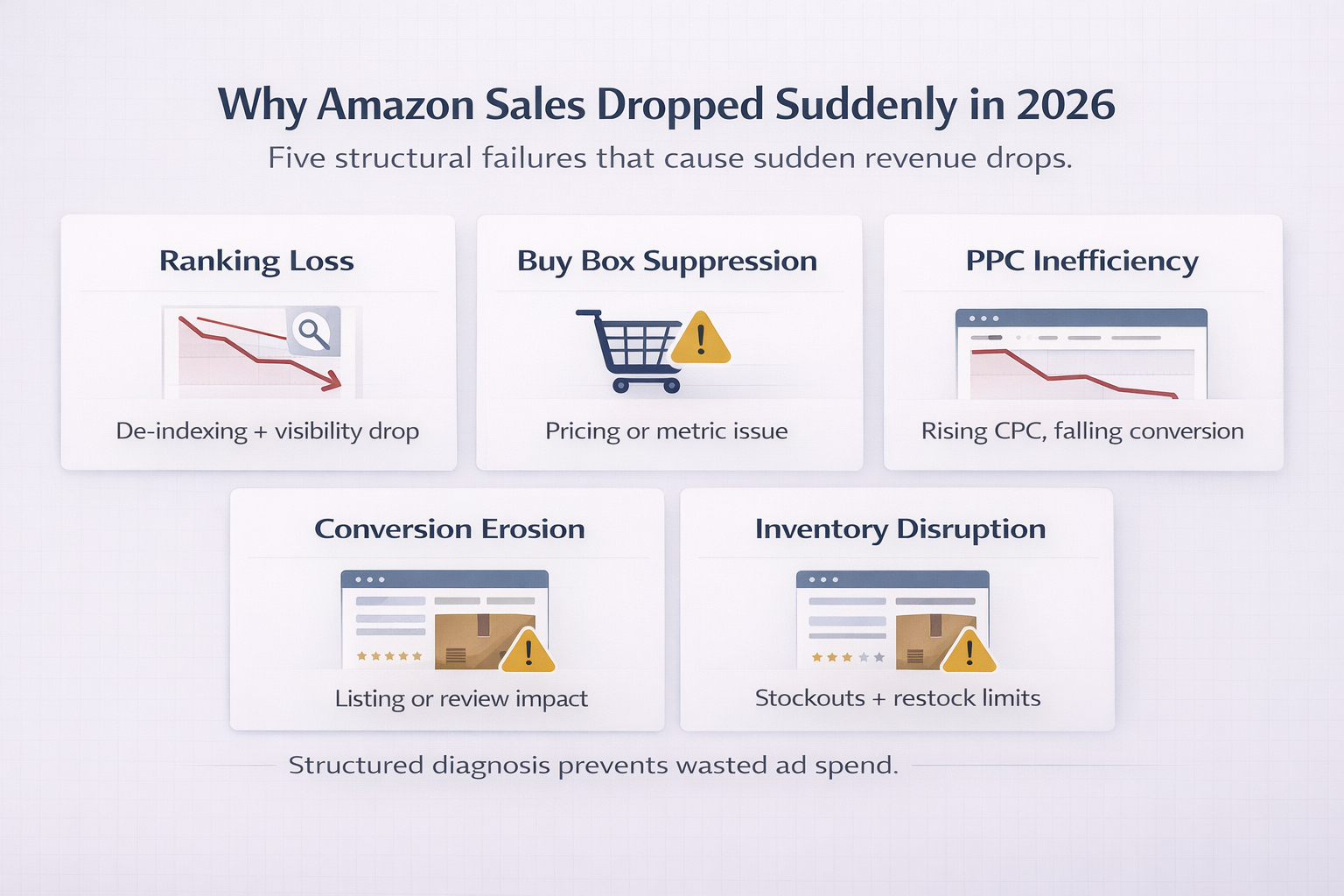
Quick answer: A sudden Amazon sales drop is caused by one of five structural failures: ranking loss, Buy Box suppression, PPC inefficiency, conversion erosion, or inventory disruption. Identifying which one is active is the only path to a clean recovery.
In 2026, sudden revenue collapses have become more frequent and more severe. The marketplace has changed structurally. Sellers who understand the mechanics behind the drop recover faster and spend less time doing it.
This guide covers all five causes in detail, a step-by-step diagnostic framework, a financial impact model, and a structured three-phase Amazon sales recovery strategy. The goal is clarity and action.
Amazon Marketplace Conditions in 2026
The Amazon sales decline 2026 pattern is not random. It reflects structural shifts that have been building for years and reached a tipping point in the current selling environment.
The A10 algorithm now weights external traffic signals, recent conversion velocity, and seller authority score far more heavily than before.
Listings that relied on organic keyword saturation without a strong sales-to-traffic ratio are losing ground. According to Jungle Scout’s 2024 State of the Amazon Seller Report, over 63 percent of active sellers cited increased competition as their top challenge.
Meanwhile, the search results page structure has shifted dramatically. Sponsored placements now dominate the top half of most category pages. Impression share for non-sponsored organic listings has contracted, meaning even a well-ranked product may receive fewer clicks than it did 18 months ago.
Additionally, CPC inflation is accelerating across competitive categories. Marketplace Pulse data shows average CPCs rising 15 to 25 percent year-over-year. That directly raises TACoS for sellers who have not restructured their bidding strategy.
Amazon has also tightened enforcement. Listing suppression, ASIN restrictions, and account health flags have all increased in frequency. For multi-SKU brands and wholesale FBA operators, one flagged product can affect the entire portfolio.
In contrast to a few years ago, a drop in organic rankings no longer self-corrects quickly. When Amazon Buy Box lost scenarios and ranking issues compound together, the revenue impact is multiplicative, not additive.
Why Amazon Sales Dropped Suddenly: 5 Core Causes
Most sudden revenue collapses trace back to one of five specific failure points. Each has a distinct mechanism, a financial consequence, and a different path to recovery.
1. Ranking and Keyword Indexing Loss
When Amazon ranking dropped, it rarely announces itself. Sales begin declining, and search position data in Business Reports starts shifting before most sellers catch what is happening.
Ranking in 2026 is tightly connected to keyword indexing health and recent conversion velocity. When a listing loses indexing on its primary search terms, it becomes invisible to the buyers searching for it.
Amazon impressions dropped is the first measurable signal that indexing loss has occurred. The ranking damage typically shows up in revenue two to four days later.
This can happen after a listing edit that removes backend keywords, after a category change, or after a stockout that breaks the velocity signal. According to Helium 10’s Amazon SEO research, even minor content changes that trigger a review can reset keyword indexing progress.
As a result, Amazon traffic decline follows within days. Sellers often mistake this for a seasonal dip when the actual cause is indexing loss that requires active correction.
Fix steps:
- Pull Brand Analytics keyword share data and identify which terms have lost visibility
- Cross-reference with the Search Term Report to confirm indexing gaps
- Re-enter backend keywords following Amazon’s current character limits
- Run Sponsored Products campaigns on lost keywords to rebuild conversion velocity
- Monitor for 7 to 10 days after changes and track the Amazon ranking dropped recovery weekly
2. Buy Box Suppression
Amazon Buy Box lost is one of the most immediate drivers of a sudden revenue collapse. Without the Buy Box, organic purchase flow stops almost entirely. Sessions continue. Revenue does not.
Buy Box suppression occurs for several reasons. Pricing parity is the most common trigger. If a product is priced higher on another sales channel and Amazon detects the violation, Buy Box eligibility is suspended immediately.
It also disappears when order defect rates spike, when fulfillment metrics fall below Amazon’s thresholds, or when FBA receiving delays push estimated delivery dates past acceptable windows.
More importantly, the Amazon account health impact of Buy Box suppression extends beyond that one ASIN. A pattern of suppression events reduces seller reputation scores and affects Buy Box eligibility across other products in the account. Amazon’s official Buy Box eligibility criteria outline the exact thresholds required.
Fix steps:
- Check Buy Box ownership status in Seller Central for each affected ASIN
- Review all active sales channel pricing for parity violations
- Pull the Account Health dashboard and resolve every open warning before attempting to restore Buy Box
- Check Order Defect Rate, Late Shipment Rate, and Valid Tracking Rate against thresholds
- See Amazon Wholesale FBA services for fulfillment compliance and Buy Box recovery support
3. PPC Inefficiency and Ad Spend Decay
Amazon PPC performance dropped is a leading indicator of a deeper structural issue. When ad-driven traffic stops converting, the algorithm reads low conversion rates as a relevance signal and reduces organic visibility further.
When ad spend efficiency falls and TACoS is rising at the same time, it points to a specific pattern worth understanding. ACOS measures ad spend against ad-attributed sales only. TACoS measures ad spend against total account revenue.
If ACOS holds steady but TACoS rises, organic sales are falling, and ads are propping up what remains. That model is not financially sustainable at scale.
However, CPC inflation in 2026 makes diagnosing this harder. WordStream’s Amazon PPC benchmarking shows broad match strategies are delivering declining returns across most categories. When Amazon PPC performance dropped, metrics appeared alongside rising impressions but falling conversions; the campaign structure itself is usually the primary problem.
Amazon TACoS being too high is not just a cost problem. It signals that the organic performance underpinning the whole account has weakened, and ads are compensating for it.
Fix steps:
- Pull a 30-day ACOS trend and identify which campaigns have drifted above target
- Pause underperforming ad groups temporarily while running the full diagnosis
- Rebuild campaigns using fresh Brand Analytics keyword data
- Shift budget from broad match to exact match to reduce irrelevant clicks
- Set a TACoS ceiling as a standing governance metric before scaling spend back up
4. Conversion Rate Erosion
Amazon conversion rate dropped is the most deceptive cause because it happens without any change in traffic volume. Sessions stay flat. Revenue falls. Fewer people are choosing to buy.
Unit Session Percentage in Business Reports is the metric to track. A decline of 20 percent or more is a direct red flag. It typically correlates with negative reviews, listing content decay, or competitor listings that have improved their presentation and are winning the comparison.
Additionally, Amazon traffic decline and conversion erosion often occur together when ranking and buyer intent are misaligned. A listing optimized for broad terms but selling a specialized product attracts low-intent traffic that will not convert. The algorithm reads that pattern as underperformance and compounds the ranking drop.
Amazon’s listing quality research confirms that main image quality and bullet point clarity are the two highest-leverage conversion variables across most categories.
Fix steps:
- Pull Unit Session Percentage and compare the current period against the 90-day baseline
- Audit main image, title, and bullet points against the top three competitors
- Review the most recent 15 to 20 reviews for expectation mismatch patterns
- Check listing content against Amazon’s current category-specific quality guidelines
- Use product selection strategy frameworks to evaluate whether the listing is attracting the right buyer intent
5. Inventory and FBA Disruptions
Inventory problems are uniquely damaging because they break the conversion velocity signal Amazon’s algorithm uses to assign ranking. An ASIN that goes out of stock loses its recent sales history weight. When it restocks, it typically ranks lower and requires a rebuild period.
The IPI score directly controls restock limits. A low score restricts how much inventory can be sent to FBA, creating a cycle where sellers cannot maintain the stock levels needed to protect their rankings.
As a result, FBA receives delays during peak periods compound this further. Pushed delivery estimates trigger automatic Buy Box suppression, which then accelerates the ranking drop. Amazon’s IPI scoring methodology identifies excess inventory ratio, stranded inventory, and sell-through rate as the three factors with the most direct score impact.
Fix steps:
- Check IPI score and current restock limits in the Inventory Performance dashboard
- Resolve stranded inventory and excess stock that is pulling the IPI score down
- Create a restock schedule based on current sell-through rate, not historical assumptions
- Review the full FBA automation cost breakdown to identify where inventory carrying costs are compressing margins
Step-by-Step Diagnostic Checklist
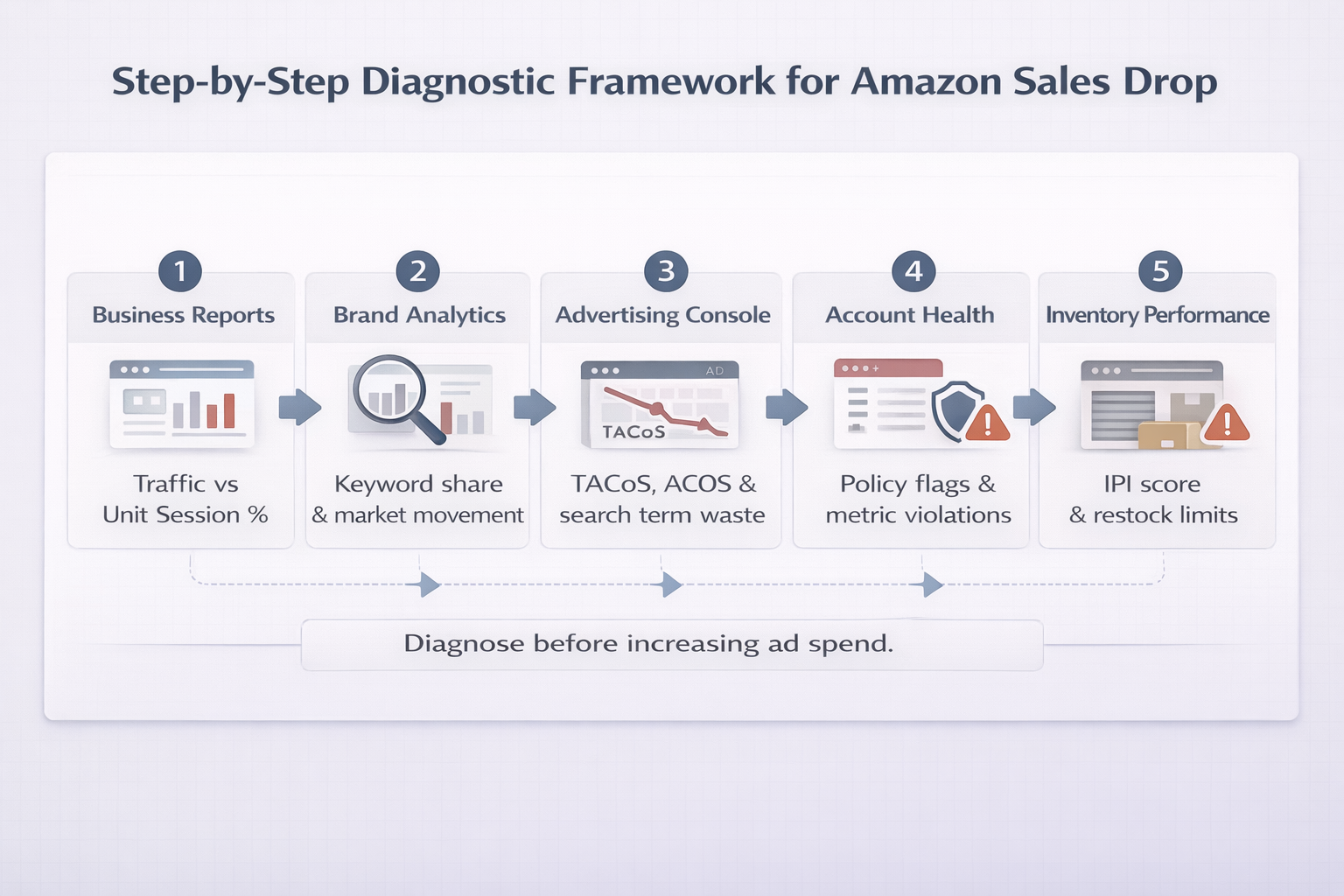
A structured diagnosis must happen before any fix attempt. Guessing at solutions wastes time and can introduce new problems. The following sequence covers the five most reliable data sources available in Seller Central.
1. Business Reports Dashboard
- Pull Sessions and Unit Session Percentage for the last 30 and 90 days
- Identify exactly when the drop started — that date is the anchor for the entire investigation
- Separate traffic loss from conversion loss, since the diagnosis path differs for each
2. Brand Analytics
- Review the Top Search Terms report to identify keyword share movement by week
- Check market basket analysis for evidence of a competitor capturing category share
- Review the repeat purchase rate to confirm whether retention has also declined
3. Advertising Console
- Review the TACoS trend across 30, 60, and 90-day windows to identify when the decay started
- Pull the Search Term Report and flag wasted spend on non-converting terms
- Check impression share by campaign to catch ad-level visibility loss and identify where reach has contracted
4. Account Health Dashboard
- Review all active policy warnings, ASIN flags, and category restriction notifications
- Check Order Defect Rate, Cancellation Rate, and Late Shipment Rate against Amazon’s thresholds
- Confirm no backend account flags exist that are not visible in the standard dashboard
5. Inventory and Fulfillment Logs
- Check for stockout events during or immediately before the decline period
- Review FBA receiving timelines for delays that may have created invisible inventory gaps
- Confirm IPI score and verify restock limits are not constraining available supply
Financial Impact Modeling
Understanding how these failure points compound financially helps prioritize which problem to solve first. A traffic drop combined with a conversion drop does not produce additive damage. It produces multiplicative damage.
Revenue Impact Formula:
Revenue Loss = (Traffic Drop % × Conversion Drop %)
+ Higher TACoS on a reduced revenue base
+ CPC inflation (margin compression per unit)
+ Refund costs (if product quality issue present)
For example, A 30% traffic drop combined with a 25% conversion drop results in ~47.5% revenue loss (0.70 × 0.75 = 0.525). The effects multiply, not add.
Layer a 10-point TACoS increase on that base, and the net profitability impact can push a previously healthy SKU into negative contribution margin territory within weeks.
More importantly, a suppression or policy warning creates a wider Amazon account health impact than most sellers anticipate. It damages ad performance scores, seller reputation metrics, and Buy Box eligibility account-wide. Every other product in the catalog feels the downstream effect.
For a detailed view of what FBA and automation costs look like against these compressed margins, the resources at HiSellIt cover the financial structure in full.
Temporary Dip vs. Structural Collapse: How to Tell the Difference
Not every revenue decline is a crisis. Some drops are seasonal, short-term algorithm fluctuations, or temporary competitor pricing plays.
However, treating a temporary dip as a structural problem leads to overcorrecting, which creates its own set of issues.
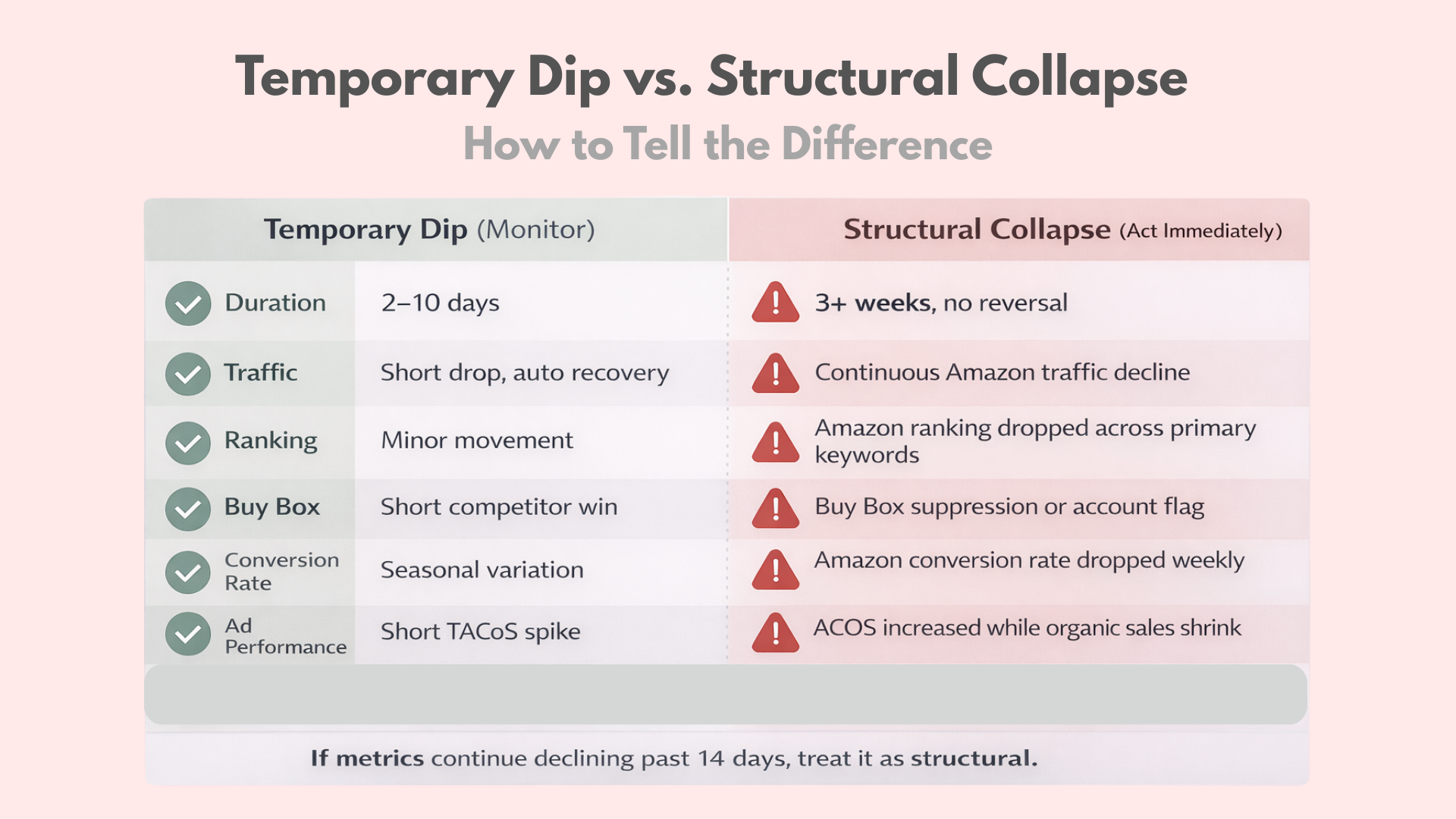
The key question is whether the decline is self-correcting. A temporary dip should show reversal signals within 5 to 10 days. If metrics are still falling at the two-week mark, treat it as structural regardless of what caused it.
If the decline is temporary, intervention should be minimal. If it is structural, delay compounds the damage.
| 🔍 Signal | 🟢 Temporary Dip (Monitor) | 🔴 Structural Collapse (Act Immediately) |
|---|---|---|
| Duration | 2–10 days | 3+ weeks with no reversal |
| Traffic Trend | Drops, then stabilizes | Continuous Amazon traffic decline |
| Keyword Rankings | Minor movement, auto-recovery | Amazon ranking dropped across core terms |
| Buy Box Status | Short-term competitor win | Buy Box suppression or account-level loss |
| Conversion Rate | Minor seasonal variation | Amazon conversion rate dropped week over week |
| Ad Efficiency | Brief TACoS spike | ACOS increased with no organic recovery |
| Impression Share | Short visibility fluctuation | Amazon impressions dropped across campaigns |
| Account Health | Clean metrics, no warnings | Policy flags, IPI decline, performance violations |
| Required Action | Monitor 5–7 days. Light optimization. | Full diagnostic audit required immediately. |
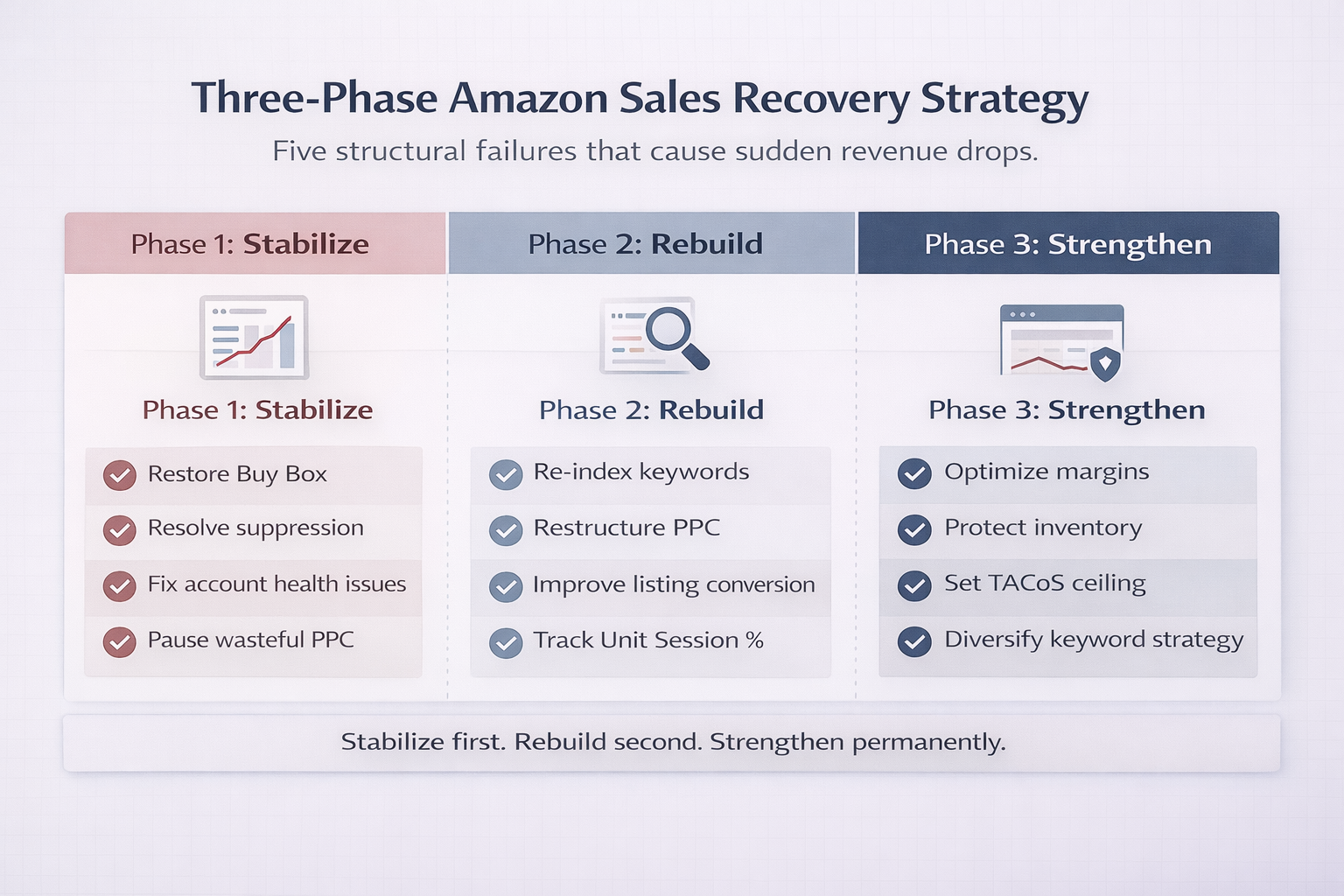
Amazon Sales Recovery Strategy for 2026: Three-Phase Framework
A structured recovery approach prevents sellers from fixing the wrong problem at the wrong time. In the Amazon sales decline 2026 environment, rushed interventions without a sequenced plan often delay recovery rather than accelerate it.
The three phases below are designed to be worked in sequence. Skipping Phase 1 before starting Phase 2 is the most common and most costly mistake.
Phase 1: Stabilize
Phase 1 is about stopping the bleeding. Every action here should remove active suppression and account for health risks before attempting to rebuild traffic or ad performance.
- Resolve pricing parity violations and fulfillment metric flags to restore Buy Box eligibility
- Address any Amazon listing suppressed status through Seller Central case management
- Clear all open Account Health warnings and confirm no ASIN or category restrictions remain
- Pause PPC campaigns that are significantly overspending without generating conversions
- Contact Seller Support to confirm no backend flags exist outside the standard dashboard view
Phase 2: Rebuild
Once stabilization is confirmed, Phase 2 focuses on restoring the traffic and conversion signals that drive organic performance. This is where the structural work happens.
- Restructure PPC campaigns using refreshed keyword data from current Brand Analytics reports
- Re-run a keyword indexing check and resubmit backend search terms where gaps are found
- Update listing content, including main image, title, and bullet points, based on the conversion audit
- Recover Amazon ranking by rebuilding conversion velocity through tightly targeted exact match campaigns
- Track Unit Session Percentage weekly against the pre-decline baseline
Phase 3: Strengthen
Phase 3 makes the operation structurally more resilient. This is the phase most sellers skip, which is why they end up in the same position six months later.
Ultimately, the goal here is to fix Amazon sales drop patterns permanently, not just recover from the current event.
- Renegotiate supplier pricing where CPC inflation has made current ACOS targets unsustainable
- Build an inventory buffer that protects against stockout-driven ranking loss in peak periods
- Set a TACoS ceiling as a standing monthly governance metric, not a quarterly review item
- Diversify the keyword strategy to reduce dependence on one or two high-volume terms that competitors can outbid
- Review the customer service model for automated Amazon stores to understand how systematic account management prevents these drops from compounding.
Conclusion
When Amazon sales dropped suddenly, the instinct is to act fast. Increasing ad spend, adjusting prices, or opening Seller Support cases all feel like progress. Without a proper diagnosis, those moves address symptoms and not causes.
The Amazon sales decline 2026 environment rewards precision over speed. The algorithm is more sensitive, competition is more aggressive, and a single account health event can cascade across an entire catalog. Sellers who diagnose first and act second recover faster and spend less doing it.
The five-cause framework in this guide covers ranking loss, Buy Box suppression, PPC inefficiency, conversion erosion, and inventory disruption. Working through them in the order shown gets to the actual problem instead of guessing at it.
Ultimately, the three-phase recovery approach provides a sequenced path from stabilization through to a stronger, more resilient operation. Stabilize first. Rebuild second. Then strengthen the business so the same drop does not happen again.
For sellers who need a professional audit before building a recovery plan, the contact page is the right starting point.
Frequently Asked Questions
Q. Why did my Amazon sales drop suddenly with no warning?
Sudden revenue drops without an obvious cause usually tie back to three things: a keyword indexing change that cut organic visibility, a Buy Box suppression event that blocked purchase flow, or an A10 algorithm update that reweighted conversion velocity.
Business Reports is the first data source to check, since it separates traffic loss from conversion loss and helps identify which problem is actually driving the revenue decline.
Q. How long does recovery take after Amazon sales dropped suddenly?
When Amazon sales dropped suddenly, recovery timelines vary by root cause. A Buy Box issue resolved quickly can improve within 24 to 48 hours.
Ranking recovery after keyword indexing loss typically takes 2 to 4 weeks, depending on how much conversion velocity was lost. Structural issues tied to account health often take longer because each case resolution adds time to the process.
Q. What does Amazon TACoS too high actually signal?
TACoS measures total ad spend as a percentage of total revenue, including organic. When TACoS is consistently elevated, it means organic sales have declined, and advertising is carrying an unsustainably large share of revenue.
Any account where TACoS exceeds 20 percent without a deliberate launch-phase rationale should be reviewed for underlying organic performance decay.
Q. What is the difference between ACOS and TACoS when diagnosing a drop?
ACOS measures ad spend against ad-attributed revenue only. When ACOS increases, it signals that campaigns are becoming less efficient per click. TACoS covers total account revenue. If ACOS holds steady but TACoS rises, organic sales are falling even though the ads are still working. That combination points to a ranking or conversion problem, not a campaign management problem.
Q. Can an Amazon listing suppress status damage rankings after it is resolved?
Yes, and this is consistently underestimated. When a listing gets suppressed, it pauses the sales velocity signal for that ASIN. Since A10 weights recent conversion performance heavily, even a brief suppression can cause a ranking drop that outlasts the suppression.
A targeted PPC push after resolution is typically required to recover Amazon ranking back toward its prior position.
Q. How do you fix Amazon sales drop problems tied to FBA inventory issues?
Start with the IPI score and restock limits in the Inventory Performance dashboard. Resolve stranded inventory and excess stock first, since those two factors carry the most weight in IPI calculations.
For ranking recovery, the priority is restocking to full capacity and running campaigns that rebuild conversion velocity. Also, review FBA receiving timelines to identify whether fulfillment delays are creating invisible stockout windows between restock cycles.