
Why YouTube RPM Is Dropping in 2026 And What to Do About It
The channel was running fine last month. Same schedule. Same niche. Same effort.
Then one morning, the revenue dashboard looked completely different. No strike. No warning. Just a lower number.
This exact situation is what sends most creators searching for answers. And the honest answer to why YouTube RPM is dropping in 2026 almost always has a real, traceable cause. However, it is rarely the one most creators assume.
In most cases, YouTube RPM dropped is not a penalty. It is not the algorithm deciding that good content deserves less. And it is almost never random.
This article diagnoses exactly what is happening, using real data points inside Creator Studio Analytics. The goal is a clear-eyed breakdown, not a panic spiral. Ultimately, there is always a measurable cause. The job is to find it. Understanding exactly why YouTube RPM is dropping requires breaking the system into measurable variables, not guessing at invisible penalties.
| Quick Definition: What is YouTube RPM?
YouTube RPM (Revenue Per Mille) is the amount a creator earns per 1,000 video views, after YouTube takes its 45% platform cut. It accounts for all revenue sources: ads, memberships, and Super Chats. Therefore, RPM is always lower than CPM because it reflects what actually reaches the creator. |
How YouTube Monetization Works in 2026
RPM vs CPM: The Difference That Matters
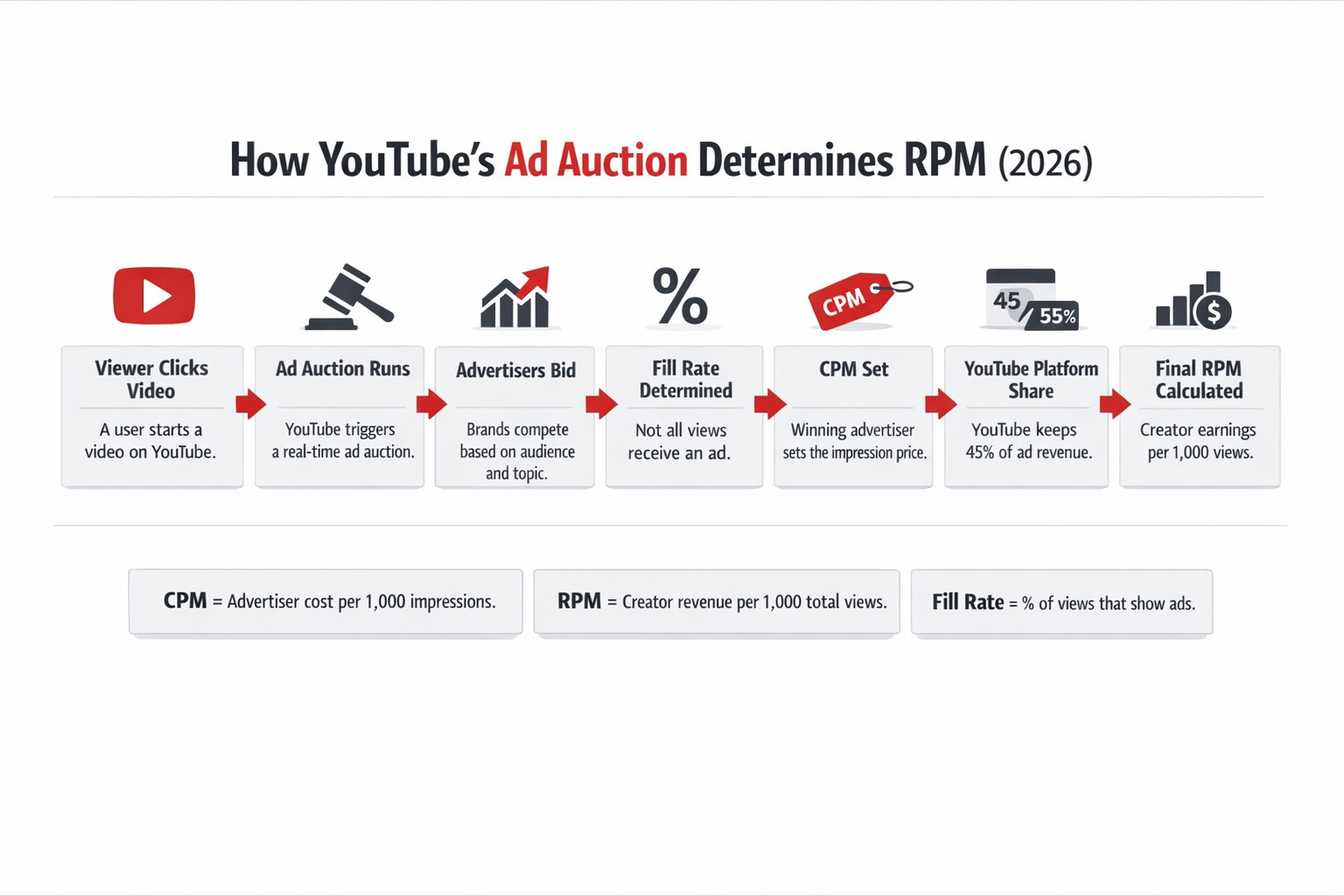
CPM (Cost Per Mille) is what advertisers pay per 1,000 ad impressions. However, RPM (Revenue Per Mille) is what the creator actually keeps per 1,000 total views, after YouTube’s platform share is removed.
Understanding the YouTube CPM vs RPM difference is the foundation of any revenue audit. For example, if CPM is $10, RPM typically lands between $3 and $5. That gap comes from three things: YouTube’s 45% cut, fill rate, how many views actually receive an ad, and unmonetized views from lower-paying countries.
For the full calculation methodology inside the YouTube Partner Program, YouTube’s official monetization documentation covers exactly how earnings are structured.
How the Ad Auction Works
Every playback triggers a real-time ad auction. Advertisers bid based on viewer geography, content category, and audience retention signals. As a result, the same video can generate very different earnings on different days, depending entirely on who is actively bidding.
Meanwhile, if no advertiser bids above the floor price, that slot goes unfilled. That is what a low fill rate on YouTube looks like. It is one of the quietest causes of RPM drops, and most creators never check it.
How Shorts Revenue Works Differently
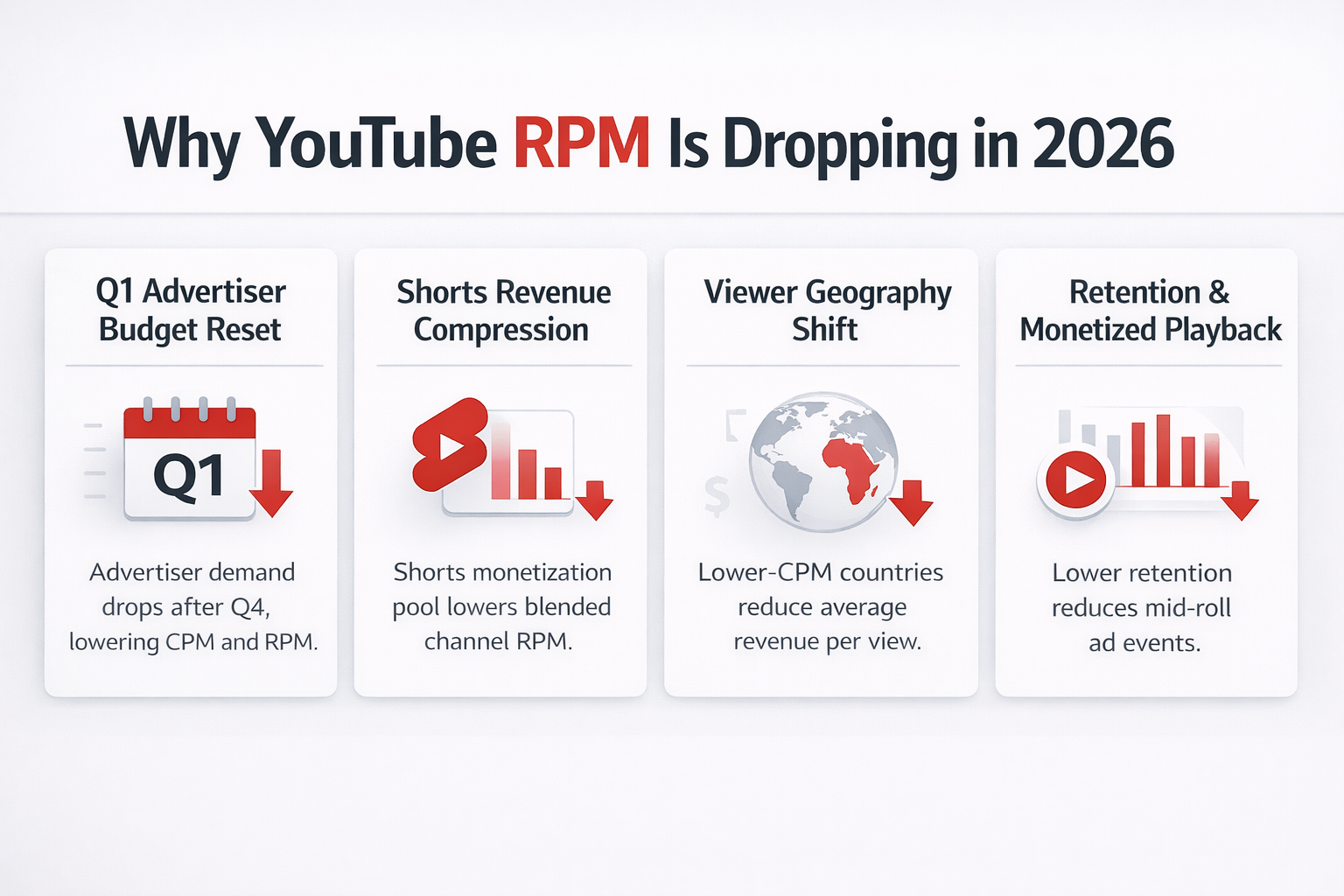
The Shorts monetization model does not use the same per-video ad auction as long-form content. Instead, revenue is drawn from a shared pool that YouTube divides across all Shorts creators. Therefore, as Shorts consumption grows platform-wide, each creator’s share of that pool shrinks, even when the total pool increases.
In contrast to long-form video, YouTube Shorts revenue is structurally lower per view. This creates a blended RPM problem for channels mixing both formats, something covered in detail in the causes section below.
Seasonal Ad Cycles, The January Reset
Historically, January and February deliver the lowest CPM of the year. Q4, October through December, is peak advertiser season. However, when January arrives, budgets reset entirely.
Finance teams approve new spending plans. Advertiser demand in the auction collapses. Fewer competitive bids mean lower CPM and lower RPM. As a result, the advertiser budget reset on YouTube every Q1 is one of the most predictable revenue drops in the calendar, and one that resolves on its own.
| Quick Definition: What is the difference between CPM and RPM on YouTube?
CPM is the rate advertisers pay per 1,000 ad impressions. RPM is what the creator earns per 1,000 total views. The YouTube CPM vs RPM difference comes from YouTube’s platform cut, fill rate losses, and unmonetized views. A high CPM with low RPM typically signals a fill rate problem or a viewer geography shift. |
What an RPM Drop Actually Tells You
Not all RPM drops are the same problem. Each has a different cause, and a different fix. As a result, diagnosing the right variable matters far more than moving quickly.
CPM Declined
Advertisers are paying less per impression. This almost always ties to a Q1 budget reset, niche advertiser pullback, or a broader slowdown in digital ad spending. Importantly, this is a market-level event, not something the creator caused or can control directly. This type of niche-level advertiser contraction often explains sudden YouTube ad revenue decline across dozens of channels at the same time.
Monetized Playback Rate Fell
The monetized playback rate measures what percentage of views that actually received an ad. When that number falls, it signals that fewer playbacks are generating revenue events. This can happen because of ad suitability restrictions on specific videos, or because fill rate dropped in certain geographies.
For example, Creator Studio’s revenue tab shows exactly which videos are receiving limited or no ads. Therefore, identifying a low monetized playback rate early is one of the fastest ways to pinpoint the revenue problem.
Viewer Geography Shifted
According to YouTube RPM by country data, U.S., U.K., Canadian, and Australian viewers generate five to ten times more revenue per view than audiences from most other regions. On the other hand, if the YouTube algorithm distribution shifts a video toward low CPM countries on YouTube, RPM falls proportionally, even if content quality and engagement signals remain unchanged.
Meanwhile, the comparison of US vs international RPM on YouTube is stark enough that a single viral video landing in the wrong region can drag down a channel’s RPM for weeks.
Watch Time and Audience Retention Dropped
Lower audience retention reduces mid-roll ad eligibility. For 8-minute-plus videos, ad insertion depends on how long viewers actually watch. Therefore, when retention slides, fewer mid-roll events trigger per view, and revenue per view quietly falls with it.
Why YouTube RPM Is Dropping for Monetized Channels in 2026
Q1 Seasonal Compression
Understanding why YouTube RPM is dropping for monetized channels in 2026 starts with separating seasonal compression from structural revenue shifts. Advertisers spend aggressively in Q4, then pause entirely while new budgets are approved. As a result, the Q1 YouTube CPM drop affects every channel simultaneously, not just yours.
Therefore, when YouTube earnings dropped overnight on January 1st or 2nd, the cause is almost certainly seasonal. It resolves in four to eight weeks without any action from the creator.
Rising Shorts Consumption Dragging Down Blended RPM
Channels blending Shorts and long-form content face a structural math problem. The Shorts vs long-form RPM gap is significant. Shorts draw from a shared pool and generate a fraction of what mid-roll-eligible long-form content earns.
Therefore, as YouTube Shorts revenue becomes a larger share of total channel views, the blended RPM calculation gets pulled down, even when long-form performance holds steady. This is one of the most common structural causes of YouTube ad revenue decline on channels that added Shorts in 2024 or 2025.
Audience Retention Erosion
When viewers drop off early, fewer mid-roll ad events trigger. For example, a 12-minute video that previously held 50% retention now holding 30% means far fewer ad placements per view. As a result, revenue per view falls quietly, without any visible flag in the dashboard.
Viewer Geography Drift
If the YouTube algorithm distribution starts pushing content to different regions, or a video gains unexpected traction in a lower-CPM country, RPM falls without any content change. In contrast to other causes, this is a distribution issue, not a content issue.
Brand Safety and Ad Suitability Restrictions
Videos covering news, politics, health, or financial controversy can be flagged under brand safety policies. When that happens, certain advertisers automatically opt out. Fewer bidders in the auction means lower CPM. However, these restrictions are visible in Creator Studio and are usually fixable with minor edits to titles, thumbnails, or video intros.
Niche Advertiser Pullback
Finance, crypto, health, and certain tech review niches are especially vulnerable. When major spenders in a category reduce YouTube budgets, CPMs across the entire niche can fall by 30 to 60 percent simultaneously, affecting every creator in that space. For industry-level context on how advertiser budgets shift, eMarketer’s digital advertising forecasts track category-level spending changes in detail.
Platform-Wide Monetization Changes in 2026
Several YouTube monetization changes in 2026 are active: updated YouTube Partner Program thresholds, revised Shorts pool allocation, and refined ad suitability scoring. However, these platform shifts account for a smaller share of observed RPM drops than seasonal and market factors do.
The YouTube Creator Insider channel publishes direct policy updates from the YouTube team, the most authoritative source for tracking what is actually changing at the platform level.
| Quick Definition: Why is YouTube RPM dropping in 2026?
YouTube RPM is expected to decline in 2026, primarily due to Q1 seasonal advertiser budget resets, rising Shorts consumption, which is lowering blended channel RPM, shifting viewer geography toward lower-CPM countries, and a niche advertiser pullback in finance and tech. Additionally, platform monetization changes under the YouTube Partner Program play a smaller but real role. |
The Revenue Audit: Finding the Real Problem
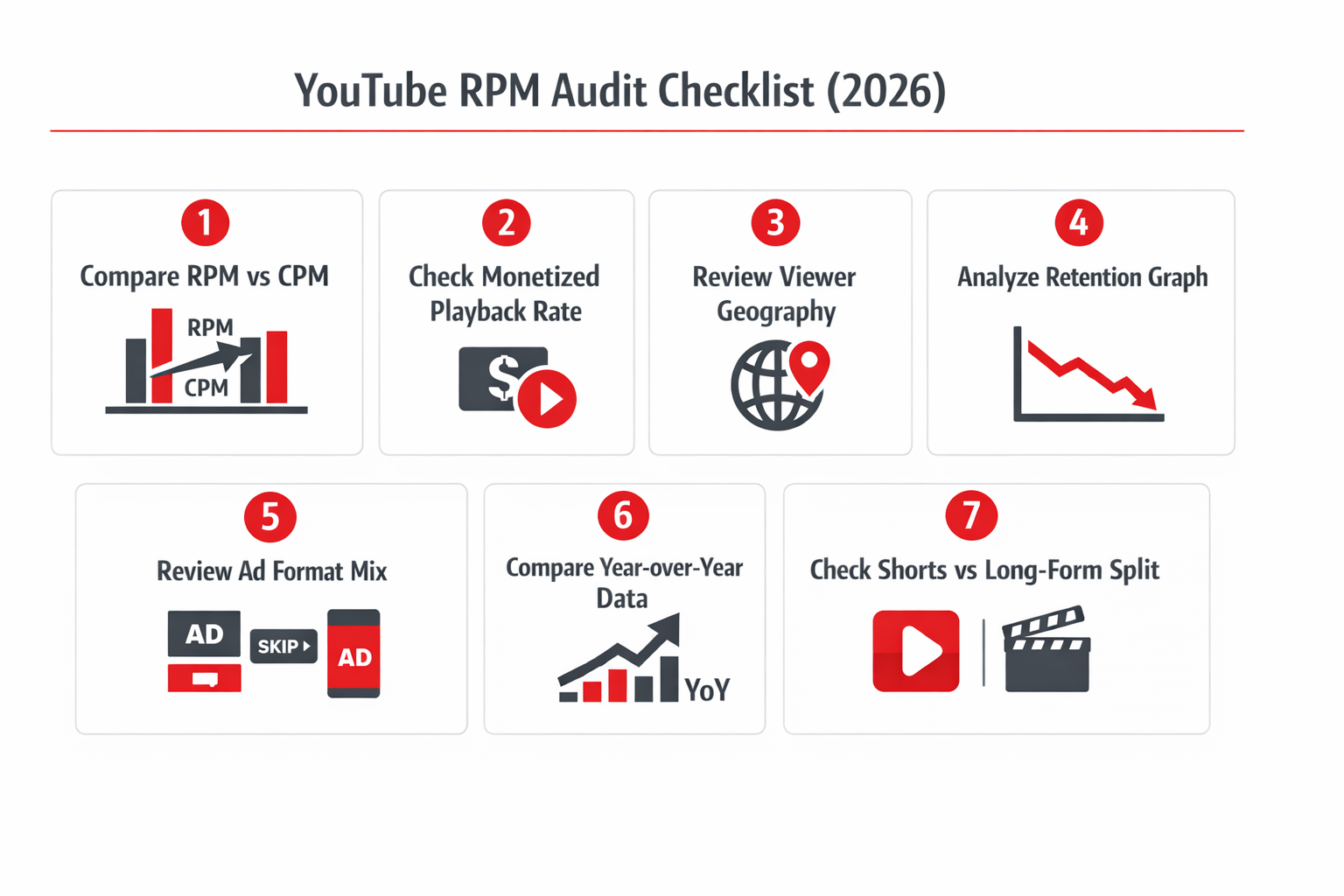
Before changing any content strategy, run this diagnostic inside Creator Studio Analytics. Each step isolates one variable. Ultimately, diagnosing the right cause prevents wasted effort and incorrect recovery attempts.
Seven-Step Audit Checklist
- Revenue Breakdown
Compare RPM to CPM. A large gap signals low fill rate or high unmonetized view percentage. - Viewer Geography
Check the top viewer countries. A shift toward lower-CPM regions explains RPM decline without content changes.
- Retention Graph
Review average view duration. Viewers dropping off before the mid-roll insertion point reduce ad events per view. - Ad Format Mix
Review skippable vs mid-roll ratio. Heavy reliance on skippable pre-roll ads produces a lower effective CPM. - Monetized Playback Rate
Check what percentage of views received an ad. Under 70% indicates a fill rate or ad suitability problem. - Year-over-Year Comparison
Compare the same month from the prior year. This separates seasonal dips from structural channel decline. - Format Split
Check Shorts vs long-form view ratio. Rising Shorts view share consistently lowers blended channel RPM.
For channels where content policy issues might be suppressing the monetized playback rate, it is worth reviewing common YouTube channel demonetization mistakes. Many ad suitability issues follow preventable patterns.
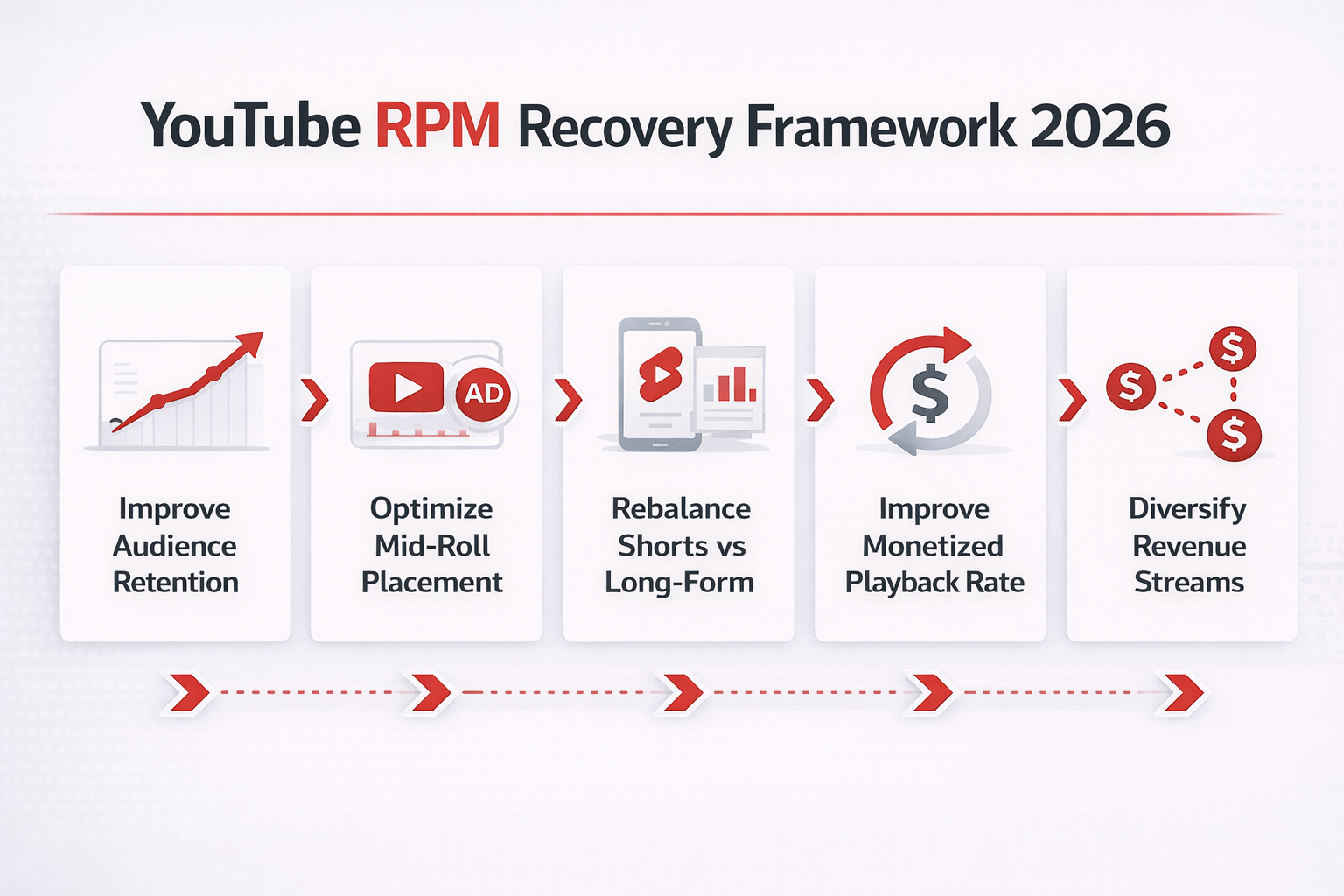
How to Recover YouTube RPM in 2026
Fix Audience Retention First
Retention is the foundation of revenue recovery. Higher audience retention means more mid-roll ad triggers per video, stronger engagement signals, and faster YouTube RPM recovery. Specifically, 40% average retention on videos over eight minutes is the minimum threshold for healthy mid-roll performance. Therefore, start with the hook, most retention problems begin in the first 30 seconds.
Place Mid-Rolls at Natural Break Points
Auto-placement for mid-roll ads is not always optimal. In contrast, manually positioning ads at scene transitions or topic breaks keeps more viewers through each ad event. As a result, this is one of the most reliable ways to improve monetized playback rate without changing upload frequency or content style.
Rebalance Long-Form vs Shorts
If Shorts account for more than 60% of total channel views, blended RPM is being significantly compressed. The Shorts vs long-form RPM gap is real and measurable. For meaningful YouTube RPM recovery, prioritize long-form content, especially videos over 10 minutes, where mid-roll opportunity is highest. Meanwhile, Shorts can still serve discovery and growth functions.
The strategic tradeoffs between format-driven and identity-driven channels, and how each one affects monetization, are covered in this breakdown of YouTube automation vs personal brand channels.
Review Ad Suitability on the Lowest-Earning Videos
In Creator Studio, sort videos by monetized playback rate. The lowest-performing videos are most likely flagged under brand safety policies. For example, minor adjustments to titles, thumbnails, and opening scripts can restore full ad serving, without touching the actual content.
Increase YouTube RPM Through Advertiser Alignment
One of the most direct ways to increase YouTube RPM is to produce content that attracts higher-bidding advertisers. Finance, software, business, and productivity niches consistently command higher CPM. Additionally, creating content that targets U.S. and U.K. audiences increases viewer geography quality, which directly raises the blended RPM calculation.
Diversify Revenue Beyond Ad Dollars
Over-reliance on a single YouTube ad revenue stream creates compounding fragility. Therefore, layering in memberships, affiliate income, digital products, or brand sponsorships reduces RPM volatility risk.
For channels exploring systematic approaches to this, this guide on whether YouTube automation is actually saturated covers sustainable revenue diversification in practical terms.
Additionally, understanding how advertisers decide where to spend helps creators align content with premium CPM categories. Google Ads Help Resources explain the exact targeting and bidding logic that determines which content attracts the highest advertiser demand.
The Biggest Misconception About RPM Drops
| The truth most creators miss:
YouTube does not randomly reduce creator earnings. RPM moves because advertiser economics move and because audience behavior signals change. It is not punishment. It is a market response. |
The most damaging belief is this: YouTube revenue suddenly down means the platform is quietly penalizing the channel. In reality, when YouTube RPM is dropping across a niche, it almost always reflects the same advertiser pool getting smaller for every creator at once.
For example, when fifty finance creators all report the same RPM drop in the same two-week window, that is not fifty separate penalties. That is one market event triggering across an entire advertiser category simultaneously.
On the other hand, treating a market correction like a content crisis leads to reactive decisions: deleting videos, pivoting niches, uploading frantically. As a result, those decisions disrupt the natural recovery cycle. The correct move is to run the Creator Studio Analytics audit, identify the real variable, and respond proportionally.
Temporary Drop vs. Structural Problem
Temporary Causes (Self-Correcting)
- Q1 seasonal advertiser budget resets are predictable happens every January
- Campaign pauses following the Q4 holiday rush
- Short-term YouTube algorithm distribution testing phases
- Brief CPM compression isolated to one advertiser category
Structural Causes (Require Real Action)
- Channel increasingly dominated by Shorts views, Shorts vs long-form RPM gap widens
- Audience geography shifting toward lower-CPM countries over time
- Audience retention consistently falling below mid-roll viability thresholds
- Primary niche advertisers are permanently reducing YouTube spend
Temporary drops self-correct within one to two months. Structural problems, however, will not be resolved without deliberate action. Therefore, the most common error is applying a structural solution, overhauling content strategy, to a temporary seasonal dip that would have fixed itself in 30 days.
When RPM Instability Becomes a Bigger Problem
Channels generating meaningful income from the YouTube Partner Program face compounding risk when RPM volatility becomes frequent. A single platform. A single revenue stream. And that stream responds to forces entirely outside the creator’s control.
When creators ask why is my YouTube revenue lower month after month, not just in Q1, the question shifts. It is no longer about diagnosing a drop. It becomes about building a revenue model that does not collapse when CPM does.
By building audience ownership, the platform cannot touch email lists, community platforms, or owned products, and it reduces the impact of any future RPM decline. The goal is not to abandon YouTube. It is to ensure that no single CPM shift triggers a cash flow crisis.
Realistic Recovery Timelines
Getting the timeline right matters. Moving too fast disrupts natural correction cycles. Waiting too long on a structural problem makes it worse.
| Situation | Timeframe | Best Move |
| Seasonal drop | ~30 days | Wait it out. Do not react. |
| Retention sliding | 30–60 days | Fix hooks and video pacing |
| Geography shift | 60–90 days | Realign content and audience targeting |
| Full format pivot | 90+ days | Diversify revenue streams now |
However, these timelines only apply if the correct diagnosis was made first. Applying a 90-day structural pivot to a seasonal dip that would have resolved in 30 days wastes momentum, and vice versa.
Final Take
Understanding why YouTube RPM is dropping in 2026 starts with one simple acceptance: the system is mechanical, not personal. Advertiser demand sets CPM. Audience behavior sets the monetized playback rate. Content format determines how many ad events happen per view. None of those are random.
For most channels, these drops are temporary, seasonal, market-driven, and self-correcting. For others, the data reveals something structural: retention sliding, geography shifting, and Shorts consumption compressing the blended average down. Those require real action.
However, both are solvable. The difference is identifying which one is actually the problem. Run the Creator Studio audit. Check the right numbers. Make decisions based on what the data shows, not on worst-case assumptions.
Ultimately, creators who treat YouTube monetization as a system to understand and manage, not a black box to fear, consistently navigate RPM drops in better shape than those who do not.
Frequently Asked Questions
Q. Why is YouTube RPM dropping in 2026?
When creators ask why YouTube RPM is dropping in 2026, the answer usually traces back to seasonal advertiser resets, Shorts compression, or geography shifts. Additionally, YouTube monetization changes in 2026, including revised YouTube Partner Program thresholds, play a smaller but measurable role. However, for most creators, the cause is market-driven, not platform punishment.
Q. Why did my YouTube RPM drop overnight?
An overnight YouTube RPM dropped event typically points to one of three causes: a Q1 seasonal advertiser budget reset, a viewer geography shift toward lower-CPM countries, or reduced monetized playback rate from ad suitability restrictions. Therefore, open Creator Studio Analytics and check which specific metric moved. In most cases, the cause is external and resolves within 30 days.
Q. Does YouTube lower RPM for certain niches?
YouTube does not manually lower RPM by niche. However, niche advertiser pullback, when primary spenders in a category reduce budgets, compresses CPM across the entire niche simultaneously. Finance, crypto, and health content are most vulnerable. As a result, when the main advertisers in a space reduce YouTube spend, every creator in that niche sees lower CPM.
Q. How long does RPM recovery take?
Recovery timelines depend on the cause. Seasonal drops resolve in approximately 30 days. Rebuilding audience retention takes 30 to 60 days. Geography or audience composition shifts take 60 to 90 days. Full structural pivots, format or niche changes, take 90-plus days before stable YouTube RPM recovery appears in the data. As a result, correct diagnosis is the most important first step.
Q. Do Shorts reduce overall channel RPM?
Yes, in most cases. The Shorts monetization model draws from a shared pool and generates significantly lower per-view earnings than mid-roll-eligible long-form content. Therefore, as Shorts views grow as a percentage of total channel views, the blended RPM falls. Shorts are valuable for discovery. However, YouTube Shorts revenue should not be relied on as a primary revenue driver.
Q. Why is CPM high but RPM low?
High CPM with low RPM reflects the YouTube CPM vs RPM difference in practice. CPM measures what advertisers bid. RPM, however, reflects what the creator receives after YouTube’s platform cut, fill rate on YouTube losses, and unmonetized views are factored in. Therefore, if many views come from low-CPM countries or the fill rate is low, CPM can appear strong while RPM stays significantly depressed.