
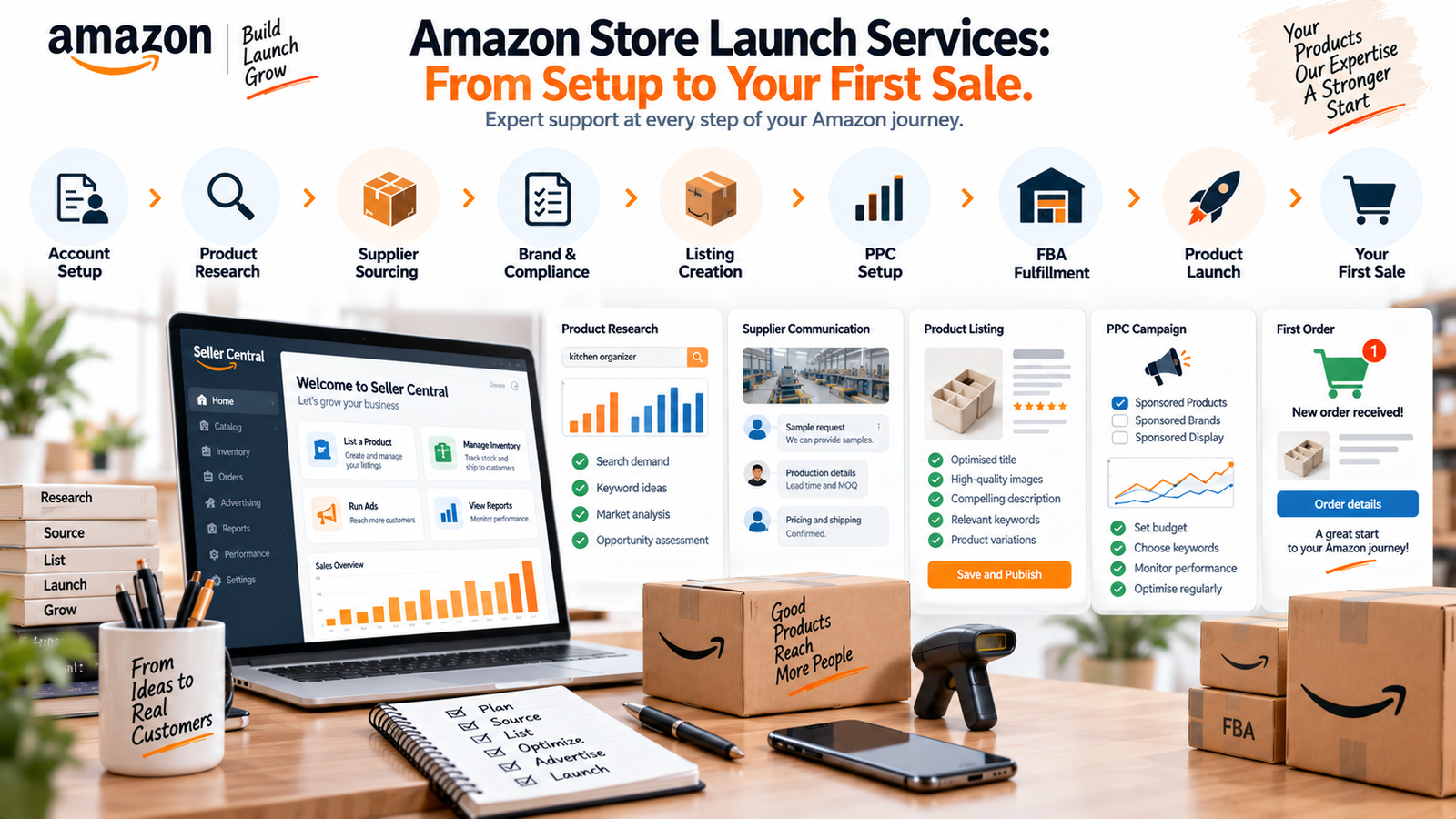
Amazon Store Launch Services: From Setup to Your First Sale
Launching on Amazon involves more than opening Seller Central. Sellers may need verification, research, supplier coordination, listings, FBA preparation, inventory, advertising, and launch monitoring. Amazon store launch services bundle some or all of that work.
This guide explains scope, the Amazon store launch process, seller responsibilities, costs, timing, risks, and provider comparison.
What Are Amazon Store Launch Services?
Amazon store launch services help launch Amazon businesses. They may cover Amazon seller account setup, product research, supplier sourcing, product listing creation, FBA configuration, Amazon Brand Registry, advertising, and inventory planning.
Some Amazon seller account setup services stop after registration. Broader Amazon store setup services and Amazon business launch services can continue through logistics, ads, and post-launch operations.
Quick Answer: What Are Amazon Store Launch Services?
Amazon store launch services are professional services that help sellers prepare and launch an Amazon business. Depending on the provider, they may include seller account setup, product research, supplier sourcing, listing creation, FBA setup, Amazon Brand Registry support, PPC preparation, inventory planning, and launch management. Services and pricing vary by provider.
What Do Amazon Store Launch Services Include?
A package may combine Amazon store setup services, Amazon product launch services, and Amazon FBA launch services. Deliverables can include competitor analysis, Amazon keyword research, product photography, inventory planning, Amazon listing optimization, Amazon PPC setup, and FBA shipment setup.
A provider may also offer an Amazon FBA setup service, an Amazon private label launch service, Amazon store management services, or Amazon PPC management. Not every Amazon launch agency covers every task.
Amazon store launch services can outsource coordination, not seller responsibility.
How Do Amazon Store Launch Services Work?
An Amazon launch service provider starts with the model, budget, product, marketplace, and goals. Amazon store launch services should turn that into a written scope. A clear Amazon store setup service should define ownership, approvals, ad budgets, and post-launch support.
The Amazon store setup process should show outsourced work and seller approvals.
| Launch Stage | Typical Work | Seller Involvement |
| Initial planning | Goals, budget, business model | High |
| Product research | Demand and competition | Medium |
| Supplier sourcing | Supplier search, quotes, samples | High approval involvement |
| Seller Central | Registration and verification | High |
| Listing creation | Copy, keywords, images | Medium |
| FBA setup | Prep and shipment planning | Medium |
| Advertising | Campaigns and targeting | Budget approval |
| Launch | Activation and traffic | Shared |
| Optimization | Data review and adjustments | Shared |
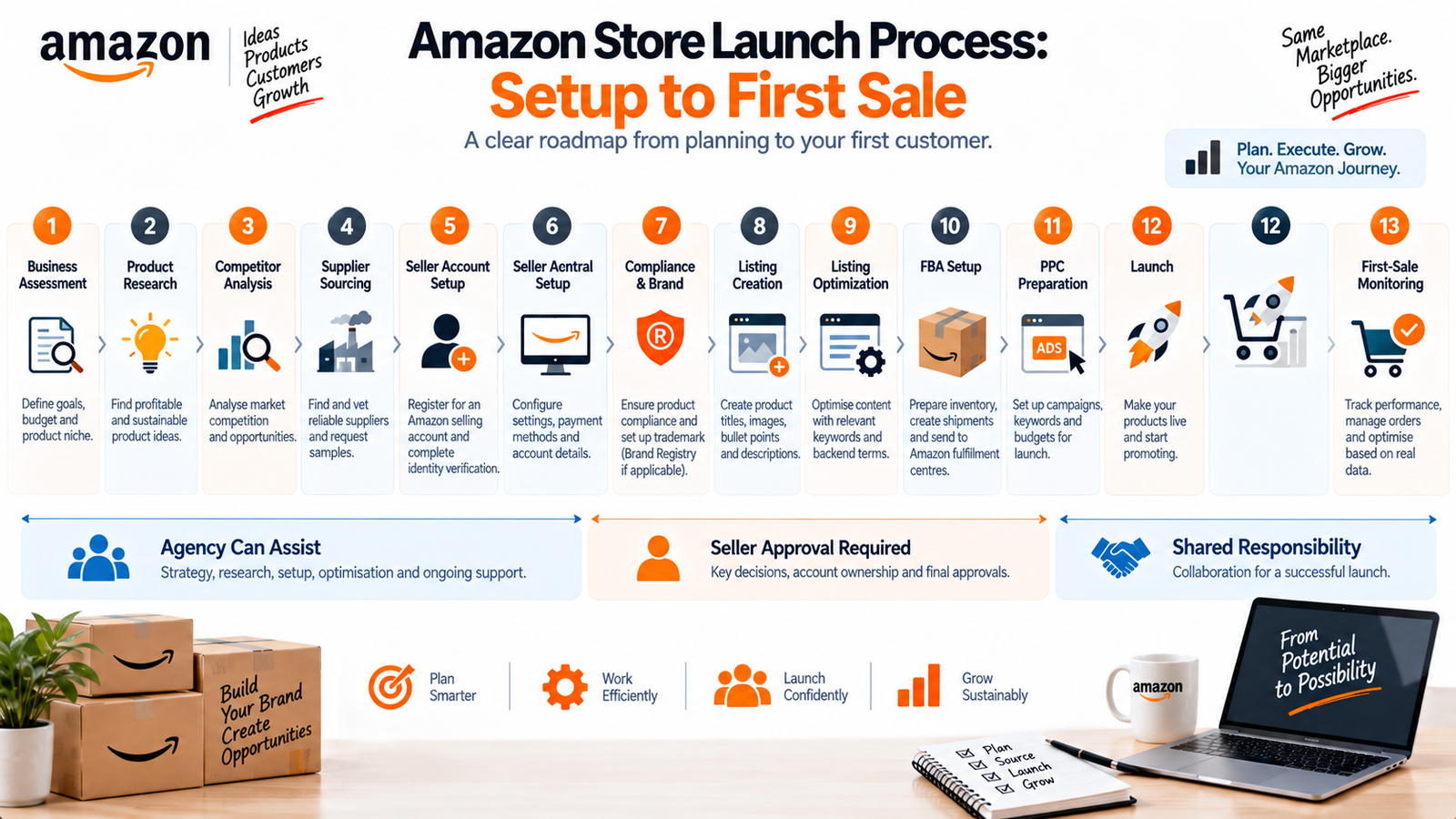
Amazon Store Launch Process: Setup to First Sale
The Amazon store launch process should move in sequence. Check inventory, compliance, pricing, creative assets, and conversion readiness before ads. A second Amazon store setup process review can catch gaps.
Step 1: Business and Product Assessment
Define the business model, marketplace, category, budget, and scope. An Amazon store setup service should state whether work is one-time or part of Amazon seller launch services.
Private label, wholesale, and other models involve different sourcing, branding, inventory, and compliance requirements.
Step 2: Product Research
Product research should test demand, price, margins, seasonality, category rules, and differentiation.
Good analysis can reduce weak assumptions, but it cannot identify a guaranteed winning product.
Step 3: Competitor Analysis
Competitor analysis should review leading listings, prices, reviews, images, offers, positioning, and keyword themes.
Those findings help shape the Amazon launch strategy without assuming competitors’ current results can be copied.
Step 4: Supplier Sourcing
Supplier sourcing may cover quotations, samples, minimum order quantities, packaging, and shipping.
The seller should still vet suppliers and approve commercial terms. An Amazon private label setup and launch service can coordinate the work, but it cannot guarantee supplier quality.
Step 5: Amazon Seller Account Setup
Amazon’s seller registration guide lists information sellers may need during registration, including identity, contact, banking, business, address, and tax details. Amazon may also require identity verification.
Amazon seller account setup must use the seller’s real information. Amazon seller onboarding can be assisted, but account approval cannot be guaranteed. Amazon seller account setup services should help organize accurate information rather than attempt to bypass verification requirements.
Step 6: Amazon Seller Central Setup
Amazon Seller Central setup covers settings, user permissions, fulfillment choices, notifications, and operational access.
Seller Central is Amazon’s central hub for listings, inventory, orders, payments, performance, and account tools. A complete Amazon Seller Central setup should keep the account and core business assets under the seller’s control throughout Amazon seller onboarding.
Step 7: Brand and Compliance Preparation
Depending on the product, setup may involve a UPC or another GTIN, a GTIN exemption, category requirements, restricted-product checks, or other product compliance steps.
Amazon Brand Registry is not required for every seller. Eligible brands with a qualifying registered or pending trademark can access additional brand-building and protection tools, including features such as A+ Content and an Amazon Brand Store. Amazon Brand Registry should therefore be treated as an eligibility-based option, not a universal launch requirement.
Step 8: Product Listing Creation
Product listing creation can cover:
- title
- bullet points
- description
- attributes
- product images
- variations
- backend information
- ASIN creation where applicable
- SKU structure
Amazon keyword research should reflect real customer language and product relevance rather than stuffing the detail page with repeated terms.
Step 9: Amazon Listing Optimization
Amazon listing optimization improves relevance, clarity, keyword coverage, and conversion readiness.
It may include backend search terms, copy improvements, Amazon keyword research, and Amazon conversion optimization. Amazon conversion optimization should make the offer clearer and more persuasive without unsupported claims.
Amazon listing optimization cannot guarantee Amazon product ranking.
Step 10: FBA Setup
The Amazon FBA launch process covers fulfillment selection, packaging, labeling, shipment planning, and inventory receiving.
Amazon’s July 2026 FBA preparation, packaging, and labeling guide stresses correct preparation before inventory is sent into the Fulfillment by Amazon network.
An Amazon FBA setup service may coordinate FBA shipment setup. Amazon FBA store setup still leaves the seller responsible for inventory, freight, preparation expenses, product compliance, and applicable Amazon fees.
Step 11: Brand Store and A+ Content
Eligible brands can use an Amazon Brand Store and A+ Content to present additional brand and product information.
Access depends on eligibility and account circumstances. These features should not be promised to every seller as part of a standard launch package.
Step 12: Amazon PPC Setup
Amazon PPC setup should follow listing and inventory readiness.
Amazon Ads says Amazon Sponsored Products are cost-per-click ads available to eligible Professional sellers with eligible products. Campaign planning can include keywords, targeting, bids, budgets, and campaign structure.
Amazon Sponsored Products can support launch advertising, while Amazon launch PPC can generate traffic. Neither can force customers to convert.
Step 13: Launch
An Amazon product launch should start with buyable inventory, compliant content, clear pricing, strong images, and prepared campaigns.
A second Amazon product launch may need different positioning. The Amazon product launch strategy should connect fulfillment, pricing, content, and advertising. A second Amazon product launch strategy can define what happens when early assumptions do not hold.
The Amazon launch strategy and Amazon sales launch strategy should define what will be monitored after activation. Useful signals can include impressions, clicks, conversion rate, ACOS, ROAS, and inventory.
Step 14: First-Sale Phase
No provider can guarantee an Amazon first sale.
Amazon FBA launch services can improve launch readiness, not control an Amazon first sale. To get your first Amazon sale, demand, product-market fit, price, competition, traffic, advertising, legitimate reviews, inventory, and conversion all matter.
The Amazon product launch process should respond to real data. A disciplined Amazon product launch process changes only what the evidence supports. Amazon product ranking and the Amazon listing conversion rate can change after launch.
 What Does the Seller Still Need to Handle?
Even with Amazon FBA launch services, the business owner remains responsible for funding, truthful business information, supplier approvals, product safety, taxes, inventory ownership, trademarks, compliance, and major spending decisions.
Amazon store setup services can coordinate execution, while Amazon account management services or Amazon store management services may continue after launch.
A full-service Amazon agency can reduce workload, but Amazon account management services should leave strategic control and ownership with the seller.
What an Amazon Launch Agency Cannot Do for You
A legitimate provider cannot:
- guarantee account approval
- guarantee a product will succeed
- guarantee rankings
- guarantee sales
- guarantee profitability
- create fake reviews
- manipulate reviews
- bypass Amazon policies
- eliminate inventory risk
- guarantee supplier quality
- remove the seller’s product-compliance responsibility
- control Amazon policy decisions
The same applies to a done-for-you Amazon FBA business. Outsourcing work does not outsource ownership or business risk.
How Much Do Amazon Store Launch Services Cost?
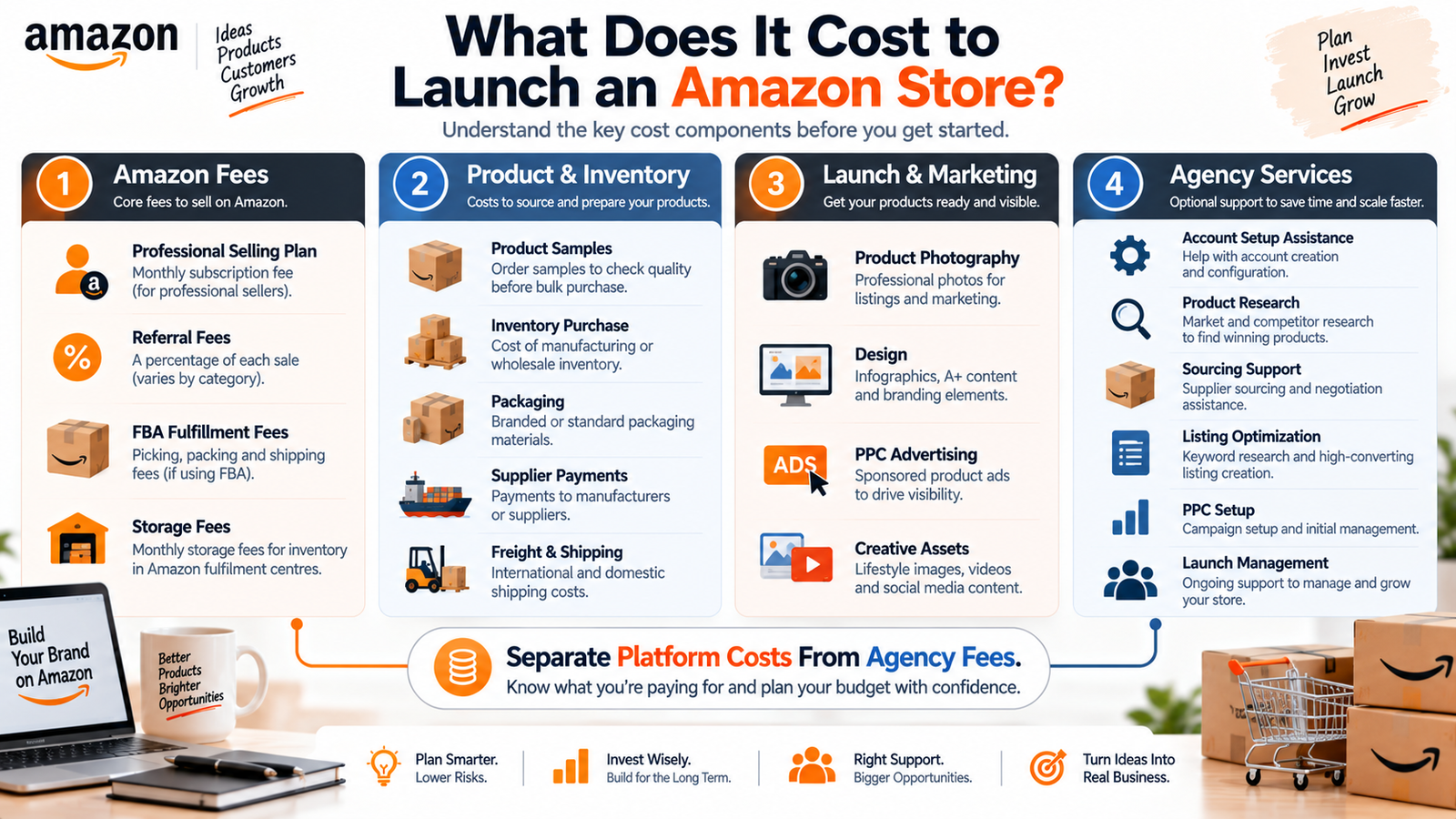
The cost to launch an Amazon store should be separated into Amazon charges, business expenses, inventory, advertising, and Amazon agency fees.
Amazon’s current seller pricing page lists the Professional selling plan at $39.99 per month plus applicable selling fees. Referral fees vary by category. Fulfillment by Amazon can add fulfillment and storage charges, while Amazon Ads spending is separate.
The Amazon store setup cost may also include:
- inventory
- samples
- product preparation
- freight
- packaging
- photography
- design
- trademarks where relevant
- advertising
A realistic Amazon store setup cost separates initial setup from recurring operating costs. The Amazon FBA setup cost depends heavily on the product, quantity, packaging, storage profile, and logistics.
Amazon launch service pricing varies by provider and scope. Some Amazon store setup services use project fees, retainers, PPC fees, management fees, percentage-based arrangements, or a combination.
Amazon store setup pricing should clearly state what is included and excluded.
| Cost Type | Paid To | Usually One-Time or Ongoing? |
| Professional selling plan | Amazon | Ongoing |
| Inventory | Supplier | Repeated |
| FBA fees | Amazon | Usage based |
| Advertising | Amazon Ads | Ongoing |
| Launch-service fee | Agency/provider | Depends on package |
| Ongoing management | Agency/provider | Often recurring |
An Amazon store launch cost is not the same thing as Amazon’s own fees.
If a buyer asks how much does it cost to launch an Amazon store, the answer should include Amazon store setup cost, Amazon FBA launch cost, inventory, logistics, creative assets, and advertising rather than quoting one misleading number.
 How Long Does It Take to Launch an Amazon Store?
There is no universal Amazon launch timeline.
Amazon says registration itself can often be completed relatively quickly, but identity verification and account review can add time. The broader launch can take longer because it may depend on:
- product research
- samples
- supplier lead times
- manufacturing
- trademarks
- Brand Registry
- product compliance
- photography
- listing creation
- freight
- FBA receiving
- campaign preparation
The Amazon launch timeline therefore depends on the specific business.
An agency can coordinate the Amazon FBA launch process, but it cannot control Amazon verification, factory delays, carrier transit, or FBA receiving.
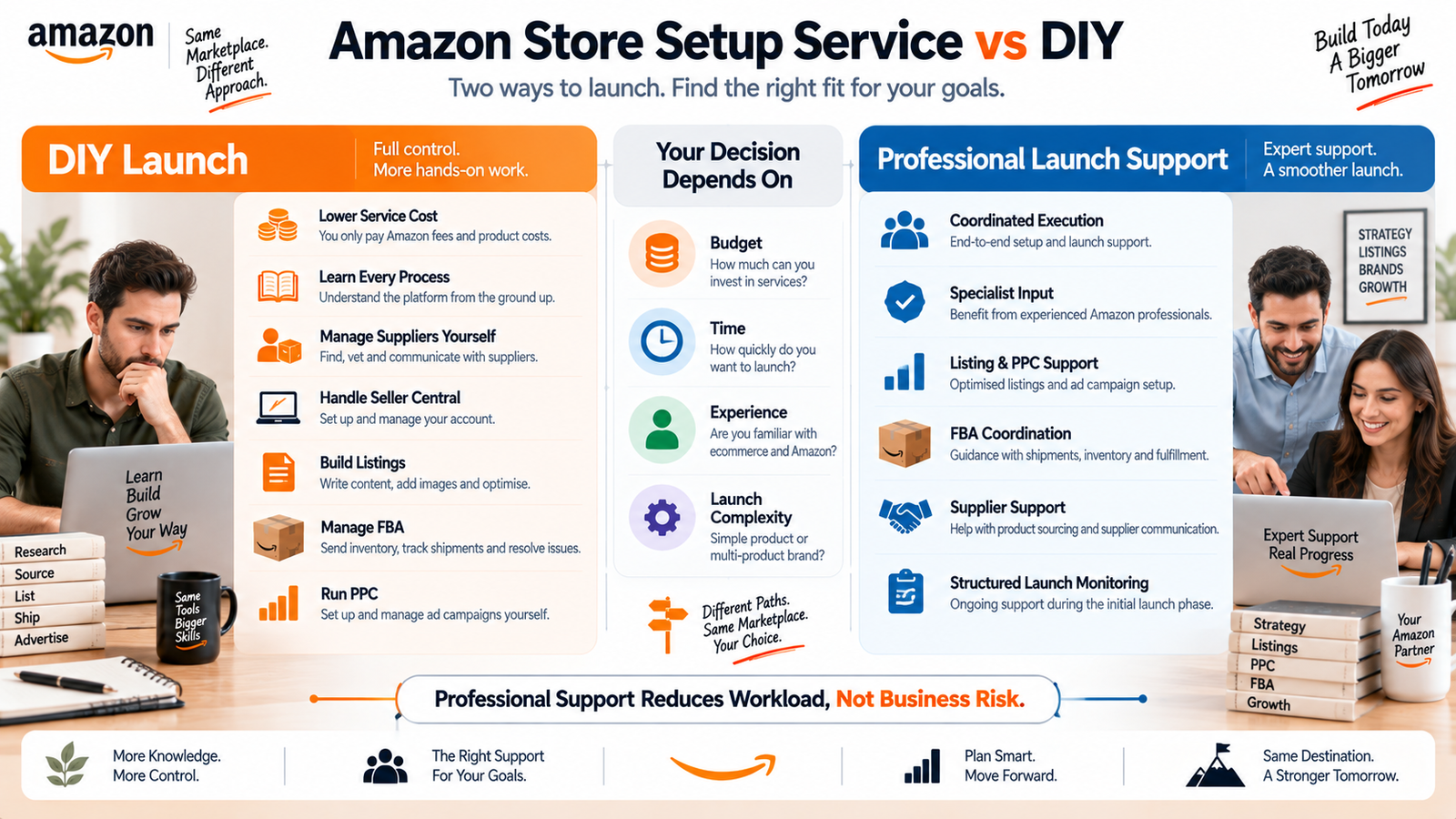
Amazon Store Setup Service vs DIY: Which Makes More Sense?
The Amazon agency vs DIY decision depends on available time, skill, budget, and launch complexity.
| DIY May Make Sense When | Professional Help May Make Sense When |
| Budget is limited | Time is limited |
| You want to learn every task | You want coordinated execution |
| Launch is simple | Many workstreams must align |
| Seller Central is familiar | Seller Central is unfamiliar |
| You can manage suppliers and PPC | Specialist support is needed |
DIY can make sense for a simple launch.
Amazon store setup services from an Amazon store setup agency may make more sense when suppliers, FBA logistics, creative assets, listings, and advertising must all be coordinated.
 Are Amazon Launch Services Worth It?
The answer to are Amazon launch services worth it depends on seller experience, available time, budget, product complexity, internal capabilities, and provider quality.
Amazon seller services can reduce coordination work and support an Amazon launch strategy, but they cannot remove normal business risk.
An Amazon FBA agency may be useful when a launch has several specialist workstreams. Comparing a second Amazon FBA agency proposal can also reveal differences in scope, ownership, and pricing.
What to Look for in an Amazon Agency
For buyers researching how to choose an Amazon agency, evaluate more than price.
Look for:
- Clear scope of work
- Transparent deliverables
- Current Amazon knowledge
- Seller ownership of accounts and assets
- Policy-compliant tactics
- Realistic expectations
- Transparent pricing
- Clear reporting
- Defined PPC responsibilities
- Defined inventory responsibilities
- A clear communication process
- Clear cancellation and contract terms
The best Amazon launch service is the one that fits the seller’s actual gaps, budget, model, and risk tolerance.
Review Amazon launch service reviews, but also ask who controls Seller Central, advertising budgets, creative files, listings, supplier relationships, and business data. Those operational questions often reveal more than testimonials alone.
Amazon Launch Service Red Flags
Be cautious with providers promising:
- guaranteed sales
- guaranteed first-page rankings
- guaranteed reviews
- guaranteed account approval
- instant passive income
- completely hands-off profits
- unrealistic revenue projections
- policy workarounds
- review manipulation
Also question unclear contracts, account ownership, inventory ownership, advertising budgets, fees, and deliverables.
If an Amazon store setup company hides account control, or an Amazon store setup agency wants ownership of core business assets, treat that as a warning.
An Amazon private label launch service should clearly define who owns inventory, supplier relationships, trademarks, creative assets, and Seller Central access.
When Does a Done-for-You Amazon Store Make Sense?
A done-for-you Amazon store can make sense when a seller has capital but lacks time or in-house expertise.
Done-for-you Amazon FBA store setup can reduce coordination across supplier sourcing, listings, FBA, advertising, and operations. It does not create a zero-work or risk-free business.
Buyers considering Amazon store setup and management services or Amazon seller account setup and management should define approval rights, account access, spending authority, and responsibilities before signing.
HiSellIt’s Amazon automation vs traditional FBA selling guide compares outsourced and hands-on models, while its guide to selling on Amazon without inventory covers business models that may reduce the need to hold inventory directly.
Final Amazon Store Launch Checklist
- Choose the Amazon business model.
- Define budget and goals.
- Complete product research and a competitive review.
- Validate product economics.
- Source and vet suppliers.
- Complete Amazon seller account setup.
- Finish identity and business verification.
- Confirm product IDs, category rules, and compliance.
- Complete Amazon Brand Registry where relevant.
- Finish listing creation and Amazon listing optimization.
- Prepare product photography and creative assets.
- Configure fulfillment and Amazon FBA store setup where used.
- Send FBA inventory and confirm receiving.
- Set pricing and offer details.
- Complete Amazon PPC setup and prepare Amazon launch PPC campaigns.
- Confirm inventory is buyable.
- Launch a product on Amazon only when the offer is ready.
- Monitor traffic, Amazon PPC management, conversion, and inventory.
- Improve the Amazon product launch using actual data.
Final Takeaway
Amazon store launch services are most useful when they replace fragmented execution with clear responsibilities.
A strong Amazon store launch package should define approvals, deliverables, costs, ownership, and limits for the Amazon product launch. Good Amazon store launch services make those boundaries clear rather than promising results they cannot control.
Sellers who want professional support can review HiSellIt’s Amazon FBA service, use its Amazon product launch checklist, or contact HiSellIt to discuss the appropriate level of support. The final Amazon launch strategy should fit the product, capital, internal capabilities, and risk tolerance.
Frequently Asked Questions
1. What do Amazon store launch services include?
Professional Amazon store setup services vary by provider, but they may include registration support, research, sourcing, listings, Amazon listing optimization, FBA preparation, advertising, and launch monitoring. Amazon product launch services may also include creative assets or post-launch analysis. Some Amazon product launch services for new sellers extend into ongoing optimization. Ask for an Amazon store setup checklist, written exclusions, account-ownership terms, and approval responsibilities before signing.
2. How much do Amazon store launch services cost?
Costs vary because package scope varies. Budget separately for Amazon selling fees, inventory, samples, freight, preparation, storage, FBA charges, creative work, trademarks, advertising, and the provider’s fee. The Amazon store launch cost should not be presented as one universal number. A clear proposal separates the Amazon FBA setup cost and other third-party expenses from agency charges so the seller can see who is being paid and for what.
3. How long does it take to launch an Amazon store?
There is no guaranteed timeframe. Verification, product research, samples, manufacturing, compliance, trademark work, photography, freight, FBA receiving, and listing issues can all delay launch. Amazon FBA setup and launch services can coordinate those dependencies, while Amazon seller launch services can organize the schedule. Neither can control Amazon processing, suppliers, manufacturers, or carriers. Build the timeline around dependencies rather than an agency’s generic launch promise.
4. Are Amazon launch services worth it?
They can be when a seller needs specialist work or coordinated execution across several tasks. They may add less value for a simple launch where the seller has time and wants to learn each step. Compare Amazon seller services based on scope, ownership, reporting, policy compliance, and the actual bottleneck. Amazon product launch services should solve a defined business problem rather than add work that the seller does not need.
5. Should I hire an Amazon agency to launch my store?
Hire an Amazon agency when the launch is complex enoug to justify specialist coordination. A seller may hire Amazon FBA experts for sourcing, listings, fulfillment, or PPC rather than outsourcing the entire business. Compare an Amazon FBA launch agency with broader providers and choose the scope that solves the real problem. Keep ownership of Seller Central, trademarks, supplier relationships, data, and other core assets.
6. Can an Amazon launch agency guarantee my first sale?
No. Amazon product launch services can prepare listings, fulfillment, traffic, and campaigns, but they cannot guarantee an Amazon first sale. Amazon FBA launch services can support fulfillment readiness, but customer demand remains outside agency control. Demand, competition, price, inventory, customer response, advertising, and conversion affect results. A guarantee of sales, profit, reviews, or rankings should be treated as a red flag.


2 Comments