
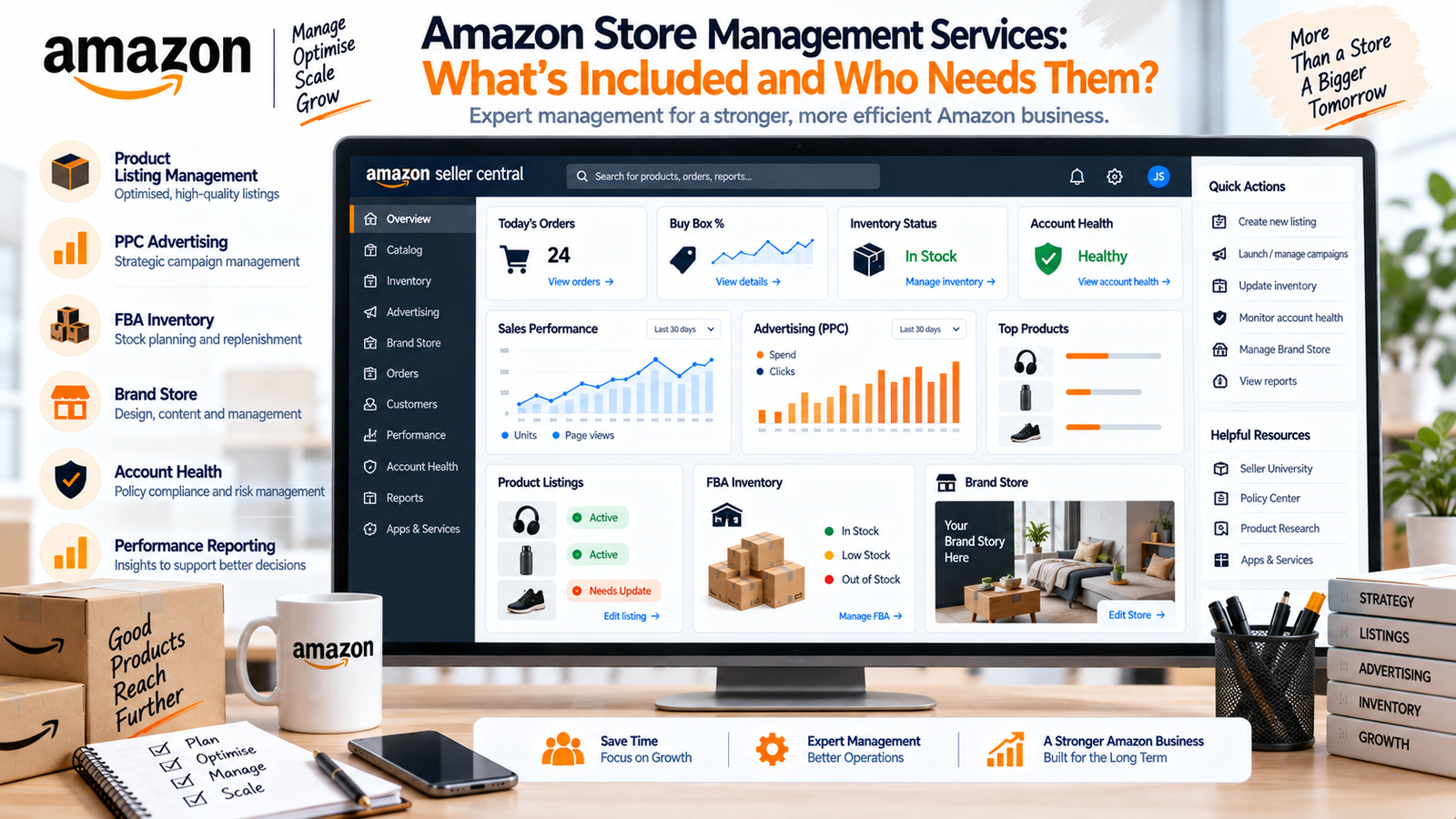
Amazon Store Management Services: What’s Included and Who Needs Them?
Managing an Amazon business gets harder as the catalog, ad spend, inventory, and compliance workload grow. Listings need updates, campaigns need attention, FBA stock must be replenished, policy alerts require action, and brand tools can go unused when nobody owns the process.
Amazon store management services bring some or all of those workflows under one operating plan. Depending on the provider, Amazon account management services may cover listings, PPC, inventory, FBA, account health, Brand Registry tools, reporting, and marketplace strategy. Broader Amazon management services may also include pricing, promotions, catalog troubleshooting, and brand content.
The key question is not whether every seller needs professional Amazon management. It is whether outside expertise can solve a real capacity, skills, or process problem at a cost the business can justify.
Quick Answer: What Do Amazon Store Management Services Include?
Amazon store management services can include listing optimization, PPC advertising, inventory and FBA oversight, account-health monitoring, brand management, reporting, and marketplace strategy. Exact deliverables vary by provider. Some agencies specialize in one function, while full-service providers coordinate several Seller Central workflows under one management plan.
What Are Amazon Store Management Services?
An Amazon store management service provides ongoing operational or strategic support for an active Amazon business.
It is different from store setup, which usually focuses on registration, configuration, and launch. Amazon listing services focus on product-detail-page work. Amazon virtual assistant services often handle assigned administrative tasks such as uploads, reports, or routine catalog changes.
Amazon seller account management is broader. It can connect catalog quality, advertising, inventory, fulfillment, compliance, branding, and reporting.
Seller Central is Amazon’s central operating hub. Its current experience includes dedicated workspaces for Products, Orders, Supply chain, Finance, Customers, and Marketing, plus an actions panel that surfaces alerts and recommendations. Sellers can also manage promotions, advertising, payments, reports, Account Health, inventory, and user permissions through the platform. Amazon explains the current structure in its official Seller Central overview.
That makes Amazon Seller Central management an operating function rather than a single task.
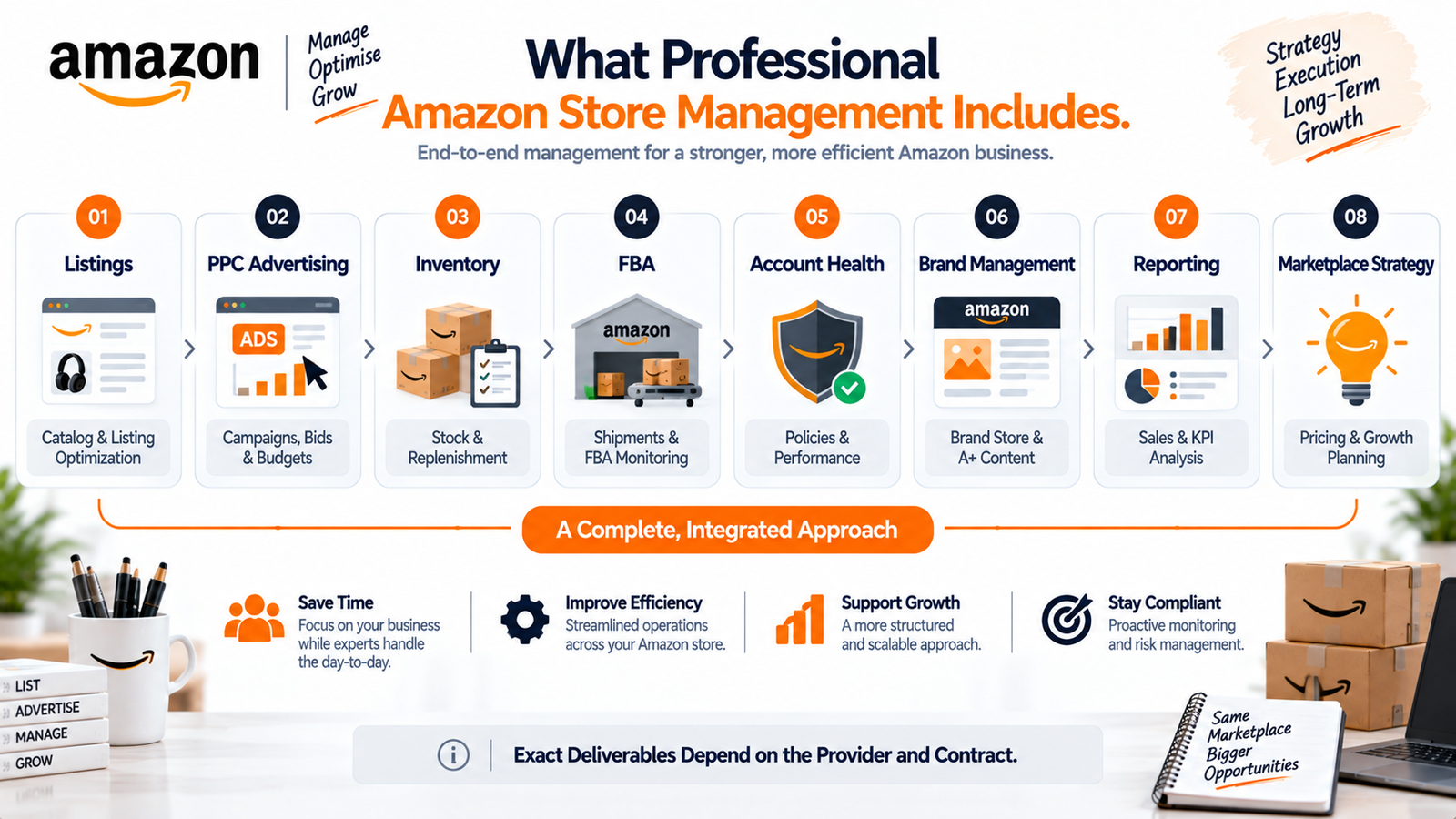
What Do Amazon Store Management Services Include?
A professional provider should define what is managed, which decisions require seller approval, and what remains outside the contract.
| Management Area | Typical Professional Tasks |
| Listings | Creation, keyword research, optimization, catalog updates |
| PPC | Campaign setup, bids, budgets, search-term optimization |
| Inventory | Stock monitoring, forecasting, replenishment |
| FBA | Shipment coordination, inventory monitoring, FBA workflows |
| Account health | Policy and performance monitoring |
| Brand management | Brand Store, A+ Content, Brand Registry tools |
| Reporting | Sales, traffic, ads, inventory and KPI analysis |
| Strategy | Pricing, promotions, catalog and marketplace planning |
Exact deliverables vary by provider and contract.
 Amazon Listing Management and Optimization
Amazon listing management can include titles, bullet points, descriptions, attributes, variations, category work, images, backend search terms, and catalog troubleshooting.
Good Amazon listing optimization combines customer clarity with Amazon keyword research. Amazon product listing services may create new detail pages, while Amazon listing optimization services improve existing ASINs.
Keyword insertion alone does not guarantee search placement or sales.
Amazon PPC and Advertising Management
Amazon PPC management may include campaign structure, keyword research, product targeting, bids, budgets, search-term analysis, negative targeting, and performance review.
Sponsored Products remain cost-per-click ads for individual product listings. Sponsored Brands can use image, video, or collection creative and support different billing models depending on the campaign goal. Amazon’s current sponsored ads overview explains Sponsored Products and Sponsored Brands, while Amazon Ads now describes self-service display ads as the product formerly known as Sponsored Display.
Professional Amazon advertising management should therefore use current terminology instead of treating every advertising product as the same form of PPC.
Useful deliverables can include Sponsored Products and Sponsored Brands management, bid and budget changes, search-term review, and ACOS or ROAS analysis.
Lower ACOS is not automatically better. Performance should be judged against margin, product maturity, inventory, conversion rate, and the campaign’s purpose.
Inventory and FBA Management
Amazon inventory management may cover stock levels, sell-through, inbound units, restock planning, stranded inventory, and aged inventory.
Amazon’s current FBA Inventory tool can help sellers plan future demand, identify excess or aged stock, fix stranded inventory, review sell-through, assess costs, and use fulfillment-center capacity more efficiently.
Amazon FBA management can add shipment coordination, replenishment, return monitoring, storage-cost awareness, and FBA inventory management.
An Amazon FBA management services provider does not automatically warehouse products or arrange freight. Physical storage, sourcing, purchasing, prep, and freight remain separate unless the agreement explicitly includes them.
Order and Fulfillment Monitoring
For eligible FBA inventory, Amazon stores products and handles picking, packing, shipping, customer service, and returns. Amazon’s official Fulfillment by Amazon overview explains the current FBA workflow.
Sellers still manage sourcing, inbound inventory, catalog accuracy, compliance, pricing, and profitability.
For FBM products, Amazon order management can include order status, shipping confirmation, tracking, cancellations, returns, and buyer communication.
Professional Amazon fulfillment management should therefore distinguish Amazon’s fulfillment role from the seller’s inventory and commercial responsibilities.
Account Health, Compliance and Performance Monitoring
Amazon account health management should be a core professional-management function.
Seller Central’s Account Health page tracks policy issues and performance signals. Amazon currently describes Account Health Rating as a color-coded score from 0 to 1,000. Amazon also advises sellers to keep Order Defect Rate below 1%. For seller-fulfilled orders, current guidance identifies a cancellation rate below 2.5% and a late shipment rate below 4%. Amazon explains these metrics in its current selling-policy and Account Health guidance.
Professional Amazon account monitoring may cover:
- Account Health Rating
- policy notifications
- listing violations
- restricted-product issues
- intellectual-property complaints
- seller metrics
- fulfillment problems
- compliance deadlines
An agency can monitor risk and help address problems. It cannot guarantee account safety or override Amazon enforcement.
Brand Registry, Brand Store and A+ Content
Amazon brand management services matter most for brands with eligible intellectual property and a developed catalog.
Amazon Brand Registry is a free program for eligible brands and can unlock access to brand-building and protection tools. Depending on role and eligibility, these can include Brand Stores, A+ Content, Sponsored Brands, Brand Analytics, Vine, and other tools. Amazon’s current Brand Registry guide explains its protection and brand-building features.
Amazon Brand Store management can include navigation, collections, seasonal updates, imagery, and advertising destinations.
Amazon A+ Content can add enhanced images, text, comparison charts, video, and other modules to eligible product detail pages. Eligibility depends on account and brand role.
Brand Analytics can give eligible Brand Representatives access to Search Query Performance, Top Search Terms, Repeat Purchase Behavior, Demographics, Market Basket Analysis, Customer Loyalty Analytics, and other dashboards.
Reporting, Analytics and Marketplace Strategy
Management should include measurement, not just execution.
Amazon sales reporting may cover sales, sessions, conversion rate, CPC, ACOS, ROAS, inventory, refunds, ad spend, and Featured Offer percentage. Amazon performance reporting should connect those figures to business decisions rather than simply repeat dashboard numbers.
Amazon sales optimization works best when listings, advertising, inventory, pricing, margin, and conversion are reviewed together.
Amazon Listing Management and Optimization
Amazon listing optimization should not be treated as a one-time keyword rewrite.
Managers may revisit titles, bullets, attributes, images, variations, backend search terms, and catalog structure as customer behavior changes.
Eligible registered brands can also use Manage Your Experiments to A/B test listing content. Amazon SEO services can support relevance, but no provider can guarantee organic rankings.
Amazon PPC and Advertising Management
The right Amazon PPC management approach depends on the account.
A new ASIN may need discovery, while a mature product may need tighter efficiency controls. Amazon campaign management should review search terms, bids, budgets, conversions, CPC, ACOS, ROAS, inventory, and margin together.
Amazon’s Sponsored Products guidance confirms that these campaigns use CPC pricing and can use keyword or product targeting.
Inventory, FBA and Order Management
Amazon inventory management affects advertising, sales continuity, storage cost, and profitability.
Amazon inventory planning should account for demand, supplier lead time, inbound receiving, seasonality, and available cash. Amazon FBA management services may include replenishment timing, shipment coordination, stranded-stock review, aged-stock monitoring, and return analysis.
FBA does not make the business hands-off.
Amazon Account Health and Compliance Management
Strong Amazon account health management is proactive.
Amazon seller performance can be affected by order defects, policy violations, cancellations, late shipments, restricted products, and other issues.
A provider handling Amazon Seller Central management should regularly review Account Health and performance notifications before problems escalate.
This is one of the clearest differences between strategic management and basic VA work.
Amazon Brand Management for Registered Brands
Amazon management for brands can extend beyond listings and advertising.
Eligible brands may use Brand Stores, A+ Content, Vine, Brand Analytics, Sponsored Brands, and Manage Your Experiments. Vine reviews are independent, and program participation does not guarantee positive reviews.
Brand content can support a more consistent customer experience, but it cannot guarantee conversion.
How Do Amazon Management Services Work?
Most Amazon management services follow a recurring operating cycle:
- Audit the catalog, PPC, inventory, FBA, branding, and Account Health.
- Define goals, responsibilities, and KPIs.
- Fix listing and catalog issues.
- Manage advertising.
- Build replenishment and inventory workflows.
- Monitor account health.
- Maintain Brand Store and A+ Content where relevant.
- Deliver Amazon performance reporting and adjust strategy.
Full-service Amazon management should still leave account ownership, capital, inventory purchases, legal compliance, tax responsibilities, and major approvals with the seller.
Who Needs Amazon Store Management Services?
Amazon store management services are most useful when account complexity exceeds the seller’s available time or expertise.
Growing FBA Sellers
Amazon management for FBA sellers may help when PPC, replenishment, shipments, catalog issues, and reporting compete for internal attention.
Private-Label Brands
Amazon management for private label sellers may combine listing work, PPC, Brand Stores, A+ Content, inventory planning, and Brand Analytics.
Manufacturers and Multi-SKU Sellers
Manufacturers may know their products well but still need Amazon-specific catalog, advertising, and Seller Central expertise.
Brands Without an Internal Amazon Team
Amazon management for brands can provide marketplace specialization without immediately building several in-house roles.
Sellers Struggling With PPC or Inventory
Sometimes Amazon PPC management or inventory support alone solves the real bottleneck. Full account outsourcing is not always necessary.
Very small catalogs, low-volume sellers, and businesses with strong in-house Amazon expertise may not need full-service support.
Sellers who are still in the launch stage rather than the management stage can first review HiSellIt’s Amazon Store Launch Services guide to understand the work that happens before ongoing management begins.
How Much Do Amazon Store Management Services Cost?
There is no universal Amazon store management cost.
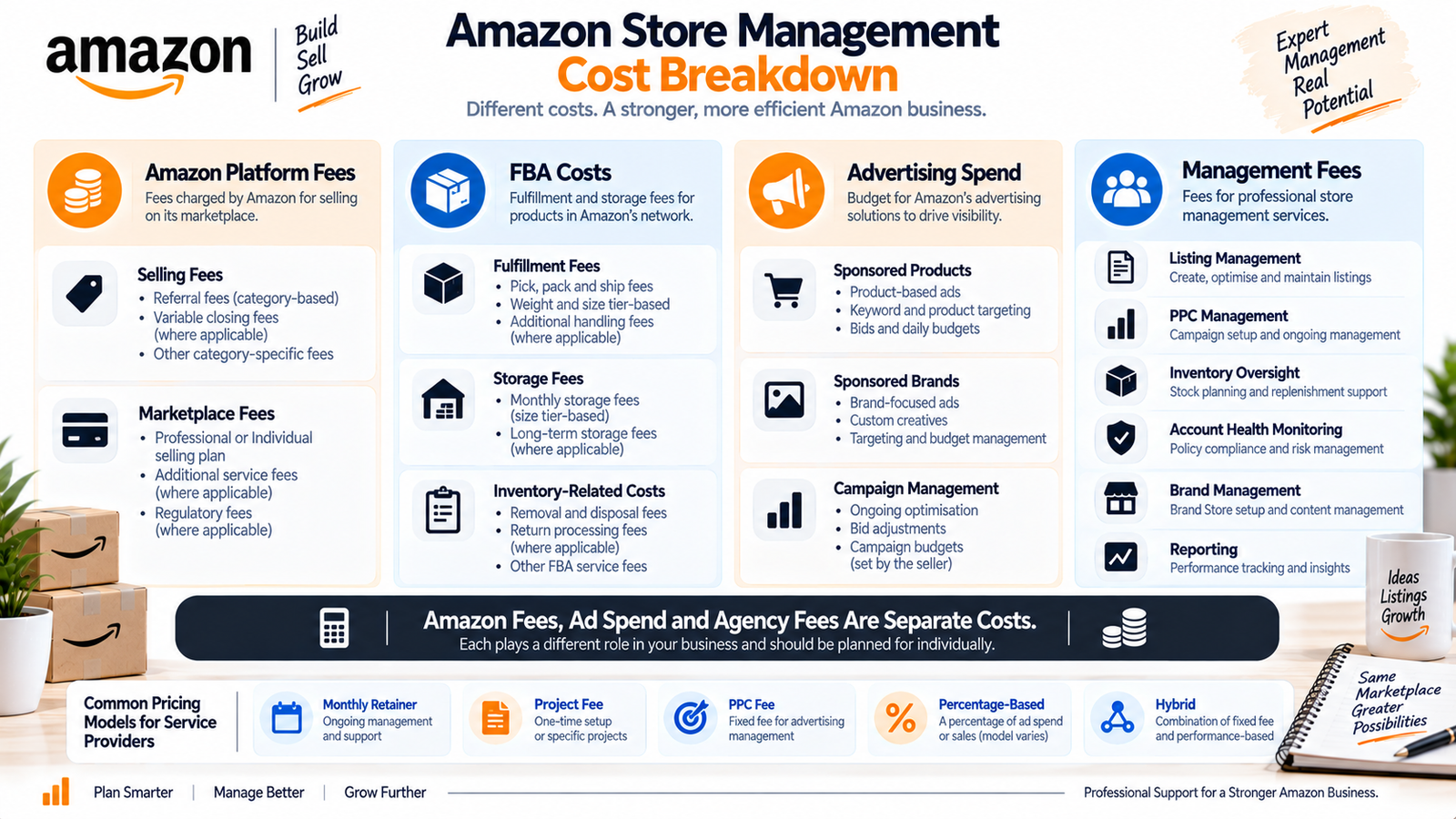
Amazon management services pricing varies with ASIN count, SKU complexity, marketplaces, FBA workload, PPC spend, campaign count, listing volume, Brand Store work, A+ Content, reporting depth, account-health needs, and customer-service scope.
| Pricing Model | How It Works | Typical Fit |
| Monthly retainer | Fixed recurring management fee | Ongoing full-service accounts |
| Tiered package | Fee changes by scope or catalog | Small to growing sellers |
| Project pricing | Fixed fee for defined work | Listing or Brand Store projects |
| Percentage based | Fee linked to sales or another metric | Certain arrangements |
| PPC fee | Separate advertising-management charge | Ad-heavy accounts |
| Hourly | Pay by time worked | Limited support |
| Hybrid | Combines pricing approaches | Complex accounts |
Separate four categories when comparing quotes:
Amazon platform fees are paid directly to Amazon.
FBA fees cover applicable fulfillment and storage services.
Advertising spend is the budget spent through Amazon Ads.
Amazon management fees are charged by the provider.
That distinction prevents Amazon store management pricing from being confused with Amazon’s own charges. A useful proposal should also state what is excluded.
 Amazon Agency vs DIY or In-House Management
The Amazon agency vs DIY decision depends on expertise, cost, control, and capacity.
| Self / In-House | Professional Amazon Management |
| Team handles listings | Dedicated listing workflow |
| Manual PPC monitoring | Ongoing campaign management |
| Reactive stock planning | Structured inventory oversight |
| Internal account monitoring | Account-health monitoring |
| Limited reporting | Scheduled KPI reporting |
| Team learns Amazon tools | Marketplace specialists manage execution |
An in-house team may be better when Amazon expertise and capacity already exist.
Professional management can make sense when specialist workflows consume too much internal time. Neither approach guarantees stronger results.
HiSellIt’s Amazon automation vs traditional FBA selling comparison provides another framework for deciding how much Amazon work should stay in-house and how much can be delegated.
 When Should You Hire an Amazon Management Agency?
Consider outside support when catalog work keeps falling behind, PPC has become difficult to manage, inventory problems repeat, too much staff time is spent inside Seller Central, reporting is inconsistent, or account-health issues are not reviewed quickly.
A seller can hire an Amazon expert for one problem before moving to broader Amazon account management services.
The decision about when to hire an Amazon manager should start with the operational bottleneck, not the sales pitch.
How to Choose an Amazon Management Agency
When evaluating an Amazon management agency, look for:
- Current Seller Central knowledge
- PPC capability
- FBA and inventory experience
- Account-health monitoring
- Listing and catalog expertise
- Brand Registry capability
- Reporting transparency
- Clearly defined deliverables
- Transparent pricing and extra fees
- Secure account-access practices
- Clear communication and escalation
- Realistic claims
For what to look for in an Amazon agency, also ask who owns the Seller Central account, Brand Registry access, advertising data, creative files, and supplier relationships.
Avoid providers promising guaranteed sales, rankings, Featured Offer placement, profitability, ACOS, account safety, or passive income.
HiSellit’s current Amazon Wholesale FBA service lists product research, sourcing, listing optimization, inventory management, customer service, returns, monthly reporting, and PPC in selected packages. Those published deliverables can be compared with other providers against the actual needs of the account.
Is Professional Amazon Management Worth It?
It can be when the business is paying for expertise or capacity it genuinely lacks.
The benefits of Amazon account management are strongest when catalog, advertising, inventory, brand, or compliance work consumes meaningful internal resources.
It may make less sense for a small account with thin margins, low complexity, or strong in-house expertise.
Conclusion
Amazon store management services can centralize listings, PPC, inventory, FBA, account health, Brand Registry tools, and reporting under one operating framework.
Strong professional Amazon management should make responsibilities, ownership, approvals, pricing, and reporting clear. Amazon account management services are most valuable when they solve a measurable skill or capacity gap rather than promising outcomes no provider controls.
Sellers comparing outside support can review HiSellIt’s current Amazon service and contact HiSellIt to discuss the account, required scope, and management responsibilities before choosing a provider.
Amazon Store Management Services FAQs
1. What do Amazon store management services include?
They can include listing optimization, PPC, inventory and FBA oversight, Account Health monitoring, Brand Registry tools, reporting, pricing, and marketplace strategy. Exact scope varies by provider, so sellers should confirm deliverables, approvals, exclusions, and account-access arrangements before signing.
2. How much do Amazon store management services cost?
Costs vary with ASIN count, marketplaces, advertising, FBA complexity, Brand Store work, reporting, and scope. Pricing may use retainers, project fees, percentage arrangements, PPC fees, hourly billing, or hybrid models. Amazon fees, FBA costs, and ad spend should remain separate from provider fees.
3. Who needs Amazon store management services?
Growing FBA sellers, private-label brands, manufacturers, multi-SKU businesses, and brands without an internal Amazon team may benefit most. Sellers with simple catalogs or strong in-house expertise may need only targeted help rather than full-service management.
4. Should I hire someone to manage my Amazon store?
Consider it when Amazon work is consuming too much internal time or requires skills the team lacks. A business can hire an Amazon expert for PPC, listings, inventory, or account health before committing to a broader management relationship.
5. Can an Amazon agency manage PPC and FBA?
Yes, if both are included in the contract. An Amazon account management agency can coordinate campaigns, replenishment, FBA shipments, inventory monitoring, and reporting. Physical warehousing, freight, sourcing, and inventory purchasing remain separate unless explicitly included.
6. What is the difference between an Amazon VA and an Amazon management agency?
A VA usually performs assigned tasks. An Amazon store management agency typically takes broader responsibility for listings, PPC, inventory, account health, brand tools, reporting, and marketplace strategy. Buyers should compare actual scope, decision authority, reporting, and accountability rather than job titles.


2 Comments