
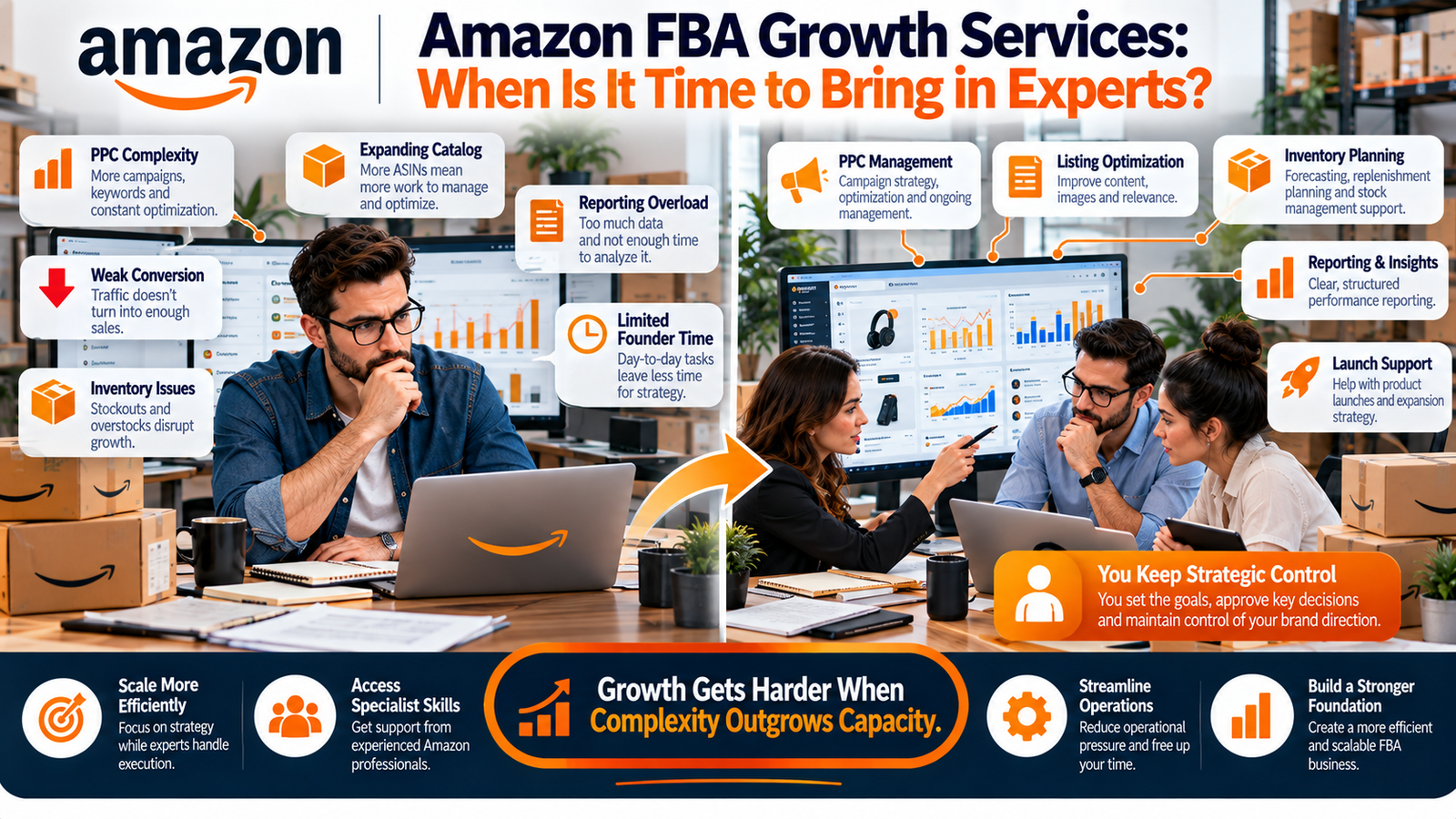
Amazon FBA Growth Services: When Is It Time to Bring in Experts?
A seller can often run a small Amazon account personally. The workload changes once PPC expands, inventory decisions get harder, new ASINs queue up, and Seller Central starts taking time away from sourcing and product development. That is where Amazon FBA growth services can help.
Outside help does not automatically create Amazon FBA growth. Good Amazon growth services add execution capacity and specialist analysis around defined bottlenecks. Amazon FBA management services may cover operations, while broader Amazon marketplace growth services add advertising, conversion, inventory, launches, and strategy.
Smaller accounts can work well in-house when the catalog, ads, and inventory are straightforward. Expert support matters when complexity, not effort alone, is slowing the business and recurring specialist work is crowding out better decisions.
When Should You Hire Amazon FBA Growth Experts?
Expert support becomes useful when growth stalls, advertising gets harder to manage, conversion remains weak, inventory problems repeat, the catalog expands, or founder time is absorbed by routine operations. Expert support should solve a defined bottleneck without replacing seller control over budgets, products, and strategy.
What Do Amazon FBA Growth Services Include?
What do Amazon FBA growth services include? Scope varies, but providers may combine PPC, listings, inventory, catalog work, launches, brand tools, reporting, account monitoring, and strategy.
That mix can include Amazon growth management, Amazon account management services, Amazon FBA management, Amazon marketplace growth services, and professional Amazon management. An Amazon FBA management agency may lean toward operations, while an Amazon growth agency may add conversion, advertising, and analysis.
A second Amazon growth services package may be narrower or broader. This separates Amazon growth management from professional Amazon management. The provider should explain the bottleneck, its scope, and the decisions that stay with the seller.
Growth Services vs Basic Account Management
Basic management is operational upkeep: cases, catalog fixes, monitoring, and Seller Central administration. Amazon account management services can help, but they are not automatically a growth program.
Amazon FBA growth services add diagnosis. A sound Amazon growth strategy connects traffic, conversion, ads, inventory, catalog expansion, and margin. An Amazon FBA growth strategy also connects launches and stock planning to cash flow.
A second Amazon growth services review may focus on higher-level decisions. That is why Amazon store management services and specialist growth support are not identical.
When Is It Time to Hire Amazon FBA Growth Experts?
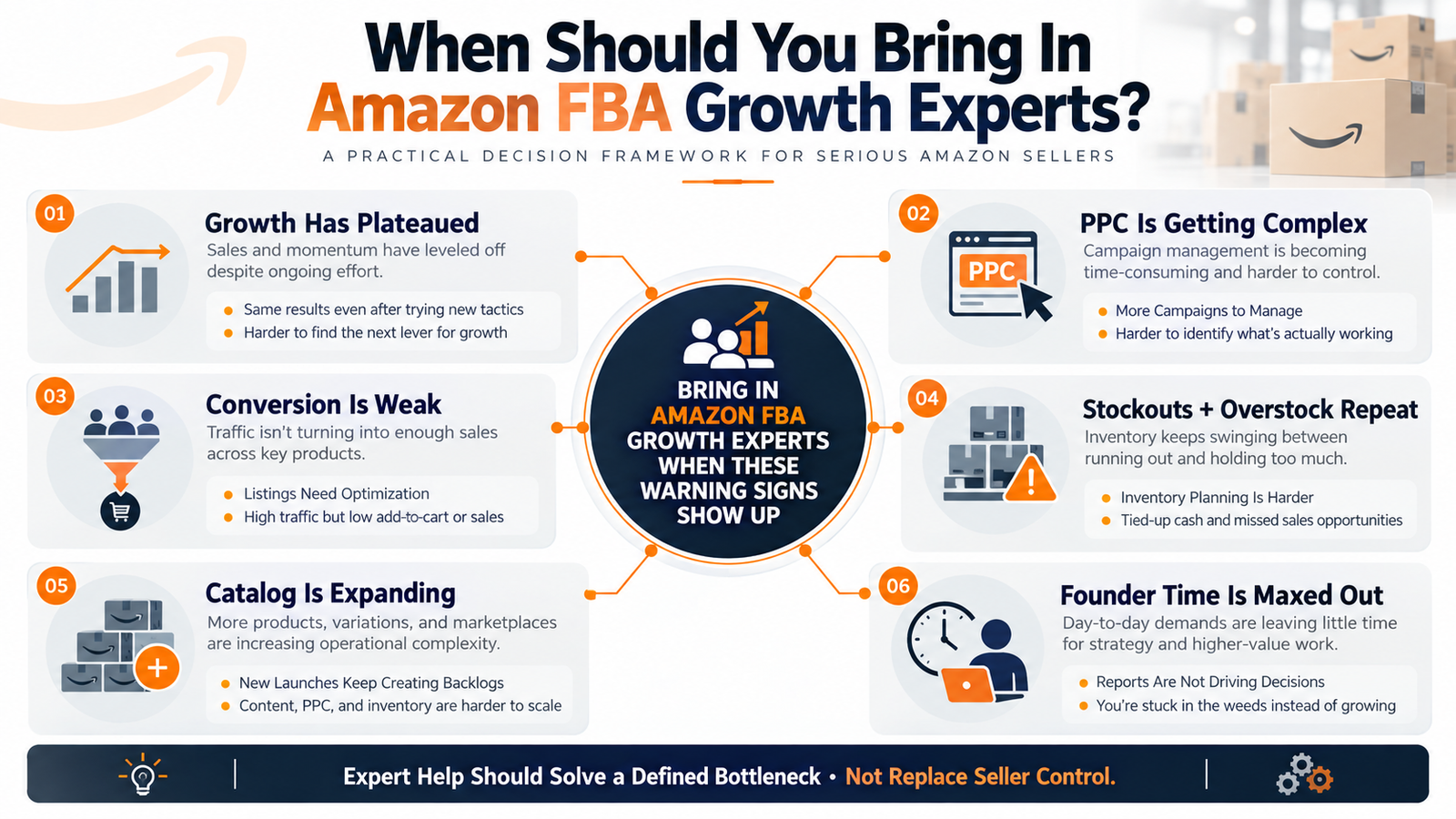 The best answer to when to hire an Amazon FBA expert is when the same bottleneck keeps returning.
Revenue has plateaued despite stable traffic. An Amazon growth expert or Amazon FBA expert can separate likely causes.
PPC spend is rising faster than profitable sales. Expanding campaigns can turn Amazon PPC management into specialist work.
ACOS and ROAS are hard to interpret. An Amazon FBA expert should connect ad results to margin and inventory.
Conversion is weak. Amazon listing optimization and Amazon conversion rate optimization may matter more than more traffic.
Stockouts or overstock recur. Amazon inventory planning becomes a growth issue once mistakes affect cash or availability.
Launches are inconsistent. An Amazon growth agency can add repeatable execution for content and an Amazon new product launch.
The catalog has outgrown one person. More ASINs create more work. An Amazon FBA management agency may add capacity.
Brand tools and reports are underused. Capabilities exist, but nobody has time to act on them.
Founder time is disappearing into Seller Central. Support cases, listings, ads, and stock checks crowd out sourcing. Some sellers hire an Amazon FBA expert for one function before adding a larger team.
Marketplace expansion is adding complexity. An Amazon marketplace strategy needs ownership.
Amazon FBA growth services should solve a defined capacity problem. For Amazon FBA growth services for established sellers, these signals matter more than revenue alone.
PPC Complexity Is Often the First Growth Bottleneck
Advertising often gets harder as campaigns expand. Amazon’s official guidance describes Amazon Sponsored Products as cost-per-click ads where sellers control bids and budgets, which is why campaign workload can increase quickly as products, targets, and search terms multiply.
Amazon PPC management can cover structure, search terms, bids, budgets, negatives, and reporting. Amazon advertising management adds broader planning, and another Amazon advertising management layer may be needed across marketplaces. Amazon PPC optimization should be tied to profitability, not only ACOS.
An Amazon PPC agency may provide Amazon PPC services, but nobody can guarantee Amazon ACOS optimization or Amazon ROAS optimization. Another Amazon Sponsored Products campaign still needs margin context. An Amazon sales growth strategy should test whether paid demand is economically useful.
Listing and Conversion Problems Can Limit Growth
Traffic without conversion is not automatically a traffic problem.
Amazon listing optimization should review keywords, titles, bullets, images, product information, and buying friction. Amazon product listing optimization goes beyond inserting terms. Amazon keyword research should reflect customer searches, while Amazon listing SEO stays accurate.
Amazon listing management keeps content current; a second Amazon listing management process may be needed as the catalog grows. Amazon product detail page optimization, Amazon conversion optimization, and another Amazon conversion rate optimization review focus on what happens after the click.
When the Amazon conversion rate is weak, another Amazon listing optimization pass may matter more than more ad spend. That is the point of Amazon sales optimization: fix the actual bottleneck.
Inventory Becomes a Growth Problem Before Sellers Expect It
Sales can rise while the business gets weaker. Stockouts lose availability; overstock ties up cash.
Amazon’s FBA Inventory tool helps sellers monitor sell-through, excess and aged inventory, stranded stock, and future demand, making inventory health part of the growth conversation rather than a back-office task.
That is why Amazon FBA inventory management belongs inside an Amazon growth strategy. A second Amazon growth strategy should also account for stock risk. Amazon inventory management tells you what you have; Amazon inventory planning asks what you will need. Amazon inventory forecasting, Amazon FBA replenishment, and Amazon inventory optimization matter more as lead times and cash commitments grow.
Amazon FBA operations balance availability and overstock. Amazon FBA profitability can fall while revenue rises.
Catalog Expansion Changes the Management Model
Each new ASIN can bring more ads, content, inventory, and reporting.
Amazon catalog management gets harder when products sit at different life-cycle stages. Amazon product catalog management, Amazon SKU management, Amazon product expansion, and Amazon catalog growth all add coordination. A second Amazon new product launch can collide with existing work.
An Amazon scaling strategy should define ownership before trying to scale an Amazon FBA business. To scale an Amazon FBA business across categories or marketplaces, the team needs repeatable launch and maintenance processes.
For wholesale expansion, see HiSellit’s Amazon wholesale FBA services.
Brand Registry and A+ Content Can Expand the Growth Toolkit
Eligible brands enrolled in Amazon Brand Registry can access additional brand-building and protection capabilities, including tools designed to improve product information and strengthen how a brand is presented in the Amazon store. Amazon Brand Registry is a free program for eligible brands that unlocks brand-building and protection capabilities, including tools such as A+ Content and Brand Analytics.
Amazon A+ Content lets eligible sellers add enhanced images, customized text, videos, comparison charts, and other richer modules to product detail pages, giving brands more options for explaining products and differentiating their content
For Amazon brand growth, these tools can differentiate the experience. Another Amazon brand growth plan may use an Amazon Brand Store, Amazon brand management, Amazon brand strategy, and Amazon Brand Analytics.
Revenue Growth vs Profitable Growth
 More revenue is not automatically healthy growth. Amazon profitability depends on what remains after advertising, fulfillment, inventory, returns, and other costs.
| Metric | What It Shows |
| Revenue | Top-line sales |
| Conversion | Traffic turning into orders |
| ACOS | Ad spend vs attributed ad sales |
| ROAS | Attributed return on ad spend |
| Inventory | Ability to maintain supply |
| Net proceeds | What remains after costs |
| Margin | Whether extra sales are worthwhile |
Amazon sales optimization should separate revenue from healthy economics. Amazon profit margin optimization may require pricing, ads, or inventory changes. Amazon FBA profitability belongs beside an Amazon sales growth strategy.
That is what separates a mature Amazon FBA growth strategy from a “sell more” plan.
Reporting Should Lead to Decisions
Reporting is not useful if nobody turns the numbers into decisions. Amazon’s Business Reports and Sales dashboard provide sales, traffic, ASIN-level performance, period comparisons, and downloadable data that sellers can use to investigate changes instead of relying on top-line revenue alone.
Amazon performance reporting answers what happened. Amazon sales analytics investigates why. A second Amazon performance reporting routine should end with priorities.
Use Seller Central reporting, Amazon sales reporting, and Amazon growth metrics as inputs. Amazon performance monitoring is the watch between reviews; another Amazon performance monitoring process may focus on ads, inventory, or account issues. A second Amazon sales analytics review should change decisions.
Founder Time Is a Real Scaling Constraint
Founder bandwidth is often the hidden hiring signal. Routine Amazon Seller Central management can include catalog issues, Seller Support cases, ads, inventory checks, and reports. Amazon account health management adds another responsibility. Amazon’s Account Health Rating indicates risk of deactivation due to non-compliance with certain selling policies; it is not a universal business-performance score.
Amazon account monitoring, Amazon seller performance, and Amazon policy compliance still need judgment. Another Amazon Seller Central management workload is hard to justify when it displaces higher-value work.
That is how to know when to outsource Amazon FBA management. Amazon FBA outsourcing should remove defined work, not ownership. A second Amazon FBA outsourcing arrangement may add capacity. Outsourced Amazon management can reduce routine execution; another outsourced Amazon management setup should leave budgets and products with the seller. Amazon growth outsourcing follows the same rule.
See HiSellit’s Amazon store automation services for broader operational options.
DIY vs In-House vs Amazon Growth Experts
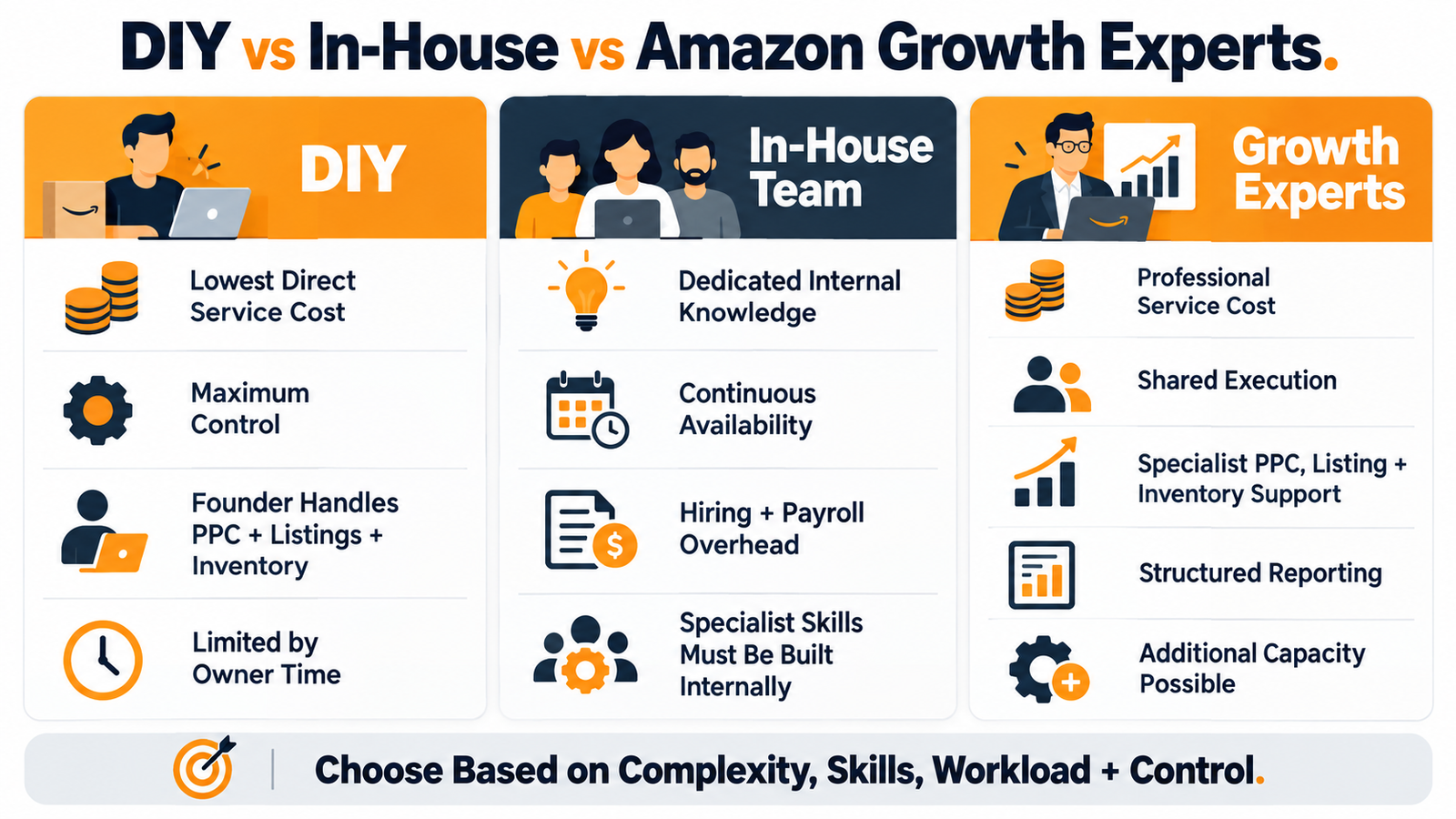 Amazon FBA management vs DIY is not a quality contest. An internal team may perform better because it knows the economics.
| Factor | DIY / In-House | Growth Experts |
| Direct fee | Lower | Professional service cost |
| Control | Highest | Shared execution |
| Expertise | Built internally | Marketplace specialists |
| Capacity | Team bandwidth | Added capacity possible |
| PPC | Internal team | Specialist support |
| Inventory | Internal planning | Specialist input |
| Reporting | Internal interpretation | Analysis may be included |
| Founder workload | Often higher | May be reduced |
| Scalability | Requires hiring | Provider-dependent |
Amazon FBA agency vs DIY matters when bandwidth is the issue. Amazon expert vs in-house management matters when specialist skill is missing. Amazon agency vs in-house team matters when several functions need coordinated support.
A freelancer may solve one narrow problem. Amazon FBA management services fit recurring cross-functional work; an Amazon FBA agency can suit broader execution.
How Much Do Amazon FBA Growth Services Cost?
Providers may use retainers, PPC-specific fees, projects, launch packages, or consulting.
Amazon FBA growth services cost changes with ASIN count, revenue scale, ad spend, marketplaces, listing workload, launches, inventory complexity, creative work, reporting, account-health support, and strategy. Another Amazon FBA growth services quote may include a different scope.
| Cost Driver | Why It Changes Scope |
| ASIN count | More listings and analysis |
| Revenue scale | Larger operation |
| PPC spend | More campaign work |
| Marketplaces | More complexity |
| Listing work | More content and research |
| Launches | More strategy and execution |
| Inventory | More planning |
| A+ Content | Creative requirements |
| Reporting | More analysis |
| Account health | More monitoring |
| Strategy | Higher-touch consulting |
Amazon FBA management cost is separate from selling fees, FBA fees, advertising spend, inventory cost, and creative or software costs. Amazon growth agency cost, Amazon management services pricing, and Amazon FBA agency cost are professional-service charges.
The cost to hire an Amazon expert should be compared with the workload and skill transferred. A second Amazon FBA management cost quote may include less.
How to Choose an Amazon Growth Provider
Start with the bottleneck. For advertising, ask about Amazon PPC management, Amazon PPC optimization, and reporting. For conversion, ask about Amazon product listing optimization, Amazon keyword research, and Amazon conversion optimization. For inventory, test knowledge of Amazon FBA inventory management and Amazon inventory management. For expansion, ask about Amazon catalog management and Amazon marketplace strategy.
An Amazon growth consultant should explain how they connect. An Amazon FBA management agency should explain permissions and Amazon account health management. An Amazon growth agency should discuss Amazon profitability, not just sales. Amazon FBA growth services need ownership and measurable deliverables.
Reject guarantees, vague deliverables, unnecessary access, or weak handover. If deciding when to hire an Amazon agency, compare broad providers with a narrower specialist first. HiSellit’s Amazon FBA launch agency checklist offers due-diligence questions.
Conclusion
Amazon FBA growth services become more relevant when PPC complexity rises, conversion remains weak, inventory gets harder to plan, the catalog expands, reports are not producing decisions, and founder bandwidth is stretched.
Healthy Amazon FBA growth still depends on product economics and disciplined execution. Compare Amazon FBA management services, internal capacity, and Amazon FBA growth services cost against the bottlenecks slowing the business.
If several functions are competing for the same team, audit the workload before you outsource Amazon FBA management or outsource Amazon growth management. Then request customized growth-management pricing for the support you actually need.
Frequently Asked Questions
Q. When should I hire an Amazon FBA expert?
Bring in specialist help when PPC, conversion, inventory, launches, or Seller Central work outgrows the team. Some sellers hire an Amazon FBA expert for one defined bottleneck.
Q. When should I hire an Amazon FBA agency?
Consider an agency when several functions need coordinated support. An Amazon FBA agency may fit when ads, inventory, and reporting all need attention.
Q. How can experts help grow an Amazon FBA business?
Experts add execution capacity around ads, conversion, inventory, launches, and reporting. They cannot manufacture demand. Sound economics still matter to grow an Amazon FBA business.
Q. Is an Amazon FBA growth agency worth it?
It can be when recurring complexity blocks important work. Value depends on scope and execution.
Q. Can an expert help with PPC and inventory?
Yes. Amazon PPC services and Amazon inventory planning can sit under one provider, but they require different skills.
Q. When should Amazon FBA management be outsourced?
Outsource Amazon FBA management when routine work consumes too much team time. Keep pricing, budget, inventory, and strategy internal.
Q. Is an Amazon FBA agency worth it?
Amazon FBA management services for growing brands can fit when several workflows need specialist attention. Simpler accounts may need DIY or a freelancer.
Q. When does an Amazon seller need professional management?
When ads, inventory, catalog work, and administration exceed capacity. Professional Amazon FBA growth services should solve measurable bottlenecks.