
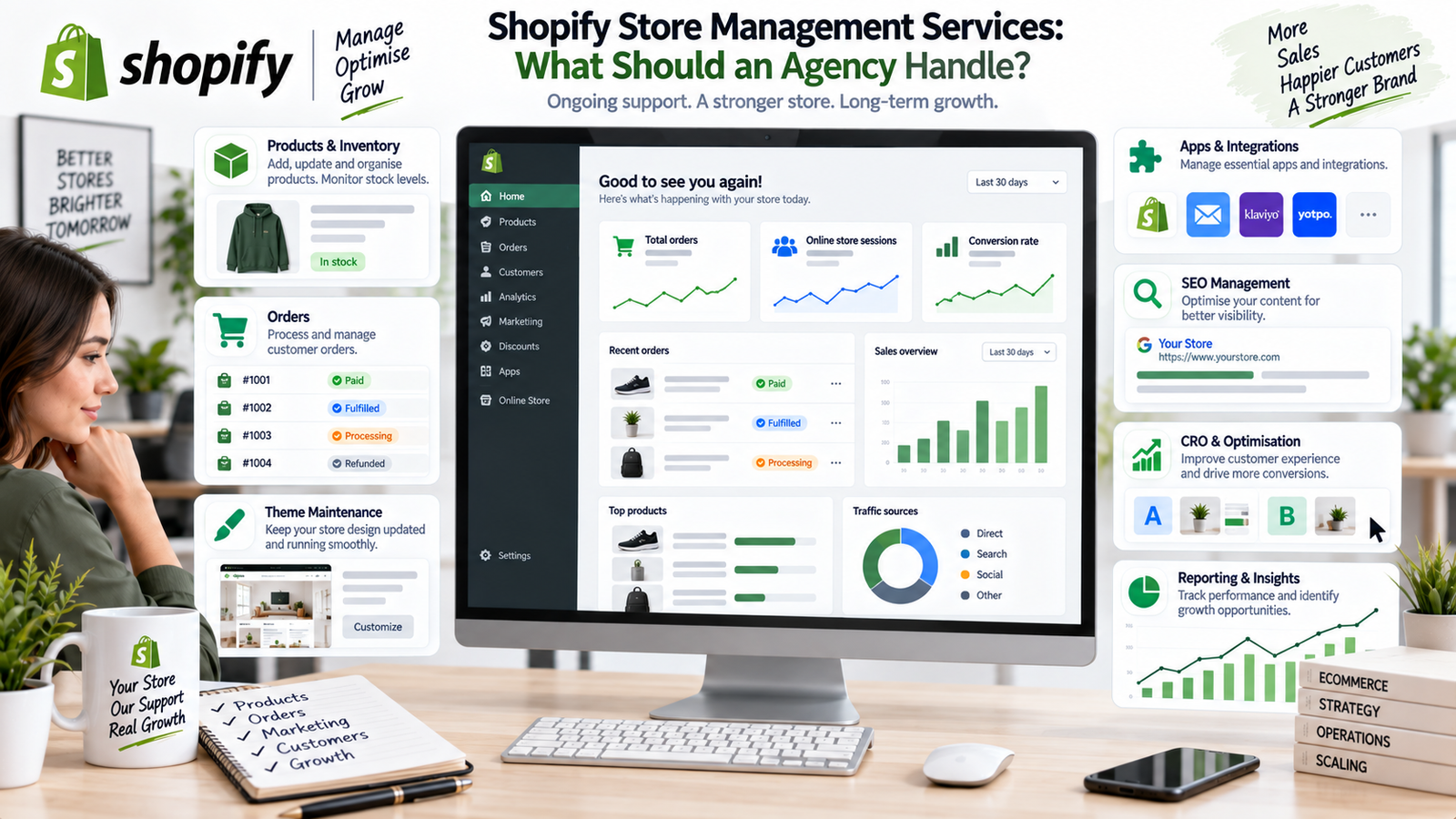
Shopify Store Management Services: What Should an Agency Handle?
Running a live Shopify store is ongoing work. Products change, inventory moves, apps need attention, themes are updated, promotions change, and performance data needs action. Shopify store management services bring those recurring tasks into a defined operating process instead of leaving them to whoever has time that week.
Depending on the contract, Shopify management services may cover products, collections, inventory, website maintenance, apps, SEO, CRO, order workflows, marketing, analytics, and reporting. Shopify ecommerce management services vary widely by provider.
The buying decision comes down to scope, ownership, add-ons, cost, and responsibilities.
What Do Shopify Store Management Services Include?
Shopify store management services can include product and collection management, inventory updates, website maintenance, app oversight, SEO and CRO where contracted, order support, marketing coordination, and analytics reporting. Scope varies by provider. Core management should be separated from growth services, custom development, and physical fulfillment.
What Are Shopify Store Management Services?
A Shopify store management service is ongoing support for an active Shopify business. It keeps the store accurate, functional, organized, and measurable after the initial build.
Store setup focuses on creating and configuring the site. Development covers technical building, integrations, custom functionality, and code. Shopify store maintenance keeps the existing store stable and current. Professional Shopify store management connects catalog work, maintenance, operations, optimization, and reporting.
Shopify’s current Partner Directory supports this distinction. It lists ongoing website management separately from product and collection setup, theme customization, SEO, conversion rate optimization, analytics and tracking, checkout upgrades, and custom integrations. Merchants can browse those categories through the official Shopify Partner Directory services.
What Should a Shopify Store Management Agency Handle?
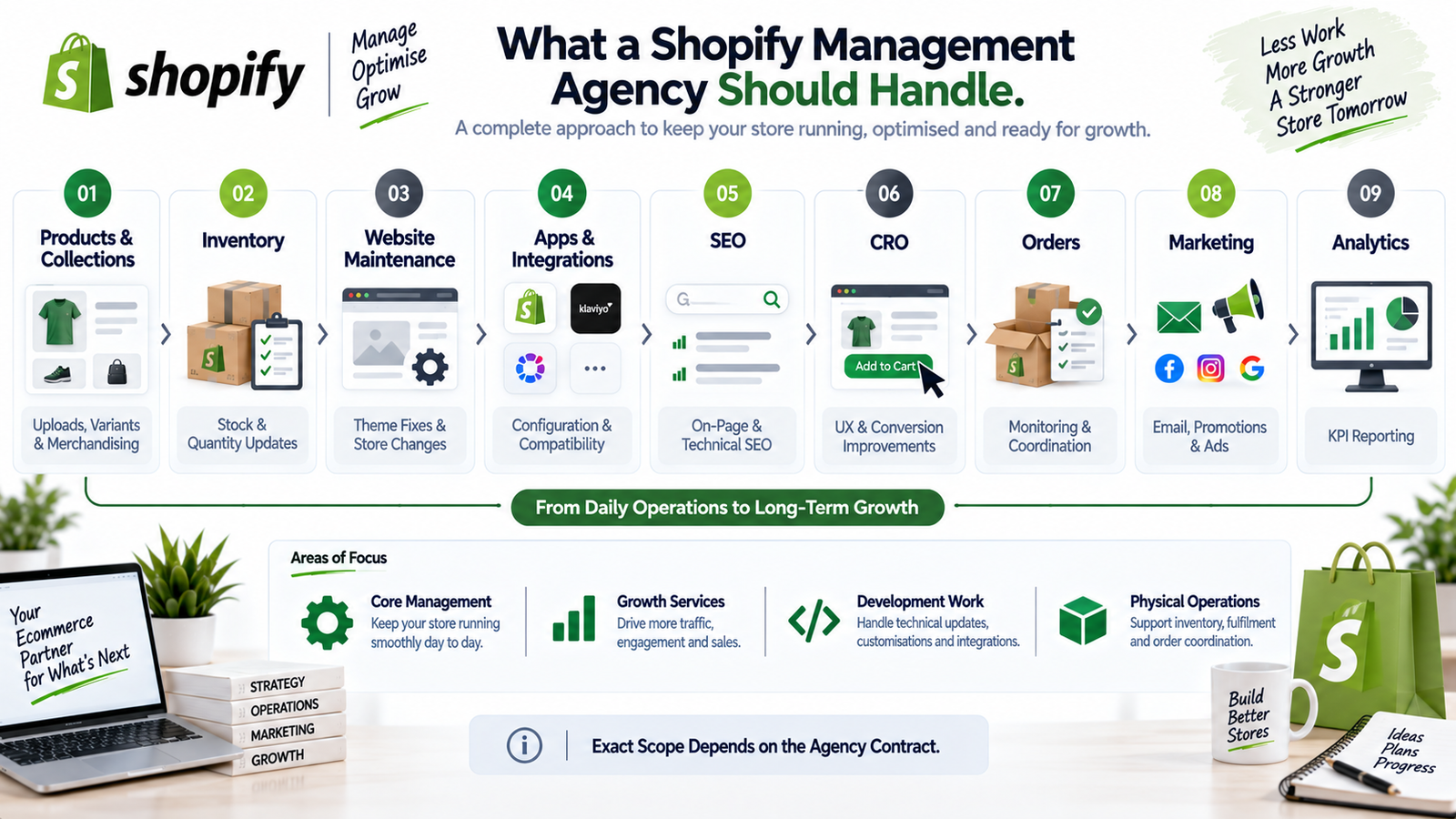 A Shopify ecommerce agency handling management should own the recurring work that keeps the storefront accurate, stable, and commercially useful. Growth work and development should be identified separately if they are not part of the base retainer.
| Management Area | Typical Agency Responsibilities | Usually Core or Optional? |
| Products & collections | Uploads, edits, variants, merchandising | Core |
| Inventory | Quantity monitoring and stock updates | Often core |
| Website maintenance | Theme fixes, content changes, troubleshooting | Core |
| Apps & integrations | Configuration and compatibility checks | Core/optional |
| SEO | On-page and technical optimization | Optional/growth |
| CRO | Product pages, UX and checkout improvements | Optional/growth |
| Orders | Monitoring and operational coordination | Scope-dependent |
| Marketing | Email, ads and campaigns | Usually optional |
| Analytics | KPI monitoring and reporting | Core |
| Custom development | New features and integrations | Usually separate |
Product and Collection Management
Shopify product management can include product creation, edits, prices, variants, SKUs, media, metafields, collections, sales-channel visibility, merchandising, and bulk updates.
Shopify supports individual and bulk catalog work from Admin, including CSV and bulk-editor workflows. Shopify collection management can also organize products and variants through collection rules and manual controls.
A strong Shopify product management process also includes merchandising. That means keeping collections logical, fixing product data, and improving the shopping path rather than simply uploading products once.
Inventory Management
Shopify inventory management includes tracking stock, adjusting quantities, reviewing inventory history, and managing inventory across locations where relevant.
Shopify inventory management services may also cover low-stock workflows, reconciliation, supplier or app synchronization, and out-of-stock handling. Shopify’s official inventory management documentation confirms that merchants can track quantities, make adjustments, review inventory changes, and use inventory reports from Shopify Admin.
The contract should state whether the agency only maintains Shopify quantities or also coordinates purchasing and suppliers.
Website and Theme Maintenance
Shopify store maintenance services can include content edits, navigation changes, theme updates, broken-section fixes, compatibility checks, and troubleshooting.
Shopify Theme Store themes can receive updated versions, but apps and custom code can affect how changes carry over. Shopify recommends reviewing updates in draft themes before publishing them.
Shopify theme maintenance should therefore include backups and testing. Small Shopify theme customization may fit normal support, while redesigns, new templates, Liquid work, and new functionality usually belong under Shopify development support or Shopify custom development.
Apps and Integrations
Shopify app management should review what each app does, what it costs, what permissions it has, and whether it still serves a business need.
Shopify app integration can include installation, configuration, testing, data-flow checks, and troubleshooting.
Checkout work needs a defined technical scope. Shopify now uses checkout extensibility and its checkout and accounts editor for supported customizations. Basic plans and above can use standard checkout branding and certain extensions, while deeper UI extensions on the information, shipping, and payment steps are restricted to Shopify Plus. See Shopify’s current checkout customization guidance.
SEO Management
Shopify SEO services should be scoped separately because basic management does not automatically equal a full SEO program.
Shopify SEO management may include keyword research, metadata, product and collection copy, internal links, image alt text, redirects, crawlability, indexing, and Google Search Console monitoring.
Shopify technical SEO may also cover canonical review, structured data from themes or apps, performance, and indexation. Shopify’s official SEO guidance recommends relevant keywords, useful page titles and descriptions, descriptive URLs and filenames, alt text, logical site structure, sitemap submission, and relevant content. Shopify SEO guidance
No Shopify SEO agency can guarantee rankings.
Conversion Rate Optimization
Shopify conversion rate optimization focuses on the buying experience.
Shopify CRO may review product pages, collection navigation, mobile usability, trust elements, merchandising, page speed, cart behavior, and checkout friction.
Shopify product page optimization can improve how price, variants, imagery, delivery information, and benefits are presented. Shopify speed optimization should focus on controllable factors such as media, scripts, apps, theme complexity, and custom code.
A high-converting Shopify store cannot be created by layout changes alone. Conversion also depends on traffic quality, product demand, offer, pricing, and trust.
Orders and Operational Support
Shopify order management can include order monitoring, payment review, refunds, cancellations, tracking, and fulfillment status.
Shopify fulfillment management may involve coordinating with an internal team, 3PL, dropshipping app, or other fulfillment service. Shopify currently supports merchant fulfillment, app-connected fulfillment, and fulfillment services through its order-management workflows.
Physical fulfillment, warehousing, returns handling, and customer-service staffing should only be described as included when they are actually part of the contract.
Marketing and Promotions
Shopify marketing management is usually optional.
A full-service Shopify agency may coordinate Shopify email marketing, discounts, paid advertising, sales channels, campaign tracking, and content. Marketing should have its own goals, budgets, and reporting because marketing work is different from store maintenance.
Analytics and Performance Reporting
Professional management should produce decisions, not just completed tasks.
Shopify Analytics currently provides customizable dashboards and reports covering sales, sessions, fulfillment data, channels, and other store metrics. Reports can also be filtered and customized for deeper analysis. See the official Shopify Analytics documentation.
Shopify performance reporting can track sales, conversion rate, average order value, returning customers, landing pages, refunds, and product performance.
Shopify analytics management should turn numbers into actions.
Shopify Product, Catalog and Inventory Management
Shopify catalog management becomes more important as product and variant counts grow.
Ongoing Shopify product management should keep descriptions, media, variants, SKUs, pricing, availability, collections, and merchandising accurate.
Shopify product page optimization can be layered on when the goal is better clarity or conversion. Shopify inventory management should also match the fulfillment model, especially when multiple locations, suppliers, or apps are involved.
This is why Shopify product and inventory management services should be treated as a recurring operating workflow rather than a one-time upload project.
Shopify Website Maintenance, Apps and Technical Support
Shopify website management services should include a defined maintenance process, clear ownership, and routine Shopify store support services.
Shopify website management services and Shopify store maintenance services can cover theme updates, content changes, broken links, app issues, navigation, domains, and minor troubleshooting.
Shopify technical support should define response times and what counts as urgent. Major redesigns, checkout engineering, custom apps, complex integrations, and large Liquid projects should normally be priced as development work rather than assumed under Shopify website maintenance services.
Shopify SEO and Organic Search Management
Shopify SEO services are useful when organic search is an agreed growth channel.
A practical workflow can include Shopify on-page SEO, Shopify technical SEO, internal links, redirects, image SEO, metadata, content gaps, and Search Console monitoring.
Shopify SEO optimization should be measured over time rather than sold as a ranking guarantee.
Businesses wanting a broader organic-search framework can also use HiSellIt’s Shopify SEO Guide for Beginners alongside the management plan.
Shopify Conversion Rate Optimization and Store Performance
Shopify store optimization services should connect UX decisions with real data.
Shopify conversion optimization may include product-page changes, collection structure, mobile layouts, trust messaging, cart design, and checkout review.
Continuous Shopify CRO and Shopify store optimization services should use analytics, customer behavior, testing, and Shopify store performance. They cannot guarantee a fixed conversion uplift.
Orders, Fulfillment and Customer Operations
Shopify order management can be included when the provider owns operational workflows.
A team may monitor orders, coordinate fulfillment status, handle Shopify returns management, update shipping information, or manage discounts and promotions.
Physical picking, packing, warehousing, and customer-service staffing remain separate unless stated in the agreement.
Stores using dropshipping or automated supplier workflows can review HiSellIt’s Shopify Dropshipping Automation Guide for examples of inventory and order processes that can be systematized.
Shopify Analytics, Reporting and Performance Monitoring
Shopify reporting should be scheduled and tied to the contracted scope.
Useful Shopify performance reporting can cover sales, sessions, conversion, average order value, products, channels, refunds, inventory, and completed management work.
Shopify sales analytics should help the merchant decide what to keep, fix, test, or stop. This is a major difference between professional Shopify store management and task-only support.
How Do Shopify Management Services Work?
Most Shopify management services follow a recurring cycle:
- Audit the store, catalog, theme, apps, analytics, and operations.
- Define responsibilities, priorities, and KPIs.
- Build maintenance and catalog workflows.
- Manage products, collections, and inventory.
- Complete SEO, CRO, or marketing work where contracted.
- Manage apps and technical issues.
- Review Shopify store performance.
- Report results and set new priorities.
Shopify management scope should be documented.
How Much Do Shopify Store Management Services Cost?
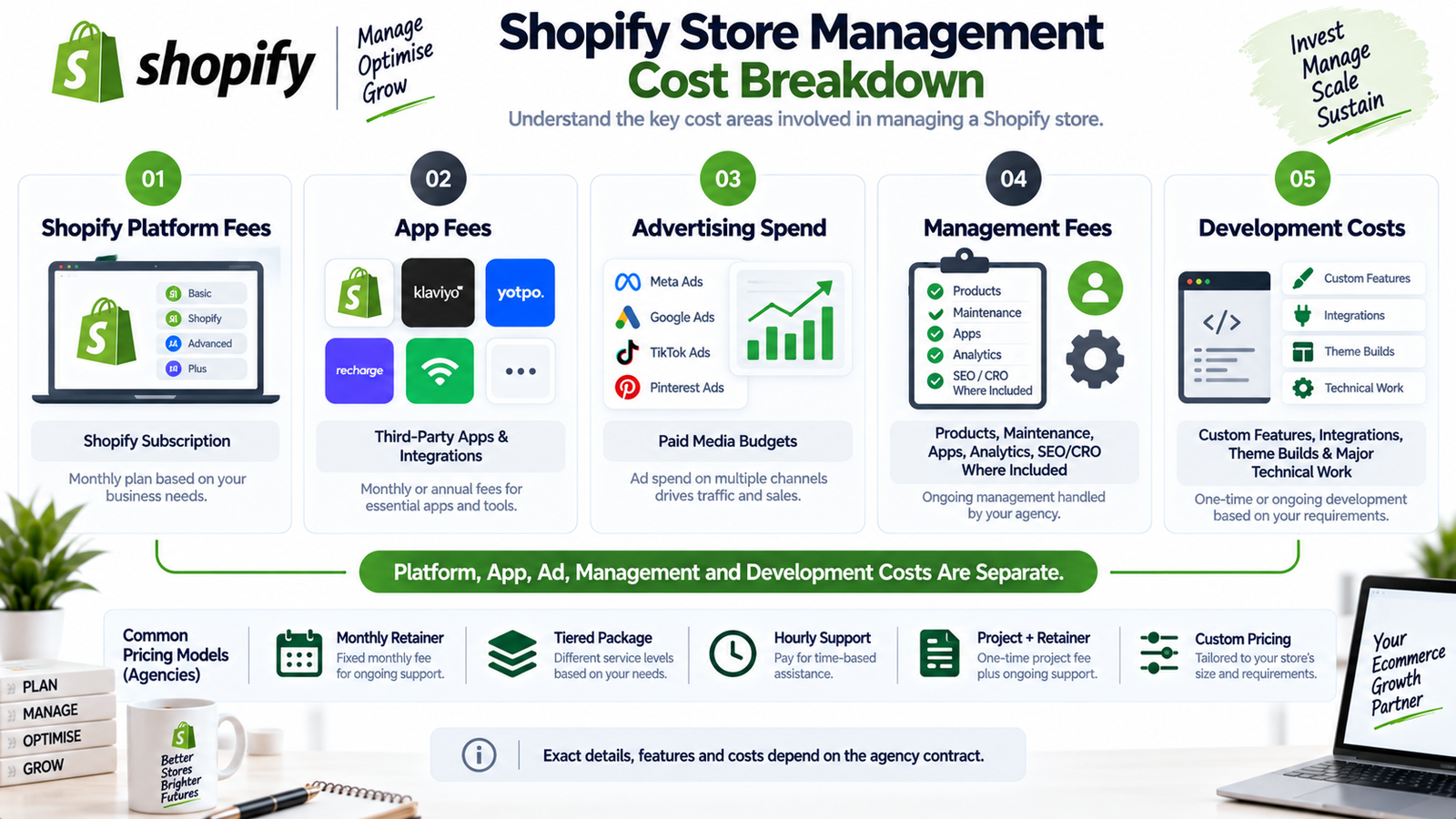
There is no universal Shopify store management cost. The Shopify store management cost changes with product count, order volume, theme complexity, app stack, integrations, markets, sales channels, SEO, CRO, marketing, analytics, and support level. Shopify management services pricing should reflect that scope.
| Pricing Model | How It Works | Typical Fit |
| Monthly retainer | Fixed recurring fee | Ongoing management |
| Tiered package | Scope changes by service level | Small to growing stores |
| Hourly support | Pay for time worked | Irregular technical needs |
| Project + retainer | Initial project plus ongoing support | Cleanup or redesign plus management |
| Custom pricing | Scope built around complexity | Large or complex stores |
A quote should separate five cost categories:
Shopify subscription fees are paid to Shopify.
App fees are paid to third-party providers.
Advertising spend goes to advertising platforms.
Shopify agency fees cover management services.
Development costs cover larger technical projects when those are outside the management retainer.
That keeps Shopify store management cost and Shopify management services pricing separate from platform or paid-media costs.
 Shopify Agency vs In-House or DIY Management
The Shopify agency vs in-house decision depends on budget, expertise, workload, and complexity.
| DIY / In-House | Professional Shopify Management |
| Internal team manages products | Structured catalog workflow |
| Reactive website fixes | Ongoing maintenance process |
| Team manages apps individually | Central app and integration oversight |
| SEO handled inconsistently | Defined SEO workflow if included |
| CRO handled occasionally | Continuous optimization if contracted |
| Internal reporting | Scheduled KPI reporting |
| Team learns Shopify tools | Shopify specialists handle execution |
Shopify management vs DIY has no universal winner. A strong internal ecommerce team may need only specialist development, SEO, or CRO support.
When Should You Hire a Shopify Management Agency?
A Shopify ecommerce agency can make sense when the catalog is growing, the app stack is difficult to maintain, technical issues recur, SEO work is inconsistent, order workflows are becoming complex, or too much founder time is spent inside Shopify Admin.
A business may also hire a Shopify expert for one narrow need such as checkout work, technical SEO, theme troubleshooting, or CRO. Some stores hire a Shopify expert before considering broader management.
The question “should I hire a Shopify agency” should start with the actual operational gap.
How to Choose a Shopify Store Management Agency
Look for a provider that can explain:
- What is included in the recurring scope.
- Which work counts as development.
- How catalog and inventory work is handled.
- Which apps and integrations the team will manage.
- Whether SEO, CRO, and marketing are included.
- How reporting works.
- What support response times apply.
- Who owns the store, licenses, apps, domains, and data.
- How account access is secured.
- How extra work is priced.
- What happens when the contract ends.
Shopify’s Partner Directory lets merchants compare providers across ongoing management, technical services, marketing, CRO, SEO, integrations, and other specialties.
Avoid a Shopify management agency that guarantees sales, rankings, conversion rates, passive income, or unlimited complex development for a tiny fixed fee. A reputable Shopify store management company should define limits clearly.
HiSellIt’s current Shopify service lists product selection, listing work, inventory and order workflows, customer support, marketing, analytics, and fulfillment oversight across its available packages. Its Shopify Dropshipping service page can therefore be used as one point of comparison when evaluating service scope.
Is Professional Shopify Store Management Worth It?
It can be when the business is paying for expertise and capacity it actually lacks.
The benefits of Shopify store management are strongest when store maintenance, catalog work, apps, SEO, CRO, operations, or analytics take meaningful time away from higher-value work.
It may be less valuable for a small store with simple operations and a capable internal team.
Conclusion
Shopify store management services should do more than update products and fix occasional bugs. Strong Shopify ecommerce management services connect catalog work, Shopify store maintenance services, apps, operations, analytics, and clearly defined growth work under one operating plan.
The right Shopify store management agency should make core responsibilities, optional services, pricing, development boundaries, reporting, and ownership clear before work begins.
Businesses comparing outsourced Shopify management or Shopify ecommerce management services should review scope, reporting, pricing, and technical boundaries before signing. Outsourced Shopify management works best when responsibilities are explicit.
Businesses that want to compare those needs with HiSellIt’s current offering can review its Shopify service options or contact HiSellIt to discuss scope.
Shopify Store Management Services FAQs
1. What do Shopify store management services include?
They can include products, collections, inventory, website maintenance, apps, SEO and CRO where contracted, order workflows, marketing support, analytics, and reporting. Providers should separate core management, growth work, custom development, and physical operations.
2. What should a Shopify management agency handle?
A provider should handle the recurring workflows defined in its contract, such as catalog work, inventory, maintenance, apps, analytics, and reporting. SEO, CRO, marketing, development, fulfillment, and customer support may be included or sold separately.
5. Does Shopify store management include SEO?
Sometimes. Shopify SEO services may be included in a full-service package or sold as a separate growth service. The contract should define whether on-page SEO, technical SEO, Search Console, content, and ongoing organic strategy are included.
6. Can a Shopify agency manage products and inventory?
Yes. Many agencies handle Shopify product management, collections, variants, SKUs, pricing, and Shopify inventory management. Supplier purchasing, warehousing, and physical stock handling should be treated separately unless included.


One Comment