
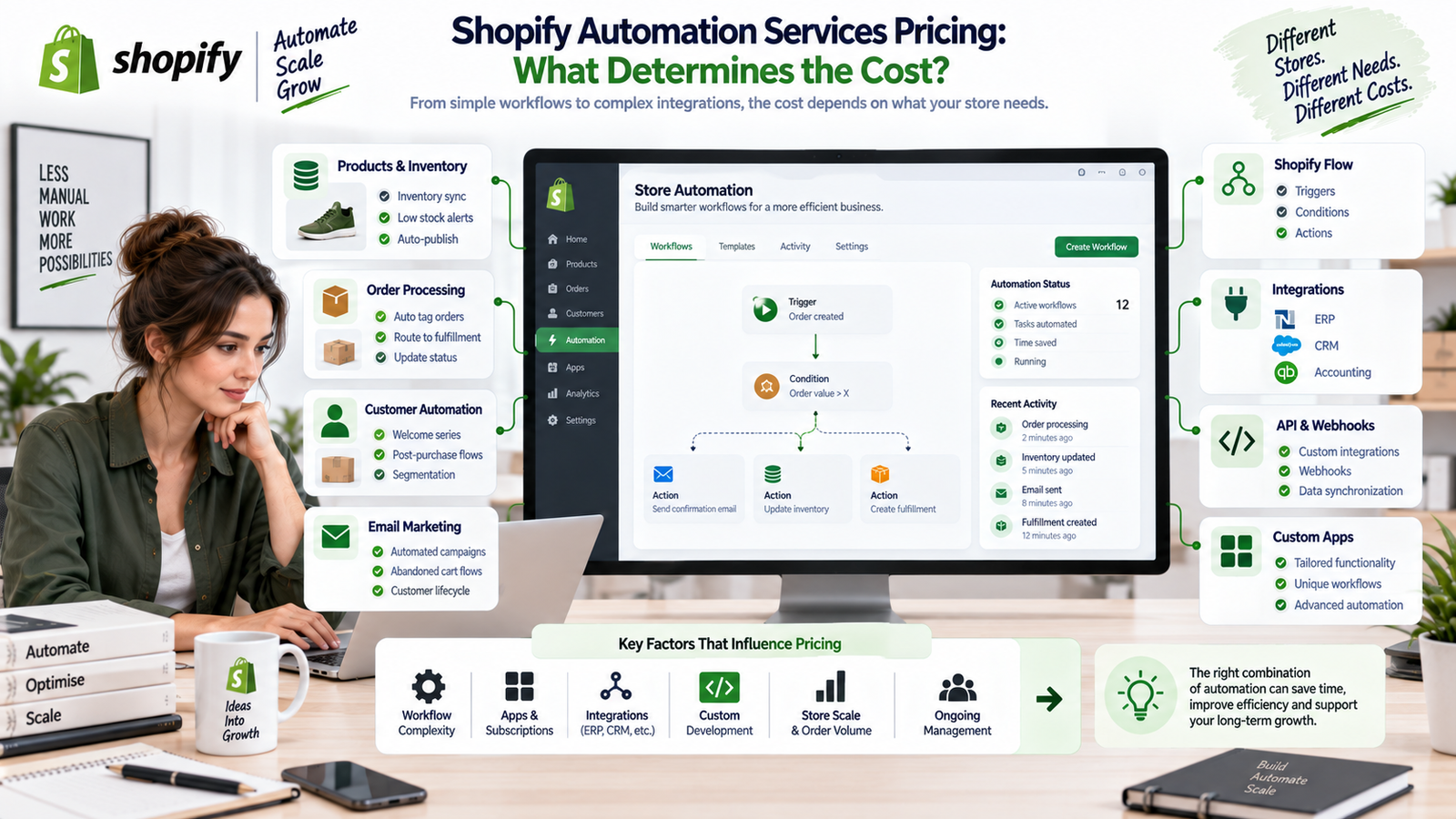
Shopify Automation Services Pricing: What Determines the Cost?
Merchants comparing quotes for Shopify automation services often notice wildly different numbers for what looks like the same request. That gap usually comes down to scope, not markup. Shopify automation services pricing depends on workflow complexity, the number of apps involved, order and SKU volume, and how much custom development or ongoing management a project needs.
There is no single Shopify automation cost that applies to every store, and no fixed Shopify automation pricing that fits both a single-workflow setup and a multi-system integration. A merchant who needs three Flow workflows for order tagging will have a very different scope from a brand connecting Shopify to an ERP, CRM, and fulfillment network.
Shopify store automation services and Shopify ecommerce automation services can therefore range from lightweight, self-managed configuration to a fully custom, actively monitored system. Understanding what drives that range makes it easier to compare quotes accurately.
Quick Answer: How Much Do Shopify Automation Services Cost?
Shopify automation services cost depends on workflow complexity, paid apps, integrations, custom development, order and SKU volume, number of stores, and ongoing management. Simple Shopify Flow workflows usually require less implementation than ERP integrations, custom apps, or multi-system automation with advanced monitoring and error handling.
What Are Shopify Automation Services?
Shopify automation services cover the tools and technical work used to reduce manual tasks across store operations. A Shopify automation service may combine native Shopify Flow automation, third-party apps, API connections, purpose-built custom apps, and managed oversight.
Shopify Flow is a free app available on the Basic, Grow, Advanced, and Plus plans. It uses a trigger, condition, action model. Most Flow functionality is available across those plans, although Shopify currently limits the Send HTTP Request action to Grow, Advanced, and Plus, while tasks created by custom partner apps require Plus. Shopify also notes that Flow usage limits can vary with plan-level API limits. See the official Shopify Flow documentation.
Shopify automation apps add packaged functionality where native workflows are not enough. Custom integrations and custom apps become relevant when external business systems need to exchange data with Shopify.
Shopify business automation, in practice, is rarely one tool doing everything. It is usually a combination of Flow, apps, integrations, and human oversight sized to the operation.
How Much Do Shopify Automation Services Cost?
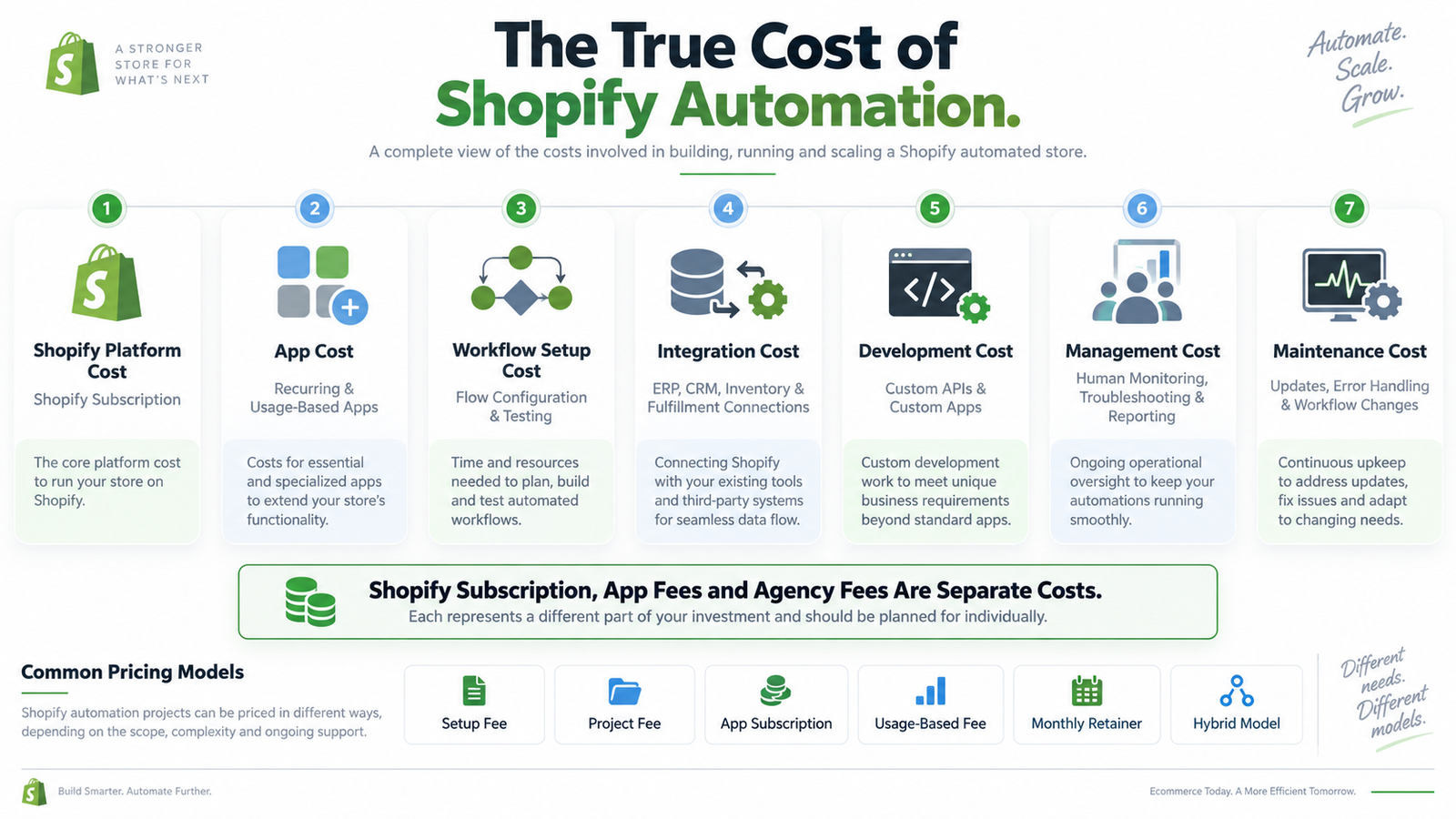
Shopify automation services pricing is built from several separate line items rather than one flat number.
A one-time configuration fee may cover initial workflow build-out, sometimes described as a Shopify automation setup cost or Shopify automation setup fee. Custom API or app work is typically priced as a defined development project. Ongoing monitoring and troubleshooting may create a Shopify automation monthly cost or Shopify automation monthly fee.
Professional Shopify automation providers may use packaged, project-based, retainer, or hybrid pricing. The cost of Shopify automation services therefore only makes sense when the scope is known.
The cost to automate a Shopify store with five straightforward Flow workflows is not comparable with the cost of integrating an ERP across several fulfillment locations.
Shopify store automation pricing also varies with how the engagement is structured. Shopify automation agency pricing may use packages, project pricing, or ongoing management fees, while Shopify automation fees should state clearly what is included.
| Pricing Model | How It Works | Typical Use |
| Setup fee | One-time configuration | Initial automation setup |
| Project fee | Fixed implementation cost | Defined workflow or integration project |
| App subscription | Recurring software charge | Third-party automation tools |
| Usage-based fee | Cost changes with usage | Certain apps and services |
| Monthly retainer | Ongoing management fee | Managed automation |
| Custom-development fee | Bespoke development | APIs and custom apps |
| Hybrid model | Setup plus recurring costs | Complex automation stacks |
No single structure is universal. Shopify automation service packages, Shopify automation pricing plans, and a Shopify automation retainer can all price similar underlying work differently.
What Determines Shopify Automation Services Pricing?
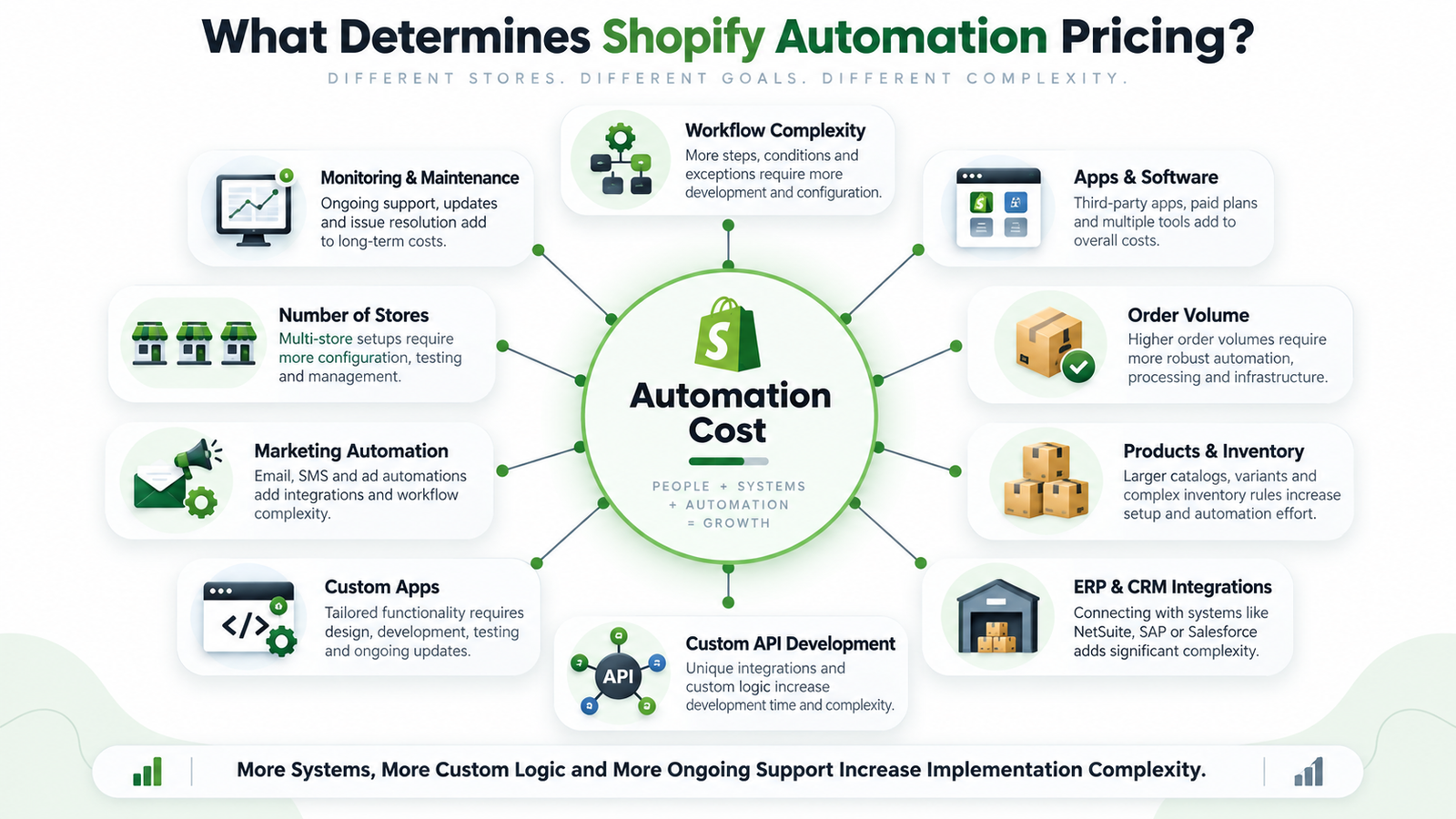 Answering what determines Shopify automation services pricing means examining the Shopify automation cost factors and Shopify automation pricing factors that materially change the implementation.
Number and Complexity of Workflows
Shopify workflow automation becomes more expensive as workflow logic branches and exceptions increase.
A handful of basic order-tagging rules requires less work than dozens of interconnected Shopify Flow workflows with multiple conditions. Custom Shopify Flow workflows may also require more testing, documentation, and exception handling.
Shopify Flow setup is usually most efficient when Shopify already provides the necessary triggers and actions. Shopify Flow services may still include workflow design, testing, documentation, and maintenance.
Apps and Software Stack
Every connected application adds another configuration and testing surface.
Shopify automation tools can reduce development requirements when packaged functionality already exists, but several paid tools can also create separate subscriptions and usage charges.
The Shopify automation software cost and Shopify automation app cost belong to the software itself rather than agency labor.
Shopify’s current app-pricing framework supports recurring subscriptions, usage-based pricing, and combinations of recurring and usage-based charges. Shopify’s legacy/manual billing system also supports certain one-time purchase models. See the official Shopify App Pricing documentation.
This means Shopify app pricing, Shopify app costs, a Shopify automation subscription, and the Shopify app subscription cost need to be evaluated app by app.
Order Volume and Fulfillment
Higher order volume increases the importance of testing, exception handling, and monitoring.
Shopify order automation can include tagging, notifications, routing, approvals, and fulfillment triggers. Shopify order processing automation and Shopify order management automation can connect additional systems for automated order processing.
Shopify fulfillment automation and Shopify shipping automation may connect Shopify with carriers, warehouses, dropshipping platforms, or 3PL systems.
Shopify order routing automation becomes more complex when geography, inventory availability, delivery speed, or warehouse capacity determines where an order should go. Reliable Shopify fulfillment workflows also need to account for failed updates, partial shipments, cancellations, and backorders.
An automation provider should not be described as physically fulfilling orders unless that service is separately included.
Product and Inventory Complexity
Large catalogs require careful SKU and location mapping.
Shopify inventory automation can handle stock updates, alerts, availability, and replenishment-related workflows. Shopify inventory management automation becomes more complicated when stock is spread across warehouses, suppliers, retail locations, marketplaces, or multiple Shopify stores.
Shopify inventory sync, automated inventory management, Shopify stock synchronization, and Shopify stock automation all depend on deciding which system owns the authoritative inventory record.
A Shopify inventory integration may connect a warehouse system, ERP, supplier, marketplace, or fulfillment platform. Shopify inventory workflows also need rules for returns, cancellations, reserved units, and synchronization failures.
ERP and CRM Integrations
A Shopify ERP integration or Shopify CRM integration usually requires more technical work than installing a prebuilt app.
These projects may require data mapping, authentication, conflict resolution, validation, and rules defining which platform is the system of record.
Customer and Loyalty Automation
Shopify customer automation and Shopify CRM automation can synchronize customer information and trigger downstream workflows.
Shopify customer segmentation automation can group customers by behavior, spending, or lifecycle stage. Shopify customer tagging automation can apply labels used by marketing or support systems.
Shopify loyalty automation may manage VIP status, rewards, or customer-value workflows. Shopify customer workflow automation becomes more complex when multiple applications must act on the same customer state.
Marketing and Retention Automation
Shopify marketing automation can connect customer behavior with email, SMS, lifecycle, and post-purchase workflows.
Common examples include:
- Shopify email automation
- Shopify abandoned cart automation
- Shopify abandoned checkout automation
- Shopify post-purchase automation
- Shopify SMS automation
- Shopify customer retention automation
Shopify ecommerce marketing automation that spans several channels requires more configuration than a single email workflow.
Marketing automation may depend on native Shopify features, third-party apps, email platforms, SMS services, CRM systems, or combinations of these tools. It should not automatically be assumed to be included in every automation package.
Custom API Development
Custom API Integrations Increase Implementation Cost
A Shopify API integration may require discovery, architecture planning, authentication, data mapping, webhooks, GraphQL queries and mutations, testing, error handling, retry logic, logging, and monitoring.
Shopify API automation therefore becomes more expensive as more systems, data objects, and synchronization rules are introduced.
Shopify’s REST Admin API has been classified as legacy since October 1, 2024. Since April 1, 2025, new public apps submitted to the Shopify App Store must use the GraphQL Admin API. See Shopify’s REST Admin API notice and current GraphQL Admin API documentation.
A Shopify custom integration or Shopify third-party integration may also need webhook processing and recovery logic.
Custom Shopify automation, Shopify integration services, and Shopify automation integration work can therefore create a larger Shopify automation implementation cost and Shopify integration cost than standard app configuration.
Custom Apps
When Flow and existing apps cannot satisfy the requirement, Shopify custom app development may be appropriate.
Shopify automation development can include proprietary business logic, background processing, custom interfaces, integrations, or data transformation.
A Shopify automation developer should be able to explain why custom code is required instead of simply recommending it by default.
The Shopify automation development cost depends on architecture and scope. Custom Shopify workflow development and Shopify integration development should therefore be distinguished from normal Flow configuration.
Number of Stores
Running Shopify store automation across several storefronts multiplies configuration and testing.
Shopify automated workflows rarely transfer perfectly between stores when catalogs, markets, apps, inventory, or fulfillment rules differ.
This is why Shopify ecommerce automation for a multi-store organization can cost more than Shopify store automation services for small businesses.
Human Oversight and Maintenance
Ongoing monitoring, troubleshooting, workflow changes, permissions, and documentation all add recurring cost.
Shopify automation management and Shopify automation management services therefore represent a different service from simply buying software.
A professional Shopify automation engagement may combine technical implementation with ongoing management.
Shopify Automation Software and App Costs Explained
The Shopify automation software cost belongs to the tools being used, not the automation provider.
The same applies to Shopify automation app cost and other Shopify app costs.
Current Shopify app billing can include recurring subscriptions, usage-based charges, and combined recurring-plus-usage models. Certain existing or outlier applications can still use legacy manual billing, including supported one-time charges.
This matters because one app might charge a predictable recurring subscription while another becomes more expensive as messages, orders, or usage increase.
The software stack therefore affects both Shopify store automation cost and Shopify store automation pricing, even when agency labor does not change.
Shopify Flow vs Custom Automation: Which Costs More?
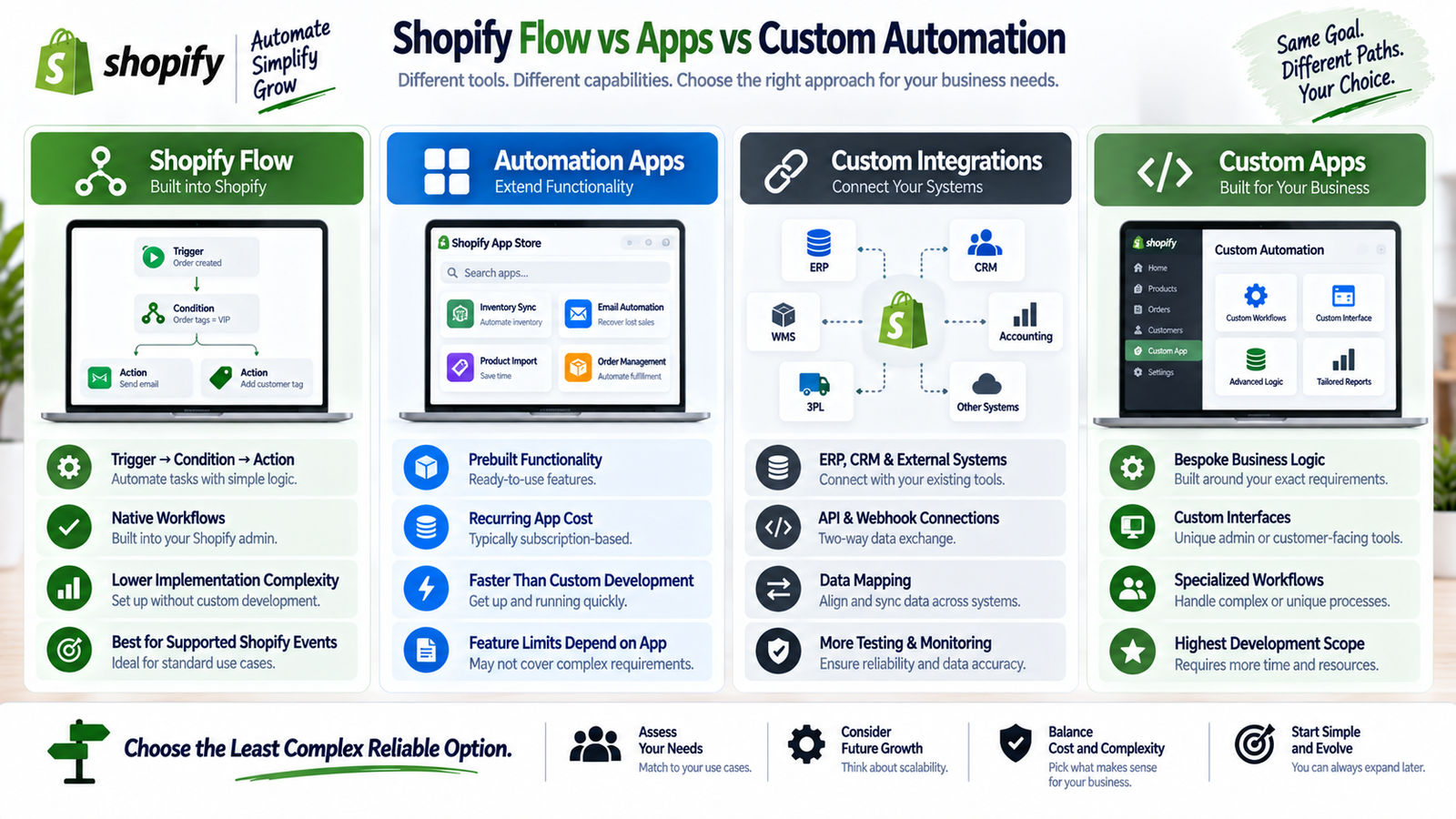 Shopify Flow
Shopify Flow automation is usually the lower-complexity option when Shopify already supports the required trigger and action.
For example, another Shopify Flow setup might handle inventory alerts, customer tags, risk-related workflows, notifications, or order actions.
A Shopify Flow integration can also work with supported applications without requiring a fully custom service.
Automation Apps
Packaged applications work well when the required functionality already exists.
They can reduce development time but introduce recurring software costs and another dependency that needs to be monitored.
Custom Integrations
Shopify integration services are appropriate when Shopify needs to communicate with an ERP, CRM, warehouse, supplier, fulfillment provider, or proprietary system that cannot be handled adequately through a standard connector.
A Shopify third-party integration can also require custom transformation or reconciliation logic.
Custom Apps
A second Shopify custom app development project should only be recommended when packaged tools and standard workflows cannot reliably meet the requirement.
Shopify automation development should solve a documented technical gap rather than replace an adequate Flow workflow or existing application.
Native Shopify workflow automation can therefore cost less to implement in appropriate use cases because the workflow environment already exists. It does not mean Shopify Flow can replace every external integration.
Software Automation vs Managed Shopify Automation Services
| Software Automation | Managed Automation |
| Merchant operates tools | Provider manages workflows |
| App subscriptions | Software plus human oversight |
| Defined tool functionality | Broader integration scope possible |
| Merchant handles exceptions | Provider may troubleshoot |
| Internal strategy required | Strategy and support may be included |
| Lower human-service overhead | Retainer or package pricing |
Managed Shopify automation services may include workflow design, setup, integration, testing, monitoring, optimization, and maintenance.
Full-service Shopify automation can extend further into related operational support. Done-for-you Shopify automation is another commercial label for this model, but buyers should still evaluate the actual contract.
Shopify automation outsourcing makes sense when the outsourced work replaces responsibilities that would otherwise consume internal resources.
For broader operational context, HiSellIt’s Shopify store management services guide explains how automation fits alongside ongoing store management.
Neither software-only automation nor managed automation is automatically better. The right model depends on internal expertise, workload, complexity, and how much troubleshooting the business wants to own.
What Costs Are Separate From Automation Agency Fees?
Pricing becomes much clearer when separate cost categories are used.
Shopify Platform Cost
The Shopify plan cost pays for the ecommerce platform. Shopify’s current pricing page should be checked when budgeting because plan pricing can vary by market and billing cycle.
The Shopify subscription cost is not an automation-provider fee.
Shopify Plus
The Shopify Plus cost is a separate platform expense for merchants that need the capabilities included with Plus. A business should not automatically move to Plus simply because an automation provider recommends it.
Shopify Flow
The Shopify Flow cost is zero as a standalone app charge on Basic, Grow, Advanced, and Plus. Some Flow features still have plan-specific availability.
App Subscriptions
App subscriptions and usage-based charges are separate from agency labor.
Email and SMS Costs
Email and SMS platforms may charge based on contacts, message volume, or usage.
Payment Processing
Shopify Payments and third-party payment processing costs are unrelated to automation implementation.
Custom Development
API, integration, and app-development projects may be priced separately from maintenance.
Automation Agency Fees
A Shopify automation agency cost may include discovery, setup, testing, support, reporting, and ongoing management.
Keeping these categories separate prevents the cost of Shopify automation services from being confused with the entire cost of operating a Shopify store.
 When Does Shopify Automation Become Expensive?
Shopify automation cost rises fastest when several systems must exchange data reliably.
ERP synchronization, multiple stores, high order volume, large catalogs, real-time inventory, legacy systems, custom apps, advanced error handling, and intensive monitoring all increase implementation complexity.
The Shopify integration cost can also grow when data must be transformed between incompatible structures or several systems can update the same record.
A custom Shopify automation cost estimate should therefore separate discovery, implementation, testing, monitoring, and maintenance.
More expensive automation is not automatically better automation. It usually means the required scope is more complex.
Is Shopify Automation Worth the Cost?
Is Shopify automation worth it depends on the specific work being automated.
A practical evaluation framework is:
Automation value = staff time saved + manual errors reduced + operational capacity gained – implementation, apps, and maintenance costs
This is a decision framework, not an official Shopify formula, and it does not guarantee positive Shopify automation ROI.
The benefits of Shopify automation are clearest when repetitive tasks are frequent, measurable, and limiting staff capacity.
Shopify automation vs manual management should compare staff time, error handling, app costs, implementation, and maintenance rather than software price alone.
A second Shopify automation vs manual management consideration is exception ownership. Even a strong automated system needs someone to handle unusual cases.
Shopify automation for scaling makes the most sense when operational workload is becoming a constraint on growth.
How to Choose a Shopify Automation Provider
A qualified Shopify automation agency should explain workflow discovery, Shopify Flow, GraphQL Admin API architecture, apps, custom development, testing, permissions, error handling, monitoring, documentation, and ongoing maintenance.
A credible Shopify automation company should also separate platform, app, development, and management charges.
Providers offering Shopify ecommerce automation, Shopify ecommerce automation services, or Shopify automation and integration services should define those terms in the proposal rather than relying on broad labels.
Businesses evaluating a wider managed ecommerce model can compare the automation scope with HiSellIt’s Shopify dropshipping services. Product-focused merchants can also review AI product research for Shopify dropshipping and the Shopify dropshipping niches guide.
Avoid providers promising guaranteed profits, passive income, zero-maintenance automation, unlimited custom integrations for a tiny fee, guaranteed error-free workflows, or policy workarounds.
Conclusion
Shopify automation services pricing is shaped by workflow complexity, apps, integrations, custom development, operational scale, and ongoing management.
Shopify store automation cost and custom Shopify automation pricing can differ substantially because standard Flow configuration and bespoke multi-system engineering are fundamentally different projects.
Businesses considering Shopify store automation services should map their existing processes before requesting quotes. The same applies to Shopify ecommerce automation services and full-service Shopify automation, where provider scope can vary considerably.
A provider should separate Shopify automation agency pricing, software charges, development, implementation, and maintenance. Businesses ready to map their workflows and request customized pricing can contact HiSellIt to discuss current systems, integrations, and automation requirements.
Frequently Asked Questions
Q. What determines Shopify automation services pricing?
Shopify automation services pricing depends on workflow complexity, apps, ERP or CRM integrations, custom development, testing, store count, and ongoing maintenance. That is also why do Shopify automation services cost different amounts between providers.
Q. How much does Shopify workflow automation cost?
Shopify workflow automation cost depends on workflow count, branching logic, exception handling, integrations, and maintenance. Standard Flow workflows generally require less custom engineering than API-driven projects.
Q. How much does Shopify Flow automation cost?
The Shopify Flow app itself is free on Basic, Grow, Advanced, and Plus. Merchants may still pay for Shopify Flow services covering design, implementation, testing, integration, documentation, and maintenance.
Q. How much does a Shopify API integration cost?
There is no universal rate. A Shopify API integration can become more expensive when it requires bidirectional synchronization, large data volumes, complex mappings, webhooks, retries, error handling, and continuous monitoring.
Q. Does Shopify automation require paid apps?
No. Shopify Flow can handle many workflows without another paid automation application. Specialized email, SMS, CRM, inventory, fulfillment, or analytics requirements may still require third-party software.
Q. What is the difference between software and managed automation?
Software automation leaves setup and monitoring with the merchant. Managed Shopify automation services pricing includes human services such as workflow design, implementation, testing, troubleshooting, and maintenance. The provider’s responsibility should be defined in the contract.