
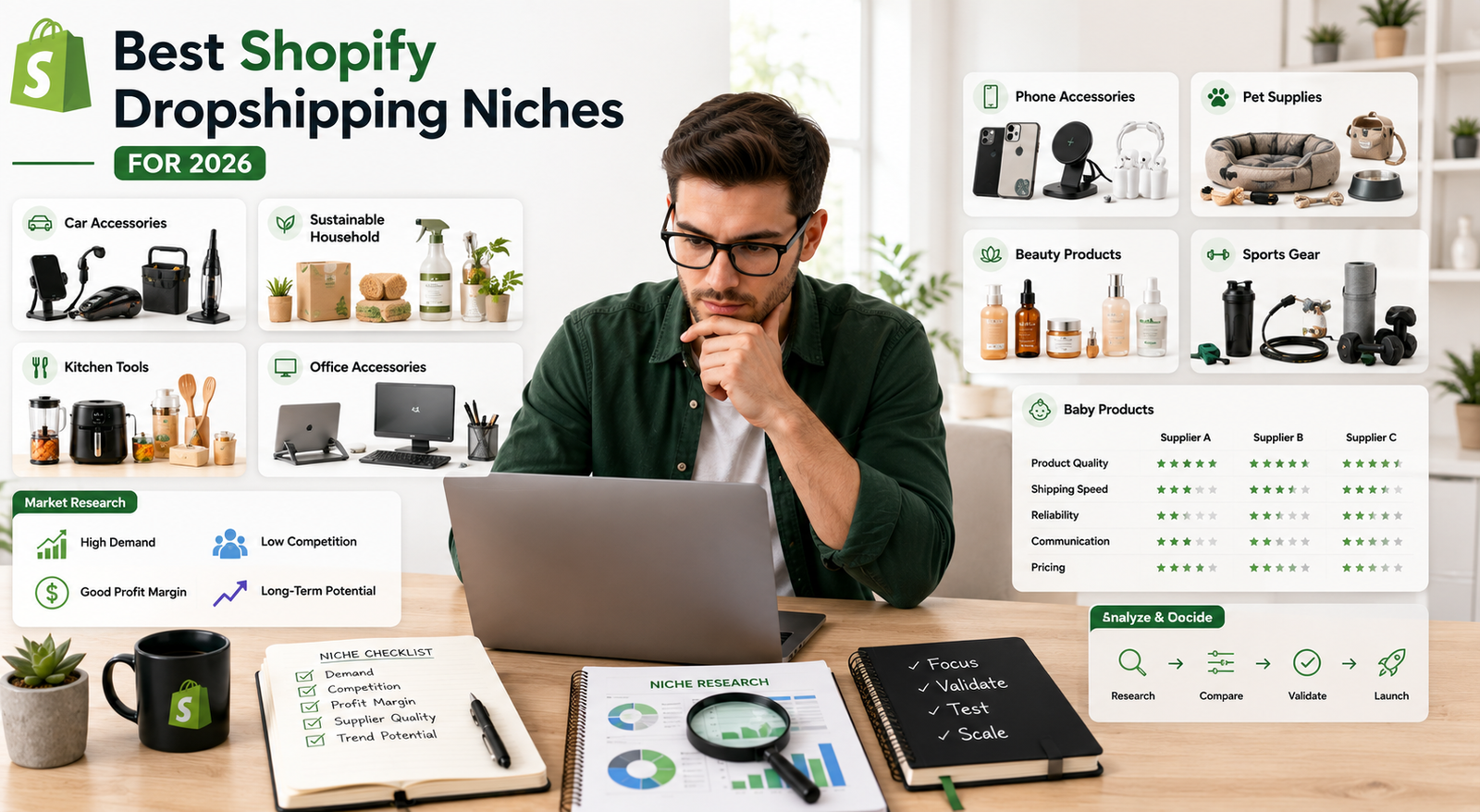
Best Shopify Dropshipping Niches for 2026: Complete Guide
Choosing the right Shopify dropshipping niche in 2026 is less about chasing whatever product happens to be trending and more about finding a market with genuine demand, reliable suppliers, workable margins, and enough room to differentiate your store.
According to Shopify’s current research on the best dropshipping products, categories attracting ecommerce interest include beauty and personal care, kitchen and dining, baby products, pet supplies, home products, office supplies, phone accessories, car accessories, and other practical consumer goods. Shopify also estimates that the global dropshipping market will exceed $583 billion in 2026, although the size of the overall market does not guarantee that an individual product or store will be profitable.
Shopify also emphasizes in its guide to finding a profitable dropshipping niche that there is no single niche that is automatically best for every seller. Product-market fit, supplier reliability, pricing, competition, marketing costs, shipping, and the ability to reach the right audience all influence results.
This guide explores Shopify dropshipping niches worth researching in 2026 and, more importantly, explains how to validate demand, analyze competition, calculate margins, choose suppliers, and build a niche store around real customer needs.
Quick Answer: What Are the Best Shopify Dropshipping Niches in 2026?
Strong Shopify dropshipping niches to research in 2026 include car accessories, sustainable products, kitchen and dining, home and bedroom, office products, phone accessories, sports and outdoors, pet supplies, beauty and personal care, and baby products. The best niche for your store depends on demand, competition, supplier reliability, shipping costs, product margins, compliance requirements, and your ability to reach the right customers.
10 Shopify Dropshipping Niches to Consider in 2026
The following categories are worth researching because they align with current ecommerce demand and categories highlighted in Shopify’s latest dropshipping product research. That does not mean every product within these markets will be profitable. Each niche still needs to be validated according to demand, competition, margins, shipping requirements, and supplier quality.
- Car Accessories – Products such as organizers, cleaning accessories, mounts, interior accessories, and other problem-solving items.
- Sustainable Products – Reusable household items, environmentally focused accessories, and products built around lower-waste lifestyles.
- Kitchen and Dining Products – Storage products, utensils, drinkware, organizers, and practical kitchen tools.
- Home and Bedroom Products – Décor, organizers, bedding accessories, lighting, and other products designed around comfort or convenience.
- Office and Home Office Products – Desk accessories, laptop stands, organizers, ergonomic accessories, and workspace products.
- Phone Accessories – Cases, stands, charging accessories, mounts, tripods, and other mobile-device accessories.
- Sports and Outdoor Products – Activity-specific accessories, compact training products, outdoor gear, and practical fitness items.
- Pet Supplies – Toys, travel accessories, grooming tools, feeders, beds, and other pet-care products.
- Beauty and Personal Care – Beauty accessories, grooming tools, cosmetic accessories, and personal-care products where regulations permit.
- Baby and Child Products – Practical accessories and everyday products, although safety, labeling, and compliance must be checked particularly carefully.
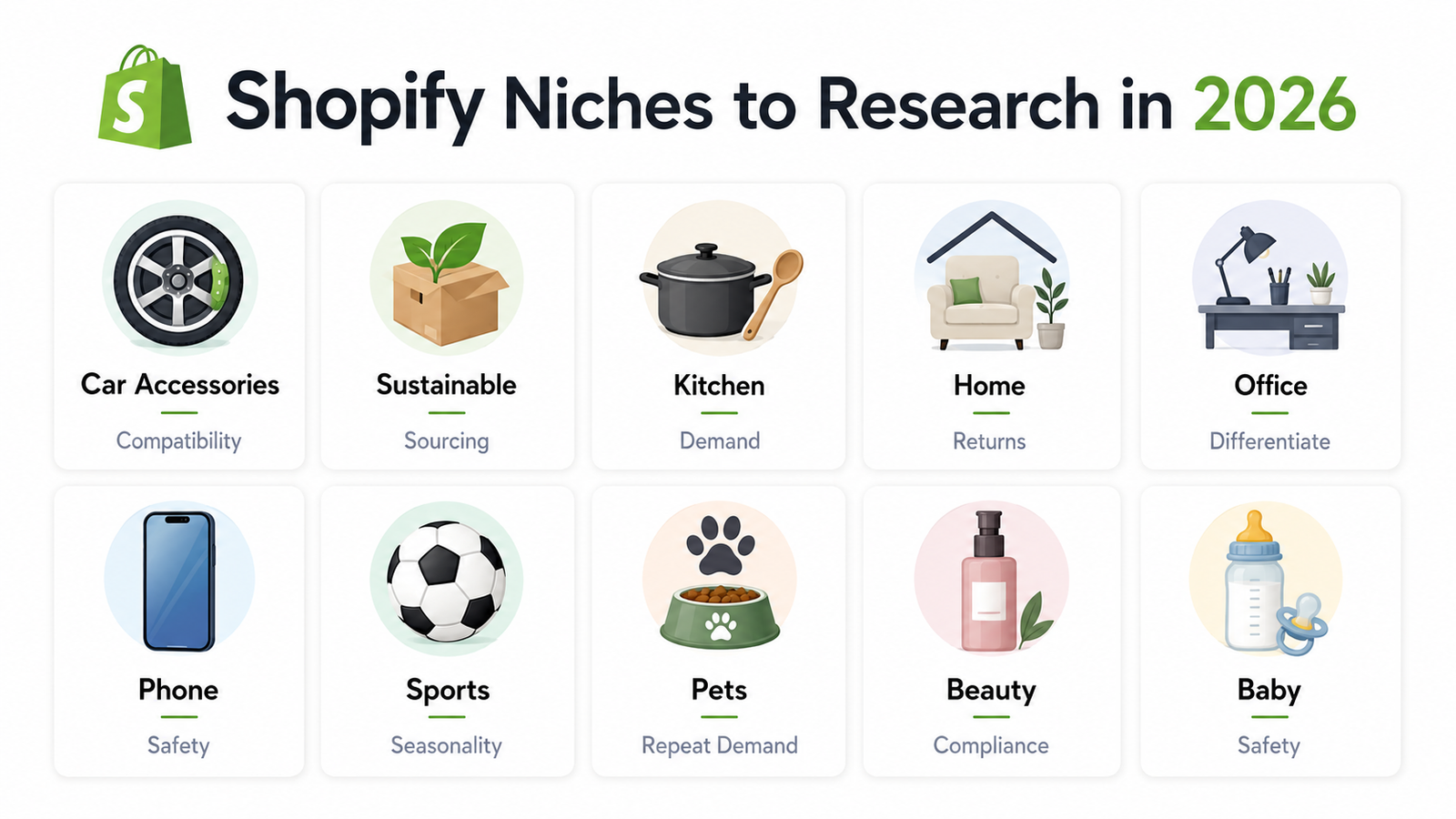 Shopify Dropshipping Niches to Research in 2026
| Niche | Product Opportunities | What to Validate |
|---|---|---|
| Car Accessories | Organizers, cleaning tools, mounts | Compatibility and competition |
| Sustainable Products | Reusable household products | Environmental claims and sourcing |
| Kitchen & Dining | Storage, utensils, practical tools | Demand and shipping costs |
| Home & Bedroom | Décor, organizers, soft furnishings | Size, breakage and return risk |
| Office Products | Desk accessories, stands, organizers | Demand and differentiation |
| Phone Accessories | Cases, stands, charging accessories | Compatibility and safety |
| Sports & Outdoors | Activity-specific accessories | Seasonality and product safety |
| Pet Supplies | Toys, grooming and travel products | Quality and repeat demand |
| Beauty & Personal Care | Accessories and beauty tools | Claims, ingredients and compliance |
| Baby & Child | Practical everyday accessories | Safety and regulatory requirements |
Shopify’s current product research includes many of these categories among the most-searched dropshipping product areas. See Shopify’s 2026 dropshipping product research
Niche Opportunities in More Detail
1. Sustainable Living and Eco-Friendly Products
Sustainability has developed into a meaningful ecommerce segment rather than being limited to a short-lived product trend. Reusable kitchenware, waste-reduction accessories, solar-powered products, and environmentally focused household goods can all support a clearly defined niche store.
The advantage of this category is not a guaranteed higher margin. Instead, it gives sellers an opportunity to build a focused brand around a specific lifestyle or customer value. Shopify includes sustainability among the areas worth considering in its dropshipping niche research, but individual products still need to be checked for demand, sourcing quality, competition, and realistic margins.
Potential sub-niches include reusable kitchen accessories, sustainability-focused pet products, solar-powered outdoor accessories, lower-waste personal-care accessories, and reusable travel products.
However, sellers need to be particularly careful with environmental claims. Terms such as “biodegradable,” “zero waste,” “compostable,” or “sustainable” should only be used when the supplier can substantiate them. Marketing claims should accurately describe what the product actually does rather than simply adding “eco-friendly” to a generic item.
2. Health and Wellness Technology
Health and wellness remains an interesting product area, but it requires more caution than many standard household niches. Products may include hydration accessories, massage tools, fitness accessories, posture-support products, sleep accessories, and non-medical wellness devices.
The appeal of this niche comes from customers looking for practical products connected to fitness, comfort, relaxation, or everyday routines. However, prices and margins vary significantly from one product to another, so there is no meaningful universal price range or profit benchmark.
Health-related products also require more supplier verification. Avoid unsupported medical, diagnostic, therapeutic, or disease-related claims, and check whether the products you intend to sell require specific certifications, labeling, registrations, or other regulatory requirements in your target market.
A wellness accessory and a regulated medical device are not the same thing. That distinction should influence both sourcing and advertising.
3. Pet Care and Comfort Products
Pet supplies remain one of the categories highlighted in Shopify’s current dropshipping product research. The niche includes everything from toys and grooming accessories to beds, leashes, travel products, feeders, and cleaning products.
The strength of the pet niche is the opportunity to build around a clearly defined audience. Instead of creating a general pet store, you might focus on apartment dogs, pet travel, enrichment toys, grooming, senior-pet comfort, or another specific use case.
Pet products can also create repeat-purchase opportunities when customers need replacement products, accessories, consumables, or additional items for the same animal. That does not guarantee a particular customer lifetime value, so CLV should be measured from your own store data rather than estimated using a generic industry figure.
Potential product areas include interactive feeding products, travel accessories, grooming tools, enrichment toys, weather-related accessories, and pet organization products.
4. Home Office and Productivity Solutions
The modern workspace continues to create opportunities for office and home-office products. Shopify includes office products among the categories in its current dropshipping product research, with opportunities ranging from desk organization and stationery to ergonomic accessories and workspace tools.
A Shopify store in this niche could focus on desk organization, laptop setups, lighting, cable management, portable work accessories, or aesthetically coordinated workspaces. The category also works well with educational content such as setup guides, organization tutorials, and workspace transformations.
The niche also lends itself well to content marketing. Instead of simply displaying a laptop stand or desk organizer, a seller can create setup guides, organization tutorials, workspace transformations, and productivity-focused content that shows the product in context.
5. Smart Home and Home Improvement Products
Smart-home and home-improvement accessories can appeal to shoppers looking for convenience, organization, security, or practical improvements around the home. Shopify’s dropshipping product research includes tools and home-improvement products among categories worth investigating, but electronic products require additional supplier checks.
Potential products can include smart plugs, motion sensors, lighting accessories, organization tools, home-maintenance accessories, and other practical devices. Electrical and connected products should be checked carefully for compatibility, certifications, safety, warranty support, and supplier quality before they are added to your store.
This niche does require extra supplier diligence. Electrical products, chargers, connected devices, and security products can create compatibility, warranty, privacy, safety, certification, and return issues.
Before listing an electronic product, verify its specifications, voltage compatibility, certifications where required, warranty arrangements, product documentation, and supplier quality. A slightly higher supplier cost may be worthwhile if it reduces defects and refunds.
If you want support setting up or managing the operational side of a store, you can also explore HiSellIt’s Shopify dropshipping services.
Emerging Niche Markets with Growth Potential
Digital Nomad and Travel Accessories
The digital-nomad niche focuses on products that make it easier to work while traveling or moving between locations. This can include tech organizers, travel-friendly laptop accessories, compact office products, cable storage, international travel accessories, portable stands, and lightweight organization products.
Instead of assuming that digital nomads will automatically pay premium prices, validate exactly what the target customer values. Someone traveling internationally may prioritize weight and compact size, while a remote worker moving between coworking spaces may care more about organization and device compatibility.
This niche can also be segmented further around business travelers, van-life workers, frequent flyers, students, or people who regularly work from cafés and coworking spaces.
Hobby and Craft Supplies
Creative hobbies can make strong niche stores because customers often need multiple products for an ongoing activity. Possible areas include art supplies, jewelry-making accessories, model-building tools, resin supplies, sewing products, scrapbooking materials, and specialized craft storage.
Rather than selling every type of craft product, a focused store can serve one community particularly well. Customers working on ongoing projects may return for replacement materials, new tools, accessories, and additional supplies, creating natural repeat-purchase opportunities.
The best way to compete is often through deeper product knowledge and useful content rather than simply offering the lowest price.
Gaming and Entertainment Accessories
Gaming remains a large consumer category, with possible Shopify niches around desk setups, controller storage, streaming accessories, lighting, cable management, ergonomic accessories, and gaming-room organization.
Gamers often compare compatibility and specifications closely, so product pages should be precise. Clearly state supported devices, dimensions, materials, connectivity, and what is included.
Be particularly careful with branded merchandise, gaming characters, franchise logos, artwork, and unofficial accessories. Verify that suppliers are authorized and that you have the right to sell products using protected trademarks, artwork, or characters. Counterfeit or unauthorized merchandise can create both platform and legal problems.
How to Validate Your Chosen Dropshipping Niche
Choosing a category is only the beginning. Before building an entire store around an idea, you need evidence that real buyers are searching for and purchasing products in that market. Shopify’s dropshipping niche selection guide recommends looking for steady or growing demand, studying competing businesses, and considering whether the niche offers complementary products that can support a broader product range.
How Do You Validate a Shopify Dropshipping Niche?
Validate a Shopify dropshipping niche by checking long-term search demand, reviewing competitors, comparing supplier costs and shipping times, studying customer reviews, calculating realistic margins, and testing a focused group of products before expanding. A promising niche should have genuine demand, reliable sourcing, workable economics, and a clear way for your store to differentiate.
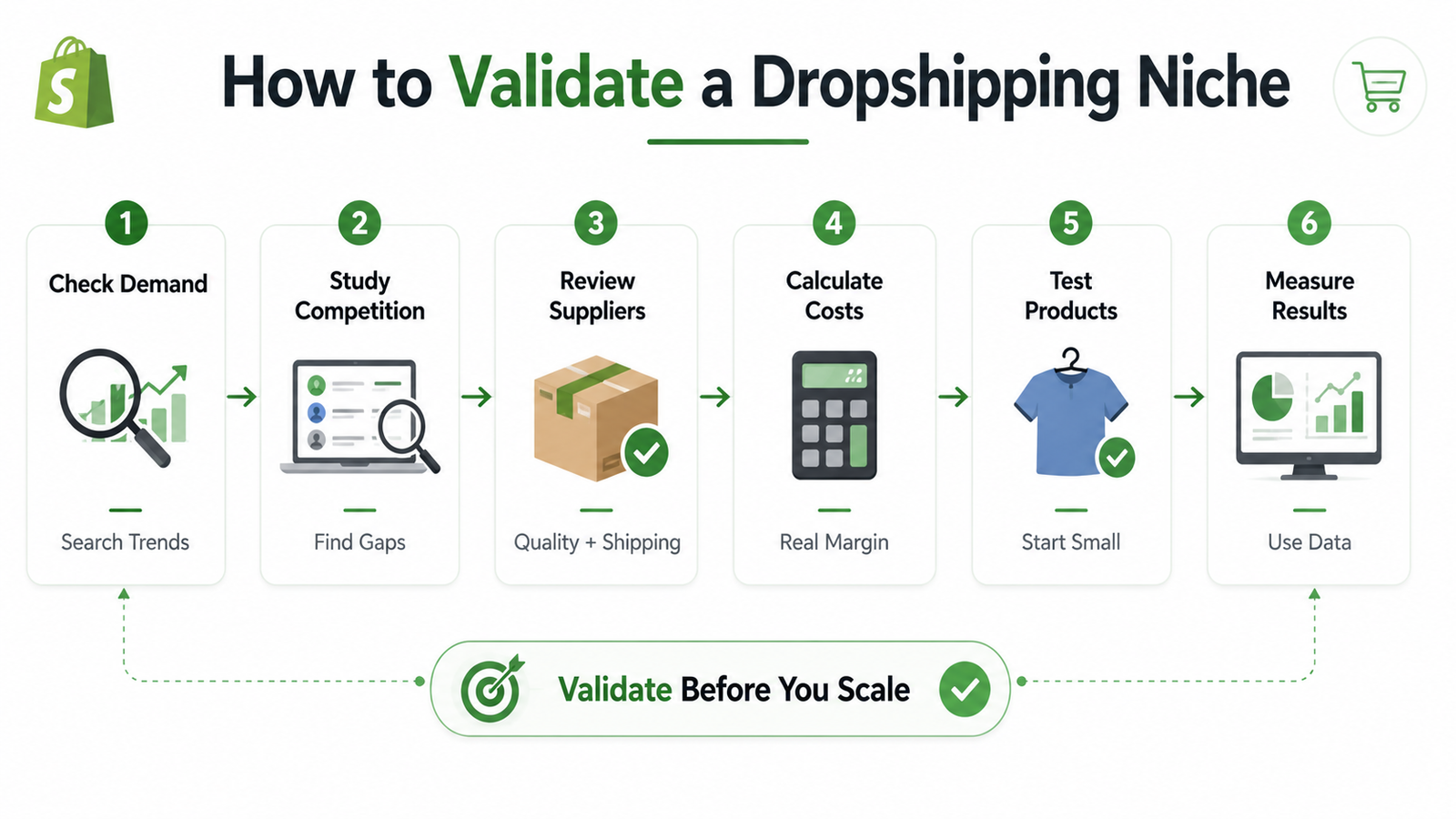 Market Research Strategies
Start with demand. Google Trends can help you compare long-term search interest, identify seasonality, and see whether interest in a topic appears to be rising, stable, or declining. Do not treat one sudden spike as proof that a product has sustainable demand. Compare trend data with competitor activity, customer reviews, supplier information, pricing, and actual purchase behavior.
Competitor research can reveal just as much as keyword data. Study product ranges, prices, delivery promises, branding, advertising, content, and customer reviews. Negative reviews are particularly useful because they can reveal recurring problems that a better product, supplier, product page, or customer-service process might solve.
Do not assume the presence of competitors makes a niche bad. Competition can be evidence that demand exists. The key question is whether your store has a meaningful way to differentiate through product selection, audience positioning, content, price, branding, service, or fulfillment.
Testing Market Demand
Instead of launching hundreds of products immediately, consider starting with a small and focused selection. Track which products generate impressions, clicks, add-to-carts, checkouts, and actual purchases before expanding the catalog.
Paid advertising can help test buyer response, but traffic alone is not validation. A product that generates inexpensive clicks but no profitable sales is not necessarily a good product.
Combine advertising data with search demand, supplier reliability, product reviews, shipping times, and margin calculations. Your objective is to determine whether there is a repeatable business case rather than simply proving that people will click an ad.
If you’re still early in the process, reviewing these Shopify dropshipping mistakes to avoid can help you avoid building a store around weak products or poor supplier economics.
Competition Analysis Framework
Competition should be evaluated at both the niche and individual-product level. A broad market may be highly competitive while a specific audience or use case within that market still provides room to differentiate.
Ask:
- How many relevant competitors are active?
- What price ranges are common?
- Which products appear repeatedly?
- How are competitors acquiring traffic?
- What complaints appear most often in customer reviews?
- How strong are competitor brands and product pages?
- What delivery times are customers being offered?
- Can your store provide a meaningful difference?
The goal is not necessarily to find a market with no competition. A completely empty market may simply indicate weak demand.
Building Your Shopify Store for Niche Success
Store Design and User Experience
Store design affects how quickly shoppers understand your business, find products, and decide whether they trust the website enough to buy.
Your design should reflect the niche without becoming overly complicated. A sustainable-products store might use natural imagery and educational content around sourcing, while a technology-accessories store might use a cleaner and more specification-focused presentation. These are branding choices, not guaranteed conversion formulas.
Mobile performance is especially important because customers should be able to browse products, read descriptions, view images, and complete checkout without unnecessary friction. Compress large images, avoid unnecessary apps and scripts, and keep navigation simple.
Organic search can also become an important acquisition channel for niche stores. Our Shopify SEO guide for beginners explains how product pages, collections, keywords, site structure, and content can work together to improve search visibility.
Product Selection and Sourcing
Product selection is one of the most important parts of building a niche dropshipping business. Avoid filling your store with every trending product you come across. Instead, focus on products that solve genuine problems, appeal to the same target audience, and can be sourced reliably.
Shopify’s guide to starting and managing a dropshipping business explains several ways sellers can source products and work with suppliers. Regardless of the sourcing method, evaluate product quality, processing time, shipping reliability, tracking, refund procedures, communication, product documentation, and inventory consistency before scaling.
Working with more than one suitable supplier can reduce dependence on a single source, although it cannot completely eliminate inventory or shipping disruptions. Whenever possible, order samples yourself before selling a product at scale.
Whenever possible, order samples yourself before selling a product at scale. It is difficult to create accurate descriptions, answer customer questions, or judge quality if you have never seen the item.
Marketing and Customer Acquisition
Content marketing can help a niche Shopify store build authority by answering the questions customers ask before buying. Guides, comparisons, tutorials, demonstrations, short-form videos, FAQs, and product education can attract search traffic while improving customer confidence.
Instead of publishing generic blog posts solely for keywords, build content around specific customer problems. A home-office store could publish desk-setup guides. A pet-travel business could create packing checklists. A kitchen store could demonstrate storage or organization products.
Email marketing can then help you reconnect with visitors and previous customers through useful content, product launches, abandoned-cart messages, replenishment reminders, and relevant offers. For a more detailed framework, see our Shopify email marketing strategy guide.
Common Mistakes to Avoid in Niche Dropshipping
Choosing Oversaturated Markets
One of the most common mistakes is choosing an extremely broad category without having a reason customers should buy from your store instead of dozens of competitors.
General electronics, broad fashion, and generic fitness stores can be difficult to differentiate because customers are comparing many similar products and brands.
A narrower market can make positioning easier. Instead of selling every type of fitness product, for example, you might focus on compact training accessories for small apartments or products for a particular activity.
Micro-niches are not automatically profitable, but they can make it easier to define an audience, create relevant content, and communicate a clearer brand proposition.
Ignoring Profit Margin Analysis
A product’s supplier price and retail price do not tell you how much profit you will actually keep. Supplier costs, shipping, payment processing, Shopify expenses, advertising, apps, refunds, chargebacks, returns, and customer service all need to be included in your calculations.
As Shopify explains in its dropshipping product and margin guidance, margins vary considerably depending on niche, pricing, supplier costs, competition, and operational efficiency. There is therefore no universal 50% margin rule that determines whether a dropshipping product is viable.
Higher-ticket products may generate more gross dollars from an individual sale, but they can also involve more expensive advertising, greater customer expectations, higher return costs, and additional fulfillment risk.
Neglecting Customer Service Excellence
Good customer service can become an important differentiator in a focused niche, especially when customers have detailed questions about sizing, compatibility, specifications, setup, or product use.
Make sure you understand the products well enough to answer common questions accurately. Be transparent about shipping times, tracking, return procedures, and delays.
Dropshipping does not remove the seller’s responsibility for the customer experience. Even when the supplier fulfills the order, the customer bought from your store and will usually expect you to resolve problems.
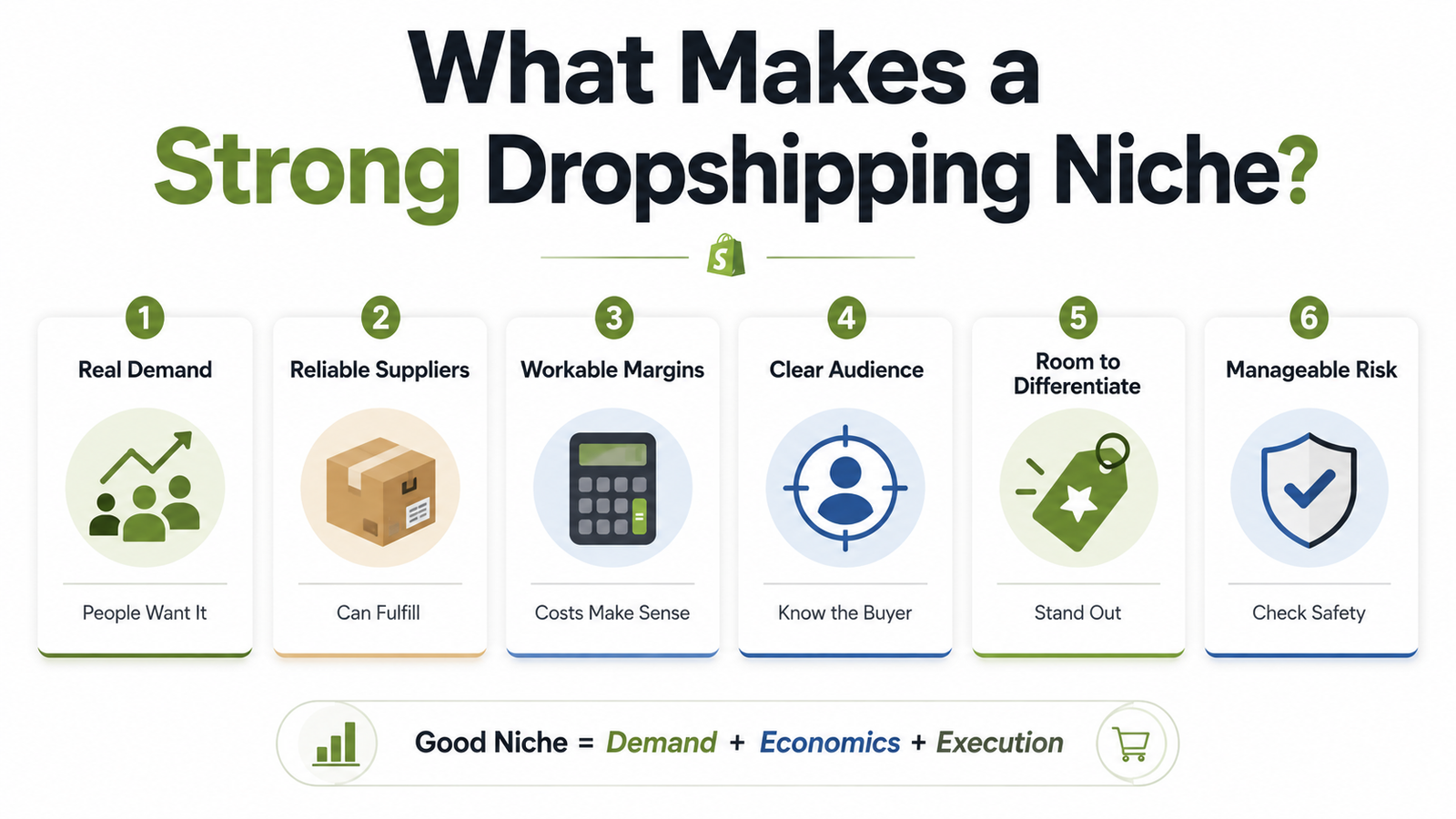 Final Thoughts on Choosing a Shopify Dropshipping Niche
Finding the best Shopify dropshipping niches in 2026 is not about identifying one category that automatically generates the highest profit. The better approach is to find a focused market with genuine demand and then determine whether your sourcing, pricing, shipping, content, and customer-acquisition strategy can support a viable business.
Car accessories, pet supplies, kitchen products, home products, office accessories, phone accessories, sustainability-focused products, beauty, sports, and baby products are all categories worth researching. Shopify’s own 2026 data shows demand across many of these areas, but the final decision should be made at the product and audience level rather than from a top-ten list alone.
Begin with research, validate a focused selection of products, calculate the real economics, and use actual customer and campaign data before scaling. A niche store becomes stronger when its product selection, branding, SEO, content, and customer experience all serve the same audience.
For businesses that want help building or managing the operational side, explore HiSellIt’s Shopify dropshipping services. If you want to discuss your store or niche strategy directly, contact the HiSellIt team.
Frequently Asked Questions
Q. How much does it cost to start a Shopify dropshipping store in a specific niche?
There is no fixed amount required to start a Shopify dropshipping store. Costs can include your Shopify subscription, domain, apps, product samples, branding, advertising, content creation, and supplier-related expenses.
According to Shopify’s current pricing page, plan costs depend on the billing option, region, and current pricing structure. Because Shopify can update pricing and promotions, check the official pricing page when creating your startup budget instead of relying on an older fixed monthly figure.
Q. What are the most profitable dropshipping niches with low competition in 2026?
There is no universal “most profitable low-competition niche.” Competition and profitability vary by product, country, audience, supplier, acquisition channel, and pricing.
Current categories worth researching include car accessories, sustainability-focused products, kitchen and dining, home products, office supplies, phone accessories, sports and outdoors, baby products, pet supplies, and beauty and personal care. Shopify also states that there is no single best niche for every dropshipping business.
Q. How long does it take to see profits from a niche Shopify dropshipping store?
There is no reliable fixed timeline for profitability. Some products can validate relatively quickly, while other stores may never become profitable.
Results depend on product-market fit, supplier quality, margins, customer-acquisition costs, pricing, conversion rate, shipping, returns, competition, and how effectively the business is managed.
Instead of targeting an arbitrary three- or six-month deadline, monitor whether the store is moving toward sustainable unit economics.
Q. Which dropshipping niches have the highest customer lifetime value?
There is no universal ranking of niches by customer lifetime value.
Categories involving replenishment, accessories, upgrades, collections, or ongoing hobbies can create opportunities for repeat purchases. Pet supplies, beauty, hobby products, home accessories, and certain wellness categories may fit that pattern, but actual CLV should be calculated from your own customer and order data.
Q. What’s the best way to research trending products within a specific niche?
Use a combination of Google Trends, keyword research, competitor analysis, marketplace activity, social-media trends, customer reviews, supplier data, and your own product tests.
A product should not be considered validated simply because it is trending on TikTok or appears on a bestseller list. Check search demand, competition, shipping times, supplier reliability, quality, return risk, advertising costs, and realistic profit after expenses before scaling.
Shopify’s dropshipping niche research guide also recommends analyzing demand and competition rather than selecting a niche based on popularity alone.


2 Comments