
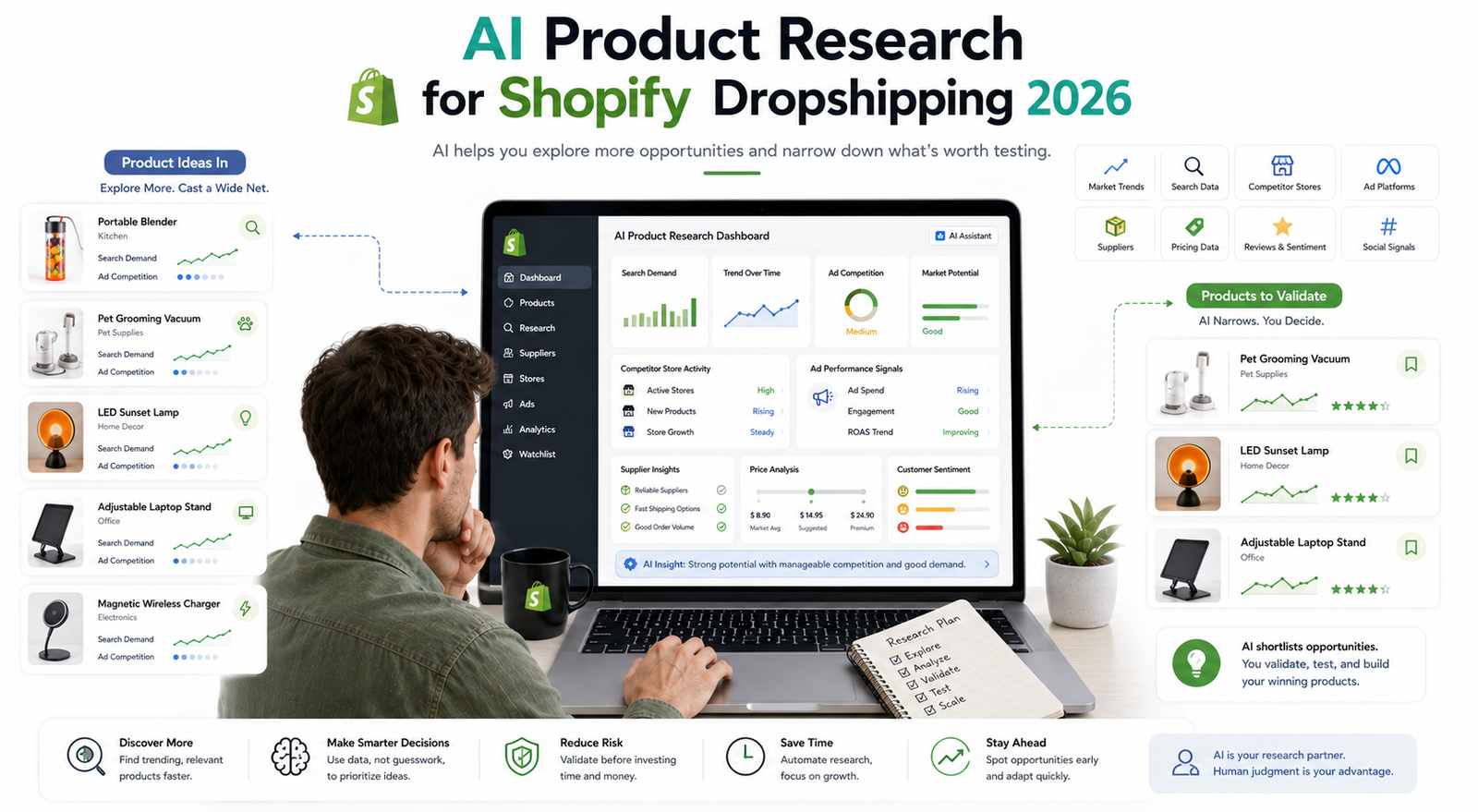
How AI Product Research Is Changing Shopify Dropshipping in 2026
AI product research for Shopify dropshipping is changing how online sellers discover and evaluate potential products in a rapidly growing market. One current industry estimate from Grand View Research values the global dropshipping market at $464.4 billion in 2025 and projects it to reach $583.5 billion in 2026. Grand View Research dropshipping market report
This growth reinforces one important point: entrepreneurs need faster and more structured methods to identify product opportunities before investing heavily in them.
Traditional product research can be slow. Sellers may spend hours scrolling through listings, checking reviews, comparing competitors, studying ads, and deciding whether a product is worth testing. Validating an idea can take considerable time when every step is performed manually.
AI can make parts of this process more efficient by analyzing larger amounts of product, competitor, advertising, pricing, and customer data. It can identify patterns and surface emerging demand signals, but it cannot predict with certainty which product will become profitable.
The reality is clear. Dropshipping in 2026 is no longer only about finding something popular at the right time. Sellers need to evaluate demand, competition, margins, supplier reliability, shipping, customer needs, and whether a product actually fits their store.
For tracking search interest over time, sellers can also use Google Trends to compare demand patterns and identify whether interest appears stable, seasonal, growing, or short-lived.
This guide breaks the process down step by step. You will see how AI can assist product discovery, which tools can support research, how to validate product ideas, and how to integrate automation into your Shopify workflow for more informed, data-driven decisions.
Quick Answer: How Does AI Help With Shopify Dropshipping Product Research in 2026?
AI can help Shopify dropshippers research products by analyzing demand signals, competitor activity, advertising trends, pricing, customer sentiment, supplier information, and product data more efficiently. It can help sellers narrow down products worth investigating, but it cannot guarantee a winning or profitable product. Sellers should still verify demand, supplier quality, landed costs, competition, shipping, advertising economics, and real customer response before scaling.
AI Product Research vs Manual Product Research for Shopify Dropshipping
Manual product research for Shopify dropshipping can be slow and exhausting. You may open supplier marketplaces, check order counts, read reviews, analyze competitor stores, examine advertisements, and repeat the process across many products.
Occasionally, you may spot a product that seems promising. However, by the time research is complete, market conditions may already have changed.
The main problem is time. Manual research requires sellers to collect and compare information across multiple sources. It can also become subjective. A product that looks attractive to one seller might not generate enough real customer demand to support a profitable campaign.
Depth is another issue. Manually monitoring competitor strategies, price changes, customer sentiment, advertising activity, and seasonal demand across multiple platforms can become difficult as the number of products being researched increases.
AI-powered product research tools can streamline parts of this process. Depending on the tool, they may analyze product listings, social activity, advertisements, competitors, pricing, reviews, or supplier data.
AI can also reduce some subjective decision-making by presenting measurable signals rather than relying entirely on personal preference. However, AI should support manual judgment rather than replace it.
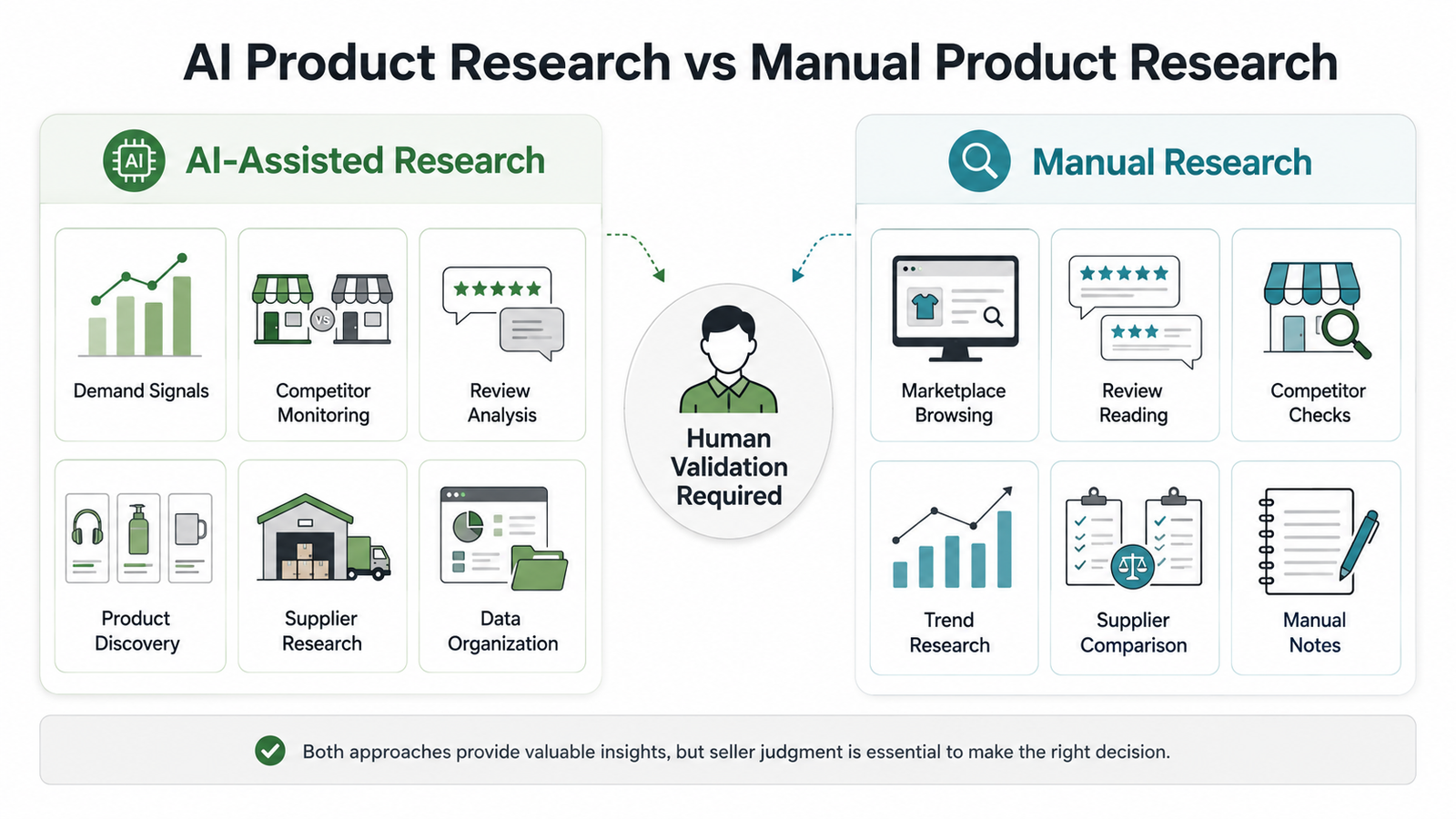 AI vs Manual Product Research
| Research Area | AI-Assisted Research | Manual Research |
|---|---|---|
| Data Collection | Can organize larger amounts of information quickly | Requires research across individual sources |
| Product Discovery | Can surface patterns and product candidates | Relies heavily on seller-led browsing |
| Competitor Monitoring | Can streamline store, ad, or product monitoring | Usually checked manually |
| Trend Analysis | Can identify signals in available data | Seller compares trends manually |
| Review Analysis | Can summarize recurring customer sentiment | Requires manually reviewing feedback |
| Supplier Research | Some tools can suggest supplier options | Sellers search and compare suppliers manually |
| Product Validation | Can assist with analysis | Human review is still required |
| Final Decision | Human review required | Human review required |
| Profitability Guarantee | No | No |
The strongest strategy combines AI research with seller judgment.
If you are still deciding which market to enter, our guide to the best Shopify dropshipping niches explains how to evaluate niche demand, competition, product potential, and market fit before selecting individual products.
Best AI Tools for Finding Dropshipping Products in 2026
Several AI-assisted product research tools can support Shopify dropshipping, but each focuses on different parts of the research process.
Using the right platform can reduce repetitive research and help sellers compare more products before deciding which opportunities deserve further investigation.
Dropship.io
Dropship.io remains a popular option for product and competitor research. Its current features include product research, competitor research, advertising intelligence, product tracking, AI-assisted search, and Shopify-related product workflows.
The platform can help sellers study existing stores and product activity, but estimated sales or revenue information should be treated as a research signal rather than verified future performance.
Sell The Trend
Sell The Trend combines product discovery with additional dropshipping workflow features.
It can help sellers research products, study trends, identify suppliers, analyze stores, and move selected products toward a Shopify store workflow.
This can be useful for beginners who prefer product research and operational tools within the same ecosystem.
Ecomhunt
Ecomhunt focuses on product discovery, advertising research, market information, and product analysis.
It can help sellers identify products receiving attention and review related advertising or competitive information.
However, a product appearing in a curated or trending-products tool does not mean it will automatically work for every Shopify store.
Niche Scraper
Niche Scraper focuses on product scraping and Shopify store research.
Its tools can help analyze products, competitor stores, product activity, supplier information, and potential niche opportunities.
This information can help sellers identify products worth investigating, but estimated sales and competitor data should still be independently evaluated.
Eliotron
Eliotron provides broader ecommerce intelligence capabilities, including competitor, market, product, and supplier research.
It can be useful for sellers who want deeper competitive intelligence rather than simply browsing lists of currently trending products.
The value of these platforms comes from organizing useful market signals. Their estimates should guide further research rather than replace real-world testing.
Horizontal infographic listing the best AI tools for Shopify dropshipping in 2026.
AI Product Research Tools Comparison 2026
Instead of choosing a tool based only on price or a claimed number of “winning products,” compare the type of research each platform supports.
| Tool Name | Main Research Strength | Best Use Case | What Sellers Should Verify |
|---|---|---|---|
| Dropship.io | Product, competitor and ad research | Broad product discovery | Demand, costs and supplier quality |
| Sell The Trend | Product discovery and sourcing workflow | Integrated dropshipping research | Margins and product-market fit |
| Ecomhunt | Product and advertising research | Product and creative discovery | Real demand and campaign economics |
| Niche Scraper | Product scraping and store analysis | Competitor and niche research | Supplier data and estimated sales |
| Eliotron | Market and competitor intelligence | Deeper ecommerce research | Market estimates and product viability |
Software pricing changes frequently, so sellers should check the current pricing and feature limits directly with each provider before subscribing.
The key is matching the platform to your actual research needs rather than assuming one tool is universally best.
How AI Product Research Works for Shopify Dropshipping in 2026
AI product research for Shopify dropshipping does not find products randomly. Instead, it can assist with a structured evaluation process that helps sellers make better-informed decisions.
First, AI can analyze demand signals. Depending on the data available to a platform, this may include search interest, social activity, marketplace information, advertising activity, or other indicators.
This can help determine whether interest in a product appears to be growing, stable, seasonal, or declining.
Next, AI can assist with competition research. It may scan competing products, stores, advertisements, prices, or other market information. This can help sellers understand how crowded a market appears and whether competitors are serving the same customer in similar ways.
Then comes profitability analysis.
AI tools may help estimate product economics based on supplier prices, retail prices, and other available cost information. However, real profitability requires more than subtracting the supplier cost from the selling price.
Sellers should consider:
- Product cost
- Shipping
- Payment processing
- Shopify and app costs
- Advertising
- Duties or taxes where applicable
- Returns
- Refunds
- Chargebacks
- Discounts
- Customer support costs
Advanced tools can also help identify seasonal or trend patterns. However, these should be treated as forecasts or research signals, not guaranteed predictions.
Some platforms also analyze customer sentiment by summarizing reviews and highlighting repeated complaints or praise. This can help sellers understand what customers like, dislike, or expect from products already on the market.
Shopify’s own updated 2026 product research guide also recommends evaluating market demand, competition, customer needs, pricing, and validation before investing significantly in a product.
AI Product Research and Validation Workflow
| Stage | What AI Can Help Analyze | What the Seller Should Verify |
|---|---|---|
| Demand | Search, social and marketplace signals | Is demand meaningful and sustainable? |
| Competition | Products, stores, ads and prices | Can your offer be differentiated? |
| Pricing | Competitor price ranges | Is your selling price realistic? |
| Suppliers | Supplier candidates and product matches | Are quality and fulfillment reliable? |
| Reviews | Customer sentiment patterns | Which problems occur repeatedly? |
| Margin | Estimated product economics | What are the real landed and acquisition costs? |
| Launch | Potential product candidates | Does real customer testing support the idea? |
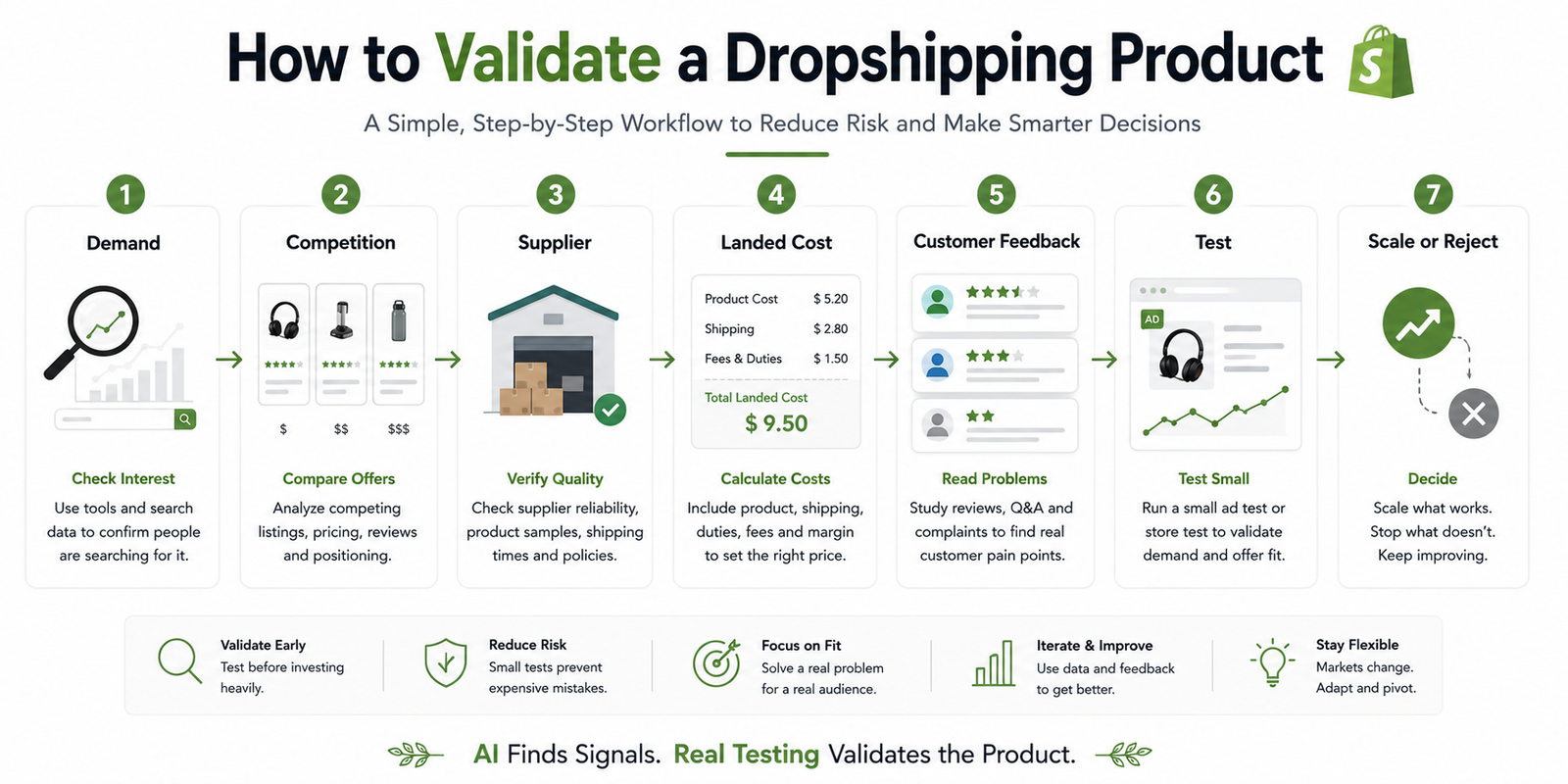
How to Validate an AI-Recommended Dropshipping Product
AI recommendations should start the product-validation process rather than finish it.
Before launching a product, verify whether there is enough evidence to justify testing it.
Check Demand
Review search and market interest over time.
A product that suddenly becomes viral may disappear just as quickly. Compare short-term spikes with longer-term patterns before assuming demand will continue.
Analyze Competition
Look at how many sellers offer similar products and how those products are positioned.
Competition itself is not always negative. It can demonstrate that buyers exist.
The more important question is whether you can provide a meaningful reason for customers to choose your offer instead.
Calculate the Landed Cost
Do not base a product decision only on supplier price.
Calculate the likely cost after:
- Product cost
- Shipping
- Payment fees
- Advertising
- Refunds
- Returns
- Relevant taxes or duties
- Operational expenses
A high selling price does not automatically mean a high profit margin.
Verify Supplier Quality
AI can help identify suppliers, but it cannot replace hands-on supplier verification.
Where practical:
- Order a sample
- Check product quality
- Test packaging
- Review shipping time
- Confirm tracking
- Evaluate supplier communication
- Understand return procedures
Review Customer Feedback
Negative reviews can be especially useful.
Repeated complaints may reveal:
- Product-quality issues
- Poor instructions
- Sizing problems
- Compatibility issues
- Packaging problems
- Unrealistic expectations
These problems may indicate either a product to avoid or an opportunity to create a better customer experience.
Test Before Scaling
Start with controlled product and marketing tests rather than committing a large budget immediately.
Review real metrics such as:
- Product-page visits
- Add-to-cart activity
- Conversion
- Customer acquisition cost
- Advertising performance
- Customer questions
- Refunds
- Returns
Real customer data is more useful than any predicted “winning product” score.
Quick Answer: How Do You Know if a Dropshipping Product Is Worth Testing?
A dropshipping product may be worth testing when there is evidence of buyer demand, manageable competition, reliable suppliers, practical shipping, a realistic selling price, sufficient margin after costs, and a clear reason customers would choose your offer. AI tools can help identify these signals, but sellers should verify supplier quality, landed costs, customer feedback, advertising economics, and real market response before scaling.
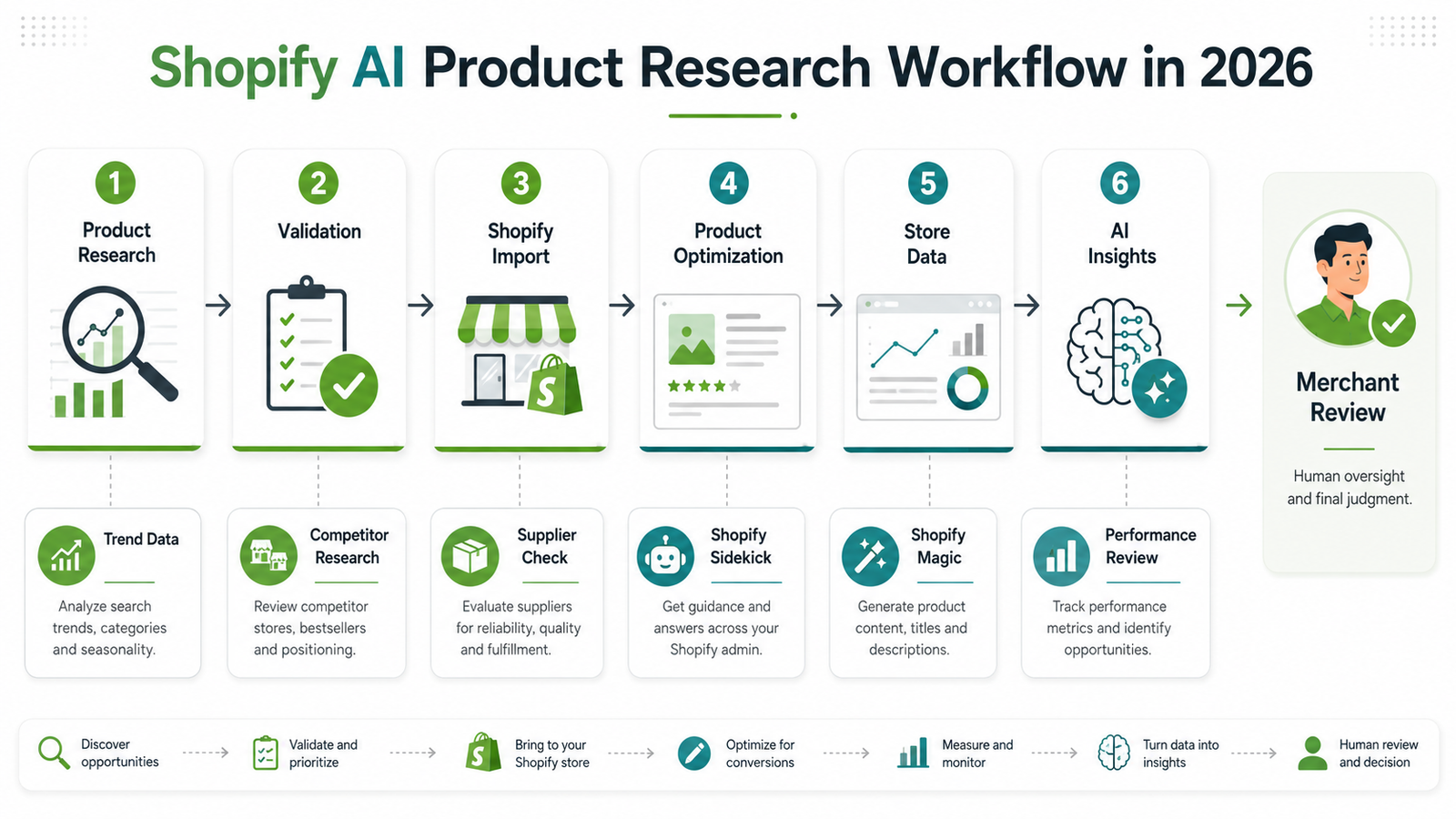
 How to Seamlessly Integrate AI Product Research Into Your Shopify Store
Finding potential products is only the first step in Shopify dropshipping. Next, you need to move selected products into your store and manage them efficiently.
Depending on the product research or dropshipping platform you use, Shopify integrations may support product importing, images, descriptions, variants, supplier information, inventory updates, and order-related workflows.
However, integration is not always a universal one-click process, and sellers should review imported information before publishing it.
Supplier descriptions may contain poor wording, inaccurate claims, unnecessary details, or content written for another marketplace.
Before publishing, review:
- Product title
- Description
- Images
- Specifications
- Variants
- Sizing
- Compatibility
- Shipping details
- Product claims
Many dropshipping platforms can also support inventory syncing when integrations with suppliers are available. This can help reduce overselling, although sellers should continue monitoring inventory exceptions and supplier availability.
Product tagging and content creation can also be streamlined with AI. Shopify provides its own AI-powered tools that can assist with store content and workflows.
Shopify Sidekick and Built-In AI Tools
Shopify’s AI ecosystem has expanded significantly.
Shopify Sidekick is Shopify’s AI-enabled commerce assistant within the Shopify admin. It can help merchants analyze data, work with products, manage certain tasks, generate content, and interact with supported apps.
Importantly, Shopify states that Sidekick presents changes for merchant review before they are applied. This reflects an important rule for AI automation in ecommerce:
AI can assist. The merchant remains responsible for the final decision.
Shopify also offers Shopify Magic, a suite of AI-powered capabilities integrated into different Shopify workflows, including content and media generation.
Sellers building a larger operational system can read our Shopify dropshipping guide to automation for strategies covering product management, inventory, orders, and other recurring workflows.
Marketing automation can extend beyond the initial product launch as well. Once your Shopify store builds a consent-based customer audience, our Shopify email marketing strategy explains how automated email workflows can support retention and repeat purchases.
Horizontal infographic showing AI integration features for Shopify stores.
 Common Mistakes That Sabotage AI Product Research for Shopify Dropshipping
AI product research for Shopify dropshipping is useful, but it is not foolproof. Many dropshippers make mistakes that reduce the value of the data they collect.
First, avoid relying blindly on AI recommendations. Use them as a starting point and cross-check important information with your own market research. AI may identify patterns, but you still need to understand your audience and business economics.
Second, do not chase every trending product. Popular products may not fit your brand, customer, margins, or store strategy. Focus on products that make sense for the audience you actually want to serve.
Third, never ignore supplier quality. AI can help identify products and possible suppliers, but sellers should still perform their own due diligence.
Order samples when practical. Check shipping times. Test product quality. Evaluate supplier communication and understand how returns will be handled.
Fourth, do not ignore total landed cost.
A supplier product costing $10 and selling for $35 does not automatically generate a $25 profit.
Advertising, shipping, payment processing, apps, refunds, returns, taxes, duties, and discounts can significantly reduce the final margin.
Fifth, do not treat estimated competitor sales as verified revenue.
Many product research platforms use estimates or modeled data. These numbers can provide useful comparison signals, but they should not be treated as audited competitor financial information or a guarantee of what your own store will earn.
Finally, update your catalog and research regularly. Trends and demand can change. Monitor actual store performance and determine whether products deserve further testing, better positioning, reduced advertising, or removal.
For specialized operational support, HiSellIt offers Shopify dropshipping services covering store and workflow needs beyond the initial product-research stage.
Horizontal infographic of common AI product research mistakes in Shopify dropshipping.
What Changed in AI Automation for Shopify Dropshipping in 2026
AI product research for Shopify dropshipping continues to evolve, but some of the most important 2026 developments are already happening rather than being speculative future trends.
Shopify is expanding AI further into commerce operations, product data, store intelligence, and AI-assisted product discovery.
Its Spring ’26 Edition introduced and expanded capabilities around Shopify Catalog, agentic commerce, AI shopping channels, and Sidekick.
Shopify Catalog and AI Product Discovery
Shopify Catalog structures product information so supported AI shopping systems can understand and surface eligible products.
This makes product-data quality increasingly important.
Sellers should pay attention to:
- Accurate titles
- Product categories
- Pricing
- Options
- Availability
- Product specifications
- Useful descriptions
Researching a strong product is only part of the process. The store also needs complete and accurate product information.
More Store-Aware AI Assistance
Shopify’s AI tools are also becoming more connected to merchants’ actual store data.
Sidekick can assist with data analysis, products, orders, content, and other supported tasks.
This becomes particularly useful after a store starts generating real traffic and sales because decisions can increasingly be based on the merchant’s own performance rather than generic market estimates.
AI Shopping Is Expanding Product Discovery
Product discovery is also becoming broader than traditional Google searches, social ads, or marketplace browsing.
AI shopping experiences can help shoppers research, compare, and discover products through conversational interfaces.
For Shopify sellers, that means high-quality structured product information may become increasingly important alongside traditional product-page optimization.
The key takeaway is not that AI will automatically create profitable dropshipping stores.
It is that AI is becoming more integrated into research, store management, content, product data, analytics, and shopping discovery.
Take Your Dropshipping Business to the Next Level
AI product research for Shopify dropshipping has changed how entrepreneurs can discover and evaluate potential products.
It can reduce repetitive research, organize larger amounts of information, and help sellers make more data-informed decisions. Whether you are starting a new store or scaling an existing business, AI can support the product-research process when it is combined with proper validation.
The key is selecting the right AI product research tools for your needs. Integrate them carefully into your workflow and avoid relying on automated recommendations without verification.
Combine AI insights with your own market knowledge.
Research demand. Verify suppliers. Calculate real product economics. Test products with real customers. Monitor results and refine your strategy using actual Shopify performance data.
Remember this: data without execution and validation has limited value.
AI can narrow the list of products worth investigating, but real market testing determines whether a product deserves to scale.
For sellers serious about building a more structured Shopify dropshipping operation, HiSellIt’s Shopify dropshipping services can help with the wider workflow.
If you need guidance deciding which parts of your store, research process, or automation setup need attention first, you can also contact the HiSellIt team.
Frequently Asked Questions
Q. What Is AI Product Research in E-Commerce?
AI product research uses artificial intelligence and machine-learning systems to help analyze market data such as product demand, competitors, pricing, advertising activity, customer feedback, and supplier information. It can help online sellers narrow down potential products more efficiently, but the final decision should still be based on validation and real market data.
Q. How Much Does It Cost to Start AI Product Research for Shopify Dropshipping in 2026?
There is no universal cost. Pricing depends on the product research platform, plan, billing cycle, Shopify subscription, apps, and other tools a seller chooses to use. Some platforms provide trials or limited access, while more advanced research features require paid subscriptions. Check current pricing directly before choosing a tool.
Q. Can AI Product Research Make Shopify Dropshipping Profitable?
AI can improve the efficiency of product research, but it cannot guarantee profitability. Profit depends on factors including product demand, supplier quality, landed costs, advertising, conversion rates, shipping, refunds, returns, and customer experience.
Q. What Tools Can Automate Shopify Dropshipping Product Research?
Popular product research options include Dropship.io, Sell The Trend, Ecomhunt, Niche Scraper, and Eliotron. Their capabilities vary across product discovery, competitor intelligence, advertising research, supplier research, product tracking, and Shopify workflows.
Q. How Does AI Product Research Help Small Business Owners?
AI can help small ecommerce businesses process more market information without researching every data point manually. Sellers can use it to narrow product ideas, compare competitors, analyze customer feedback, investigate trends, and identify products that deserve further testing. However, human judgment remains important for supplier selection, product quality, economics, compliance, and final business decisions.
Q. Should AI Replace Manual Product Research?
No. AI works best alongside manual research and real customer testing. It can organize information and identify potential opportunities, while sellers remain responsible for validating product demand, supplier reliability, costs, market fit, and actual performance.