
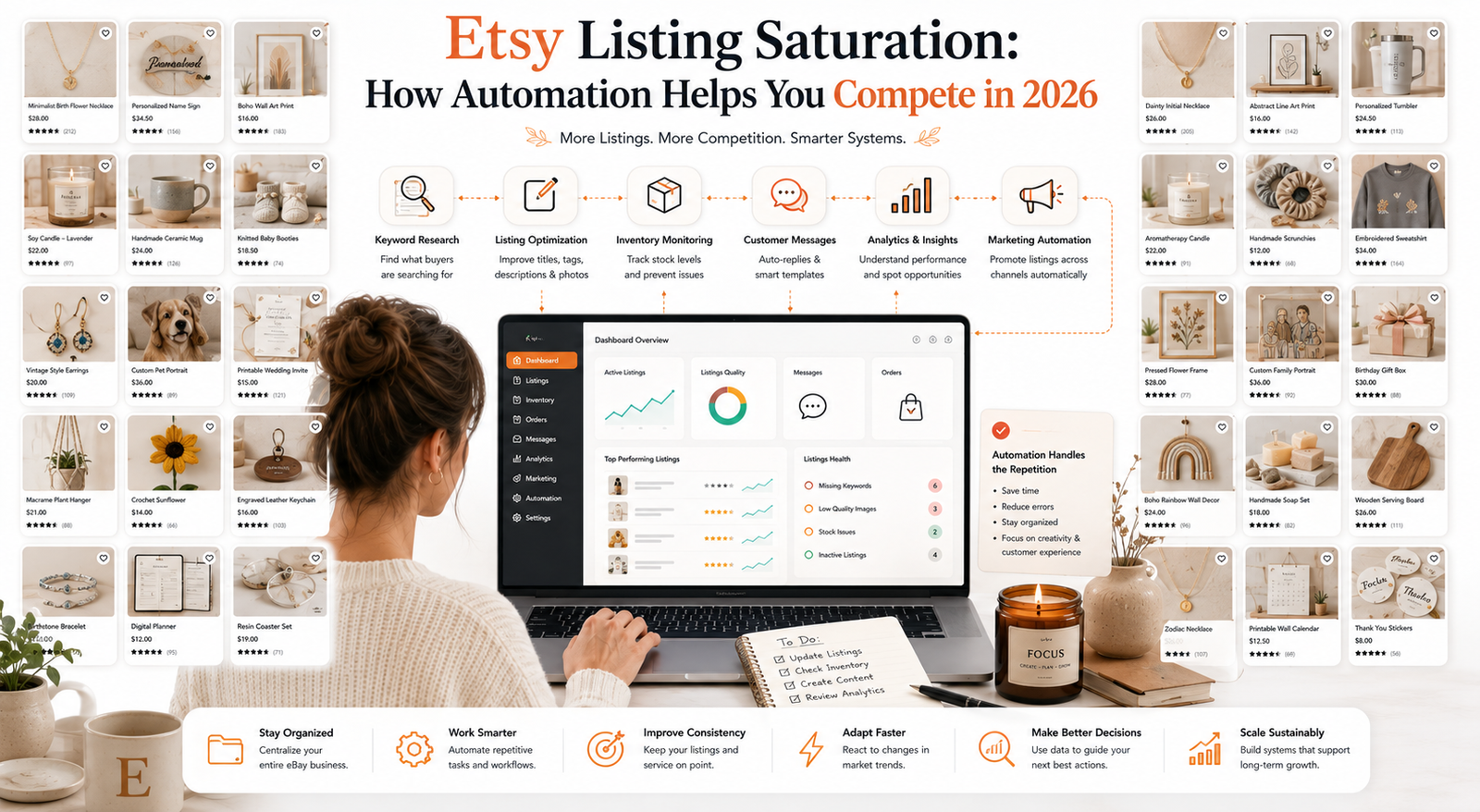
Etsy Listing Saturation: How Automation Helps You Compete in 2026
Etsy listing saturation remains a major challenge for sellers trying to gain visibility in competitive product categories. Etsy reported approximately 5.7 million active sellers as of June 30, 2026, illustrating the scale of competition across the marketplace.
However, more competition does not mean every niche is equally saturated or that new sellers cannot gain traction. The real challenge is identifying where buyer demand exists, creating relevant listings, maintaining strong listing quality, and running the operational side of the shop efficiently.
Automation can help with many of these tasks, but it does not automatically improve Etsy search rankings. The most effective approach in 2026 combines Etsy’s own search and seller tools with keyword research, listing optimization, inventory management, marketing automation, customer service systems, and human oversight.
This guide explains how sellers can respond to Etsy listing saturation using practical automation and optimization strategies that reduce repetitive work while supporting long-term shop performance.
Quick Answer: How Can Automation Help With Etsy Listing Saturation in 2026?
Automation can help Etsy sellers compete in saturated markets by simplifying keyword research, bulk listing updates, inventory monitoring, social scheduling, customer-message workflows, reporting, and other repetitive tasks. Etsy’s own tools can also help sellers identify search demand and listing-quality issues. However, automation cannot guarantee higher search rankings. Product differentiation, search relevance, listing quality, pricing, customer service, fulfillment, and buyer demand still require careful seller oversight.
What Etsy Listing Saturation Really Means in 2026
Etsy listing saturation occurs when a product niche contains a large number of similar or closely competing listings relative to buyer demand.
For sellers, this can make discovery more difficult because buyers have more alternatives to choose from. However, saturation should not be treated as an official Etsy ranking factor or as a simple situation where the newest listing is automatically pushed behind thousands of older listings.
Etsy search considers multiple aspects of a listing and shop. This means visibility depends on more than the total number of products competing for a keyword.
Sellers should evaluate three areas in particular:
- Buyer demand: Are shoppers actually searching for the product?
- Competition: How many relevant listings are competing for that demand?
- Listing quality and relevance: Does the listing accurately match the shopper’s intent and provide a strong buying experience?
Highly competitive categories can still create opportunities when sellers identify more specific searches, underserved product variations, stronger positioning, or clearer buyer intent.
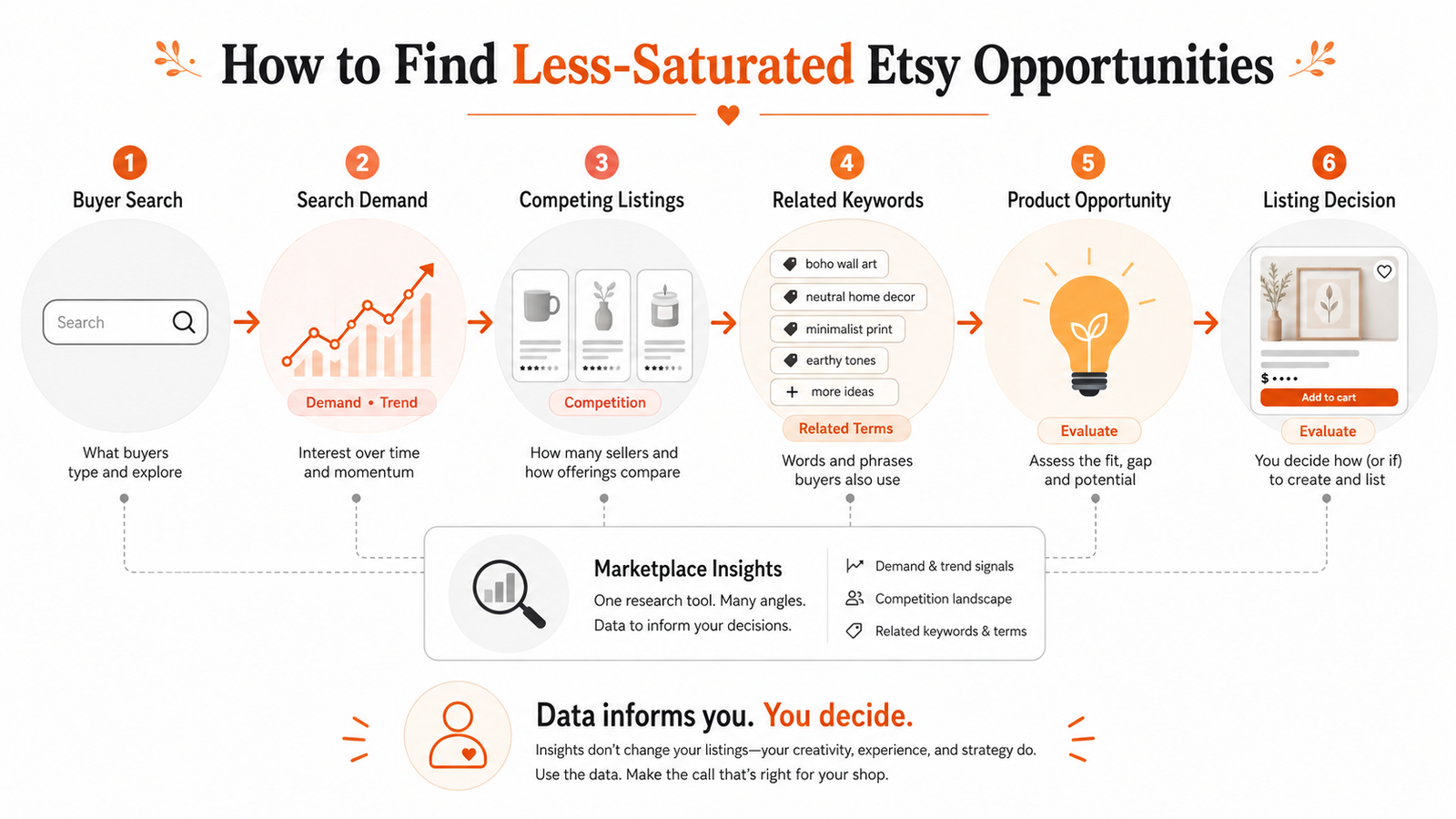
Use Etsy Marketplace Insights to Find Less-Saturated Opportunities
One of the most useful developments for sellers dealing with Etsy listing saturation is Marketplace Insights.
Etsy’s Marketplace Insights gives sellers access to actual Etsy search information, including the number of searches and listings associated with particular terms during the previous 30 days. It can also show related search terms and help sellers identify areas where buyer interest may be relatively high compared with the number of available listings.
This makes it useful for:
- Finding relevant product ideas
- Comparing keyword demand
- Identifying related search terms
- Discovering emerging trends
- Evaluating competition before creating a product
- Planning seasonal inventory
- Improving tags and listing information
For example, instead of competing only for an extremely broad term, Marketplace Insights may reveal a more specific search that attracts meaningful buyer interest but has fewer competing listings.
Importantly, Marketplace Insights does not automatically update Etsy listings. Sellers still decide which insights are relevant and whether they should be applied to titles, tags, products, or inventory decisions.
That distinction is important. Automation and data should support seller decisions rather than replace them.
 How Automation Helps Sellers Compete With Etsy Listing Saturation
Automation helps sellers reduce the repetitive workload involved in running a growing Etsy shop.
Inventory updates, marketing schedules, product data management, customer-message workflows, reporting, and bulk listing tasks can become difficult to manage manually as the number of products and orders increases.
The purpose of Etsy shop automation is therefore not to manipulate search rankings. It is to create a more efficient operational system.
A seller who spends less time performing repetitive administrative tasks can spend more time on areas such as:
- Product development
- Photography
- Branding
- Customer experience
- Keyword research
- New niche research
- Conversion optimization
- Pricing strategy
Sellers who want help building those systems can explore Etsy automation services designed around listing management, workflows, operations, and shop growth.
How Automation Can Improve Etsy Listing Management
Automation tools can support Etsy listing management by organizing data, identifying opportunities, suggesting changes, and simplifying repetitive updates.
Depending on the system being used, sellers may be able to streamline:
- Bulk product information updates
- Keyword research
- Inventory alerts
- Social media scheduling
- Customer support workflows
- Reporting
- Order-related processes
- Marketing tasks
However, sellers should review changes before publishing them.
Automatically changing titles, descriptions, prices, or product information without checking accuracy can create new problems instead of solving saturation.
The strongest Etsy automation strategy combines software efficiency with human control.
Optimize Your Listings With Smart Etsy SEO
Search optimization remains one of the most important ways to compete in crowded Etsy categories.
However, Etsy SEO in 2026 should not revolve around stuffing as many keywords as possible into a title.
Etsy introduced updated listing-title guidance in 2026. The platform recommends clearly stating what the item is, placing important objective characteristics near the beginning, avoiding unnecessary repetition, and keeping titles clear and easy for shoppers to scan. Etsy also introduced optional AI-powered title suggestions for eligible listings.
Etsy’s search systems consider information across the listing rather than relying on the title alone.
That means sellers should optimize their:
- Titles
- Tags
- Categories
- Attributes
- Descriptions
- Product photos
- Shop information
- Customer experience
Keyword research platforms such as eRank and Marmalead can still support research, but sellers should compare third-party information with Etsy’s own Marketplace Insights and shop performance data.
For a more detailed SEO workflow, see our complete guide to Etsy SEO automation.
Etsy SEO Elements to Review in 2026
| SEO Element | What Matters | Recommended Action |
|---|---|---|
| Listing Title | Clarity, relevance and important product characteristics | Clearly describe the item and avoid unnecessary repetition |
| Tags | Relevant buyer search phrases | Use relevant tags that accurately describe the product |
| Category | Specific product classification | Select the most accurate category available |
| Attributes | Complete product details | Add applicable material, colour, size and other attributes |
| Description | Accuracy and useful product information | Explain the product naturally and answer buyer questions |
| Primary Photo | Quality and clear presentation | Use a clear, well-lit image focused on the finished product |
| Marketplace Insights | Search demand and competition information | Research keywords and product opportunities |
| Search Visibility | Listing and shop improvement signals | Review Etsy’s recommendations and correct relevant issues |
The goal is not to make every listing contain the same high-volume keywords. It is to create the strongest possible match between the product and the buyer’s actual search intent.
Use Etsy Search Visibility Before Blaming Saturation
A decline in traffic does not always mean the niche has become too saturated.
Sometimes the listing itself has issues affecting its potential search visibility.
Etsy’s Search Visibility page provides personalized information about areas that may influence how listings appear in search. Etsy currently evaluates areas relating to listings, the shop, and customer service.
Examples of listing issues Etsy may flag include:
- Low-quality primary images
- Dark or unclear photos
- Collaged primary images
- Categories that are not specific enough
- Missing return policies
- Other listing-quality issues
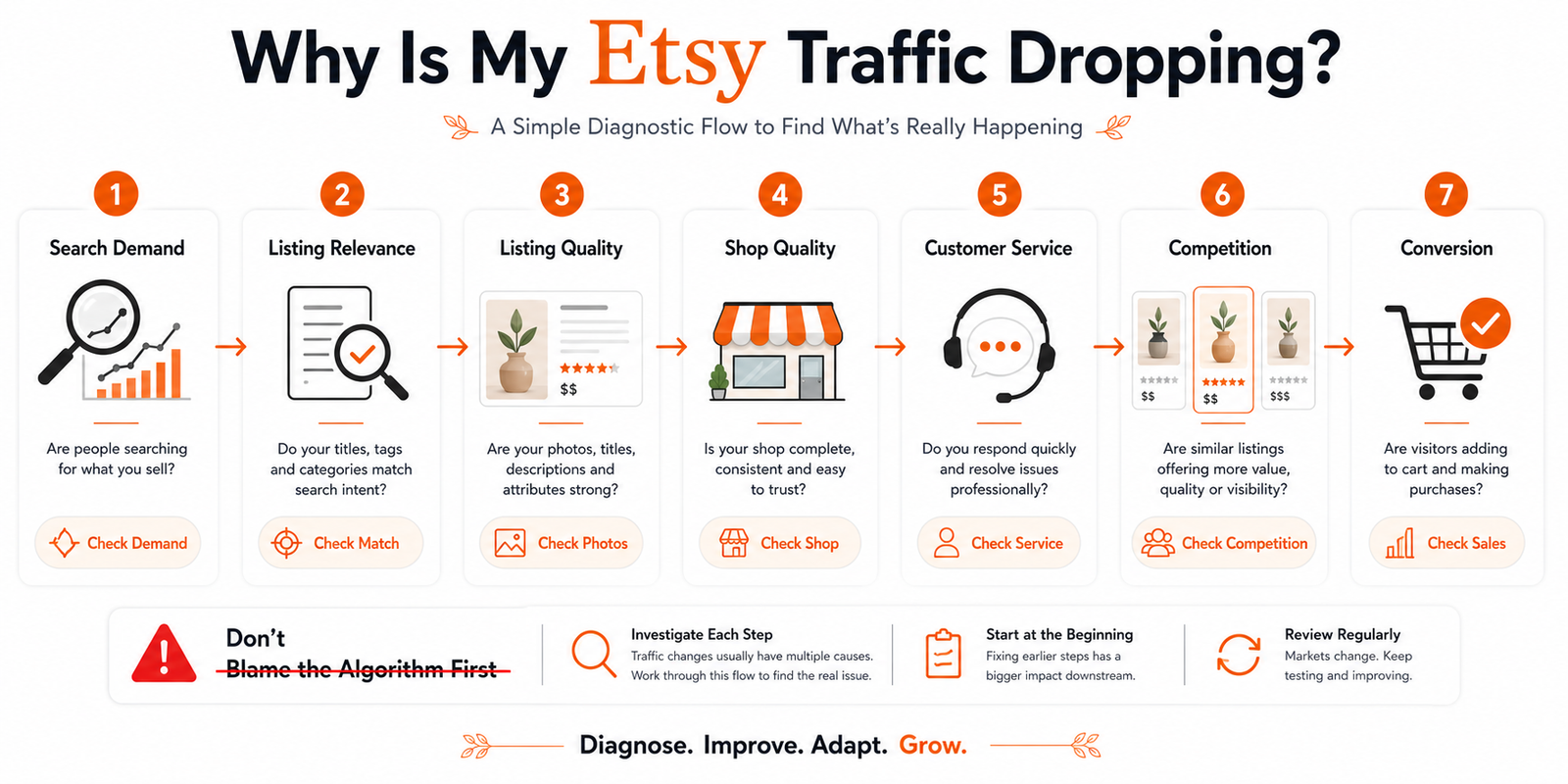
This creates a better troubleshooting process.
Instead of assuming:
Traffic dropped → competition increased → Etsy algorithm changed
sellers can investigate:
Search demand → listing relevance → listing quality → shop quality → customer service → competition → conversion
That approach produces more useful decisions than blaming every performance change on saturation.
 Leverage Social Media Automation for Etsy Traffic
Search is only one way shoppers discover Etsy products.
Social platforms can help sellers create additional traffic sources, especially in visual categories such as home décor, jewelry, weddings, fashion, crafts, templates, and personalized products.
Tools such as Buffer and Later can help schedule social content in advance rather than requiring sellers to publish manually every day.
A seller might batch several weeks of:
- Instagram Reels
- Pinterest Pins
- Product videos
- Behind-the-scenes content
- Seasonal promotions
- New-product announcements
The objective should not simply be to post more often. Sellers should monitor which content actually sends qualified shoppers to their products.
Pinterest is particularly relevant for products with long discovery cycles and strong visual appeal. Our guide on how to use Pinterest to drive Etsy sales explains how sellers can use Pinterest more strategically.
Paid promotion can also support discovery in certain situations, but it should not automatically replace organic marketing. Sellers deciding where to allocate their budget can compare the differences in our guide to Etsy Ads vs free marketing.
Use Inventory Management Tools
Inventory automation becomes increasingly useful as an Etsy shop grows or expands to multiple sales channels.
Running out of materials can delay fulfillment, while inaccurate stock quantities can create overselling problems.
Inventory systems can help sellers monitor:
- Available quantities
- Low-stock levels
- Material requirements
- Product variations
- Reorder points
- Multi-channel stock quantities
For sellers using Etsy alongside another marketplace or ecommerce website, centralized inventory management can reduce the risk of selling an item on one platform after the available quantity has already been sold somewhere else.
Automation is particularly useful for alerts and synchronization.
However, sellers should continue reviewing inventory exceptions, supplier delays, damaged stock, handmade production capacity, and seasonal demand manually.
Implement Email Marketing Automation Carefully
Email marketing can support customer retention, but Etsy sellers must distinguish between Etsy buyer information and a separately collected, consent-based email audience.
Etsy’s Seller Policy states that transaction information obtained about buyers cannot simply be used for unsolicited commercial marketing. Etsy sellers should not automatically add buyers to external mailing lists without the appropriate consent.
This means a seller should not export Etsy customer email addresses into platforms such as Klaviyo or Mailchimp simply because those customers purchased something.
External email marketing tools can still be useful when sellers have built a separate email audience through a compliant opt-in process.
For example, a consent-based email marketing workflow might include:
- Welcome emails
- New-product announcements
- Educational content
- Seasonal campaigns
- Product launches
- Re-engagement emails
Sellers should always follow Etsy policies as well as applicable privacy and consent requirements.
Quick Answer: Can Etsy Sellers Add Buyers to an Email Marketing List?
Etsy sellers should not automatically add customer information obtained through Etsy transactions to promotional email lists. Buyer information must be handled according to Etsy’s Seller Policy and applicable privacy rules. External email automation platforms can be used for audiences that have provided the appropriate marketing consent through a separate opt-in process.
Common Challenges Sellers Face With Etsy Listing Saturation
Standing Out in Crowded Niches
When many sellers offer similar products, differentiation becomes increasingly important.
Instead of looking only at broad competition numbers, sellers should examine:
- Buyer search intent
- Product design
- Materials
- Personalization
- Target customer
- Use case
- Photography
- Pricing
- Shipping
- Reviews
- Product positioning
Marketplace Insights and keyword research tools can help identify potential gaps, but they do not guarantee that a product will sell.
Testing should also be controlled.
Rather than automatically changing photographs, titles, descriptions, and prices at the same time, change meaningful elements carefully and monitor performance over a suitable period.
If everything changes simultaneously, it becomes difficult to understand what actually influenced the result.
Managing Time and Resources
Running an Etsy shop involves much more than publishing products.
Sellers may need to handle:
- Buyer questions
- Photography
- Orders
- Product creation
- Shipping
- Inventory
- Marketing
- Listing updates
- Returns
- Customer service
Automation can reduce some of this workload.
Saved responses and supported automated messaging features can make routine communication faster, while inventory alerts can reduce manual stock checking.
Print-on-demand businesses may also automate certain production and fulfillment steps when the business model and Etsy policies allow it.
The goal is not to automate every interaction. Complicated complaints, customization questions, returns, damaged orders, and unusual customer situations often benefit from direct human attention.
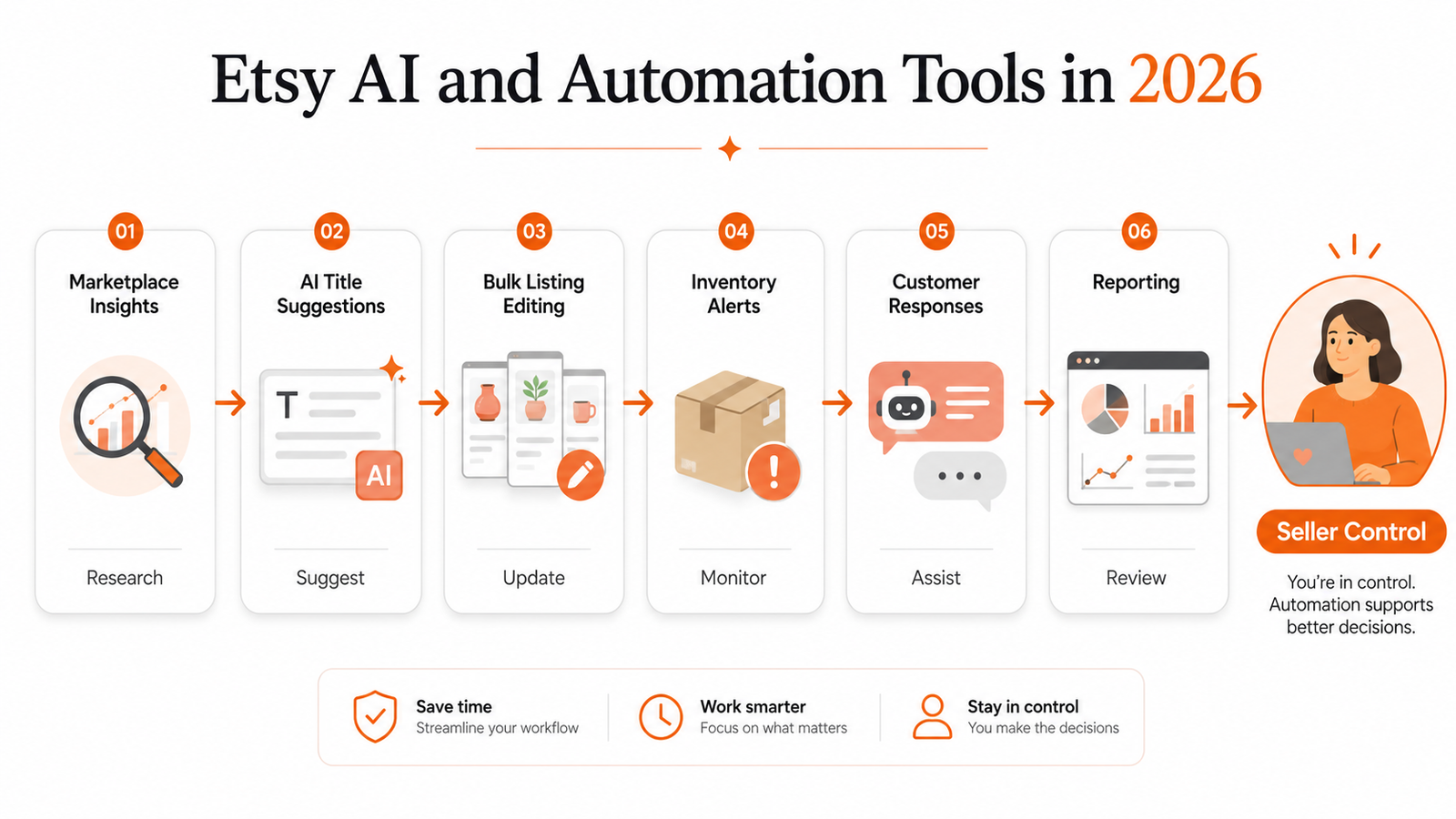
Etsy AI and Automation Tools Sellers Can Use in 2026
Etsy itself is increasingly introducing tools designed to make seller workflows more efficient.
One important example is Etsy’s optional AI-powered title suggestion system. Eligible sellers can receive suggestions based on existing listing information and can choose whether to accept, customize, or ignore those suggestions.
The important principle is seller control.
AI should be used to assist decisions rather than automatically replacing seller judgment.
Useful automation-related capabilities in a modern Etsy workflow can include:
| Tool or Capability | How It Helps | Seller’s Role |
|---|---|---|
| Marketplace Insights | Identifies search trends and keyword opportunities | Decide which opportunities fit the product |
| AI Title Suggestions | Provides clearer title alternatives for eligible listings | Review and edit before publishing |
| Bulk Listing Editing | Speeds up changes across multiple products | Check accuracy before applying broadly |
| Inventory Alerts | Identifies low-stock situations | Decide when and how much to reorder |
| Social Scheduling | Publishes planned marketing content | Create and review the content |
| Saved Customer Responses | Speeds up routine replies | Handle complex cases personally |
| Reporting Tools | Organize performance information | Interpret results and make decisions |
Automation works best when it removes repetitive steps while leaving strategic decisions with the seller.
 Keep Up With Etsy Search and Policy Changes
Etsy regularly updates seller tools, search guidance, policies, advertising features, and marketplace systems.
However, sellers should be careful with claims that a third-party automation platform will immediately detect every Etsy algorithm update and automatically change a shop to match it.
No tool can guarantee that.
Instead, sellers should regularly review:
- Etsy Seller Handbook updates
- Search Visibility
- Marketplace Insights
- Etsy Shop Manager
- Seller policies
- Shop performance data
Current first-party guidance should generally carry more weight than social media rumours about hidden Etsy algorithm changes.
What Etsy Sellers Can and Cannot Automate in 2026
The previous approach of assigning unsupported percentages to automation savings can create unrealistic expectations.
A more useful framework is identifying what software can streamline and where human oversight remains necessary.
| Task | Can It Be Automated or Streamlined? | Human Oversight Needed? |
|---|---|---|
| Keyword Research | Yes | Yes |
| Marketplace Research | Yes | Yes |
| Listing Title Suggestions | Partially | Yes |
| Bulk Listing Updates | Yes | Yes |
| Inventory Monitoring | Yes | Yes |
| Social Scheduling | Yes | Yes |
| Routine Message Responses | Partially | Yes for exceptions |
| Email Marketing | Yes for consent-based audiences | Yes |
| Order Workflows | Partially | Yes |
| Product Photography | Partially | Yes |
| Pricing Decisions | Partially | Yes |
| Policy Compliance | Tools can assist | Yes |
| Search Ranking | No guaranteed automation | Yes |
| Product Differentiation | No | Yes |
The best Etsy automation setup is therefore not the one that removes the seller from the business completely.
It is the one that removes unnecessary repetitive work.
Measure Whether Automation Is Actually Helping
Automation should be evaluated using real business results rather than assumptions.
Before introducing a new tool, establish a baseline.
Then monitor areas such as:
Search Traffic
Review whether relevant Etsy search traffic is increasing or declining.
A drop may indicate changes in demand, listing relevance, competition, or listing quality.
Conversion
Traffic alone does not make a successful Etsy listing.
If many shoppers view a listing but few purchase, investigate:
- Product photography
- Price
- Shipping
- Description clarity
- Reviews
- Product positioning
- Variations
- Buyer expectations
Time Saved
Track how much time repetitive work requires before and after automation.
This is more useful than relying on generic claims that every Etsy seller will save a particular percentage of time.
Inventory Accuracy
Monitor:
- Overselling
- Stockouts
- Delayed orders
- Material shortages
- Quantity errors
If these decline after implementing inventory automation, the system is providing measurable operational value.
Customer Experience
Automation should make communication more consistent without making it impersonal.
Review buyer questions, complaints, reviews, response processes, fulfillment performance, refunds, and returns.
If automation creates confusion or inaccurate replies, adjust the workflow.
Future Outlook for Etsy Automation
Automation will continue to become more accessible to Etsy sellers, but the competitive advantage will not come from simply using more software.
The advantage comes from using better information and reducing low-value repetitive work.
In 2026, sellers have access to more Etsy-native search and optimization tools than before. Marketplace Insights provides direct search information, Search Visibility identifies potential listing issues, and optional AI-assisted listing tools can reduce some editing work.
At the same time, automation cannot determine:
- Which product should exist
- What makes a brand memorable
- Whether a niche fits your capabilities
- How customers should be treated
- Whether a design is genuinely differentiated
- When a strategy should change
Those remain business decisions.
Conclusion: Competing With Etsy Listing Saturation in 2026
Etsy listing saturation does not mean new or smaller sellers cannot compete.
It means sellers need a more deliberate approach.
Automation can reduce the manual work involved in keyword research, listing management, inventory monitoring, marketing schedules, customer communication, and reporting. Etsy’s own tools can also help sellers better understand search demand and identify listing-quality issues.
However, automation should not be treated as an Etsy ranking shortcut.
Strong performance still depends on combining relevant products with accurate listings, clear photography, useful keywords, competitive positioning, reliable fulfillment, good customer service, and continuous analysis.
Start with the process consuming the most unnecessary time.
That might be keyword research, inventory updates, listing management, social scheduling, or customer-service workflows. Automate carefully, measure the impact, and retain human oversight where judgment matters.
For sellers who want help determining which workflows should be automated first, contact the HiSellIt team.
The long-term goal is not to automate everything. It is to build an Etsy business that can handle more demand without allowing repetitive tasks to consume the time needed for product development, customer experience, and strategic growth.
Frequently Asked Questions
Q. What Is Etsy Listing Saturation?
Etsy listing saturation occurs when a niche contains a large number of similar competing products relative to buyer demand. This can make visibility more difficult, especially for broad and highly competitive search terms. Sellers can respond by researching demand, targeting relevant searches, improving listing quality, differentiating products, and using automation to reduce repetitive operational work.
Q. How Can Automation Help With Etsy Listing Saturation?
Automation can streamline keyword research, inventory monitoring, listing management, social scheduling, reporting, and routine customer-service processes. This gives sellers more time to improve products and make strategic decisions. Automation does not guarantee higher Etsy search rankings.
Q. How Much Do Etsy Automation Tools Cost in 2026?
There is no universal cost for Etsy automation because pricing depends on the software, features, catalog size, sales volume, and business model. Some tools offer free functionality or limited plans, while advanced inventory, marketing, analytics, and multi-channel systems may require paid subscriptions. Sellers should compare the cost of a tool with the measurable time or operational value it provides.
Q. Can New Etsy Sellers Compete in Saturated Niches?
Yes, new Etsy sellers can compete, but success is not guaranteed. Rather than copying broad products already offered by many shops, sellers should research buyer demand, explore more specific opportunities, differentiate their products, optimize listings, and provide a strong customer experience.
Q. What Tools Help Optimize Etsy Listings?
Etsy Marketplace Insights and Search Visibility are useful first-party tools for identifying search opportunities and listing issues. Etsy also provides optional listing-title suggestions for eligible sellers. Third-party keyword and research tools such as eRank and Marmalead can provide additional information, but sellers should review recommendations rather than applying changes automatically.
Q. Does Automation Improve Etsy Search Rankings?
Automation is not a guaranteed Etsy ranking factor. It can make research, listing management, inventory control, marketing, and reporting more efficient, but Etsy search visibility also depends on factors such as relevance, listing quality, shop quality, customer service, and the buyer’s search context.
Q. How Does Automation Help Small Etsy Business Owners?
Automation can reduce repetitive administrative work and make growing catalogs easier to manage. Sellers can use it for tasks such as inventory monitoring, bulk updates, marketing schedules, reporting, and routine communication while continuing to handle product strategy, quality control, complex buyer issues, and policy compliance personally.


One Comment