
Etsy Marketplace Insights: How to Find High-Demand, Low-Competition Keywords
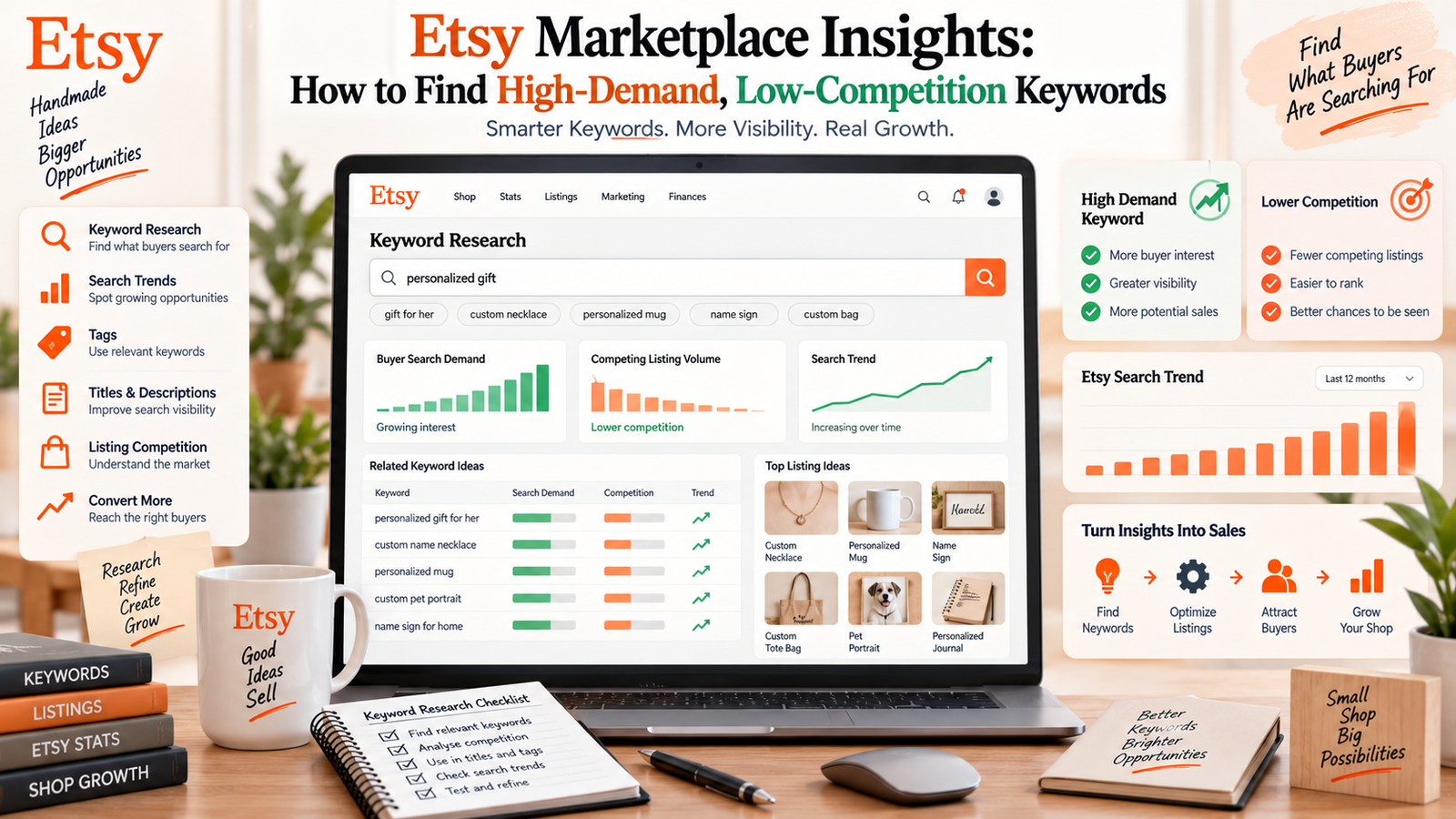
Etsy Marketplace Insights gives sellers direct access to real Etsy search data, while third-party keyword tools generally rely on their own datasets and estimates. For Etsy keyword research, that distinction matters because Marketplace Insights can show recent buyer searches, the number of competing listings, related search terms, and trend information directly from Etsy.
Those signals can help sellers identify potential high-demand, low-competition keywords without relying entirely on guesswork.
Used correctly, Marketplace Insights can strengthen Etsy SEO, Etsy product research, and Etsy niche research. The goal is not to chase the keyword with the biggest search number. A useful Etsy keyword needs buyer demand, but it also needs strong product relevance, realistic competition, clear buyer intent, and a genuine match with the listing.
This guide explains what Etsy Marketplace Insights shows in 2026, which newer capabilities are still being tested, and how to turn Etsy search data into practical decisions for titles, tags, descriptions, categories, and attributes.
Quick Answer: How Do You Find High-Demand, Low-Competition Keywords on Etsy?
Use Etsy Marketplace Insights to compare recent buyer searches with the number of competing listings, then explore related terms for relevant long-tail opportunities. Check trend direction, product relevance, and buyer intent, and validate promising terms against Etsy Stats. High buyer interest with relatively fewer listings can signal an opportunity, but it does not guarantee ranking or sales.
What Is Etsy Marketplace Insights?
Marketplace Insights is Etsy’s built-in keyword and market research tool for sellers. Etsy says the tool provides direct access to real Etsy search data and can help sellers identify popular buyer keywords, discover similar search terms, spot emerging trends, optimize listings, and plan inventory.
Etsy Marketplace Insights is currently available on desktop and mobile web.
To access it:
Shop Manager → Stats → Marketplace Insights
Sellers currently receive up to 15 keyword searches per week for free, and each unlocked result remains available for seven days from the original search. Etsy Plus subscribers receive unlimited keyword searches. Etsy also makes clear elsewhere in its search documentation that an Etsy Plus subscription does not improve organic search placement by itself. Etsy Marketplace Insights help page
Marketplace Insights can support both existing-listing optimization and new-product research, but it should be treated as a research tool rather than an automatic keyword selector.
What Data Does Etsy Marketplace Insights Show?
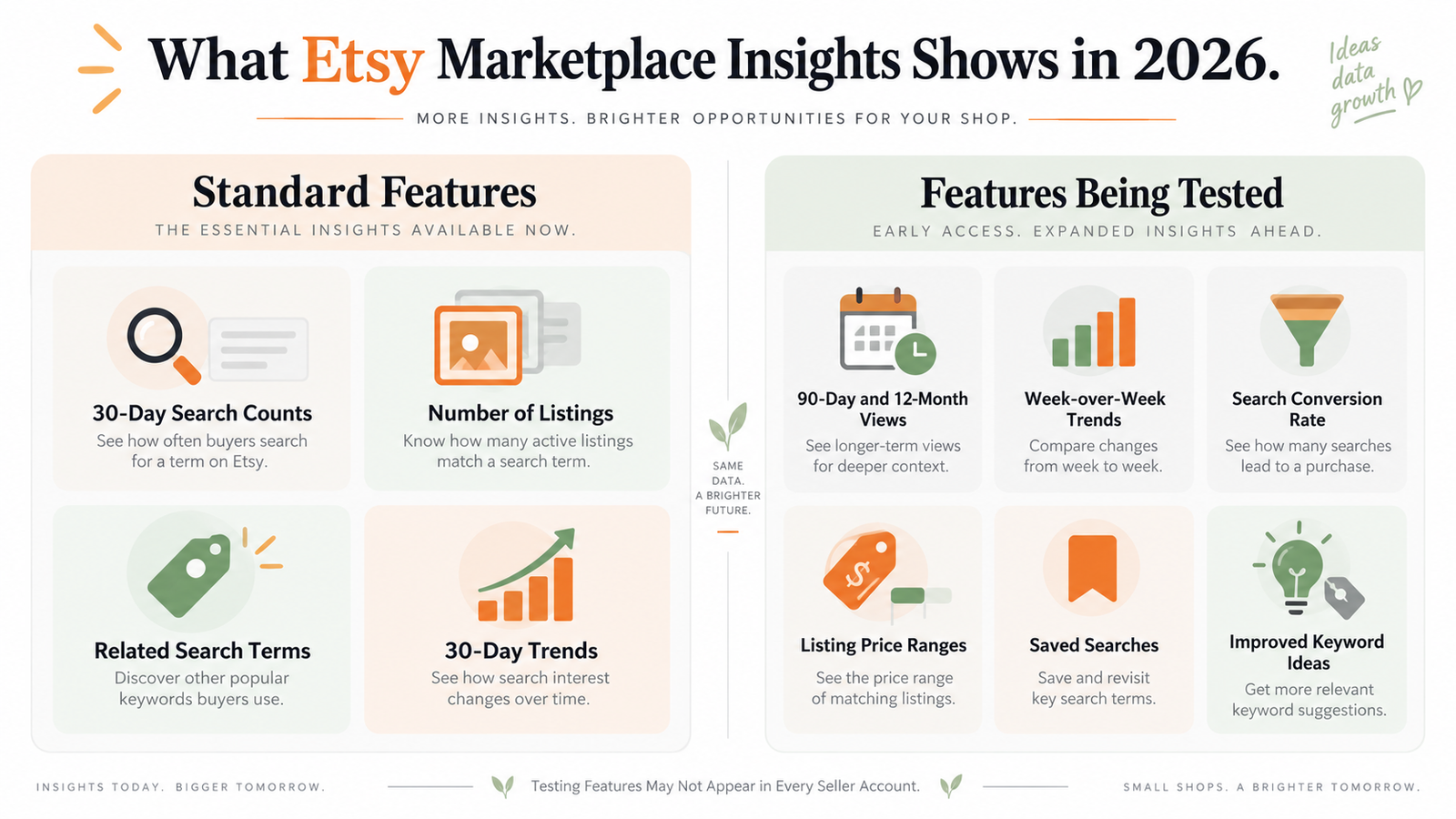
The important distinction in 2026 is that some Marketplace Insights features are already part of the standard experience, while others are still being tested and may not appear in every seller account.
Current vs. Testing Marketplace Insights Features
| Feature | Current Status |
|---|---|
| Number of searches over the last 30 days | Standard |
| Number of listings | Standard |
| Similar/related search terms | Standard |
| 30-day trend information | Standard |
| 90-day and 12-month date ranges | Testing |
| Week-over-week trend signals | Testing |
| Search conversion rate | Testing |
| Listing price ranges | Testing |
| Saved searches | Testing |
| Sorting similar terms by searches or listings | Testing |
| Improved keyword ideas | Testing |
Etsy’s 2026 seller updates confirm that extended date ranges, recently purchased listing price ranges, search conversion rate, week-over-week trends, saved searches, similar-term sorting, and improved keyword ideas are being tested and may not be visible to all sellers. Etsy’s 2026 Marketplace Insights updates
 Number of Searches
The standard tool shows the number of searches for a term over the last 30 days.
It is better to describe this as Etsy’s recent search count or 30-day search activity rather than inventing a monthly search-volume average that Etsy does not publish.
Number of Listings
Marketplace Insights also shows the number of Etsy listings associated with a search term.
This can help identify queries where buyer interest appears strong relative to available listings.
However, listing count is not an official Etsy keyword difficulty score.
Two terms with similar listing counts can still offer very different opportunities because Etsy search ranking considers factors beyond competition volume.
Similar and Related Searches
Related search terms can uncover:
- Etsy long-tail keywords
- niche phrases
- materials
- styles
- recipients
- occasions
- use cases
- personalization language
These terms can be more useful than the original broad keyword because they often describe what the shopper actually wants more precisely.
Recent Search Trends
Marketplace Insights allows sellers to explore trending searches in their categories over the previous 30 days.
This can help identify:
- emerging demand
- seasonal growth
- cooling trends
- shifts in shopper language
Experimental Trend and Conversion Data
Some sellers may also see longer date ranges, week-over-week signals, price ranges, and search conversion data.
Do not write a listing strategy that assumes every account has these features yet. Etsy specifically identifies them as tests.
How to Do Etsy Keyword Research With Marketplace Insights
A strong Etsy keyword research workflow starts with the actual product rather than whichever phrase has the largest search count.
Enter a broad term that accurately describes the item, inspect the marketplace data, and then move toward more specific related searches.
The process is:
Seed keyword → buyer demand → listing count → related searches → buyer intent → trends → Etsy Stats
Marketplace Insights provides marketplace-wide signals. Your job is to decide which search terms genuinely match your product.
How to Find High-Demand, Low-Competition Keywords on Etsy
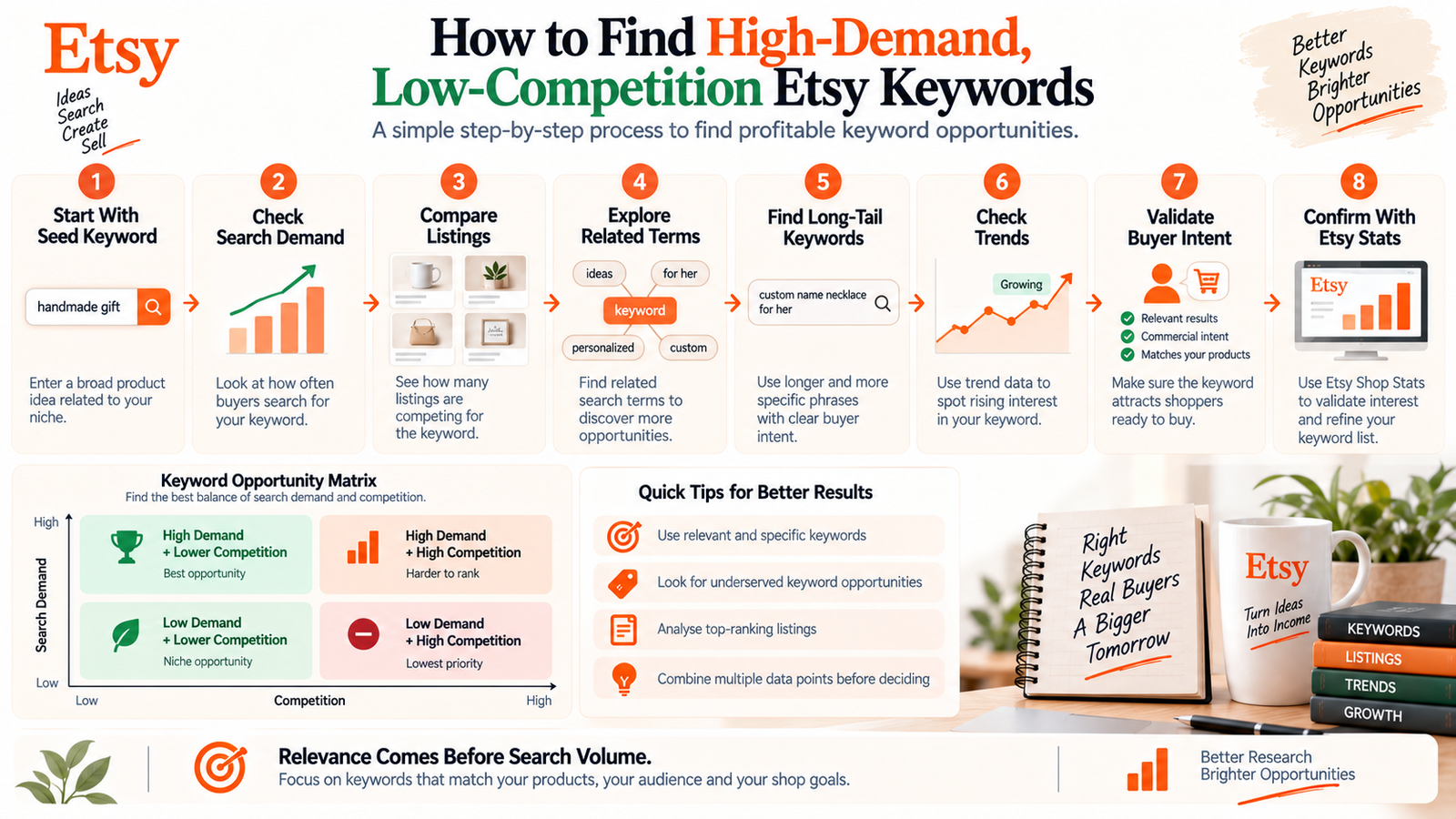
The practical answer to how to find high-demand low-competition keywords on Etsy is to compare search activity with listing volume, then filter every apparent opportunity through relevance and buyer intent.
Step 1: Start With a Broad Seed Keyword
Begin with the core product.
Examples:
- necklace
- ceramic mug
- wedding invitation
- wall art
- tote bag
The broad keyword is primarily a research starting point.
Step 2: Check Buyer Search Demand
Review the number of searches shown for the keyword.
Higher activity can indicate stronger buyer interest, but a high number alone does not make a keyword suitable.
For example, necklace may receive meaningful demand while still being too broad to accurately describe a specific handmade item.
Step 3: Compare the Number of Listings
Next, compare buyer search activity with the number of listings associated with the term.
A phrase with meaningful buyer demand and relatively fewer competing listings may deserve closer investigation.
Use this as a research framework:
| Keyword Type | Demand | Competition | Strategy |
|---|---|---|---|
| High demand + lower competition | High | Lower | Investigate first if highly relevant |
| High demand + high competition | High | High | Use selectively |
| Low demand + lower competition | Low | Lower | Useful niche support |
| Low demand + high competition | Low | High | Usually lower priority |
This is not Etsy’s ranking formula.
Marketplace Insights can help reveal opportunities, but Etsy does not publish a guaranteed searches-to-listings ratio that determines rankings.
If your broader concern is competing in crowded Etsy niches, our guide to Etsy listing saturation and automation explains why strong positioning, listing quality, and operational execution matter alongside keyword research.
Step 4: Explore Related Keyword Opportunities
Inspect similar searches and related keyword ideas.
Look for modifiers describing:
- material
- style
- color
- size
- personalization
- recipient
- occasion
- use case
The goal is to find wording that brings the search query closer to the actual product.
Step 5: Find Long-Tail Keywords
Compare increasingly specific terms:
- necklace
- personalized birth flower necklace
- dainty silver birth flower necklace
Long-tail phrases can have clearer buyer intent and may sometimes face fewer competing listings.
However, a longer phrase is not automatically better or less competitive.
Use it only when it accurately describes the item and reflects realistic shopper language.
Step 6: Check Trend Direction
A term with strong recent demand may be:
- steadily popular
- seasonal
- rapidly growing
- beginning to decline
For seasonal products, timing matters.
Researching Christmas, wedding, graduation, Mother’s Day, or back-to-school searches only after demand peaks can leave too little time for product development, photography, listing optimization, and inventory planning.
Step 7: Validate Buyer Intent
Ask what the shopper expects to see after typing the phrase.
For example:
minimalist silver necklace
and
personalized bridesmaid necklace
may both describe jewelry, but the shoppers likely have different goals.
Search activity has little value if the intent does not match your product.
Step 8: Validate the Keyword With Etsy Stats
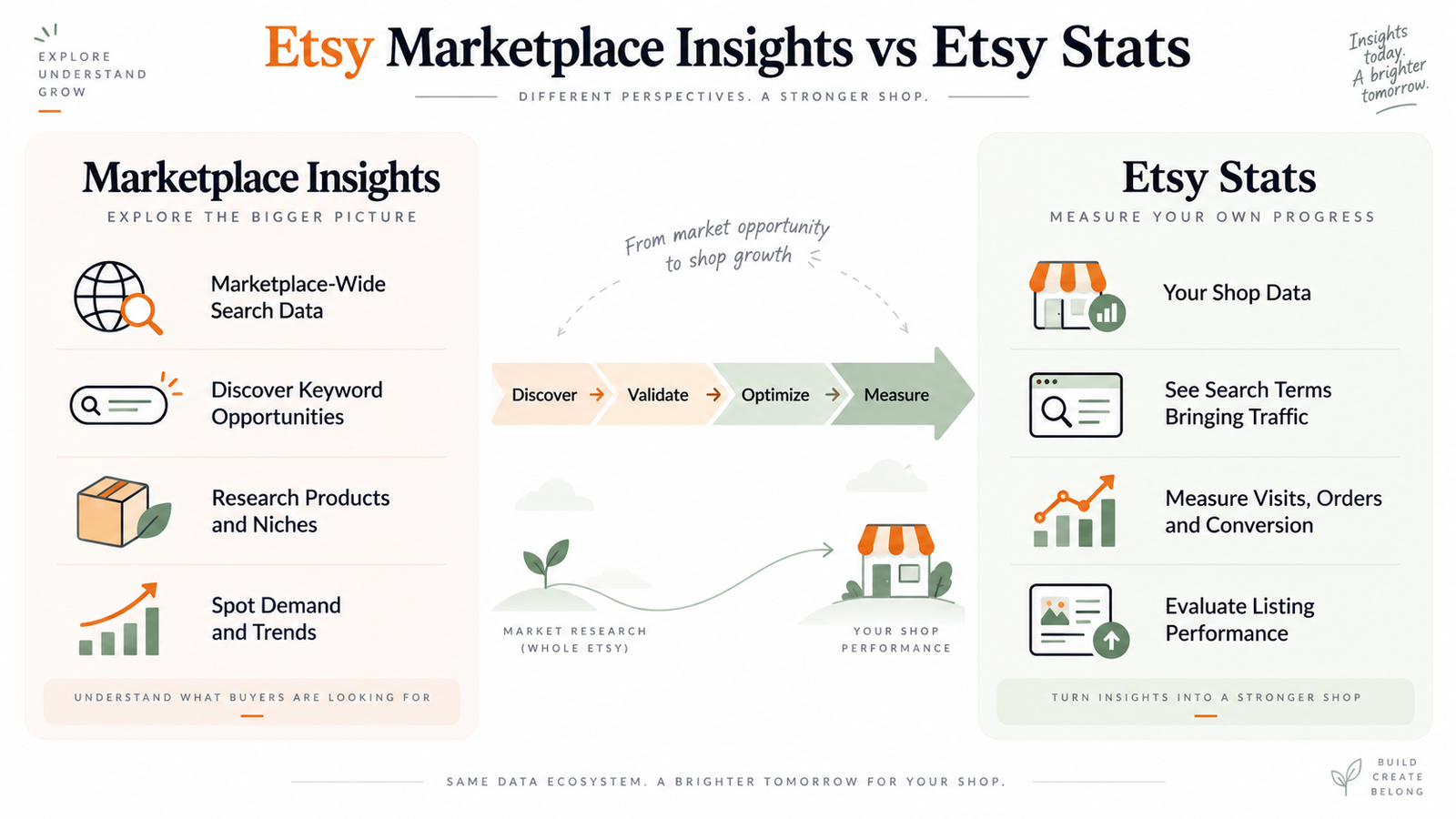
Marketplace Insights tells you what buyers are searching for across Etsy.
Etsy Stats tells you what is actually happening inside your shop.
Under Shop Manager → Stats, choose Etsy search under How shoppers found you to see search terms shoppers used to find your listings. Official Etsy Stats guide
This creates a much stronger feedback loop than relying on keyword research alone.
 High Search Volume vs. Low Competition: What Should You Prioritize?
Neither metric should automatically win.
A strong Etsy keyword strategy balances:
- buyer demand
- product relevance
- search intent
- listing competition
- trend direction
- seasonality
- listing quality
- customer-service quality
- engagement and conversion
A broad high-volume phrase can be difficult because many products satisfy the query, and the buyer’s intent is unclear.
A smaller, more specific search can be valuable when it brings a listing in front of shoppers who already know what they want.
Quick Answer: What Makes a Good Etsy Keyword?
A good Etsy keyword combines real buyer demand with strong product relevance and clear search intent. Relatively fewer competing listings can make a term more attractive, but listing count alone does not determine ranking difficulty. Also consider trend direction, product fit, listing quality, customer service, engagement, and conversion before deciding which keywords deserve priority.
How to Find Long-Tail Keywords With Marketplace Insights
Etsy long-tail keywords narrow a broad product idea by adding meaningful detail.
They may include:
- material
- color
- size
- style
- occasion
- recipient
- personalization
- intended use
Start with the product itself and inspect related Marketplace Insights searches for natural combinations.
A ceramic seller might move from:
mug
to:
handmade ceramic coffee mug
or a more specific phrase based on glaze, personalization, size, or gift context.
Specificity is useful when it improves relevance.
It should not become keyword stuffing.
How to Spot Trending Etsy Keywords Before Competitors
Trend research is about timing as much as popularity.
Marketplace Insights provides standard 30-day trend information, while Etsy is currently testing longer 90-day and 12-month views and week-over-week trend signals for some sellers.
Use trends to answer questions such as:
- Is interest increasing?
- Is the search seasonal?
- Is demand already declining?
- Does the shop have time to prepare inventory?
- Can the product realistically serve this trend?
Do not add irrelevant trending terms simply to attract impressions.
Irrelevant traffic can create poor shopper alignment and does not strengthen Etsy relevance.
How to Use Marketplace Insights Keywords in Your Etsy Listings
Keyword research should lead to accurate Etsy listing optimization.
Etsy says its search system takes a holistic view of listing information, including titles, tags, attributes, descriptions, first photos, reviews, and other signals. Etsy then ranks matching listings using factors such as relevancy, listing engagement, customer-service quality, recency, and shopper context. How Etsy Search Works
Listing Titles
Turn Marketplace Insights Keywords Into Better Etsy Titles
Etsy’s April 2026 title guidance recommends:
- clearly stating what the item is
- placing the most important objective traits early
- avoiding unnecessary repetition
- keeping titles easy to scan
- considering fewer than 15 words when important traits can still be communicated clearly
Etsy also introduced an optional AI-powered title suggestion tool. Etsy describes the suggestions as starting points sellers can review and edit, not mandatory titles. Etsy’s 2026 listing-title guidance
Do not force every keyword discovered in Marketplace Insights into the title.
Use the strongest relevant wording there and distribute other useful information across tags, descriptions, categories, and attributes.
Tags
Etsy currently allows up to 13 tags per listing.
Use accurate phrases and vary your tags rather than repeating nearly identical wording.
For example, using several tags that simply rearrange the same two words can waste opportunities to match other relevant shopper searches.
Descriptions
Descriptions should clearly explain the product while naturally using relevant descriptive language.
Useful information may include:
- materials
- size
- dimensions
- personalization
- intended use
- care information
- what is included
Descriptions are part of Etsy’s query-matching system, but mechanically repeating the same keyword does not create a guaranteed ranking advantage.
Categories
Choose the most specific accurate category available.
Categories provide Etsy with additional context and can unlock more relevant listing attributes.
Attributes
Complete relevant attributes such as:
- color
- material
- size
- style
- occasion
- other category-specific details
The practical relationship is:
Marketplace Insights keyword → accurate listing information → stronger relevance potential
Marketplace Insights vs. Etsy Stats
| Marketplace Insights | Etsy Stats |
|---|---|
| Marketplace-wide buyer-search data | Your own shop-performance data |
| Helps discover keyword opportunities | Shows terms already bringing traffic |
| Useful for product and niche research | Useful for listing-performance analysis |
| Helps identify broader demand and trends | Helps measure actual visits, orders, and conversion |
Marketplace Insights supports discovery.
Etsy Stats supports validation and measurement.
A practical workflow is:
Marketplace Insights → discover → Etsy Stats → validate → optimize → test → measure
 Check Etsy Search Visibility Before Blaming Your Keywords
Weak Etsy traffic is not always a keyword problem.
Etsy’s Search Visibility page evaluates three broad areas:
- listings
- shop quality
- customer service
It can flag issues involving primary-image quality, collage-style main images, category specificity, return policies, shop setup, and customer-service standards. For U.S. domestic listings, shipping-price conditions can also influence search visibility.
Before rewriting every tag or title, check whether a listing has a visibility issue elsewhere.
This is particularly important because Etsy also uses listing engagement and conversion when ranking search results. Etsy says it looks at whether shoppers who view a listing ultimately purchase it.
Keywords can help a listing qualify for relevant searches, but the listing still has to persuade shoppers.
Etsy Search Results Are Personalized
Another common mistake is searching Etsy for your own listing and treating its position as an objective rank.
Etsy uses Context Specific Ranking, which personalizes results based partly on shopper behavior.
That means two buyers can see different ordering for the same query.
Etsy specifically advises sellers not to use manual searches across devices or over time as a reliable rank tracker. Instead, use Stats to evaluate the traffic and search terms actually bringing shoppers to the shop.
Common Etsy Keyword Research Mistakes
Targeting Search Volume Alone
High search activity does not automatically make a keyword relevant or profitable.
Ignoring Competition
Broad, popular phrases may place the listing against a large and mature result set.
Using Irrelevant Trending Keywords
A popular term that inaccurately describes the product attracts the wrong shopper and weakens relevance.
Choosing Only Broad Keywords
Broad searches often hide intent.
More specific Etsy keywords can provide a stronger product-query match.
Ignoring Buyer Intent
A keyword is only useful when the person using it is realistically interested in the product.
Repeating Nearly Identical Tags
Use variety across your 13 available tags to expand relevant matching opportunities.
Ignoring Seasonal Changes
Research seasonal demand before the peak rather than changing keywords after shoppers have already moved on.
Assuming One Keyword Guarantees Ranking
Etsy also considers listing quality, engagement, conversion, customer service, recency, and shopper context.
Stuffing Titles With Keywords
Etsy’s 2026 title guidance emphasizes clear, buyer-friendly wording rather than repetitive title strings.
Treating Your Own Search Results as a Rank Tracker
Search is personalized. Use Etsy Stats rather than your own manual search position to evaluate organic performance.
Once Etsy SEO is in place, sellers can also compare organic visibility with paid promotion using our guide to Etsy Ads vs. free marketing.
For off-Etsy discovery, our guide on using Pinterest to drive Etsy sales explains how external traffic can complement Etsy search optimization without replacing it.
Conclusion
Etsy Marketplace Insights makes Etsy keyword research more evidence-based by combining direct buyer search activity, listing volume, related terms, and trend information.
The strongest strategy is not to hunt for a magic keyword score.
Instead:
Research demand → compare competition → check relevance → understand buyer intent → review trends → validate with Etsy Stats → optimize the listing → measure performance
High-demand Etsy keywords with relatively fewer competing listings can reveal opportunities, but they do not guarantee rankings or sales.
For Etsy SEO in 2026, keyword research works best when it is combined with accurate listing information, clear titles, diverse tags, complete attributes, strong photos, good customer service, and listings that convert shoppers once they arrive.
If you want help improving your Etsy keyword strategy, listing optimization, or overall shop performance, contact the HiSellIt team for professional support.
FAQs
Q. What Is Etsy Marketplace Insights?
Etsy Marketplace Insights is Etsy’s built-in seller research tool that provides direct marketplace search data. It helps sellers review recent buyer searches, listing volume, related terms, and trend information for keyword, product, and inventory research.
Q. Is Etsy Marketplace Insights Free?
Yes. Sellers currently receive up to 15 keyword searches per week for free, with each result available for seven days after the initial search. Etsy Plus subscribers receive unlimited keyword searches.
Q. How Do You Find High-Demand, Low-Competition Keywords on Etsy?
Compare the number of recent searches with the number of listings for highly relevant terms, then explore related long-tail searches. Prioritize product relevance and buyer intent, review trend direction, and validate promising terms through Etsy Stats.
Q. How Do I Check Etsy Search Volume?
Open Shop Manager → Stats → Marketplace Insights and search for a keyword. The standard tool shows the number of searches and listings from the previous 30 days. Some sellers may also see experimental 90-day or 12-month data.
Q. How Do I Know if an Etsy Keyword Is Too Competitive?
Etsy does not publish one official keyword difficulty score. Compare search demand with listing volume, then consider the strength of product relevance, competing listings, listing quality, customer service, engagement, and buyer intent.
Q. How Many Tags Can You Use on Etsy?
Etsy currently allows up to 13 tags per listing. Use relevant, varied phrases rather than repeating essentially the same keyword across multiple tags.


One Comment