
Etsy Ads vs Free Marketing 2026: Which Works Better?
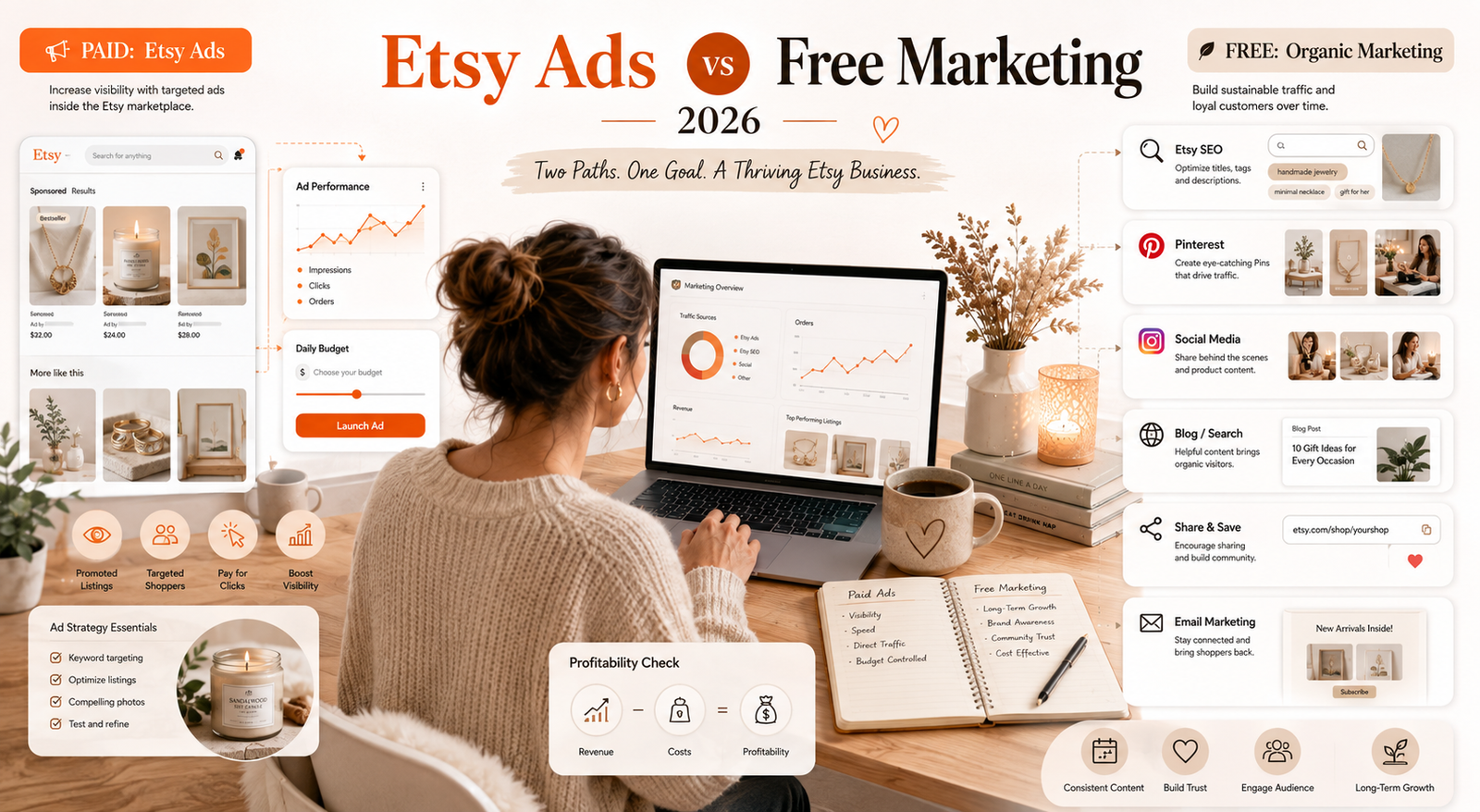
Etsy Ads vs free marketing is one of the most significant decisions Etsy shop owners face when trying to grow their businesses. Etsy’s global marketplace currently reaches 89.6 million active buyers, giving sellers access to a large audience, but visibility inside such a competitive marketplace still requires deliberate marketing. Etsy Ads can provide additional paid exposure inside Etsy, while free or organic strategies can attract shoppers through Etsy search, Pinterest, social media, search engines, direct traffic, and other channels.
The answer is not the same for everyone. Etsy’s advertising platform can help sellers place eligible listings in paid positions across Etsy, while organic growth strategies such as Etsy SEO, Pinterest marketing, content creation, direct traffic, and customer retention can generate visibility without paying for each Etsy Ads click.
It is important to clarify that “free marketing” is not completely cost-free. Organic marketing may require substantial time, photography, content production, software, design work, or other resources even when you are not paying for advertising clicks.
The strategy that makes sense for your shop depends on your budget, product economics, niche, listing quality, seasonal demand, and the amount of time you can dedicate to marketing.
In this guide, we will compare the costs, benefits, limitations, and long-term potential of Etsy Ads vs free marketing so you can decide whether paid advertising, organic growth, or a combination of both makes sense for your Etsy shop.
Quick Answer: Etsy Ads vs Free Marketing, Which Works Better in 2026?
Neither Etsy Ads nor free marketing works better for every shop. Etsy Ads can provide additional paid visibility inside Etsy and are charged per click, while organic strategies such as Etsy SEO, social media, Pinterest, content marketing, and Share & Save can attract traffic without paying for each Etsy Ads click. The better approach depends on your margins, budget, available time, product demand, listing quality, and the profitability of each traffic source.
Understanding Etsy Ads: How They Work and What They Cost
Etsy Ads, previously known as Promoted Listings, is a pay-per-click advertising system designed to give sellers additional visibility within Etsy.
When a shopper clicks one of your Etsy Ads, you pay for that click whether or not the visitor eventually makes a purchase. Ads can appear across Etsy search results, Category Pages, Market Pages, Etsy.com, and the Etsy app.
How Etsy’s Advertising Platform Operates
With Etsy Ads, sellers set a daily advertising budget. Etsy’s current technical minimum is $1 per day, although Etsy’s 2026 Seller Handbook recommends considering at least $3 to $5 per day when beginning a meaningful test and allowing the campaign to run for around 30 days before making major performance judgments. Etsy’s current Etsy Ads setup guidance Etsy’s 2026 Etsy Ads testing guidance
New Etsy shops also currently have a 15-day waiting period before they can begin an Etsy Ads campaign. Etsy Ads campaign requirements
Sellers can choose which listings participate in Etsy Ads. Etsy then optimizes ad delivery and bidding based on its advertising system.
A major 2026 update gives some advertisers additional control. Sellers with a daily Etsy Ads budget of $25 or more can use listing-level strategies:
| Etsy Ads Listing Strategy | What It Prioritizes |
|---|---|
| Greater Visibility | More reach for selected listings |
| Lower Click Cost | Lower-cost clicks where possible |
| Efficient Spending | A balance between visibility and cost |
Etsy introduced these listing strategies in June 2026 to let eligible sellers guide budget allocation at the individual-listing level. Etsy’s 2026 listing strategies announcement
The cost per click is not fixed. Etsy explains that CPC is determined by the bid for each individual ad, so sellers should use their own Etsy Ads dashboard rather than relying on generic CPC benchmarks. How Etsy Ads charges work
 Etsy Ads and Offsite Ads Are Not the Same
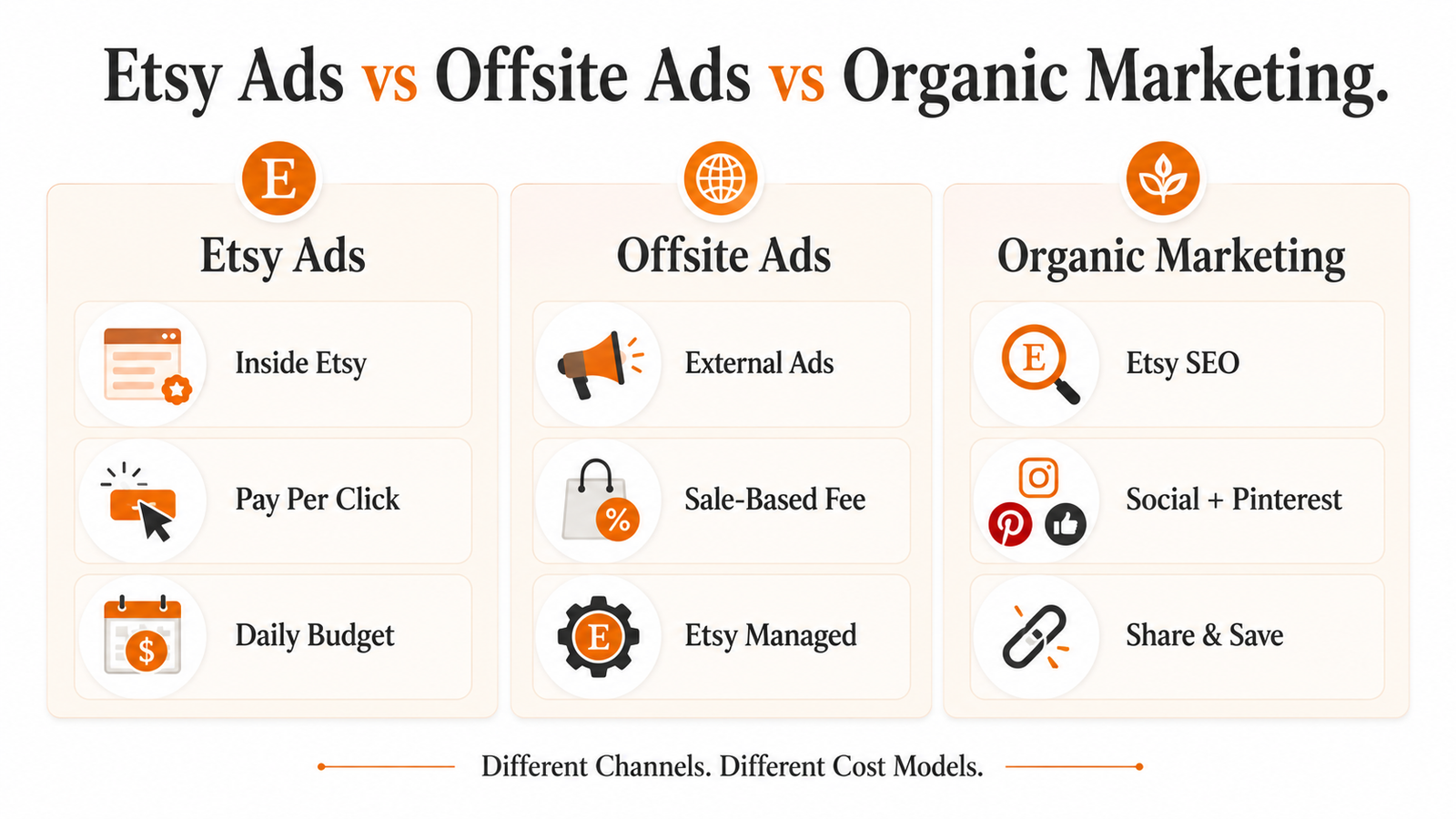
One of the most important distinctions for Etsy sellers is the difference between Etsy Ads and Offsite Ads.
The 15% advertising fee often discussed in Etsy marketing guides does not apply to normal Etsy Ads clicks.
| Feature | Etsy Ads | Offsite Ads | Free / Organic Marketing |
|---|---|---|---|
| Where It Appears | Inside Etsy | External advertising channels | Etsy search, social media, blogs, email, direct traffic, etc. |
| Cost Model | Pay per click | Fee on attributed orders | No direct ad-click cost |
| Seller Sets Budget | Yes | No | Seller controls own resources |
| Seller Chooses Listings | Yes | Etsy controls Offsite Ads selection | Yes |
| Minimum Budget | $1/day | No seller-set budget | None |
| 15% / 12% Offsite Fee | No | Yes, depending on shop eligibility | No |
| Primary Purpose | Additional visibility within Etsy | Etsy-funded external advertising | Organic/direct discovery |
Under Etsy’s current Offsite Ads rules, shops below the applicable $10,000 USD sales threshold generally pay a 15% fee on attributed Offsite Ads orders and may be able to opt out. Shops that meet or exceed the threshold receive a reduced 12% fee and participation becomes mandatory under Etsy’s current policy. The Offsite Ads fee is capped at $100 per attributed order. Etsy’s current advertising fee rules
Real Costs Beyond the Daily Budget
Rather than relying on generic Etsy Ads examples using assumed CPCs, conversion rates, or profit margins, calculate the economics of your own listings.
For an advertised product, evaluate:
Revenue attributed to Etsy Ads
− Etsy Ads spend
− product or material cost
− Etsy seller and payment fees
− packaging
− shipping costs you absorb
− refunds and returns
− production or labor costs
= contribution from advertised sales
This is more useful than simply asking whether an ad achieved a particular ROAS.
If you want broader support evaluating your ecommerce marketing and profitability, you can explore HiSellIt’s ecommerce solutions.
Free Marketing Strategies for Etsy Sellers
Free marketing does not require paying Etsy for each ad click, but it does demand consistency, time, and effective execution.
Organic strategies can also help reduce dependence on a single paid advertising channel.
Search Engine Optimization Within Etsy
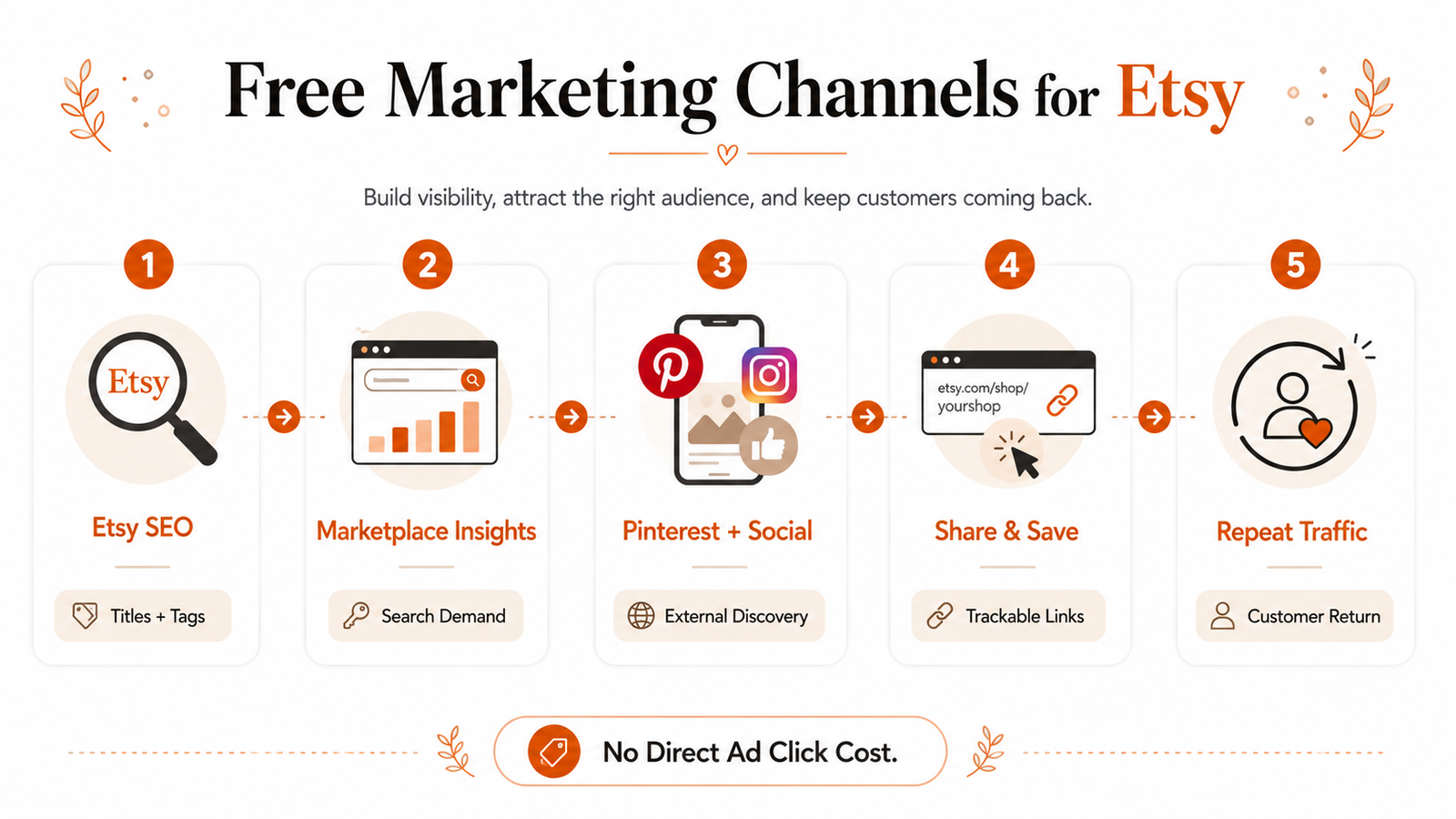
Etsy SEO remains one of the most important ways to improve unpaid visibility inside the marketplace.
Etsy currently explains that its search system evaluates listings holistically, looking at information including titles, tags, attributes, descriptions, first photos, reviews, categories, and other listing and shop signals. Etsy’s official explanation of how search works
Key areas to focus on include:
- Titles: Write clear, descriptive titles that quickly explain the product. Relevant keywords still matter, but Etsy says the exact position of a phrase within a title does not directly affect ranking. Leading with the most descriptive words is still useful because shoppers see them first, particularly on mobile. Etsy’s current keyword and title guidance
- Tags: Use all 13 available tags where you have relevant phrases to target. Avoid wasting tags by repeating identical concepts unnecessarily.
- Attributes: Complete relevant attributes and choose the most accurate product category.
- Descriptions: Write useful descriptions that answer shopper questions while naturally incorporating relevant language.
If your Etsy listings are struggling to gain organic visibility, our Etsy SEO automation guide covers keyword research, listing optimization, and ways to streamline repetitive SEO work.
 Use Etsy Marketplace Insights for Keyword Research
Etsy now provides sellers with Marketplace Insights, a native keyword-research tool based on actual Etsy search data.
Through Shop Manager → Stats → Marketplace Insights, sellers can investigate buyer search terms and view information such as search activity, competing listings, and related keyword opportunities.
Etsy currently allows sellers to perform up to 15 keyword searches per week for free. How Etsy Marketplace Insights works
This can provide stronger Etsy-specific research than relying exclusively on external keyword tools.
Social Media Marketing for Etsy Shops
Social media platforms such as Pinterest, Instagram, and TikTok can help Etsy sellers reach audiences outside the marketplace.
Pinterest can be particularly relevant for visually oriented products because users use the platform for discovery, planning, and search. Instagram and TikTok can support product demonstrations, behind-the-scenes content, lifestyle photography, packaging videos, and creator-style storytelling.
There is no universal percentage of Etsy traffic that Pinterest or another social platform should generate. Results vary significantly by niche, creative quality, posting strategy, seasonality, and audience.
If Pinterest is part of your marketing strategy, our guide on how to use Pinterest to drive Etsy sales explains how to structure Pins, Pinterest SEO, traffic measurement, and product links.
Use Etsy Share & Save for External Marketing
Etsy’s Share & Save program is now one of the strongest additions to the organic side of an Etsy marketing strategy.
Sellers can create trackable links to their shop or listings and share them through approved off-Etsy channels such as social media, blogs, newsletters, and other marketing sources.
When an eligible buyer makes a purchase within 30 days of clicking the seller’s Share & Save link, Etsy currently gives the seller 4% back on the eligible order total through their Etsy bill. Etsy’s current Share & Save guidance
Share & Save can therefore turn external organic marketing into a measurable channel:
Pinterest / Instagram / Blog / Newsletter → Share & Save Link → Etsy Listing → Eligible Order
Etsy also provides Share & Save reporting for clicks, orders, revenue, and credits.
However, participating in Share & Save does not improve your organic Etsy search ranking. Etsy explicitly states that joining the program has no effect on search placement. Etsy’s Share & Save search-ranking clarification
Email Marketing and Customer Retention
Email can help sellers maintain relationships with customers and audiences outside Etsy, but sellers need to follow Etsy’s privacy and communication rules.
Do not automatically take email addresses obtained from Etsy transactions and add those buyers to marketing lists.
Etsy’s current Seller Policy states that transaction information such as buyer email addresses may not be used for unsolicited commercial messages or added to mailing lists without the necessary consent. Etsy’s Seller Policy on buyer information and email marketing
Instead, build an email list through a separate, consent-based signup process.
Once customers have voluntarily subscribed, email can support:
- New-product announcements
- Seasonal collections
- Behind-the-scenes content
- Customer education
- Discounts
- Restocks
- Share & Save links back to Etsy
Content Marketing and Blogging
Publishing useful content can attract visitors from Google and other search engines.
For example, a shop specializing in wedding invitations could publish content about invitation etiquette, wedding planning, stationery styles, or event ideas.
Useful search-optimized content can continue attracting visitors after publication if it remains relevant and maintains search visibility. However, no blog post is guaranteed to rank or generate traffic indefinitely.
Comparing Results: Paid vs Organic Performance
Comparing Etsy Ads with free marketing requires looking at more than visibility.
The most useful comparison considers speed, cost, sustainability, traffic quality, and actual profitability.
Speed of Results
Etsy Ads can create additional paid visibility relatively quickly once a campaign is active, but impressions, clicks, and sales are not guaranteed immediately.
Etsy recommends allowing a new advertising campaign to run for approximately 30 days so its system can collect enough performance data to optimize delivery and give sellers a more useful basis for evaluation. Etsy’s guidance on evaluating Ads after 30 days
Free marketing does not have one standard timeline either.
Etsy SEO, Pinterest, social media, email, and blogging can all perform at different speeds depending on product demand, competition, shop history, content quality, and search intent.
Cost Per Acquisition
Customer acquisition cost is an important metric, but there is no reliable universal Etsy Ads CAC benchmark that applies to every shop.
For Etsy Ads:
CPA = Etsy Ads Spend ÷ Attributed Orders
Then compare that CPA with the contribution margin available before advertising.
Free marketing shifts more of the cost toward time, content production, software, photography, or other resources rather than direct CPC spend.
That does not make organic acquisition literally free. Your time and creative resources still have value.
Long-Term Sustainability
Etsy Ads only provide paid placement while the campaign is active and funded.
Organic marketing can create assets that continue attracting traffic without paying Etsy for each click. Optimized listings may remain discoverable in Etsy search, Pinterest content can continue resurfacing, and useful external content can generate referral traffic.
However, organic visibility is not permanent. Competition, shopper demand, search systems, trends, and listing performance can all change.
Quality of Traffic
Neither paid nor organic traffic should automatically be considered higher quality.
Etsy Ads are shown within the Etsy marketplace, including to shoppers actively searching for products, while organic Etsy search can also bring highly relevant buyers.
Pinterest, social media, Google, email, and direct visitors may enter at different stages of the buying journey.
Instead of relying on generic conversion benchmarks, compare your own traffic sources using:
- Visits
- Orders
- Conversion rate
- Revenue
- Average order value
- Refunds
- Repeat purchases where relevant
- Contribution margin
Etsy’s current Shop Stats separates sources including Etsy search, Etsy Ads, Offsite Ads, social media, Etsy marketing and SEO, and direct traffic, making it easier to compare channels. Etsy’s Shop Stats traffic-source definitions
If you need help evaluating the broader marketing strategy for your shop, you can contact the HiSellIt team.
When Etsy Ads Make Sense
Despite their cost, there are situations where testing Etsy Ads can make strategic sense.
You’re Launching New Products
New listings may benefit from additional paid visibility while you gather information about how shoppers respond to the product.
However, Etsy Ads do not directly buy higher organic rankings. Etsy explicitly states that running an Etsy Ads campaign does not influence organic search placement outside designated advertising spaces. Etsy’s explanation of Ads and organic search ranking
Use ads to test visibility and shopper response rather than assuming a specific number of ad-generated sales or reviews will automatically improve organic rankings.
Your Product Economics Can Support Paid Acquisition
Products do not need to hit a specific price or profit threshold to work with Etsy Ads.
Instead, calculate how much you can afford to spend acquiring a sale.
A product with high material costs, shipping expenses, production labor, and Etsy fees may need a much stronger ROAS than a digital or high-margin product.
Your break-even ROAS should be based on your own contribution margin rather than a universal 2x, 3x, or 4x target.
Your Competition Is Intense
In competitive Etsy categories, additional paid visibility may help your listings reach shoppers while you continue improving organic SEO, photography, pricing, and conversion performance.
However, advertising does not fix a weak product-market fit.
Sometimes the better strategy is to refine your positioning, target a more specific search intent, or strengthen your listing rather than spending more to compete against established sellers.
You Have Seasonal Products
Seasonal products can have limited periods of stronger buyer demand.
Ads may be useful when your product is relevant to holidays, weddings, back-to-school periods, gifting events, or other seasonal searches.
The decision should still be based on your own performance data rather than assuming seasonal advertising automatically produces better ROI.
When Free Marketing Is the Better Choice
For many Etsy sellers, organic marketing can provide an important foundation before or alongside advertising.
You’re Working With Limited Capital
If your cash budget is limited, improving listings and developing organic traffic can make sense before increasing paid advertising.
Focus on:
- Etsy SEO
- Product photography
- Listing quality
- Social content
- Share & Save
- Customer experience
You can add paid advertising later if the economics support it.
Your Margins Don’t Comfortably Support Paid Clicks
Do not assume products under a specific price, such as $25, automatically perform poorly with Etsy Ads.
Instead, calculate your actual contribution margin.
If your product costs, Etsy fees, shipping, packaging, refunds, and production expenses already consume most of the selling price, paying for additional clicks may leave insufficient room for profitable acquisition.
You Can Commit to Consistency
Organic marketing generally works best as an ongoing process rather than an occasional burst of activity.
Regularly improving listings, publishing content, testing Pinterest creative, researching Etsy keywords, and reviewing Shop Stats gives you more useful information over time.
There is no universal number of weekly hours required.
You Enjoy Content Creation
If photography, video, writing, Pinterest, or social media naturally fit your skills and products, external organic marketing may be easier to maintain.
Creative content can show:
- How a product is made
- How it is used
- Gift ideas
- Styling
- Product variations
- Behind-the-scenes processes
- Customer questions
The goal is to create relevant content that helps potential buyers understand the product.
Creating a Hybrid Approach
Paid and organic marketing do not need to be mutually exclusive.
Some Etsy shops benefit from using free marketing as an ongoing acquisition system while selectively using Etsy Ads when paid visibility makes financial sense.
Allocate Resources According to Performance
There is no universal 80/20 split between organic marketing and Etsy Ads.
Instead, allocate money and time according to:
- Product margins
- Available cash
- Available time
- Seasonal demand
- Listing performance
- Organic traffic
- Ad profitability
- Business goals
One shop may rely mostly on Etsy SEO and Pinterest. Another may generate profitable Etsy Ads traffic year-round.
Testing Before Scaling
Etsy’s current Seller Handbook recommends considering a $3 to $5 daily starting budget for an initial Etsy Ads test and giving the campaign approximately 30 days to collect performance data. Etsy’s current Ads testing recommendations
This should be treated as platform guidance for gathering useful campaign data, not as a guaranteed profitable budget.
After the test period, review:
- Spend
- Clicks
- Orders
- Revenue
- ROAS
- Search terms
- Listing-level performance
- Contribution margin
Then decide which listings deserve continued advertising.
Do not scale merely because a listing reaches an arbitrary 3x or 4x ROAS.
Building Consent-Based Audiences
Etsy does not provide sellers with a conventional Meta-style website retargeting pixel for visitors to an Etsy shop.
Sellers can still build consent-based audiences through channels they control, such as an independent website, social following, or voluntary email signup.
Once a shopper has properly opted into your marketing, you can use email or content to encourage future visits to your Etsy store.
Share & Save links can also help measure eligible traffic that you personally drive back to Etsy.
Seasonal Budget Allocation
Your advertising budget can change with seasonal demand.
If your shop receives more demand around Christmas, weddings, Mother’s Day, Valentine’s Day, or another relevant period, you may decide to increase paid visibility during that window.
During quieter periods, you might allocate more resources toward SEO, Marketplace Insights research, new photography, Pinterest content, or listing improvements.
Use your own historical data rather than assuming Q4 or another season is automatically more profitable.
Measuring Success: Key Metrics to Track
Regardless of your marketing approach, measurement should focus on business outcomes rather than surface-level metrics.
For Etsy Ads Campaigns
Monitor:
- Ad Spend: What you paid for Etsy Ads clicks
- Revenue From Ads: Revenue attributed to advertised listings
- ROAS: Revenue attributed to Etsy Ads divided by Etsy Ads spend
- CPC: Average cost per click
- CTR: Percentage of ad impressions that produce clicks
- Orders: Orders attributed to advertising
- Conversion Rate: Percentage of relevant ad traffic resulting in orders
- CPA: Etsy Ads spend divided by attributed orders
Do not add the Offsite Ads 15% fee automatically when calculating normal Etsy Ads ROAS.
Also remember:
ROAS is not profit.
A profitable Etsy Ads calculation must consider product costs, Etsy seller fees, payment processing, packaging, shipping, refunds, returns, production costs, and advertising spend.
For Organic Marketing Efforts
Track:
- Etsy search visits
- Search terms
- Listing views
- Orders
- Conversion rate
- Social-media referral traffic
- Direct traffic
- External-search visits
- Share & Save clicks
- Share & Save orders
- Share & Save revenue and credits
- Marketplace Insights keyword demand
Etsy’s Shop Stats provides specific traffic-source categories that can help you distinguish between Etsy search, social media, Etsy Ads, Offsite Ads, and other acquisition channels. Etsy Shop Stats glossary
Customer Lifetime Value
Customer lifetime value can also be useful for shops where repeat purchasing is relevant.
However, do not assume organic customers automatically have higher lifetime value than customers acquired through advertising.
Track actual repeat behavior.
If buyers frequently return for additional purchases, you may be able to justify a higher initial acquisition cost than a shop that mostly sells one-time products.
Common Mistakes to Avoid
Understanding common Etsy marketing mistakes can help you avoid spending time or money on strategies that are poorly matched to your shop.
Running Ads With Poor Listing Optimization
A common mistake is starting Etsy Ads before improving the underlying listings.
Ads can bring additional visitors, but they cannot compensate for weak photography, unclear product information, poor pricing, or a product shoppers do not want.
Etsy’s current Etsy Ads guidance specifically notes that ads work best when listings are already attracting buyer interest and are unlikely to turn a low-demand listing into a top seller. Etsy’s guidance on optimizing listings before Ads
Before spending heavily on advertising, review:
- Photos
- Titles
- Tags
- Attributes
- Descriptions
- Pricing
- Shipping
- Returns
- Reviews
- Product-market fit
If an Etsy listing becomes inactive unexpectedly, advertising will not solve the underlying compliance or listing issue. Our guide to common Etsy listing deactivation reasons explains what sellers should check.
Ignoring External Traffic Sources
External traffic can still be valuable because it provides additional ways for shoppers to discover your shop.
Pinterest, Instagram, TikTok, blogs, newsletters, direct links, and search engines can all send potential buyers to Etsy.
However, do not assume Etsy automatically rewards external visits with higher organic rankings.
Etsy does not list external traffic as a direct search-ranking reward, and participation in Share & Save specifically does not affect organic ranking. Etsy’s Share & Save ranking clarification
The value of external traffic is that it may create genuine visits, orders, and customers.
Inconsistent Free Marketing Efforts
Organic marketing benefits from consistent testing and improvement, but there is no official rule stating that posting less frequently causes Etsy or another platform to penalize your shop.
Instead of chasing arbitrary posting targets, create a manageable system for:
- Etsy SEO reviews
- Pinterest content
- Social posts
- Email campaigns
- Marketplace Insights research
- Listing updates
Consistency makes it easier to learn what works.
Not Tracking Profitability Accurately
Many sellers focus heavily on ROAS without considering what remains after the order is fulfilled.
A 2.5x ROAS may be profitable for one listing and unprofitable for another.
Build a calculation that includes:
Revenue
− materials/product cost
− Etsy fees
− payment processing
− shipping
− packaging
− refunds/returns
− labor
− advertising
= actual contribution
Make marketing decisions from this number rather than a universal ROAS threshold.
Giving Up Too Soon on Organic Strategies
SEO, Pinterest, blogging, and social-media marketing do not have a universal three-month or six-month success timeline.
Some products gain traction sooner. Others may never attract meaningful organic demand without repositioning or improvements.
Instead of waiting for an arbitrary deadline, review:
- Search impressions
- Search terms
- Visits
- Click-through behavior
- Saves or engagement
- Listing conversion
- Orders
- Search demand
- Competition
Use those signals to decide whether to continue, improve, or change the strategy.
Making Your Decision: What’s Right for Your Shop?
Choosing between Etsy Ads and free marketing is not about selecting one method permanently.
The right strategy depends on your product margins, cash budget, available time, listing quality, organic visibility, competition, seasonal demand, and customer acquisition costs.
Etsy Ads may be worth testing when your listings are already strong and you want additional visibility inside Etsy.
Organic strategies such as Etsy SEO, Marketplace Insights, Pinterest, social media, Share & Save, blogging, and consent-based email marketing can help diversify traffic without paying Etsy for every click.
Some sellers may benefit from combining the two. Others may find that organic traffic provides enough demand without significant advertising, while another shop may discover that Etsy Ads produce profitable incremental sales.
Start by auditing your business.
Calculate your real contribution margin, identify your strongest listings, review Shop Stats, investigate keywords through Marketplace Insights, and determine how much cash and time you can realistically allocate to marketing.
If Etsy SEO is one of the weak points in your current strategy, our Etsy SEO automation guide can help you strengthen the organic side before increasing advertising.
Your Etsy marketing strategy should evolve with your data rather than follow a fixed formula.
Track results, calculate profitability, test new approaches, and invest more heavily only in channels that produce worthwhile business outcomes.
 Final Thoughts: Etsy Ads vs Free Marketing
The debate over Etsy Ads vs free marketing does not have one universal winner.
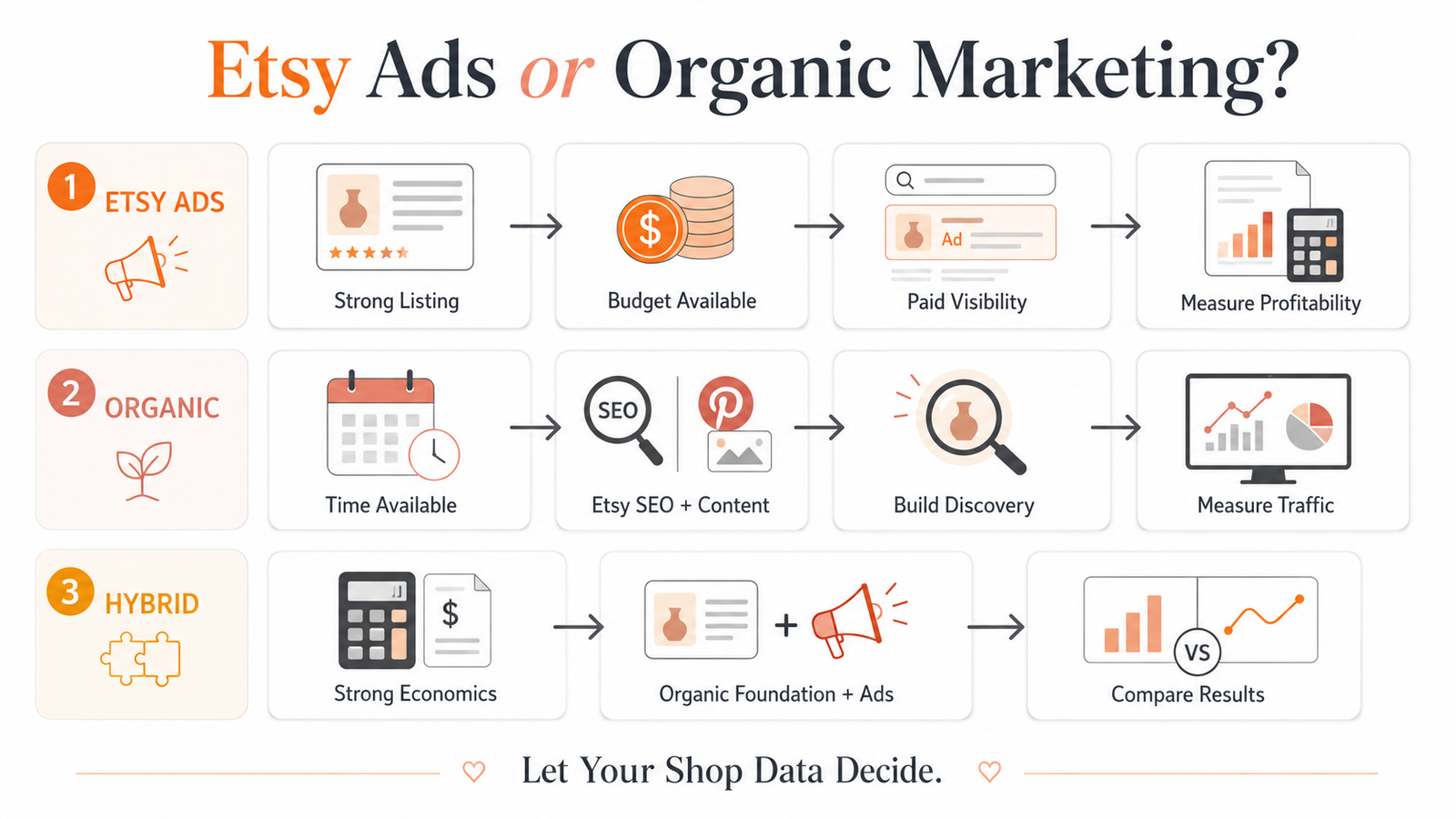
Etsy Ads can give strong listings additional paid exposure within the marketplace. Free marketing can build traffic through Etsy SEO, Marketplace Insights, Pinterest, social media, Share & Save, direct traffic, content, and consent-based customer relationships.
The strongest strategy is the one that produces sustainable profit for your particular shop.
Do not judge Etsy Ads only by clicks or ROAS, and do not judge organic marketing only by the fact that it has no CPC charge. Both approaches consume resources. Measure the full economics, improve your listings first, diversify traffic where it makes sense, and let your own shop data determine where you invest next.
For help reviewing your wider ecommerce growth strategy, explore HiSellIt or contact the team directly.
Frequently Asked Questions
Q. How Much Should I Spend on Etsy Ads Per Day?
Etsy Ads currently have a technical minimum budget of $1 per day.
Etsy’s June 2026 Seller Handbook recommends considering at least $3 to $5 per day when starting a campaign test and allowing roughly 30 days for the advertising system to gather and optimize performance data. This is not a guaranteed profitable budget.
Your long-term spend should depend on product margins, inventory, goals, CPA, ROAS, and actual contribution after advertising.
Q. Can I Succeed on Etsy Without Using Paid Advertising?
Yes. Etsy Ads are optional.
Sellers can generate traffic through Etsy search, Pinterest, social media, direct traffic, external search, repeat buyers, consent-based email marketing, and programs such as Share & Save.
However, organic marketing still requires work and does not guarantee sales.
Q. How Long Does It Take to See Results From Free Marketing on Etsy?
There is no universal timeline.
Etsy SEO, Pinterest, blogging, social content, and other organic channels can perform at different speeds depending on demand, competition, content quality, search intent, shop history, and consistency.
Evaluate actual traffic and conversion data instead of expecting results after a fixed number of weeks or months.
Q. Which Marketing Strategy Has Better Conversion Rates?
Neither Etsy nor reliable marketplace data supports one universal paid-versus-organic conversion-rate benchmark.
Compare Etsy Ads, Etsy search, Pinterest, social media, direct visits, and other channels using your own:
- Visits
- Orders
- Conversion rate
- Revenue
- CPA
- Contribution margin
A channel with a lower conversion rate may still be more profitable if acquisition costs are sufficiently low.
Q. Should I Use Etsy Ads and Offsite Ads Simultaneously?
Yes, Etsy Ads and Offsite Ads can both contribute to your shop’s marketing, but they work differently.
Etsy Ads are seller-funded pay-per-click advertisements displayed within Etsy.
Offsite Ads are advertisements Etsy places on external channels. Etsy charges an advertising fee only when an eligible order is attributed to an Offsite Ad.
Under Etsy’s current rules, shops below the applicable $10,000 USD threshold generally pay 15% on attributed Offsite Ads orders, while shops that meet or exceed that threshold receive the reduced 12% rate and are required to participate. The Offsite Ads fee is capped at $100 per attributed order. The 15% fee does not apply to Etsy Ads.