

Etsy SEO Automation: How to Use AI to Rank Higher in 2026
Etsy SEO automation can make keyword research, listing reviews, trend monitoring, and repetitive optimization work much easier, but it cannot put Etsy rankings completely on autopilot. AI and SEO tools are most useful when they help sellers find opportunities and make faster decisions while the seller still controls what actually gets changed.
There is plenty of competition for buyer attention. According to Etsy’s Q2 2026 results, Etsy marketplace gross merchandise sales reached approximately $2.6 billion in Q2 2026, while the marketplace had roughly 87 million active buyers on a trailing twelve-month basis.
Etsy itself has also introduced more tools to make SEO research and listing optimization easier. Marketplace Insights gives sellers access to real Etsy search data, while Etsy’s optional AI-powered title tool can suggest clearer listing titles and help eligible sellers update multiple listings more efficiently.
If you have spent countless evenings testing keywords, rewriting product titles, and trying to decode why your rankings refuse to move, this guide will help simplify that process. You will see how to use AI-assisted and Etsy SEO tools to analyze data, improve titles and tags, monitor search performance, and spot opportunities while you focus on design, marketing, and running your shop.
By the end, you will understand how Etsy SEO automation can reduce repetitive research and monitoring without handing important listing decisions completely over to AI.
Quick Answer: What Is Etsy SEO Automation?
Etsy SEO automation uses native Etsy tools, AI features, and third-party SEO platforms to speed up keyword research, listing reviews, title and tag optimization, trend monitoring, and performance tracking. It can reduce repetitive work, but sellers should still review recommendations for accuracy, relevance, and buyer intent.
How Etsy’s Algorithm Ranks Listings (And Why Automation Matters)?
Before you start automating your Etsy SEO process, it is important to understand what Etsy’s search system actually values.
Etsy explains search in two main stages: query matching and ranking. First, Etsy identifies listings that may match what a buyer searched for. It then ranks those matching listings using a range of factors. Etsy takes a holistic view of listing information, including titles, tags, attributes, descriptions, the first photo, reviews, listing quality, shop quality, customer service, engagement, and shopper behavior.
This means Etsy SEO is not simply about putting a high-volume keyword into a title and waiting for the listing to rank.
Etsy’s search system also changes over time, and buyer behavior, competition, and seasonality can change with it. A keyword that brings traffic during one period may become less useful later as shopper demand shifts.
This is where Etsy SEO automation becomes useful. AI and SEO tools can help monitor keyword trends, identify listing issues, organize performance data, and surface new opportunities. Instead of manually researching every listing from scratch, sellers can use these tools to decide where their attention is actually needed.
Recency, however, is often misunderstood. New listings receive a small temporary boost while Etsy gathers engagement information, and renewed listings may receive a smaller temporary boost. Etsy specifically says that repeatedly renewing listings just to gain this boost is not an effective search optimization strategy.
So automation should not constantly edit or renew listings simply to make them look fresh. It should help you find genuine opportunities to improve relevance, listing quality, and buyer engagement.
For a deeper explanation, review Etsy’s official How Etsy Search Works guide.
 Best Etsy SEO Automation and AI Tools for 2026
Etsy Marketplace Insights
Before paying for several third-party platforms, start with Etsy’s own Marketplace Insights.
Built into Shop Manager, Marketplace Insights uses real Etsy search data to show what shoppers are looking for, how frequently different terms are searched, and how much competition exists around those searches.
You can use Marketplace Insights to research keywords, compare buyer demand with listing volume, spot seasonal patterns, discover related search phrases, and get ideas for products or listing updates.
The tool is especially useful because the information comes from Etsy search itself rather than being estimated entirely from external marketplace data.
At the time of Etsy’s current guidance, sellers receive 15 free Marketplace Insights searches each week, while Etsy Plus subscribers receive unlimited searches.
Still, a popular phrase should only be added when it genuinely describes your product. Keyword data is there to guide decisions, not to justify stuffing unrelated phrases into listings.
Etsy AI-Powered Listing Title Suggestions
Etsy now also provides an optional AI-powered title tool for eligible English-language listings.
The tool uses information from the current title, first photo, and description to suggest clearer listing titles. Sellers can review suggestions individually, edit them, reject them, or update multiple listings more efficiently. Etsy makes clear that these suggestions are starting points rather than instructions.
Etsy’s newer title guidance focuses more heavily on clarity and readability. Sellers are encouraged to clearly state what the item is, include the most important objective traits, avoid unnecessary repetition, and keep titles easy to scan. Etsy says sellers can consider titles of fewer than 15 words when the important information can be communicated clearly.
You can read Etsy’s current listing title guidance and AI tool information for more detail.
The automation benefit here is straightforward. If you manage a large number of listings, AI can make the initial title-review process faster. But every suggestion should still be checked for accuracy, relevance, and whether it sounds natural to a real buyer.
eRank and Marmalead: Etsy Keyword Intelligence
Two established tools for Etsy SEO research are eRank and Marmalead. Both focus specifically on Etsy rather than relying only on broad Google keyword data.
eRank can help sellers research keywords, explore trends, review listings, study competition, and compare different search opportunities. This is particularly useful when you are looking for long-tail keywords or trying to understand seasonal changes in buyer language.
Instead of treating any single eRank score as a guarantee of ranking potential, use the platform as a research layer. Compare its keyword information with Etsy Marketplace Insights, Etsy Stats, and what is actually happening in your own shop.
Marmalead offers a similar Etsy-focused approach and can help sellers evaluate keyword demand, competition, engagement, and seasonality.
You do not necessarily need both tools. Using several platforms may sound more advanced, but overlapping tools can quickly create extra work. Test them and choose the one that gives you information you actually use when making listing decisions.
Etsy Ads Data and Native Automation
Many sellers also use Etsy Ads data when evaluating listing performance.
However, paid and organic search should not be treated as the same system. Etsy explicitly states that running an Etsy Ads campaign does not influence where your listings appear in organic Etsy search outside designated advertising placements.
Etsy Ads can still provide useful information about which products and offers attract buyer attention. If a particular listing earns clicks from paid traffic but struggles to convert, that may tell you to investigate the product images, price, shipping, description, or overall offer.
Use advertising data as another signal in your SEO research, not as proof that an advertised keyword will automatically rank organically.
 Etsy SEO Automation Tools at a Glance
| Tool | Best Use | Human Review Needed |
|---|---|---|
| Marketplace Insights | Keyword demand, competition, and trend research | Check keyword relevance |
| AI Title Suggestions | Drafting clearer listing titles | Check accuracy and readability |
| Etsy Stats | Traffic, search terms, orders, and conversion trends | Interpret why performance changed |
| Search Visibility | Identifying listing and shop issues | Decide which issues need action |
| eRank / Marmalead | Additional keyword, trend, and competitor research | Do not follow scores blindly |
Step-by-Step: Setting Up Your AI Automation Workflow
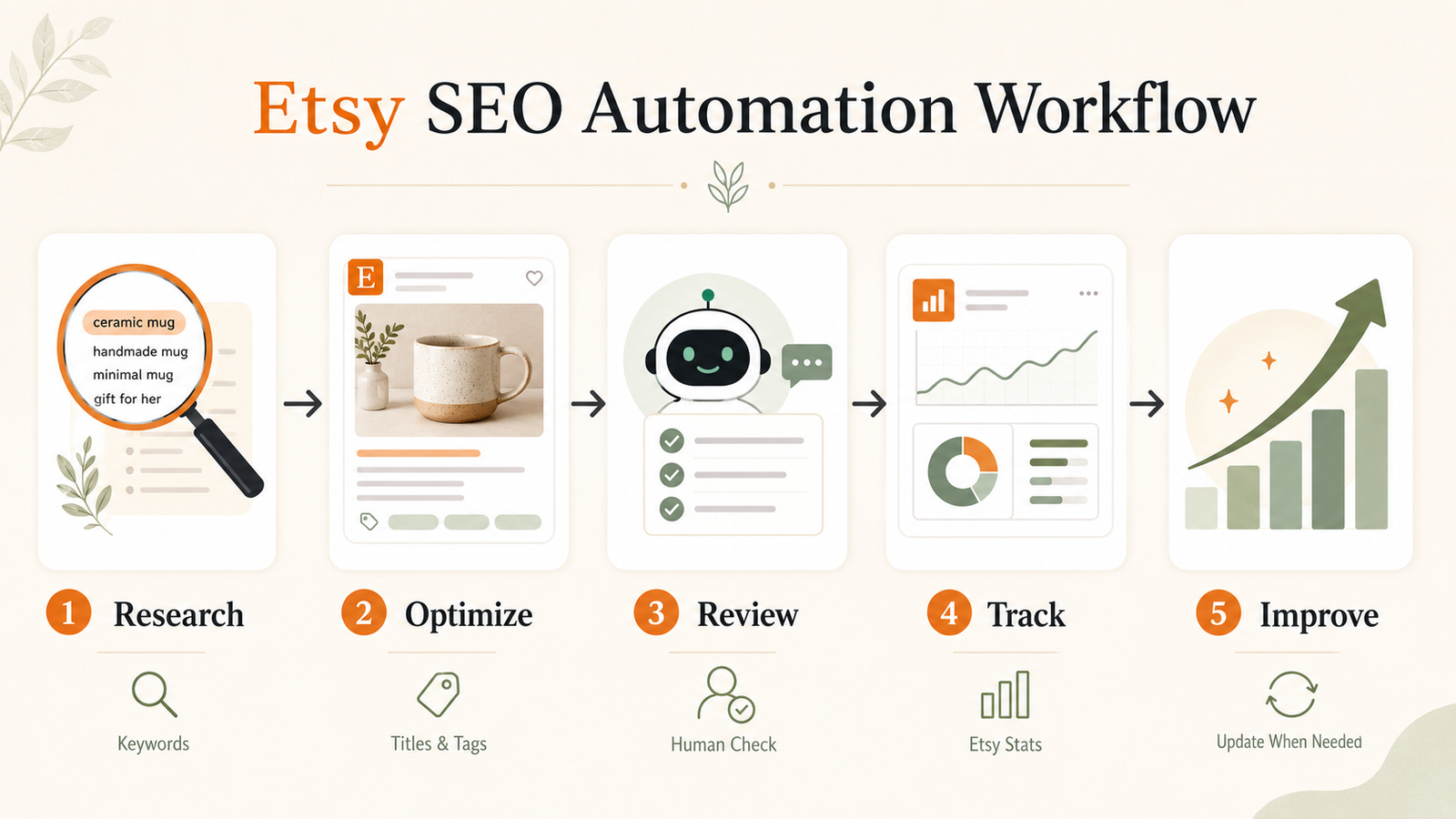
Step 1: Select Your Core Automation Stack
The most effective setup does not need to include every available SEO platform.
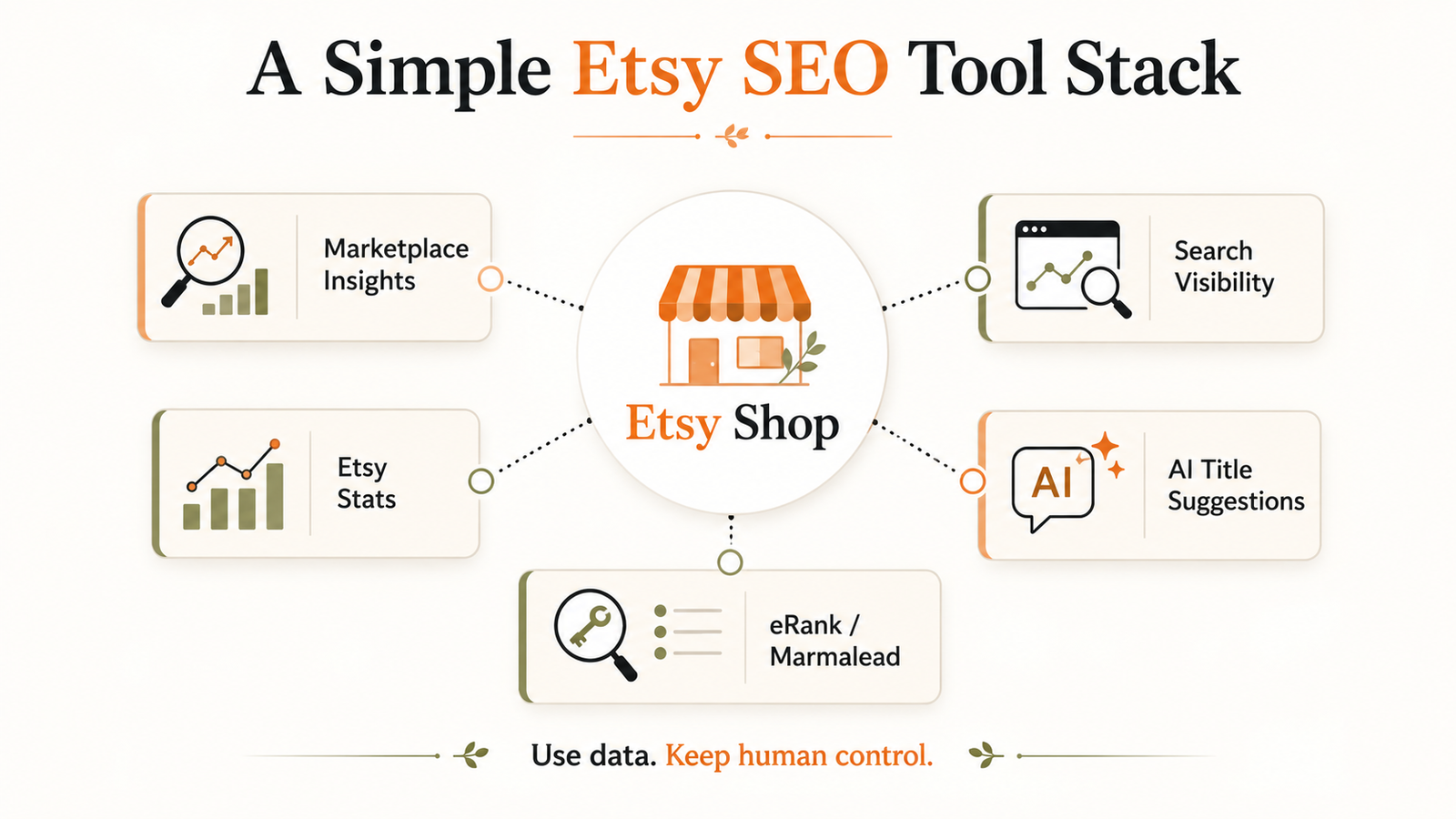
A practical starting stack can include:
- Etsy Marketplace Insights for search demand and competition
- Etsy Search Visibility for listing-quality issues
- Etsy Stats for actual shop traffic and search terms
- Etsy’s AI-powered title suggestions where available
- eRank or Marmalead for additional keyword and trend research
Always begin with the smallest number of tools you need. Test how each one fits your workflow before adding another subscription.
Using multiple tools may be useful because each can provide a different type of insight. Marketplace Insights gives you Etsy’s own search data, Etsy Stats shows what is actually happening in your shop, while platforms such as eRank or Marmalead can provide additional keyword and marketplace research.
If you would rather have help building and managing the operational side of your shop, you can also explore our Etsy automation services.
Step 2: Complete Your Baseline Optimization
Before automation can help consistently, your listings need to be well structured and aligned with Etsy’s SEO principles. Automation can improve the research process, but it cannot completely fix listings with weak products, inaccurate information, poor images, or unclear offers.
Start by reviewing both your stronger and weaker listings in Etsy Stats. Look at which products receive Etsy search traffic, which search terms bring visitors into the shop, and which listings attract views but struggle to convert.
Then go through each listing and ask a few key questions. Is the main product clearly identified in the title? Are your tags diverse and specific? Have you completed relevant categories and attributes? Does your product description clearly explain the item and answer common customer questions?
Etsy recommends using all 13 available tags, adding variety to those tags, choosing relevant attributes, and categorizing products as specifically as possible because these can create more opportunities for query matching.
These listings give you a baseline for understanding what is already working and which areas need attention.
Focus first on listings where the data gives you an actual reason to make a change rather than automatically editing a fixed percentage of your shop.
Step 3: Configure Monitoring Around Useful Signals
Once your listings have a solid baseline, move to monitoring.
Do not create alerts simply because a platform offers them. Track information that can lead to an actual decision.
Useful signals include:
- Search terms bringing visitors to your shop
- Listings gaining or losing Etsy search traffic
- Emerging keywords in Marketplace Insights
- Seasonal search changes
- Search Visibility issues
- Views and visits
- Orders and conversion trends
- Listings receiving traffic but few sales
For eRank or Marmalead, you can monitor keywords that matter to your product categories and periodically review how demand or competition is changing.
The goal is to stay informed without reacting to every small movement.
Some changes are temporary. A keyword may fluctuate because of seasonality, a short-lived trend, or ordinary changes in buyer demand. Give the data enough time to show a useful pattern before changing a listing.
Step 4: Establish Your Optimization Workflow
Create a workflow that fits your actual schedule, not an ideal one. Consistency matters more than constantly editing listings.
Weekly: Check Etsy Stats, Search Visibility, Marketplace Insights, and any meaningful alerts from your chosen SEO tool. Note which listings or keywords deserve closer attention. At this stage, resist the urge to make instant edits to everything. Collect the data and look for patterns.
Every few weeks: Use those insights to focus on a small group of listings that have a clear reason for improvement. Review titles, tags, attributes, descriptions, and product presentation. Update only the areas that actually need attention.
Monthly: Take a broader look at shop performance. Compare categories, search traffic, orders, and conversion trends to see whether particular products are improving or losing visibility.
This workflow keeps automation manageable. You are not constantly changing listings, but you are also not ignoring useful information.
Step 5: Implement AI-Generated Recommendations Strategically
When Etsy’s AI tools or third-party SEO platforms suggest updates, never accept them blindly. The technology identifies opportunities, but your judgment determines what genuinely fits your product.
If a tool recommends replacing a tag because another term appears to have stronger demand, pause before acting. Ask whether that phrase genuinely describes your product. Just because another shop uses it does not mean it belongs in yours.
When title suggestions appear, read them carefully. Does the suggested version clearly explain the product? Does it sound natural? Has it added a color, material, size, personalization option, or other detail that is not accurate?
The same goes for description improvements. AI might help identify vague language or missing details. For example, it may point out that an item description does not mention materials or care instructions.
Review those prompts thoughtfully and add only information that genuinely helps buyers.
Automation should never override accuracy or authenticity. AI can highlight opportunities and draft changes. You decide what actually gets published.
 Step 6: Track Performance Metrics Over Time
The real value of automation comes from understanding whether the changes you make are helping.
Each month, compare relevant shop metrics such as:
- Etsy search traffic
- Search terms
- Visits
- Views
- Orders
- Conversion rate
- Revenue
- Listing-level traffic
- Search Visibility issues
Do not judge success only by a third-party SEO or optimization score.
Whenever performance improves, take note of what changed. Did you improve a product title? Replace irrelevant tags? Add missing attributes? Update the first photo? Improve pricing or shipping?
This feedback loop helps you understand what drives results in your specific niche.
If performance stays flat, the limiting factor may not be SEO. Your pricing, photography, product demand, shipping offer, competition, or conversion experience may need attention instead.
If you are making changes but still struggling to gain visibility, our guide on why Etsy SEO is not working covers other issues that may be holding listings back.
Quick Answer: How Should You Use AI for Etsy SEO?
Use AI for Etsy SEO to research keywords, identify listing gaps, draft clearer titles, monitor trends, and organize performance data. Review every suggestion before publishing, and only change a listing when the recommendation accurately matches the product and gives buyers clearer information.
Automation Mistakes That Waste Time and Money
Even though Etsy SEO automation can save manual work, it can also waste time and money if it is not managed carefully.
The most common mistake is setting up too many alerts. When tools notify you about every small movement, the information quickly becomes background noise. Begin with the signals that matter most to your shop and adjust your monitoring once you understand what normal performance looks like.
Another mistake is expecting automation to fix a weak listing. If your product title is unclear, your photos are low quality, or your pricing does not fit the market, no keyword optimization system can solve those fundamental problems on its own.
Sellers also make the mistake of treating AI suggestions as final truth. If an AI tool recommends adding a keyword to your title, check whether that keyword genuinely matches your audience and product. A trending phrase that attracts the wrong buyers might increase irrelevant traffic without helping sales.
Another common mistake is forgetting to maintain the system. Some sellers set up an SEO tool once and then rarely review the information again.
Choose a review schedule based on the size of your catalog, the seasonality of your niche, and how frequently useful data changes. Automation still needs regular human oversight.
Compliance matters too. Automated listing changes should never introduce inaccurate keywords, prohibited claims, intellectual property problems, or misleading product information. If Etsy removes or disables one of your listings, our guide to Etsy listing deactivation reasons explains common causes and what to review next.
Example Etsy Listing Optimization Scenarios
The examples below are illustrative scenarios. They show how AI-assisted research might guide a listing update, but they are not promises of specific ranking or sales improvements.
Example 1: Title Optimization
Original title:
Handmade Ceramic Mug
A listing review may show that the title is accurate but too broad to communicate important product details.
Updated title:
Handmade Ceramic Coffee Mug with Galaxy Print, 12 oz
The revised title identifies the product more clearly and adds useful objective details while remaining readable.
This does not guarantee a ranking increase. It simply gives Etsy and potential buyers clearer information about what is being sold.
Example 2: Tag Strategy Shift
Original tags:
galaxy, mug, ceramic, coffee, handmade, blue, design, art, gift, pottery, home, drinkware, personalized
Keyword research may reveal other relevant phrases worth considering, while also highlighting that personalized is inaccurate if the item cannot actually be customized.
Updated approach:
Remove personalized and consider relevant phrases such as coffee lover mug or ceramic tea mug if they accurately describe the item.
The goal is not to chase higher-volume phrases blindly. It is to use the available tag space to match the relevant ways buyers may search for the product.
Example 3: Engagement Gap Identification
Suppose Etsy Stats shows that a listing receives healthy traffic but converts poorly.
That may mean shoppers are interested enough to click, but something on the listing page is holding them back.
If the description focuses heavily on the handmade process but provides little information about size, materials, everyday use, care instructions, or gifting suitability, those areas may be worth improving.
Updated description approach:
Open with clear information about the product and its practical use, then provide materials, dimensions, care instructions, and other details buyers need.
The important point is that weak conversion does not automatically mean the keywords are wrong. Photography, price, shipping, reviews, product positioning, and the offer itself may also need attention.
Continuous Optimization: What Happens After Implementation
After the initial setup, the real value of automation comes from turning SEO into a manageable review cycle rather than a constant editing cycle.
Monitor Etsy Stats and Search Visibility, check Marketplace Insights when researching changing or seasonal demand, and review listings that have a clear performance issue.
When the data gives you a reason to make a change, update the relevant title, tags, attributes, description, or photos.
After making meaningful changes, give Etsy time to collect new performance information before editing the same listing again. Etsy’s current title guidance notes that listing changes can take time to have an effect.
Not every traffic decline is an SEO problem either. Search demand can shift with seasons, competition, product trends, and buyer behavior.
If traffic falls unexpectedly, read our guide on why Etsy traffic drops suddenly before assuming your entire SEO strategy needs to be rebuilt.
The goal of continuous optimization is not to keep every listing constantly changing. It is to notice meaningful opportunities sooner and make better-informed updates.
How AI Automation Connects to Your Broader SEO Strategy
Automation handles parts of the technical and research side of optimization, including keywords, tags, titles, trend analysis, and performance monitoring. But Etsy SEO also depends on elements that automation influences without fully controlling.
When you are scaling your product line or expanding into new categories, a consistent research workflow can make that process faster. You can review new listings against the same SEO fundamentals instead of starting from scratch every time.
The same principle applies across different types of Etsy products. Different categories may have different search behavior, competition, and seasonality, but the broader workflow remains similar: research buyer language, build accurate listings, monitor real performance, and adjust where the data gives you a reason.
For sellers scaling through multiple product categories or building toward a more automated Etsy operation, understanding how AI-assisted optimization works gives you a stronger foundation.
AI can also help draft product descriptions, but the final copy should still be reviewed by someone who understands the product and the customer. Automation can flag missing information, organize ideas, or generate a first draft, but you should check accuracy, usefulness, tone, and whether the copy genuinely answers buyer questions.
The strongest approach combines AI efficiency with human understanding.
Conclusion
Etsy SEO automation is not about replacing your role as a seller. It is about reducing repetitive research, monitoring data, and spotting patterns so you can spend more time making useful decisions about your shop.
In 2026, sellers also have more native Etsy tools available for this work. Marketplace Insights provides real Etsy search data, Search Visibility can highlight listing issues, and Etsy’s optional AI-powered title suggestions can make title reviews faster. Third-party tools such as eRank and Marmalead can provide additional keyword and trend research when you need it.
The strongest Etsy SEO automation setup is therefore not completely hands-off. Let the tools collect and organize the information, use Etsy Stats to see what actually happens, and use your own judgment to decide which changes make sense for your products and brand.
If you want help building a more efficient Etsy operation, explore our Etsy automation services.
Frequently Asked Questions
Q. How long does it take before you see results from Etsy SEO automation?
There is no fixed timeline. Changes to titles, tags, attributes, photos, and other listing elements may take time to generate enough new search and buyer data to evaluate properly. Etsy itself notes that listing updates can take time to have an effect.
Results also depend on search demand, competition, listing quality, engagement, pricing, seasonality, and the product itself.
Make purposeful changes, monitor Etsy Stats, and avoid repeatedly editing a listing before you have enough information to judge what happened.
Q. Can automation handle multiple product categories or niches?
Yes. Automation and SEO tools can make keyword research and performance monitoring easier across multiple categories.
However, each category should still be evaluated separately because buyer language, competition, seasonality, and search intent can differ significantly from one niche to another.
The workflow can remain consistent while the actual keywords and optimization decisions change by category.
Q. What’s the difference between free tools and paid Etsy SEO platforms?
Etsy’s native tools already provide useful information through Marketplace Insights, Search Visibility, Etsy Stats, and AI-assisted title suggestions where available.
Paid third-party tools may provide additional keyword research, trend history, competitor research, listing audits, or workflow features.
Whether a paid platform is worthwhile depends on what extra information your shop actually needs, not on an arbitrary number of listings.
Q. Will AI automation make my listings sound generic?
Only if you implement recommendations without reviewing them.
AI can suggest titles, keywords, descriptions, and improvements, but you decide what actually fits your product and brand voice.
Read every suggestion as a shopper would. Make sure it is accurate, natural, useful, and specific to what you are selling.
Q. How do you know if your Etsy SEO automation setup is actually working?
Track performance using Etsy’s actual shop data rather than relying only on a third-party optimization score.
Look at Etsy search traffic, search terms, visits, orders, conversion trends, revenue, and listing-level performance. Search Visibility can also help identify issues Etsy has detected.
If those metrics remain flat after meaningful SEO changes, investigate whether the real bottleneck is product demand, photography, pricing, shipping, competition, or another part of the offer rather than continuing to change keywords unnecessarily.
Not sure which part of your Etsy shop needs attention first? Contact the HiSellIt team to discuss your current setup, SEO challenges, and growth goals.


2 Comments