
Etsy Listing Deactivated: Reasons, Fixes & How to Prevent It (2026 Guide)
Etsy had 5.6 million active sellers and more than 100 million items for sale at the end of 2025, according to Etsy’s 2025 Annual Report. So if you suddenly find an Etsy listing deactivated, you are dealing with a problem that can affect sellers across a marketplace handling millions of shops and listings.
Finding out your listing has disappeared can be stressful, especially when it was live the day before, and you are not immediately sure what went wrong. The worst thing you can do is panic, relist the same product, or send an appeal before understanding why Etsy removed it.
A listing can be deactivated for several reasons, including marketplace policy issues, intellectual property complaints, prohibited or restricted products, or problems with how an item is represented. Some issues are relatively simple to correct, while others require documentation or a formal response.
This guide explains why Etsy listings get deactivated, how to fix a deactivated Etsy listing, how the appeal process works, and what you can do to prevent future removals.
Need Help Growing Your Ecommerce Business? Fixing one listing is important, but building a stronger, more scalable ecommerce business requires the right systems and strategy. Explore HiSellIt to discover solutions designed to help online sellers grow more efficiently.
Quick Answer: What Does “Etsy Listing Deactivated” Mean?
An Etsy listing may be deactivated or removed when Etsy believes it violates its marketplace policies, Creativity Standards, prohibited items rules, or Intellectual Property Policy. Sellers should check their Policy violations page and Etsy email to identify the reason and determine whether an appeal is available.
Why Etsy Deactivates Listings: The Full Breakdown
Etsy is not random about removals. Every Etsy listing removed has a reason behind it. The platform runs a marketplace built on buyer trust. When a listing puts that trust at risk, it gets taken down.
Here are all the core reasons.
Etsy Policy Violation
Sellers agree to Etsy’s rules when they open a shop. Those rules live in the Etsy Seller Handbook. When a listing breaks those rules, even by accident, it can be flagged as an Etsy policy violation.
Common examples include:
- Selling mass-produced goods as handmade without disclosure
- Using misleading titles or descriptions to rank for unrelated searches
- Misrepresenting what a product does or what it is made of
- Hiding a production partner relationship from Etsy
Etsy Prohibited Items Policy
Some products are not allowed on Etsy at all. The Etsy prohibited items policy covers things like alcohol, weapons, tobacco, certain health products, and anything connected to hate, violence, or illegal activity.
Sellers often get caught here by accident. A product can look fine on the surface but fall into a restricted category. Certain herbal remedies, replica items, and vintage goods with age restrictions have tripped up sellers who had no idea they were violating anything.
Always check the Etsy Seller Handbook before listing something new. Here is the official guide: Etsy Seller Handbook
Etsy Intellectual Property Violation
Intellectual property complaints are an important reason Etsy listings can be removed, especially when protected artwork, photographs, brand names, logos, or other copyrighted or trademarked material is used without authorization.
There are two main types:
- Etsy copyright infringement: Using artwork, photos, text, or designs that belong to someone else without permission.
- Etsy trademark violation: Using brand names, logos, or slogans that are registered trademarks without authorization.
Under the Digital Millennium Copyright Act (DMCA), marketplaces like Etsy are legally required to remove listings when a copyright holder files a valid takedown notice. The United States Copyright Office oversees these rules.
Counterfeit goods, fake replicas, and unauthorized fan merchandise all fall under this category. They almost always lead to removal and can trigger a full account review.
Trademarks are registered through the United States Patent and Trademark Office (USPTO). Using a protected brand name or logo without permission can trigger an automatic Etsy trademark violation complaint, even if the rest of the product is original.
Brand protection programs allow companies to monitor marketplaces and file complaints against unauthorized sellers. Intellectual property complaints are one of the most common reasons listings are removed on major marketplaces. For example, a seller listing a “Nike-inspired hoodie” without a license may receive a trademark complaint, even if the design itself is original.
You can learn more about copyright law directly from the United States Copyright Office.
Handmade Policy and Reselling Violations
Etsy was built for handmade, vintage, and craft supply items. Dropshipping on Etsy without clear disclosure, or reselling factory goods while calling them handmade, goes against core platform rules.
This is a growing enforcement area. Etsy has tightened its review process significantly. If listings look like wholesale reselling or dropshipping, they get flagged.
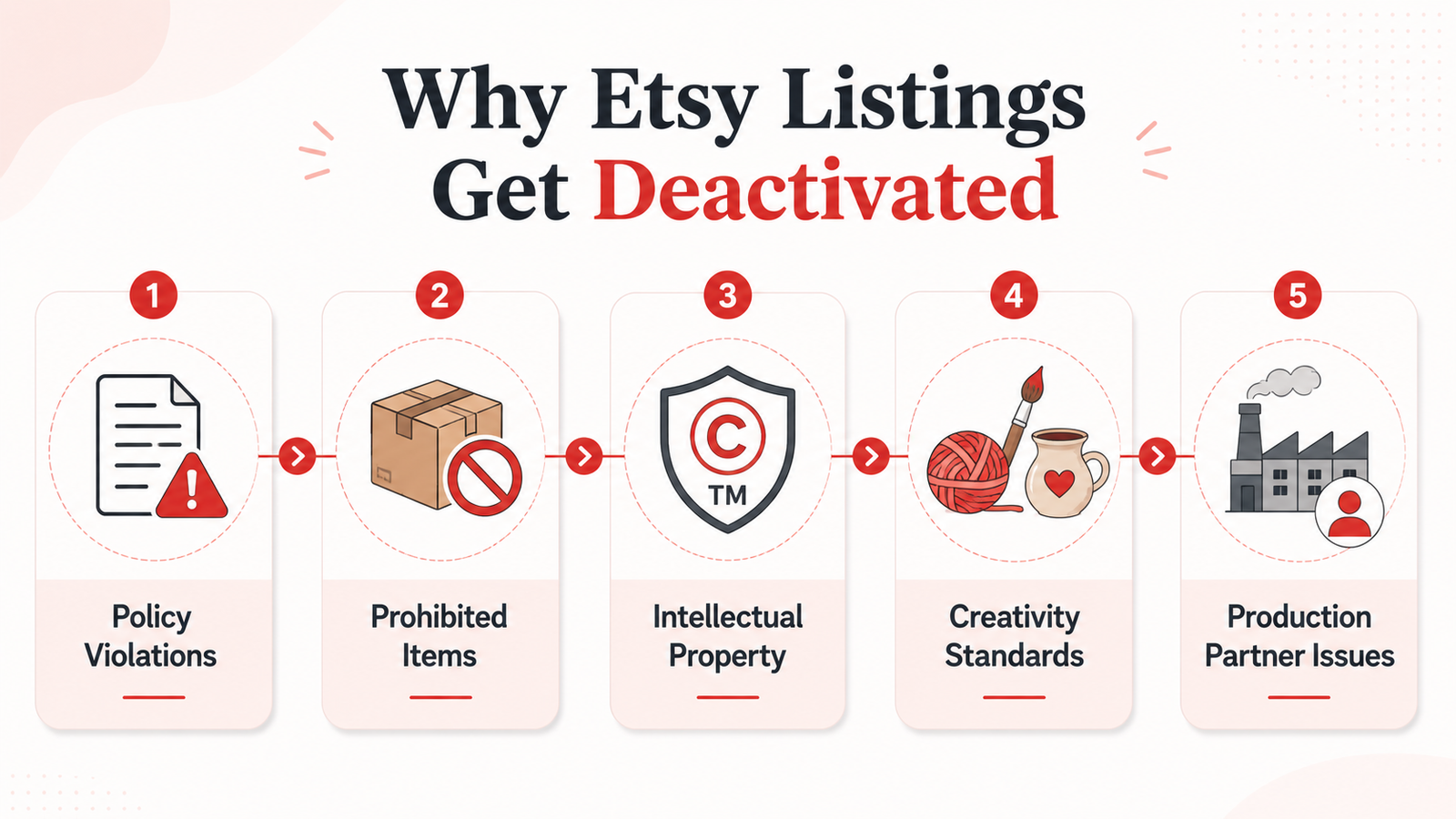
The most important reasons an Etsy listing may be deactivated or removed
Why Did Etsy Deactivate My Listing Without Warning?
Sometimes an Etsy listing disappears, and the reason is not immediately obvious. Maybe the product has been live for months without a problem, or maybe the notice from Etsy does not give you much to work with.
That can make it feel like the listing was removed for no reason. Usually, though, there is something worth checking before you appeal or try to list the product again.
Inaccurate Listing Information
Start with the basics. Does the listing accurately describe what you are selling?
Your photos, title, description, category, attributes, and production details should all match the actual product. Something as simple as describing an item in a way that gives buyers the wrong impression can create a problem.
Go through the listing as if you were a customer seeing it for the first time. If anything could be misunderstood, fix it.
Irrelevant Keywords
It is tempting to add popular search terms to a listing just to get more visibility, but those keywords still need to make sense for the product.
For example, adding a popular brand name because the product has a similar style can create problems, particularly if that name is protected by trademark.
Keep titles and tags focused on what you are actually selling. Good Etsy SEO is about relevance, not squeezing every possible keyword into a listing. If your listings are compliant but still struggling to appear in search, the problem may be SEO rather than enforcement. Our guide on why Etsy SEO is not working explains the ranking issues that can reduce listing visibility and what sellers can do about them.
Wrong Categories or Attributes
Categories can seem like a small detail, but they help Etsy understand what your product actually is.
If a listing has been placed in a category that does not accurately match the item, review it. The same applies to attributes such as material, occasion, style, size, and other product details.
Choose the category that genuinely describes the product rather than the one you think might attract the most traffic.
Intellectual Property Complaints
This is one sellers need to take seriously.
A listing may be removed after Etsy receives an intellectual property complaint involving a brand name, logo, photograph, artwork, character, design, or other protected material.
If Etsy’s notice mentions intellectual property, do not immediately recreate the listing with slightly different wording. First, find out exactly what was reported and whether you actually have permission or legal rights to use the material.
Products That Do Not Meet Etsy’s Creativity Standards
Etsy is not designed as a marketplace for every type of product. Items sold there need to meet Etsy’s current Creativity Standards.
This becomes especially important with products sourced from third parties. Just because an item was previously listed without a problem does not necessarily mean it meets the rules today.
If your Etsy listing was deactivated without warning, compare the product with Etsy’s current requirements for items that are made, designed, handpicked, or sourced by sellers.
For the latest requirements, check Etsy’s official Creativity Standards before making changes.
Undisclosed Production Partners
Using a production partner is not automatically a problem. Plenty of Etsy sellers use printers, manufacturers, and print-on-demand companies. The important part is being transparent about it.
If another business physically produces an item based on your design, check whether that business needs to be disclosed as a production partner. Make sure the information on your listing and shop accurately reflects how the product is made. Etsy explains when production partners should be disclosed and how sellers can add them in Etsy’s official production partner guidance.
If print-on-demand is part of your business model, our Etsy print-on-demand automation guide explains how to streamline listings, fulfillment, and other repetitive processes while building a more scalable Etsy operation.
Before You Relist Anything
If a listing suddenly disappears, resist the urge to put up the same product again straight away.
Read Etsy’s notice first. Then compare the listing with the relevant policy and work out what actually needs fixing. If Etsy removed the listing because of an intellectual property complaint, prohibited product, or another serious compliance issue, simply creating a new version of the same listing may leave the underlying problem unresolved.
The goal is not just to get the product back online. It is to understand why the Etsy listing was deactivated so you do not end up dealing with the same issue again.
What Happens When Etsy Deactivates a Listing
Understanding what happens when you receive an Etsy listing deactivated notice helps you react correctly instead of making things worse.
If your Etsy listing deactivated again after a previous warning, it may signal a deeper compliance issue.
Here is the chain of events:
- Listing disappears from search and your shop immediately. Buyers cannot find it. Sales stop.
- You get a notification. Etsy sends a message explaining the removal. Read it carefully before doing anything.
- Revenue may be held. Sales linked to the listing can be reviewed or put on hold depending on the type of violation.
- Repeated violations can put your shop at greater risk. Multiple policy violations may lead to additional enforcement actions, including the loss of certain seller privileges or account suspension.v
- Shop suspension becomes possible. If the violation is serious or it is not your first offense, Etsy may suspend the entire shop.
Like Amazon and eBay, Etsy uses automated risk detection systems combined with manual Trust and Safety reviews to protect buyers and brand owners. This is not unique to Etsy. It is how marketplace compliance works across every major platform.
If your Etsy traffic dropped around the same time your listing was removed, that is worth investigating separately. Here is a useful resource on why Etsy traffic drops suddenly and what to do about it.
Quick Answer: How Do You Fix a Deactivated Etsy Listing?
To fix a deactivated Etsy listing, first read Etsy’s removal notice and identify the specific violation. Correct any listing or policy issues, gather supporting evidence if needed, and submit an appeal when Etsy provides that option. Do not relist the same product until you understand why it was removed.
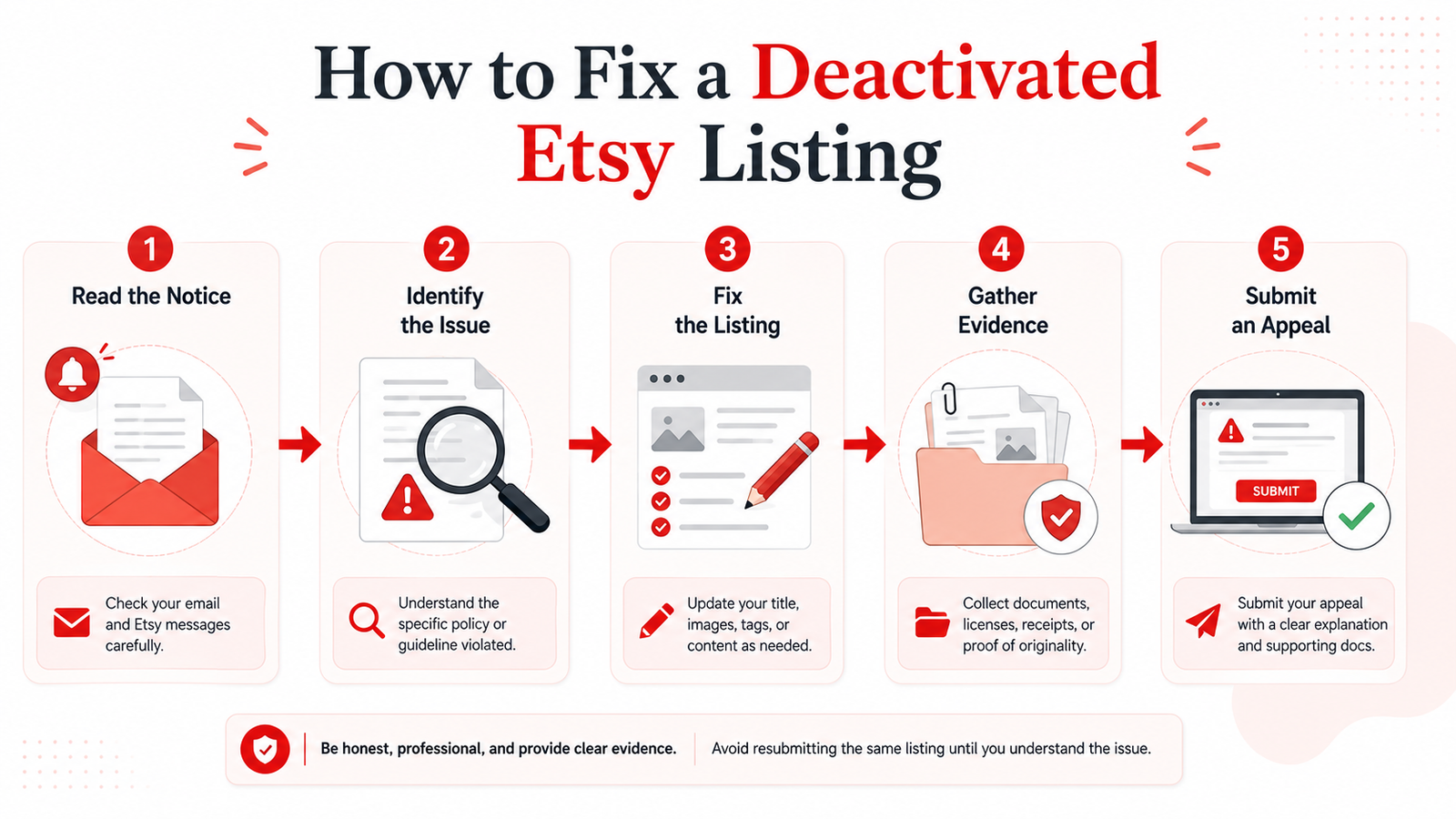
A simple step-by-step process for responding to a deactivated Etsy listing.
How to Fix a Deactivated Etsy Listing: Step-by-Step Appeal Process
This is the section most sellers skip or rush. Do not do that. A bad appeal makes things worse. A good appeal gets your listing back faster.
Here are the exact steps to appeal an Etsy suspension and reactivate your listing properly.
- Read the removal notice word for word.
Etsy tells you why the listing was removed. Do not guess. Do not assume. The exact language they use matters for what you do next.
- Identify the specific violation type.
Is it an IP complaint? A prohibited item? A policy issue? Each type needs a different response strategy.
- Fix the problem first.
Never submit an appeal before correcting the issue. If there was keyword stuffing, clean it. If you used an image you do not own, remove it. If the product is restricted, do not relist it.
- Gather any supporting documentation.
For IP complaints, this means licensing agreements, original design files, or written permission from the rights holder. For handmade violations, process photos work well.
- Contact Etsy Trust and Safety through the Help Center.
Go to Shop Manager → Policy violations and open the removed listing. If Etsy has made the listing eligible for appeal, you will see a View & appeal option. Follow the prompts and provide any supporting information Etsy requests. Appeal availability is still being expanded, so not every removed listing will necessarily have this option.
- Things NOT to say in your appeal:
Do not blame Etsy. Do not threaten to leave the platform. Do not send multiple follow-up messages in the same day. All of these slow down the process.
- Wait for the review.
Etsy says most listing appeals are reviewed within three days, although some cases can take up to 10–12 business days. Avoid sending unnecessary duplicate requests while your appeal is being reviewed.
How to Avoid Etsy Listing Deactivation: Prevention Checklist
The best way to avoid an Etsy listing deactivated situation is to prevent it from happening at all. Run through this checklist before every new listing goes live.
This is the pre-listing compliance audit that protects your shop.
Quick Answer: How Can You Prevent Etsy Listing Deactivation?
To prevent Etsy listing deactivation, use original or properly licensed content, avoid prohibited products, check trademarks before using brand names, disclose production partners when required, choose accurate categories, and keep titles, tags, descriptions, and product claims relevant and truthful.
Before You Create the Listing
- Verify originality.
Every image, graphic, and piece of written content must be original or licensed for commercial use.
Product presentation matters too. If you need professional listing visuals without reusing questionable or unlicensed images, explore these Etsy mockup tools for sellers to create stronger product images and mockups.
- Search for trademark conflicts.
Look up any brand names or terms used in your title on the USPTO trademark database. One trademark complaint can take down a listing instantly.
- Review the prohibited items list.
Cross-check your product category against the Etsy prohibited items policy every time. These lists get updated.
- Confirm production partner status.
If you use a print-on-demand service or manufacturer, add them to your shop settings as a production partner before listing.
Before You Publish
- Review all listing content claims.
No vague health claims. No misleading benefits. No descriptions that contradict what the product actually is.
- Check your tags and keywords.
Each tag should directly describe your product. Remove anything unrelated or inserted just to capture extra traffic.
- Look for duplicate listings.
Search your own shop. If you have a near-identical listing already active, consolidate instead of duplicating.
- Match category to product.
The category you select must accurately reflect what you are selling. Mismatched categories are a metadata manipulation signal.
Ongoing Shop Health
- Stay current with the Etsy Seller Handbook.
Policies change. Check for updates regularly, especially in high-risk categories.
- Monitor your shop notifications.
Etsy sends early warnings before full removal in some cases. Catching these fast can prevent escalation.
- Audit listings after platform updates.
When Etsy announces policy changes, review your entire catalog against the new rules.
For a broader approach to scaling Etsy safely, building compliance into your workflow from the start is what separates long-term sellers from those who keep getting knocked back.
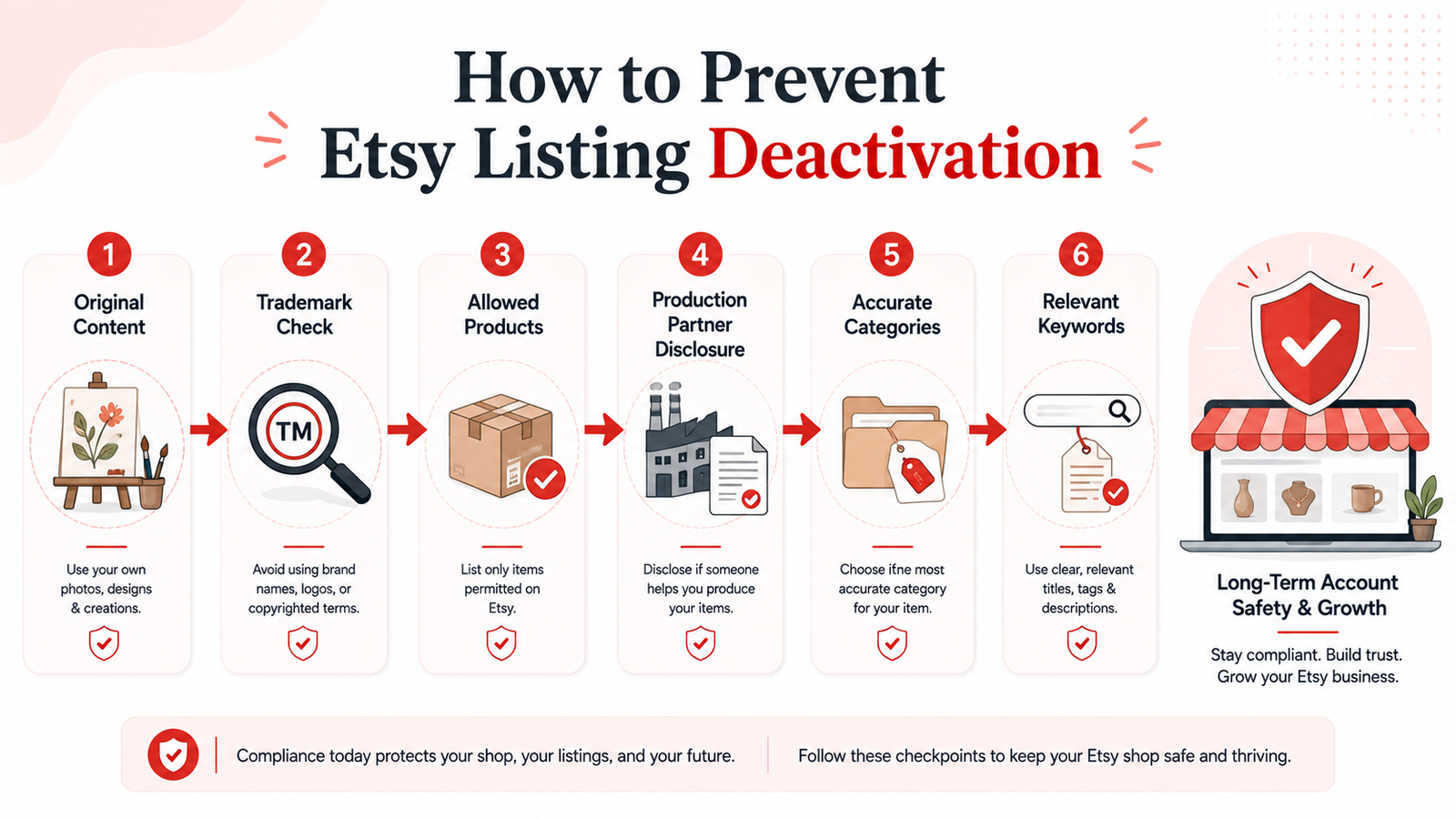
Key checks Etsy sellers can make before publishing listings to reduce the risk of deactivation.
When Listing Deactivation Becomes Account-Level Suspension
Most sellers do not understand the difference between these three outcomes. Knowing which one you are dealing with changes everything about how you respond.
Listing Deactivation
This is a single listing being removed. Your shop stays open. Other listings keep running. This is the most common outcome and the easiest to recover from. Address the violation, appeal if appropriate, and move on.
Shop Suspension
This means Etsy has suspended the entire shop. All listings disappear. Buyers cannot access your store. This happens when violations are serious, when there have been multiple offenses, or when account-level risk signals pile up.
An Etsy seller account suspended at this level requires a stronger appeal, more documentation, and usually a longer review period. The approach is similar to a listing appeal but requires you to address the shop-level pattern, not just one listing.
Permanent Ban
A permanent ban means the account cannot come back. This is rare. It is reserved for the most serious violations, including large-scale IP infringement, selling counterfeit goods repeatedly, fraud, or repeated policy abuse after multiple clear warnings.
If you have received a permanent ban, creating a new account with shared information, same device, IP, or payment method, will result in the new account being flagged immediately. That is how brand protection and enforcement systems work across Etsy, Amazon, and eBay alike.
Listing Deactivation vs Shop Suspension vs Permanent Ban
| Action | What Happens | Can You Appeal? | Risk Level |
| Listing Deactivated | Individual listing removed | Sometimes, if eligible | Low–Moderate |
| Shop Suspended | Shop/account restricted | Depends on suspension | High |
| Permanent Ban | Account privileges removed | Yes, within Etsy’s appeal window | Critical |
Final Word: Protecting How to Prevent Etsy Listing Deactivation Long TermYour Etsy Shop for the Long Run
An Etsy listing deactivated notice does not have to end your shop. Most sellers who respond correctly, fix the actual problem, and appeal through the right channels get their listings back.
But the real goal is prevention. Every time you launch a new listing, run the compliance checklist. Stay current with the Etsy Seller Handbook. Know what your rights are when IP complaints come in. Understand the difference between a listing removal and a shop suspension so you know exactly how serious each situation is.
Platforms like Amazon, eBay, Shopify, and Walmart Marketplace all enforce these kinds of rules. Marketplace compliance is not extra work. It is the foundation that keeps your business running.
Sellers who want structured help building a compliant Etsy shop can explore additional support options and find resources built for sellers who want to grow without the constant risk of enforcement issues.
FAQ: Your Most Common Questions Answered
Q. Why is my Etsy listing deactivated?
Your listing was most likely removed because of an Etsy policy violation, an intellectual property complaint, or a prohibited item flag. The most common causes are using a trademarked image or name, listing a restricted product, keyword stuffing, or failing to disclose a production partner. Etsy sends a message with the reason. Start there before doing anything else.
Q. Can I get my deactivated Etsy listing back?
Yes, in most cases. If the violation was correctable, fix the problem first, then submit an appeal to Etsy Trust and Safety. If an IP complaint was filed incorrectly, you can submit a formal counter-notice. Your chances improve significantly when you address the actual issue rather than just asking for reinstatement without changes.
Q. Can I relist a deactivated Etsy listing?
Sometimes. Whether you can relist a deactivated Etsy listing depends on why Etsy removed it. Fix the underlying issue and review Etsy’s removal notice before creating another listing. If the listing was removed following an intellectual property complaint, Etsy specifically advises sellers not to create additional listings for the reported content unless the issue has been resolved.
For current guidance, check Etsy’s official help documentation.
Q. How long does Etsy suspension last?
For listing deactivations, reviews typically take up to 10–12 business days after you submit an appeal. For shop-level suspensions, it can take two weeks or longer depending on the complexity. Etsy explicitly provides an appeal process for permanently suspended accounts, and sellers generally have six months from the suspension date to appeal. One polite follow-up after 10 business days is fine. Sending multiple messages before that will slow your case down.
Q. What if my Etsy listing was deactivated for no reason?
It always has a reason, even if the notice feels vague. Algorithmic flags, third-party IP complaints, and automated risk signals can all remove a listing without any obvious seller error. Compare your listing carefully against the current Etsy Seller Handbook. If you still believe the removal was a mistake, contact support with a calm, evidence-based explanation.
Q. Will my whole shop get suspended over one listing?
Not normally. A single listing removal rarely escalates to a full shop suspension unless the violation is severe, like selling counterfeit goods or large-scale IP infringement. However, repeated listing violations raise your account risk score over time and can result in an Etsy seller account suspended status. Fix each issue quickly, learn from it, and do not repeat the same mistake.
Q. What is an Etsy listing removed due to IP infringement?
This means a brand owner, copyright holder, or their legal representative filed a formal complaint under Intellectual Property Law or submitted a DMCA takedown notice. Etsy is legally required to act on these. To resolve it, remove the infringing content permanently. If you have a genuine right to use the material, submit a counter-notice with documentation. The United States Copyright Office website explains the full DMCA counter-notice process.


One Comment