
Amazon FBA Management Agency vs DIY: Which Is More Cost-Effective?
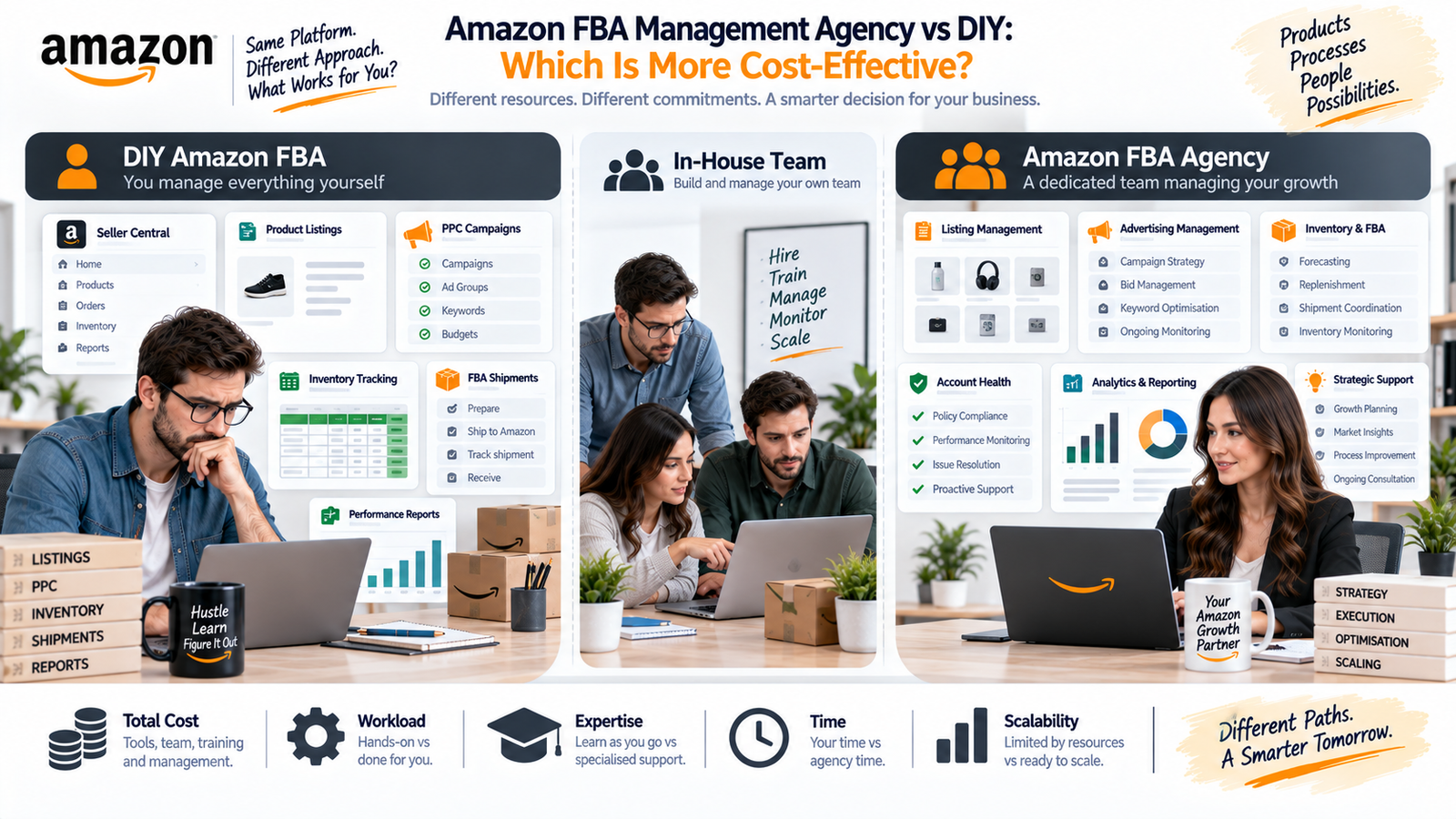
Choosing between an Amazon FBA management agency and self-management is not a simple “fee versus no fee” decision. In an Amazon FBA management agency vs DIY comparison, DIY removes the external management retainer but adds owner time, training, software, creative contractors, PPC work, inventory planning, and execution risk. An agency adds a direct fee but may replace part of that workload with specialized Amazon FBA management services.
For simple accounts, DIY Amazon FBA management can be economical. Larger catalogs, material ad spend, complex replenishment, or limited owner time can make outsourcing more attractive. In-house management becomes another option when Amazon justifies permanent headcount.
The right comparison is total economic cost, not just the agency invoice.
Quick Answer: Is an Amazon FBA Management Agency More Cost-Effective Than DIY?
An Amazon FBA management agency can be more cost-effective when owner time, PPC complexity, inventory workload, and specialist expertise justify the management fee. DIY may cost less when the catalog is small, operations are simple, the seller has Amazon expertise, and enough time is available to manage the account directly.
What Does an Amazon FBA Agency Do?
An Amazon FBA agency manages agreed parts of the seller’s operation. Professional Amazon FBA management can cover several Seller Central workstreams under one scope.
Amazon Seller Central currently supports listing and pricing management, orders, returns, inventory, FBA and FBM workflows, performance monitoring, and Account Health.
Amazon Seller Central overview
Broader Amazon FBA account management and Amazon account management services may include:
- Amazon listing optimization, keyword research, A+ Content, and catalog troubleshooting
- Amazon PPC management, including Sponsored Products and Sponsored Brands where eligible
- Amazon FBA inventory management, inbound shipments, replenishment, excess stock, and stranded inventory
- Amazon account health management, policy notifications, listing issues, and performance monitoring
- Sales reporting, profitability review, and operational planning
For a deeper breakdown of ongoing responsibilities, see HiSellIt’s Amazon store management services guide.
Creative services, customer support, reimbursements, Brand Store work, sourcing, and freight may be separate from Amazon FBA management services.
Amazon FBA Management Agency vs DIY: Key Differences
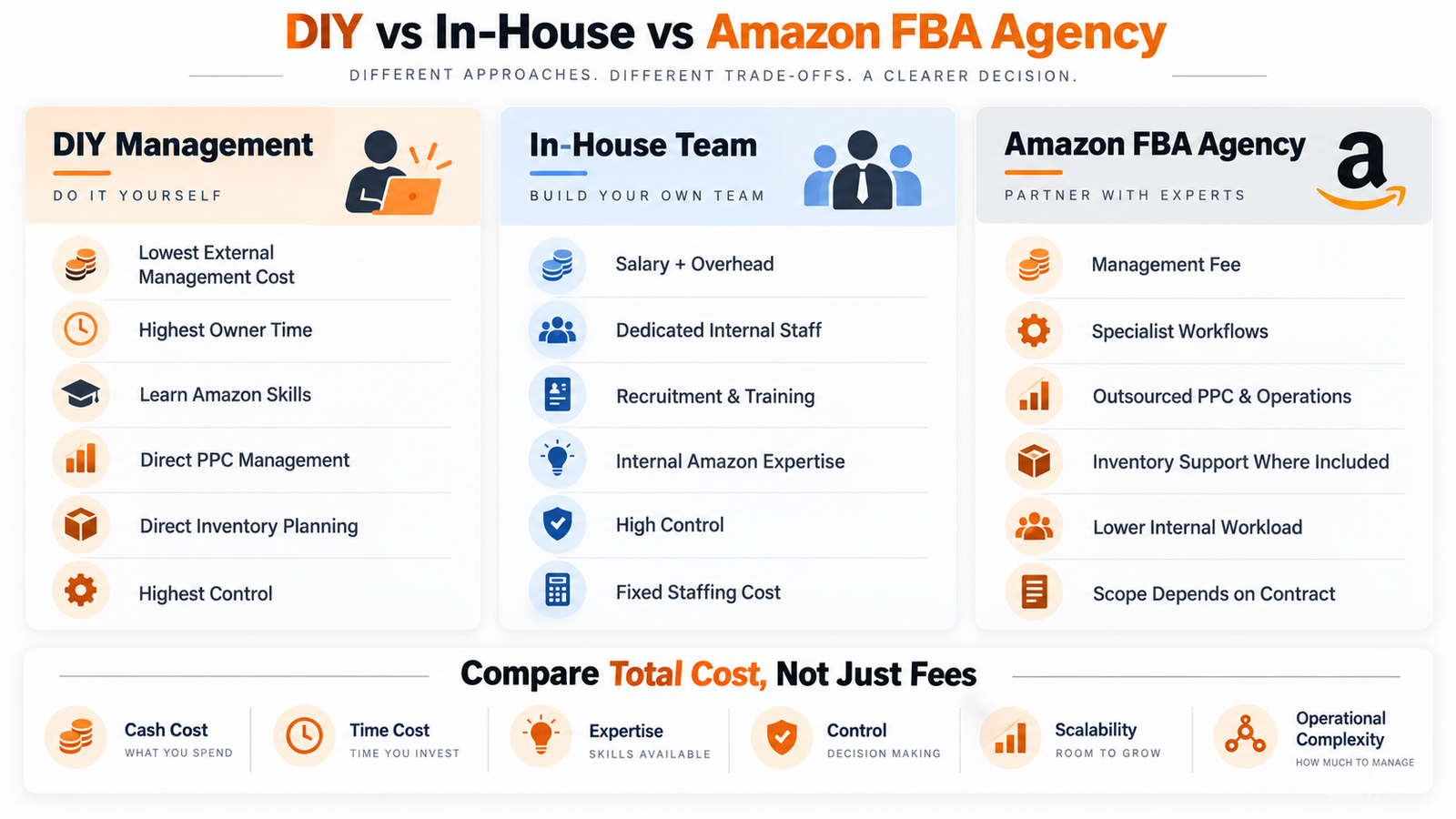
The most useful Amazon FBA management agency vs DIY comparison includes in-house management as a third option.
| Factor | DIY Management | In-House Team | Amazon FBA Agency |
| Direct management cost | Lower cash outlay | Salary + overhead | Retainer/management fee |
| Owner time | High | Lower | Lower internal workload |
| Amazon expertise | Must be learned | Depends on hire | Usually specialist workflows |
| PPC management | Seller handles it | Internal specialist | May be included |
| Inventory planning | Seller handles it | Internal workflow | May be included |
| Account health | Seller monitors | Team monitors | Can be monitored |
| Scalability | Limited by owner time | Depends on staffing | Depends on agency capacity |
| Control | Highest | High | Shared/outsourced |
| Fixed overhead | Low | Higher | Usually contract-based |
| Flexibility | High | Medium | Depends on contract |
Amazon FBA agency vs DIY comes down to cash cost, time, expertise, control, scalability, and operational complexity.
HiSellIt’s Amazon automation vs traditional FBA selling comparison provides another framework for deciding which workflows should stay hands-on.
 How Much Does an Amazon FBA Management Agency Cost?
There is no universal Amazon FBA agency cost or Amazon FBA management cost.
Current providers use different pricing structures, including:
- monthly retainers
- fixed service packages
- percentage of Amazon revenue
- percentage of advertising spend
- separate PPC management fees
- project-based listing or launch fees
- hourly consulting
- hybrid pricing
Current provider pages show wide variation in scope and pricing structure, which is why a single “average Amazon agency fee” can be misleading. Amazon’s Service Provider Network similarly notes that provider reference prices are informational and the amount ultimately charged can differ.
The Amazon FBA management cost and Amazon FBA agency cost usually depend on ASIN count, marketplaces, PPC spend, catalog complexity, inventory workload, Brand Registry work, reporting requirements, and account-health scope.
A quote should state whether Amazon PPC management, creative work, inventory planning, and catalog fixes are included. Amazon management fees are separate from Amazon selling fees, FBA charges, and advertising spend.
Quick Answer: How Much Does an Amazon FBA Management Agency Cost?
Amazon FBA agency pricing varies by service scope, ASIN count, marketplaces, PPC spend, inventory complexity, reporting requirements, and account-health support. Agencies may charge monthly retainers, fixed packages, percentages of revenue or ad spend, project fees, hourly rates, or hybrid pricing. Amazon fees and advertising spend are separate.
What Does DIY Amazon FBA Management Actually Cost?
DIY removes the agency retainer. It does not remove the work.
The cost of managing Amazon FBA yourself can include:
- owner time
- Amazon training
- keyword research software
- PPC tools
- inventory software
- designers
- photographers
- copywriters
- analytics tools
- specialist contractors
There is also opportunity cost. Time spent on search terms, stranded inventory, listings, fees, and policy notices cannot be used for sourcing, product development, or supplier work.
DIY can still be cost-effective when the seller already has the required skills and capacity.
DIY Is Not Free: Hidden Amazon FBA Costs Sellers Forget
Many hidden costs of Amazon FBA are platform or operating expenses that exist whether the account is managed by the seller, an employee, or an agency.
As of September 2026 in the U.S., Amazon lists the Professional selling plan at $39.99 per month and the Individual plan at $0.99 per item sold, plus applicable referral fees. Amazon says most referral-fee categories fall between roughly 8% and 15%, although the actual percentage depends on category.
Amazon selling fees and pricing
Amazon’s 2026 U.S. fee update increased average FBA fees by about $0.08 per unit, with most changes effective January 15, 2026. FBA fulfillment fees vary by product size and weight.
Amazon’s 2026 U.S. FBA fee update
Monthly Amazon storage fees are based on inventory volume and vary seasonally. Other Amazon FBA operating costs can include:
- FBA fulfillment fees
- monthly storage
- aged-inventory surcharges
- inbound placement service fees
- return-processing charges where applicable
- removal and disposal charges
- advertising
- optional services
Amazon confirms that FBA costs can include fulfillment, storage, aged inventory, return processing, removals or disposals, and inbound placement.
As of September 2026, aged-inventory surcharges begin at 181 days. The current U.S. schedule includes $0.50 per cubic foot at 181–210 days, $5.90 at 331–365 days, the greater of $6.90 per cubic foot or $0.30 per unit at 366–455 days, and the greater of $7.90 per cubic foot or $0.35 per unit at 456+ days.
These are platform and FBA expenses, not Amazon FBA agency cost.
| Cost Category | DIY | In-House | Agency |
| Management fee | None | Salary/overhead | Retainer/agency fee |
| Seller time | High | Lower | Lower |
| Software | Seller pays | Business pays | May be included or separate |
| PPC management | Seller time/tools | Employee | Often included or separate |
| Creative work | Seller/contractors | Team/contractors | Depends on scope |
| Inventory planning | Seller | Team | May be included |
| Training | Seller learning time | Staff training | Agency expertise |
| Recruitment | None | Yes | No internal recruitment |
| Amazon platform fees | Yes | Yes | Yes |
Amazon’s Revenue Calculator can estimate selling fees, FBA costs, and revenue using a product’s actual price, dimensions, weight, category, and fulfillment method.
Amazon Revenue Calculator and fee-estimation guidance
PPC Management: Where Agency vs DIY Costs Can Diverge
Amazon PPC management can materially change the economics of self-management.
Sponsored Products are CPC ads. Sellers choose budgets and bids and are charged when shoppers click. Amazon updated its Sponsored Products guidance in August 2026 and continues to describe the product as cost-per-click advertising. Sponsored Brands can use CPC or viewable-impression pricing depending on campaign goals.
Amazon Sponsored Products guidance
DIY PPC requires:
- campaign creation
- keyword targeting
- product targeting
- bid management
- budgets
- search-term analysis
- negative targeting where applicable
- CPC monitoring
- ACOS analysis
- ROAS analysis
- conversion and sales reporting
An Amazon PPC agency or agency PPC team can reduce internal workload, but it cannot guarantee lower ACOS or higher ROAS.
Larger advertising budgets simply make the financial impact of campaign-management quality more material.
When comparing Amazon PPC management services, separate advertising spend from the management fee. Amazon PPC costs exist regardless of whether campaigns are run internally or externally.
Listing Optimization and SEO: DIY or Outsource?
Amazon listing optimization is another recurring workload.
It can include Amazon keyword research, titles, bullets, descriptions, backend search terms, images, A+ Content, and Amazon listing optimization updates.
DIY works well when the seller can maintain content consistently. Outsourcing may be more efficient when a large catalog creates a backlog or specialist creative work is needed.
The question is whether internal Amazon SEO services can deliver the same scope at a lower total cost.
Sellers preparing new ASINs can use HiSellIt’s Amazon product launch checklist to separate launch work from ongoing management.
Inventory and FBA Operations: The Hidden Workload
Amazon FBA inventory management often becomes the point where DIY stops feeling simple.
The workload can include:
- demand forecasting
- supplier lead times
- Amazon FBA replenishment
- inbound FBA shipments
- stockouts
- excess inventory
- sell-through
- stranded inventory
- storage exposure
- aged inventory
Amazon’s FBA Inventory tool helps sellers plan future demand, reduce excess and aged inventory, fix stranded stock, monitor sell-through, assess costs, and manage fulfillment-center capacity.
Poor Amazon inventory planning can create stockouts, excess Amazon inventory costs, storage charges, and removals. Professional Amazon FBA operations management can shift this workload if inventory planning is included.
Account Health and Seller Central Management
Amazon Seller Central management includes work that is easy to underestimate because it does not always generate revenue directly.
The Account Health page surfaces alerts, policy compliance, and performance information. Amazon currently describes Account Health Rating as a color-coded score from 0 to 1,000 and advises sellers to keep Order Defect Rate below 1%.
Amazon Account Health and seller-policy guidance
Amazon account monitoring may include:
- policy notifications
- listing violations
- restricted-product issues
- intellectual-property complaints
- seller-performance problems
- compliance deadlines
An Amazon management agency providing Amazon Seller Central management, Amazon FBA account management, and Amazon account health management can monitor and help address these issues if contracted.
It cannot guarantee that an account will never be restricted or suspended.
Amazon FBA Agency vs In-House Team
An in-house Amazon manager sits between DIY and Amazon account management services.
Compare salary, employer taxes, benefits, recruitment, software, training, and management overhead. These costs vary by geography and seniority, so a universal Amazon account manager salary estimate would be misleading without a specific labor market.
An internal team offers brand knowledge and direct control. An Amazon management agency can provide multiple skill sets without permanent headcount.
A hybrid model can pair internal Amazon FBA account management with external PPC, catalog, or operational specialists.
| Option | Main Advantages | Main Drawbacks |
| DIY | Highest control, low external fees, direct learning | Time-intensive, expertise burden, harder to scale |
| In-house | Internal control, dedicated employee/team, brand knowledge | Salary, recruitment, training, fixed overhead |
| Agency | Specialist team, broader skill set, outsourced workload | Management fee, less direct control, provider quality varies |
Which Is More Cost-Effective?
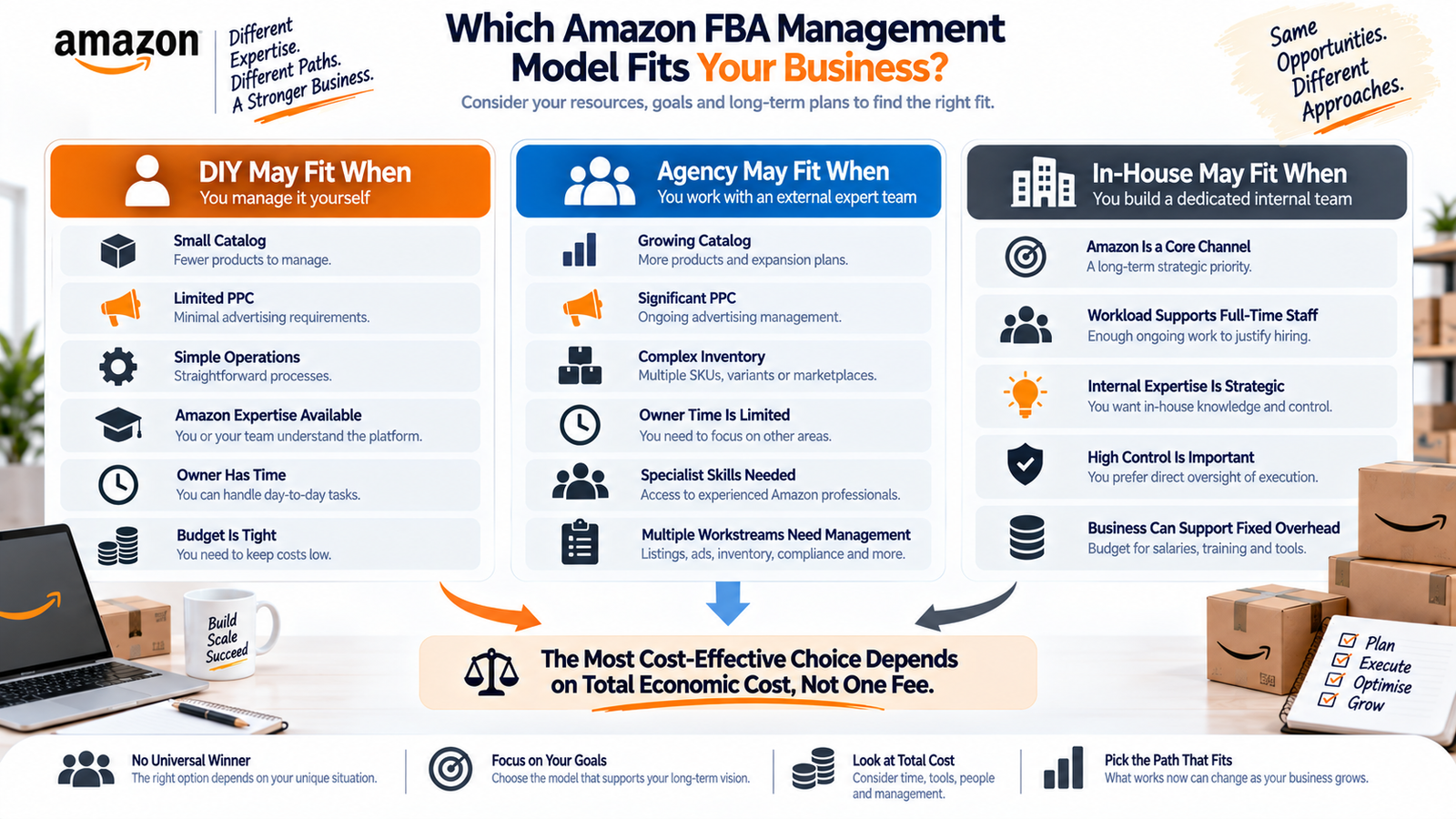
There is no universal winner.
DIY may be more cost-effective when:
- the catalog is small
- PPC spend is limited
- operations are simple
- the seller already understands Amazon
- owner time is available
- margins cannot support external fees
An Amazon FBA agency may be more cost-effective when:
- the catalog is growing
- advertising spend is material
- inventory is difficult to plan
- execution keeps falling behind
- specialist skills are missing
- owner time has a high opportunity cost
In-house management may be more cost-effective when:
- Amazon is a major strategic channel
- workload supports permanent employees
- internal control is important
- the business can recruit and retain Amazon expertise
Compare total cost for equivalent capability.
 How to Calculate Whether an Amazon Agency Is Worth It
A useful Amazon management ROI framework is:
Cost-effectiveness = value created or costs avoided relative to management cost
This is a decision framework, not an official Amazon formula.
Compare the agency fee with:
- owner hours saved
- internal labor avoided
- software included
- execution speed
- PPC waste identified
- inventory errors reduced
- operational errors avoided
- opportunity cost
- measurable margin impact
Run the same categories for DIY and in-house management.
An Amazon agency ROI analysis should use actual account data rather than promised percentage improvements.
Amazon FBA profitability still depends on product economics, margins, demand, pricing, advertising, inventory, and execution.
When Should You Hire an Amazon FBA Agency?
The question should I hire an Amazon FBA agency becomes more relevant when:
- too much owner time is spent in Seller Central
- PPC has become difficult to manage
- inventory problems recur
- catalog work is falling behind
- reporting is inconsistent
- account-health work needs more attention
- Brand Registry tools are underused
- internal Amazon expertise is limited
Businesses may hire an Amazon FBA expert for one narrow requirement before moving to broader Amazon account management services.
Some sellers hire an Amazon agency only after that specialist need expands.
Knowing when to hire an Amazon agency is mainly about identifying the bottleneck. Outsourcing makes financial sense only when the capability purchased is worth more than its total cost.
How to Choose an Amazon FBA Management Agency
When evaluating an Amazon management agency, compare scope before price.
Scope
Which responsibilities are actually included?
FBA Expertise
Does the provider handle inventory planning, replenishment, and shipment coordination?
PPC Capability
Who manages campaigns, budgets, search terms, bids, and reporting?
Listing Expertise
Are keyword research, creative coordination, A+ Content, and Amazon listing optimization included?
Account Health
Does the provider monitor policy and performance issues?
Reporting
Which KPIs are reported, and how often?
Pricing
Which charges are fixed, percentage-based, ad-spend based, project based, or extra?
Account Access and Security
How are Seller Central and Amazon Ads permissions managed?
Contract Terms
Check minimum terms, notice periods, account ownership, data ownership, and handover requirements.
Realistic Claims
Avoid providers promising:
- guaranteed sales
- guaranteed search rankings
- guaranteed ACOS
- guaranteed ROAS
- guaranteed Featured Offer placement
- guaranteed account protection
- effortless passive income
HiSellIt’s Amazon Wholesale FBA service can be compared with other providers based on actual scope rather than headline price.
Conclusion
The Amazon FBA management agency vs DIY decision should be based on total economic cost, not only the agency invoice.
DIY can minimize external Amazon management fees, but it carries owner time, learning, software, PPC, inventory, and opportunity costs. An agency adds a direct fee but can shift agreed work to specialists. In-house management adds permanent staffing costs but can provide deeper internal control.
The most cost-effective model depends on catalog size, PPC complexity, inventory workload, account-health requirements, margins, and the value of the seller’s time.
Sellers comparing Amazon FBA management services or professional Amazon FBA management can contact HiSellIt to request an account review and compare a proposed management scope with the real cost of DIY or internal staffing.
Amazon FBA Agency vs DIY FAQs
1. Is professional Amazon FBA management worth it?
It can be when saved owner time, specialist work, and reduced internal workload justify the fee. A small, simple account may be cheaper to manage internally. Cost-effectiveness depends on scope, margins, inventory complexity, PPC spend, available expertise, and provider quality.
2. Is it cheaper to manage Amazon FBA yourself?
DIY usually has the lowest direct management fee because there is no agency retainer. The seller still pays Amazon fees, advertising, software, creative costs, and the economic cost of their time. It works best financially when the seller already has the skills and capacity.
3. How much does professional Amazon FBA management cost?
There is no universal price. Amazon FBA agency pricing may use retainers, packages, revenue or ad-spend percentages, PPC fees, projects, hourly consulting, or hybrid models. Pricing depends on ASIN count, ad spend, marketplaces, inventory complexity, and scope.
4. What does an Amazon FBA agency do?
It can manage listings, PPC, FBA inventory, Seller Central, account health, reporting, and Brand Registry assets. Scope varies, so sellers should verify whether sourcing, customer service, creative work, reimbursements, or logistics are included.
5. When should I outsource Amazon FBA management?
Outsourcing Amazon FBA management can make sense when owner time is constrained, PPC or inventory becomes complex, or catalog work falls behind. It is less compelling when operations are simple and the seller already has enough expertise.
6. Can an Amazon agency manage PPC and inventory?
Yes, if the contract includes both. Amazon PPC management and Amazon FBA inventory management are common service areas, but bundles vary. Confirm whether campaign work, replenishment, forecasting, inbound shipments, and reporting are included or separate.