
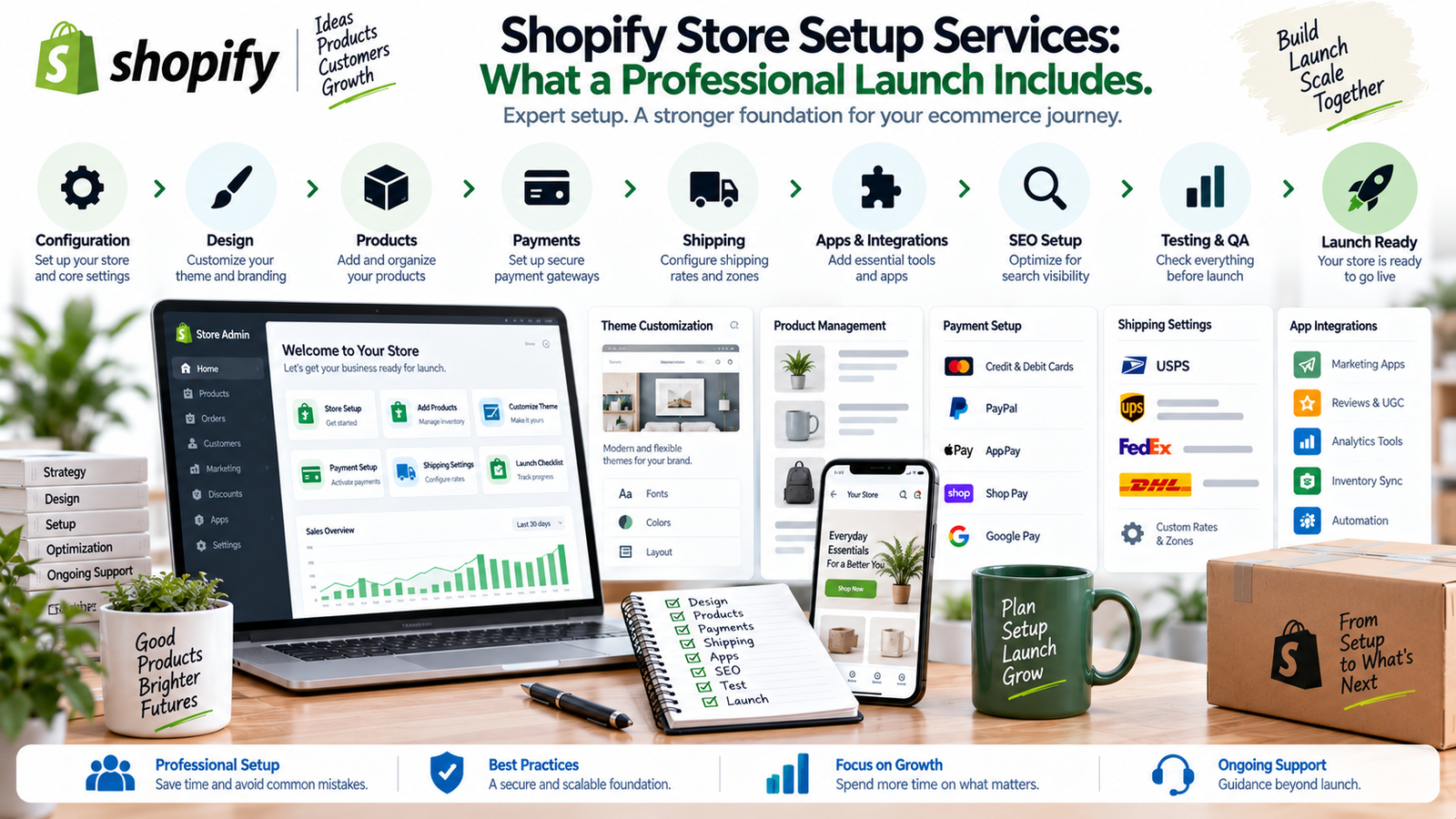
Shopify Store Setup Services: What a Professional Launch Includes
Setting up a Shopify store takes more than choosing a theme. Professional Shopify store setup may include configuration, design, products, payments, shipping, apps, SEO, analytics, testing, and launch checks so the business can become operational.
What Are Shopify Store Setup Services?
These services can configure, design, develop, test, and launch a store across settings, products, payments, shipping, apps, SEO, analytics, and theme work. Depending on the provider, the package may also cover collections, tracking, quality assurance, and launch support, while ongoing marketing or management may remain separate.
Quick Answer: What Are Shopify Store Setup Services?
Shopify store setup services are professional services that help businesses configure, design, develop, test, and launch an ecommerce store. Depending on the provider, they may include product setup, theme customization, payments, shipping, apps, SEO, analytics, mobile testing, checkout testing, and launch support.
What Is Included in Professional Shopify Store Setup?
A professional package can combine setup, design, content organization, and QA. It may include theme work, product organization, payments, shipping, analytics, testing, launch support, and documented handover for store owners, plus Shopify store development services, Shopify website development services, or Shopify launch services when custom code or migration is needed.
Typical work includes Shopify product setup, Shopify collection setup, navigation, Shopify domain setup, Shopify payment setup, Shopify shipping setup, Shopify app integration, and Shopify SEO setup. Shopify store setup services for small business may be narrower than migration work.
| Setup Area | Typical Professional Work | Business Owner Input |
| Strategy | Scope and launch planning | Goals and requirements |
| Theme | Selection and customization | Brand approval |
| Products | Product and collection setup | Product data |
| Payments | Gateway configuration | Financial details |
| Shipping | Zones and rates | Shipping rules |
| SEO | Technical and on-page basics | Brand/product input |
| Apps | Required integrations | Tool approvals |
| Analytics | Tracking setup | Account access |
| QA | Device and checkout testing | Final approval |
| Launch | Final checks and go-live support | Launch decision |
A complete Shopify store setup service should state exclusions so buyers do not assume copywriting, migration, CRO, or management is included.
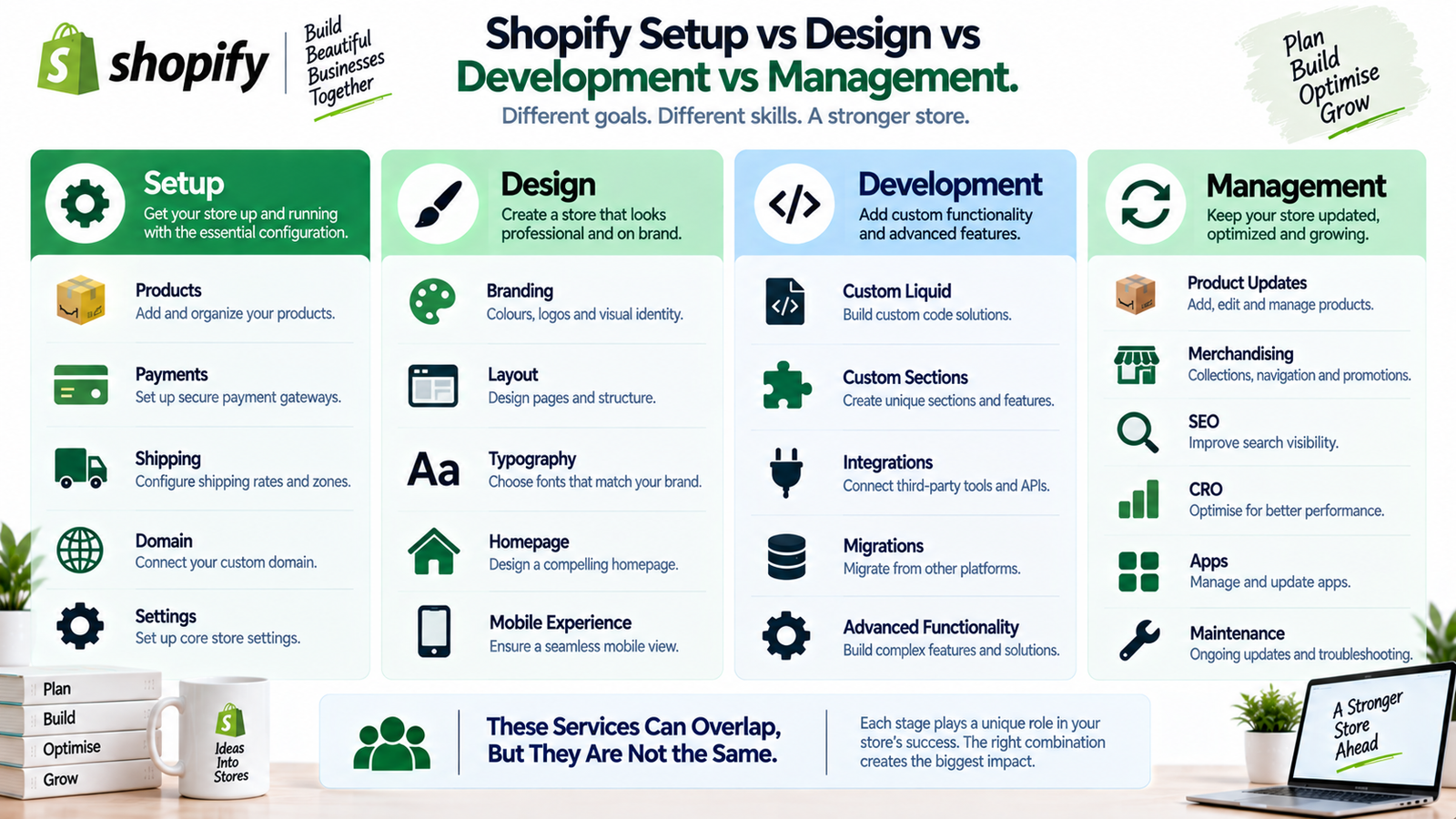
Shopify Setup vs Design vs Development: What’s the Difference?
Shopify setup services cover operational settings, products, payments, shipping, domains, apps, policies, and launch checks. Broader Shopify setup services may add migration.
Shopify website design services and Shopify store design services focus on branding, layout, hierarchy, and mobile presentation. Some Shopify website design services also include UX review. Professional Shopify website design improves clarity, not guaranteed sales.
Shopify store development services and Shopify website development services may involve Liquid, custom sections, integrations, or migrations. Custom Shopify store development fits needs standard settings cannot meet. Complex integration logic can also justify custom Shopify store development.
Management can include merchandising, apps, SEO, CRO, and product updates. Buyers comparing Shopify design and development services should ask if it is included.
How Does Professional Shopify Store Setup Work?
Start with requirements. A good Shopify store setup service maps goals, products, integrations, approvals, and risks. Shopify setup services help coordinate several workstreams.
The Professional Shopify Store Launch Process
The Shopify store launch process varies by catalog, migration, markets, and systems.
1. Business Planning and Configuration
Define products, markets, brand needs, features, integrations, and priorities. Shopify store configuration then covers business details, currency, contacts, and markets where relevant.
2. Theme Selection and Customization
Choose a free or paid option from the Shopify Theme Store based on features, maintainability, and budget. Shopify theme customization can cover branding, sections, navigation, templates, and mobile layout. A second Shopify theme customization pass may refine loaded content. Shopify currently offers both free and paid themes.
A Shopify design agency may add sections.
3. Products, Collections, and Navigation
Shopify product setup can include titles, images, prices, variants, SKUs, and inventory.
4. Domain, Payments, Shipping, and Taxes
Shopify domain setup can use a Shopify-bought or third-party domain, with DNS changes where needed.
Shopify payment setup depends on location and eligibility because Shopify Payments is not available everywhere. Shopify maintains an official list of supported Shopify Payments countries and regions.
Shopify shipping setup may include markets, rates, delivery rules, and fulfillment. Tax settings depend on the business and jurisdiction.
5. Policies, Apps, and Integrations
Policies should match the business. Shopify app integration can support reviews, email, analytics, and fulfillment, but extra apps add cost and complexity.
6. SEO and Tracking
Shopify SEO setup can cover titles, meta descriptions, headings, URLs, redirects, alt text, and internal links. Tracking may include Google Analytics, Search Console, Meta Pixel, and email. Rankings are not guaranteed.
For a broader search optimization framework, HiSellIt’s Shopify SEO guide covers current Shopify SEO fundamentals.
7. Conversion and UX Review
A conversion-focused Shopify store should make the buying path clear. Review mobile use, trust, delivery, cart flow, and checkout. Shopify product page optimization and Shopify conversion optimization go beyond styling.
8. QA, Test Orders, and Launch
QA should cover devices, forms, links, inventory, shipping, emails, and checkout. Shopify recommends test orders before launch. Its current store launch guidance says test orders can verify checkout, order processing, inventory, shipping, and taxes.
Shopify checkout setup should be reviewed before testing. A Shopify launch checklist catches gaps a polished design can hide.
Go live only after QA, product checks, domain, payments, shipping, tracking, and policies are ready. The second Shopify store configuration review confirms live settings.
9. Post-Launch Optimization
After launch, review analytics, merchandising, speed, retention, and SEO. Shopify launch services may include this period or end at handover.
What Makes a Shopify Store Conversion-Ready?
A good-looking store is not automatically a high-converting Shopify store. Results also depend on demand, traffic, pricing, trust, delivery, and payments.
A conversion-focused Shopify store needs clear navigation, useful images, calls to action, shipping details, and a smooth mobile path. Calling any site a high-converting Shopify store should be supported by data. A mobile responsive Shopify store must stay usable.
Shopify user experience and Shopify UX design should reduce friction. Shopify product page optimization can clarify benefits, price, variants, and delivery. Shopify checkout optimization addresses friction. Ongoing Shopify conversion optimization should use real behavior.
Speed Matters Too
Shopify speed optimization should focus on images, video, scripts, apps, theme complexity, and custom code.
Repeat Shopify speed optimization after major changes to catch issues. Shopify CRO is ongoing, not a one-time promise.
How Much Do Shopify Store Setup Services Cost?
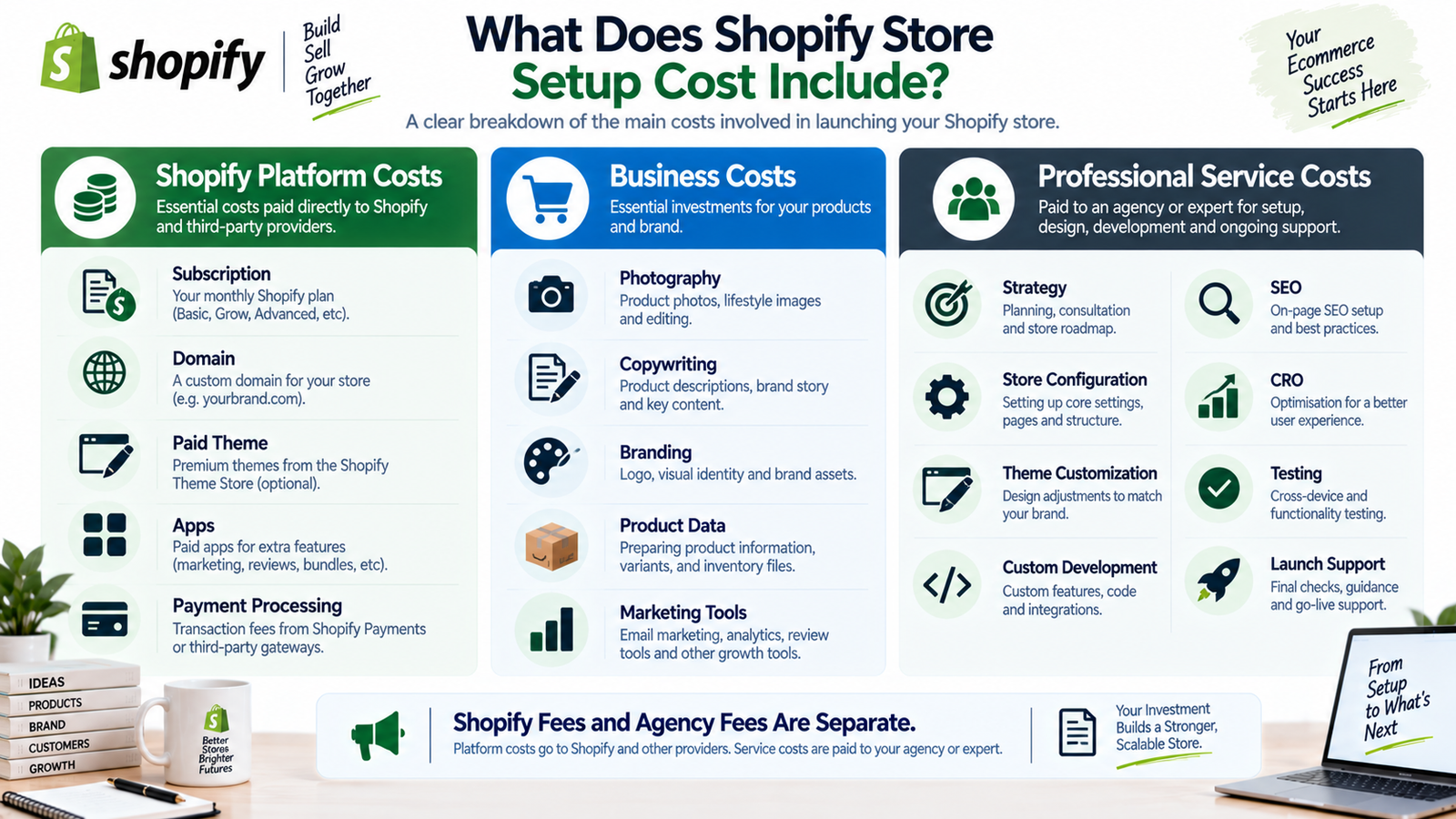
There is no universal Shopify store setup cost because scope varies. Total spending can include the Shopify subscription, themes, apps, domain, business assets, and professional service fees. Basic configuration costs less than migration, custom development, integrations, SEO, CRO, or extended launch support, and agency quotes should separate one-time and recurring costs.
Shopify’s current U.S. pricing page lists Basic at $39 per month when paid monthly or $29 per month when billed annually. Higher plans and payment rates vary.
The cost to build a Shopify store should be separated into platform, business, and professional-service costs.
| Cost Category | Paid To | Typical Nature |
| Shopify subscription | Shopify | Recurring |
| Domain | Shopify or registrar | Usually recurring |
| Paid theme | Theme provider | Often one-time license |
| Apps | App providers | Free or recurring |
| Payment processing | Payment provider | Transaction based |
| Professional setup | Freelancer/agency | Project based |
| Ongoing support | Freelancer/agency | Retainer or hourly |
The Shopify store setup cost rises with catalog size, migrations, custom functions, apps, or markets. Shopify website development cost and Shopify store development cost rise with custom code. Integration work can raise Shopify website development cost, while migration complexity can raise Shopify store development cost.
The Shopify website design cost is separate. Shopify development pricing and Shopify agency pricing should follow a written scope.
The answer depends on the plan, tools, business assets, and professional scope. Shopify setup cost also includes what continues after launch, such as apps, support, and maintenance. A realistic Shopify setup cost estimate should separate recurring and one-time items.
For how much does a Shopify store cost, include platform fees, apps, themes, domain, payments, assets, and professional work. Shopify store setup pricing is separate.
Quick Answer: How Much Does Shopify Store Setup Cost?
Shopify store setup cost varies based on store size, product count, theme choice, custom development, integrations, SEO, testing, and launch support. Total costs can include the Shopify subscription, domain, themes, apps, payment processing, business assets, and professional freelancer or agency fees.
 How Long Does It Take to Set Up a Shopify Store?
A small, ready catalog can take less work than a migration or custom build. Timing depends on catalog size, theme complexity, content readiness, integrations, revisions, migration, domain changes, payment setup, approvals, and QA. A Shopify website setup service can coordinate those tasks but cannot control every third-party approval or DNS delay.
Professional Shopify Setup vs DIY
The Shopify agency vs DIY decision depends on budget, time, and complexity.
| DIY May Make Sense When | Professional Setup May Make Sense When |
| Budget is limited | Time is limited |
| Store is simple | Store has many requirements |
| Merchant wants to learn Shopify | Merchant wants specialist execution |
| Few products are involved | Large catalog or migration is involved |
| No custom development is needed | Custom functionality is needed |
| Merchant can test everything | Professional QA is important |
DIY can work for a straightforward store. Shopify developer vs DIY matters more with custom code, migration, or advanced integrations.
Professional help makes sense when it saves time, reduces meaningful risk, or adds missing skills.
Shopify Freelancer vs Agency
A freelancer may offer direct communication, while a Shopify ecommerce agency may bring a broader team.
When Is Hiring a Shopify Expert Worth the Cost?
Professional help can be worthwhile when migration, tracking, or conversion need specialist attention.
The benefits of hiring a Shopify expert can include coordinated setup, QA, and missing skills. DIY can still suit simple stores.
If you hire a Shopify expert, keep ownership of the Shopify account, domain, analytics, theme licenses, and other core assets.
How to Choose a Shopify Development Agency
Compare Shopify experience, scope, deliverables, development skills, mobile thinking, SEO, app strategy, QA, ownership, pricing, support, and contract terms.
For what to look for in a Shopify agency, ask what is custom, which apps are required, who owns assets, and who maintains the store.
Shopify’s official Partner Directory lets merchants compare providers by services, reviews, work samples, pricing, and partner tier. A Shopify store setup agency should be judged on scope and ownership. A Shopify development agency should explain code responsibility.
Businesses asking who can set up my Shopify store for me can compare specialists by scope. HiSellIt offers professional Shopify ecommerce store setup within its Shopify dropshipping support. HiSellIt’s current service page lists store building, product work, supplier support, operations, optimization, and marketing among its Shopify-related services.
Shopify Store Setup Service Red Flags
A Shopify store setup service should not promise guaranteed sales, conversion rates, rankings, passive income, or unrealistic revenue.
Other red flags include copied stores, unlicensed themes, unnecessary apps, hidden fees, or unclear ownership. A Shopify store setup company should explain inclusions and asset ownership.
When Does a Done-for-You Shopify Store Make Sense?
This model suits merchants with a clear plan but limited time or technical capacity.
The owner provides products, prices, assets, policies, and approvals.
A done-for-you Shopify store offer should define seller involvement. A Shopify store build service, Shopify website setup service, or Shopify store creation service should define responsibilities. Buyers seeking custom Shopify store setup services should separate configuration from custom development.
Shopify Store Launch Checklist
Use this Shopify store setup checklist before go-live:
- Confirm business details and domain.
- Confirm theme, branding, and navigation.
- Review products, collections, inventory, and variants.
- Configure payments, shipping, and tax settings.
- Add required policies and contact details.
- Review installed apps.
- Complete SEO basics and analytics.
- Check mobile layouts, forms, and links.
- Run a test order and review Shopify checkout setup.
- Check emails, tracking, and final QA.
- Complete the Shopify store launch.
- Monitor post-launch data.
This second Shopify store setup checklist works as a launch-readiness gate. The second Shopify launch checklist should be completed again after major pre-launch changes.
Final Takeaway
Shopify store setup services are most valuable when they solve a real execution gap. Strong professional Shopify store setup connects design, operations, testing, usability, and launch readiness.
A Shopify store build service may include deeper development, while Shopify ecommerce development services, Shopify store development services, and Shopify launch services can cover more complex needs. Additional Shopify theme customization may also be needed when standard theme settings cannot support the business.
HiSellIt offers Shopify dropshipping support across store building, product work, optimization, suppliers, operations, and marketing. Businesses comparing professional options can review HiSellIt’s Shopify dropshipping automation guide, Shopify SEO guide, or contact HiSellIt to discuss requirements without assuming any provider can guarantee traffic, conversions, or sales.
Frequently Asked Questions
Q. What do Shopify store setup services include?
A professional package can include settings, themes, products, collections, domains, payments, shipping, apps, SEO, analytics, QA, and launch support. Some providers also offer Shopify ecommerce development services or Shopify store design services. Ask for a written deliverable list because every package differs. Confirm who supplies product data, branding, legal policies, account access, and approvals, and whether post-launch marketing or management is separate.
Q. How much do Shopify store setup services cost?
There is no universal fee. The Shopify store setup cost depends on the plan, theme, apps, catalog size, migration, design, custom code, integrations, SEO, testing, and support. The cost to build a Shopify store should separate Shopify fees from business expenses and professional fees. Itemized pricing is more useful than a vague package price because it shows one-time work, recurring apps, and ongoing support separately.
Q. How long does it take to set up a Shopify store?
A simple store can take less work than a migration or custom build. Timing depends on catalog size, theme work, content, integrations, revisions, domain changes, payment setup, and QA. Providers should explain dependencies instead of promising one timeline. Missing product data, delayed approvals, payment verification, DNS changes, or third-party systems can all extend the schedule. The timeline should be tied to a clear scope and approval process.
Q. Should I hire someone to set up my Shopify store?
Yes, when the project needs skills, coordination, or time the business lacks. Shopify experts for store setup can support configuration, design, QA, and launch work. A simple store may still be practical to build alone. The should I hire a Shopify expert decision should reflect complexity, risk, budget, and time. Keep the Shopify account, domain, analytics, and paid assets under business ownership.
Q. Is hiring a Shopify expert worth it?
It can be for migrations, custom features, large catalogs, or launches where tracking and QA matter. Shopify website development services and professional Shopify website design can reduce internal workload, but they do not guarantee sales. Compare scope, ownership, communication, support, maintenance, and handover terms before choosing an expert. DIY can still be the better value for a simple store with enough internal time and skill.
Q. What should I look for in a Shopify store setup agency?
Look for relevant experience, clear deliverables, transparent pricing, account ownership, mobile-first design, sensible app choices, QA, SEO basics, and post-launch support. A Shopify ecommerce agency should explain its process without promising sales or rankings. Compare proposals on scope and handover. The merchant should retain control of the store, domain, analytics, paid assets, and other core business accounts. Ask how post-launch support is handled.