
Shopify Dropshipping Management Services: What Should You Outsource?
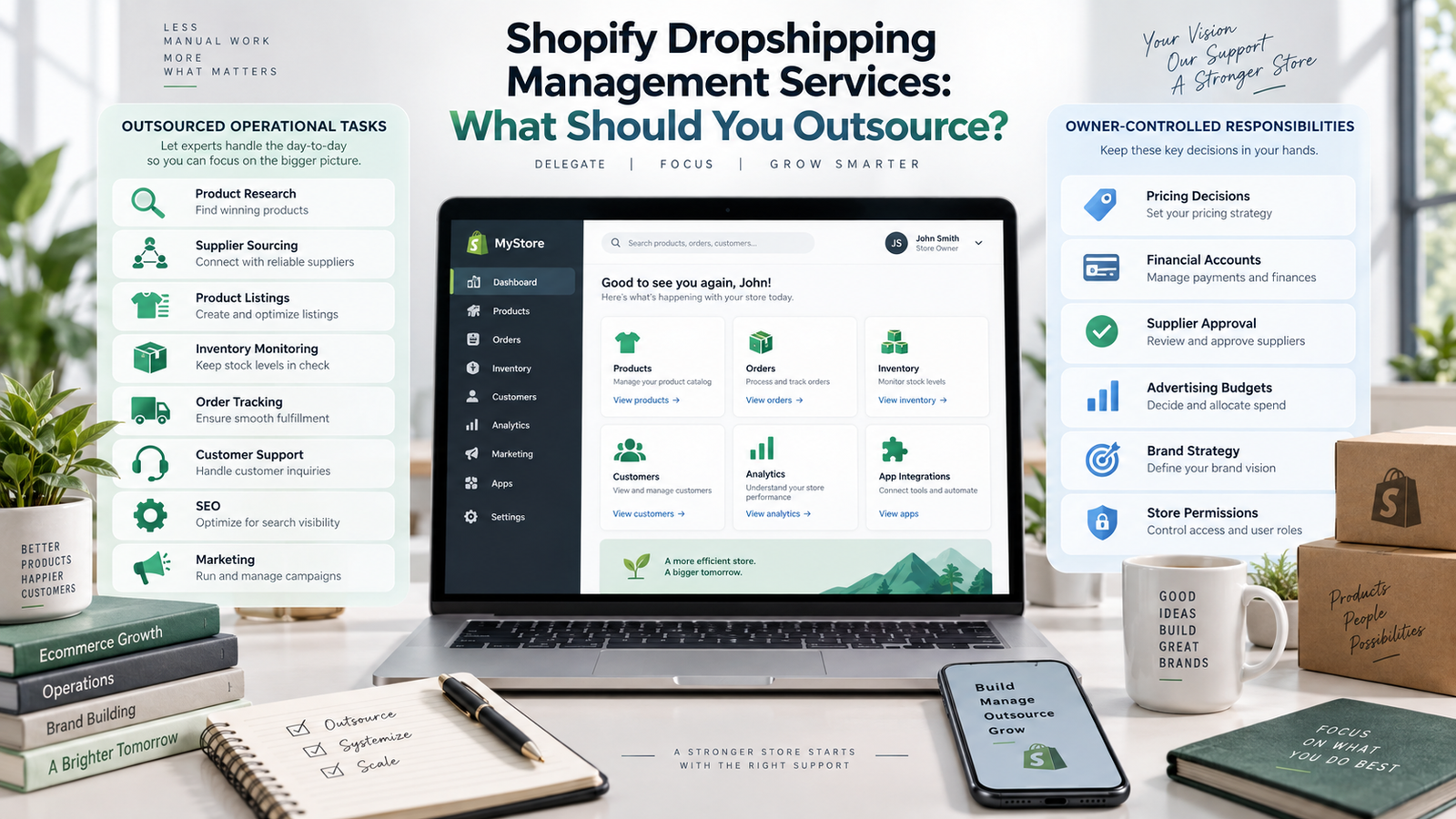
Shopify dropshipping management services cover the recurring work behind a store: sourcing, listings, orders, support and growth tasks. Good Shopify dropshipping management does not mean handing over the business. The best tasks to outsource are usually repeatable, operational or specialist tasks that consume time without requiring final owner-level decisions. Strategic control, financial decisions, brand positioning and supplier approval should normally remain with the owner.
Shopify dropshipping services differ between providers, so Shopify dropshipping outsourcing works best when scope is written down. Full-service Shopify dropshipping management suits some stores, while a single Shopify dropshipping expert suits others. This guide sorts tasks into outsourcing, automation, human oversight and owner control, so you can see where each responsibility belongs, estimate cost and judge a provider fairly. Written scope and clear access limits matter more than any package label.
Quick Answer: What Should You Outsource in Shopify Dropshipping?
Outsource repeatable and specialist work such as product research, supplier research, listings, inventory checks, order monitoring, customer support, SEO, marketing and automation setup. Keep strategic and financial control with the owner, including pricing, refund policy, final supplier approval, payment accounts, permissions, and major ad budgets.
What Are Shopify Dropshipping Management Services?
These dropshipping management services are ongoing, defined support for the operational and growth work behind a store. Some providers call it Shopify dropshipping store management, and others sell Shopify dropshipping store management services as a package. Shopify’s dropshipping guidance explains that suppliers ship orders to customers, while the merchant remains responsible for customer service and order tracking.
Professional Shopify dropshipping management services usually cover Shopify dropshipping product and order management, from sourcing to fulfillment oversight. Scope can also reach Shopify ecommerce management services such as analytics and merchandising. Shopify ecommerce management services stretch further than Shopify dropshipping services covering one function. See HiSellIt’s Shopify dropshipping service for an example of a managed-service scope.
Four categories are easy to confuse:
- Dropshipping apps: software that automates steps such as imports or order forwarding.
- Shopify virtual assistants: task-level support, usually without strategy.
- Shopify store management services: broader ecommerce operations, which a Shopify management agency may bundle.
- Professional dropshipping management: integrated operational and growth support.
What Should You Outsource in Shopify Dropshipping?
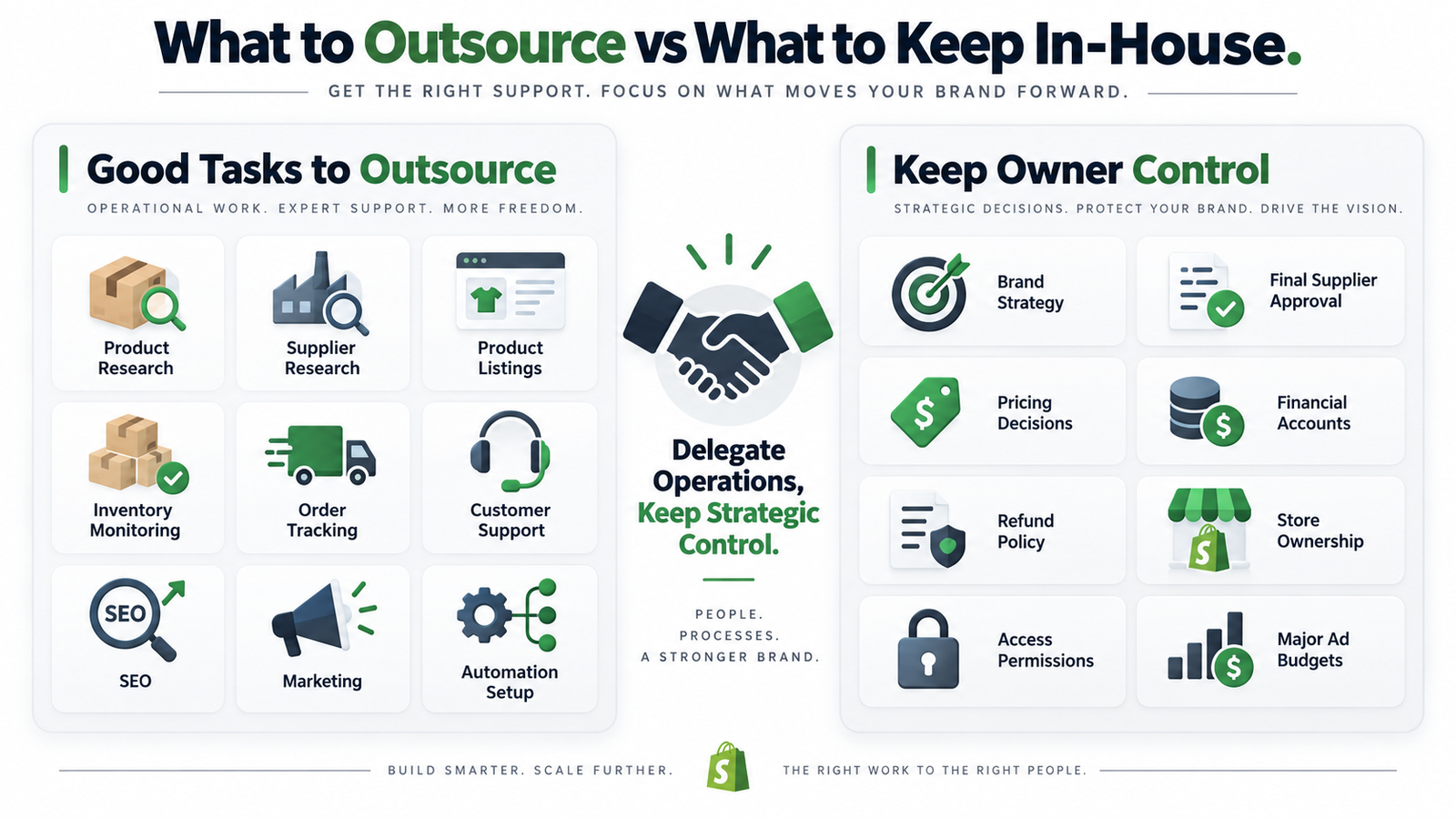 Shopify dropshipping management services work best when every task is sorted into one of four groups. Repeatable or specialist work suits outsourcing. Rule-based workflows suit automation. Exceptions and judgment need human oversight. Strategy, finances, permissions, final supplier decisions and major budgets stay with the owner. Also separate core management (operations) from optional growth services (SEO, marketing, CRO and advertising).
Shopify store outsourcing is not all or nothing. Outsource Shopify store management in stages, and use this framework to decide what to outsource in dropshipping. Dropshipping outsourcing services may price tasks individually, so you can outsource dropshipping tasks one at a time. These are the dropshipping tasks to outsource first, with what the owner still approves.
Product Research
Shopify product research and dropshipping product research cover demand, competitor review and shortlisting. The owner approves final products.
Supplier Sourcing and Management
Dropshipping supplier sourcing and dropshipping supplier management cover finding suppliers, communication and monitoring. The owner approves suppliers and terms.
Product Listings and Catalog Management
Shopify product listing services cover uploads, variants, descriptions, and media. Shopify product management also keeps collections tidy. The owner sets brand standards.
Inventory and Order Monitoring
Providers can watch stock, order status, and tracking through Shopify inventory management routines. The owner sets escalation rules.
Customer Service
Dropshipping customer service tasks include routine questions and status updates. The owner sets the refund policy.
SEO
Shopify SEO services cover product and collection optimization. This is often an add-on, not standard.
Marketing
Shopify dropshipping marketing may include ads, email, and promotions. The owner controls budgets.
Conversion Optimization
Shopify conversion rate optimization reviews product pages, navigation, mobile UX, and checkout. No result is guaranteed.
Automation and App Management
Shopify dropshipping automation needs someone to configure and maintain apps. Shopify app management still requires owner approval of access.
Should You Outsource Product Research and Supplier Sourcing?
Often, yes. Dropshipping product sourcing and Shopify product sourcing involve hours of comparing demand, competition and product suitability. Dropshipping supplier sourcing adds supplier vetting: product quality, shipping speed, fulfillment consistency, communication, return and refund terms and inventory updates.
Shopify product research and dropshipping product research should both weigh competition and suitability. Both Shopify product sourcing and dropshipping product sourcing should end in a shortlist, not a decision. Shopify’s supplier guidance advises checking order processing efficiency and support quality before committing. Shopify also notes in its dropshipping compliance guidance that merchants remain responsible for applicable product-safety and sales requirements. Shopify supplier management continues after approval, and ongoing dropshipping supplier management tracks late shipments and stock accuracy.
The provider can research and recommend. The owner should retain final supplier approval. Research reduces guesswork but never guarantees product success.
Should Product Listings and Catalog Management Be Outsourced?
Usually, once product volume grows. A small catalog may be manageable alone, but maintenance becomes more demanding as SKUs, variants, suppliers and pricing changes increase.
Shopify product listing services and Shopify product upload services handle new items, variants, pricing and media. Shopify catalog management covers categorization and cleanup, while Shopify collection management keeps navigation logical. Shopify product management, Shopify product optimization and Shopify product page optimization then improve descriptions and clarity.
As SKU count grows, Shopify catalog management and Shopify product optimization become harder to keep consistent alone. Shopify product page optimization is where specialists add value. Owners keep control of brand standards and pricing.
Inventory, Orders and Fulfillment: What Can Be Delegated?
Dropshipping inventory management often depends on the supplier app or integration used for Shopify inventory sync between supplier and store. Providers can monitor stock, supplier availability, order routing, and tracking. Shopify order management and dropshipping order management also need exception handling for delays, out-of-stock items, and address errors.
Shopify order processing and dropshipping order fulfillment can be partly automated. Automated fulfillment does not mean zero operational oversight. Dropshipping order management still needs a person to catch failed syncs and late suppliers. Shopify inventory management alerts and Shopify inventory sync reports show where stock data drifts. Shopify order management dashboards and Shopify order processing reports show where orders stall. Dropshipping order fulfillment problems usually surface as tracking gaps. Dropshipping inventory management needs a review cadence based on order volume, supplier reliability, stock volatility, and integration quality. Shopify fulfillment management covers that monitoring.
Should You Outsource Customer Service?
Often, as order volume grows. Dropshipping customer support suits order-status questions, late orders, complaints, and supplier-related delays. Shopify customer service outsourcing can extend coverage across time zones. Order tracking support, Shopify returns management, and dropshipping returns management should follow written refund rules.
Even if a supplier ships the parcel, the merchant owns the customer relationship. Suppliers do not automatically handle support. Dropshipping customer service quality depends on response times, accurate order information and escalation rules, so Shopify customer service outsourcing and Shopify customer support services need a defined workflow. Dropshipping customer support also improves when tracking data is accurate. Shopify dropshipping customer service outsourcing suits stores with rising ticket counts.
Should You Outsource Shopify SEO and CRO?
Specialist skills can justify it. Shopify SEO services and Shopify dropshipping SEO cover keyword research, meta titles, meta descriptions, internal linking, image alt text and technical basics. Shopify store SEO also includes collection pages, while Shopify product SEO and Shopify product page SEO focus on individual listings. Shopify SEO optimization is often an add-on, and rankings are never promised. Shopify dropshipping SEO and Shopify store SEO both need ongoing updates.
Shopify conversion rate optimization and Shopify store optimization review trust, navigation, mobile UX, and cart flow. Shopify CRO depends on testing. Shopify speed optimization and Shopify checkout optimization are specialist tasks. Shopify store optimization carries no guaranteed improvement.
Should You Outsource Marketing and Advertising?
Partly. Dropshipping marketing services may include Shopify advertising management, Shopify email marketing, and promotions. Shopify Facebook ads management, Shopify Google Ads management, and Shopify social media marketing are separate skills. Shopify marketing services should never be assumed to include paid media.
Shopify dropshipping marketing packages differ widely, and Shopify marketing services often list ads separately. Dropshipping marketing services, Shopify advertising management, and Shopify email marketing are usually optional add-ons. Advertising spend is paid to the platform. Agency management fees are paid to the provider. Final ad-budget authority should normally remain with the owner.
Shopify Dropshipping Automation vs Human Management
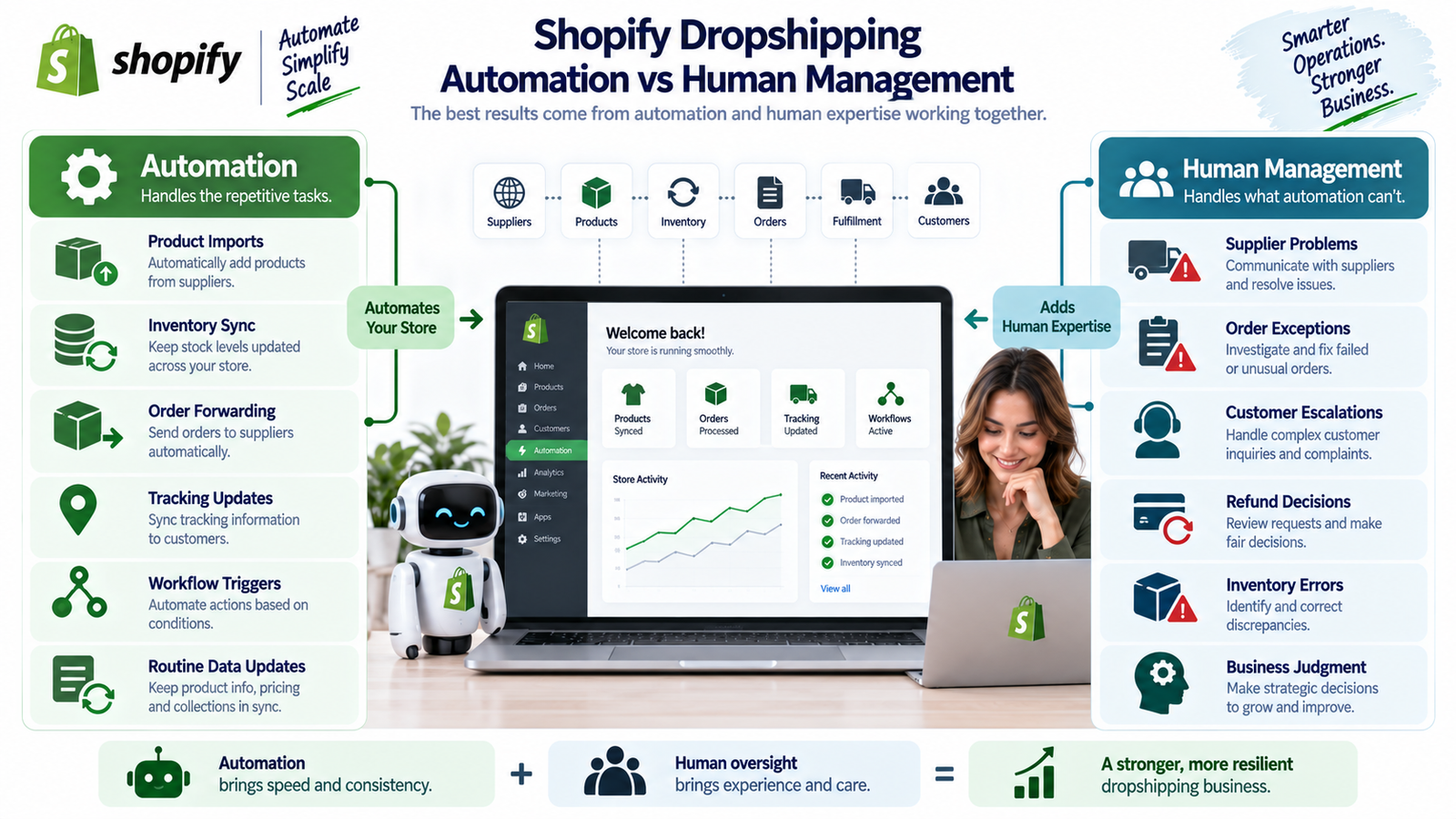 Dropshipping automation handles rules. Humans handle judgment.
| Automation | Human Management |
|---|---|
| Handles repetitive workflows | Handles exceptions and decisions |
| Can sync products and inventory | Evaluates supplier problems |
| Can forward orders | Handles unusual order issues |
| Can update tracking | Resolves customer escalations |
| Can trigger workflows | Applies business judgment |
Different dropshipping apps automate different parts of the workflow, such as product import, order forwarding and pricing updates. Shopify inventory automation helps with stock, and Shopify app integration must be tested. Shopify automation services connect these tools. Dropshipping apps still need a person watching them, and dropshipping automation never replaces oversight. The strongest model combines both. HiSellIt’s Shopify dropshipping automation guide explains these workflows in more detail.
What Should You Keep In-House?
A sound Shopify outsourcing strategy keeps decisions with the owner. What not to outsource in dropshipping is easy to list: brand positioning, brand voice, strategic direction, pricing strategy, financial accounts and payment control. Also keep final supplier approval, refund-policy decisions, access permissions and major advertising-budget decisions.
What should a dropshipping owner manage? Anything that defines the business. Dropshipping tasks to keep in-house should be documented, and providers should get limited, role-based access rather than unrestricted control. Shopify recommends collaborator accounts for Partners working on client stores; merchants can limit permissions and remove access when the work ends, rather than sharing owner credentials.
How Much Do Shopify Dropshipping Management Services Cost?
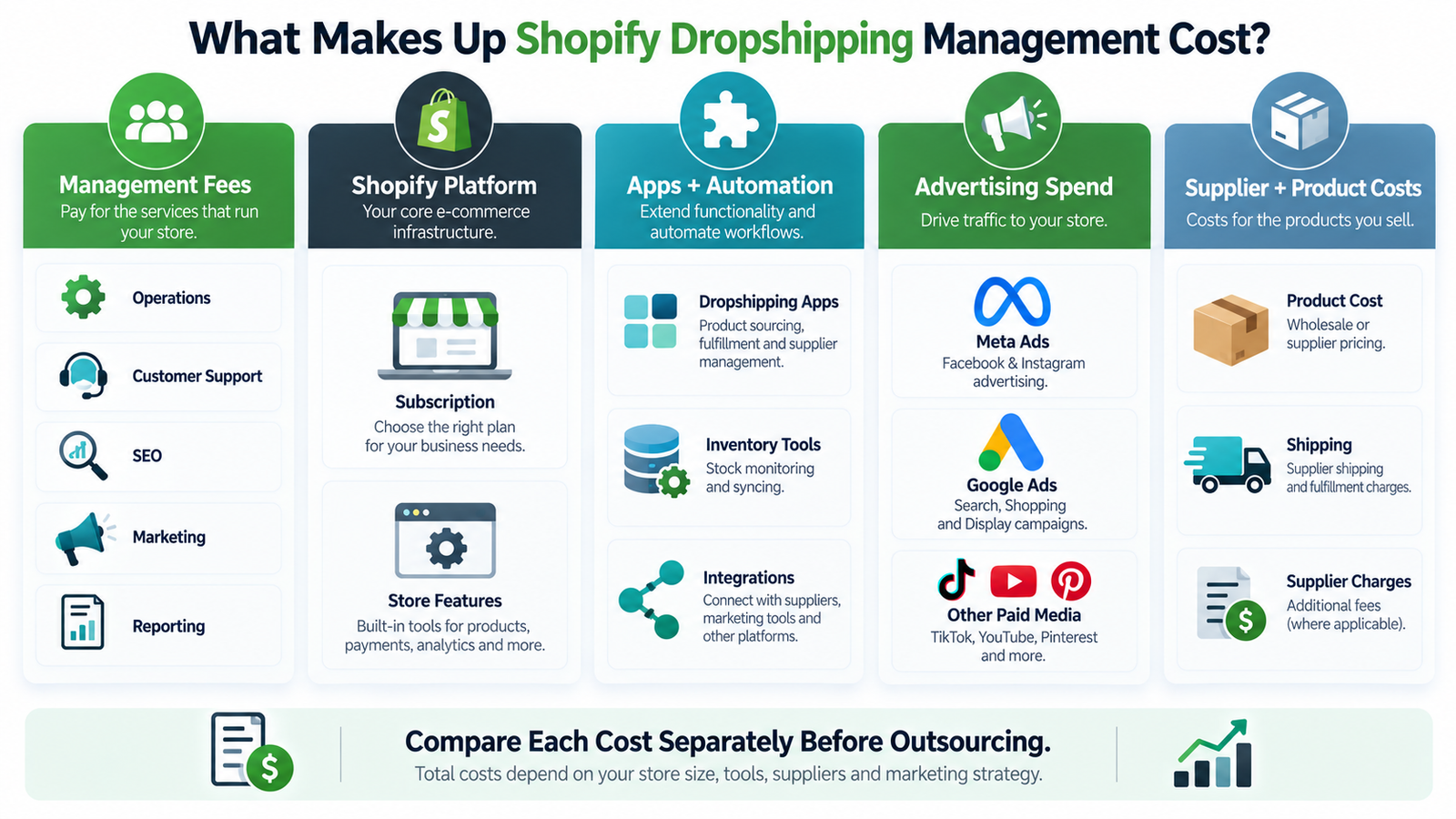 Providers may charge monthly retainers, fixed packages, hourly support or bundles, with add-ons for marketing, SEO, CRO, and customer service. Custom management arrangements exist too. No universal price applies. Dropshipping management services vary too much for one number.
Shopify dropshipping management cost and dropshipping management cost depend on product count, order volume, suppliers, catalog complexity, support workload, SEO and marketing scope, automation, reporting, markets and strategy level. Dropshipping management cost can also rise with reporting depth and strategic involvement. Shopify dropshipping services cost changes with app stack and advertising scope. Shopify dropshipping agency cost can reflect the depth of strategic management and operational scope.
Keep these separate: Shopify platform fees, app costs, advertising spend, supplier and product costs, agency management fees and custom development. Ask for written dropshipping management pricing. Shopify dropshipping pricing, agency quotes and the cost to outsource Shopify management should each list what is included. Some providers let you outsource dropshipping tasks individually. If automation is included in a proposal, compare implementation and software separately using this guide to Shopify automation services pricing.
DIY vs Outsourced Shopify Dropshipping Management
| DIY Management | Outsourced Management |
|---|---|
| Owner handles operations | Team handles defined tasks |
| Lower external service cost | Direct management fee |
| High owner time requirement | Reduced operational workload |
| Maximum direct control | Shared operational control |
| Owner learns each function | Access to specialist skills |
| Simple for small stores | Useful for more complex workloads |
Outsourcing does not automatically produce stronger performance. Outsourced Shopify management adds cost and coordination. Outsourced Shopify management also carries handover risk, so document processes first. Shopify dropshipping services cost may appear lower under DIY because external management fees are reduced, but the owner still pays in time.
When Should You Hire a Shopify Dropshipping Agency?
A Shopify dropshipping agency makes sense when the founder spends too much time on repetitive operations, order volume grows, suppliers multiply, the catalog gets complicated, support backlogs form or inventory data becomes inconsistent. Weak SEO, paid-media complexity, fragmented apps and limited internal expertise are other signs. Shopify dropshipping store management becomes worth reviewing at that point, as do broader Shopify store management services.
Should I outsource my Shopify store? Only if you can define tasks and deliverables. Before you outsource Shopify store management, list the dropshipping tasks to outsource and score each one. Some owners hire a Shopify dropshipping expert for one function, others hire a dropshipping manager as a single accountable person. A full-service dropshipping agency covers more but costs more. A Shopify dropshipping agency for small business owners should offer flexible packages. DIY may remain appropriate for small, simple stores with one supplier and manageable orders. If the store itself still needs configuration before ongoing management begins, review what store setup services typically include.
How to Choose a Dropshipping Management Agency
A dropshipping management agency should show Shopify dropshipping management experience, supplier-management knowledge, clear scope, catalog capability, order and inventory workflows, customer support, SEO and CRO capability, marketing expertise, reporting, transparent pricing, account security and a clear exit process. Compare dropshipping management services on written deliverables, and ask whether Shopify dropshipping services include reporting. Dropshipping outsourcing services and Shopify dropshipping outsourcing services range from task packs to full management. A Shopify ecommerce agency differs from professional dropshipping management. The Shopify Partner Directory is one place to start.
Avoid guaranteed profits or sales, passive-income promises, vague supplier claims, hidden ad-spend fees, unrestricted access demands, missing written deliverables and policy workarounds.
Outsourcing Decision Table
| Task | Good Outsourcing Candidate? | Owner Should Retain |
|---|---|---|
| Product research | Yes | Final product approval |
| Supplier sourcing | Yes | Final supplier approval |
| Product uploads | Yes | Brand standards |
| Inventory monitoring | Yes | Major purchasing decisions |
| Order monitoring | Yes | Escalation policy |
| Customer support | Often | Refund-policy authority |
| SEO | Often | Brand positioning |
| Paid ads | Often | Final budget control |
| Automation | Often | Access/security approval |
| Financial management | Usually no | Direct owner control |
Service Deliverables Table
| Management Area | Typical Tasks |
|---|---|
| Product research | Research, competitor review, product shortlisting |
| Suppliers | Sourcing, communication, monitoring |
| Catalog | Uploads, collections, optimization |
| Inventory | Sync and stock monitoring |
| Orders | Processing and fulfillment oversight |
| Customer support | Tracking, returns, customer issues |
| SEO | Product and collection optimization |
| Marketing | Ads, email, promotions where included |
| CRO | Product pages, UX, checkout |
| Automation | Apps, integrations, workflows |
| Reporting | Sales, orders, marketing and operations |
Exact scope varies by provider.
FAQ
Q. What should I outsource in Shopify dropshipping?
Repeatable and specialist work such as research, listings, order monitoring, support, and SEO. Keep strategy, finances, and final supplier approval.
Q. What do Shopify dropshipping management services include?
Scope varies. Common areas are research, suppliers, catalog, inventory, orders, support, and reporting, with SEO, ads, and CRO often optional.
Q. Should I outsource my Shopify dropshipping store?
Consider it when repetitive work crowds out strategy and you can define tasks in writing.
Q. What does a Shopify dropshipping agency do?
It handles defined operational and growth tasks, reports results, and escalates decisions to the owner.
Q. Is Shopify dropshipping management worth it?
It can be, when it frees the owner’s time for strategy and the scope is clear. It does not guarantee profit.