

Shopify Store Optimization Services: When Should You Hire Professionals?
If traffic is healthy but orders are not following, sending more people to the store may only send more shoppers into the same broken funnel. The problem could be the product page, mobile UX, speed, checkout friction, SEO, tracking, or a stack of apps and custom code that has become difficult to manage.
That is where Shopify store optimization services can start to make sense.
Not every problem needs an agency. Plenty of Shopify store optimization work, such as clearer copy, better images, straightforward navigation changes, or basic metadata updates, can stay in-house. Shopify optimization services earn their fee when the problem is persistent, measurable, and difficult to diagnose. Good Shopify website optimization should tell you what is actually broken before anyone starts changing the store.
When Should You Hire Shopify Store Optimization Professionals?
Hire professional Shopify optimization help when low conversion, slow speed, weak mobile UX, checkout friction, SEO problems, technical debt, or unclear analytics continue after basic fixes. Professional support is most useful when the problem is measurable, affecting meaningful traffic or revenue, and difficult for the internal team to diagnose or solve confidently.
What Do Shopify Store Optimization Services Include?
Shopify store optimization services can cover conversion work, speed, SEO, product pages, checkout, UX, mobile, analytics, technical cleanup, and audits.
The exact combination should depend on what the data shows.
Shopify itself separates many of these disciplines. Its Partner Directory conversion rate optimization category sits alongside services such as website audits, optimization strategy, site performance and speed, SEO, analytics and tracking, troubleshooting, themes, and checkout work.
That is useful because it stops “optimization” becoming a vague package.
Some providers offer broad Shopify ecommerce optimization. Others specialize in Shopify website optimization services, CRO, performance, development, or SEO. A good provider should be able to explain why you need one service and not another.
For day-to-day store operations rather than optimization, see our guide to Shopify ecommerce management services.
Start With an Audit, Not Random Changes
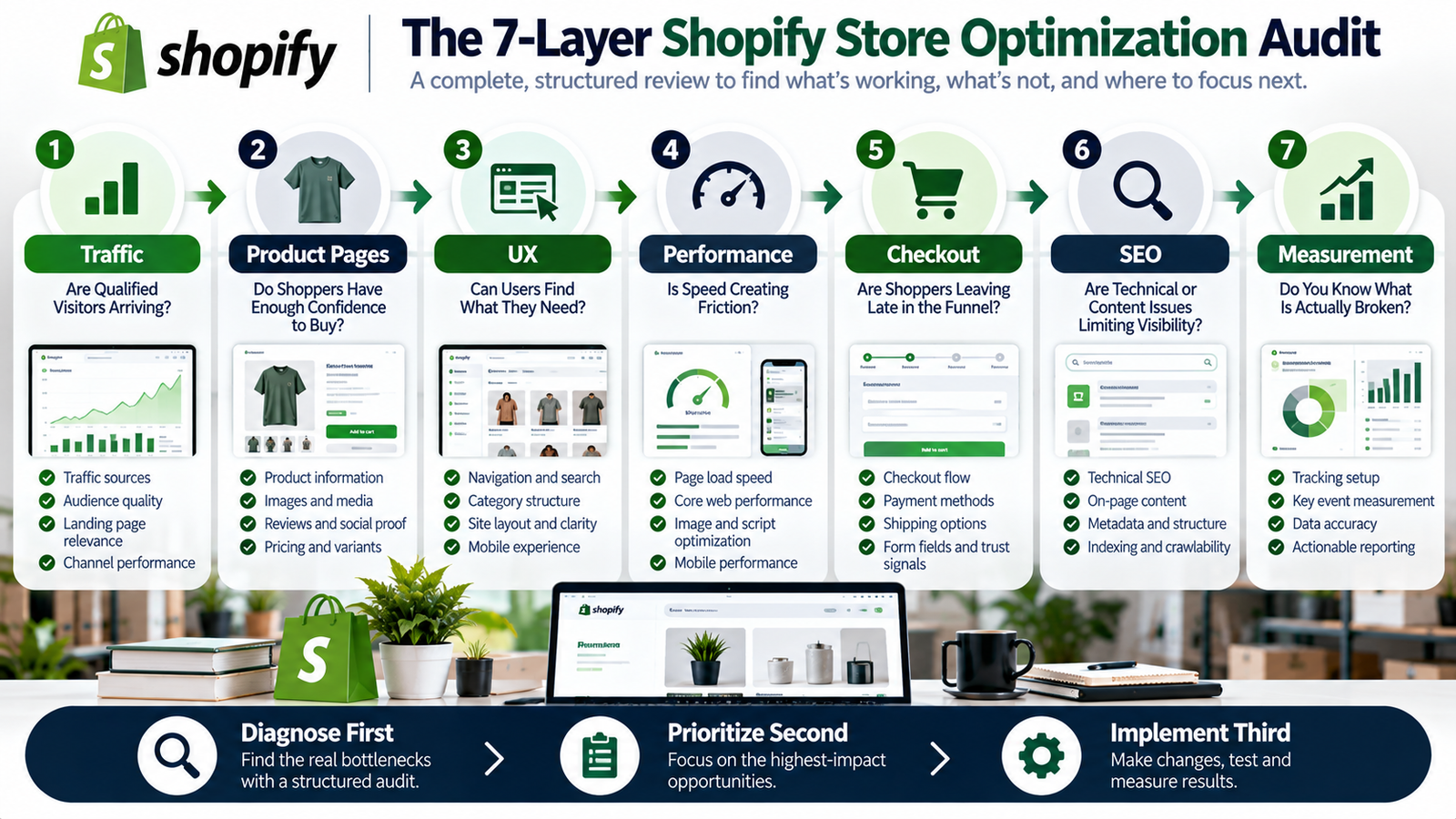 An audit should identify the bottleneck before you pay to fix the wrong thing.
If checkout abandonment is high because shoppers only discover expensive shipping at the final step, redesigning the homepage will not solve the problem.
A useful Shopify store audit should work through seven layers:
- Traffic: Are enough qualified visitors arriving?
- Product pages: Are shoppers getting enough confidence to buy?
- UX: Can people find what they need easily?
- Performance: Is speed creating friction?
- Checkout: Are shoppers leaving late in the funnel?
- SEO: Is organic visibility limited by technical or content issues?
- Measurement: Does the team actually know what is broken?
From there, the store may need a Shopify website audit, Shopify optimization audit, Shopify CRO audit, Shopify performance audit, or Shopify SEO audit.
Diagnosis should come first. Implementation comes second.
When Should You Hire Shopify Store Optimization Professionals?
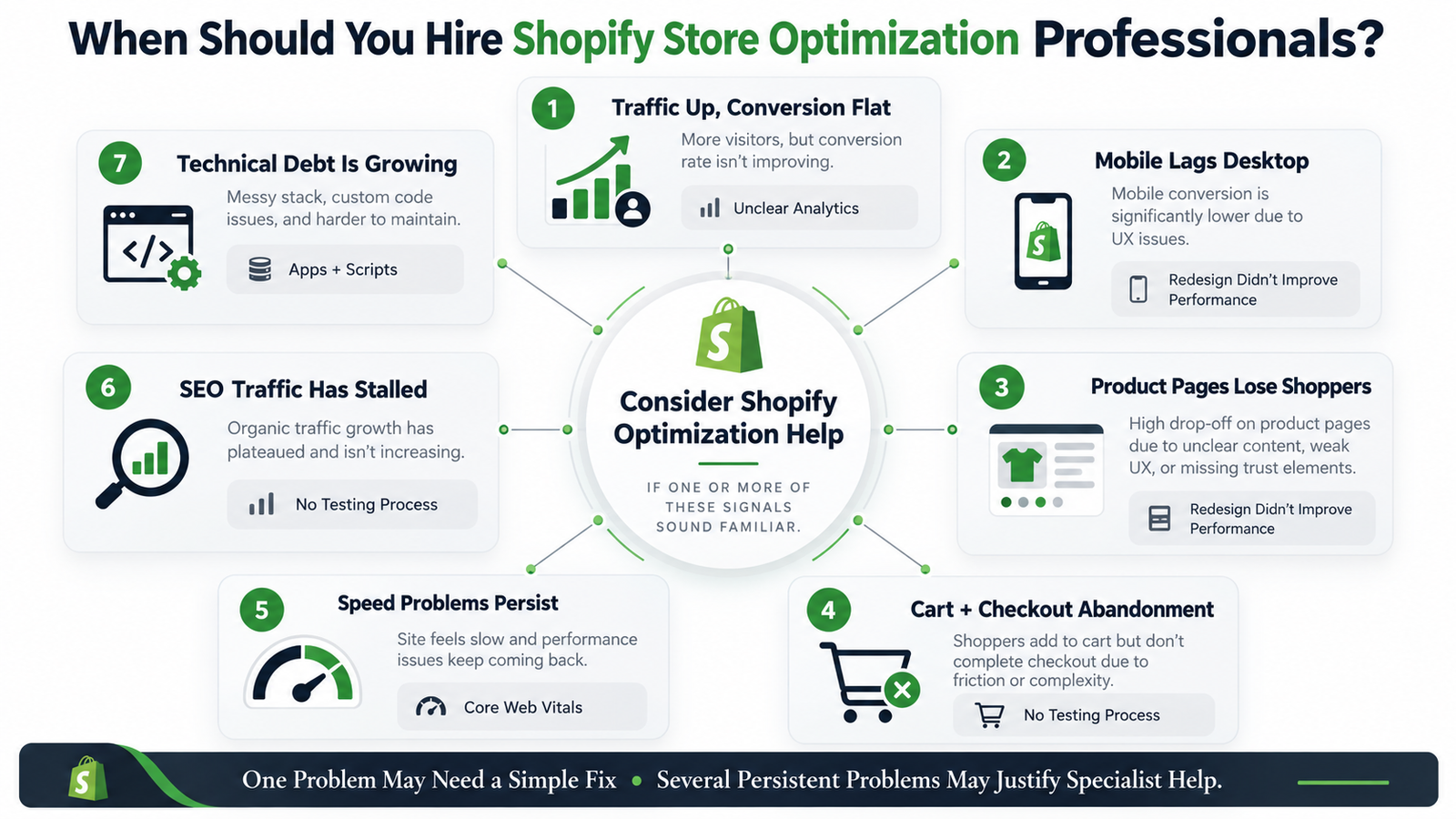
One problem does not automatically justify professional help. Several persistent problems together are a stronger signal.
Traffic Is Growing but Conversion Is Not
Sessions increase, but orders barely move.
Check conversion by traffic source, landing page, product, and device first. If the obvious issues are already fixed, a Shopify optimization expert can trace where the funnel is breaking.
Conversion Rate Has Plateaued
A flat Shopify conversion rate is not automatically a problem. Context matters.
But if the store has meaningful traffic and months of small changes have stopped producing useful insight, structured Shopify conversion rate optimization may make sense.
Mobile Performance Lags Desktop
A blended conversion rate can hide a poor mobile experience.
Compare device-level data. If mobile users struggle with navigation, variants, sticky elements, images, cart actions, or page speed, Shopify mobile optimization deserves separate attention.
Product Pages Have High Exit Rates
Thin descriptions, weak product imagery, confusing variants, hidden shipping information, or unclear CTAs can all create doubt.
Some issues are easy to fix internally. Template-level Shopify product page optimization may need specialist help.
Cart or Checkout Abandonment Is High
Look at the gap between add-to-cart, checkout, and completed orders.
If the problem is not obvious, a specialist may investigate shipping surprises, payment friction, mobile behavior, delivery expectations, or trust.
Store Speed Has Become Noticeably Poor
Do not judge the store from one speed-test screenshot.
Check real-user and device-level patterns. If performance remains weak after obvious image and app cleanup, Shopify speed optimization may require technical work.
Core Web Vitals Problems Persist
Persistent issues with loading, interactivity, or layout stability can point to theme code, scripts, apps, or media.
That is where a Shopify performance expert becomes more useful than another generic optimization checklist.
Apps and Custom Code Have Created Technical Debt
Overlapping apps, scripts left behind by old tools, and undocumented theme edits can make simple changes risky.
When fixing one issue breaks another, the store may need Shopify technical optimization.
SEO Traffic Has Stagnated
Flat organic traffic may come from content, but it may also come from crawlability, indexation, weak internal linking, collection structure, or technical SEO.
A Shopify technical SEO review may be more useful than simply publishing more content.
A Redesign Did Not Improve Performance
A new design is not the same as optimization.
If the store looks better but the numbers have not improved, compare before-and-after performance instead of redesigning again.
The Team Has Data but No Clear Priorities
This is common.
You may have dashboards, reports, heatmaps, and campaign data but no agreement about what should be fixed first.
A one-off audit may solve this better than a retainer.
Changes Are Being Made Without Structured Testing
If five things change at once, you learn almost nothing.
A professional can help build a testing process so changes produce evidence rather than more opinions.
Small Improvements Could Matter at Your Revenue Scale
The economics matter.
For a very small store, specialist fees may outweigh the value of small improvements. For a mature store with substantial traffic and revenue, even modest improvements in a high-friction part of the funnel can become commercially important.
If two or three of these signals appear together, it may be time to hire a Shopify optimization expert.
Knowing when to hire a Shopify expert versus when to hire a Shopify agency usually comes down to scope. A Shopify CRO agency may suit ongoing testing across the funnel, while a professional Shopify expert or Shopify performance expert may be better for one defined technical problem.
Conversion Problems Need More Than Guesswork
Your conversion rate is a symptom, not a diagnosis.
Two stores can have the same conversion rate for completely different reasons.
Shopify conversion rate optimization should break the journey into stages and ask where shoppers leave. Product-page friction, weak trust, navigation problems, poor recommendations, cart confusion, and broken tracking can all look like “low conversion” from a distance.
Shopify’s Behavior reports can help merchants review conversion-related behavior, sessions by device, landing pages, cart activity, checkout progress, and completed orders.
A serious Shopify CRO project should use that kind of evidence. Shopify conversion optimization may involve navigation, product pages, trust signals, cart behavior, and checkout. Professional Shopify CRO services should explain the testing process instead of promising a lift.
Product Pages Are Often Where Optimization Becomes Visible
Traffic does not become revenue if the product page creates doubt.
Common problems include thin descriptions, repetitive images, confusing variants, hidden delivery information, buried reviews, weak trust signals, or a CTA that disappears on mobile.
Shopify product page optimization targets those areas without automatically rebuilding the whole store.
Good Shopify product optimization can include Shopify product description optimization, Shopify product image optimization, product information, variants, reviews, shipping information, and Shopify product page design.
Start with products that already receive meaningful traffic but show weak engagement or add-to-cart behavior.
Speed and Performance Problems Can Become Technical
Shopify speed optimization usually starts with the theme and then works outward to apps, scripts, large media, custom code, third-party tracking, chat tools, and other storefront functionality.
Shopify’s web performance guidance explains that themes, apps, third-party services, analytics libraries, images, and videos can all influence storefront performance. Shopify also reports Core Web Vitals across mobile and desktop experiences.
That makes Shopify site speed optimization a prioritization problem.
A specialist should ask which scripts and features justify their performance cost. Shopify website speed optimization should improve real customer experience without removing useful functionality just to chase a score.
No credible provider should guarantee a perfect speed score on every template, network, and device. Judge Shopify performance optimization, Shopify page speed, and Shopify site performance over time.
SEO Problems Need Technical and Content Diagnosis
Shopify SEO services should not mean adding keywords everywhere.
Shopify’s SEO guidance recommends natural keyword use in titles, descriptions, page content, and image alt text. Organic performance can also be affected by crawlability, indexation, internal linking, collection structure, duplicate or thin pages, and metadata.
That is why Shopify SEO optimization needs both content and technical diagnosis.
Shopify technical SEO may address indexing, site structure, crawl issues, collections, and internal links. Shopify store SEO can also include Shopify product SEO and content gaps.
Do not hire anyone who guarantees rankings.
Mobile UX Deserves Separate Attention
A mobile-friendly store is not simply the desktop experience squeezed onto a smaller screen.
Shopify UX optimization should review menus, search, tap targets, variants, imagery, sticky elements, CTA placement, cart behavior, and checkout on mobile.
Shopify mobile optimization often reveals problems hidden inside blended averages. Shopify user experience optimization, Shopify store design optimization, and Shopify navigation optimization should improve an existing journey, not automatically replace the design.
A redesign may help, but it should not be the default answer.
Cart and Checkout Friction
Late-stage friction can be expensive because these shoppers have already shown buying intent.
Shopify cart optimization may investigate quantity changes, shipping estimates, promotional clutter, upsells, and surprise costs.
Shopify checkout optimization focuses further down the purchase path.
Shopify’s abandoned checkout guidance lets merchants review incomplete checkouts and investigate payment events and patterns behind abandoned orders.
That matters because Shopify cart abandonment can have many causes. Shopify checkout conversion should be reviewed alongside device, source, order value, payment behavior, and delivery expectations before anyone recommends a Shopify checkout improvement.
Analytics Should Tell You What to Test Next
Optimization without measurement becomes opinion.
Shopify analytics can show conversion, product performance, traffic sources, device differences, average order value, and funnel behavior.
A clean Shopify analytics setup and reliable Shopify conversion tracking should come before serious testing.
Otherwise, you cannot trust Shopify performance reporting or Shopify ecommerce analytics enough to know whether a change helped.
A specialist should turn Shopify store performance data into priorities, not just another monthly dashboard.
Technical Debt Can Make Simple Changes Expensive
Old theme code, overlapping apps, third-party scripts, and undocumented custom changes create hidden costs.
A button change that should take 20 minutes can become a full day of troubleshooting.
Shopify theme optimization may involve cleaning up outdated code, removing conflicts, or simplifying unnecessary functionality. Shopify app optimization should review overlap without blindly deleting apps that support tracking, checkout, reviews, or integrations.
Some stores need Shopify code optimization, Shopify technical support, or Shopify troubleshooting from a developer rather than a CRO specialist.
For stores where apps and operational complexity are also affecting day-to-day management, see our Shopify dropshipping automation guide and Shopify dropshipping management services.
DIY vs Professional Shopify Optimization
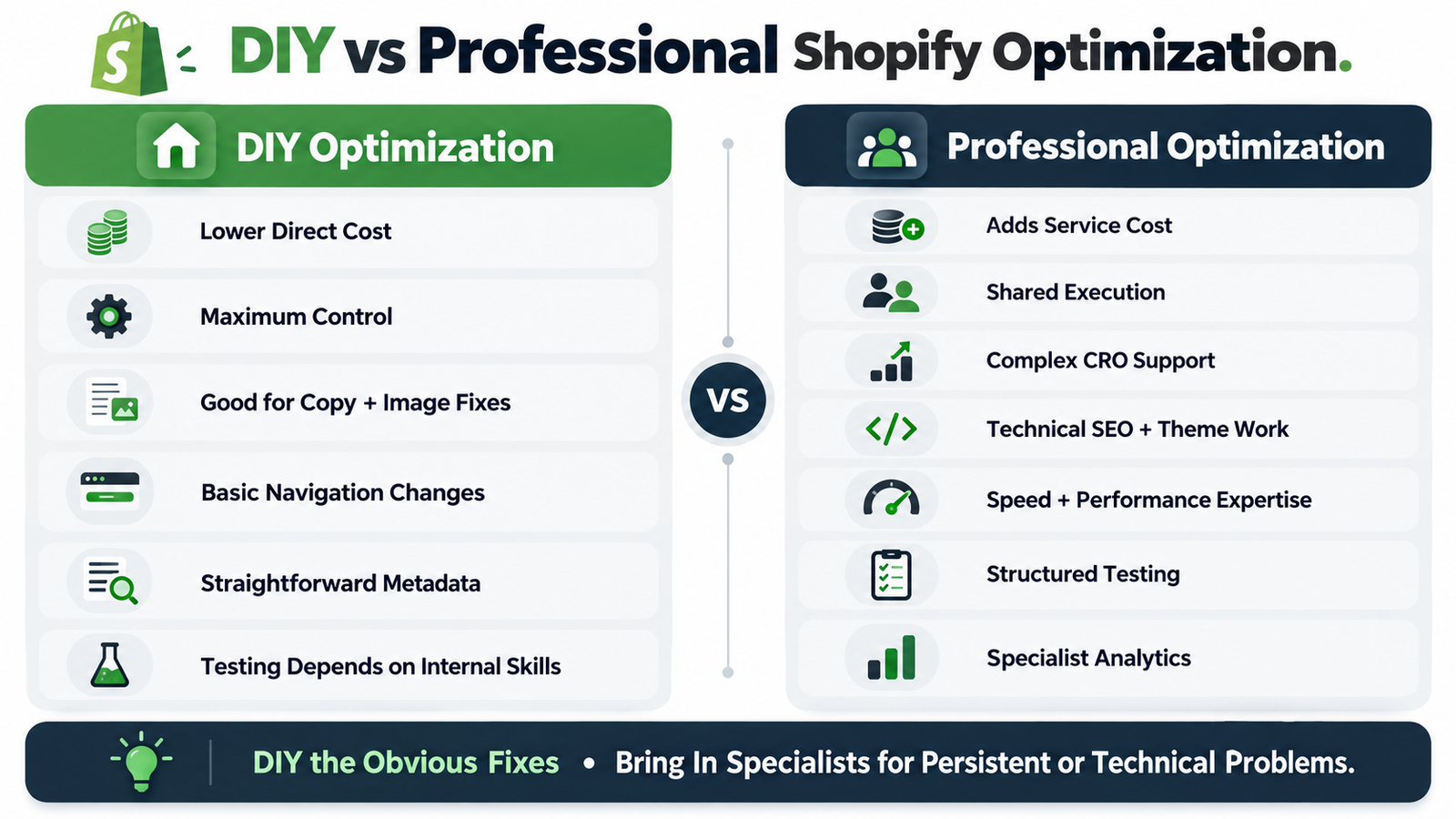 DIY can work extremely well for obvious problems.
| Factor | DIY Optimization | Professional Optimization |
| Direct cost | Lower | Adds service cost |
| Control | Highest | Shared execution |
| Simple fixes | Often manageable | Usually unnecessary |
| Complex CRO | Requires expertise | Specialist support |
| Technical issues | Limited by internal skills | Deeper technical support |
| Testing | Owner/team handles | Structured process may be included |
| Speed work | Depends on expertise | Performance specialist may help |
| Analytics | Internal interpretation | Specialist analysis may be available |
DIY Shopify optimization is reasonable for simple copy changes, straightforward image updates, navigation fixes, and basic metadata.
Shopify optimization vs DIY becomes harder when the issue involves complex CRO, testing, technical SEO, theme code, performance, or analytics.
Shopify expert vs DIY often means DIY first, expert for what remains. Professional Shopify optimization vs DIY only becomes a real question when the problem survives sensible internal fixes.
How Much Do Shopify Store Optimization Services Cost?
There is no honest universal rate.
Shopify store optimization services may be sold as an audit-only engagement, fixed project, hourly specialist work, CRO retainer, SEO retainer, ongoing optimization package, or custom development.
Shopify store optimization cost changes with store size, traffic, theme complexity, app stack, product-page count, CRO scope, SEO scope, checkout work, analytics, testing, and custom code.
| Cost Driver | Why It Changes Scope |
| Store size | More pages and templates |
| Traffic volume | More data and testing potential |
| Theme complexity | More technical work |
| App stack | More third-party interactions |
| CRO scope | More funnel analysis |
| SEO scope | More technical and content work |
| Product pages | More templates and products |
| Checkout/cart | More specialized analysis |
| Analytics | Tracking setup and validation |
| Custom code | Development effort |
| Testing | More implementation and QA |
Shopify optimization services cost should be compared on scope, not headline price.
Shopify optimization pricing, Shopify CRO cost, Shopify speed optimization cost, and Shopify optimization agency cost can all refer to very different work.
The cost to optimize a Shopify store only becomes meaningful once the provider defines the problem and deliverables.
How to Choose a Shopify Optimization Provider
Look for CRO experience, Shopify platform knowledge, performance capability, technical SEO, product-page experience, mobile expertise, analytics skills, testing discipline, development capability, reporting, transparent pricing, and a clear handover.
A Shopify optimization expert should explain how they would diagnose the problem before suggesting the fix.
Ask:
- What data would you review first?
- What would make you decide not to redesign?
- How will changes be measured?
- Who handles implementation?
- Are development costs included?
- What happens after the audit?
- Who owns documentation and testing history?
The Shopify Partner Directory can also be useful when comparing specialists.
Avoid guaranteed conversion increases, guaranteed rankings, “100 speed score” promises, vague audits, unnecessary apps, hidden development fees, or a full redesign recommended before the provider has looked at the data.
Is Shopify Store Optimization Worth It?
Is Shopify store optimization worth it? It depends on what is broken and what solving it is worth.
Professional support tends to make more sense when:
- The store already has meaningful traffic;
- Conversion problems persist;
- Performance issues require code-level work;
- Internal testing is weak;
- Analytics exists, but nobody knows what to prioritize;
- Revenue is high enough that friction in key funnel stages matters;
- The team lacks CRO, SEO, development, or performance expertise.
DIY may still be the better answer when the store is new, traffic is very low, problems are obvious, there is not enough behavioral data yet, or the internal team already has the relevant expertise.
A Shopify optimization agency for growing stores should add diagnostic depth, testing discipline, or specialist execution. It should not simply produce a longer list of generic recommendations.
Conclusion
Shopify store optimization services become more useful when conversion problems persist, Shopify site performance deteriorates, mobile UX is weak, product pages underperform, technical SEO issues continue, analytics is not turning into action, or internal teams lack specialist skills.
Good Shopify store optimization is not endless tweaking. It is finding the actual bottleneck, choosing the right intervention, and measuring what changed.
Compare the Shopify store optimization cost with the commercial importance and technical difficulty of the problem before choosing a Shopify optimization agency. Keep obvious fixes in-house where that makes sense.
Start by auditing performance, identify the main bottleneck, compare provider scope, and request customized Shopify optimization pricing for the work your store actually needs.
Frequently Asked Questions
Q. When should I hire Shopify store optimization professionals?
Consider professional help when conversion, mobile UX, speed, SEO, checkout, analytics, or technical problems continue after straightforward fixes. Several persistent issues appearing together are a stronger hiring signal than one isolated problem.
Q. What do Shopify store optimization services include?
They may include CRO, speed, SEO, product pages, UX, mobile, checkout analysis, analytics, technical cleanup, audits, testing, and implementation. Actual scope varies, so compare deliverables carefully.
Q. How much do Shopify store optimization services cost?
Pricing depends on whether you need an audit, project, specialist hours, retainer, development, or ongoing testing. Theme complexity, apps, traffic, custom code, and the number of pages involved also affect scope.
Q. When should I hire a Shopify optimization expert?
Hire one when a measurable problem persists after sensible internal fixes, especially where the issue requires CRO, analytics, technical SEO, performance work, testing, or development expertise.
Q. Can professionals improve conversion rates?
They can identify friction, implement changes, and test whether those changes help. No credible provider can guarantee a conversion increase. Professional Shopify conversion optimization services should explain how improvements will be measured.
Q. Do optimization services include speed and SEO?
Sometimes. Shopify speed and conversion optimization services may combine performance and CRO, while other providers separate speed, SEO, development, and testing into different scopes.
Q. Should I hire someone to optimize my Shopify store?
If you already have meaningful traffic, recurring problems, and limited internal expertise, start with an audit. Shopify store audit and optimization services can help determine whether you need one technical fix, several specialists, or no outside support at all.