
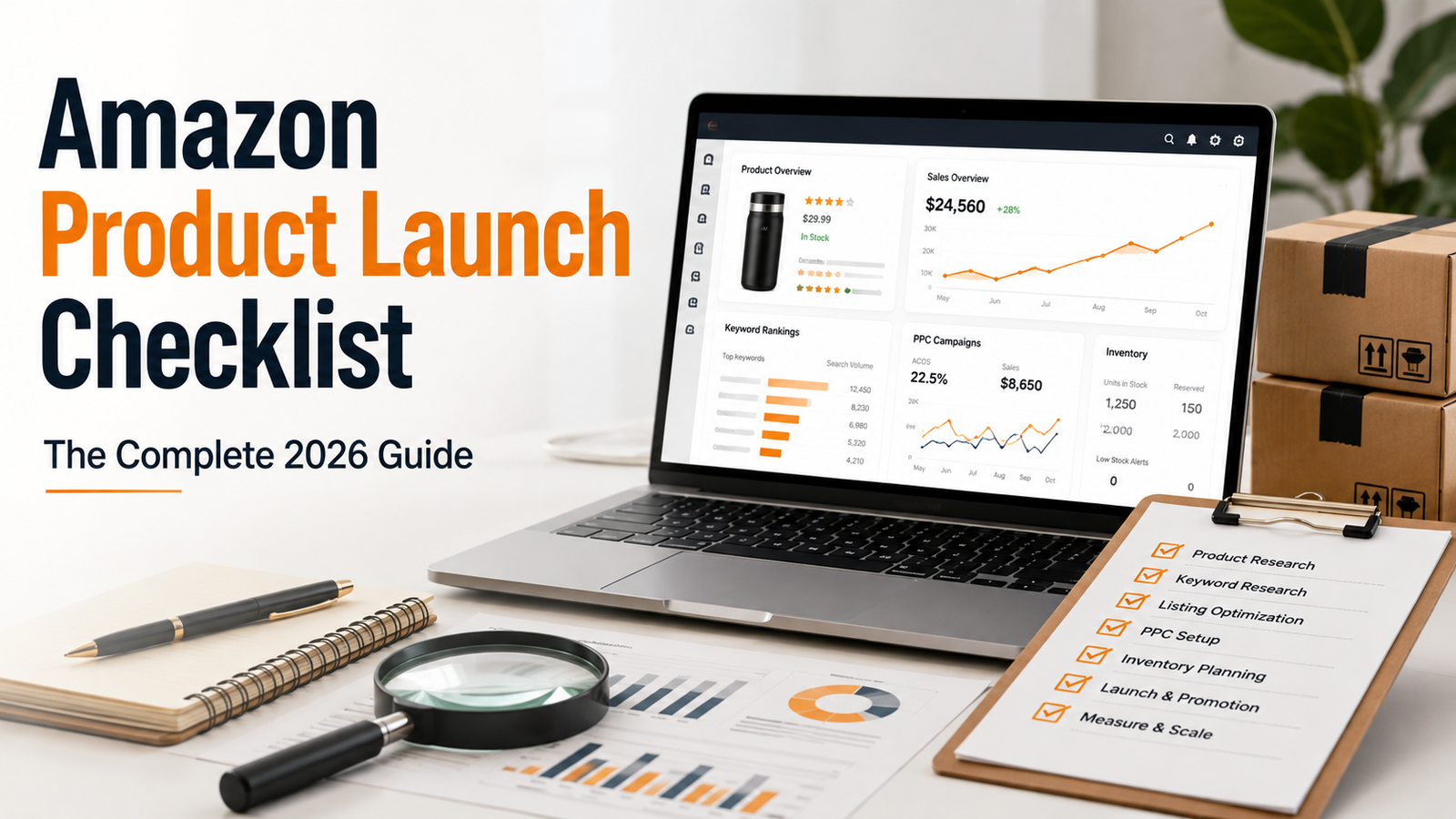
Amazon Product Launch Checklist: The Complete 2026 Guide
Launching a product on Amazon without a plan is one of the fastest ways to lose money. Most new sellers skip key steps, guess on pricing, and wonder why sales never come.
This Amazon product launch checklist fixes that. It covers every Amazon product launch step from picking the right product to ranking on page one. Follow this Amazon product launch checklist in order, and every launch has a real chance to succeed.
Whether someone is brand new to Amazon FBA or preparing a fifth private label product, this Amazon product launch guide gives a clear, proven path from idea to income.
Think of this as the only Amazon product launch guide needed. It combines Amazon product launch strategy with listing optimization, PPC setup, and Amazon product ranking strategy into one complete resource.
What Is an Amazon Product Launch Checklist?
Quick Answer: What Is an Amazon Product Launch Checklist?
An Amazon product launch checklist is a step-by-step framework that helps sellers research products, optimize listings, prepare inventory, launch PPC campaigns, and generate early sales to improve Amazon rankings and long-term visibility.
What an Amazon Product Launch Really Means
A product launch on Amazon is not just going live. It is a coordinated effort that combines listing quality, keyword targeting, paid ads, and early sales momentum.
Amazon ranks products using its A9 algorithm. This system looks at relevance, sales history, reviews, and conversion rates. A brand new listing has none of that history. The goal of every launch is to build those signals fast enough that Amazon starts showing the product to shoppers on its own.
Every action in a good Amazon product launch plan is designed to feed the algorithm with strong positive signals. Sellers who understand this build real momentum fast. Those who skip steps stall out and never rank.
A strong Amazon product launch strategy also includes understanding how to launch a product on Amazon legally and safely. Black-hat tactics like fake reviews or review manipulation lead to account suspension.
Amazon accounts for over 37 percent of all US e-commerce sales, making it the largest online retail platform in the country. (Statista) That means more buyers are searching on Amazon than anywhere else online. Getting this launch right matters.
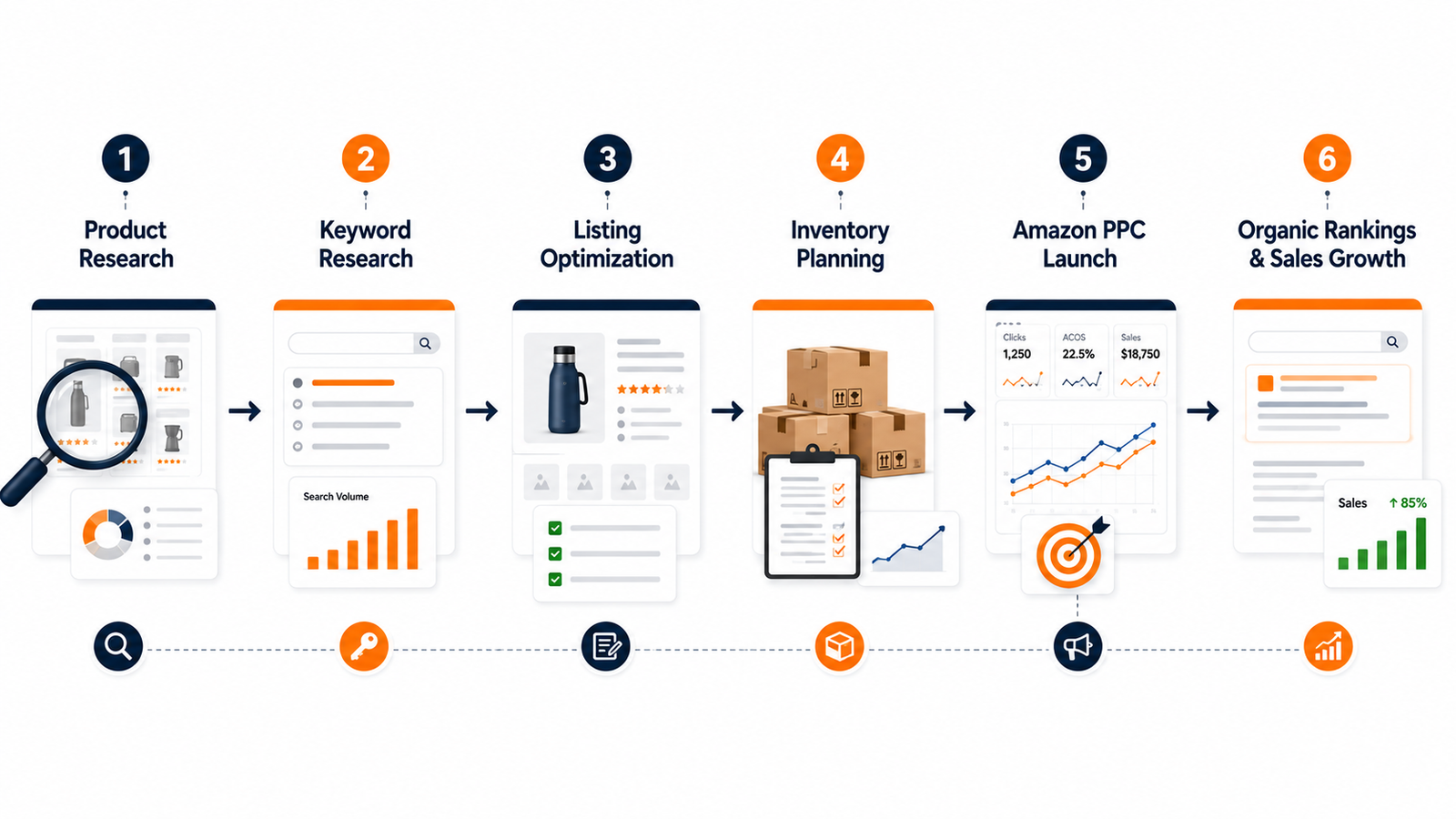
A step-by-step overview of the Amazon product launch process, from product research to organic rankings.
Manual Launch vs Planned Launch
Every Amazon product launch is different. A well-planned launch often delivers better rankings and sales, while a rushed or unstructured approach can make it much harder for a product to gain traction.
| Without a Launch Plan | With an Amazon Product Launch Checklist |
|---|---|
| Poor keyword targeting | Optimized keyword strategy |
| Weak listings | High-converting listings |
| Slow sales | Faster sales velocity |
| Low visibility | Better Amazon rankings |
| Higher launch risk | Structured launch process |
Pre-Launch Product Research
Strong launches start with strong products. Choosing the wrong product is the single biggest reason why Amazon product launches fail. Spend serious time on research before investing a dollar in inventory.
Finding Profitable Products
Profitable products share a few traits. They have steady demand, manageable competition, and healthy margins after Amazon fees. Amazon seller tools like Helium 10 and Jungle Scout make this research faster and more accurate.
Use product research strategies for Amazon automation to choose products with the best odds of success.
Look for products that:
- Sell at least 300 units per month across the top 10 listings
- Have a price between $20 and $70
- Show low average review counts on page one (under 200)
- Can be sourced for less than 25 percent of the selling price
- Are lightweight and easy to ship through Amazon FBA
Competitor Analysis
Study the top ten listings for the target keyword. Look at their titles, bullet points, pricing, and review counts. Find gaps where a new product can offer more value.
Read negative reviews on competitor products. They show exactly what customers want but are not getting. Solving those problems inside the new product is a powerful edge.
Amazon Keyword Research Strategy
Strong Amazon keyword research is the foundation of every successful launch. Without the right keywords, even a great product stays invisible in search results.
Start by finding one primary keyword with high search volume and manageable competition. Then build a list of 50 to 100 supporting keywords. These should cover variations, use cases, and related terms. Amazon seller tools like Helium 10 and Jungle Scout pull real Amazon search data to build this list accurately.
This step also feeds the Amazon launch marketing strategy. Knowing which terms shoppers search most helps prioritize PPC bids, listing copy, and backend keyword placement. A good Amazon launch marketing strategy always starts with deep keyword data.
Keyword types to target:
- Primary keywords: high volume, most relevant terms
- Long-tail keywords: specific phrases with lower competition
- Use-case keywords: describe how the product is used
- Seasonal keywords: high demand during specific periods
Organize all keywords by search volume and relevance before writing the listing. This makes Amazon listing SEO much more focused and effective.
Amazon Listing Optimization Checklist
Amazon listing optimization is where most sellers win or lose the launch. A fully optimized listing converts more visitors into buyers. That is exactly the signal the A9 algorithm rewards with higher rankings.
This is one of the most important Amazon product launch steps and it must be done before going live. Every serious Amazon product launch checklist puts listing optimization as a top priority.
Title Optimization
The product title is the most important part of Amazon listing SEO. It should include the primary keyword near the front. Add one or two secondary keywords naturally. Keep the title under 200 characters and make it readable for real shoppers.
Format: Brand + Primary Keyword + Key Feature + Size or Quantity. This structure satisfies both the algorithm and the customer scanning search results.
Bullet Points
Five bullet points are available on most listings. Use all five. Each bullet should lead with a benefit, not just a feature. Include secondary keywords naturally. Keep each bullet under 200 characters for mobile readability.
Think about what questions a customer has before buying. Answer those questions directly inside the bullet points.
Product Description
Products enrolled in Amazon Brand Registry can use A+ Content instead of a plain description. A+ Content uses images, comparison charts, and formatted text that lifts conversion rates significantly.
For standard listings, write a clear product description between 1,500 and 2,000 characters. Tell the product story, expand on key benefits, and weave in remaining keywords naturally.
Backend Search Terms
Amazon Seller Central gives every listing a backend search terms field with 250 bytes of space. Fill it completely. Use keywords that could not fit naturally into the front-facing listing. Do not repeat terms already used in the title.
Misspellings, regional variations, and non-English translations of product names can go here, too. This captures extra search traffic without cluttering the visible listing.
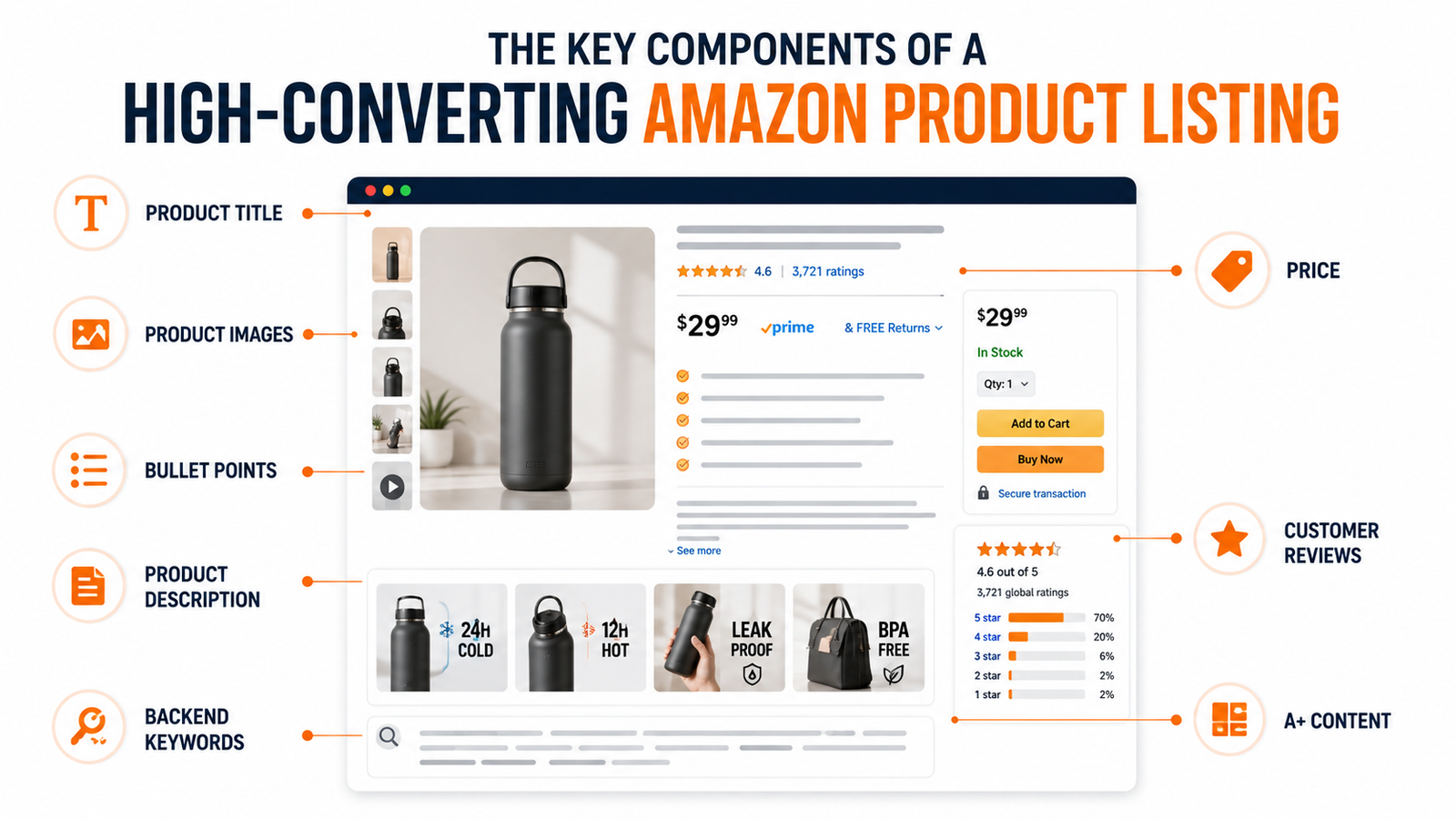
The essential elements of a high-converting Amazon product listing for better rankings and higher conversions.
Inventory Planning and Pricing Strategy
Running out of stock during a launch destroys rankings. Amazon rewards consistent availability. Send enough inventory to Amazon FBA to cover at least 60 to 90 days of projected sales before the listing goes live.
Pricing during a launch should be competitive but not desperate. The Amazon product launch plan goal is to win sales velocity. Price slightly below the category average to attract early buyers, then adjust as reviews and ranking build up.
Winning the Amazon Buy Box is critical from day one. The Amazon Buy Box is the default purchase button on every product page. Sellers who do not win it lose most of their sales to competitors. New FBA sellers typically win the Buy Box automatically when they are the only seller on a listing, but pricing, fulfillment method, and seller metrics all affect Buy Box eligibility as more sellers join the listing.
Inventory and pricing checklist:
- Calculate the break-even price after Amazon FBA fees, cost of goods, and PPC spend
- Send a minimum of 200 to 500 units for the initial launch phase
- Set up a reorder trigger when 30 days of stock remain
- Enable automatic pricing rules inside Amazon Seller Central
- Monitor the sell-through rate every week during the first 30 days
Amazon PPC Launch Strategy
Paid advertising through Amazon Advertising is essential for every new product. A new listing has no organic rank yet. Amazon PPC launch strategy fills that gap by buying visibility while organic ranking builds up over time.
This is a core part of any Amazon product launch guide. Skipping PPC during the first 30 days almost always leads to a slow, painful launch with little momentum.
Setting Up Amazon Advertising Campaigns
Part of the Amazon product launch steps is getting three campaign types live on day one:
- Sponsored Products Auto Campaign: Amazon matches the listing to relevant searches. This collects keyword data in the first 7 to 14 days.
- Sponsored Products Manual Exact Campaign: Target the 10 to 20 highest-priority keywords with exact match. Bid aggressively on launch day.
- Sponsored Products Manual Broad Campaign: Target longer keyword variations to find new converting search terms.
Amazon PPC Campaign for Product Launch Budget
Budget at least $20 to $50 per day per Amazon PPC campaign for product launch during the first 30 days. This is a marketing investment, not a permanent expense. It builds the sales velocity needed for organic ranking to kick in. Forbes data shows that new Amazon sellers who invest in structured advertising from day one see stronger long-term return on their inventory spend.
After two weeks, pull the search term report from Amazon Seller Central. Move high-converting search terms from the auto campaign into the manual exact campaign. Lower bids on terms with high spend and zero sales.
A final PPC tip: never pause all campaigns at once. Even when cutting ad costs after month one, keep at least one manual exact campaign running on the top five keywords.
Launch Day Checklist
The Amazon launch day strategy requires every element to be ready before going live. Use this checklist before turning on any advertising:
- Listing fully optimized: title, bullets, description, and backend keywords complete
- All product images meet Amazon requirements (main image on white background)
- Inventory checked in and available at an Amazon FBA fulfillment center
- Pricing set competitively with the buy box active
- All three PPC campaign types live with budgets and bids set
- Amazon Brand Registry enrolled if applicable (unlocks A+ Content and Vine)
- Amazon Vine requested if eligible for early review generation
- Product is listed under the correct category and subcategory
- All product variations are set up correctly under one parent ASIN
The Amazon launch day strategy also includes sharing the listing on any social media or email list available. Every extra sale on day one sends a strong signal to the algorithm.
First 30 Day Amazon Ranking Strategy
The first 30 days after launch decide whether a product ranks or stalls. This is the most critical window in the entire Amazon product ranking launch strategy. Executing the Amazon product ranking launch strategy correctly here creates compounding benefits for months to come.
Amazon product launch steps during this phase focus on three things: driving sales, collecting data, and optimizing spend. Revisit this Amazon product launch checklist every two weeks to make sure nothing is being missed.
Sales Velocity Strategy
Amazon sales velocity strategy means generating consistent daily orders. The A9 algorithm responds to volume. A product making 5 to 10 sales per day ranks faster than one making 2 to 3 per day.
To build Amazon sales velocity strategy results, maximize PPC coverage on primary keywords, use limited-time coupons or promotions, and share the listing link externally. Every extra sale in the first 30 days compounds ranking improvements.
This is also at the heart of how to rank a new product on Amazon. Sales history plus conversion rate plus keyword relevance equals organic position. The Amazon product ranking strategy is really that simple. Sellers who want to know how to rank a new product on Amazon fast should focus here first.
Review Generation Using Amazon Vine
How to launch a new product on Amazon FBA without any reviews is one of the most common challenges sellers face. Amazon Vine is the most reliable solution available inside Amazon Seller Central.
Vine allows Amazon Brand Registry members to send up to 30 units to trusted Vine reviewers. These reviewers test the product and leave honest reviews. Vine reviews carry real weight in boosting early conversion rates.
For how to get first sales on Amazon, combine Vine with aggressive PPC and a competitive price. These three things together create the momentum needed to break into the first two pages of search results.
Sellers who want support building this system can explore a professional Amazon product launch service to speed up the process.
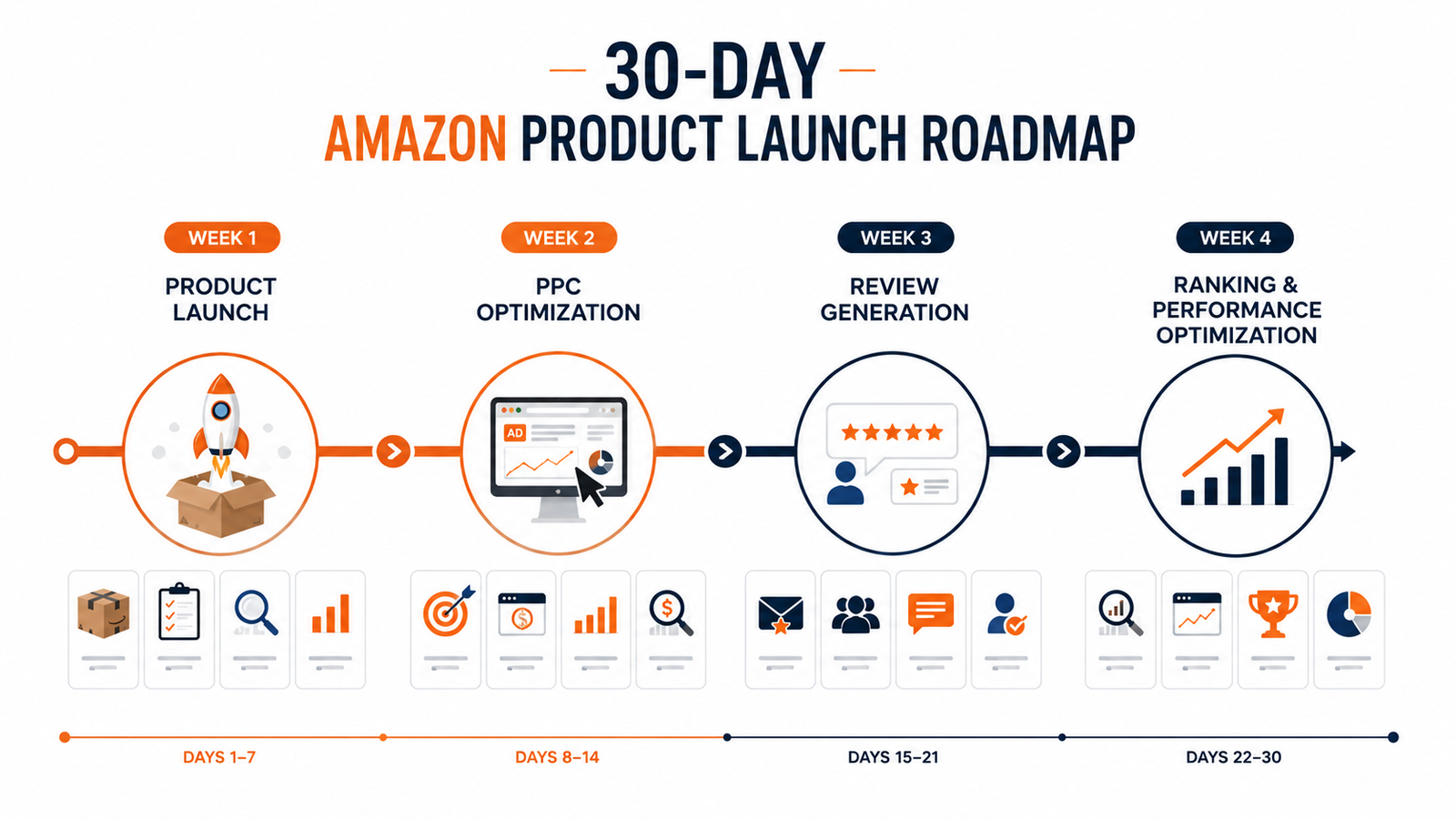
A 30-day roadmap showing the key stages of a successful Amazon product launch and ranking strategy.
How Long Does an Amazon Product Launch Take?
An Amazon product launch takes time and involves more than just listing a product. Research, sourcing, listing optimization, and inventory preparation usually take 30 to 60 days.
Once the product is live, sellers typically spend the next 30 days running ads, improving the listing, and building sales. While some products start ranking within the first month, competitive niches often take 60 to 90 days to gain consistent organic visibility.
Common Amazon Product Launch Mistakes
Understanding why Amazon product launches fail is just as important as knowing the right steps. Here are the most expensive mistakes sellers make:
- Choosing a product with too much competition or too little demand
- Launching with poor images that hurt click-through and conversion rates
- Underfunding PPC during the first 30 days and expecting organic rank to appear
- Running out of stock within 60 days, which resets all ranking gains
- Ignoring Amazon listing SEO and launching with keyword-poor titles and bullets
- Not enrolling in Amazon Brand Registry before the listing goes live
- Pricing is too high to compete with listings that already have hundreds of reviews
- Failing to check and optimize the Amazon PPC campaign for product launch every week
If sales start dropping after launch, the Amazon sales drops explained guide covers the most common causes and fixes.
Also, review Amazon listing ranking factors to understand what keeps products visible long after the launch ends.
Amazon Product Launch Checklist
- Research profitable products
- Perform Amazon keyword research
- Optimize your product listing
- Prepare inventory and pricing
- Launch Amazon PPC campaigns
- Generate early reviews
- Monitor rankings and optimize
Following these launch steps helps build sales velocity and improves your chances of ranking higher in Amazon search results.
Complete Amazon Product Launch Checklist
Use this Amazon FBA product launch checklist as a master reference. Every seller following this Amazon FBA product launch checklist should work through each phase in order before moving to the next.
Phase 1: Pre-Launch Research
- Complete product demand validation using Helium 10 or Jungle Scout
- Verify margin after Amazon FBA fees, shipping, and cost of goods
- Run competitor analysis on the top 10 listings for the target keyword
- Build a full keyword list of 50 to 100 terms using Amazon keyword research tools
- Order samples and confirm quality before placing the full inventory order
Phase 2: Listing Creation
- Write a keyword-optimized title with the primary keyword near the front
- Complete all five bullet points with benefit-first copy
- Write the product description or create A+ Content through Brand Registry
- Fill the backend search terms field completely (250 bytes)
- Upload 7 to 9 professional product images, including lifestyle shots
Phase 3: Pre-Launch Setup
- Send inventory to Amazon FBA covering at least 60 days of projected sales
- Set a competitive launch price slightly below the category average
- Enroll in Amazon Brand Registry to unlock A+ Content and Vine
- Request Amazon Vine reviews if eligible
- Set up all three PPC campaign types with correct budgets and bids
Phase 4: Launch and Post-Launch
- Activate the listing and all PPC campaigns at the same time
- Monitor daily sales velocity and adjust bids within 48 hours if needed
- Pull search term reports at day 7 and day 14
- Move converting search terms from auto into manual exact campaigns
- Reorder inventory at day 30 if the sell-through rate is strong
- Review and optimize the Amazon product launch strategy every two weeks for the first 60 days
This Amazon FBA product launch checklist works for new private label products, wholesale, and Amazon FBA automation businesses alike. Treat it as a living Amazon product launch guide and revisit it before every new product.
Benefits of Following an Amazon Product Launch Checklist
Following a structured Amazon product launch checklist helps sellers prepare every stage of the launch while reducing costly mistakes and improving the chances of ranking successfully on Amazon.
- Choose more profitable products
- Create stronger Amazon listings
- Target the right keywords
- Build sales velocity faster
- Optimize Amazon PPC campaigns
- Increase organic rankings
- Reduce launch risks and costly errors
- Scale future product launches with confidence
A repeatable launch checklist gives every new Amazon product a consistent, data-driven foundation for long-term growth.
Final Thoughts
A successful Amazon launch requires preparation, speed, and steady execution across every phase. This Amazon product launch checklist gives sellers a repeatable process that removes guesswork and replaces it with strategy. Save this Amazon product launch checklist and use it for every future launch.
Use the right research tools for product and keyword discovery. Build listings that serve both the algorithm and the customer. Invest properly in paid advertising. Protect inventory availability at all costs. These habits separate sellers who rank from sellers who stall.
Amazon marketing strategy, built around these principles, works in almost every category. The sellers who win are the ones who plan ahead and follow through on every step.
For those who want a faster path to results, working with a professional Amazon product launch service or an Amazon FBA automation partner can compress the timeline and cut costly mistakes significantly.
Learn more about how to launch a product on Amazon with expert support at HiSellIt or explore scaling Amazon automation consultation options.
Frequently Asked Questions
Q. How long does it take to launch a product on Amazon?
Most products take 60 to 90 days from decision to being live with early reviews and ranking traction. The prep phase, which includes product research, sourcing, listing creation, and shipping to Amazon FBA, takes 30 to 60 days on its own. Once live, the first 30 days of PPC and sales generation build the initial ranking signals. Some niches with lower competition see page-one results within 30 to 45 days. Highly competitive categories may take 3 to 6 months of steady effort. The more complete the Amazon product launch plan is before going live, the faster the results tend to come.
Q. What is the best Amazon product launch strategy?
The best Amazon product launch strategy combines three things at once: a fully optimized listing, aggressive PPC advertising, and a review generation plan. Launching with strong Amazon listing optimization makes sure the listing converts well when traffic arrives. Investing in a solid Amazon PPC launch strategy during the first 30 days drives visibility while organic ranking builds. Using Amazon Vine to generate early reviews removes the biggest conversion barrier for new listings. Together, these three actions create the sales velocity that the A9 algorithm rewards with higher organic placement over time.
Q. How many reviews do you need to rank on Amazon?
There is no fixed review count needed to rank on Amazon. Ranking is driven by sales velocity, conversion rate, and keyword relevance more than reviews alone. That said, getting to 10 to 15 reviews lifts conversion rates, which then accelerates ranking. In most categories, 15 to 25 reviews are enough to compete for mid-range keywords. Highly competitive categories with thousands of reviews on page one will need a longer review-building phase. As part of the Amazon product ranking strategy, focus on getting sales first, and reviews will follow naturally.
Q. How much does it cost to launch a product on Amazon?
A realistic Amazon product launch budget ranges from $3,000 to $10,000, depending on the category, inventory size, and PPC investment. Inventory is usually the biggest cost, often $1,500 to $5,000 for a first batch. An Amazon Professional Seller account costs $39.99 per month. PPC advertising during the first 30 days averages $500 to $2,000. Additional costs include product photography at $300 to $600, listing copywriting if outsourced, and Amazon Vine enrollment. Planning for all of these costs is a core part of any solid Amazon product launch plan.
Q. How to launch a product on Amazon without reviews?
Launching an Amazon FBA product without reviews is one of the biggest challenges for new sellers. Since reviews come after sales, the focus should be on generating initial orders through Amazon PPC, promotions, and competitive pricing. Brand Registry sellers can also use Amazon Vine to collect genuine reviews, while the Request a Review feature in Seller Central helps encourage feedback from verified buyers. Avoid black-hat review tactics, as they can lead to permanent account suspension.


One Comment