
How to Sell on Amazon Without Inventory: Complete 2026 Guide
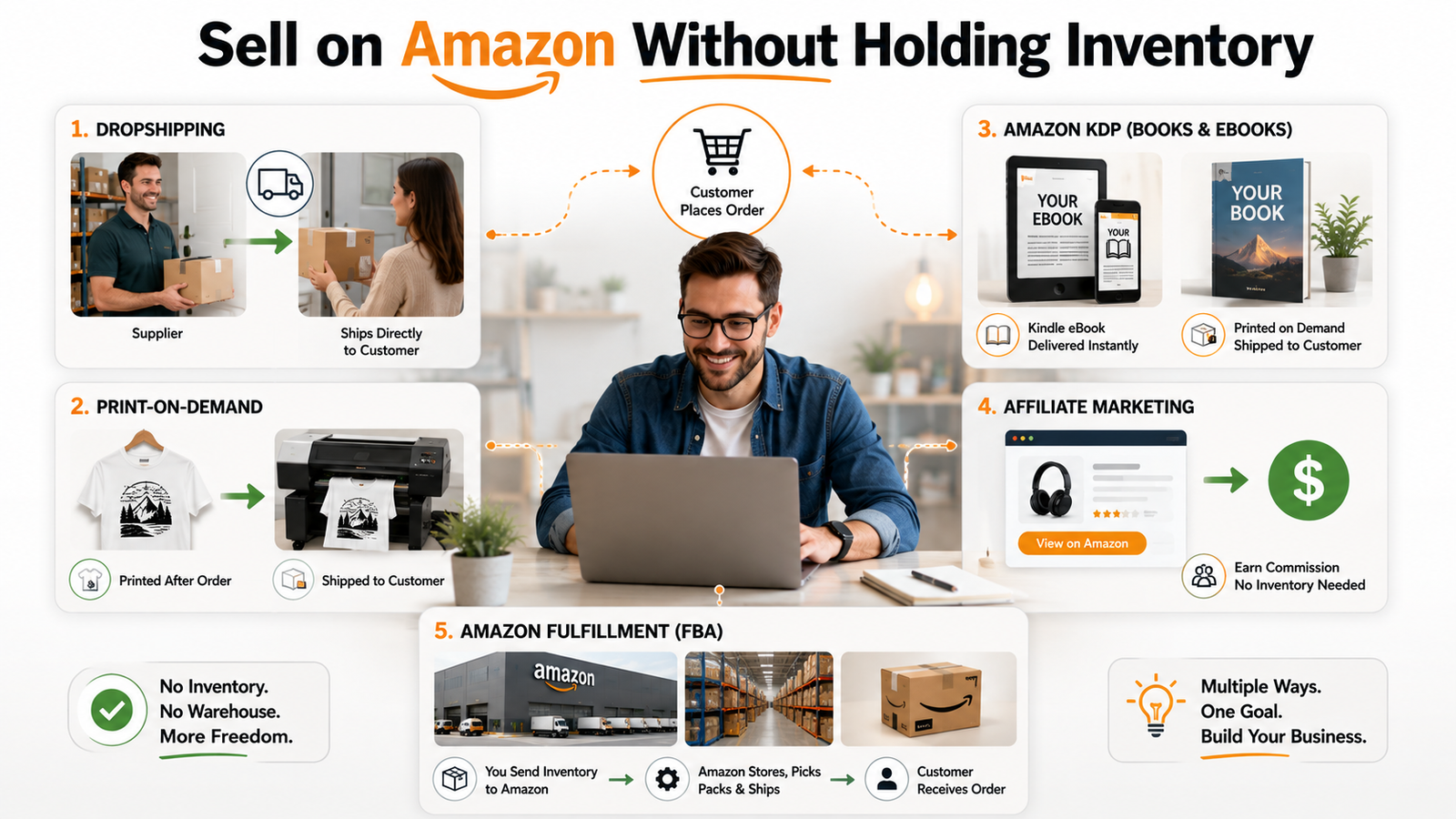
Wondering how to sell on Amazon without inventory? You are not alone. The good news is that there are several legitimate ways to earn through Amazon without personally storing boxes of products in your home or warehouse.
You do not necessarily need a warehouse or a large upfront inventory purchase. Some Amazon programs have no upfront platform or inventory cost, although optional tools, marketing, designs, samples, and other business expenses can still apply.
Amazon reported in 2026 that more than 60% of sales in its store come from independent sellers, most of which are small and medium-sized businesses. That figure includes sellers using many different inventory and fulfillment models, so it should not be interpreted as the percentage using inventory-free businesses. You can read Amazon’s 2025 Small Business Empowerment Report for the current seller data.
This guide covers the main models, how each one works, the real pros and cons, and a step-by-step plan to help you choose the option that fits your skills and budget.
Quick Answer: Can You Sell on Amazon Without Inventory?
Yes. You can sell on Amazon without inventory through compliant dropshipping, Amazon Merch on Demand, and Amazon KDP, where products are fulfilled by a supplier or produced after an order is placed. Amazon Associates is another inventory-free way to earn through Amazon, although it is affiliate marketing rather than selling your own products. Amazon FBA reduces storage and fulfillment work but still requires you to own inventory.
What Does Selling on Amazon Without Inventory Mean?
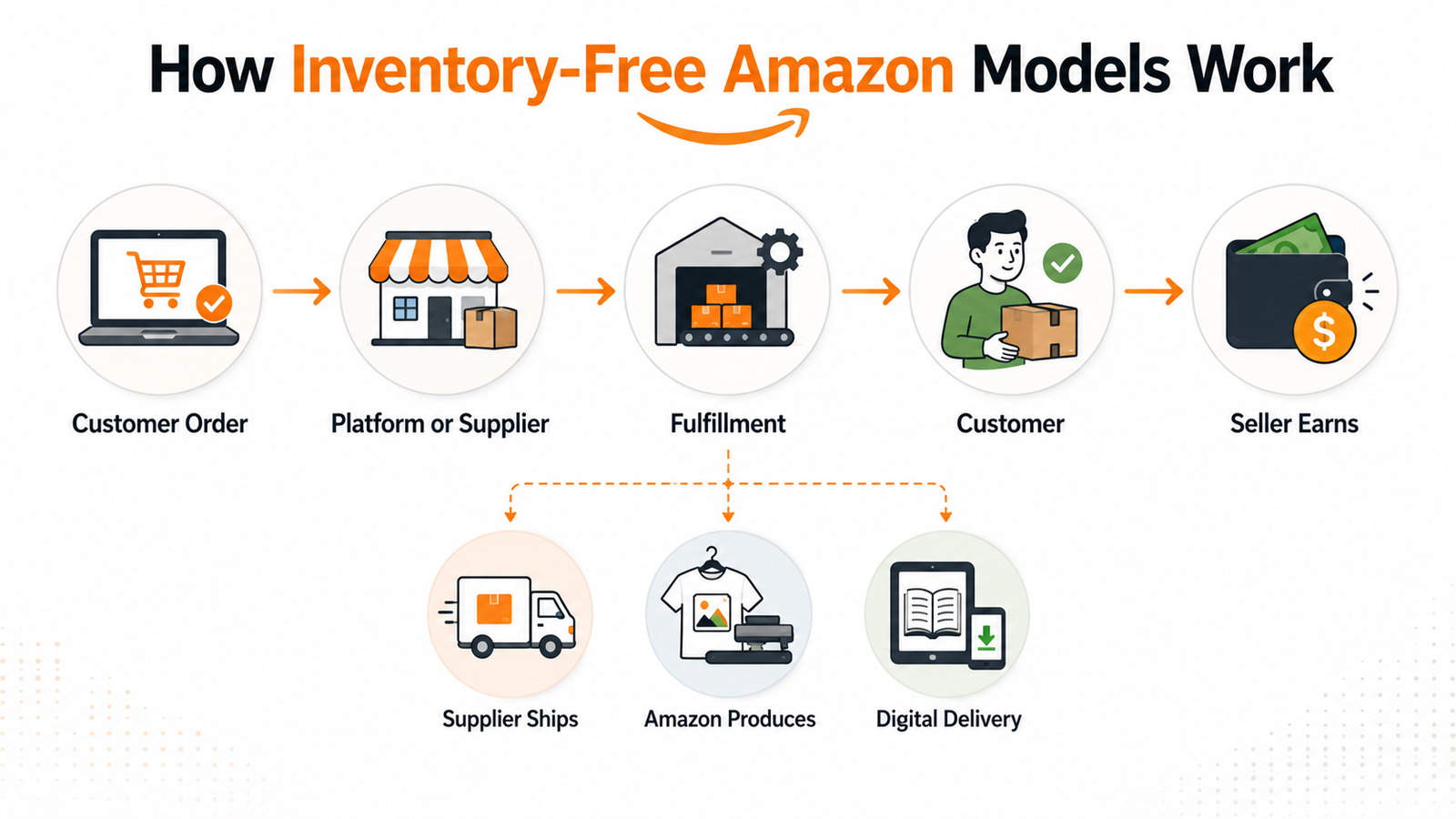
Selling on Amazon without inventory generally means using a business model where you do not personally hold physical stock before fulfilling customer orders.
Depending on the model, products may be shipped by a supplier, printed after an order is placed, delivered digitally, or produced by Amazon itself.
Amazon FBA is slightly different because the seller still owns inventory, but Amazon stores and fulfills it.
Can You Sell on Amazon Without Inventory?
Can you sell on Amazon without inventory? Yes, but the different models should not all be treated as the same type of Amazon business.
Amazon offers several ways to earn through its ecosystem without personally storing products. Merch on Demand and Kindle Direct Publishing let creators publish products that Amazon produces or delivers when customers order.
Amazon Associates works differently. You promote qualifying Amazon products and earn referral commissions rather than selling the products yourself.
You can also use Amazon FBA to reduce the need to store and ship products yourself. However, FBA is not an inventory-free business model because you still purchase or own the products. Amazon stores, picks, packs, ships, and handles eligible customer-service and return tasks after you send inventory to its fulfillment network.
The Amazon dropshipping business model is another option. You list products for sale, and when someone buys, a compliant supplier fulfills the order directly to the customer. Amazon allows dropshipping as long as you remain the seller of record and follow its fulfillment and customer-facing documentation requirements.
So yes, there are real Amazon business models that let you operate without personally storing products. The right one depends on your skills, budget, risk tolerance, and what you actually want to sell.
How to Sell on Amazon Without Inventory: 5 Proven Methods
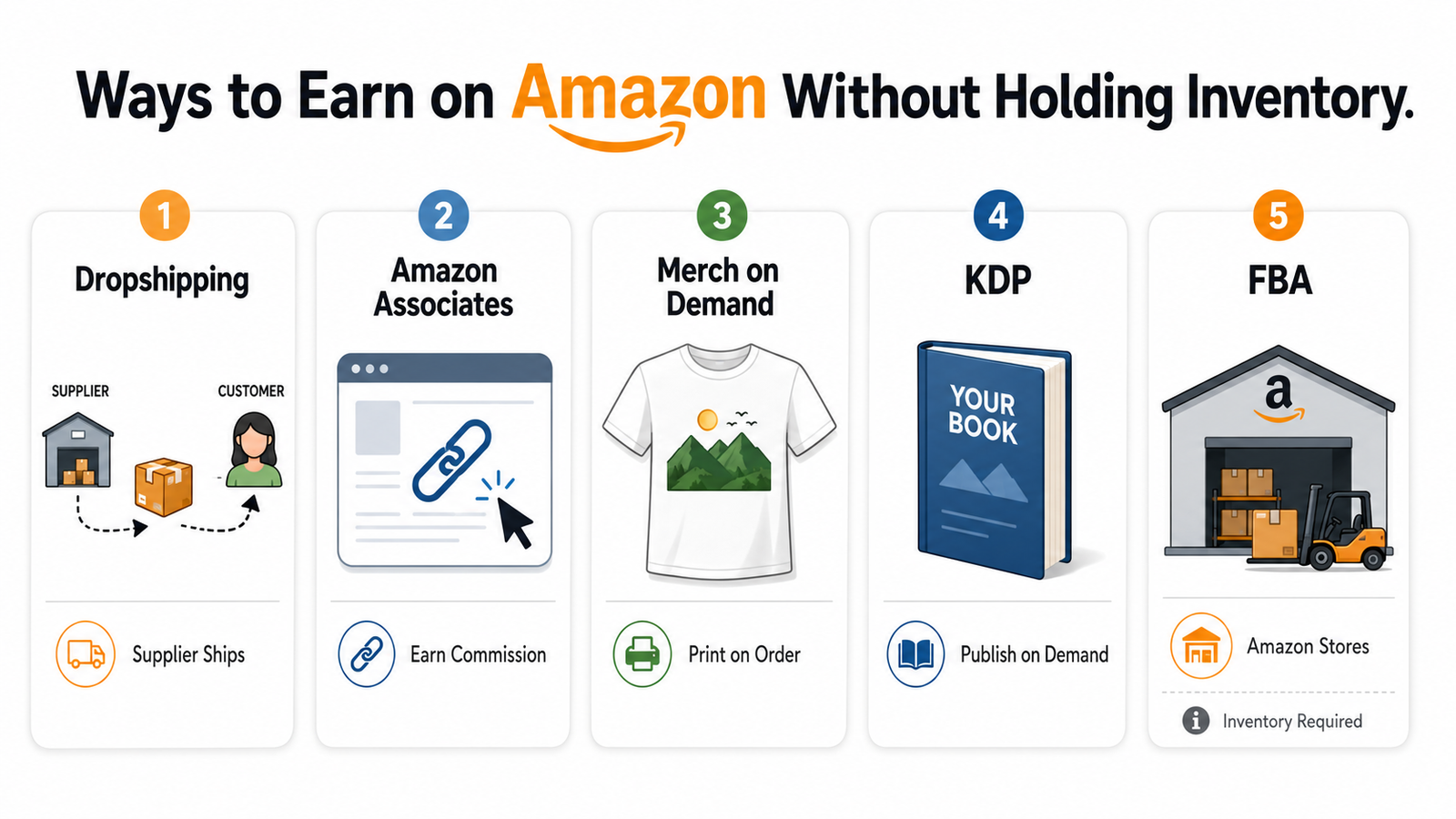 There are several ways to sell or earn through Amazon without personally storing inventory. Each one works differently and has its own learning curve, cost structure, and level of involvement.
Here is a clearer breakdown for 2026.
Comparison of Amazon Business Models Without Inventory
| Business Model | Hold Inventory Yourself? | Main Account | How You Earn |
|---|---|---|---|
| Amazon Dropshipping | No | Amazon Seller Central | Margin after product, Amazon, and operating costs |
| Amazon Associates | No | Amazon Associates | Referral commission |
| Merch on Demand | No | Merch on Demand | Royalty |
| Amazon KDP | No physical stock | Kindle Direct Publishing | Royalty |
| Amazon FBA | Yes, but Amazon stores it | Amazon Seller Central | Product margin after inventory, Amazon, and operating costs |
Amazon Dropshipping Business Model
The Amazon dropshipping business model is one of the most popular ways to sell physical products without storing inventory yourself. Here is how it works:
- You list a product on Amazon
- A customer buys the product from your listing
- You place the order with a compliant manufacturer, wholesaler, or other supplier
- The supplier ships the product directly to the customer
- Your profit depends on what remains after the product cost, Amazon fees, fulfillment expenses, returns, advertising, and other operating costs
Amazon allows dropshipping, but the rules matter.
You must remain the seller of record. Amazon’s policy requires that you are clearly identified as the seller on packing slips, invoices, external packaging, and other customer-facing information where applicable. You are also responsible for processing customer returns. Amazon’s official dropshipping guide explains the seller-of-record requirement.
Dropshipping can reduce the need to buy inventory before an order is received, but that does not mean the business has zero costs. Seller fees, supplier charges, software, samples, returns, advertising, and other expenses may still apply.
Experienced sellers often research and validate products carefully before committing to a long-term supplier relationship. Tools such as Helium 10 and Jungle Scout can support research, but no tool can guarantee that a particular product will be profitable.
If you are building a new physical product offer, our Amazon product launch checklist can help you review the wider product, listing, pricing, inventory, and launch setup before scaling.
Amazon Affiliate Marketing: Amazon Associates
The Amazon Associates program is Amazon’s official affiliate marketing platform.
This model is different from actually selling a product on Amazon. Instead, you recommend qualifying products through special referral links and can earn a commission when eligible purchases are made.
You never buy the product, store inventory, process the order, or ship anything to the customer.
Here is how it works:
- Join the Amazon Associates program
- Choose relevant products to recommend
- Create qualifying affiliate links
- Share those links through an eligible blog, website, YouTube channel, social platform, or other approved content
- Earn commissions on qualifying purchases
This makes Amazon Associates one of the clearest inventory-free ways to earn through Amazon, particularly for bloggers, YouTubers, publishers, and content creators.
Commission rates vary by qualifying product category and Amazon may update its schedule over time, so sellers should check the current Associates terms rather than budgeting around one universal percentage. Amazon’s current U.S. standard schedule lists different rates across categories, including rates from 1% up to 10% for certain qualifying categories.
Inventory needed: None
Earnings: Category-based referral commissions
Amazon Print on Demand Business
An Amazon print-on-demand business lets you sell designs without buying physical inventory in advance.
With Amazon Merch on Demand, you upload artwork for eligible products, create the listing, and Amazon handles production, shipping, and customer service when products sell.
Amazon states that Merch on Demand has no upfront production or inventory cost, and creators receive a royalty when eligible products are sold. You can review the program directly through Amazon Merch on Demand.
The royalty is not a fixed dollar amount.
Amazon calculates Merch royalties based on the product’s offer price minus applicable taxes and Amazon’s costs. That means earnings vary according to the product and selling price.
The Amazon print-on-demand model can suit designers, artists, and creators who want to test product ideas without buying boxes of printed merchandise first.
Upfront inventory cost: None through Merch on Demand
Earnings: Royalty varies by product and selling price
Amazon Kindle Direct Publishing (KDP)
Amazon KDP is Amazon’s self-publishing platform.
You can publish Kindle eBooks or create print editions that Amazon produces when a customer orders. That removes the need for authors to buy and store large print runs themselves.
For Kindle eBooks, KDP currently offers 35% and 70% royalty options, subject to Amazon’s eligibility, pricing, territory, and delivery-cost rules.
Print royalties work differently. KDP currently uses 50% or 60% royalty rates for eligible paperbacks and hardcovers depending on list price and marketplace, with printing costs deducted from the royalty. Amazon provides more detail through its KDP royalties guidance.
A published title can continue generating sales without the author personally printing or shipping each order. However, ongoing demand, promotion, updates, competition, and policy compliance can still affect performance.
Upfront physical inventory: Not required
Earnings: Royalty structure depends on book format, price, and marketplace
 What About Amazon FBA?
Amazon FBA, or Fulfillment by Amazon, is not fully inventory-free.
You still purchase or own the inventory.
What FBA removes is the need to store, pick, pack, and ship those products yourself. You send inventory into Amazon’s fulfillment network, and Amazon handles order fulfillment, customer service, and eligible returns.
This can make FBA much lighter operationally than storing boxes at home or running your own warehouse, but the inventory cost still exists.
Costs vary depending on the products you buy, Amazon selling fees, fulfillment fees, storage, inbound shipping, returns, advertising, and other business expenses. There is no universal FBA startup budget or guaranteed profit margin.
Amazon FBA can work well with Amazon Wholesale FBA services when the goal is to build a more managed inventory-based operation.
Cost Structure for Amazon Business Models
Instead of relying on fixed startup-cost estimates that can quickly become outdated, it is more useful to understand where costs can arise.
| Business Model | Inventory Purchase | Main Potential Costs |
|---|---|---|
| Amazon Dropshipping | Usually after an order | Selling fees, supplier costs, software, returns, advertising |
| Amazon Associates | None | Content production, website, hosting, marketing |
| Merch on Demand | None | Optional design, research, and marketing costs |
| Amazon KDP | None | Optional editing, formatting, cover design, advertising |
| Amazon FBA | Yes | Inventory, selling fees, fulfillment, storage, inbound shipping, advertising |
How to Start an Amazon Business Without Inventory
Knowing how to start an Amazon business without inventory is easier when you separate the models instead of treating them as one system.
Here is a simple step-by-step plan:
- Pick your model. Choose from dropshipping, Amazon Associates, Merch on Demand, or KDP based on your skills, goals, and budget. Consider FBA only if you are comfortable owning inventory.
- Create the account required for your chosen model. Dropshipping and FBA use Amazon Seller Central. KDP, Merch on Demand, and Amazon Associates each use their own program accounts and application processes.
- Do your product or niche research. Use research methods appropriate to your model. Physical-product sellers may use Amazon research tools or third-party platforms, while KDP, Merch, and affiliate creators need research tailored to books, designs, keywords, or content audiences.
- Build your listings or content. Write clear and accurate product listings, upload your book or design if using KDP or Merch, or create useful content if using Amazon Associates.
- Drive traffic. Depending on the model, this might involve Amazon Ads, SEO, social media, video content, or other marketing channels. If paid advertising becomes part of your physical-product strategy, our guide on how Amazon AI ads are changing seller marketing explains how automation is changing campaign management in 2026.
- Track, test, and improve. Monitor the data available through your chosen Amazon program and make changes based on performance rather than assumptions.
Pros and Cons of Selling on Amazon Without Inventory
 Selling on Amazon without personally holding inventory can reduce some of the financial and operational pressure associated with traditional ecommerce.
Before you pick a model, it is still important to understand the tradeoffs.
| Pros | Cons |
| Some models require no upfront inventory purchase | Profit margins or royalties can vary significantly |
| No personal warehouse or storage needed | Supplier delays can hurt physical-product businesses |
| Easier to test some ideas with less inventory risk | Dropshipping policy violations can lead to account enforcement |
| Royalty income potential with KDP and Merch | Affiliate income depends heavily on relevant traffic |
| Scalable with the right tools and systems | Competitive niches can be difficult |
| Can be managed remotely | Every model still requires research and ongoing management |
Best Tools for Amazon Sellers
The right tools depend on the Amazon business model you choose.
For physical-product sellers, tools such as Helium 10 and Jungle Scout can support keyword research, product research, and competitive analysis.
Amazon Seller Central is the main dashboard for sellers using models such as compliant dropshipping and FBA.
KDP publishers should use the research, reporting, and publishing tools relevant to Kindle Direct Publishing, while Merch on Demand sellers need design and trend-research tools suited to print-on-demand products.
Amazon Associates sellers need a different toolkit entirely. Content research, SEO, website analytics, video production, and audience-building tools may matter more than traditional Seller Central software.
Avoid paying for several tools simply because they are popular. Start with what your chosen model actually requires and add software when it solves a clear problem.
Common Beginner Mistakes to Avoid
Even inventory-free Amazon business models have traps that catch beginners.
Here is what to watch out for:
- Skipping supplier vetting. Bad suppliers can ship late, send incorrect products, or create customer-service problems.
- Violating Amazon’s dropshipping policy. Amazon allows dropshipping only when you remain clearly identified as the seller of record. Using another business to fulfill orders in a way that makes that retailer or supplier appear to be the seller can violate Amazon’s policy.
- Ignoring keyword and demand research. Publishing KDP books, Merch designs, or physical products without understanding demand can leave you competing for searches that have little buyer interest.
- Not tracking profitability. You still need to understand fees, commissions, supplier costs, returns, advertising, taxes, and other expenses even when you do not personally store inventory.
- Rushing to scale too fast. Build a working process first. Scaling a model with weak suppliers, poor listings, bad unit economics, or compliance problems only creates bigger problems.
Policy compliance deserves special attention. If a mistake has already caused account enforcement, our Amazon account suspension appeal guide explains what to review before responding to Amazon.
Final Thoughts
Now you know how to sell on Amazon without inventory, but the models are not all the same.
Amazon dropshipping lets a compliant supplier fulfill customer orders while you remain the seller of record. Merch on Demand and KDP remove the need to buy physical stock before sales occur. Amazon Associates allows you to earn referral commissions without selling products yourself. FBA is different because you still own inventory, even though Amazon stores and fulfills it for you.
The key is this: pick one model, learn it well, and stay consistent.
These models can create ways to earn through Amazon without personally storing inventory, but none of them guarantees profit. Success still depends on demand, quality, pricing, compliance, marketing, and the decisions you make along the way.
If you want to build an inventory-based Amazon business without handling the operational side alone, explore our Amazon Wholesale FBA services.
Frequently Asked Questions
Q. Is it possible to sell on Amazon without inventory?
Yes. Amazon supports several models that do not require you to personally store products. Amazon Merch on Demand produces eligible products after they are ordered, while KDP can deliver eBooks digitally or manufacture print books on demand. Compliant dropshipping allows a third-party supplier to fulfill physical orders while you remain the seller of record.
Amazon Associates provides another inventory-free way to earn through Amazon, although it is affiliate marketing rather than selling your own products.
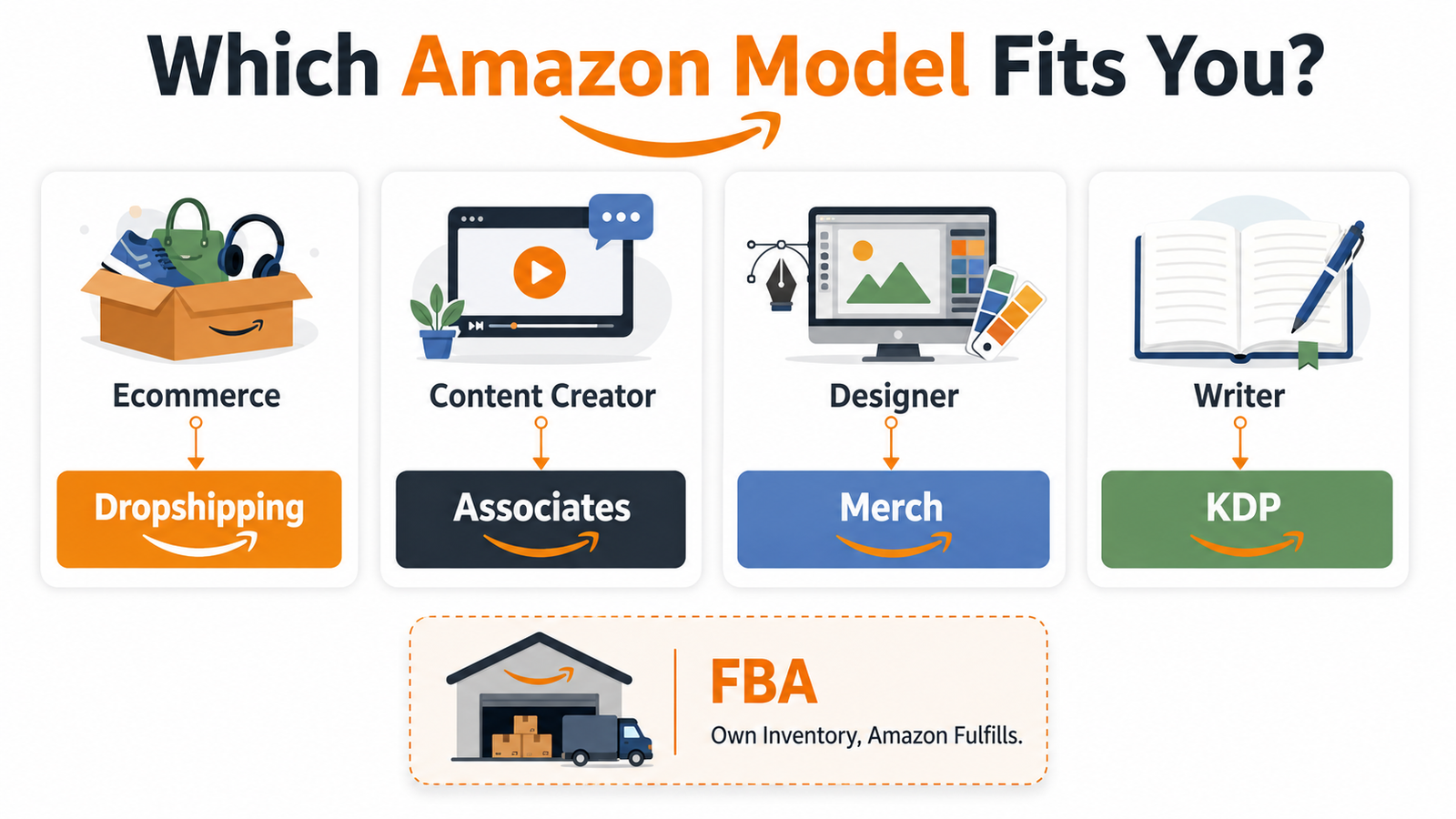
The right model depends on your skills. Designers may prefer Merch, writers and publishers may choose KDP, content creators may prefer Associates, and ecommerce operators may be more comfortable with dropshipping.
Q. Is Amazon dropshipping allowed?
Yes, Amazon dropshipping is allowed, but only when you follow Amazon’s policy. You must remain the seller of record. The customer should identify you, not another retailer or supplier, as the seller. You are also responsible for complying with Amazon’s requirements for packing slips, invoices, external packaging, and returns.
Using another retailer or supplier to fulfill an order in a way that identifies that company as the seller can lead to selling restrictions or other account enforcement.
Q. How much money do you need to start an Amazon business without inventory?
There is no single startup cost because the models are very different. KDP and Merch on Demand do not require you to purchase inventory before making sales. Amazon Associates does not require a Seller Central selling plan. For physical-product sellers on Amazon.com in the U.S., Amazon currently offers an Individual selling plan at $0.99 per item sold and a Professional plan at $39.99 per month, plus applicable referral and other selling fees. The old idea that the first 40 sales are free is incorrect.
Other costs may include suppliers, advertising, research tools, design work, samples, returns, shipping, or professional services.
Q. What is the easiest Amazon business model for beginners?
There is no single easiest model for everyone. Merch on Demand and KDP can be relatively simple from an inventory and fulfillment perspective because Amazon handles production or digital delivery. However, creating products that people actually want to buy still requires research and good execution.
Amazon Associates may make sense if you already have a blog, YouTube channel, website, or social audience. Dropshipping requires more operational oversight because supplier performance, pricing, fulfillment, returns, and Amazon policy compliance all matter.
The easiest model is usually the one that fits your existing skills and resources.
Q. What are the risks of selling on Amazon without inventory?
The risks depend on the model.
With dropshipping, supplier problems and policy violations can affect customer experience and seller-account health. Amazon Associates income depends on traffic, qualifying purchases, and Amazon’s program terms.
KDP and Merch on Demand remove the need to hold inventory, but sales are not guaranteed. Competition, intellectual-property rules, product quality, demand, and Amazon’s policies still matter. Across all models, ignoring Amazon’s rules is one of the biggest avoidable risks.
Q. Can you earn passive income from Amazon without inventory?
KDP, Merch on Demand, and Amazon Associates can continue generating royalties or commissions from books, designs, or content you have already created.
However, the income is not guaranteed and should not be treated as completely passive. Products and content may still need promotion, updates, research, optimization, policy monitoring, and ongoing audience development.
The main advantage is that you can build income streams without personally storing and shipping every physical product yourself.
Not sure which Amazon model makes the most sense for your budget and goals? Contact the HiSellIt team to discuss your options.