
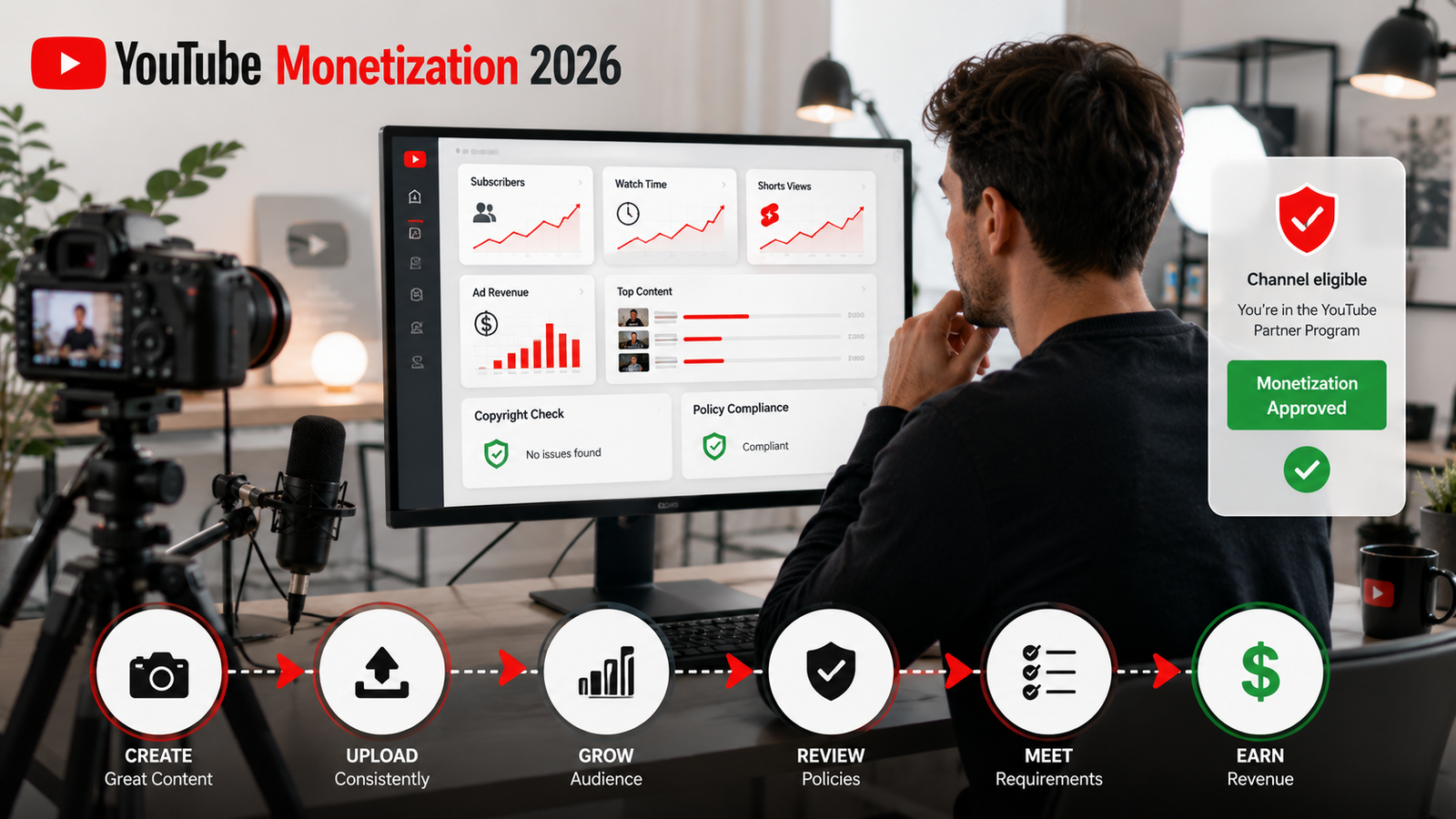
YouTube Monetization Policies 2026: The Complete Guide Every Creator Needs
YouTube monetization policies in 2026 have changed more than most people realize. Some of it is good news. Some of it catches creators off guard. Either way, not knowing the rules is the fastest way to get rejected or, worse, demonetized after you’ve already been approved.
This guide breaks it all down. No fluff. No confusion. Just clear, simple explanations of exactly what YouTube expects from you before it starts sharing revenue with your channel.
Quick Answer: What Are the YouTube Monetization Requirements in 2026?
For full ad revenue sharing in 2026, creators generally need 1,000 subscribers and either 4,000 qualified public watch hours in the previous 12 months or 10 million qualified public Shorts views in the previous 90 days. Channels must also follow YouTube monetization policies, have no active Community Guidelines strikes, enable 2-Step Verification, have access to advanced features, and link or set up an active AdSense for YouTube account.
What the YouTube Partner Program Actually Is
The YouTube Partner Program (YPP) is YouTube’s official system for paying creators. It’s the gateway between making videos and making money from them. YouTube outlines the full program structure and eligibility criteria directly on the YouTube Partner Program overview page.
When a channel joins the YPP, it gets access to several income streams depending on its eligibility and the monetization modules it accepts. These can include ad revenue, YouTube Premium revenue, channel memberships, Super Chat, Super Stickers, Super Thanks, and Shopping features.
AdSense for YouTube is the account used to receive eligible creator payments. YouTube connects the channel to AdSense for YouTube during the monetization application process, and creators can either link an existing active account or set one up through YouTube Studio.
YouTube Studio is the dashboard where everything gets managed. Video uploads, analytics, monetization settings, copyright notices, and the YPP application itself.
YouTube Monetization Requirements 2026: What You Actually Need
This is where a lot of creators get confused because there are now two levels of access to the YouTube Partner Program, and each has different YouTube monetization requirements.
Tier 1: Basic Access Through the Expanded YPP
In countries and regions where the expanded YPP is available, the lower eligibility threshold is:
- 500 subscribers
- 3 valid public uploads in the last 90 days
- 3,000 qualified public watch hours in the last 12 months OR 3 million qualified public Shorts views in the last 90 days
This tier can give eligible creators earlier access to fan-funding and select Shopping features, including options such as channel memberships, Super Chat, Super Stickers, and Super Thanks. But it does not include full Watch Page or Shorts Feed ad revenue sharing.
Tier 2: Full Ad Revenue and YouTube Premium Revenue
This is where most creators want to be. To unlock full ad and YouTube Premium revenue sharing in 2026, the YouTube monetization eligibility thresholds are:
- 1,000 subscribers
- 4,000 qualified public watch hours in the past 12 months OR 10 million qualified public Shorts views in the last 90 days
- No active Community Guidelines strikes
- 2-Step Verification enabled
- Access to YouTube’s advanced features
- An active AdSense for YouTube account linked to the channel, or one ready to be set up through YouTube Studio
- A channel based in a country or region where YPP is available
- Compliance with YouTube’s monetization policies
The YouTube 1,000 subscribers rule hasn’t changed for full ad revenue in 2026. The YouTube 4,000 watch hours requirement is also still the standard long-form route. What’s become increasingly important is YouTube’s enforcement of originality, authenticity, and overall channel quality.
Important 2027 Update Creators Should Know About
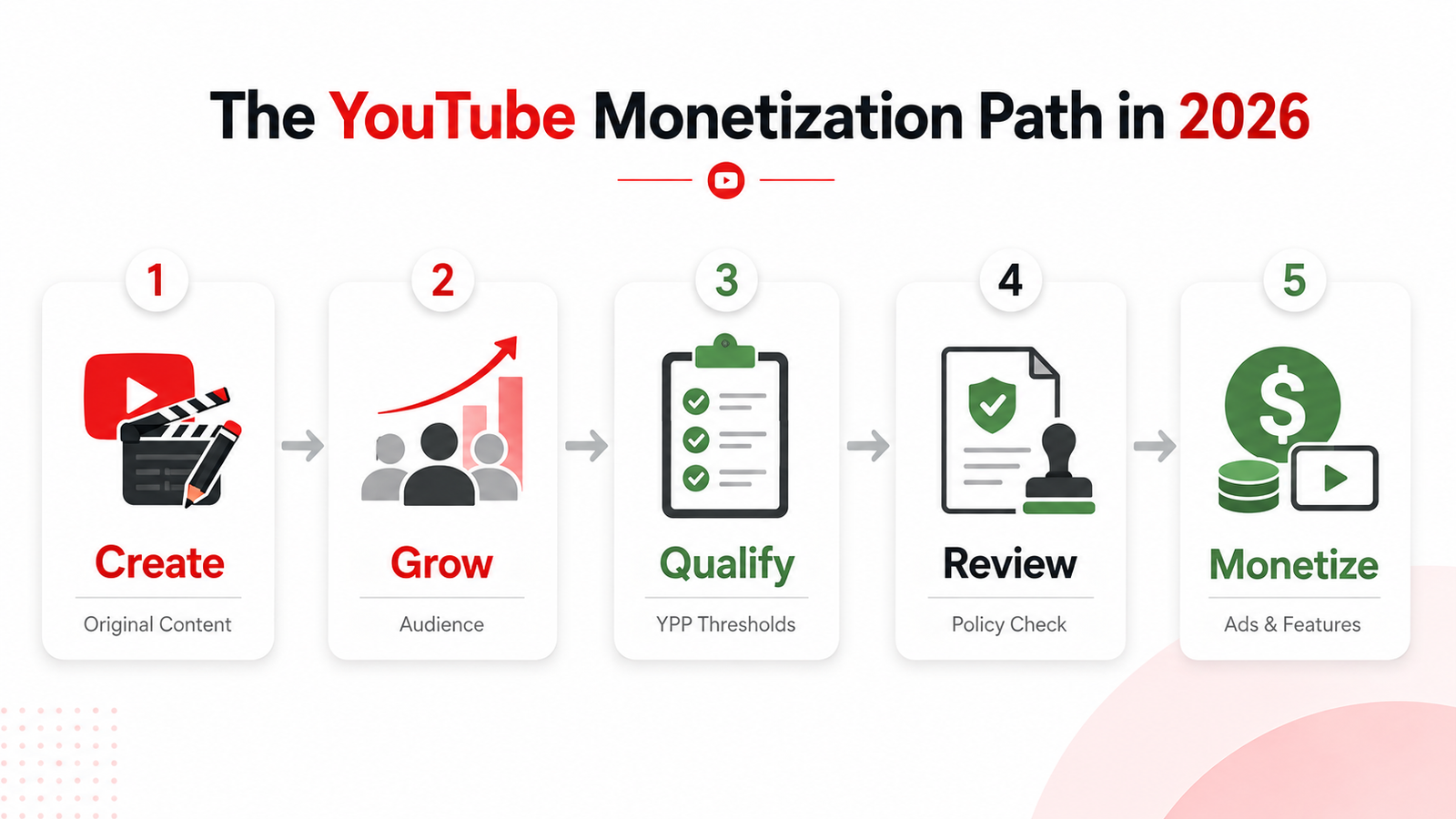
The requirements above remain the correct rules for 2026, but YouTube has already announced a major change for new YPP applicants.
Starting February 1, 2027, new creators seeking ads and YouTube Premium revenue sharing will need 1,000 subscribers plus either 8,000 qualified watch hours in the previous 365 days or 20 million qualified Shorts views in the previous 90 days. YouTube says channels already in YPP will not lose their status simply because these entry thresholds change. The earlier-access fan-funding thresholds remain unchanged. YouTube’s official 2027 YPP update explains the upcoming changes in full.
 YouTube Shorts Monetization 2026: How It’s Different
YouTube Shorts runs on a separate monetization model. Understanding this matters because a lot of creators assume Shorts and long-form videos work the same way. They don’t.
For YouTube Shorts monetization in 2026, YouTube pools revenue from ads shown between Shorts in the feed. Revenue is then allocated to eligible monetizing creators based on their share of qualifying engaged Shorts views, after YouTube accounts for music licensing where applicable.
Monetizing Shorts creators keep 45% of the revenue allocated to them from the Creator Pool.
For Shorts to generate revenue, the creator must be in YPP, accept the Shorts Monetization Module, and comply with YouTube’s monetization, copyright, Community Guidelines, and advertiser-friendly policies. Non-original Shorts, artificial views, and other ineligible engagement can be excluded from revenue sharing. Shorts longer than one minute that contain active claimed content are blocked and are not eligible for monetization. YouTube’s Shorts monetization policies explain these rules in detail.
The Shorts watch-hours requirement also doesn’t work the same way. Watch time from Shorts viewed in the Shorts Feed does not count toward the 4,000 qualified public watch-hour threshold for the long-form route.
YouTube Shorts can now be up to three minutes long when they meet YouTube’s current Shorts-format requirements.
Here’s a corrected comparison:
Long-Form vs YouTube Shorts Monetization
| Feature | Long-Form Videos | YouTube Shorts |
|---|---|---|
| Main Full-YPP Threshold | 4,000 qualified public watch hours | 10M qualified public Shorts views |
| Measurement Window | 12 months | 90 days |
| Ad Revenue Model | Watch Page ads | Shorts Feed revenue pool |
| Creator Revenue Share | 55% of net Watch Page ad revenue | 45% of allocated Creator Pool revenue |
| Shorts Feed Watch Time Counts Toward 4,000 Hours? | Not applicable | No |
| Shorts Length | Not applicable | Up to 3 minutes |
The two formats use different revenue systems, so per-view earnings shouldn’t be treated as directly interchangeable. Long-form Watch Page creators receive 55% of net Watch Page ad revenue under the applicable module, while Shorts creators receive 45% of their allocated Creator Pool revenue.
If your Shorts aren’t reaching enough viewers to make the monetization threshold realistic, our guide on why YouTube Shorts are not getting views covers the visibility side separately.
YouTube Reused Content Policy: The Rule That Trips People Up
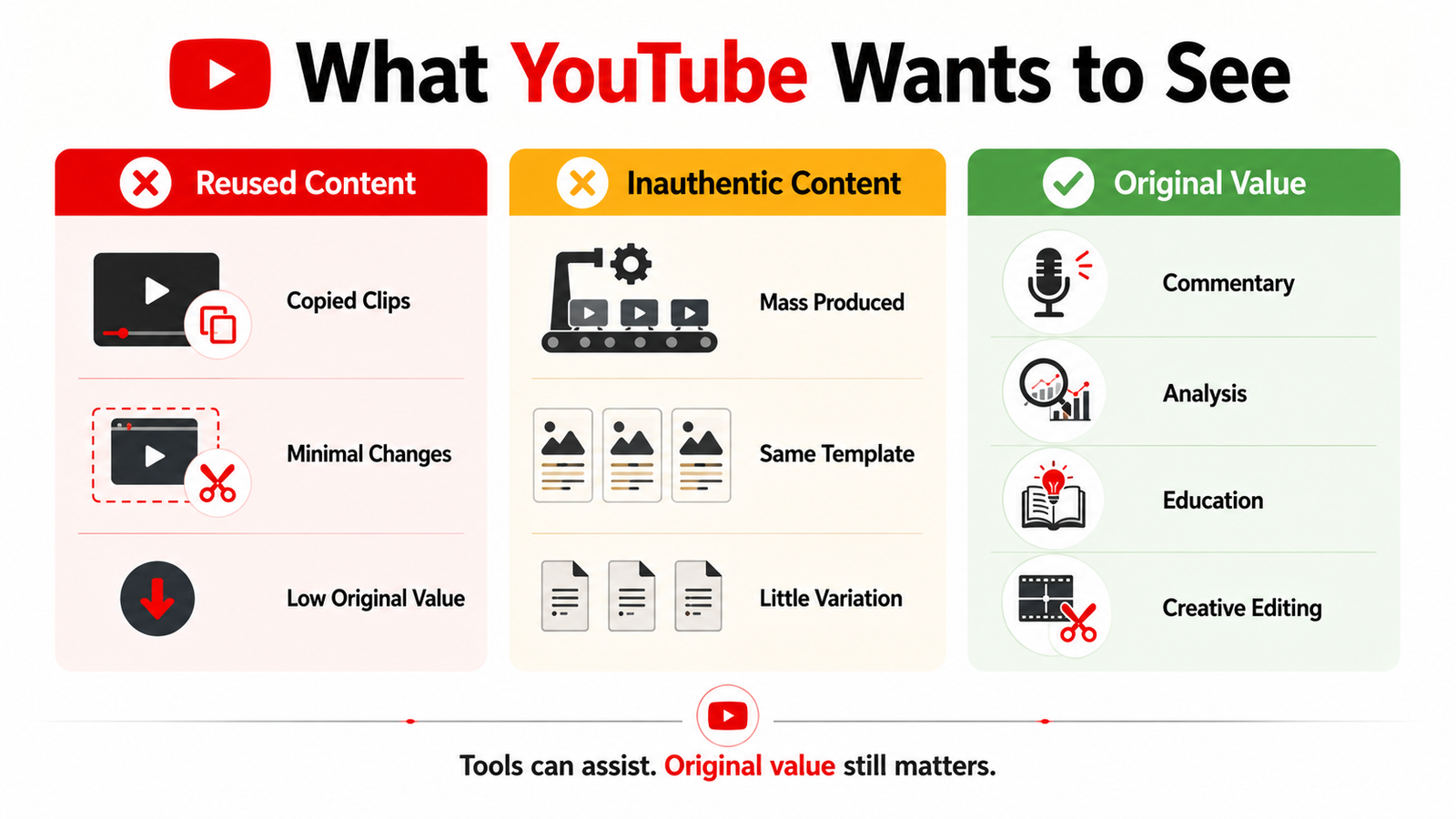
This one matters more in 2026 than ever before. The YouTube reused content policy focuses on channels that repurpose material already available on YouTube or elsewhere without enough original commentary, substantial modification, educational value, or entertainment value.
YouTube’s position is straightforward. If you’re using someone else’s content, the finished video needs to demonstrate meaningful original contribution.
What can create reused content problems:
- Compilations of clips from other YouTube channels without meaningful commentary
- Slideshows with stock images and text-to-speech voiceover but little original insight
- Reaction videos where the reaction itself adds little value
- Re-uploaded content from other platforms with only minor edits
What may qualify when done properly:
- Commentary, critique, or analysis added to third-party footage
- Educational breakdowns with original narration
- Documentary-style content using clips with proper rights and substantial original context
- Reaction content where the creator adds meaningful commentary or analysis
A lot of channels in the YouTube automation space use voiceover and stock footage. That format is not automatically a violation, but the content has to demonstrate original value. If the finished video gives viewers little more than they would get from the original source material, monetization can become difficult.
Channels building automated content workflows should review common demonetization mistakes in YouTube automation before submitting a monetization application.
Inauthentic Content: The Other Rule Automation Channels Need to Know
There is another policy that creators using scalable production systems need to understand in 2026.
YouTube renamed its former repetitive content policy to inauthentic content. This clarification focuses on content that is mass-produced, generic, highly repetitive, template-based, or designed mainly to generate views rather than provide meaningful creative, educational, or entertainment value. YouTube also made clear that this update did not replace or change its separate reused-content policy.
This distinction matters for YouTube automation channels.
Using AI, stock footage, templates, synthetic voices, or production systems does not automatically make a channel ineligible for monetization. The problem is when videos become so repetitive that the substance barely changes from one upload to the next.
YouTube specifically says that channels following a similar pattern can still monetize when the substance of each video is materially different and provides real value.
If you’re evaluating the business model itself as well as the monetization rules, our guide on whether YouTube automation is saturated looks at the wider opportunity in 2026.
 YouTube Copyright Policy 2026: Strikes, Claims, and Content ID
The YouTube copyright policy is enforced partly through Content ID. This is an automated matching system that YouTube uses to identify copyrighted audio and video.
When you upload a video and Content ID identifies a match, the rights holder may choose to:
- Monetize the video
- Block the video in certain locations or entirely
- Track the video’s viewing statistics
- In some cases, share revenue with the uploader
A copyright claim is different from a copyright strike. A Content ID claim usually affects the individual video and does not itself create a copyright strike. A copyright strike usually follows a valid legal copyright removal request.
Copyright strikes are more serious. They can expire after 90 days when the relevant requirements are met, and channels with three active copyright strikes are at risk of termination.
For monetization, a Content ID claim does not automatically mean your entire channel becomes ineligible. Depending on the rights holder’s policy, the video may be blocked, tracked, monetized by the rights holder, or sometimes subject to revenue sharing.
Channels aiming for monetization still need clean rights management. That means using material you own, have permission to use, have properly licensed, or can otherwise lawfully include.
YouTube Community Guidelines and Monetization
YouTube Community Guidelines are the rules around what content is allowed on the platform. They cover areas such as hate speech, violence, harassment, dangerous content, spam, and other harmful behavior.
The strike process works like this:
- A first violation is typically a warning
- A first Community Guidelines strike usually causes a one-week posting restriction
- A second strike within the same 90-day period usually causes a two-week posting restriction
- Three strikes within the same 90-day period may result in the channel being permanently removed
Eligible creators may also be offered policy training for certain warnings.
Even without a Community Guidelines strike, individual videos can still receive limited or no ads if they don’t meet YouTube’s advertiser-friendly content guidelines.
Advertiser-friendly guidelines are separate from the basic rules about whether content can remain on YouTube. Sensitive subjects may receive different monetization treatment depending on factors such as context, graphic detail, language, presentation, and whether the material is educational, journalistic, documentary, or primarily designed to shock viewers.
YouTube publishes its full advertiser-friendly content guidelines so creators can review the rules before uploading.
Invalid Traffic and Ad Fraud: A Silent Demonetization Risk
Invalid traffic refers to fake views, artificial engagement, automated traffic, or ad activity that YouTube does not consider genuine.
This is a less talked-about YouTube demonetization reason, but it’s real.
If YouTube detects invalid traffic, it may adjust earnings, temporarily limit ad serving, delay payments, suspend or disable the associated AdSense for YouTube account, or in serious cases remove monetization from the channel.
The fix here is straightforward: don’t buy views, don’t use traffic bots, don’t encourage artificial ad interactions, and don’t participate in view-exchange or incentivized-traffic schemes designed to manipulate performance.
YouTube Demonetization Reasons: Why Channels Lose Monetization
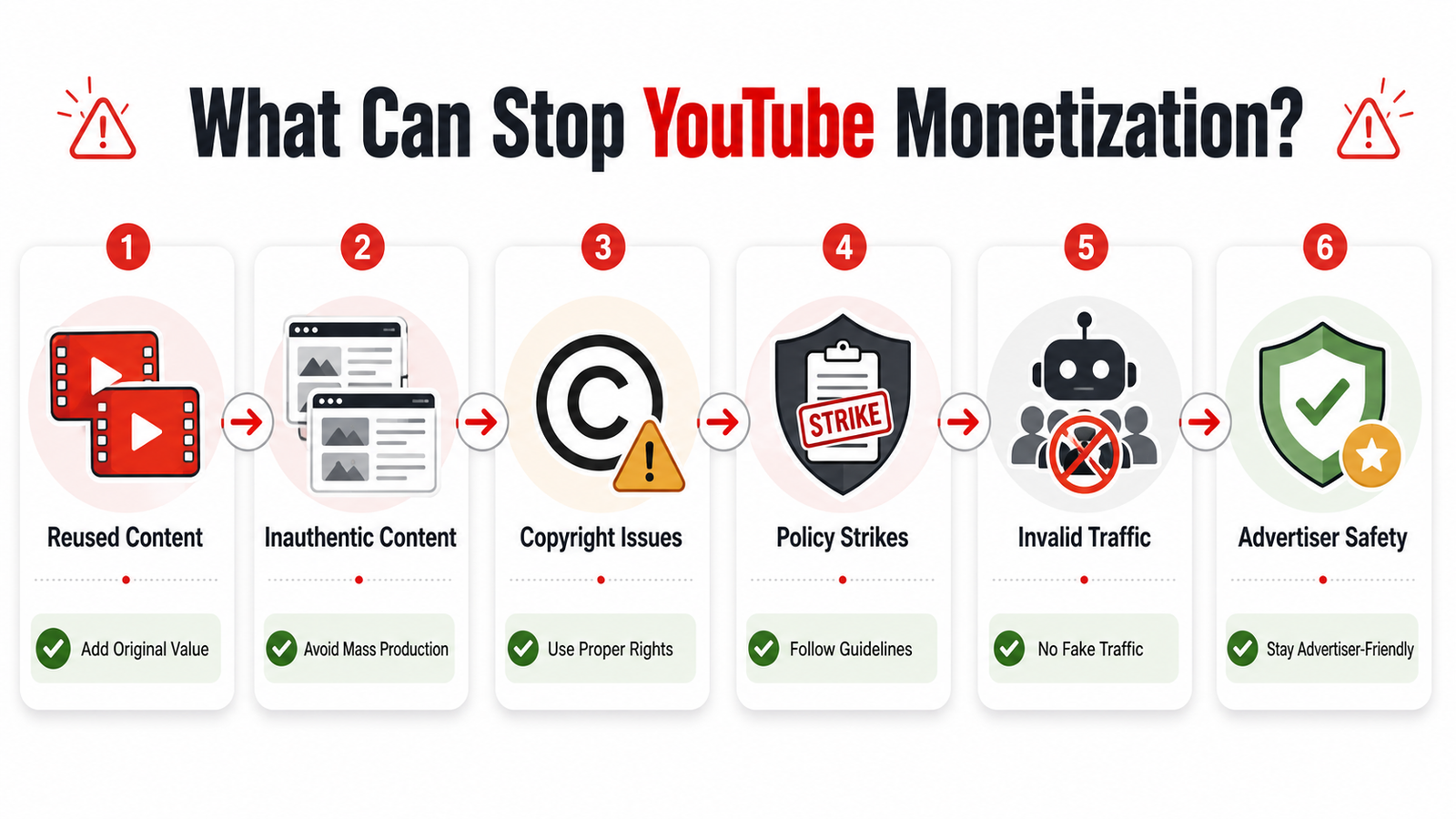
Understanding YouTube demonetization reasons helps creators avoid them. Here are some of the most common risks:
- Reused content — not enough original contribution
- Inauthentic content — mass-produced, generic, or highly repetitive videos
- Copyright violations — serious or repeated rights issues
- Community Guidelines violations — channel-policy problems
- Advertiser safety issues — videos that don’t meet advertiser-friendly standards
- Invalid traffic — artificial views, clicks, or other suspicious activity
- Ongoing monetization-policy violations
- Channel inactivity
YouTube may turn off monetization on channels that haven’t uploaded a video or posted to the Posts tab for six months or more.
Policy changes themselves do not automatically demonetize every previously approved channel. However, YouTube continues to review channels in YPP, which means creators need to remain compliant with the current monetization rules over time.
 How Long Does YouTube Monetization Review Take?
The YouTube monetization review time in 2026 is typically around one month, although it can be shorter or longer depending on application volume, system issues, available review resources, and whether a channel requires additional review.
During review, automated systems and human reviewers assess whether the channel meets YPP requirements.
They’re looking at the channel as a whole. YouTube says reviewers may focus on areas such as:
- Your main channel theme
- Most-viewed videos
- Newest videos
- Videos generating the largest share of watch time
- Titles, thumbnails, descriptions, and other metadata
- The channel’s About section
Meeting the subscriber and watch thresholds allows you to apply. It does not guarantee acceptance.
How to Appeal a Demonetization Decision
If a channel gets rejected or loses monetization, the exact appeal process depends on what happened.
If Your YPP Application Is Rejected
If you believe YouTube incorrectly rejected your YPP application, you can appeal within 21 days.
If it is your first unsuccessful application and you don’t appeal successfully, you can generally work on the channel and reapply after 30 days. If the channel has already been rejected before, the reapplication period can be 90 days.
If Your Channel Is Suspended From YPP
For YPP suspensions, creators may have the option to appeal before or after the suspension depending on the notice they receive.
YouTube may give a creator seven days to appeal a scheduled suspension before it takes effect. If the channel is already suspended, there may be a 21-day appeal window. If the appeal is rejected, the creator can generally reapply to YPP 90 days after the suspension date.
YouTube may also ask creators to submit a video appeal showing how they create their content and explaining why the channel follows YPP policies. So the process is not always just a short written explanation.
Appeal options appear in the Earn section of YouTube Studio when the channel is eligible to use them.
For demonetization of individual videos rather than the full channel, creators can review the monetization status inside YouTube Studio and request a review where that option is available.
How YouTube Ad Revenue Actually Works: CPM, RPM, and Real Numbers
This part confuses a lot of creators, so let’s make it very simple.
CPM (Cost Per Mille) is an advertiser-side metric that shows the cost advertisers pay for 1,000 ad impressions before YouTube’s revenue share.
RPM (Revenue Per Mille) shows how much revenue you earn per 1,000 video views after YouTube’s revenue share. Depending on the report, RPM can include revenue from ads, YouTube Premium, memberships, Super Chat, and other creator revenue sources.
For Watch Page ads, YouTube currently pays creators 55% of net advertising revenue under the Watch Page Monetization Module. Shorts use a different model, with creators receiving 45% of the revenue allocated to them from the Shorts Creator Pool.
How Much Does YouTube Pay Per 1,000 Views?
There is no single YouTube payment rate per 1,000 views in 2026.
CPM and RPM vary depending on factors such as:
- Advertiser demand
- Viewer location
- Content niche
- Seasonality
- Monetized playbacks
- Video format
- Audience behavior
- Ad availability and formats
- YouTube Premium viewing
This is why generic CPM tables can be misleading. A finance channel, gaming channel, technology channel, and entertainment channel can all see very different rates, and two channels in the same niche can still earn different RPMs.
For example, if a creator’s actual YouTube Analytics shows an RPM of $3, then 100,000 views at that RPM would work out to roughly $300 in revenue.
That is simply a mathematical example. It is not a typical or guaranteed YouTube rate.
The most useful CPM and RPM numbers are the ones shown inside your own YouTube Analytics.
Monetization Checklist: Before You Apply
Use this before hitting the apply button:
- Channel has at least 1,000 subscribers for full ad revenue
- Channel has 4,000 qualified public watch hours in the last 12 months or 10M qualified public Shorts views in 90 days
- All videos use original content or material you have the necessary rights to use
- No active Community Guidelines strikes
- Existing Content ID claims have been reviewed
- Channel content follows YouTube monetization policies
- Channel content follows advertiser-friendly guidelines
- 2-Step Verification is enabled
- Advanced features access is enabled
- An active AdSense for YouTube account is linked or ready to be set up
- No suspicious traffic patterns, bought views, or fake engagement
- Channel has been reviewed for reused and inauthentic content
Channels that check every box before applying are in a stronger position than channels that rush into review simply because the subscriber and watch-hour numbers have been reached.
Final Thoughts on YouTube Monetization Policies 2026
The rules aren’t complicated, but they are strict. YouTube has built the YPP to reward creators who treat their channels like real media operations: original content, clean rights management, policy compliance, and content that viewers actually want to watch.
Understanding YouTube monetization policies isn’t just about hitting a subscriber count. It’s about building a channel that earns and keeps monetization long-term.
In 2026, creators also need to think beyond reused content. YouTube’s inauthentic-content policy makes it especially important to avoid mass-producing highly repetitive videos that provide too little meaningful variation or value.
The creators who thrive aren’t the ones who game the system. They’re the ones who understand it well enough to build something that fits cleanly inside it, then scale from there.
Whether that means growing a single channel or building out automated content systems with YouTube automation services, the foundation is still the same: original, compliant, advertiser-safe content that viewers actually want to watch.
Frequently Asked Questions
Q. What are the YouTube monetization eligibility requirements in 2026?
To qualify for full ad and YouTube Premium revenue sharing through the YouTube Partner Program in 2026, a channel generally needs 1,000 subscribers and either 4,000 qualified public watch hours in the past 12 months or 10 million qualified public Shorts views in the past 90 days.
Beyond the numbers, the channel must follow YouTube’s monetization policies, have no active Community Guidelines strikes, use 2-Step Verification, have advanced features access, be based in a YPP-supported country or region, and link or set up an active AdSense for YouTube account.
Q. What are the most common YouTube demonetization reasons?
Common reasons channels lose monetization include reused content that doesn’t add enough original value, inauthentic or highly repetitive content, serious copyright issues, Community Guidelines violations, advertiser-friendly content problems, invalid traffic, and broader violations of YouTube’s channel monetization policies.
YouTube may also turn off monetization on channels that remain inactive for six months or more.
Q. What exactly is the YouTube reused content policy, and how does it affect monetization?
The YouTube reused content policy applies when creators repurpose material that already exists without enough original commentary, substantial modification, educational value, or entertainment value.
This can affect channels that rely heavily on clip compilations, re-uploaded footage, minimally transformed source material, or reaction videos with little original contribution.
The key is meaningful transformation and original value.
Reused content is also different from YouTube’s separate inauthentic content policy, which focuses more on mass-produced, generic, repetitive, or template-based content with too little meaningful variation from one video to another.
Q. How does YouTube Shorts monetization work compared to long-form videos?
YouTube Shorts monetization runs on a pooled revenue model rather than the standard Watch Page ad model.
YouTube collects eligible Shorts Feed ad revenue, accounts for music licensing, allocates revenue to monetizing creators based on their share of qualifying engaged views, and creators then keep 45% of the revenue allocated to them.
Long-form Watch Page ads work differently, with creators receiving 55% of net Watch Page advertising revenue under the applicable monetization module.
Q. How much does YouTube pay per 1,000 views in 2026?
YouTube does not publish one fixed payment rate for every 1,000 views.
Actual RPM varies based on advertiser demand, viewer geography, niche, video format, seasonality, monetized playbacks, ad availability, and other factors.
The most accurate RPM benchmark for an individual creator is the number shown in that channel’s own YouTube Analytics.
Q. How long does the YouTube monetization review process take?
YouTube says YPP applications are typically reviewed in about one month, although some channels receive a decision sooner and others may take longer.
If a first application is rejected, creators can generally appeal within 21 days or make changes and reapply after 30 days. Later rejected applications may require a 90-day wait before another application.
If you’re unsure whether your current channel is ready to apply, scale, or recover from a monetization problem, contact the HiSellIt team to discuss your current setup.