
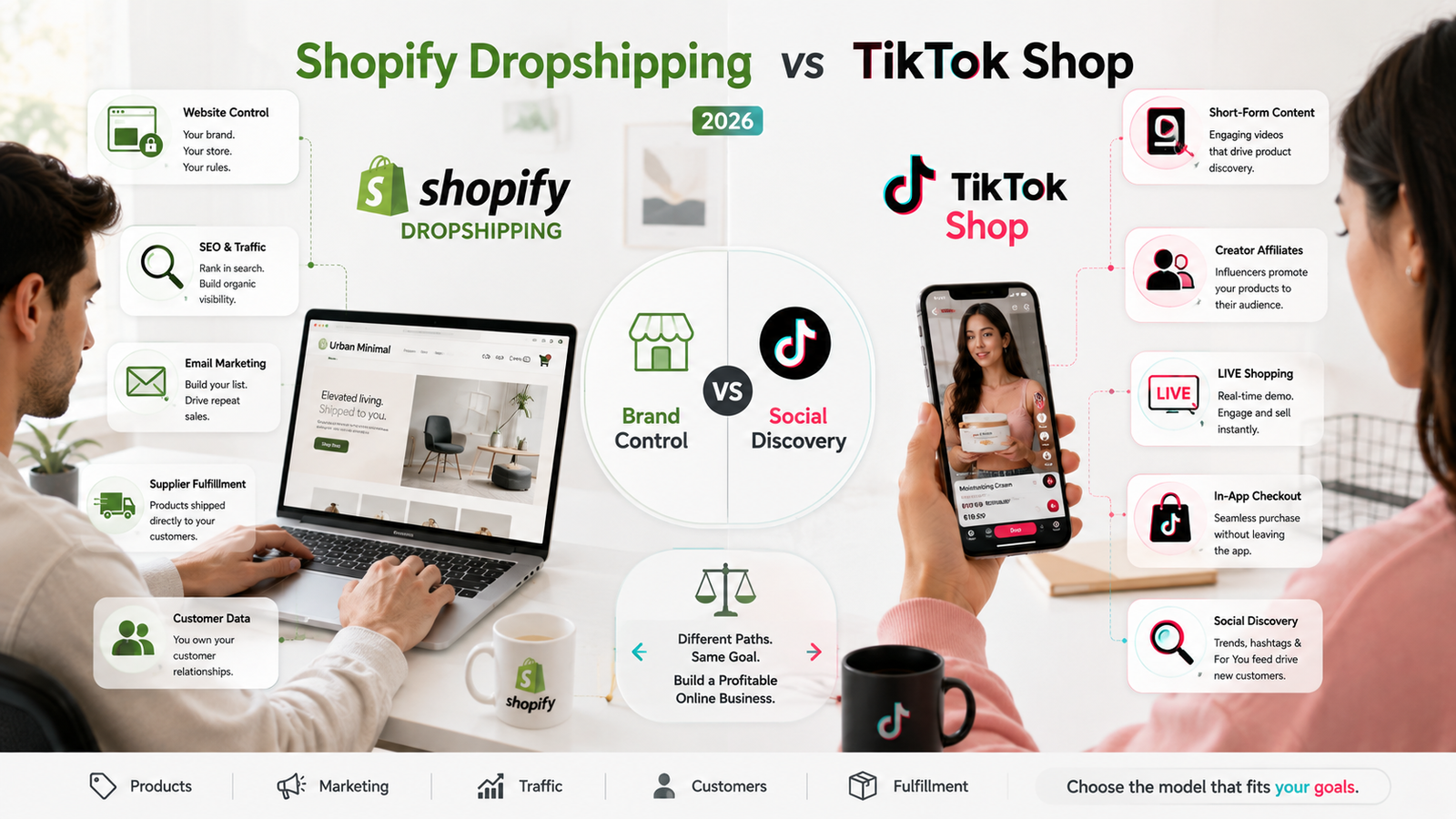
Shopify Dropshipping vs TikTok Shop 2026: Which Is Better?
One of the most important decisions ecommerce business owners may face is whether to build an independent Shopify dropshipping store or sell through TikTok Shop. However, these are not identical business models. Shopify is an ecommerce platform that can be used with dropshipping fulfillment, while TikTok Shop is a social-commerce sales channel where sellers can use different fulfillment methods.
Both opportunities remain significant in 2026. Shopify’s current dropshipping research describes dropshipping as a retail fulfillment model where suppliers ship products directly to customers and estimates that dropshipping will generate more than $476 billion in ecommerce sales in 2026. Shopify’s 2026 dropshipping overview TikTok Shop has also expanded rapidly in the U.S., with TikTok reporting that Shop sales increased 120% year over year during the first part of 2025. TikTok Shop’s U.S. growth update
Over the past few years, the ecommerce landscape has changed significantly as social commerce has become more closely connected with product discovery. Shopify dropshipping gives merchants a standalone storefront and access to multiple customer-acquisition channels, while TikTok Shop combines content, creators, product discovery, and purchasing inside the TikTok ecosystem.
It is therefore not enough to simply ask which platform is more profitable. You need to consider your products, margins, marketing strengths, fulfillment strategy, customer-acquisition plan, and how much control you want over the customer relationship. This comprehensive Shopify dropshipping vs TikTok Shop comparison will help you understand the differences and decide which model better aligns with your goals.
Quick Answer: Shopify Dropshipping vs TikTok Shop, Which Is Better in 2026?
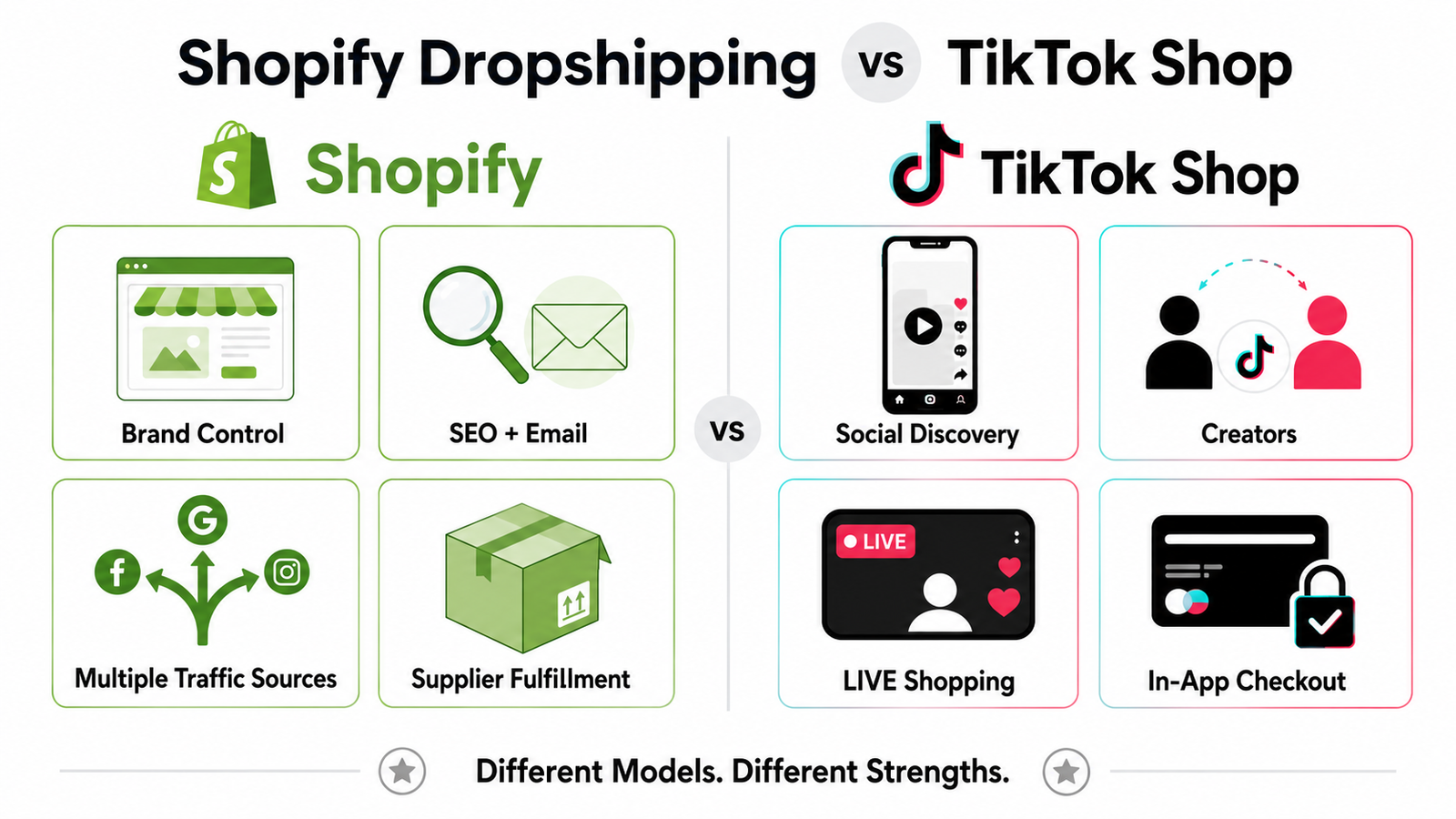
Shopify dropshipping is generally better suited to sellers who want greater control over their storefront, branding, customer relationships, SEO, email marketing, and traffic sources. TikTok Shop is well suited to products that benefit from short-form video, creator affiliates, LIVE shopping, social discovery, and in-app purchasing. Neither is automatically more profitable. The better option depends on your products, margins, marketing skills, fulfillment strategy, audience, and business goals.
Understanding Shopify Dropshipping in 2026
What Is Shopify Dropshipping?
Shopify dropshipping remains a popular way for entrepreneurs to launch an online store without purchasing and storing inventory upfront. With this business model, you sell products through your own branded Shopify store while a supplier handles storage, packaging, and shipping directly to your customers.
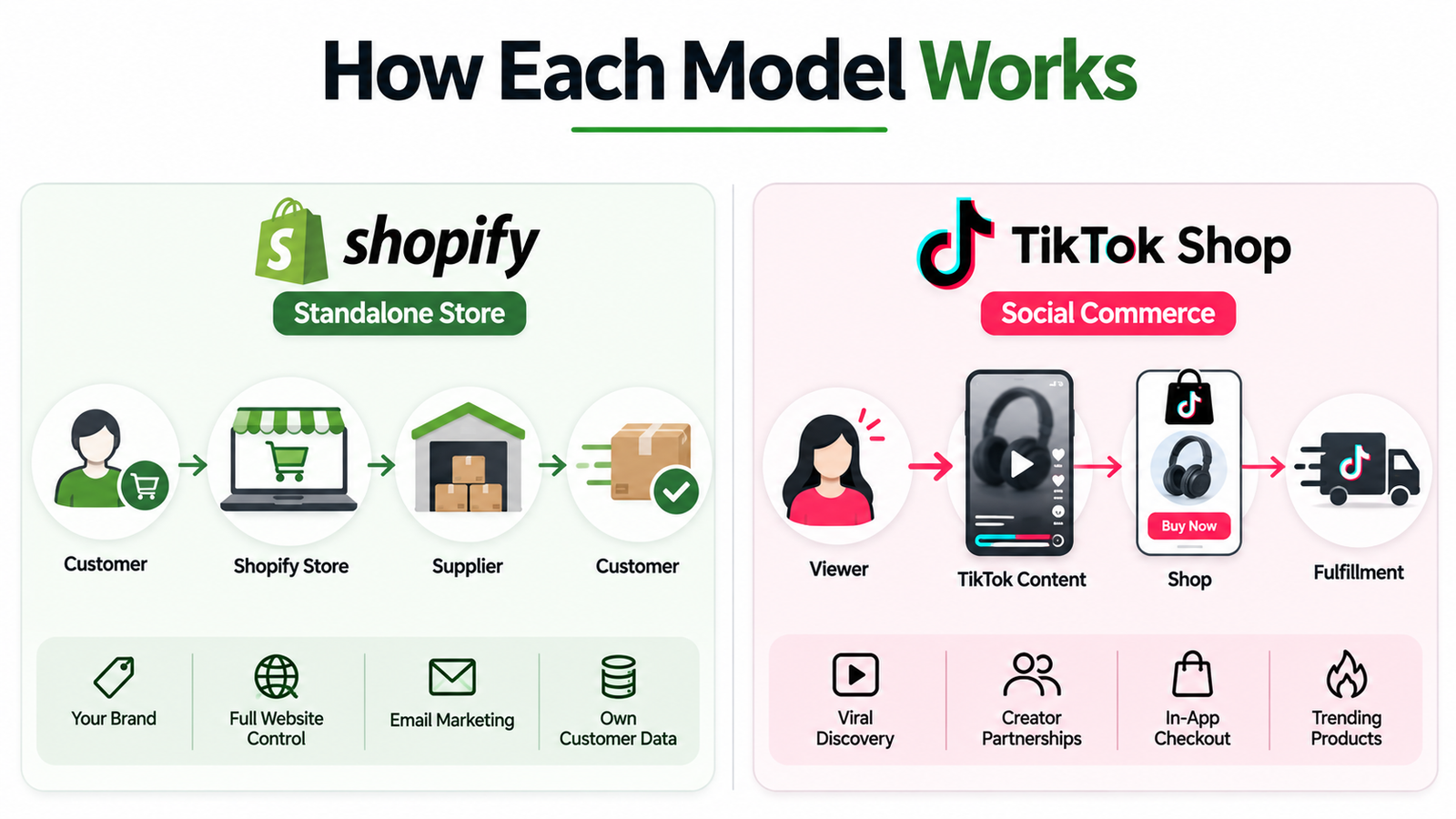
As explained in Shopify’s official dropshipping guide, the customer places an order through your store, the order is sent to the dropshipping supplier, and the supplier prepares and ships the product directly to the customer. The merchant remains responsible for important parts of the business, including product selection, pricing, marketing, customer communication, and the overall buying experience.
One of the biggest advantages is control. You can build your own storefront, choose how customers experience your brand, change your catalog, create content, run email campaigns, and acquire visitors through different channels.
Shopify also gives merchants more direct access to customer profiles than a marketplace-style sales channel. Customer information and segments can be managed within Shopify, and customer lists can be exported where appropriate, subject to privacy and marketing-consent requirements. Shopify’s customer management guidance
This does not make a Shopify store completely independent of platforms. You are still subject to Shopify’s terms, payment providers, advertising-platform policies, search-engine algorithms, and supplier performance. However, the ability to diversify traffic through SEO, email, paid advertising, social media, affiliates, and direct visits can reduce reliance on one discovery algorithm.
Current Market Position and Statistics
Dropshipping remains a significant ecommerce model in 2026. Shopify’s current research estimates more than $476 billion in ecommerce sales will be generated through dropshipping in 2026, while also making clear that the model comes with tradeoffs such as reduced control over fulfillment and customer experience.
That market size should not be interpreted as a guarantee of success for individual stores. There is no reliable universal “Shopify dropshipping success rate,” nor is there evidence that a specific percentage of stores reaches a particular monthly revenue level.
Success depends on factors such as product-market fit, supplier reliability, customer-acquisition costs, conversion, pricing, shipping, competition, refunds, and execution.
If you are still deciding what type of products to sell, our guide to the best Shopify dropshipping niches can help you evaluate potential markets before committing to a product category.
Advantages of Shopify Dropshipping
Complete Brand Control: With Shopify, you can build your own website with your chosen domain, branding, navigation, product pages, and customer experience. This gives you significantly more control over how your business is presented than selling only through a marketplace.
Diverse Traffic Sources: You do not have to rely on one recommendation system. Shopify stores can acquire visitors through Google search, paid advertising, social media, influencers, affiliates, direct traffic, and email marketing. Diversifying acquisition can reduce the impact if one channel becomes more expensive or performs poorly.
Flexible Unit Economics: Shopify does not use the same marketplace referral-fee structure as TikTok Shop, but that does not mean Shopify sales are fee-free. You still need to calculate Shopify subscription costs, payment processing, apps, supplier costs, shipping, advertising, refunds, returns, and customer service. Whether Shopify produces better margins depends on the economics of the specific product and store.
Standalone Brand Experience: A Shopify store gives you more room to build detailed product pages, educational content, comparisons, FAQs, bundles, and other brand assets. This can be particularly useful for businesses trying to build a recognizable ecommerce brand rather than relying entirely on marketplace discovery.
For businesses that want help with the operational side of the model, HiSellIt’s Shopify dropshipping services are focused specifically on building and managing Shopify-based dropshipping operations.
Disadvantages and Challenges
Store and Operating Costs: Shopify dropshipping requires a paid ecommerce plan as well as any other tools you decide to use. Shopify’s current U.S. pricing lists Basic at $39 per month when paid monthly or $29 per month when billed annually, although regional pricing and promotions can differ. Check Shopify’s current pricing Additional costs may include a domain, apps, themes, samples, advertising, and content creation.
Marketing Complexity: Shopify gives you access to multiple marketing channels, but you are also responsible for bringing customers to the store. This can involve SEO, paid ads, social content, creators, email marketing, or a combination of channels.
Building Traffic Takes Work: Shopify does not automatically provide a built-in audience for every new store. Some businesses may generate traffic quickly, while others require more time to test products and acquisition channels. There is no reliable universal timeline for profitability.
Technical and Operational Requirements: Running a Shopify store can involve website management, payment setup, product pages, apps, supplier integrations, customer service, analytics, and conversion optimization.
 Exploring TikTok Shop Selling in 2026
What Is TikTok Shop?
TikTok Shop is an example of social commerce, allowing eligible businesses and creators to sell products within the TikTok ecosystem. TikTok Shop launched in the U.S. in September 2023 and has since expanded around shoppable videos, LIVE shopping, search, Shop discovery, affiliate creators, and paid advertising.
Unlike Shopify dropshipping, TikTok Shop is not inherently a dropshipping model. TikTok Shop sellers can use different fulfillment methods depending on their eligibility and business setup.
The platform combines content and commerce, allowing buyers to discover products while watching videos, interacting with creators, searching, viewing LIVE sessions, or exploring Shop content.
Market Growth and Opportunities
TikTok Shop’s growth has created meaningful opportunities for social-commerce sellers. TikTok reported that U.S. Shop sales increased 120% year over year during the first part of 2025. During the four-day Black Friday and Cyber Monday shopping period in 2025, U.S. TikTok Shop sales exceeded $500 million.
The discovery-driven model gives sellers an opportunity to reach potential customers through content rather than relying entirely on conventional search or advertising.
However, viral reach should never be treated as guaranteed. TikTok’s recommendation systems use signals such as user interactions, content information, and user information to decide what content is recommended. Strong content can sometimes reach people beyond an account’s existing follower base, but distribution and sales vary from video to video.
If you want to explore this part of the strategy in more depth, our TikTok Shop marketing hacks guide covers current approaches to content, Shop SEO, creators, listings, and advertising.
Benefits of TikTok Shop Selling
Social Product Discovery: Products can be discovered through short-form video, TikTok search, LIVE shopping, creator recommendations, and Shop surfaces rather than depending entirely on conventional product searches.
Built-in Creator Affiliate System: TikTok Shop’s Affiliate Center supports Open Collaboration and Target Collaboration. Open Collaboration allows eligible creators to discover products to promote, while Target Collaboration lets sellers invite specific creators and set commission arrangements. TikTok Shop’s official affiliate collaboration guide
Integrated Shopping Experience: Buyers can discover and purchase eligible products without leaving TikTok’s Shop environment, reducing the number of steps between discovery and checkout.
Content-Driven Marketing: Sellers can use demonstrations, tutorials, reviews, comparisons, LIVE content, and creator partnerships to explain and promote products.
Paid Advertising Options: TikTok Shop advertising has also evolved. Since July 2025, GMV Max has become the default and only supported campaign type for new TikTok Shop Ads campaigns using TikTok Shop as the sales destination, with certain legacy exceptions. TikTok’s official GMV Max guidance
Drawbacks and Limitations
Platform Dependency: Your TikTok Shop operation is subject to TikTok’s marketplace rules, product policies, recommendation systems, seller-performance standards, and account enforcement.
More Restricted Customer Relationships: TikTok Shop gives sellers access to information needed to process and support orders, but customer communication and personal information are more tightly controlled than on a standalone Shopify store.
Content and Creator Demands: TikTok Shop often works best when sellers can consistently produce useful content or collaborate with creators who can demonstrate products effectively. This can require ongoing creative planning and campaign management.
Referral and Other Selling Costs: TikTok Shop does not use a standard monthly U.S. seller subscription like Shopify, but it does charge referral fees. Current U.S. guidance shows most product categories at 6%, with some categories at 5% and specific exceptions. TikTok Shop’s current U.S. referral-fee schedule
Affiliate commissions, samples, advertising, fulfillment, shipping, returns, and product costs can add to those expenses.
Businesses that want help operating on this channel can explore HiSellIt’s TikTok services. Our TikTok Shop automation tools guide also explains where software can support repetitive Shop workflows.
Head-to-Head Comparison: Key Factors
Shopify Dropshipping vs TikTok Shop in 2026
| Factor | Shopify Dropshipping | TikTok Shop |
|---|---|---|
| Business Type | Standalone ecommerce store using dropshipping fulfillment | Social-commerce sales channel and marketplace |
| Inventory | Seller usually does not hold inventory | Depends on fulfillment method |
| Platform Pricing | Monthly Shopify plan plus applicable operating costs | No standard monthly U.S. seller subscription; referral fees apply |
| Customer Relationship | Greater access to customer profiles, segments and opted-in marketing contacts | More restricted by TikTok Shop customer-data and communication rules |
| Primary Discovery | SEO, ads, email, social media, affiliates and direct traffic | Videos, search, Shop, creators, LIVE and paid Shop ads |
| Creator Affiliate Tools | Available through apps and external partnerships | Built into TikTok Shop Affiliate Center |
| Brand Control | High | More limited by marketplace structure |
| Fulfillment | Dropshipping supplier normally ships directly to the customer | Seller Shipping, TikTok Shipping or Fulfilled by TikTok, depending on eligibility |
| Best Fit | Standalone brand building and diversified customer acquisition | Social discovery, creator-led commerce and in-app shopping |
 Startup Costs and Investment Requirements
The cost difference between Shopify dropshipping and TikTok Shop cannot be reduced to one fixed startup number.
For Shopify dropshipping, expenses can include your Shopify plan, domain, optional apps or themes, samples, supplier costs, payment processing, advertising, branding, refunds, and customer service. The Shopify Basic plan currently starts at $39 per month on monthly U.S. billing or $29 per month when billed annually.
TikTok Shop does not charge a standard monthly U.S. seller subscription, but sellers should account for referral fees, product costs, shipping or fulfillment, affiliate commissions, samples, paid advertising, content production, returns, and refunds. Most current U.S. product categories have a 6% referral fee, although category-specific exceptions exist.
TikTok Shop may therefore require less fixed platform spending at the beginning, but it should not be described as free. Shopify has a recurring platform cost, but the final economics of either model depend much more on product margin and customer-acquisition costs than on the initial subscription.
Revenue Potential and Profit Margins
There is no reliable universal profit-margin range, monthly revenue potential, time-to-first-sale, or scale-up timeline for either Shopify dropshipping or TikTok Shop.
With Shopify dropshipping, profitability depends on supplier costs, shipping, payment processing, advertising, apps, returns, refunds, conversion, and customer retention.
With TikTok Shop, profitability can be affected by product costs, referral fees, creator commissions, advertising, fulfillment, samples, returns, and conversion.
Neither platform is inherently more profitable. The better comparison is the amount of contribution margin left after all costs required to generate and fulfill a sale.
Marketing and Customer Acquisition
Shopify Dropshipping Marketing: To succeed with Shopify dropshipping, sellers can use several customer-acquisition channels. SEO, Google Ads, paid social, creators, affiliates, content marketing, and email can all contribute to traffic. This diversity can make the business less dependent on one marketing source, but it also requires sellers to understand which channels actually work for their audience.
Email is particularly useful once a store starts building an opted-in audience. Our Shopify email marketing strategy guide covers abandoned-cart flows, segmentation, campaigns, retention, and other ways to use email without relying entirely on paid acquisition.
Customer-acquisition cost varies widely depending on the product, audience, advertising channel, geography, competition, and creative quality. Sellers should calculate CAC from their own campaign data rather than assuming a universal dollar benchmark.
TikTok Shop Marketing: TikTok Shop marketing focuses heavily on product discovery through short-form content, creators, search, LIVE, affiliate partnerships, and paid Shop advertising. The opportunity for organic discovery can be significant, but the platform does not guarantee that content will reach millions of users.
A sustainable TikTok strategy should therefore measure actual product views, clicks, orders, creator performance, conversion, advertising costs, affiliate commissions, and margins instead of relying on virality alone.
Time Investment and Management
Both models require ongoing work, but there is no reliable fixed number of hours that applies to every seller.
Shopify dropshipping may involve customer service, supplier management, marketing, website optimization, product research, order monitoring, analytics, and conversion work.
TikTok Shop can involve content creation, creator management, community engagement, Shop operations, fulfillment, analytics, advertising, and LIVE shopping.
The important difference is the type of work involved, not whether one requires exactly four hours or eight hours per day.
Long-Term Business Sustainability
Shopify Dropshipping Sustainability
Shopify stores can build long-term business assets such as a recognizable domain, content library, organic search visibility, customer profiles, opted-in email subscribers, direct traffic, and brand awareness.
The ability to use several traffic sources can reduce dependence on one social-media recommendation algorithm. However, the business still depends on Shopify, payment providers, suppliers, and other marketing platforms.
For sellers who want a standalone ecommerce brand and are willing to build multiple acquisition channels, Shopify can provide a strong foundation for long-term development.
TikTok Shop Sustainability
TikTok Shop sustainability depends on more than viral content. Sellers need repeatable processes around product selection, creator relationships, advertising, fulfillment, Shop performance, customer service, and content.
Platform dependence remains an important difference because TikTok controls the selling environment and marketplace policies. Changes to Shop rules, product requirements, fulfillment standards, or content distribution can influence seller performance.
The strongest TikTok Shop businesses therefore focus on consistent operations rather than expecting each product to become viral.
Target Audience and Seller Considerations
Who Succeeds With Shopify Dropshipping?
Shopify dropshipping can suit sellers who enjoy managing a standalone ecommerce business and want more control over branding, customer acquisition, product pages, analytics, SEO, and marketing.
A useful Shopify seller profile is someone who is willing to learn multiple channels, analyze data, work with suppliers, optimize a website, and build a brand over time. There is no particular age group or fixed amount of startup capital that automatically makes someone a better Shopify dropshipper.
Who Thrives With TikTok Shop?
TikTok Shop can suit sellers who are comfortable with short-form video, creator partnerships, social trends, LIVE commerce, and rapid creative testing.
Being comfortable on camera can help, but it is not mandatory. TikTok Shop’s affiliate system means brands can also work with independent creators who demonstrate and promote products on their behalf.
The better question is not whether the seller is under 35 or belongs to a particular generation. It is whether the product and marketing strategy fit a social-commerce environment.
Platform Features and Capabilities
Shopify’s Comprehensive Ecommerce Ecosystem
Shopify offers a broad ecommerce infrastructure for managing products, customers, orders, analytics, apps, payments, marketing integrations, and online-store design. Dropshippers can connect with suppliers using apps, direct supplier relationships, or Shopify’s own sourcing ecosystem.
Key Shopify capabilities for dropshippers include inventory and supplier integrations, SEO tools, customer profiles, email and marketing integrations, sales analytics, multichannel selling, and extensive store customization.
The main advantage is that these tools operate around your own ecommerce storefront rather than requiring the customer journey to remain inside a social marketplace.
TikTok Shop’s Social Commerce Innovation
TikTok Shop integrates shopping with short-form content, creators, search, and LIVE experiences.
Current features include shoppable content, LIVE shopping, Affiliate Center, Open Collaboration, Target Collaboration, Seller Center reporting, Shop discovery, and GMV Max advertising.
TikTok Shop also currently supports several U.S. fulfillment approaches: Seller Shipping, TikTok Shipping, and Fulfilled by TikTok. Under FBT, sellers send inventory to TikTok Shop-operated warehouses, which then handle storage, packing, and delivery. TikTok Shop’s current shipping options
This is an important distinction from Shopify dropshipping, where the dropshipping supplier normally stores the inventory and ships each order directly to the customer.
Integration and Scalability Options
Both platforms can be part of a larger ecommerce strategy.
Shopify integrates with a wide range of marketing tools, apps, suppliers, marketplaces, and social channels, allowing the store to serve as a central ecommerce hub.
TikTok Shop is more focused on commerce happening within its own ecosystem. Businesses can still operate both TikTok Shop and Shopify, but the two channels must be managed according to their respective rules.
TikTok Shop specifically prohibits sellers from using Shop interactions to bypass its sales process and redirect buyers to external websites or sales channels to complete purchases. TikTok Shop’s customer redirection policy
That means you can operate a Shopify store and TikTok Shop simultaneously, but TikTok Shop purchases should remain inside TikTok Shop. Your Shopify store can separately acquire customers through SEO, email, advertising, affiliates, direct traffic, and other compliant marketing channels.
Success Strategies for Each Platform
Mastering Shopify Dropshipping Success
Product Research and Selection: Successful product selection requires more than choosing items with a high markup. Analyze demand, competition, supplier reliability, shipping, returns, advertising costs, payment fees, and actual contribution margin. Our Shopify dropshipping niches guide can help you narrow down markets worth researching.
Traffic Generation: Diversify your traffic sources where practical. Paid advertising can provide one source of traffic, while SEO, content, email, social media, creators, and direct visits can gradually reduce reliance on a single paid channel.
Conversion Rate Optimization: Your store’s conversion performance depends on factors such as mobile usability, page speed, product photography, product-page clarity, pricing, shipping, trust, and checkout experience. Test changes using your own customer and analytics data rather than relying on universal conversion promises.
Customer Retention: Repeat customers can improve the economics of suitable product categories. Email campaigns, useful content, customer service, product launches, and relevant offers can help create additional purchases when customers have opted in to marketing.
Winning TikTok Shop Strategies
Content Creation: TikTok Shop sellers should create content that helps shoppers understand products through demonstrations, use cases, comparisons, questions, creator experiences, or LIVE content. There is no universal requirement to post several times every day.
Trend Adaptation: Trends can provide useful creative formats, but products should only be integrated when the connection makes sense. Chasing every trending sound is not a sustainable strategy.
Creator Partnerships: Use Affiliate Center to identify creators who fit the product and audience. Open Collaboration can broaden creator access, while Target Collaboration allows more selective partnerships.
Product-Content Alignment: Products that can be demonstrated clearly or solve an easy-to-understand problem may be easier to explain through short-form content. However, content potential should still be evaluated alongside demand, fees, competition, supplier quality, and margins.
For a deeper content framework, see our TikTok Shop marketing strategies guide.
Common Mistakes to Avoid
Shopify Dropshipping Mistakes
Common mistakes include choosing highly competitive products without differentiation, underestimating advertising and customer-acquisition expenses, working with unreliable suppliers, neglecting mobile performance, ignoring SEO and email retention, and scaling a product before validating its economics.
TikTok Shop Mistakes
Common TikTok Shop mistakes include focusing on follower counts instead of actual sales performance, creating overly promotional content, expecting guaranteed viral reach, ignoring marketplace policies, failing to calculate referral and affiliate costs, weak fulfillment, and depending too heavily on a single creator or product.
Both models become risky when sellers focus on revenue without calculating actual profit after acquisition and fulfillment costs.
Making Your Decision: Which Platform Is Right for You?
Choose Shopify Dropshipping If:
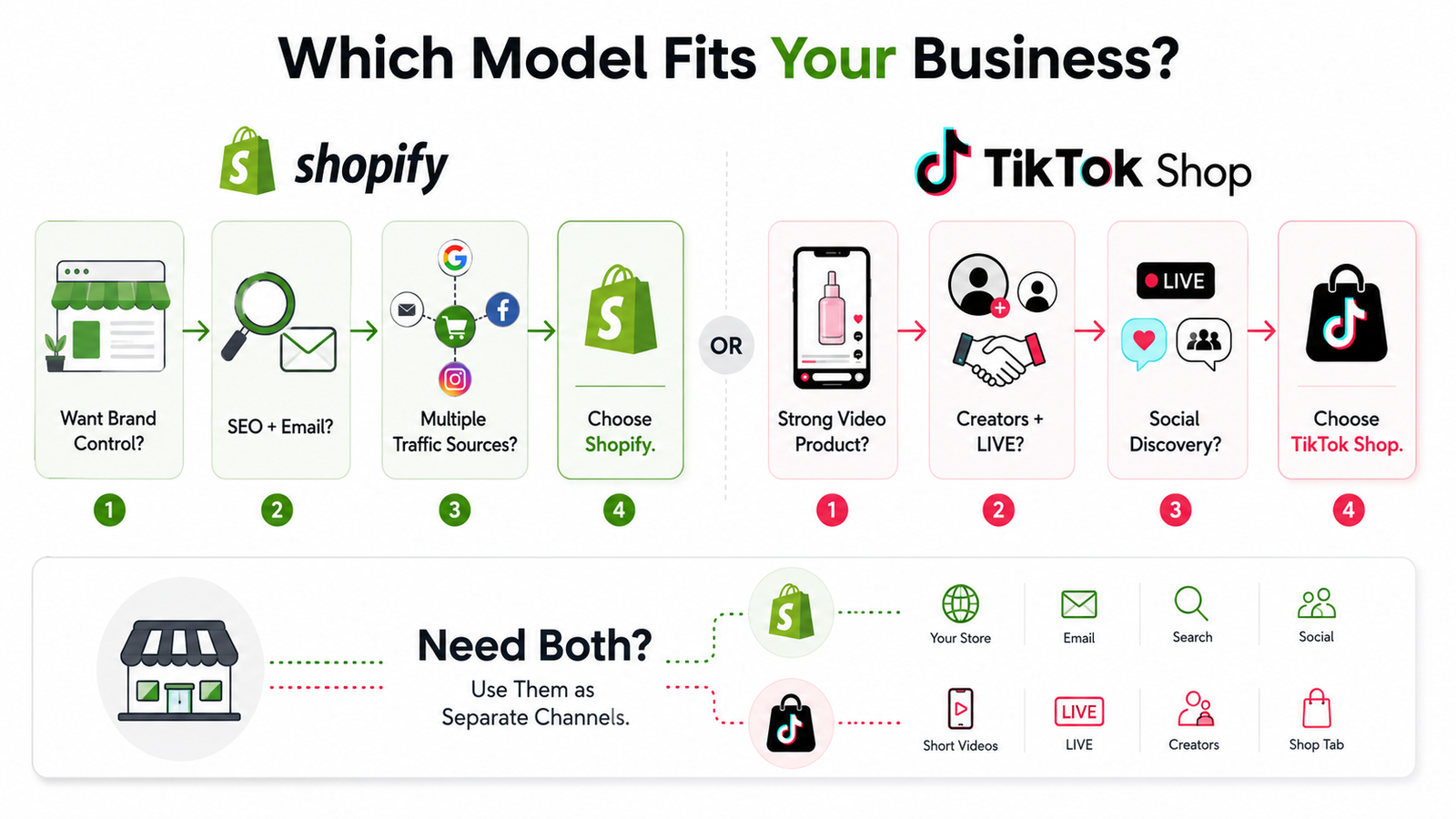
Shopify dropshipping may suit you if you want to build a standalone ecommerce brand and have greater control over your website, customer experience, marketing, SEO, email, and product presentation.
It is also a strong option for sellers who want to diversify traffic across several channels instead of relying primarily on social discovery.
Shopify may be a better fit when:
- You want greater control over branding and the storefront
- You want to build SEO, email, and direct traffic
- You prefer data-driven ecommerce management
- You want access to customer profiles and segmentation
- You are comfortable managing a website and supplier relationships
- You want to diversify customer acquisition
There is no fixed $5,000 or $10,000 investment requirement and no universal period you must wait before the business can become profitable.
Choose TikTok Shop If:
TikTok Shop may suit you if you are comfortable with social-commerce marketing and your products can benefit from demonstrations, creators, short-form content, LIVE shopping, or social discovery.
The platform can also be useful for businesses that want access to a built-in creator affiliate ecosystem rather than arranging every creator relationship independently.
TikTok Shop may be a better fit when:
- Your products work well in short-form demonstrations
- You want to work with affiliate creators
- You understand or are willing to learn TikTok content
- LIVE shopping fits your category
- You want access to in-app product discovery
- You are comfortable operating within marketplace rules
TikTok Shop should not automatically be described as delivering faster profits or lower total costs. Actual results depend on the product and economics.
Hybrid Approach: Using Both Platforms
Businesses can operate both platforms strategically.
A Shopify store can serve as a standalone ecommerce destination for customers acquired through SEO, direct traffic, paid advertising, email, affiliates, and other channels. TikTok Shop can operate separately as a social-commerce channel using Shop discovery, creators, LIVE, affiliate promotion, and TikTok-native advertising.
The important policy distinction is that sellers should not use TikTok Shop content or customer communication to move TikTok Shop transactions to Shopify. TikTok explicitly prohibits bypassing its sales process and redirecting buyers to external websites or payment methods.
Used correctly, the two channels can complement each other without relying on prohibited customer redirection.
 Shopify and TikTok Shop Trends Beyond 2026
Ecommerce Evolution
Ecommerce continues to move toward a blend of independent stores, social discovery, creators, search, and marketplace shopping.
TikTok Shop demonstrates how content and shopping can operate together, while Shopify gives merchants infrastructure for maintaining their own ecommerce destination and connecting it with multiple acquisition channels.
Instead of assuming one model will replace the other, sellers should expect customers to continue discovering and purchasing products through several different environments.
Technology Integration and AI
Artificial intelligence is becoming more deeply integrated into ecommerce workflows, including content creation, advertising, product management, customer service, analytics, and discovery.
Shopify continues expanding automation and AI-assisted merchant tools. TikTok Shop is also using automation within areas such as GMV Max advertising and seller workflows.
AI can reduce repetitive tasks, but sellers still need human review for product accuracy, advertising decisions, customer service, supplier issues, and business economics.
Platform Policy and Regulation Changes
Policies and regulations can change on both platforms.
Shopify merchants need to follow applicable product, payment, tax, consumer-protection, advertising, and privacy rules. TikTok Shop sellers must also comply with product, fulfillment, content, customer-service, intellectual-property, and marketplace policies.
A strong ecommerce business should monitor these requirements and avoid becoming overly dependent on one product, supplier, creator, or marketing source.
Final Verdict: Shopify Dropshipping vs TikTok Shop in 2026
Your products, resources, marketing skills, and business goals determine whether Shopify dropshipping or TikTok Shop is the better option.
Choose Shopify dropshipping when your priority is building a standalone branded store with greater control over the website, customer experience, SEO, email marketing, product presentation, and traffic diversification.
Choose TikTok Shop when your products fit social discovery and you want to use short-form content, creators, Affiliate Center, LIVE shopping, Shop search, and in-app purchasing.
Neither platform guarantees faster profits, better margins, or easier success. Profitability depends on product demand, supplier costs, marketplace or payment fees, customer acquisition, content or advertising performance, conversion, fulfillment, returns, and execution.
For many businesses, the answer may ultimately be to use both as separate, policy-compliant sales channels rather than treating the decision as Shopify or TikTok forever.
If you want help evaluating or building either model, contact the HiSellIt team. You can also explore our Shopify dropshipping services or TikTok services depending on the channel you want to develop.
Frequently Asked Questions
Q. How much does it cost to start selling on Shopify vs TikTok Shop?
There is no fixed startup cost for either model.
A Shopify dropshipping business may require a Shopify plan, domain, optional apps, product samples, content, marketing, and payment-processing costs. Shopify’s current U.S. Basic plan is $39 per month when billed monthly or $29 per month when billed annually.
TikTok Shop does not use a standard monthly U.S. seller subscription, but sellers should budget for referral fees, supplier or inventory costs, fulfillment, affiliate commissions, samples, advertising, returns, and content production. Most current U.S. categories have a 6% referral fee, with some category-specific exceptions.
Q. Which platform generates faster profits?
Neither platform has a reliable universal time-to-profit.
TikTok Shop can sometimes provide rapid feedback when content, affiliate promotion, or LIVE shopping gains traction, while Shopify can acquire customers through multiple marketing channels. However, neither model guarantees an early sale or a specific profitability timeline.
Measure profitability using actual product margin, customer-acquisition costs, fees, fulfillment, returns, and conversion rather than days since launch.
Q. Can I use both platforms simultaneously?
Yes. A business can operate both a Shopify store and TikTok Shop at the same time.
However, TikTok Shop transactions must comply with TikTok’s anti-redirection policy. Sellers cannot use TikTok Shop messages, product descriptions, videos, or other Shop communications to direct customers to an external Shopify checkout.
Q. Which platform is better for beginners?
Neither is universally better for beginners.
Shopify may suit someone who wants to learn website management, supplier coordination, product pages, SEO, advertising, email, and ecommerce analytics.
TikTok Shop may suit someone who is comfortable with short-form content, creator partnerships, LIVE commerce, and social product discovery.
The better choice depends on your product, skills, budget, fulfillment plan, and marketing strategy rather than simply your experience level.
Q. What are the biggest risks with each platform?
For Shopify dropshipping, important risks include supplier reliability, product quality, customer-acquisition costs, competition, long shipping times, returns, and dependence on third-party fulfillment.
For TikTok Shop, risks include marketplace dependence, policy changes, referral and affiliate costs, content demands, creator dependence, fulfillment standards, and more restricted control over customer data and communications.
Both models are more resilient when sellers monitor their unit economics and avoid relying entirely on one product, supplier, creator, or acquisition source.