
Shopify Dropshipping 2026: The Complete Guide to Building Your Automated Online Store
Launching a Shopify dropshipping business in 2026 represents one of the most accessible and practical ways to enter the ecommerce sector. The reasons for this interest are obvious. It is not necessary to have substantial funds tied up in inventory, maintain a warehouse stocked with products, or personally package and deliver each order. Instead, beginners can focus on practical strategies such as selecting the right Shopify dropshipping products, improving the visibility of their marketing efforts, and ensuring that customers enjoy a seamless shopping experience.
To provide some context, the dropshipping market itself continues to grow. Shopify’s current analysis estimates the global dropshipping market at approximately $583.5 billion in 2026. However, the size of the market does not guarantee success for an individual store. Product demand, supplier reliability, marketing costs, competition, fulfillment, and customer experience all influence whether a business can become sustainable. You can review Shopify’s current assessment of whether dropshipping is worth it for additional context.
These changes highlight the importance of having a solid plan for 2026. It is no longer enough to launch a store and wait for customers to appear. Success requires understanding the evolving Shopify ecommerce landscape, choosing dependable suppliers, monitoring your costs, and using automation where it genuinely improves efficiency.
This comprehensive Shopify dropshipping guide for 2026 offers a step-by-step approach to building a sustainable store. It covers everything from actual Shopify pricing to the functionality of Shopify dropshipping automation and strategies for choosing products with real sales potential. While many people assume that dropshipping is a quick way to make money, the reality is different. Building a sustainable Shopify dropshipping store takes time, careful preparation, testing, and consistent effort.
The opportunity remains, but dropshipping should not be viewed as guaranteed passive income. By learning how to start Shopify dropshipping for beginners in 2026 and staying aware of current market trends, entrepreneurs can build more efficient ecommerce operations. Automation can reduce repetitive work, but product selection, suppliers, advertising, customer service, finances, and compliance still require ongoing oversight.
Quick Answer: Is Shopify Dropshipping Still Worth It in 2026?
Shopify dropshipping can still be viable in 2026 when product demand, pricing, supplier reliability, shipping, marketing costs, and customer experience work together. The model reduces the need to purchase and store inventory upfront, but it is not guaranteed passive income. Sellers still need to manage products, suppliers, marketing, customers, finances, compliance, and overall store performance.
How to Start Shopify Dropshipping in 2026: Step-by-Step Guide
The first step in understanding how to start Shopify dropshipping in 2026 is to recognize how the industry has changed. A few years ago, sellers could sometimes copy a product from a supplier marketplace, apply a markup, and still get sales. That older approach to dropshipping on Shopify is no longer reliable. Modern shoppers are far more selective, expect clear delivery information, and often compare prices and alternatives before making a purchase. Furthermore, growing competition makes it increasingly difficult to rely on shortcuts.
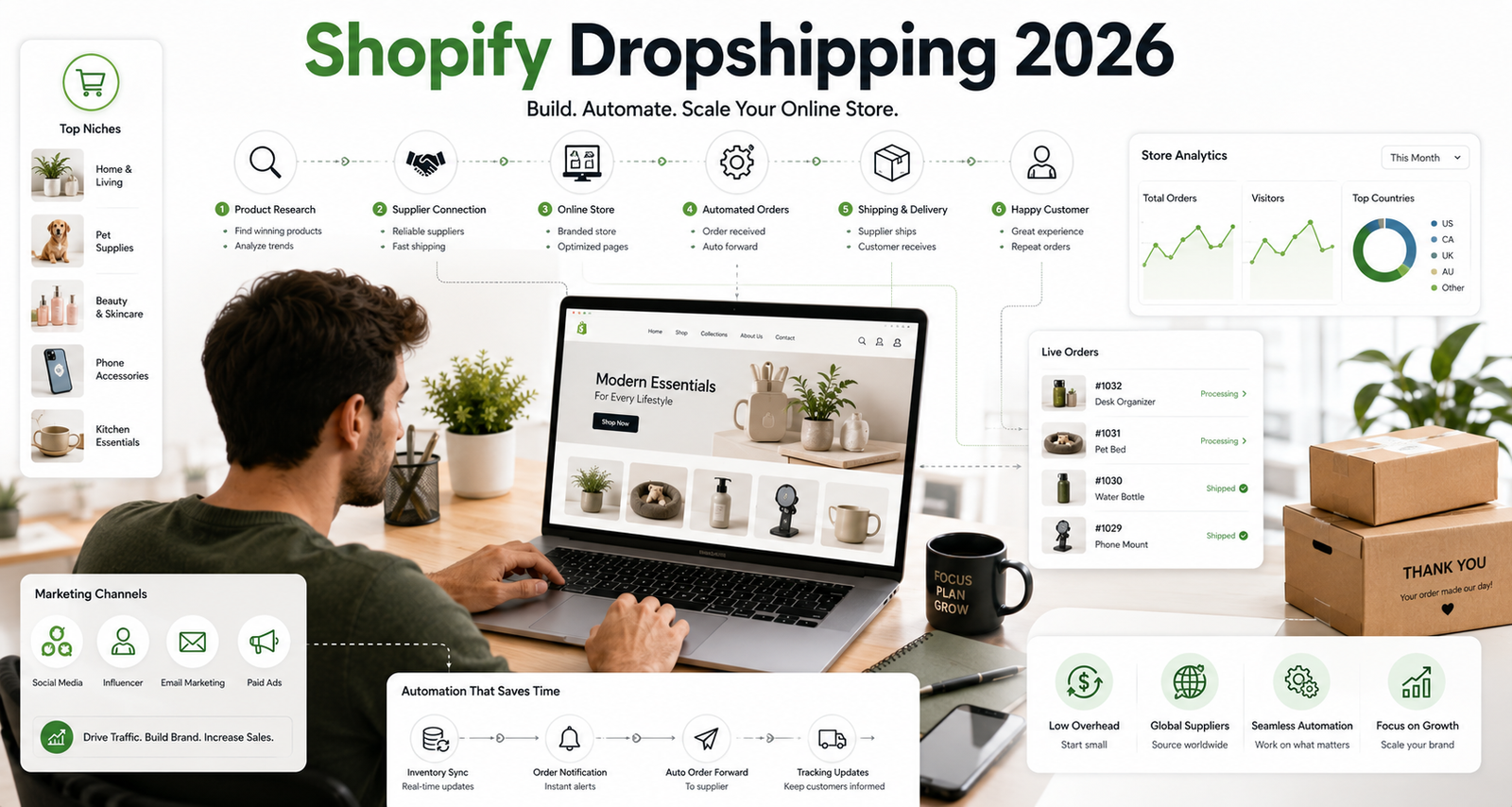
This is where Shopify dropshipping automation can become useful. Automation is not mandatory for every beginner, but it can become increasingly valuable as order volume and operational complexity grow. Many routine tasks within a Shopify dropshipping store can be supported by automated tools, including:
- Monitoring inventory and stock levels
- Managing order processing and supplier communication
- Handling routine customer service inquiries and live chat
- Supporting product research and competitive analysis
This transition to automation is not simply about convenience. It can reduce repetitive work and give store owners more time to focus on product strategy, marketing, customer experience, and supplier relationships. However, automation should support the business rather than remove human oversight from important decisions.
Shopify has also evolved to match these changes. Its app ecosystem offers solutions for abandoned cart recovery, upselling, analytics, fulfillment, email marketing, inventory management, and many other ecommerce tasks. Store owners can use third-party integrations to build a software stack appropriate to their business without assuming that every process needs an app.
Customer preferences also continue to shape this shift. Buyers increasingly expect clear shipping information, responsive customer support, reliable tracking, and transparency about the products they are purchasing. This means a Shopify dropshipping business can no longer succeed simply by offering cheap products. Long-term success requires providing a strong customer experience from product discovery through delivery.
For a current overview of the business model, Shopify’s dropshipping guide explains how sellers can work with dropshipping apps, suppliers, and other fulfillment options.
If you want professional support with product sourcing, store setup, and automation, explore HiSellIt’s Shopify dropshipping services.
 Shopify Dropshipping Costs in 2026: How Much Do You Need to Start?
What is the cost of starting a dropshipping business on Shopify in 2026? One of the first questions every newcomer asks is about actual startup costs.
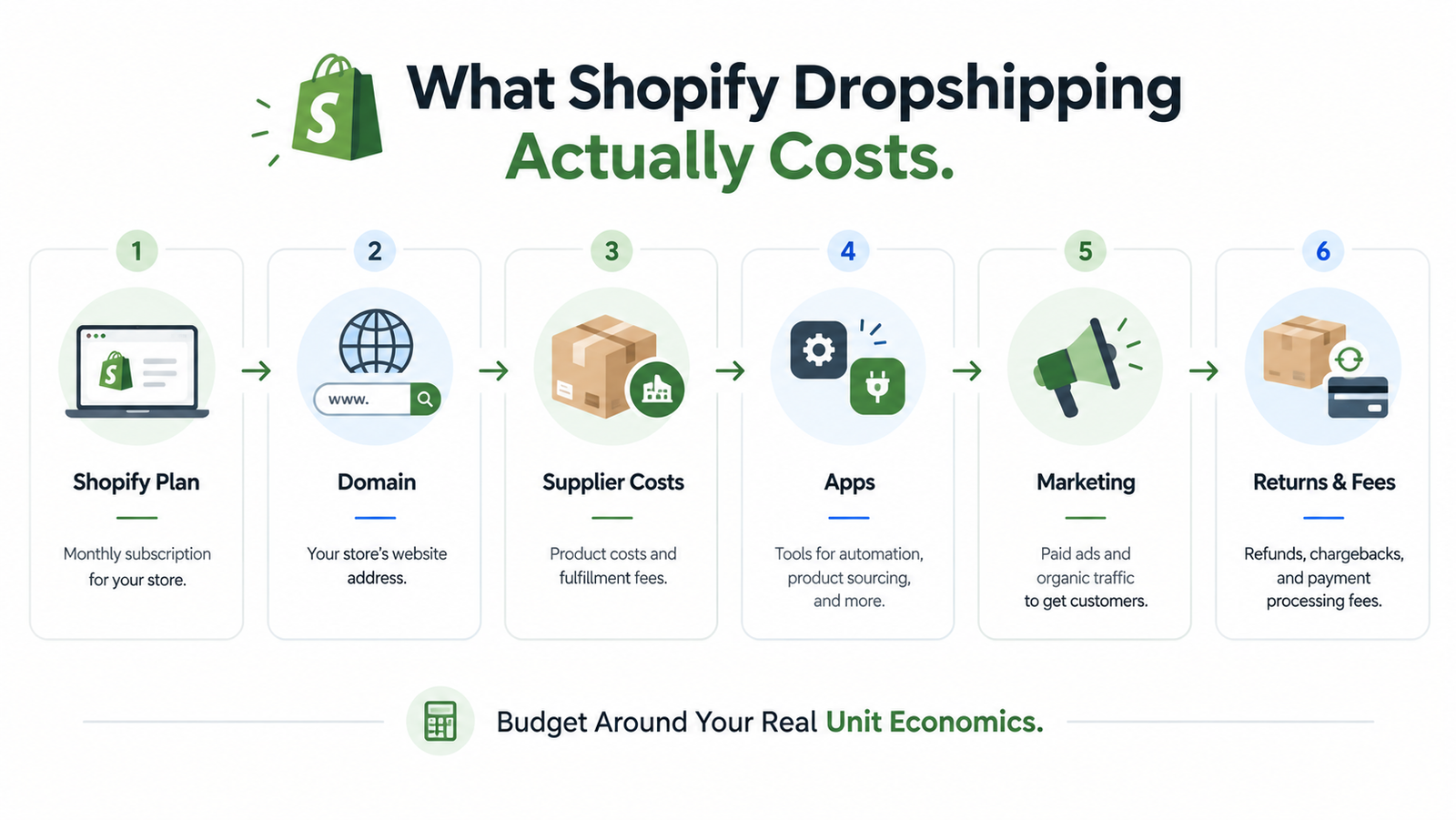
There is no universal $200, $300, or $500 minimum that applies to every Shopify dropshipping business. The total depends on your Shopify subscription, domain, apps, product samples, supplier arrangements, creative production, advertising strategy, payment processing, returns, refunds, and other operating expenses.
Your Shopify subscription is one cost that should be accounted for. At the time of writing, Shopify’s U.S. pricing lists the Basic plan at $39 per month when paid monthly or $29 per month when billed annually. Pricing and payment-processing rates can differ by country and plan, so always check Shopify’s current pricing before creating your budget.
Shopify Dropshipping Cost Breakdown
| Cost Area | What It Covers | Fixed or Variable? |
|---|---|---|
| Shopify Plan | Ecommerce platform subscription | Mostly fixed |
| Domain | Custom website domain | Usually annual |
| Product Samples | Testing quality, packaging, and shipping | Variable |
| Supplier/Product Cost | Product cost after receiving orders | Variable |
| Dropshipping Apps | Sourcing, fulfillment, inventory, and automation | Variable |
| Marketing Tools | Email, analytics, reviews, or customer support | Variable |
| Payment Processing | Card and payment processing | Variable |
| Advertising & Creative | Ads, photography, creator content, and video | Variable |
| Returns & Refunds | Refunds, replacements, and chargebacks | Variable |
| Customer Support | Software, staff, or outsourced assistance | Variable |
Dropshipping apps and marketing tools can add up quickly, so choose them according to what your store actually needs. Product importing and fulfillment tools such as DSers or AutoDS can support supplier and order workflows, while platforms such as Klaviyo or Mailchimp can support email marketing. Google Analytics 4 can also be used for website analytics.
Avoid hard-coding third-party app prices into your long-term budget because pricing plans change frequently. Check each provider’s current pricing before subscribing.
Marketing costs also vary significantly. There is no universal daily advertising budget that guarantees a meaningful product test. Build your advertising budget around your expected cost per acquisition, product economics, available creative, testing strategy, and the amount of conversion data you need before making a decision.
It is also important to distinguish between payment-processing rates and Shopify’s other fees. For example, Shopify’s U.S. Basic plan currently lists online card rates from 2.9% + 30¢ USD when using the applicable payment setup. Additional third-party payment-provider fees can apply depending on your Shopify plan, payment provider, and region.
To manage Shopify dropshipping costs effectively, start with the tools you genuinely need and scale gradually. First, validate that your products have real demand, make sure your supplier and delivery experience meet customer expectations, and then reinvest in tools, creative, and marketing when the economics justify it.
How Much Does Shopify Dropshipping Cost in 2026?
There is no universal startup budget for Shopify dropshipping. Costs can include your Shopify subscription, domain, product samples, supplier costs, apps, advertising, creative, payment processing, returns, and customer support. Build your budget around your actual products and business model instead of relying on a fixed startup estimate.
 Best Shopify Dropshipping Products in 2026: How to Find Profitable Niches
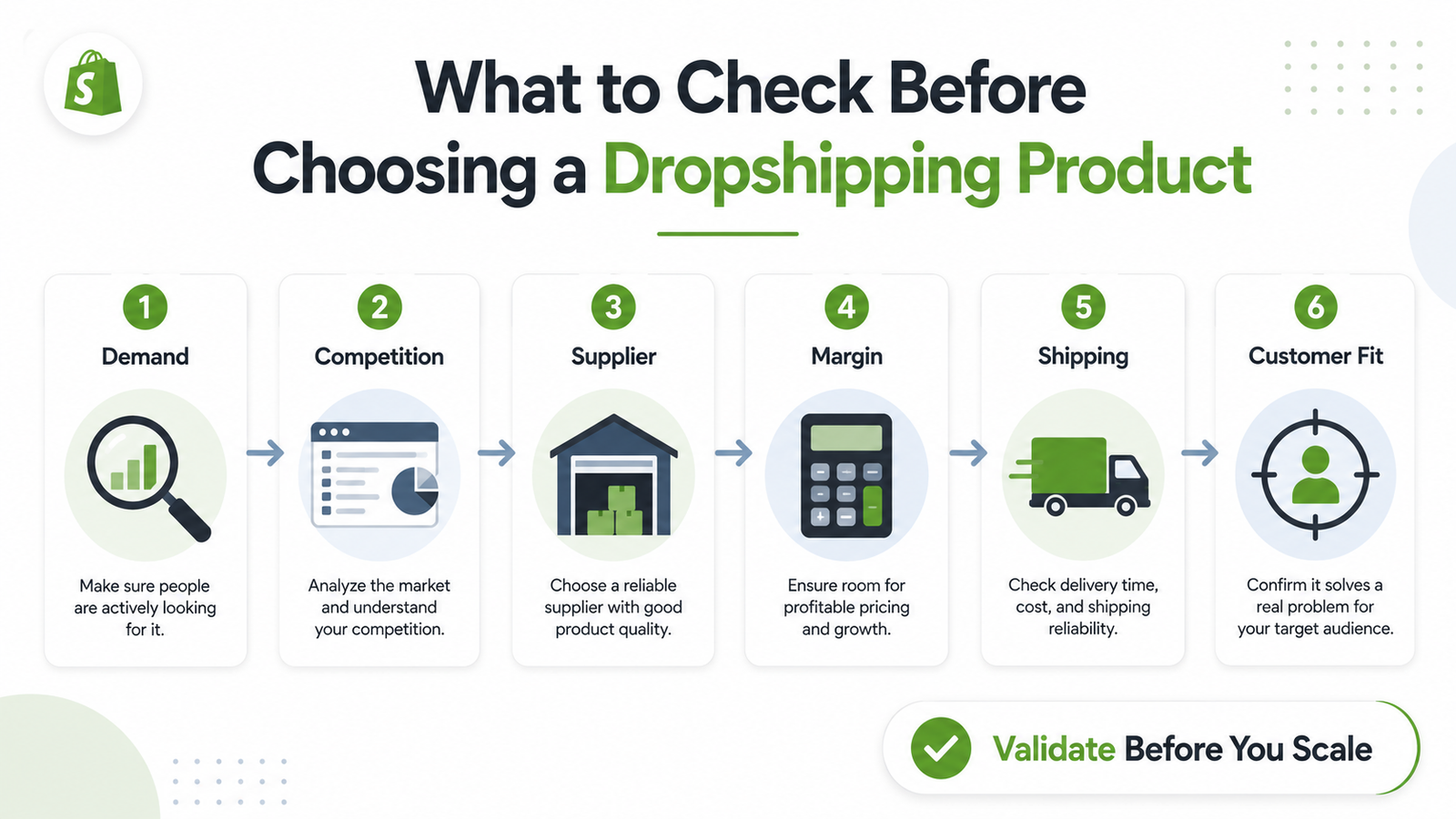
Selecting the appropriate products is crucial for a Shopify dropshipping store. Even exceptional advertising cannot salvage a store that offers poor-quality products, unreliable fulfillment, unrealistic pricing, or products with weak demand.
In 2026, strong Shopify dropshipping products will typically exhibit several useful characteristics:
- They address a specific issue, interest, or customer need.
- Their pricing leaves a workable margin after product cost, shipping, marketing, fees, apps, refunds, and other expenses.
- They offer a reason for customers to buy from your store rather than a readily available alternative.
- They have enough demand to justify marketing without being impossible to differentiate.
- They can be sourced from suppliers with reliable quality, stock, and fulfillment.
A few broad categories are worth researching when examining current Shopify dropshipping trends. Shopify’s updated dropshipping product research highlights categories such as:
- Apparel and footwear
- Beauty and personal care
- Kitchen and dining
- Baby products
- Pet supplies
- Home décor
- Office products
- Tools and home improvement
- Phone accessories
- Car accessories
These are categories to investigate, not guaranteed profitable niches. Product profitability depends on demand, competition, supplier pricing, fulfillment, advertising costs, returns, and how effectively the store differentiates itself.
For a more detailed niche-level breakdown, read our Best Shopify Dropshipping Niches guide.
One of the most significant errors that new dropshippers make is pursuing trending products without a clear understanding of their target customers. While trends can be engaging, a lack of knowledge about your customer base may lead to ineffective advertising expenditure and poor conversion performance.
Effective Methods for Conducting Product Research
Individuals who achieve the strongest results often balance trending opportunities with products that have more stable demand. Rather than purchasing the latest viral item simply because it is popular, consider whether the product solves a meaningful problem, fits your audience, and can remain competitive after the initial trend fades.
Research tools for product discovery have improved, yet manual investigation often uncovers details that automated tools may miss. Useful places for product research include:
- Facebook groups used by your target demographic
- Reddit communities where individuals discuss their challenges
- Comment sections on YouTube product reviews
- Customer feedback on Amazon or comparable marketplaces
Finally, remember the significance of your supplier. Suppliers that offer faster shipping, better packaging, consistent product quality, accurate tracking, and reliable communication can provide an advantage over simply choosing the lowest-cost option.
While price matters, the real value lies in achieving the right balance among price, shipping speed, quality, reliability, and customer experience.
 Complete Shopify Dropshipping Store Setup Guide
Establishing a Shopify dropshipping store in 2026 requires close attention to detail. Your store should present a professional appearance, load efficiently, and function well across mobile and desktop devices. The era of relying solely on basic templates with minimal modifications has passed.
Selecting and Customizing Your Theme
Select a theme that aligns with your brand and niche, ensuring you go beyond the default options where necessary. Adjust the colors, fonts, imagery, and layout to create a consistent brand identity. Your homepage should quickly communicate what your store offers and make it easy for visitors to understand where to go next.
PageFly and Shogun are examples of Shopify page-building tools that can provide additional customization. Review tools such as Loox or Stamped can also help display authentic customer feedback. However, avoid adding unnecessary applications simply because they appear on popular app lists. Every app can add cost and complexity.
User Experience and Navigation
The configuration of your navigation is crucial for both Shopify SEO and user experience. Ensure that your menu structure is intuitive for first-time users and that your collection hierarchies are clearly defined. Include filtering options when they genuinely help customers find relevant products.
Consider how individuals within your niche naturally search for information and design your navigation accordingly.
Numerous store owners also engage professionals to establish and optimize their Shopify dropshipping stores. Seeking assistance can help ensure that your setup, product pages, navigation, and operational workflows are structured correctly from the beginning.
Get expert assistance with your Shopify store setup if you want help with store optimization, automation, or ecommerce strategy.
Optimizing Product Pages for Higher Conversions
It is advisable to pay close attention to product pages because this is where customers evaluate whether the product meets their needs.
Use high-quality images, accurate descriptions, customer reviews where available, and transparent delivery information. Incorporate sizing charts, care instructions, compatibility information, specifications, and any additional details that help customers make an informed purchase.
Trust signals throughout your store can also help reduce uncertainty. This includes genuine reviews, clear return and refund policies, recognizable payment methods, professional contact information, realistic shipping expectations, and accurate product information.
Avoid relying on decorative security or trust badges that do not communicate genuine information. Trust should come from transparency and a consistent customer experience.
Many dropshippers also include an About Us page that explains their brand story and values. This can make a Shopify dropshipping business more relatable to its audience.
Best Marketing Strategies for Shopify Dropshipping in 2026
Effective marketing distinguishes Shopify dropshipping stores that attract qualified visitors from those that struggle to generate demand. In 2026, marketing strategies for dropshipping can include a balanced mix of paid advertising, organic social media, creator partnerships, email marketing, and consistent content creation.
Paid Advertising on Facebook and Instagram
Facebook and Instagram ads remain important tools for ecommerce advertising, although the landscape continues to evolve.
Rather than relying only on increasingly narrow manual targeting, advertisers should focus on strong creative, appropriate tracking, reliable landing pages, and the actual economics of customer acquisition.
Meta Pixel and the Conversions API can support measurement where appropriate, but campaigns should ultimately be judged against real store results such as purchases, customer acquisition cost, revenue, and contribution margin.
Influencer Marketing in 2026
Influencer marketing has evolved beyond simply showcasing products.
Micro and nano influencers can provide useful opportunities for niche Shopify dropshipping businesses because their audiences may be tightly aligned with particular interests. However, smaller influencers do not automatically provide a better ROI than larger creators.
Evaluate influencer partnerships through measurable outcomes such as traffic, sales, cost per acquisition, content quality, discount-code usage, and whether the creative can be reused in other marketing channels.
Platforms such as Upfluence or Influencity can help brands discover and manage creator relationships.
Advanced Marketing Automation Solutions
Email marketing can support customer retention, abandoned-cart recovery, customer education, product launches, post-purchase communication, and promotional campaigns.
Successful Shopify store owners often go beyond welcome emails or abandoned-cart reminders by creating useful lifecycle messaging based on customer behavior and interests.
Tools such as Klaviyo and Omnisend can support automated email flows, segmentation, and personalization. Shopify’s own marketing and automation features can also handle parts of this process.
Automation should simplify repetitive communication, while complex support issues and important customer conversations still receive human attention.
Content Marketing and SEO for Shopify Dropshipping
Content creation remains a sustainable strategy for building long-term visibility. Blog posts, YouTube tutorials, buying guides, comparisons, and consistent social media content can generate organic traffic while helping customers understand your products and niche.
Although SEO generally takes longer than paid advertising, it can reduce dependence on fluctuating ad costs over time.
To improve your Shopify store’s search visibility, balance technical SEO with useful content. Product descriptions should be original and helpful, category pages should match search intent, internal links should guide users naturally, and informational content should answer genuine customer questions.
Automation Tools and Strategies for Shopify Dropshipping
Automation can free time for strategy, product development, marketing, and stronger customer relationships, particularly as a Shopify dropshipping business becomes more complex.
However, automation is not required to reach a particular revenue level, and it does not eliminate the need for business oversight.
Many dropshippers begin by automating parts of the order-fulfillment process. Applications such as DSers, AutoDS, and other current Shopify dropshipping apps can support product importing, supplier coordination, inventory updates, tracking, and order processing depending on the specific integration.
Automation can reduce manual processing, but the amount of time saved varies according to order volume, supplier reliability, integrations, and the number of exceptions that require attention.
Inventory management can also be streamlined. Some ecommerce automation tools can synchronize supplier stock levels, update prices, or trigger other actions according to configured rules. However, these capabilities vary by platform and should not be assumed to work automatically with every supplier.
Customer service can also be streamlined. Chatbots and automated email responses can handle common inquiries, but maintaining a personal approach to complex issues, complaints, delivery problems, and refunds remains important.
Marketing automation also plays a central role. Automated email sequences, scheduled social posts, and remarketing workflows can help maintain communication without constant manual input.
Shopify also provides abandoned checkout recovery, allowing eligible stores to send recovery emails to customers who leave checkout before completing an order.
Finances can also be supported by automation. Applications that track expenses, taxes, sales, fees, and profit reports can make financial management easier, although the owner should still review the data and understand actual profitability.
Where Shopify Dropshipping Automation Can Help
| Area | Tasks That Can Be Automated | Where Human Oversight Still Matters |
|---|---|---|
| Orders | Order forwarding and tracking updates | Supplier errors and fulfillment exceptions |
| Inventory | Stock synchronization | Supplier accuracy and availability |
| Pricing | Monitoring costs and rule-based updates | Margin strategy and positioning |
| Customer Service | FAQs and routine responses | Complaints, disputes, and complex issues |
| Email Marketing | Welcome, cart, and post-purchase flows | Strategy, messaging, and offers |
| Reporting | Dashboards and scheduled reports | Profitability analysis and decisions |
| Product Research | Trend and competitor research support | Final product validation |
Common Shopify Dropshipping Mistakes to Avoid
The most costly mistakes in Shopify dropshipping in 2026 often come from impatience or poor preparation.
Launching your store without carefully assessing products, suppliers, fulfillment, margins, and customer expectations can lead to complaints, refunds, and negative reviews.
A common error is focusing only on cost when choosing suppliers. Inexpensive providers may struggle with shipping delays, inadequate packaging, inconsistent products, or communication problems. Refunds, replacements, chargebacks, and poor customer experiences can quickly offset any saving from a cheaper supplier.
Reliable dropshipping suppliers are generally a safer long-term choice than simply selecting the lowest-priced source.
Legal requirements are another overlooked step. Depending on your location, target market, and products, you may need to consider business registration, taxation, consumer-protection requirements, privacy rules, product safety, advertising regulations, and other obligations.
Requirements vary significantly, so obtain qualified professional guidance where necessary rather than assuming one set of rules applies to every Shopify dropshipping business.
Another mistake is relying too heavily on a single traffic source. Platform changes, increasing advertising costs, or changes in customer behavior can affect acquisition performance. Diversifying traffic through SEO, paid advertising, email, creators, social media, and other appropriate channels can reduce dependency on one source.
Financial management is often ignored until problems surface. Track expenses from the start, including supplier costs, shipping, payment processing, advertising, refunds, applications, taxes, and customer support, so you always have a clearer view of profitability.
Advanced Strategies for Scaling Your Shopify Dropshipping Business
Once you have established consistent demand and workable unit economics, scaling requires a different approach compared with the setup phase.
Advanced Shopify dropshipping strategies in 2026 focus on streamlining operations, carefully expanding the product catalog, entering additional markets or sales channels where appropriate, and implementing systems capable of handling larger order volumes.
Successful growth depends on careful testing rather than simply increasing advertising spend.
As your store matures, optimizing conversion performance can become one of the most impactful steps. With steady traffic, even modest improvements can influence overall revenue. This can include testing product-page layouts, refining checkout flows, improving product photography, clarifying shipping information, or adding genuine reviews and other useful trust signals.
Track the effect of changes rather than assuming a redesign automatically improves results.
Diversifying your product catalog can help capture a broader market while reducing dependency on a single item. However, this should be done after you understand your first niche. Each new product requires appropriate marketing, supplier relationships, customer support, and financial evaluation.
International growth is another potential scaling option. While it opens access to new markets, it introduces additional complexity such as shipping times, customs duties, currency differences, returns, customer support, and local compliance requirements.
Expand internationally only when your supplier, fulfillment, and support systems can reliably serve the new market.
As your business grows, scaling can also mean building a reliable team. Virtual assistants for customer service, social media managers for content creation, or operations staff for supplier relationships can help you focus on higher-level strategy. Delegating effectively requires documenting important processes so work remains consistent.
Private labeling can also become an option once dropshippers want greater control over branding and product differentiation. Working with manufacturers to create customized products or packaging can provide stronger brand control and sometimes greater product differentiation.
However, private labeling may also require higher order commitments, more capital, additional quality-control responsibilities, and potentially more inventory risk. It does not automatically guarantee higher Shopify profit margins.
The Future of Shopify Dropshipping Beyond 2026
The dropshipping landscape continues to evolve, making it important for sellers to monitor changes in customer expectations, technology, fulfillment, and marketing.
Shoppers are increasingly attentive to product quality, delivery transparency, and the claims brands make about sustainability or sourcing. Sellers who make environmental or ethical claims should ensure those statements are accurate and supported rather than using them simply as marketing language.
Artificial intelligence and machine learning are also becoming increasingly accessible to smaller ecommerce businesses. AI tools can support product research, market analysis, pricing decisions, customer segmentation, content creation, and customer-service workflows.
Shopify’s current guide to AI dropshipping discusses how AI can assist with areas such as product research, pricing, ecommerce operations, and customer engagement. These tools can support decisions, but they do not automatically identify profitable products or remove the need for validation.
The rise of social commerce is another important trend. TikTok, Instagram, creators, and other discovery environments give ecommerce brands additional ways to introduce products to potential customers. Dropshippers should evaluate which channels actually align with their audience rather than trying to maintain a presence everywhere.
Faster and more reliable fulfillment is also becoming increasingly important. Accurate delivery estimates, reliable tracking, better packaging, and responsive support can help differentiate a store from competitors using similar products.
Finally, subscription models can be useful for products that customers genuinely need on a recurring basis. Replenishment products, curated recurring boxes, or repeat-use items may fit this model.
However, subscriptions do not automatically increase lifetime customer value. Product fit, retention, pricing, fulfillment consistency, cancellation policies, and customer satisfaction determine whether the model works.
Build a Sustainable Shopify Dropshipping Business in 2026
This comprehensive guide can help you establish a more sustainable Shopify dropshipping business in 2026. Long-term success requires dedication, continuous learning, strong supplier relationships, careful financial management, and the ability to adapt as the market evolves.
Automation can make repetitive tasks easier, but it should support rather than replace strategic oversight. Likewise, Shopify provides the ecommerce infrastructure, but a store still needs products customers want, effective marketing, reliable fulfillment, and a customer experience that encourages trust.
The strongest approach is to validate demand carefully, calculate your full costs before scaling, choose suppliers based on reliability rather than price alone, and use automation where it genuinely saves time or reduces errors.
If you want to discuss your store, niche, or strategy, contact the HiSellIt team to book a strategy call.
Frequently Asked Questions
Q. How much money do you need to start Shopify dropshipping in 2026?
There is no universal amount required to start Shopify dropshipping in 2026.
Your costs can include the Shopify subscription, domain, product samples, dropshipping apps, supplier costs, marketing, creative production, payment processing, refunds, and customer support.
At the time of writing, Shopify’s U.S. Basic plan is listed at $39 per month when paid monthly or $29 per month when billed annually, although regional pricing can differ. Check Shopify’s current pricing before budgeting.
Q. What are the most profitable dropshipping niches on Shopify right now?
There is no single most profitable Shopify dropshipping niche.
Categories such as apparel, beauty and personal care, kitchen products, pet supplies, home décor, office products, phone accessories, baby products, home improvement, and car accessories can all provide opportunities worth researching.
Profitability depends on product demand, competition, supplier reliability, selling price, fulfillment, advertising costs, return rates, and customer acquisition.
For more niche ideas and validation strategies, read our Shopify dropshipping niches guide.
Q. Is Shopify dropshipping still profitable in 2026?
Shopify dropshipping can still be profitable in 2026, but profitability is not guaranteed.
Successful stores need workable margins, dependable suppliers, effective marketing, good customer service, accurate product information, and sustainable customer acquisition costs.
The key is to treat dropshipping as a legitimate ecommerce operation that requires testing, management, and continuous improvement.
Q. How long does it take to make money with Shopify dropshipping?
There is no universal timeline for making money with Shopify dropshipping.
Some stores may generate early sales quickly, while others require extensive product testing, advertising optimization, content development, pricing changes, or niche adjustments.
The timeline depends on factors including product selection, demand, marketing budget, competition, conversion performance, supplier quality, pricing, and how quickly you learn from actual customer and campaign data.
Q. What’s the difference between dropshipping and traditional ecommerce on Shopify?
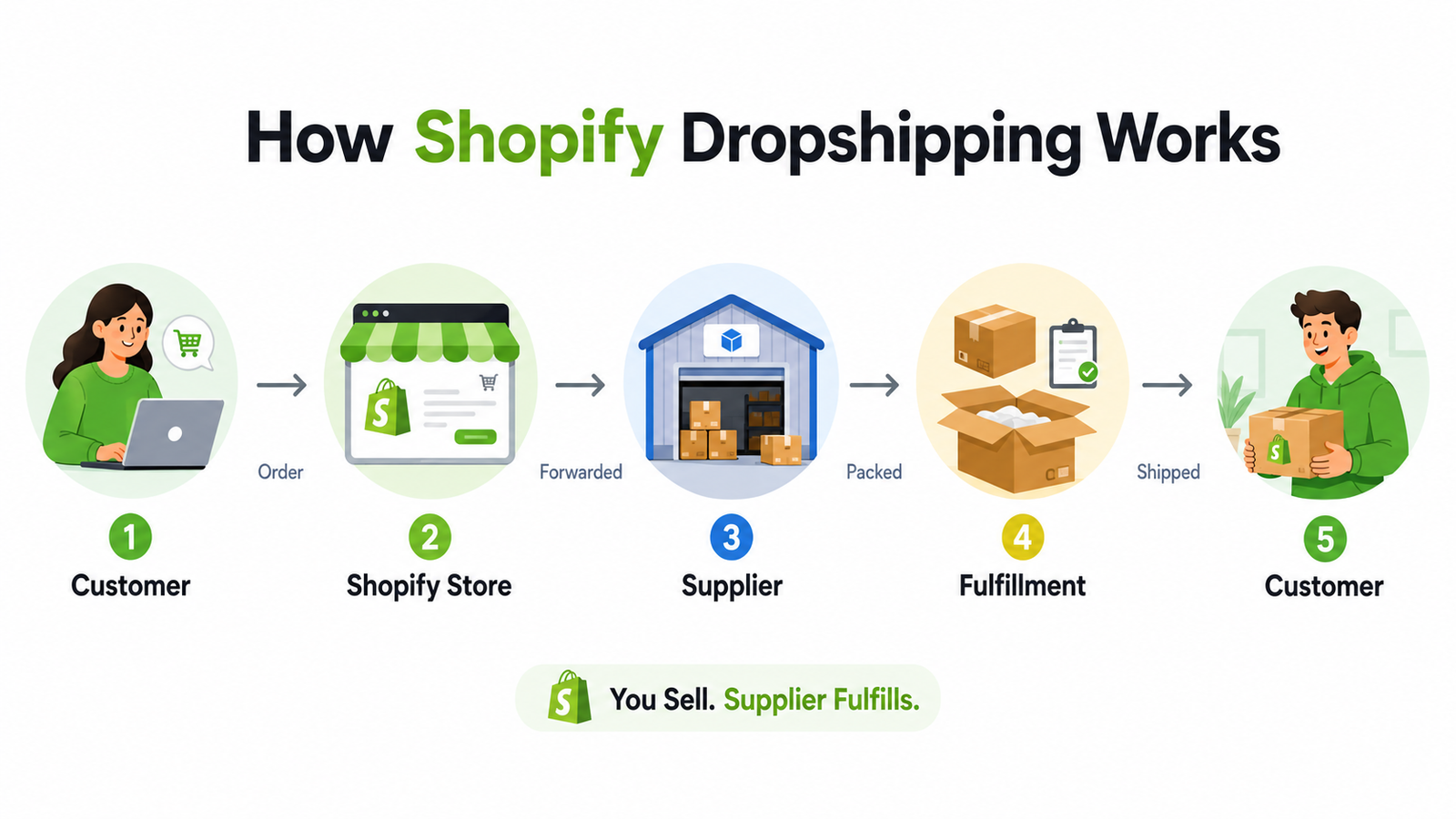
Dropshipping generally does not require the seller to hold inventory before receiving customer orders.
The main difference is inventory management and fulfillment. Traditional ecommerce businesses commonly purchase or manufacture inventory, store it, and fulfill orders themselves or through a fulfillment partner.
With dropshipping, a supplier normally stores and fulfills products after customers purchase them from your store.
Dropshipping can reduce upfront inventory exposure, but it also gives the merchant less direct control over aspects of product availability, packaging, fulfillment, shipping times, and quality.


2 Comments