
TikTok Ads vs Meta Ads 2026: Which Converts Better?
If you’re running an ecommerce business in 2026 and trying to decide between TikTok Ads vs Meta Ads, you’re not alone. Both platforms give online stores access to powerful paid advertising systems, but there is no reliable universal benchmark proving that one always delivers a better conversion rate, lower customer acquisition cost, or higher return on ad spend.
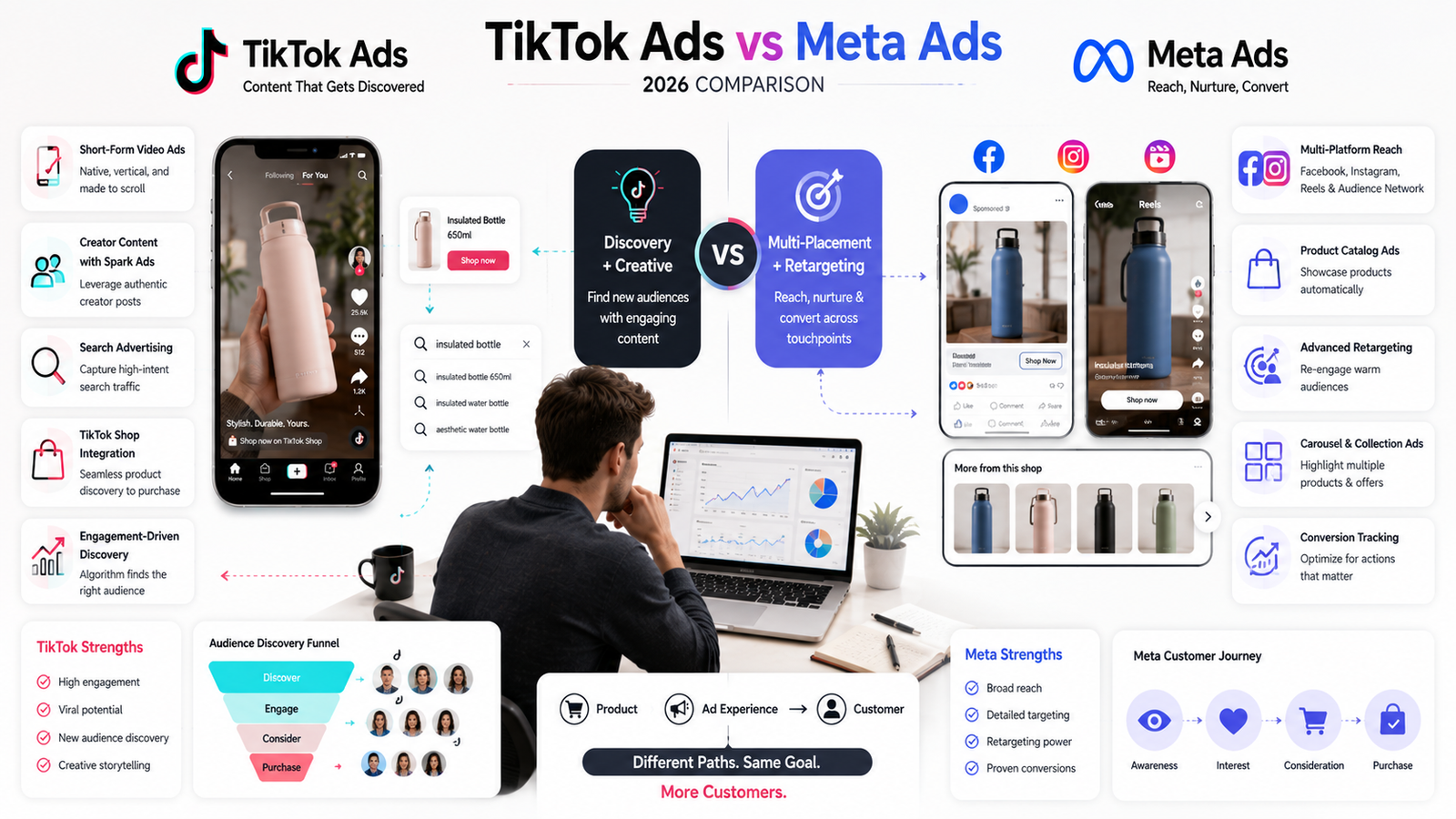
The platforms also work differently. TikTok is built heavily around short-form video, creators, search, discovery, and social commerce, while Meta distributes ads across Facebook, Instagram, Reels, Messenger, and other eligible placements. Meta’s advertising ecosystem increasingly uses AI-assisted Advantage tools, while TikTok has expanded automation through its upgraded Smart+ campaign experience, which can support different levels of automated and manual campaign management.
The best ad platform therefore depends on your product, customers, creative, campaign objective, website experience, tracking setup, margins, and advertising economics. In this guide, we’ll compare TikTok Ads vs Meta Ads to help you determine where your ecommerce advertising budget has the strongest chance of producing profitable customers.
Quick Answer: TikTok Ads vs Meta Ads, Which Converts Better in 2026?
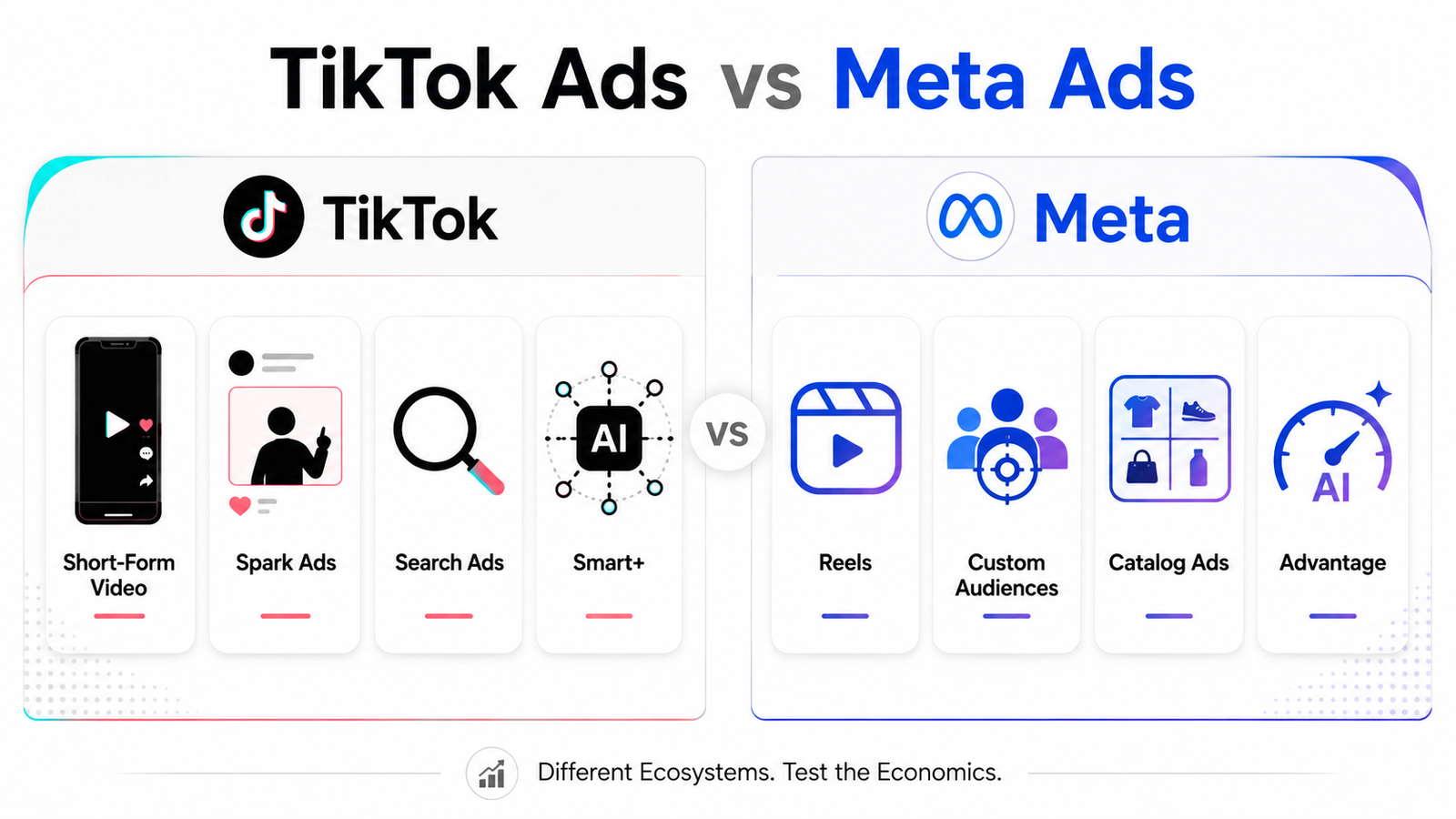
Neither TikTok Ads nor Meta Ads converts better for every ecommerce business. TikTok can be strong for short-form product discovery, creator-style creative, Spark Ads, TikTok Shop, Search Ads, and rapid creative testing. Meta offers broad placement options, Custom Audiences, Reels, catalog advertising, and mature ecommerce measurement tools. The better platform is the one that produces profitable customer acquisition for your specific product after ad spend, creative costs, conversion performance, and margins are considered.
Understanding the Platforms: TikTok Ads vs Meta Ads
Before comparing conversion performance, it is important to understand exactly what we’re comparing.
Meta Ads refers to the advertising ecosystem behind Facebook, Instagram, Messenger, Reels, and other eligible Meta placements. Advertisers can use different creative formats, first-party audiences, automated delivery, retargeting, catalog campaigns, and Meta’s Advantage tools to support customer acquisition.
Reels is now an important part of that ecosystem. Meta’s official guidance on Facebook and Instagram Reels ads shows how advertisers can use Reels within broader campaign strategies, including automated Advantage+ placements or selected manual placements depending on campaign setup.
TikTok Ads is centered heavily around short-form video but has expanded well beyond simple For You feed advertising. Current options include Spark Ads, Search Ads, Smart+ campaigns, creator content, ecommerce campaigns, and TikTok Shop advertising where supported.
TikTok’s current Search Ads Campaign setup allows eligible advertisers to reach people searching for relevant keywords directly within TikTok search results, adding a search-intent layer to the platform’s traditional discovery-focused advertising.
The main difference is therefore less about “precision versus virality” than it once was. Both platforms now combine manual advertiser controls with significant algorithmic optimization.
TikTok Ads vs Meta Ads: Quick Comparison
| Feature | TikTok Ads | Meta Ads |
|---|---|---|
| Core Environment | Short-form video, search, creators, TikTok Shop | Facebook, Instagram, Reels, Messenger and other placements |
| Creative Strength | TikTok-first video, creator content, Spark Ads | Reels, video, images, carousels, catalog and partnership creative |
| Automated Campaigns | Smart+ | Meta Advantage suite |
| Manual Targeting | Demographics, interests, behaviors, Custom Audiences, devices and other eligible controls | Demographics, Custom Audiences, Lookalikes and eligible audience controls |
| Retargeting | Website, engagement, app, customer, Shop and other eligible Custom Audiences | Website, customer, engagement, app and catalog-based audiences |
| Ecommerce Tracking | TikTok Pixel + Events API | Meta Pixel + Conversions API |
| Organic-Content Ads | Spark Ads | Existing posts, Reels and partnership ads |
| Search Advertising | Dedicated keyword-based Search Ads | Not directly equivalent to TikTok’s keyword Search Ads |
| Creative Formats | Strong emphasis on video, plus supported carousel/catalog formats | Video, Reels, images, carousels, collections and catalog creative |
| Best Fit | Product discovery and TikTok-native creative | Broad ecommerce acquisition, multiple placements and retargeting |
| Which Converts Better? | Depends on campaign economics | Depends on campaign economics |
TikTok’s targeting capabilities are considerably broader than basic age and interest filters. According to TikTok’s official Ads Manager targeting guidance, available options can include demographics, interests and behaviors, Custom Audiences, website activity, engagement signals, device information, and other eligible audience controls depending on the market and campaign type.
 Audience Fit: Where Are Your Customers?
Understanding your audience still matters, but choosing between TikTok and Meta based only on broad age stereotypes is increasingly unreliable.
TikTok has a strong reputation for product discovery through short-form content, creators, search, and social trends. That can make it valuable for products that are easy to demonstrate or communicate visually. However, advertisers should not assume TikTok is only relevant to people under 35.
Meta also reaches a broad range of consumers across Facebook and Instagram. Instagram and Reels may overlap with some TikTok audiences, while Facebook can provide additional reach across different customer groups.
Rather than deciding that “TikTok means young shoppers” and “Meta means older shoppers,” look at your own:
- Customer demographics
- Purchase history
- Website analytics
- Email/customer data
- Platform analytics
- Creative performance
- Conversion data
If your ecommerce strategy includes TikTok Shop, selecting the right market matters just as much as selecting the ad platform. Our guide to finding profitable TikTok Shop niches explains how to evaluate demand, competition, product potential, and category fit before committing ad spend.
Ad Formats and Creative Requirements
The way you showcase your product plays a major role in campaign performance on either platform.
TikTok Ads Creative
TikTok Ads generally work best when the creative feels appropriate for the TikTok environment. That does not mean every ad must look amateur or that user-generated content automatically outperforms professionally produced creative.
Instead, focus on communicating the central idea quickly, using vertical mobile-first creative where appropriate, and giving viewers a clear reason to continue watching.
TikTok’s current creative guidance emphasizes TikTok-first content, vertical 9:16 creative, strong visual quality, appropriate safe zones, trends where relevant, and content that fits naturally into the platform.
Spark Ads remain particularly useful because they allow advertisers to promote organic TikTok posts from their own account or from authorized creators. TikTok’s official Spark Ads guide explains how promoted activity stays connected to the original organic post, allowing the ad to retain its native context and existing engagement.
This makes Spark Ads useful when you already have organic or creator content that fits your paid strategy. However, they should still be tested against other creative formats rather than assumed to convert better automatically.
If TikTok Shop is part of your advertising strategy, our TikTok Shop marketing guide covers content, creators, Shop SEO, listings, and paid promotion in more detail.
Meta Ads Creative
Meta offers more format flexibility across its ecosystem. Depending on campaign and placement, advertisers can use images, video, carousels, catalog creative, Reels, and other eligible formats.
Reels deserves particular attention in 2026. Meta recommends adapting creative specifically for the vertical Reels environment, including 9:16 video, audio where appropriate, and keeping important visual elements inside safe zones. Meta provides current creative and placement guidance through its Reels advertising resources.
The key is not simply repurposing one asset into every placement. Creative should be adapted according to the environment in which people will see it.
Targeting Capabilities: Manual Control and Automated Discovery
Meta and TikTok both provide targeting controls, but both platforms also increasingly rely on automated delivery.
Meta Ads Targeting
Meta provides advertisers with tools such as Custom Audiences and Lookalike Audiences, allowing businesses to use eligible first-party customer information or existing audience signals as part of their campaign strategy.
Meta’s Customer List Custom Audiences, for example, allow advertisers with the appropriate rights and permissions to create audiences using customer information such as email addresses or phone numbers.
Modern Meta advertising should not, however, be described as purely “laser-focused manual targeting.” Meta’s Advantage ecosystem increasingly uses automation to help determine placements, creative presentation, and delivery.
Available targeting also varies by location, campaign objective, audience, advertising policy, and product category. Do not assume every advertiser can target every behavior, profession, income group, or sensitive interest.
TikTok Ads Targeting
TikTok’s targeting tools have expanded significantly.
Current TikTok Ads targeting can include demographics, Custom Audiences, interests and behaviors, website traffic, engagement, app activity, Shop activity, business-account activity, purchase intent, device information, spending power, and household income in eligible U.S. campaigns.
TikTok’s upgraded Smart+ system also supports automatic targeting. In fully automated campaigns, TikTok can identify and optimize toward audiences with limited advertiser input while still allowing audience controls or suggestions. Advertisers who want more direct control can switch to custom targeting.
TikTok should therefore no longer be described as a platform with only basic targeting and weak retargeting.
Cost Comparison: Which Platform Offers Better ROI?
Advertising cost is one of the most important parts of the TikTok Ads vs Meta Ads comparison, but there is no reliable universal CPM, CPC, CPA, or ROAS range that applies to every ecommerce advertiser.
Advertising costs can change based on:
- Country
- Audience
- Campaign objective
- Season
- Competition
- Bidding strategy
- Creative
- Conversion event
- Product category
- Account history
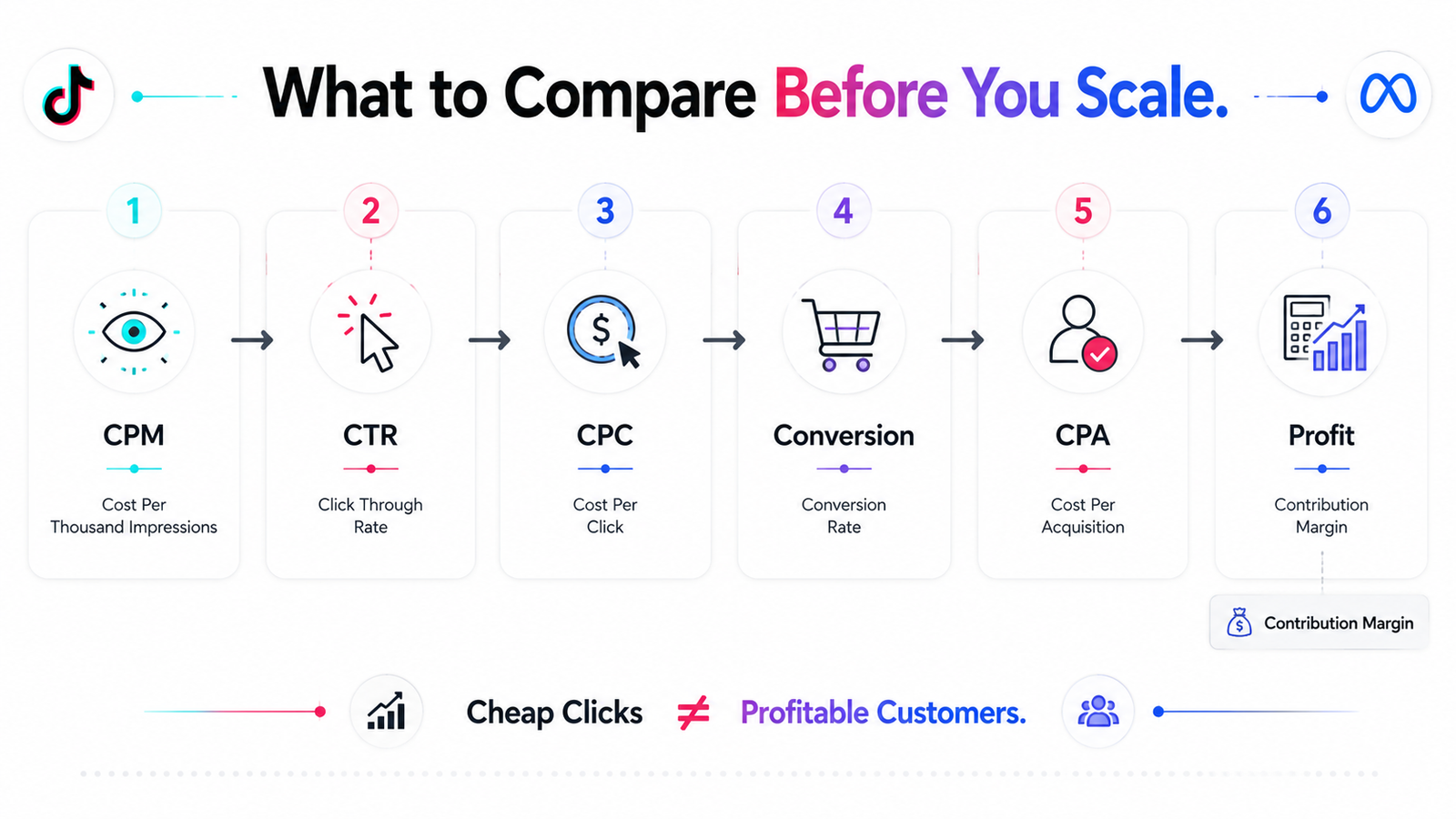
A lower CPM does not necessarily mean a better advertising platform. One campaign might purchase impressions cheaply but generate expensive customers, while another has a higher CPM but converts those impressions more efficiently.
For ecommerce campaigns, compare metrics such as:
- CPM
- CTR
- CPC
- Conversion rate
- Cost per acquisition
- ROAS
- Average order value
- Contribution margin
Which Is Cheaper: TikTok Ads or Meta Ads?
Neither TikTok Ads nor Meta Ads is consistently cheaper. Advertising costs vary by country, audience, objective, season, bidding strategy, creative and competition. A lower CPM or CPC does not necessarily mean better performance. Ecommerce advertisers should compare cost per acquisition, ROAS and contribution margin to determine which platform is more efficient for their business.
TikTok does have technical minimum-budget requirements, but these are not recommended testing budgets. As of July 2026, TikTok states that campaign-level daily or lifetime budgets must exceed $50, while ad-group daily budgets must exceed $20.
That does not mean $50 is enough to determine whether TikTok is profitable for your store. Your real test budget should be based on expected CPA, margins, campaign structure, and how much conversion data you need.
If you want support developing TikTok campaigns around your actual product economics rather than generic benchmarks, you can explore HiSellIt’s TikTok services.
 Conversion Rates: What the Data Actually Shows
So, which platform converts better?
There is no authoritative universal ecommerce conversion rate proving that Meta Ads always converts better than TikTok Ads or vice versa.
Conversion rate depends on factors such as:
- Product-market fit
- Creative
- Offer
- Landing page
- Website speed
- Product price
- Customer trust
- Campaign objective
- Audience quality
- Retargeting
- Checkout friction
- Attribution setup
Meta may perform strongly for businesses that already have meaningful customer data, established website traffic, catalog infrastructure, and historical conversion signals.
TikTok may perform strongly when the product naturally fits short-form demonstrations, creator-led storytelling, search discovery, or TikTok Shop.
TikTok Shop can also reduce the number of steps between discovery and checkout for eligible purchases, but that does not guarantee a specific conversion-rate lift.
Likewise, a product should not automatically be assigned to TikTok because it costs under $50 or to Meta because it costs more. The platform should be selected according to the customer’s buying journey and the actual campaign economics.
Testing and Optimization: Which Platform Is Easier to Scale?
Scaling campaigns on either platform requires testing, measurement, creative development, and enough conversion data to make useful decisions.
Meta Ads Testing and Optimization
Meta gives advertisers access to campaign experimentation, different placements, audience tools, and its Advantage automation ecosystem.
Reels can be included through Advantage+ placements or selected manually, and Meta supports A/B testing to evaluate changes in creative or campaign strategy.
Advertisers should avoid thinking of Meta scaling as purely manual. Increasingly, campaign performance depends on giving Meta enough high-quality creative and conversion data for its automated systems to optimize delivery.
TikTok Smart+
TikTok’s Smart+ ecosystem is now an important part of advertising on the platform.
TikTok’s upgraded experience can support fully manual, partially automated, or fully automated campaigns for supported objectives. In a fully automated setup, TikTok can handle areas including audience optimization and budget allocation while advertisers provide objectives, controls, and creative assets.
This means TikTok can no longer simply be described as “easier for beginners because the algorithm does the work.” Both TikTok and Meta now offer substantial automation, and the amount of manual control depends on the campaign setup.
For sellers trying to reduce repetitive TikTok Shop work outside ad buying itself, our TikTok Shop automation tools guide covers areas where automation can support Shop operations.
TikTok Search Ads
TikTok advertising also now includes dedicated Search Ads Campaigns.
These campaigns allow advertisers to target keywords in TikTok search results, manage bids and budgets, and use video, carousel, or eligible catalog creative. Current Search Ads support varies by market and objective.
This gives ecommerce advertisers another way to reach users with active search intent rather than relying only on recommendation-feed discovery.
Best Practices for Each Platform
TikTok Ads Best Practices
Start with a clear opening. Communicate the product, problem, benefit, or central idea quickly. There is no universal two-second rule, but the viewer should understand why the video is worth watching from the opening moments.
Create for TikTok first. Vertical video, strong visual clarity, captions where useful, and platform-appropriate storytelling can help the ad feel natural within the TikTok experience.
Test creator-style content without assuming it always wins. UGC-style and creator content can work well, but compare it with demonstrations, testimonials, tutorials, product-led creative, and other approaches.
Use trends selectively. A trend should make sense for the product rather than being added simply because it is popular.
Use commercially cleared music. Businesses should use TikTok’s Commercial Music Library or otherwise ensure they have appropriate rights to use audio commercially. TikTok’s current Commercial Music Library contains music cleared for business use.
Test Spark Ads. Spark Ads allow businesses to promote their own organic posts or authorized creator content while preserving engagement on the original post.
Do not force every ad into a fixed duration. The right length depends on how quickly you can communicate the product and message effectively.
Meta Ads Best Practices
Design for mobile-first placements. Reels and Stories benefit from vertical creative, while other placements may support different formats.
Use first-party data responsibly. Customer lists and Custom Audiences can support acquisition and retargeting when you have the required rights, permissions, and lawful basis for using the information.
Use catalog and retargeting tools where they fit. Ecommerce businesses with product catalogs can use product-focused campaigns to reconnect with relevant audiences.
Test materially different creative concepts. There is no universal requirement to launch exactly three or five variations. Test enough creative to learn which hooks, offers, formats, and messages actually influence business outcomes.
Use Reels-specific creative where appropriate. Meta recommends vertical 9:16 Reels creative, quality audio, and keeping key messages inside the safe zone.
Do not assume every campaign needs a manually built warm audience first. Automated acquisition and broad delivery can also work depending on the campaign and available signals.
How Product Type Can Influence Platform Fit
Different products create different advertising opportunities, but no product category automatically belongs on TikTok or Meta.
Fashion and beauty products often provide strong visual creative opportunities because styling, transformations, routines, demonstrations, and creator content can be communicated quickly. This can fit TikTok particularly well, but Meta Reels and Instagram can use many of the same visual concepts.
Technology and electronics may work on either platform. Demonstration-led products can fit TikTok content, while products that require more detailed explanation can also benefit from Meta’s combination of video, Reels, images, carousels, and retargeting.
Home and lifestyle products can work across both ecosystems. The deciding factor should be where your customers respond best rather than assuming Facebook automatically converts better for homeowners.
Health, wellness, financial, and other sensitive or regulated categories require careful review of each platform’s current advertising rules and targeting restrictions. Do not assume that detailed health-related targeting will be available simply because a platform offers interest-based advertising.
Visually demonstrable products can provide more opportunities for TikTok-native content, while products with longer buying journeys may benefit from Meta’s broad placement and retargeting ecosystem. However, category alone does not determine conversion performance.
If you’re still deciding which products or categories are worth building a TikTok Shop strategy around, our guide to profitable TikTok Shop niches can help you validate the opportunity before spending heavily on ads.
The Hybrid Approach: Using Both Platforms Together
In 2026, ecommerce businesses do not necessarily need to treat TikTok Ads and Meta Ads as mutually exclusive.
A store might use both platforms because different customers discover and respond to products in different places. TikTok may introduce the brand through creator content, Search Ads, Spark Ads, or Shop discovery, while Meta can provide additional touchpoints across Facebook, Instagram, and Reels.
However, do not assume TikTok must always be the top of the funnel and Meta must always handle retargeting. TikTok itself supports website, engagement, app, customer-list, and Shop-based Custom Audiences.
Likewise, Meta is not only a retargeting platform. Reels and Meta’s broader advertising inventory can also support discovery and new-customer acquisition.
Using both platforms can diversify customer acquisition, but it can also increase creative-production and campaign-management costs. Measure whether adding the second platform actually improves incremental revenue, contribution margin, and customer quality.
Do not assume TikTok must always be the top of the funnel and Meta must always handle retargeting. TikTok itself supports several Custom Audience sources, including website, engagement, customer, app, and other eligible activity, as explained in its current advertising targeting documentation.
Pay attention to:
- Aspect ratio
- Safe zones
- Captions
- CTA
- Audio licensing
- Video pacing
- Placement
- Platform-specific UI
Privacy, Tracking, and Attribution Challenges
Privacy changes have affected how digital advertising platforms collect, model, and attribute conversion activity.
Instead of relying on one tracking method, ecommerce advertisers increasingly combine platform tracking, server-side data connections, first-party information, and independent analytics.
For Meta, this commonly involves the Meta Pixel alongside server-side measurement through the Conversions API where appropriate.
For TikTok, advertisers can use TikTok Pixel, Events API, or both. TikTok currently recommends combining Pixel and Events API when practical because the two systems are designed to create a more reliable web-data connection for measurement, targeting, and campaign optimization.
Do not assume platform-reported results will always match Google Analytics or your ecommerce backend exactly. Attribution models, windows, identifiers, consent, modeled conversions, and event configuration can all create differences.
The most useful approach is to establish a consistent measurement framework and compare:
- Platform-attributed conversions
- Website purchases
- Revenue
- CPA
- ROAS
- Contribution margin
- New versus returning customers
Review the attribution settings actually being used in each advertising platform before comparing performance.
Making Your Decision: TikTok, Meta, or Both?
So, which platform converts better?
The answer still depends on your business.
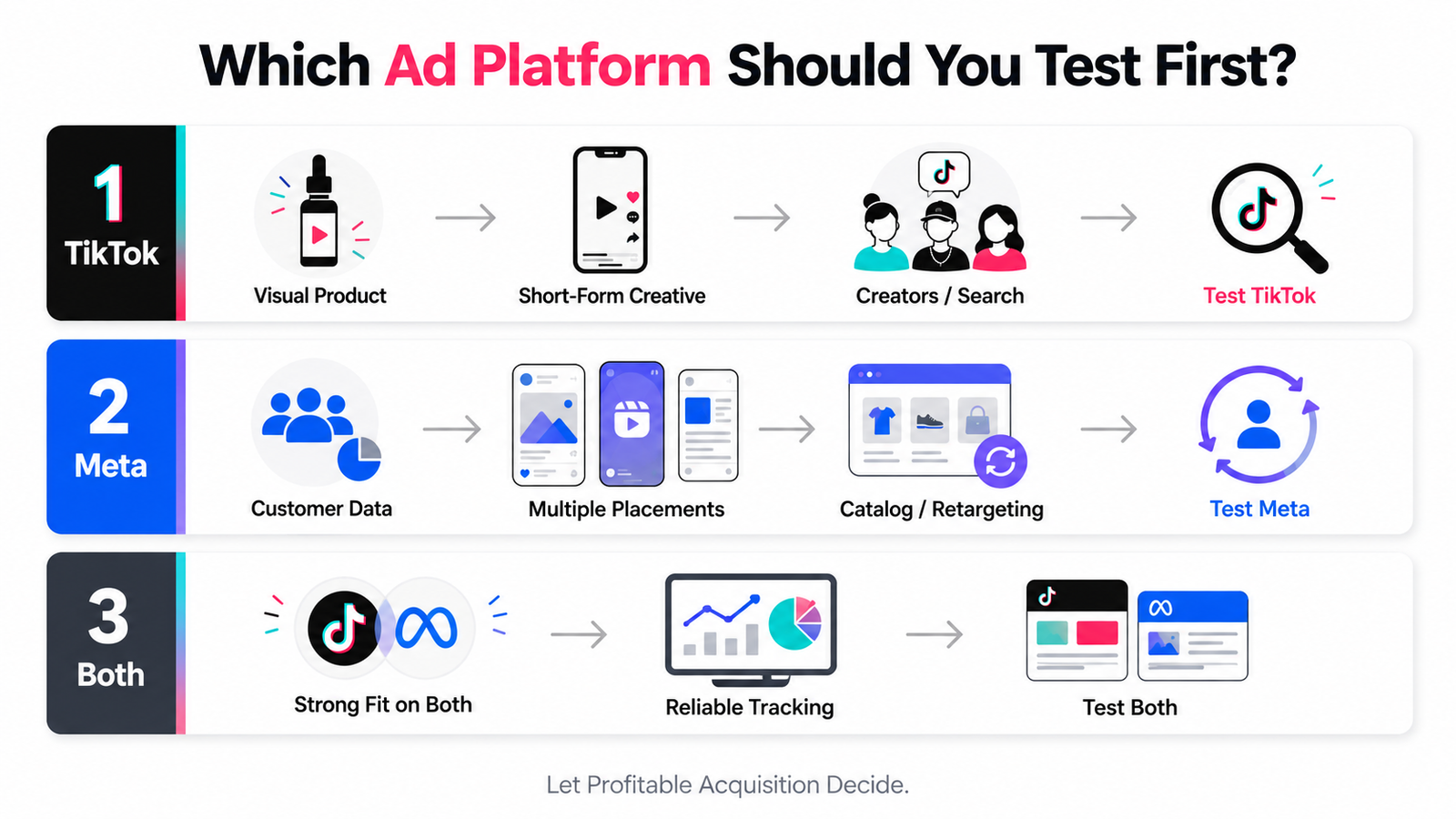
Choose TikTok to Test First If:
- Your product is easy to demonstrate through short-form creative
- You already have TikTok-native or creator content
- Spark Ads fit your strategy
- TikTok Search Ads are relevant to your target market
- TikTok Shop is important to your ecommerce model
- You can produce and refresh creative consistently
Choose Meta to Test First If:
- You already have useful website or customer data
- Catalog campaigns are important
- Retargeting is central to your acquisition strategy
- Facebook, Instagram, or Reels strongly align with your customers
- You need multiple creative formats and placements
- You already have useful Meta campaign history and conversion signals
Test Both If:
- Your economics support multiple acquisition channels
- You can create appropriate content for each platform
- You have reliable cross-platform measurement
- You want to reduce dependence on a single paid advertising ecosystem
There is no universal testing budget such as $500 or $1,000 that guarantees enough information to choose a winner.
Build your test according to:
- Expected CPA
- Product margin
- Number of creatives being tested
- Campaign objective
- Conversion volume
- Available budget
- Platform minimums
TikTok’s technical budget minimums currently require campaign budgets above $50 and ad-group daily budgets above $20, but those figures are delivery requirements rather than recommended ecommerce testing budgets.
 Final Thoughts: Test, Learn, and Scale
The debate over whether TikTok Ads or Meta Ads convert better does not have one universal answer.
Meta should not automatically be treated as the safer or higher-converting option, just as TikTok should not automatically be treated as cheaper, younger, or better for impulse products.
TikTok’s advertising ecosystem now includes sophisticated targeting, Custom Audiences, Spark Ads, Smart+, Search Ads, ecommerce tools, and server-side measurement. Meta continues to provide a mature advertising environment across Facebook, Instagram, Reels, Custom Audiences, catalog campaigns, and Advantage automation.
The practical answer is to test the platforms against the same business goal and judge them on the metrics that matter to your store.
A campaign with cheaper clicks but unprofitable customers is not the winner. A campaign with a higher CPM but stronger contribution margin may be.
If TikTok is the channel you want to develop, HiSellIt’s TikTok services can help you build a more structured strategy around content, Shop growth, and advertising. For personalized guidance on choosing the right acquisition strategy, you can also contact the HiSellIt team.
Frequently Asked Questions
Q. Which is cheaper, TikTok Ads or Meta Ads?
Neither platform is consistently cheaper.
CPM, CPC, CPA, and other advertising costs vary according to audience, country, season, objective, competition, creative, and bidding strategy. A lower CPM does not automatically mean better performance. Compare cost per profitable customer and contribution margin rather than choosing a platform based on impression cost alone.
Q. Can I use the same ad creative on TikTok and Meta?
You can repurpose the same core idea, but it is better to adapt the execution.
TikTok creative should fit the TikTok viewing environment, while Meta assets may need to work across Reels, Stories, feeds, and other placements. A strong vertical video can potentially work on both TikTok and Meta Reels, but check safe zones, captions, CTA placement, pacing, and music rights before reusing it.
Q. How much budget do I need to test TikTok Ads vs Meta Ads?
There is no universal testing budget.
Build your budget around expected CPA, margins, conversion volume, campaign objectives, and the number of meaningful creative concepts you want to test. TikTok currently requires campaign daily or lifetime budgets above $50 and ad-group daily budgets above $20. These are technical platform minimums and should not be interpreted as recommended testing budgets.
Q. Do TikTok Ads work for B2B businesses?
TikTok can work for some B2B businesses, particularly when the audience uses the platform for professional education, product discovery, thought leadership, or industry-related content.
Meta may also work for B2B campaigns depending on the audience and offer. If job-role or professional-network targeting is central to your strategy, LinkedIn Ads is a separate advertising platform that may also be worth evaluating. Meta Ads does not provide “LinkedIn integration” as a substitute for LinkedIn advertising.
Q. What conversion tracking should I set up for both platforms?
For Meta Ads, consider Meta Pixel and the Conversions API where appropriate for your ecommerce setup.
For TikTok Ads, use TikTok Pixel, Events API, or both. TikTok currently recommends combining Pixel and Events API when practical to create a more reliable web-data connection. You can also use Google Analytics 4 and your ecommerce platform’s own sales reporting to compare results across channels. No single attribution system should automatically be treated as a perfect source of truth.
If you want help deciding which platform fits your store or building a TikTok-focused growth strategy, contact HiSellIt for a strategy tailored to your products and business goals.