
TikTok Shop Growth Strategy After Algorithm Changes in 2026
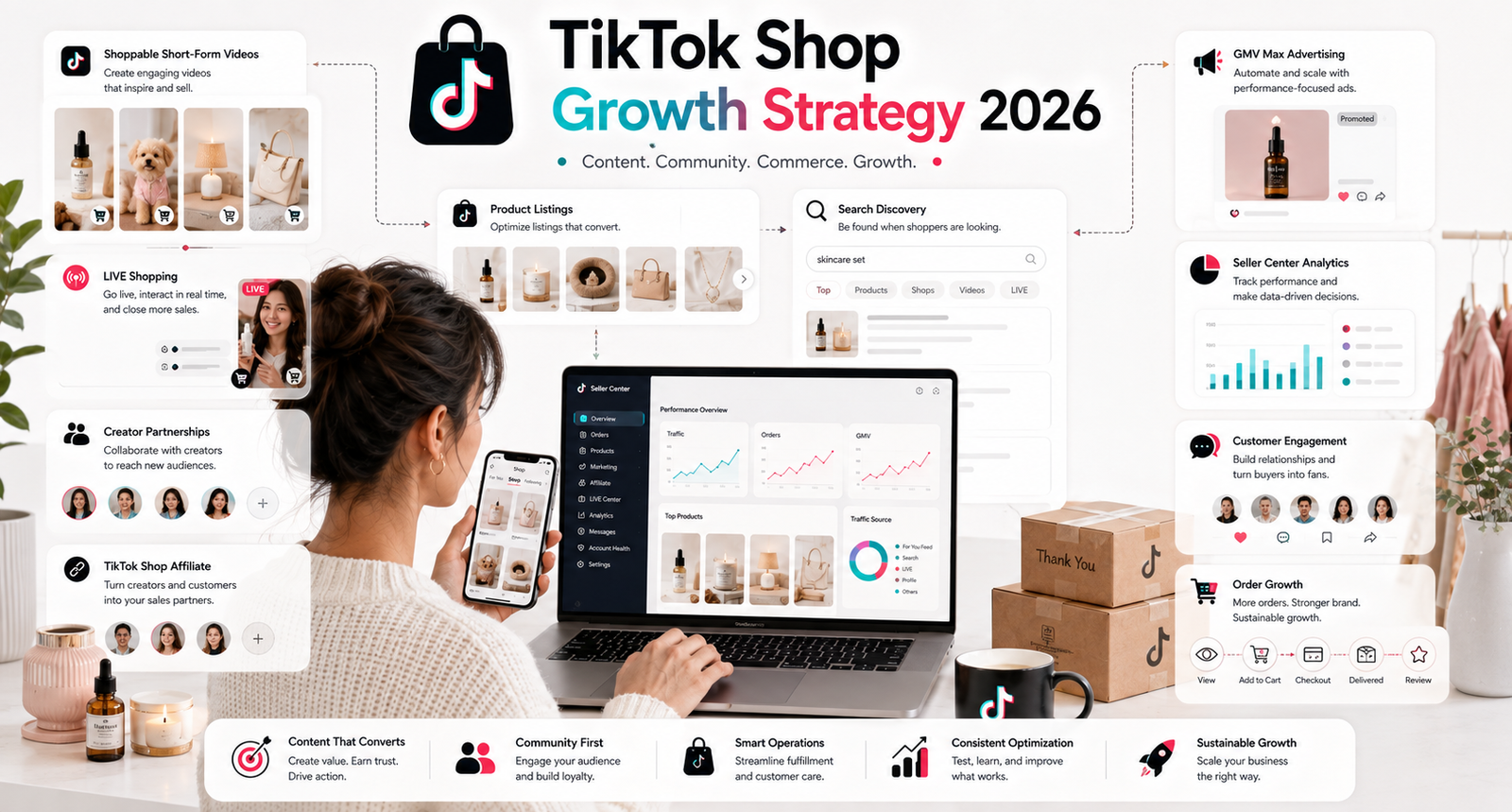
A strong TikTok Shop growth strategy in 2026 requires more than reacting to rumors about the latest algorithm change. TikTok’s recommendation and commerce systems continue to evolve, but there is no reliable first-party evidence of one single January 2026 algorithm reset that suddenly replaced all of the rules sellers followed in 2025.
What has changed is the number of ways shoppers can discover products. TikTok Shop now combines the For You feed, search, Shop Tab recommendations, product cards, shoppable videos, LIVE, creators, Affiliate, and paid Shop campaigns. TikTok’s latest published U.S. growth figures also show the scale of the opportunity: TikTok reported that U.S. TikTok Shop sales increased 120% year over year during the first part of 2025, while sales exceeded $500 million during the four-day Black Friday and Cyber Monday period in 2025. These figures demonstrate marketplace momentum, not guaranteed results for individual sellers.
The important question for sellers in 2026 is therefore not, “What secret algorithm trick works now?” It is how to build a strategy around the signals and commerce features TikTok actually documents. That means improving content relevance, search visibility, product listings, creator partnerships, Shop performance, advertising economics, and customer experience.
Quick Answer: What Is the Best TikTok Shop Growth Strategy in 2026?
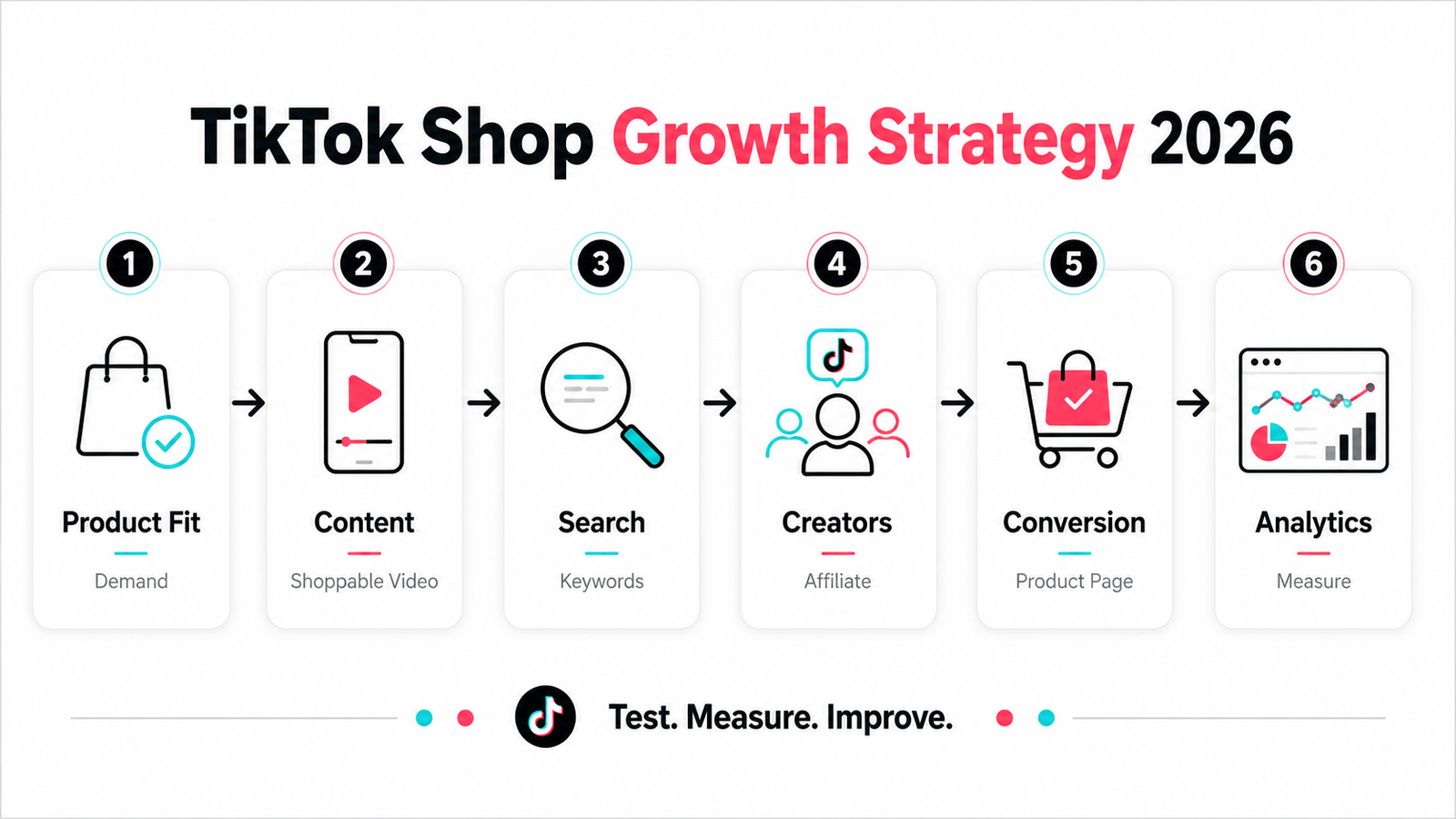
A strong TikTok Shop growth strategy in 2026 combines engaging shoppable content, TikTok Shop search optimization, Shop Tab visibility, creator partnerships through Affiliate Center, product and traffic analytics, reliable fulfillment, and GMV Max advertising when the economics support paid acquisition. TikTok does not document a single formula that guarantees reach, so sellers should use their own watch behavior, search, traffic, conversion, orders, GMV, and profitability data to decide what to scale.
Understanding the 2026 TikTok Shop Algorithm Updates
TikTok’s recommendation systems are more complex than a simple checklist of “algorithm rules.” According to TikTok’s current explanation of how its recommendation systems work, recommendations can be influenced by user interactions, content information, and user information. The importance of individual signals can vary by recommendation surface and over time.
For sellers, another major development in 2026 is the growing importance of Shop Tab and search. TikTok launched a refreshed Shop Tab & Search Analytics experience in Seller Center in May 2026, allowing merchants to analyze product recommendations, search traffic, impressions, orders, GMV, items sold, and conversion performance.
 Watch Time Matters, but It Does Not Replace Every Other Signal
The original idea that TikTok suddenly changed from “views in 2025” to “watch time in 2026” is too simplistic.
TikTok currently states that For You recommendations can consider actions such as likes, shares, comments, whether someone watches a video in full or skips it, and other interaction signals. For most users, interactions, which can include time spent watching a video, are generally weighted more heavily than some other signal groups.
That makes retention important, but it does not mean raw view count suddenly became irrelevant.
A better TikTok Shop content strategy in 2026 is to monitor:
- Whether viewers stay after the opening
- How long they watch
- Whether they finish or skip
- Product clicks
- Search and Shop traffic
- Orders and conversion
- Comments, shares, and saves where relevant
A video that receives fewer views but generates qualified product traffic may be more valuable to a seller than a viral video that produces little shopping activity.
Table 1: TikTok Shop Discovery Signals to Focus on in 2026
| Area | What Matters in 2026 | How Sellers Should Respond |
|---|---|---|
| Video Engagement | Watch behavior, likes, shares, comments, skips and other interactions | Improve hooks, pacing, usefulness and relevance |
| Search | Query relevance and product information | Optimize listings and content around genuine search intent |
| Shop Tab | Search, recommendations, product-card traffic and promotions | Monitor Shop Tab & Search Analytics |
| Product Listings | Titles, categories, search terms, attributes and product information | Keep listings clear, accurate and optimized |
| Creators | Product-audience fit and actual commerce performance | Use Affiliate Center data rather than follower count alone |
| Paid Growth | GMV Max and campaign economics | Scale only when margins and results justify spend |
The Product Tagging Shift
There is no reliable current TikTok documentation establishing an algorithm rule that one or two products per video are rewarded while five products are penalized.
A more focused video can certainly make a product easier for the viewer to understand, but sellers should choose the number of linked products according to the content and shopping experience rather than a supposed universal algorithm threshold.
The principle is simple: if linking several unrelated products makes the content confusing, narrow the focus. If multiple related products genuinely belong in the video, evaluate the actual performance instead of following an arbitrary product-tag count.
Organic Content and Paid Advertising Serve Different Roles
The claim that TikTok universally prioritizes organic commerce content over paid advertising in 2026 should also be removed.
Organic recommendations and paid Shop Ads are different distribution systems. Sellers can use both.
Paid commerce has actually become more automated. Since July 2025, GMV Max has been the default and only supported campaign type for new TikTok Shop Ads using the Sales objective with TikTok Shop as the destination, subject to TikTok’s stated legacy exceptions.
A strong TikTok Shop growth strategy therefore does not need to choose between “organic” and “paid” as opposing systems. Organic content can help with discovery and creative testing, while paid campaigns can support additional acquisition when your product economics allow it.
Content Formats to Test in 2026
Tutorials, unboxing videos, behind-the-scenes clips, product demonstrations, creator content, and LIVE can all be useful TikTok Shop formats. However, there is no universal 2026 engagement-rate table proving that one format always converts better than another.
The right question is what each format allows you to communicate.
Short-Form Tutorials and Unboxing Videos
Tutorials can work well when a product requires explanation, demonstration, styling, setup, or education.
Instead of assuming that a thirty-second tutorial will automatically outperform a traditional product video, test different approaches:
- Problem → solution
- Before → use → result where claims are accurate
- Product setup
- Comparison
- Common mistake
- Use case
- Unboxing
- Frequently asked question
A useful tutorial gives viewers a reason to keep watching beyond the fact that a product is for sale.
Behind-the-Scenes Content
Behind-the-scenes content can help humanize a business by showing processes such as packing, product development, sourcing, design, production, or preparation.
This can build familiarity and generate useful customer questions. However, comments do not automatically trigger an algorithmic “boost,” so evaluate the content through actual audience and commerce results.
LIVE Shopping Sessions
LIVE remains an important TikTok commerce format. TikTok’s recommendation documentation confirms that LIVE recommendations can consider interactions such as likes, comments, creator relationships, watch time, Gifts, and content information. For most users, user interactions, including time spent watching a LIVE, can be weighted heavily.
LIVE can be especially useful for:
- Product demonstrations
- Customer Q&A
- Product comparisons
- Launches
- Bundles
- Real-time education
- Creator-led selling
Do not rely on unsupported claims that TikTok automatically shows every LIVE to thousands of non-followers.
User-Generated and Creator Content
Customer and creator content can provide additional ways for shoppers to see products in realistic contexts.
Make sure you have the appropriate rights to reuse content and avoid presenting paid, incentivized, or affiliate content as though it were completely independent when disclosure is required.
Table 2: TikTok Shop Content Formats to Test
| Content Type | Best Use Case | What to Measure |
|---|---|---|
| Short Tutorials | Education and use cases | Watch behavior, product clicks, orders |
| Unboxing | Product introduction | Retention, comments, product-page visits |
| Behind-the-Scenes | Brand storytelling | Engagement, follows, assisted product interest |
| LIVE | Demonstration and Q&A | Watch time, product clicks, orders, GMV |
| Creator Content | Audience expansion | Orders, GMV, commission cost, returns |
| Product Demos | Feature explanation | Product clicks, conversion, orders |
For sellers who need help building the underlying store before optimizing content, our guide on how to become a TikTok Shop seller covers registration, products, fulfillment, creators, and Seller Center operations.
Optimizing Your Posting Schedule and Frequency
Consistency Matters, but There Is No Five-Posts-Per-Week Rule
The original recommendation to post at least five times per week should not be treated as a TikTok algorithm requirement.
The best publishing frequency is one you can maintain while continuing to produce useful content and analyze results.
Posting more often can create more opportunities to test ideas, but higher volume is only valuable when the additional content serves a purpose.
Best Times to Post
There is also no universal 6 PM to 9 PM TikTok Shop window.
The right posting time depends on:
- Audience location
- Customer behavior
- Content type
- Product category
- Time zone
- Creator audience
- LIVE schedule
- Historical performance
Instead of following a generic timetable, use account and content analytics to identify patterns.
Table 3: Weekly TikTok Shop Content Testing Framework
| Content Goal | Format to Test | What to Review |
|---|---|---|
| Product Education | Tutorial / How-to | Retention, clicks, conversion |
| Brand Building | Behind-the-scenes | Engagement and follows |
| Product Evaluation | Demo / Comparison | Product-page traffic |
| Social Proof | Creator / Customer Content | Orders and conversion |
| Direct Selling | LIVE | Viewers, product clicks, orders, GMV |
| Search Discovery | Search-led video | Search traffic and product visits |
| Community | Q&A / Response Content | Useful questions and engagement |
This is a testing framework, not a fixed algorithm-approved schedule.
Beyond Just Uploading Content
Replying to useful comments and participating in relevant conversations can strengthen community relationships and reveal new customer questions.
However, there is no reliable TikTok rule stating that every comment must be answered within the first hour for a post to receive reach.
Similarly, use trending sounds or formats only where they support the content. Relevance matters more than forcing every trend into a sales video.
If managing TikTok content and ecommerce operations is becoming difficult, HiSellIt’s TikTok services can support businesses with TikTok Shop strategy and operations.
Leveraging Creator Partnerships Effectively
Creator Fit Matters More Than Follower Tier
The original claim that TikTok’s 2026 system specifically rewards micro creators with 10,000 to 50,000 followers should be removed.
Follower count alone does not determine creator ROI.
A smaller creator may outperform a larger one, but the opposite can also happen. The most useful approach is to compare creators using real commercial performance.
TikTok Shop’s current Affiliate program supports Open Collaboration, where eligible products can be made available to a broader creator pool, and Target Collaboration, where sellers invite specific creators to promote selected products.
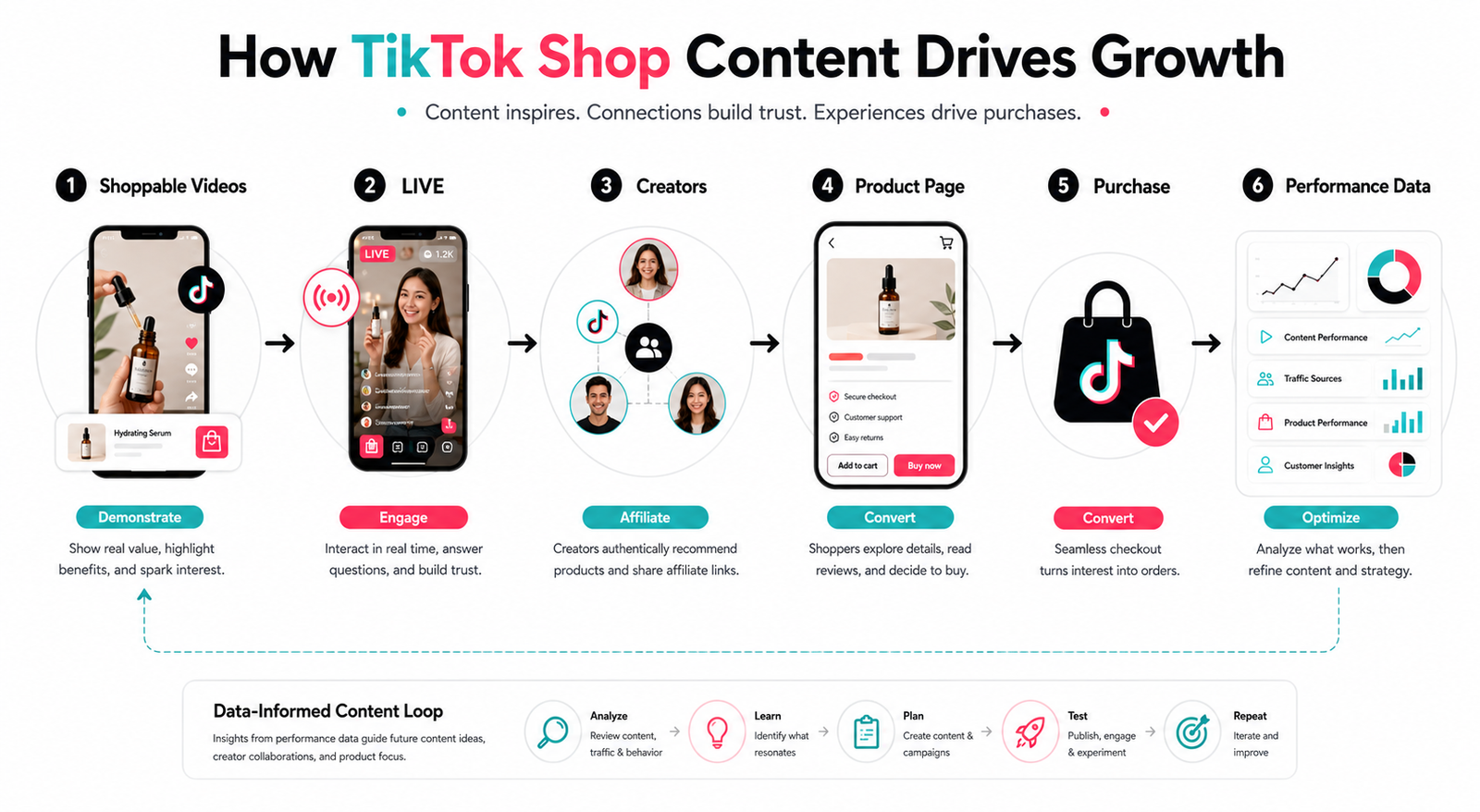 Table 4: How to Evaluate TikTok Shop Creators in 2026
| Factor | What to Evaluate |
|---|---|
| Audience Fit | Does the creator reach the right potential customers? |
| Product Fit | Does the product make sense within their normal content? |
| Content Quality | Can they communicate the product clearly? |
| Commerce Performance | Orders, GMV and conversion where available |
| Cost | Commission, samples, flat fees and ad costs |
| Return Quality | Refund and return patterns where relevant |
| Reliability | Communication, deadlines and deliverables |
| Repeat Performance | Can the creator generate results consistently? |
This replaces arbitrary engagement rates, creator fees, and conversion benchmarks.
Alignment Matters More Than Reach
When selecting creators, audience-product alignment is usually more useful than follower count alone.
A large creator with a poorly matched audience may generate visibility without useful sales. A smaller creator with strong category relevance may produce more qualified shoppers.
Use TikTok Shop’s own Affiliate Center performance information to make these decisions.
TikTok Shop Affiliate Tools Have Expanded
Rather than relying on the older generic “Creator Marketplace” framing, sellers should understand TikTok Shop’s current Affiliate Center.
Open and Target Collaboration allow merchants to:
- Select products
- Set commissions
- Invite or attract creators
- Offer eligible samples
- Track creator performance
TikTok has also added additional collaboration capabilities, including flat-fee Target collaborations for supported sellers and creator arrangements.
Product Seeding
Product sampling remains useful, but free products do not automatically create “authenticity” or guarantee algorithmic distribution.
TikTok Shop currently supports Free Samples and, in eligible Open Collaborations, Refundable Samples, giving sellers structured ways to place products with creators.
Evaluate sampling through actual creator uptake, content, orders, GMV, costs, and repeat performance.
Navigating Common Challenges in 2026
Declining Reach Issues
If reach declines, do not assume TikTok has automatically penalized the account because the content is “too promotional.”
Possible factors can include:
- Lower watch behavior
- Weak audience-product fit
- Content repetition
- Search mismatch
- Increased competition
- Creative fatigue
- Product availability
- Listing quality
- Recommendation eligibility
- Content or commerce policy issues
Use analytics to isolate the problem rather than diagnosing every decline as an algorithm penalty.
Finding the Right Balance
Entertainment and product value can work together.
A useful product video should give viewers a reason to continue watching, whether through information, demonstration, storytelling, curiosity, comparison, or entertainment.
However, no fixed entertainment-to-selling ratio is required.
Standing Out in a Crowded Marketplace
Instead of saying TikTok Shop has “millions of sellers worldwide,” focus on the actual competitive environment in your product category.
TikTok Shop now gives sellers more native tools for identifying opportunities. Product Opportunities can surface trending products, searches, video hashtags, subcategories, and potential gaps between demand and supply.
If product selection is part of the problem, our guide to finding profitable TikTok Shop niches explains how to evaluate demand, competition, suppliers, content potential, and product economics before scaling.
Rising Ad Costs
Remove the unsupported claim that TikTok CPMs increased 45% in 2026.
Advertising costs vary by campaign, market, audience, competition, objective, creative, and season. Sellers should evaluate their own:
- Spend
- GMV
- Orders
- Target ROI
- Customer acquisition
- Creator commissions
- Contribution margin
Paid advertising only makes sense when the economics support it.
Staying Compliant
TikTok Shop commerce policies continue to matter because product eligibility, listing accuracy, content claims, fulfillment, and seller behavior can affect account health and participation.
A strong growth strategy therefore includes compliance before scaling.
For a broader overview of seller setup, product qualification, fulfillment, creator partnerships, and account management, see our guide on becoming a successful TikTok Shop seller.
If you need more hands-on help with ecommerce operations and TikTok Shop growth, HiSellIt can help you evaluate the wider strategy without relying on unsupported algorithm shortcuts.
Building Long-Term Success on TikTok Shop
Building a Loyal Community
Long-term growth goes beyond chasing one viral post.
Responding to useful questions, creating recognizable content, maintaining product quality, and delivering a consistent customer experience can help a brand become more memorable.
Do not treat community engagement as a guaranteed ranking factor. Its real value comes from building relationships and producing useful feedback.
Email Marketing Integration
An owned audience can reduce dependence on one platform, but customer information should only be used in ways permitted by TikTok Shop policies and applicable privacy and consent requirements.
Do not automatically export TikTok Shop buyer information into a promotional email list.
Instead, build a separate consent-based audience through channels you control.
Cross-Platform Marketing
Cross-platform marketing can support a broader brand strategy.
Depending on the business, content can also appear on:
- Instagram Reels
- YouTube Shorts
- A brand website
- Search
- Consent-based email
The objective is not to post everywhere. Use additional channels when they genuinely contribute useful customers.
TikTok Shop Affiliate has also expanded beyond TikTok itself. TikTok’s Affiliate Links feature allows participating creators to share eligible Shop products through external social channels, blogs, or newsletters, with seller commissions governed by the Affiliate collaboration setup.
Automation Tools
Automation can become increasingly useful as a shop grows.
Scheduling, order workflows, inventory monitoring, reporting, customer support, and creator management can all become more complex as volume increases.
Do not rely on a generic statistic claiming automation produces 14.5% higher sales productivity. The value of automation depends on the actual business process.
If you want to evaluate current systems, our guide to TikTok Shop automation tools covers options for streamlining different parts of a TikTok Shop operation.
TikTok Shop Search Optimization Matters More in 2026
One important area missing from many older TikTok Shop growth guides is search.
TikTok Shop introduced dedicated Search terms and Product highlights fields for listings in June 2026. TikTok says the Search terms field helps its search system better understand products and match them with relevant customer queries, while Product highlights can communicate key benefits on product pages.
Sellers should therefore optimize:
- Product titles
- Categories
- Search terms
- Product highlights
- Attributes
- Descriptions
- Images
- Content around relevant buyer searches
TikTok’s current Seller Center training also specifically recommends researching search demand through Keyword Rankings and Product Opportunities.
This means a 2026 TikTok Shop growth strategy should treat search optimization as a core sales channel rather than relying exclusively on For You virality.
Use Shop Tab & Search Analytics
Another major 2026 improvement is TikTok Shop’s refreshed Shop Tab & Search Analytics.
Sellers can access this through Seller Center under Analytics and examine areas such as:
- GMV
- Impressions
- Orders
- Items sold
- Conversion rate
- Search performance
- Recommended-product performance
- Top products
- Traffic sources
TikTok also provides optimization guidance for products that may have recommendation-eligibility issues, such as stock or image-quality problems.
This makes it much easier to distinguish:
Content problem → search problem → listing problem → recommendation problem → conversion problem
instead of blaming every sales decline on “the algorithm.”
Future-Proofing Your TikTok Shop Strategy
Staying Informed
TikTok Shop continues to evolve, so sellers should prioritize first-party platform documentation over social-media rumors about secret ranking changes.
TikTok itself notes that the relative importance of recommendation factors can change over time.
Follow Seller Center updates, TikTok Shop Academy, policy announcements, and your own analytics.
Experimenting With New Features
Testing new features can be useful, but remove the claim that early beta users automatically receive extra visibility.
There is no universal guarantee.
Instead, experiment because a new tool might:
- Improve discovery
- Provide better data
- Reduce friction
- Create new content formats
- Improve creator workflows
Then measure whether it actually benefits your shop.
One example is GMV Max, which now plays a central role in TikTok Shop Ads. Product GMV Max and LIVE GMV Max allow eligible sellers to use TikTok’s automated Shop advertising system, but merchants should still evaluate ROI and contribution margin rather than assuming automation guarantees profitable sales.
Customer Feedback First
Customer feedback remains useful because reviews, comments, questions, refunds, and returns can reveal problems that analytics alone may not explain.
Use recurring feedback to improve:
- Product listings
- Creative
- Sizing or compatibility information
- Packaging
- Fulfillment
- Product quality
- FAQs
- Supplier decisions
The Opportunity Ahead
TikTok Shop continues to offer meaningful opportunities for merchants who can combine content with strong ecommerce execution.
But long-term growth does not depend on predicting every recommendation-system adjustment.
It depends on building a business that can adapt as discovery surfaces, customer behavior, creator tools, advertising systems, and platform policies change.
 Conclusion
A TikTok Shop growth strategy in 2026 is no longer about chasing supposed algorithm hacks or copying an old posting formula.
TikTok’s own documentation shows that recommendation systems consider multiple signals, including user interactions, content information, and user information. Watch behavior matters, but there is no official “watch time replaces views” rule. Likewise, there is no proven requirement to post five times per week, answer every comment within an hour, tag only one or two products, or work exclusively with micro creators.
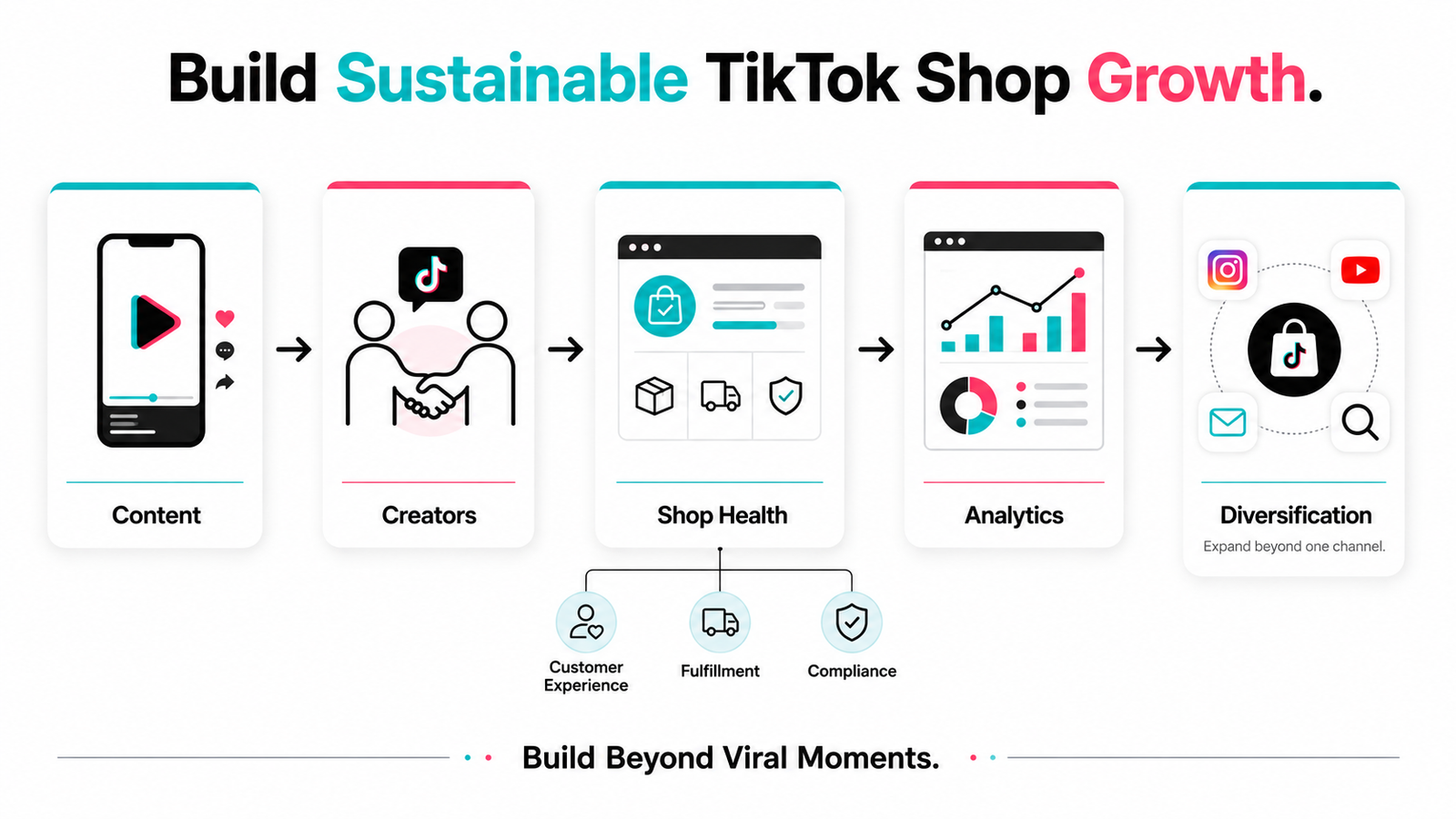
The strongest opportunity in 2026 comes from using the platform more comprehensively. Sellers can combine shoppable videos and LIVE with Shop search, product-card optimization, Product Opportunities, creators through Affiliate Center, Shop Tab & Search Analytics, and GMV Max advertising.
Adaptability remains important, but it should be data-driven adaptability.
Track how people find products, what they watch, where they click, which creators generate orders, how listings convert, what customers return, and whether sales remain profitable after product, fulfillment, commission, promotion, and advertising costs.
That approach creates a TikTok Shop growth strategy that can survive future platform changes far better than relying on unsupported algorithm predictions.
For support building a TikTok Shop strategy around your products, operations, creators, and growth goals, you can contact the HiSellIt team.
Frequently Asked Questions
Q. What Is a TikTok Shop Growth Strategy in E-Commerce?
A TikTok Shop growth strategy is a coordinated approach to increasing product discovery, traffic, orders, and sustainable sales through TikTok Shop.
In 2026, this can include shoppable content, LIVE, Shop search, product optimization, Shop Tab recommendations, creator Affiliate partnerships, analytics, fulfillment, customer experience, and GMV Max advertising.
Q. How Much Does It Cost to Start a TikTok Shop Business in 2026?
There is no universal $500 to $2,000 starting budget.
Actual costs depend on the business and can include:
- Product sourcing or inventory
- Samples
- Packaging
- Fulfillment
- Shipping
- Creator commissions
- Content production
- Advertising
- Returns and refunds
- Applicable TikTok Shop fees
- Software and operational costs
Calculate the startup requirements around the product and fulfillment model rather than relying on a generic budget range.
Q. Is TikTok Shop Profitable for Beginners?
TikTok Shop can be profitable, but profitability is not guaranteed for beginners or established sellers.
Remove claims that beginners usually break even within 60 to 90 days or become profitable within six months. There is no universal timeline.
Profitability depends on product demand, pricing, product cost, fulfillment, TikTok Shop fees, creator commissions, advertising, refunds, returns, and operating expenses.
Q. What Tools Automate TikTok Shop Marketing?
TikTok Shop Seller Center itself provides tools for analytics, product management, Affiliate collaborations, promotions, Shop advertising, and other operations.
Third-party tools may also assist with areas such as scheduling, inventory, order management, customer service, or reporting depending on their current TikTok integrations.
For a full breakdown, see our guide to TikTok Shop automation tools.
Q. How Does a TikTok Shop Growth Strategy Help Small Businesses?
A well-planned strategy can help a small seller use multiple TikTok Shop discovery channels instead of depending entirely on paid advertising or one viral post.
Potential channels include:
- For You content
- Search
- Shop Tab
- Product cards
- LIVE
- Creator Affiliate partnerships
- Organic content
- Paid GMV Max campaigns where appropriate
Small sellers still compete on product quality, content, pricing, fulfillment, customer experience, and economics, so TikTok Shop does not automatically create a level playing field or guarantee access to millions of customers.
Q. What Should I Track After a TikTok Shop Algorithm Change?
Instead of monitoring views alone, track metrics that show where the growth problem actually occurs.
Useful indicators include:
- Video watch behavior
- Product impressions
- Search traffic
- Product-page views
- Product clicks
- Orders
- GMV
- Conversion rate
- Creator performance
- LIVE performance
- Refunds and returns
- Advertising spend and ROI
- Contribution margin
TikTok’s current Shop Tab & Search Analytics and Product Analytics provide much of the information needed to make these decisions.


2 Comments