
Amazon FBA vs FBM: How the Fulfillment Models Actually Work
Amazon FBA vs FBM comes down to a practical question: who will store your inventory and handle each order after a customer buys?
With Fulfillment by Amazon, you send inventory into Amazon’s network and Amazon handles most physical fulfillment. With Fulfilled by Merchant, inventory stays with you or a 3PL, so you control storage, packing, carriers, and shipping.
For anyone comparing Amazon FBA vs FBM for beginners, neither model is automatically cheaper or better. FBA vs FBM changes your workload, cost structure, Prime path, inventory control, customer-service responsibilities, and returns process.
These Amazon fulfillment options can also be combined. The useful decision is often not “FBA or FBM for my business?” but “Which fulfillment method makes sense for each product?”
What Is the Difference Between Amazon FBA and FBM?
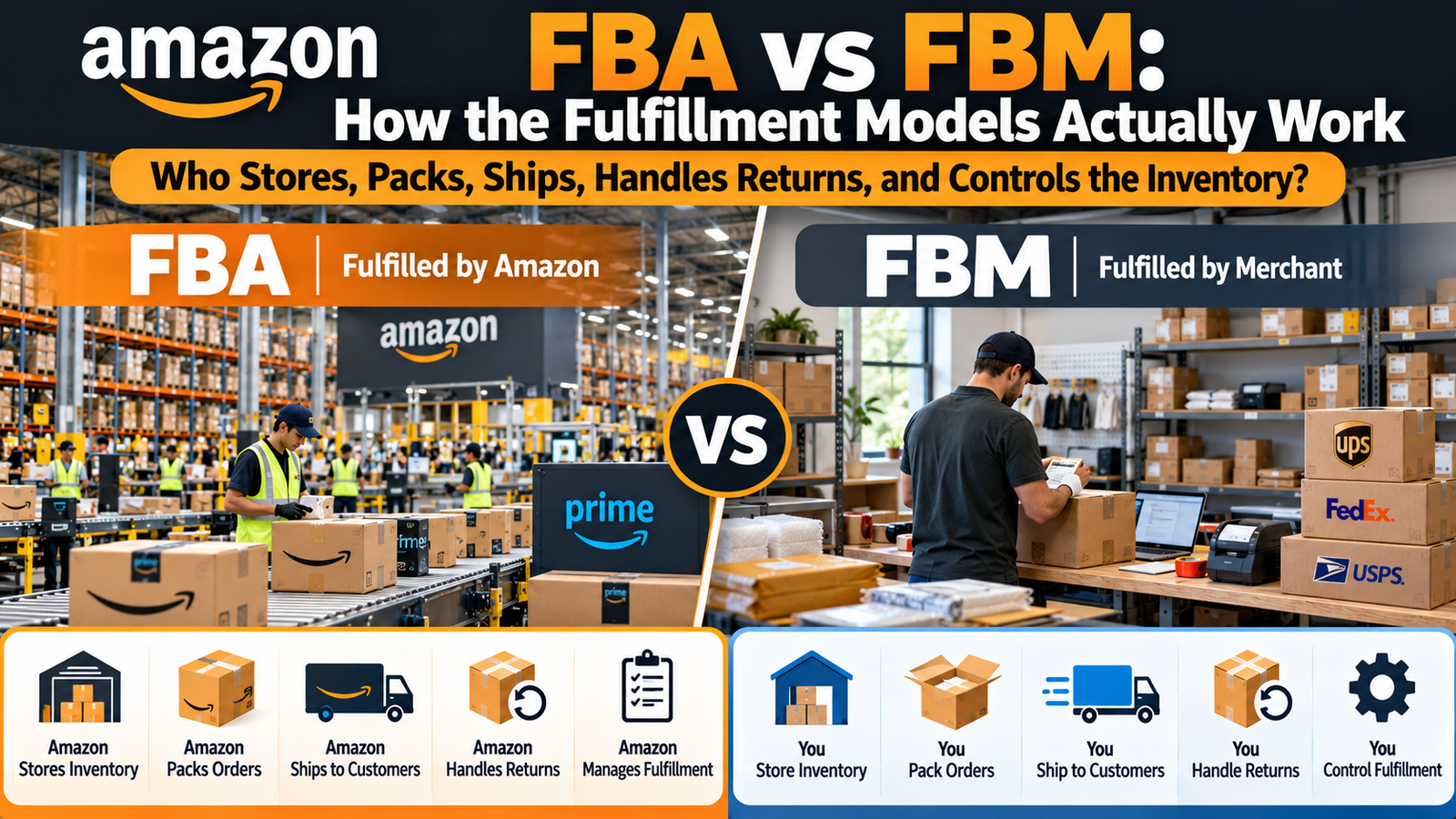
FBA means Amazon stores your inventory and handles picking, packing, shipping, applicable customer service, and returns. FBM means you or your logistics provider store and fulfill orders. Prime access, costs, control, and seller responsibility also differ. Sellers can use both methods across the same catalog.
What Is Amazon FBA?
Amazon FBA stands for Fulfillment by Amazon.
The workflow is straightforward:
Seller sends stock to Amazon → Amazon stores it → customer orders → Amazon picks and packs → Amazon ships → Amazon manages applicable customer service and returns.
That is the simplest explanation of how Amazon FBA works.
Amazon FBA inventory sits inside Amazon fulfillment centers rather than in your own warehouse. When FBA orders arrive, Amazon performs the physical fulfillment.
Amazon describes FBA as a pay-as-you-go service rather than a flat monthly fulfillment subscription. Fulfillment charges cover picking, packing, and shipping, while storage and other inventory-related charges can apply separately.
Amazon FBA fulfillment does not mean Amazon runs the entire business. You still manage sourcing, listings, pricing, forecasting, compliance, and inventory planning.
For Amazon FBA for beginners, that distinction matters.
What Is Amazon FBM?
Amazon FBM means Fulfilled by Merchant.
With Amazon merchant fulfilled orders, inventory remains in your own warehouse, home, 3PL, or another seller-controlled location.
The workflow becomes:
Seller stores inventory → customer orders → seller receives order → seller picks and packs → seller ships → tracking is provided → seller manages applicable post-order responsibilities.
That explains how Amazon FBM works.
But FBM does not mean operating outside Amazon’s systems.
Current FBM tools include Amazon Buy Shipping, Amazon Shipping Settings Automation, Multi-Location Inventory, and Veeqo. Sellers can use these tools to manage inventory, create shipping labels, calculate delivery promises, and streamline Amazon seller fulfilled orders.
Official Amazon Fulfilled by Merchant guide
For Amazon FBM for beginners, the main difference is control. You control more of fulfillment, but you are also responsible for more of it.
Amazon FBA vs FBM: What’s the Difference?
 The clearest Amazon FBA vs FBM comparison is operational.
| Area | FBA | FBM |
| Inventory storage | Amazon fulfillment network | Seller or 3PL |
| Picking and packing | Amazon | Seller |
| Shipping | Amazon | Seller |
| Customer service | Amazon handles applicable FBA support | Seller has greater responsibility |
| Returns | Amazon manages FBA return workflow | Seller manages merchant-fulfilled workflow |
| Fulfillment cost | FBA fees | Seller logistics costs |
| Storage | Amazon storage pricing | Seller/3PL storage |
| Prime | Direct FBA path | Possible through Seller Fulfilled Prime |
| Packaging control | Less customer-order control | Greater control |
| Carrier control | Amazon network | Seller chooses services |
| Workload | Lower direct fulfillment workload | Higher seller responsibility |
This Fulfillment by Amazon vs Fulfilled by Merchant distinction is the foundation of the decision.
Amazon FBA versus FBM is not simply “pay Amazon or ship it yourself.” You are comparing two different operating systems.
FBA vs merchant fulfilled changes where inventory sits, who touches each order, who manages shipping problems, and how costs appear on your profit calculation.
Who Stores Inventory With FBA and FBM?
With FBA inventory storage, products sit inside Amazon’s fulfillment network.
Amazon FBA storage is charged based partly on the space inventory occupies, and storage economics can change with season and storage duration.
Who stores inventory with Amazon FBA? Amazon does after the seller sends eligible inventory into its network.
FBM inventory storage remains under seller control.
That might mean:
- your own warehouse
- your home
- a third-party logistics provider
- multiple seller-controlled facilities
The important point is that merchant fulfilled inventory is not free to store.
FBM inventory storage simply moves the cost away from Amazon’s storage-fee structure and into your own warehouse, rent, labor, insurance, systems, or 3PL pricing.
Who Picks, Packs and Ships Orders?
For FBA, Amazon pick and pack operations happen after inventory reaches the fulfillment network.
FBA pick and pack is included within the fulfillment process. Amazon also handles customer-order delivery.
With FBM packing orders, the seller or 3PL receives the order and prepares it for dispatch.
That means merchant fulfillment operations require packaging materials, labor, warehouse processes, label creation, and carrier handoff.
This operational difference is one of the biggest Amazon FBA advantages for sellers who do not want to build their own fulfillment operation.
It is also one of the Amazon FBM advantages for sellers who want direct seller packaging control.
How Shipping Works With FBA vs FBM
Amazon FBA shipping is handled by Amazon once inventory is inside the network.
Does Amazon FBA include shipping? Yes. Amazon states that FBA fulfillment costs include picking, packing, and shipping eligible customer orders.
Amazon FBM shipping works differently.
With merchant fulfilled shipping, the seller is responsible for getting orders to customers within the promised delivery window.
However, Amazon seller shipping can still use platform tools.
What Is Amazon Buy Shipping?
Amazon Buy Shipping lets eligible FBM sellers buy and print Amazon shipping labels from supported carriers.
Amazon says Buy Shipping offers pre-negotiated rates and can provide additional protection for qualifying delivery claims when sellers meet applicable conditions.
Amazon discounted shipping rates therefore give FBM sellers another option besides negotiating every carrier contract independently.
Shipping Settings Automation can also calculate Amazon transit time using customer location, seller warehouse location, carrier performance, and inventory availability.
That makes current Amazon shipping options for FBM much more developed than simply “ship everything manually.”
How FBA Costs Work
Amazon FBA fees are not one flat charge.
Common FBA costs can include:
- FBA fulfillment fees
- FBA storage fees
- aged-inventory charges
- inbound placement costs
- returns processing where applicable
- removal or disposal charges where applicable
FBA fulfillment fees depend partly on product size, weight, price, and other characteristics.
FBA storage fees depend on the amount of space inventory occupies and can change based on factors such as storage period and season. Amazon also notes that inventory held too long can create additional inventory-related costs.
Does Amazon FBA charge storage fees? Yes.
That is why Amazon FBA cost should be calculated product by product rather than from one generic FBA rate.
Is FBM Cheaper Than FBA?
Sometimes.
But Amazon FBM costs do not disappear just because there is no FBA fulfillment charge.
Merchant fulfillment costs can include:
- warehouse or 3PL storage
- labor
- boxes and packing materials
- shipping labels
- carrier charges
- returns handling
- software
- insurance
- operational overhead
FBM shipping costs can become especially important for large or distant orders.
So is FBM cheaper than FBA? It depends on the SKU and your operation.
Likewise, is FBA cheaper than FBM? Sometimes, particularly when outsourcing pick, pack, shipping, customer service, and returns would otherwise require significant internal resources.
This is why FBA vs FBM costs need to include real seller-controlled expenses, not only visible Amazon charges.
How Should Sellers Compare FBA and FBM Costs?
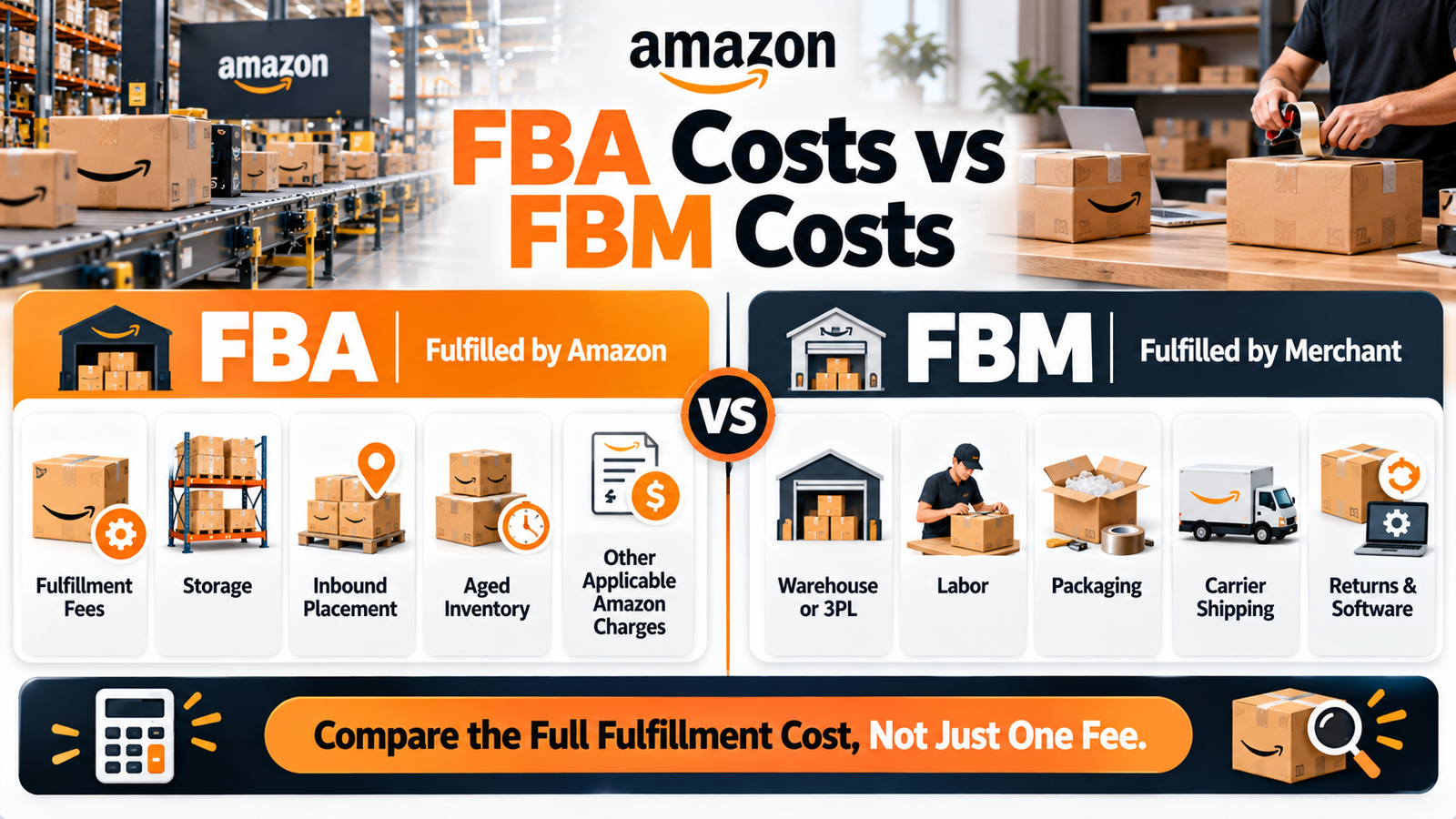 A practical FBA vs FBM fees comparison looks like this:
FBA
Fulfillment fee + storage + inbound and other applicable charges
FBM
Warehouse + labor + packaging + carrier + software/3PL + return handling
That is a more useful Amazon FBA vs FBM cost comparison than saying one method is always cheaper.
Amazon provides a Revenue Calculator specifically for this decision. You can compare “Amazon fulfillment” with “Your fulfillment” using product dimensions, weight, category, price, shipping, and other inputs.
Amazon Revenue Calculator and fee-estimation tools
The Amazon Revenue Calculator should be used with your actual labor, packaging, warehouse, and carrier costs if you want a meaningful FBA cost comparison.
Can FBM Products Get the Prime Badge?
Yes.
Can FBM products have Prime? They can if the seller qualifies for Seller Fulfilled Prime.
FBA Prime eligibility is more direct because eligible FBA inventory can receive Prime fulfillment through Amazon’s network.
FBM Prime is different. Seller Fulfilled Prime allows qualified sellers to display Prime branding while fulfilling products themselves.
Amazon currently requires sellers to prequalify, enter a trial, meet delivery and performance requirements, and continue maintaining program standards.
Official Seller Fulfilled Prime guide
The Prime badge FBM path therefore exists, but it is not automatic.
SFP Amazon sellers retain fulfillment control while accepting much stricter delivery responsibilities.
Who Handles Customer Service and Returns?
Fulfillment by Amazon vs Fulfilled by Merchant changes post-order responsibilities too.
| Task | FBA | FBM |
| Shipping | Amazon | Seller |
| Customer service | Amazon handles applicable FBA support | Seller has greater responsibility |
| Returns | Amazon manages FBA returns | Seller handles merchant-fulfilled workflow |
| Tracking | Amazon fulfillment network | Seller responsible |
FBA customer service is one of the benefits of Amazon FBA because Amazon handles applicable order-related support.
FBA returns are also processed through Amazon’s FBA return workflow.
FBM customer service places more responsibility on the seller. Amazon’s current FBM documentation says sellers use Buyer-Seller Messaging for customer inquiries and manage applicable returns and refunds through Seller Central.
Who handles customer service with Amazon FBM? The seller generally has the greater direct responsibility unless another Amazon program specifically changes that arrangement.
Who handles returns with Amazon FBA? Amazon manages the customer-facing FBA return process.
How FBM Changes Seller Performance Responsibility
More fulfillment control creates more performance responsibility.
FBM performance metrics can include areas such as:
- Amazon order defect rate
- late shipment rate Amazon measures
- valid tracking rate Amazon records
- cancellation performance
- delivery performance
Seller Fulfilled Prime adds its own continuing performance requirements.
Amazon seller performance therefore becomes directly tied to warehouse execution, handling time, tracking, carrier selection, and delivery.
Amazon Shipping Settings Automation can help produce more accurate delivery promises, but the seller still has to ship correctly and on time.
Which Model Gives More Control?
FBM gives the seller more direct operational control.
FBM packaging can be customized within Amazon’s applicable rules. You choose packing materials, warehouse processes, and carriers.
FBA packaging offers less control over the final customer-order packing process because Amazon handles fulfillment after the stock enters its network.
Inventory works the same way.
FBA inventory management means stock is allocated within Amazon’s fulfillment network.
FBM inventory management leaves more Amazon inventory control with the seller, which can be useful when the same physical stock supports several channels or specialized workflows.
The trade-off is simple: greater control usually means greater responsibility.
Which Products May Fit FBA or FBM Better?
Neither method fits every SKU equally well.
FBA fast moving products can be worth evaluating when inventory turnover is predictable, products are standard size, and sellers want outsourced fulfillment.
High inventory turnover FBA scenarios may reduce some of the problems associated with long storage periods.
By contrast, FBM for bulky products can make sense when the seller already has efficient warehouse and carrier arrangements.
FBM slow moving inventory can also be worth modeling because holding stock in Amazon’s network for long periods may create storage economics that are less attractive.
Amazon’s own FBM guidance specifically highlights heavy, bulky, slow-moving, and some temperature-sensitive products as potential merchant-fulfilled scenarios.
These are scenarios to evaluate, not universal rules.
Can Sellers Use FBA and FBM at the Same Time?
Yes.
Can I use FBA and FBM together? Yes. Amazon explicitly allows sellers to use FBM for some products while using FBA for others.
That means Amazon FBA and FBM together can be used product by product.
A seller might use FBA for predictable bestsellers while keeping specialized or bulky products merchant fulfilled.
This ability to combine FBA and FBM is important because the choice is not permanent or all-or-nothing.
When Can a Hybrid FBA and FBM Strategy Make Sense?
A hybrid FBA FBM strategy can work when different products have very different fulfillment economics.
For example:
FBA: fast-moving, predictable, standard-size products.
FBM: bulky, slow-moving, customized, specialized, or operationally unusual products.
That hybrid FBA FBM approach can let sellers outsource the products that suit Amazon’s network while keeping greater control over products that do not.
A mixed Amazon fulfillment strategy can also reduce dependence on one fulfillment route.
This is an example strategy, not a universal recommendation.
What Is Amazon Multi-Channel Fulfillment?
Amazon Multi-Channel Fulfillment lets sellers use eligible FBA inventory to fulfill orders from other sales channels, including their own websites.
Amazon MCF uses the same fulfillment network to pick, pack, and ship eligible non-Amazon orders.
Official Amazon Multi-Channel Fulfillment guide
That can make FBA multichannel fulfillment relevant for sellers trying to centralize inventory across several ecommerce channels.
Do FBA and FBM Sellers Still Pay Amazon Selling Fees?
Yes.
Amazon selling fees vs FBA fees are separate concepts.
Both FBA and FBM sellers can still pay Amazon selling fees such as referral fees and applicable selling-plan charges.
FBA then adds fulfillment and inventory-related costs.
FBM sellers avoid FBA fulfillment charges, but they pay their own logistics expenses.
Understanding FBA fees vs referral fees prevents beginners from assuming the fulfillment choice replaces normal marketplace selling charges.
Which Model Is More Profitable?
Neither model is automatically more profitable.
FBA vs FBM profitability depends on:
- product price
- size and weight
- storage duration
- inventory turnover
- warehouse cost
- labor
- packaging
- carrier rates
- returns
- Prime value
- sales volume
FBA vs FBM profit therefore needs to be modeled SKU by SKU.
The Amazon Revenue Calculator is useful because it lets sellers compare Amazon fulfillment with their own fulfillment method using product-specific inputs.
Your Amazon fulfillment profit margin should then include expenses the calculator cannot know automatically, such as your real labor or warehouse overhead.
Should You Choose FBA or FBM?
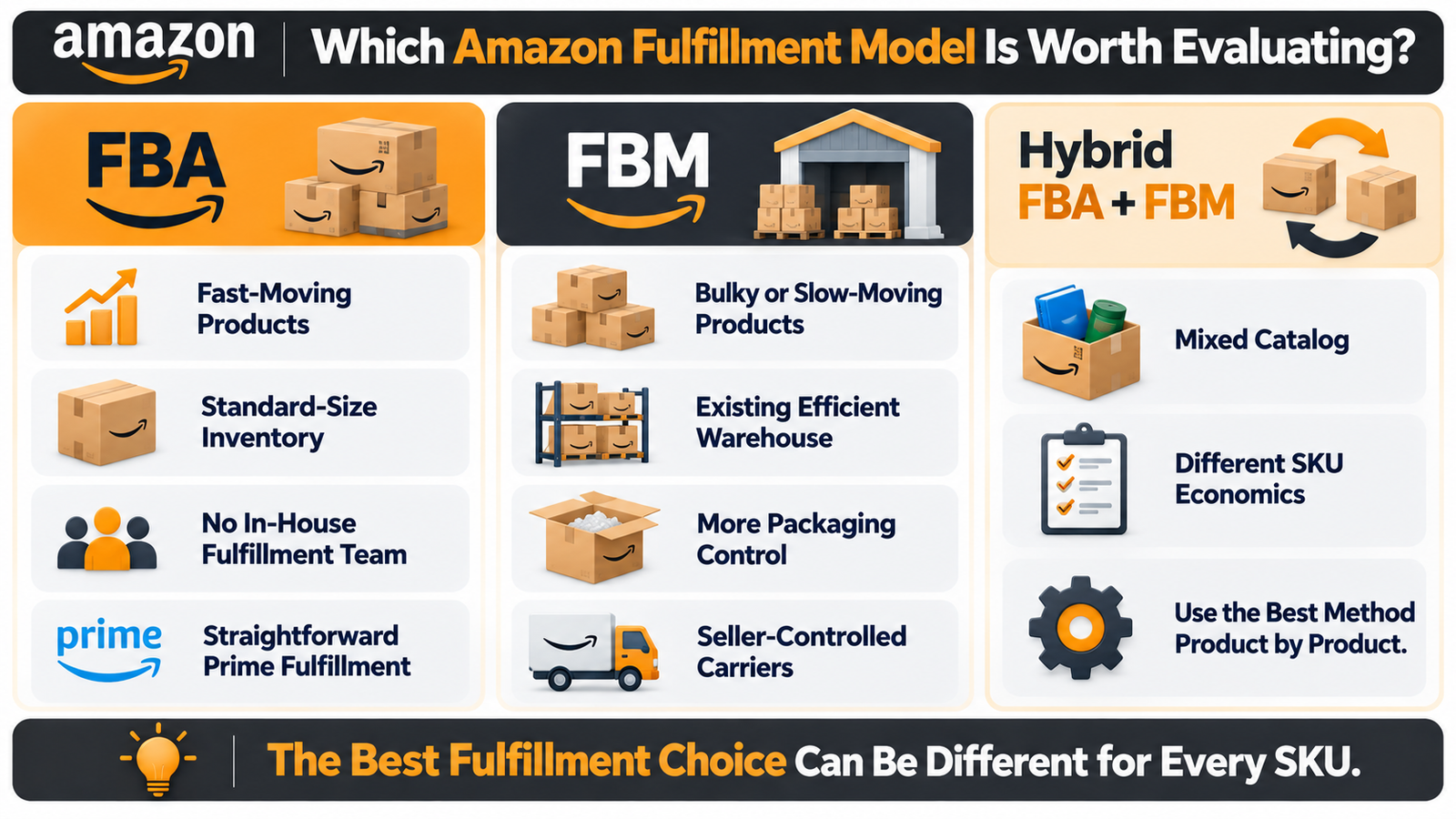
| Situation | Model Worth Evaluating |
| Want Amazon to handle fulfillment | FBA |
| Need direct packaging control | FBM |
| No warehouse or packing operation | FBA |
| Existing efficient warehouse | FBM |
| Fast-moving standard products | Often FBA worth modeling |
| Slow, bulky, or specialized items | Often FBM worth modeling |
| Want straightforward Prime fulfillment | FBA |
| Can qualify for Seller Fulfilled Prime | FBM/SFP |
| Mixed catalog | Hybrid FBA + FBM |
For Amazon FBA vs FBM for beginners, this should be treated as a starting framework rather than a verdict.
If you are asking should I use FBA or FBM, answer seven questions:
- Where will inventory sit?
- Who will pick, pack, and ship?
- Who will handle the buyer after purchase?
- How important is Prime?
- What does each model actually cost?
- How much operational control do you need?
- Does every SKU really need the same method?
That last question is often the most useful one.
Conclusion
Amazon FBA vs FBM is ultimately a choice between outsourcing more fulfillment work and keeping more direct operational control.
The main Amazon fulfillment options carry different responsibilities, Prime paths, storage structures, shipping processes, customer-service obligations, and costs.
FBA vs FBM costs should never be judged from Amazon fulfillment fees alone. FBM also has warehouse, labor, packaging, carrier, software, and return-handling expenses.
For a practical Amazon fulfillment guide, compare representative products rather than choosing one method for your entire catalog automatically.
Before deciding, model several SKUs in Amazon’s Revenue Calculator and add your real labor, warehouse, packaging, and shipping expenses. The best fulfillment choice is often made product by product.
If you need support evaluating or managing your Amazon operations, explore our Amazon Wholesale FBA services or contact HiSellIt to discuss your fulfillment requirements.
Frequently Asked Questions
Q. What Is the Difference Between Amazon FBA and FBM?
Amazon FBA vs FBM mainly differs in who controls fulfillment. FBA stores inventory in Amazon’s network and Amazon handles most physical order fulfillment. FBM keeps inventory and fulfillment with the seller or a 3PL, creating more control but also more operational responsibility.
Q. Does Amazon FBA Include Shipping?
Yes. Amazon states that FBA fulfillment charges include picking, packing, and shipping customer orders. Storage and other applicable inventory-related charges are separate.
Q. Is FBA Cheaper Than FBM?
Not automatically. FBA includes fulfillment and storage charges, while FBM can involve warehouse rent, labor, packaging, carrier rates, software, returns, and 3PL expenses. Compare the same SKU under both models.
Q. Can FBM Products Have Prime?
Yes. Qualified sellers can use Seller Fulfilled Prime after meeting Amazon’s current eligibility, trial, delivery, and performance requirements. Standard FBM listings do not automatically receive Prime branding.
Q. Can I Use FBA and FBM Together?
Yes. Sellers can use FBA for some products and merchant fulfillment for others. A hybrid approach can be useful when a catalog contains products with very different sizes, turnover rates, margins, or operational requirements.
Q. Does Amazon FBA Charge Storage Fees?
Yes. Amazon charges for inventory storage in its fulfillment network. Storage economics can depend on space occupied, season, and how long inventory remains in the network.