
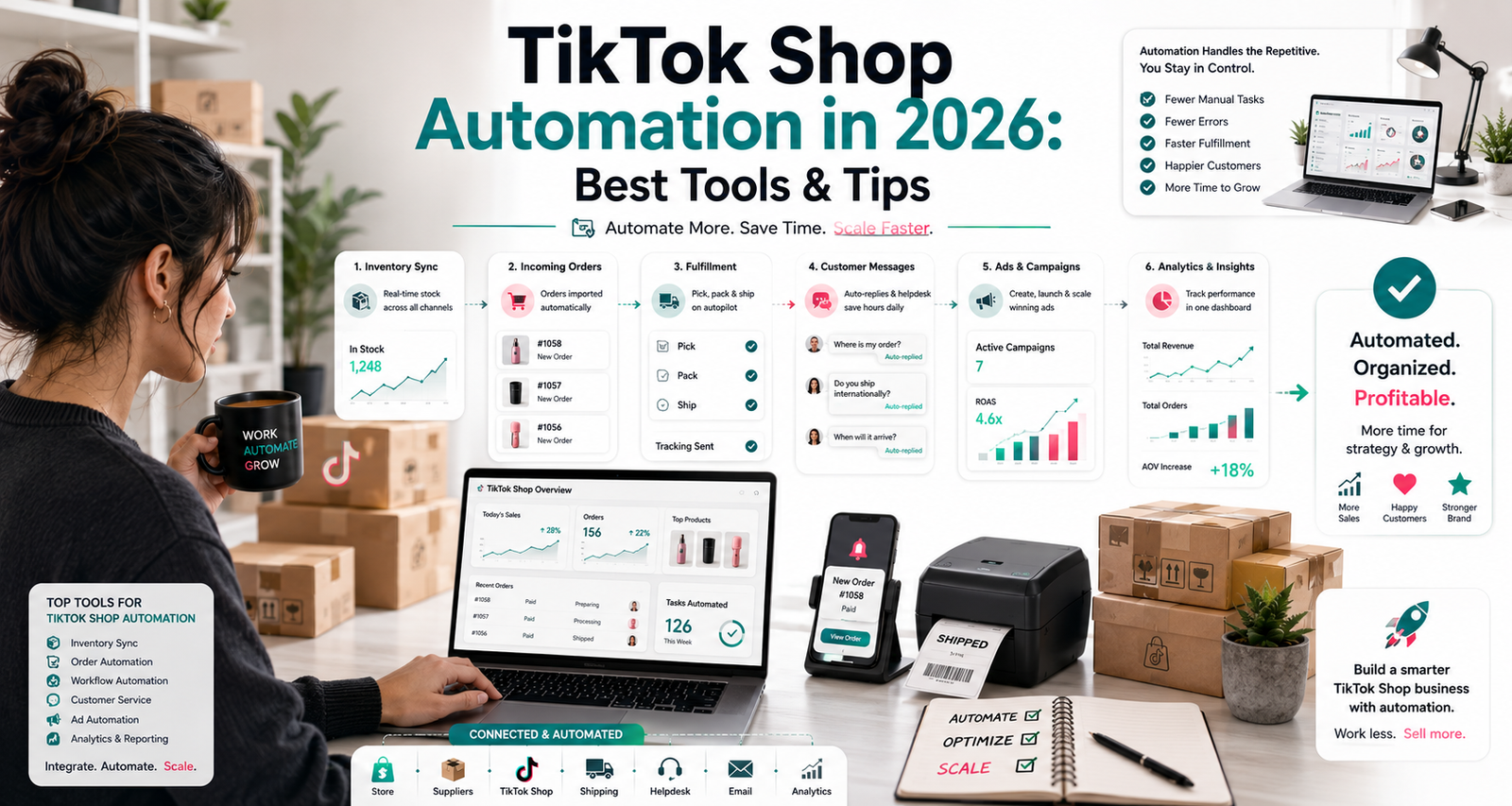
TikTok Shop Automation in 2026: Best Tools & Tips
TikTok Shop automation can take a lot of repetitive work off a seller’s plate. As orders increase, simple jobs like updating stock, processing orders, answering routine customer questions, managing campaigns, and coordinating fulfillment can quickly start eating into the time you should be spending on products and growth.
The platform itself is also expanding quickly. According to TikTok’s 2026 European expansion update, more than 100,000 businesses had joined TikTok Shop across France, Germany, Italy, Spain, and Ireland, while daily GMV across those markets recorded triple-digit growth between August 2025 and February 2026. The bigger the marketplace becomes, the more useful efficient systems become for sellers trying to keep operations organized.
The goal, however, is not to put your entire store on autopilot. The best TikTok Shop automation tools handle repetitive tasks while leaving important decisions, customer issues, product quality, and strategy in human hands. This guide covers the tools and workflows that can help with inventory, orders, fulfillment, customer service, marketing, analytics, and day-to-day store management in 2026.
Automation also works much better when the underlying product opportunity is strong. If you are still deciding what to sell, our guide to finding profitable TikTok Shop niches explains how to validate demand, competition, margins, and content potential before scaling.
Quick Answer: What Is TikTok Shop Automation?
TikTok Shop automation uses built-in platform features, connector apps, and third-party tools to reduce repetitive work across inventory, orders, fulfillment, customer communication, advertising, CRM, and reporting. It can make a growing store easier to manage, but tasks involving judgment, compliance, product quality, and complex customer issues still need human oversight.
TikTok Shop Automation at a Glance
| Workflow | What Can Be Automated | Where Human Oversight Still Matters |
|---|---|---|
| Products & Inventory | Product syncing, stock updates, quantity changes, and catalog data | Product quality, supplier problems, and incorrect data |
| Orders | Order routing, status updates, and connected-system workflows | Exceptions, cancellations, disputes, and unusual orders |
| Fulfillment | Warehouse routing, shipping labels, tracking, and delivery updates | Delays, damaged goods, lost packages, and supplier failures |
| Customer Service | FAQs, greetings, saved replies, and routine message workflows | Complaints, refunds, disputes, and complex customer issues |
| Marketing & CRM | Abandoned-cart outreach, promotions, customer campaigns, and reminders | Brand strategy, offer planning, and customer segmentation decisions |
| Advertising | Campaign optimization, creative selection, delivery, and bidding workflows | Budget strategy, profitability targets, and creative direction |
| Analytics | Reporting, alerts, dashboards, and recurring performance monitoring | Interpreting results and deciding what to change |
What Can You Automate on TikTok Shop in 2026?
TikTok Shop automation now covers much more than content scheduling. Sellers can automate or streamline parts of product synchronization, inventory updates, order processing, fulfillment, customer communication, retention marketing, advertising, and reporting.
TikTok has also expanded its own automation ecosystem. Connector apps can synchronize products, inventory, orders, and other ecommerce data, while Seller Center includes tools for customer messaging, CRM campaigns, advertising automation, and performance monitoring. Third-party software becomes useful when a store needs deeper integrations, multichannel management, or more specialized workflows.
The key is deciding what actually needs automation rather than adding software to every part of the business.
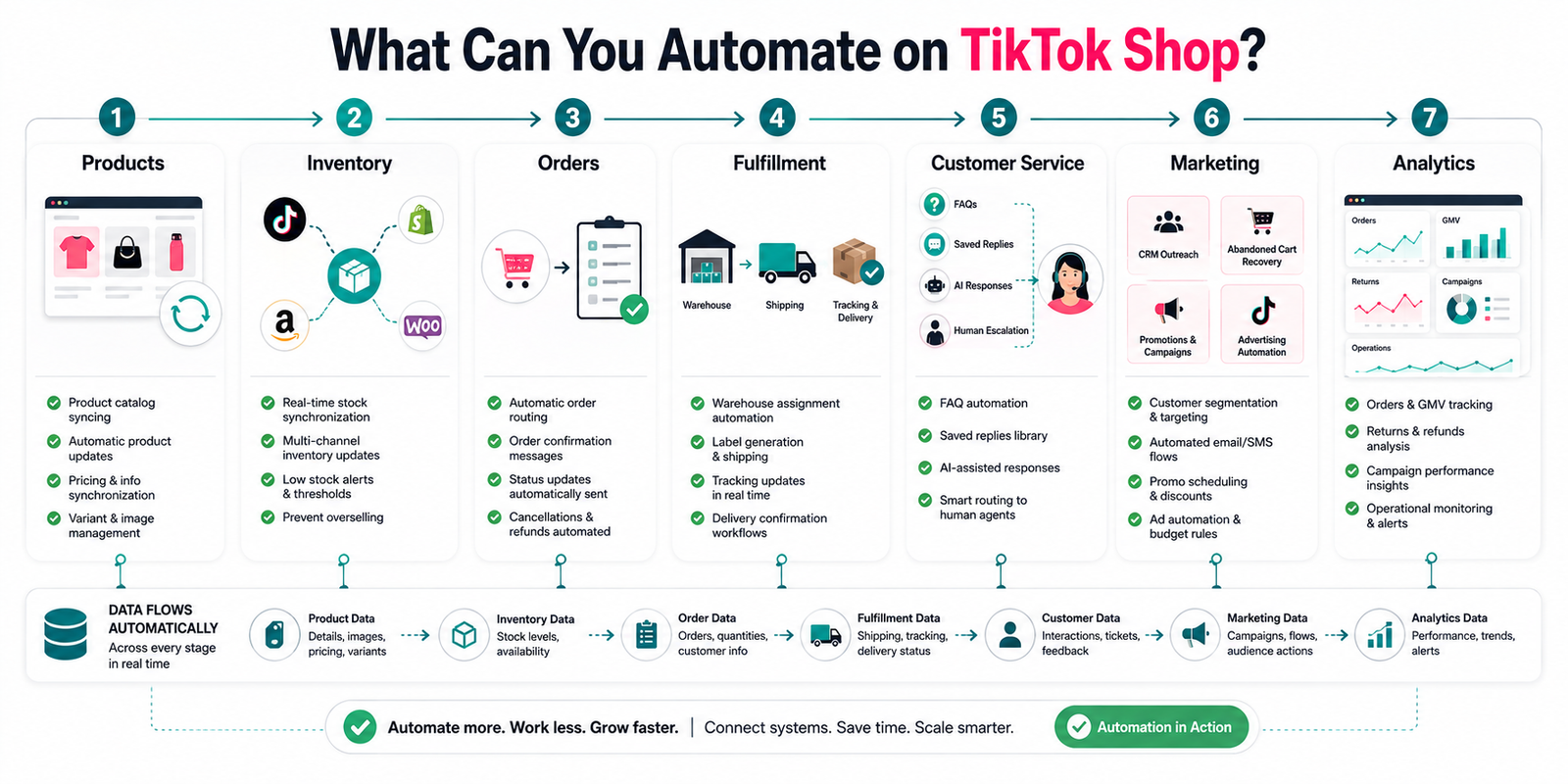
TikTok Shop sellers can automate or streamline repetitive workflows across products, inventory, orders, fulfillment, marketing, support, and analytics.
Why TikTok Shop Automation Matters as You Scale
TikTok Shop can move quickly. If a product suddenly starts gaining traction, weak inventory, fulfillment, or customer-service processes can become obvious very fast. Automation helps sellers handle more of that repetitive operational work without manually updating every order, stock level, or routine customer interaction. TikTok Shop automation tools 2026 enable businesses to respond to these changes in real time, making sure they can take advantage of trends while keeping their operations stable and getting the most out of their social commerce.
As order volume grows, customers still expect accurate stock information, timely fulfillment, and responsive support. Managing all of that manually becomes increasingly difficult as a catalog and customer base expand. Automation becomes especially useful when sales volume increases faster than the team can comfortably handle repetitive operational work. Accurate inventory, timely order processing, reliable fulfillment, and responsive customer support become harder to maintain when everything depends on manual updates.
This makes automation technologies necessary for staying visible and reaching new people in the competitive social commerce space.
Also, because TikTok Shop is so competitive, businesses need to make sure that every part of their business is running as well as possible to stay profitable. Different tools solve different problems. Some keep inventory synchronized, others route orders or support advertising, while customer-service and CRM tools can reduce repetitive communication. The goal is not to replace human judgment but to use it where it has the most value.
Best TikTok Content Scheduling Tools for Shop Sellers
Making content for TikTok is still one of the most time-consuming parts of running a TikTok Shop, but it’s also very important for social commerce success. To solve this problem, a number of TikTok automation tools have come out that offer advanced ways to plan, create, and share content that can make your TikTok marketing strategies much better.
Hopper HQ can help sellers plan and schedule TikTok content in advance, making it easier to maintain a consistent publishing calendar. It is best viewed as a content-management tool rather than a TikTok Shop operations platform. This makes it a great tool for businesses that want to have a steady flow of material without having to do it all by hand all the time.
Later is another option for planning, scheduling, and reviewing social content. Its analytics can help teams understand which posts are earning engagement and use those patterns when planning future content.
Zebracat can help create draft video content using AI, which may be useful for stores producing content across a larger catalog. AI-generated content should still be reviewed for product accuracy, brand consistency, and whether it actually feels natural on TikTok.
How Can You Manage TikTok Shop Inventory and Synchronization?
For TikTok Shop to be successful, it needs to be able to manage its inventory well. This is especially important because the platform can have sudden viral moments that make demand skyrocket. Accurate inventory becomes especially important when demand changes quickly. Inventory automation can keep stock levels synchronized across TikTok Shop and other ecommerce systems, reducing the risk of overselling and avoiding the need to update quantities manually.
A good place to start is TikTok Shop’s own Connector Apps. They can connect platforms such as Shopify, Etsy, or Wix with TikTok Shop and automatically synchronize products, orders, and inventory. TikTok offers both simpler built-in connectors and more advanced options for businesses with larger catalogs or more complex operations.
Linnworks is useful for businesses managing inventory and orders across multiple sales channels. Its TikTok Shop integration can connect Seller Center with Linnworks so sellers can manage listings, inventory, orders, and related marketplace workflows from a broader multichannel system.
Inventory automation works best when one system has a clearly defined role. Avoid connecting multiple apps that are simultaneously trying to control the same stock or order data. TikTok specifically advises sellers not to run overlapping connector apps for the same task because conflicting synchronization can create problems.
Native TikTok Shop Tools vs Third-Party Automation
| Option | Best For | Examples | Main Consideration |
|---|---|---|---|
| Native TikTok Shop Tools | Sellers who want simpler workflows inside the TikTok ecosystem | Connector Apps, CRM, customer messaging, GMV Max, Seller Center analytics | Features and availability can vary by account and market |
| Third-Party Tools | Stores needing specialized or multichannel workflows | Linnworks, ShipBob, Zendesk, Tray.io, Later | Additional subscriptions and integration complexity |
| Hybrid Setup | Growing stores combining TikTok’s native tools with selected specialist software | Native Connector + fulfillment platform + support or analytics tool | Avoid overlapping tools controlling the same workflow |
What Are the Best Order Processing and Fulfillment Solutions?
The order fulfillment process is one of the most important parts of running a TikTok Shop. How quickly and accurately orders are filled affects both customer happiness and the shop’s bottom line. In 2026, TikTok Shop automation tools in this area got better at handling complicated fulfillment workflows while still being flexible enough to operate with varied business models and making sure that ecommerce automation works as well as it can.
ShipBob can be useful for sellers who want to outsource inventory storage, picking, packing, and shipping. In the U.S., ShipBob is also involved in powering Fulfilled by TikTok, giving eligible sellers another way to move fulfillment away from manual in-house operations.
Sellers who already hold inventory in Amazon’s fulfillment network may be able to use Amazon Multi-Channel Fulfillment (MCF) for TikTok Shop orders through supported integrations. MCF uses the seller’s FBA inventory pool to fulfill orders placed outside Amazon, while connected apps can help synchronize eligible orders and inventory.
Easyship is one option for sellers who need help managing shipping labels, carriers, rates, and tracking across ecommerce channels.
Fulfillment choices can have a major impact on delivery speed, costs, inventory control, and customer experience. Our TikTok Shop fulfillment guide for sellers in 2026 compares the main fulfillment options in more detail.
How Do You Automate TikTok Shop Customer Service?
Customer service is one of the clearest examples of where partial automation works better than full automation. TikTok Shop can help with FAQs, chatbots, saved replies, and AI-assisted response suggestions, but sellers still need to step in when an issue cannot be resolved automatically.
Zendesk is a stronger option for larger support operations because TikTok Shop currently offers a Zendesk integration that lets eligible sellers manage TikTok Shop customer inquiries alongside their wider support workflow.
Freshchat can also be relevant for businesses already using Freshworks and looking to bring TikTok Shop conversations into their existing support setup.
Automation should not become an excuse to ignore the inbox. TikTok Shop’s 24-Hour Response Rate requirements still require sellers to provide meaningful responses when customer questions need manual attention. Automated replies can reduce the workload, but they do not replace a required seller response when a chatbot cannot resolve the issue.
Best TikTok Shop Advertising Automation Tools
TikTok Shop’s advertising ecosystem has grown to incorporate advanced automation technologies that can make campaigns better in real time, change bidding methods, and get the most out of ad spending. These TikTok marketing automation tools are quite important for firms that want to grow their advertising efforts smartly while still making money from social commerce.
GMV Max is TikTok’s native advertising automation solution for TikTok Shop. It can use available organic, affiliate, and paid creative assets while automating campaign setup and optimization around Shop performance. In 2026, it is one of the most important native automation tools for sellers running TikTok Shop advertising.
Bïrch, formerly Revealbot, offers rule-based advertising automation for platforms including TikTok. It can be useful for advertisers who need more advanced campaign rules, but it should be treated as an advertising tool rather than a TikTok Shop operations platform.
TikTok Shop Analytics and Performance Monitoring
Start with TikTok Shop Seller Center when evaluating actual store performance. Social-media analytics platforms can tell you how content is performing, but Shop-level metrics such as orders, product performance, GMV, returns, fulfillment issues, and advertising results are what show whether that attention is turning into business.
Sprout Social and Hootsuite can still be useful for broader TikTok content and social-media reporting, especially for teams managing several channels.
Emplifi, formerly Socialbakers, has AI-powered analytics that can tell you how well your content will do, how your audience will act, and what the market trends are. Businesses can use the platform’s automation tools to improve their TikTok marketing tactics based on data-driven insights and boost their overall social commerce performance.
How Do You Set Up Integration and Workflow Automation?
For modern TikTok Shop operations to work well, many technologies and platforms need to work together smoothly. To meet this need, workflow automation tools were created. They provide solutions that link disparate systems and automate complicated business processes to improve the productivity of ecommerce and social commerce.
Zapier can still be useful for surrounding marketing and business workflows, particularly when TikTok data needs to trigger actions in other apps. However, it should not automatically be treated as a replacement for a dedicated TikTok Shop connector.
Tray.io is more relevant for complex integrations because it offers TikTok Shop connectivity for areas such as products, inventory, orders, fulfillment, and custom workflows.
If you want a broader comparison of the available software categories, our complete TikTok Shop automation tools guide covers more options and use cases.
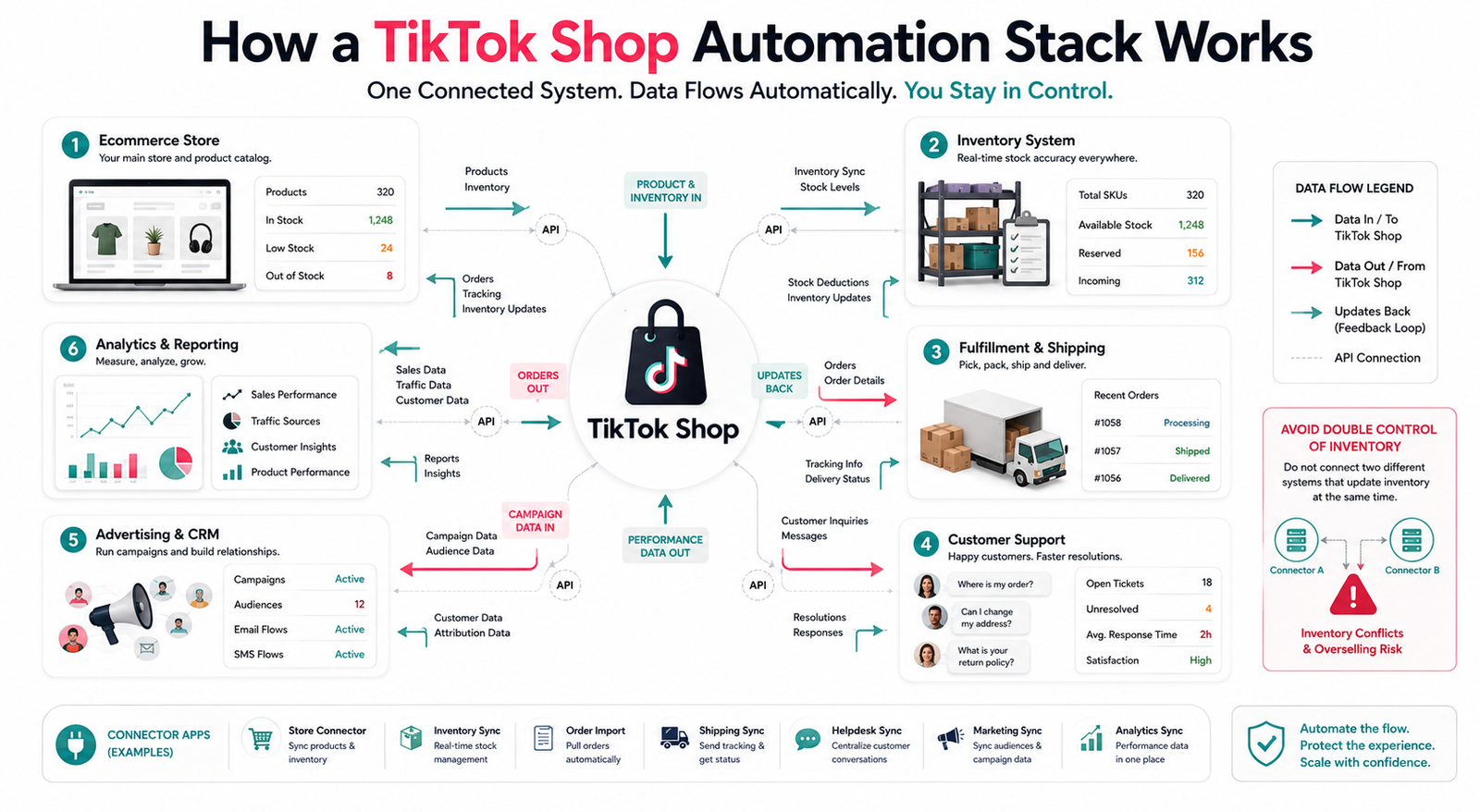
A well-designed TikTok Shop automation stack connects store data, inventory, orders, fulfillment, customer support, marketing, and analytics without overlapping workflows.
What are the newest AI and machine learning tools for TikTok Shop?
Adding AI and machine learning to TikTok Shop automation is the most advanced e-commerce technology available today. These tools can do more than just automate tasks. They can also do predictive analytics, provide personalized experiences, and optimize things intelligently.
TikTok Symphony is TikTok’s AI-assisted creative suite for generating and adapting marketing content. It can speed up creative production, but product accuracy, brand consistency, claims, and final quality should still be reviewed by a person.
Smart+ is focused on AI-assisted advertising and campaign optimization. Treat it as part of the marketing stack rather than a tool for inventory, fulfillment, or customer service operations.
AutoDS is more relevant to dropshipping sellers who need product, pricing, inventory, and order-management workflows. It is a specialized option rather than something every TikTok Shop seller needs.
Implementation Best Practices
To successfully use automation solutions for TikTok Shop, you need to plan and be strategic. Businesses should first figure out which of their manual tasks take the most time and then focus on automation solutions that fix these problems first.
Do not try to automate every workflow at once. Start with the process creating the most repetitive work or the most operational mistakes, test the automation, and then expand from there.
The integration process should happen in stages, starting with basic tasks like managing inventories and processing orders, and moving on to more complicated tasks like making content and helping customers. This method lets companies gain trust in automation solutions without causing too much trouble for their current processes.
Also avoid giving two different apps control over the same workflow unless the setup has been deliberately designed that way. Duplicate inventory or order connectors can create conflicting updates rather than saving time. TikTok’s own connector guidance specifically warns against overlapping apps performing the same task.
To keep automation working well, you need to check on it and make changes regularly. Companies should set key performance indicators (KPIs) for their automation technologies and check on them periodically to find ways to make them work better.
Before adding another subscription, ask whether the time saved, fewer errors, or improved scalability actually justify the cost. Our guide on whether TikTok Shop automation is worth it looks at the benefits, costs, and limitations in more detail.
If you want help building a more efficient TikTok Shop operation without piecing every workflow together yourself, explore our TikTok Shop services for support with store setup, automation, operations, and growth.
Quick Answer: What Should You Automate First on TikTok Shop?
Start with the TikTok Shop workflow that creates the most repetitive work or operational errors. For many sellers, that means inventory syncing, order processing, fulfillment, or routine customer communication. Automate one process, test it carefully, monitor exceptions, and expand only after the workflow is working reliably.
What Is Changing in TikTok Shop Automation in 2026?
TikTok Shop is steadily moving more automation inside Seller Center instead of leaving every workflow to third-party software. Its 2026 CRM tools can help sellers re-engage customers, recover abandoned carts, send promotions, and create automated messaging plans based on shopper behavior.
TikTok has also expanded automated email campaigns, AI-assisted customer-service tools, connector apps, advertising automation through GMV Max, and deeper integrations with ecommerce and fulfillment systems.
For sellers, that means the smartest automation stack may actually become simpler over time. Before adding another third-party tool, check whether TikTok Shop already provides the feature natively.
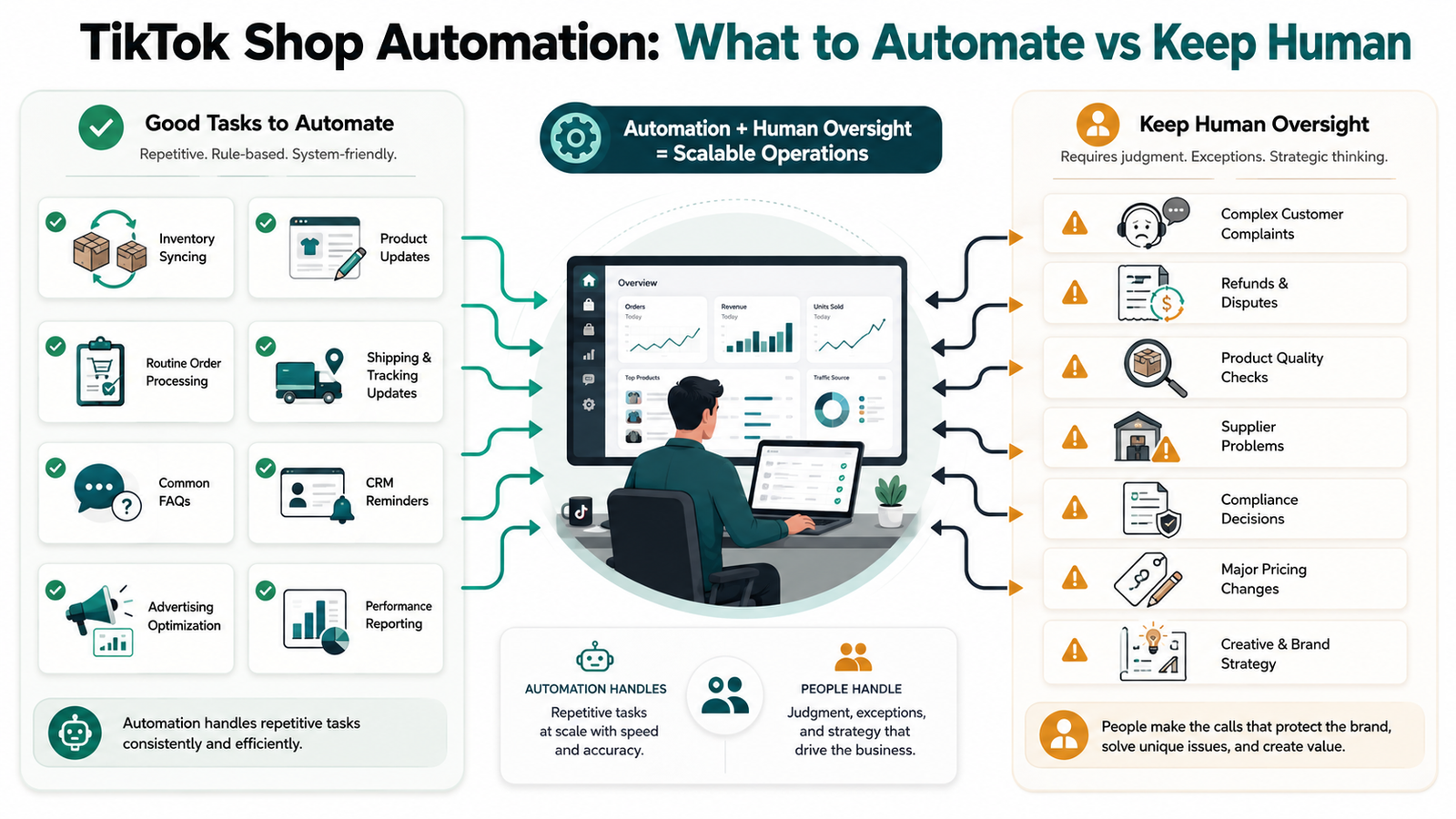
Routine TikTok Shop workflows can be automated, while customer escalations, compliance, quality, supplier issues, and strategic decisions still need human oversight.
Conclusion
TikTok Shop automation in 2026 is most useful when it removes repetitive work without removing human oversight. Inventory syncing, order processing, fulfillment, routine customer messages, CRM outreach, advertising, and reporting can all become more efficient with the right setup.
The mistake is assuming that more automation automatically means a better store. A complicated stack of overlapping tools can create just as many problems as doing everything manually. Start with the workflow that is slowing you down, choose the simplest reliable solution, test it properly, and expand only when it is actually helping the business.
The best setup will look different for every seller. A small shop may only need native TikTok tools and one connector, while a larger multichannel business may benefit from more advanced inventory, fulfillment, support, and integration software.
Not sure which parts of your TikTok Shop should be automated first? Contact the HiSellIt team to discuss your current setup, bottlenecks, and growth goals.
Frequently Asked Questions
Q. What is TikTok Shop automation?
TikTok Shop automation is the use of native platform features, connector apps, and third-party software to reduce repetitive work such as inventory syncing, order processing, fulfillment, customer communication, advertising, and reporting.
Q. What are TikTok Shop automation tools?
TikTok Shop automation tools are software and built-in features that help sellers manage repetitive ecommerce workflows more efficiently. They can include inventory connectors, fulfillment systems, customer-service software, advertising automation, CRM tools, and integration platforms.
Q. Can you fully automate a TikTok Shop?
Not realistically. Many routine workflows can be automated, but sellers still need to monitor customer escalations, product quality, suppliers, compliance, pricing decisions, campaign performance, and unexpected operational issues.
Q. What should I automate first on TikTok Shop?
Start with the workflow that consumes the most time or causes the most errors. For many sellers, that is inventory synchronization, order processing, fulfillment, or repetitive customer-service tasks.
Q. Do I need third-party software to automate TikTok Shop?
Not always. TikTok Shop now includes native tools for connectors, CRM, advertising, customer messaging, analytics, and other workflows. Third-party tools become more useful when you need deeper integrations, multichannel management, specialized fulfillment, or more advanced automation.


One Comment